Most buyers searching for appointment-setting companies do not need another ranked list. They need a clear way to avoid the wrong vendor.
Bad providers book weak meetings, miss follow-up, and hide behind activity reports. Closers sit idle while the budget disappears. The damage shows up as no-shows, weak pipeline, compliance risk, and months of unclear blame.
The fix is to judge the work model before the sales pitch. This guide gives you the Appointment Setting Company Evaluation Matrix: five vendor types, five review gates, pricing checks, reference questions, and red flags. Use it with a B2B appointment-setting methodology in mind before signing a contract or paying for appointments.


What Appointment Setting Companies Actually Do
Appointment-setting companies contact prospects, assess interest, and book sales calls for your team.
But the category is broad.
Some vendors only provide individual appointment setters. Others provide fully outsourced appointment-setting delivery models that include data, dialing, QA, scripts, reports, call reminders, and campaign management.
A strong provider in the appointment setting services category should help with four things:
- Qualified appointments with the right buyers
- Clear handoff notes for sales or closers
- Better show rates
- Reports that tie work to sales results
Activity alone does not build a pipeline.
Dials, emails, LinkedIn touches, and call attempts only matter when they fit a clear sales prospecting operating model and lead to qualified sales talks.
For regulated or high-trust markets, the risk is higher. Finance, healthcare, insurance, legal, and home services campaigns may involve consent rules, data handling, or industry limits.
For example, the FTC’s Telemarketing Sales Rule guidance says sellers and telemarketers must keep company-specific Do Not Call lists. The FTC also notes that calling someone who asked not to be called can lead to civil penalties of $53,088 per violation. The FCC’s TCPA materials state that private plaintiffs may recover actual damages or up to $500 per violation, with higher penalties for knowing violations. That is why TCPA compliance for outbound operations belongs in vendor review. Healthcare campaigns can also raise HIPAA issues when a vendor handles protected health information for a covered entity.
That is why appointment setting is not just booking calls.
It is an operating function.
Why “Best Appointment Setting Companies” Lists Are Not Enough
Many buyers search for “best appointment setting companies,” “top appointment setting companies,” or “best B2B appointment setting companies 2026.”
That makes sense. Buyers want a shortcut.
But most lists miss the first choice that matters.
The real question is not, “Who is the best appointment setting company?”
The better question is, “Which work model fits our sales process, risk, budget, and team?”
A company with five closers and a clear script needs a different vendor than a healthcare SaaS company selling to practice admins.
A B2B SaaS company selling $75,000 contracts needs different outreach than an HVAC company booking home estimates.
An agency that resells the work needs different reports than a founder buying appointments for an internal team.
So, do not start with a vendor list.
Start with the model.
The Five Appointment Setting Company Models
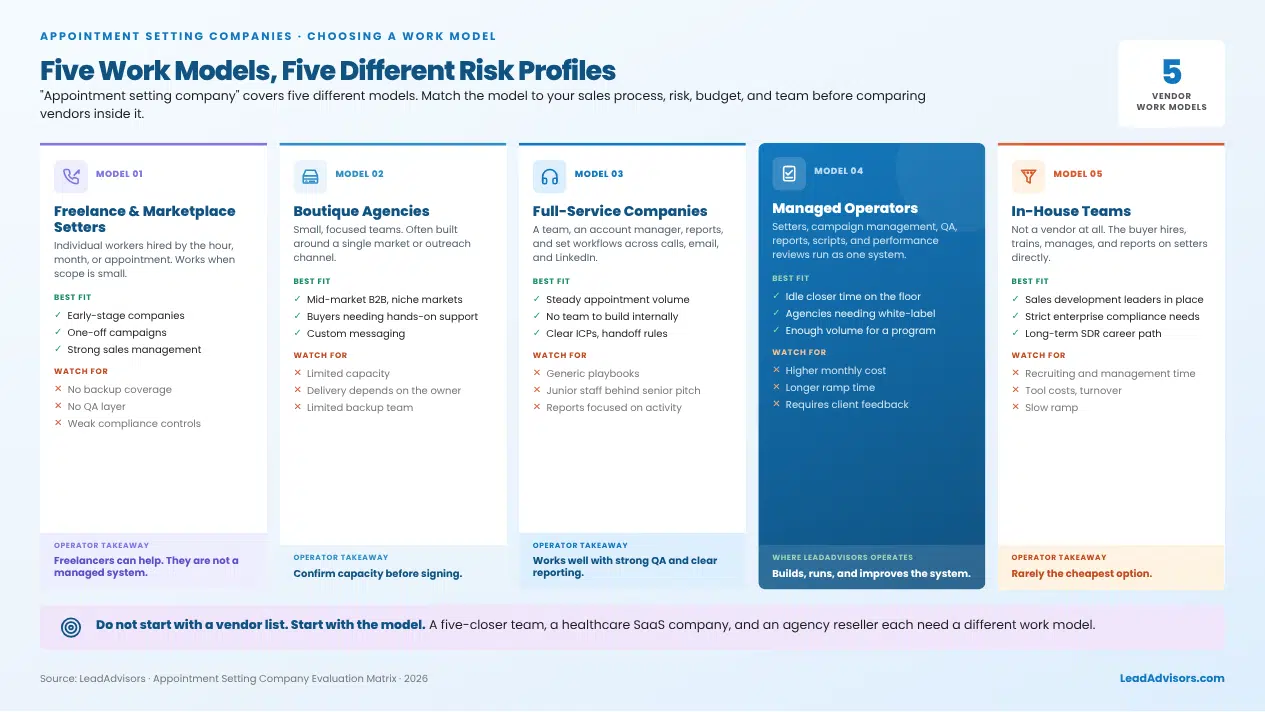
Appointment setting companies usually fall into five models.
Each model has different costs, support, and risks.
1. Freelance And Marketplace Appointment Setters
Freelance appointment setters are individual workers hired through marketplaces or referrals. Buyers should understand the appointment setter’s role and responsibilities before setting goals.
They may charge by the hour, by the month, or by appointment.
This model can work when the scope is small, and the buyer can manage the work.
Best fit:
- Early-stage companies
- One-off campaigns
- Buyers with strong sales management
- Teams testing appointment setting
Typical risks:
- No backup coverage
- No QA layer
- Weak reporting
- High management work
- Weak compliance controls
Freelancers can help. But they are not a managed system.
2. Boutique Appointment Setting Agencies
Boutique appointment-setting agencies are small, focused teams.
They often focus on a single market or outreach channel.
This model works when the buyer prioritizes deep focus over scale.
Best fit:
- Mid-market B2B companies
- Niche markets
- Buyers who need hands-on support
- Campaigns with custom messaging
Typical risks:
- Limited capacity
- Higher cost per appointment
- Delivery may depend on the owner
- Limited backup team
A good boutique agency can beat a large generalist. But the buyer must confirm capacity before signing.
3. Full-Service Appointment Setting Companies
Full-service companies usually provide a team, an account manager, reports, and set workflows.
They may handle cold calling, appointment setting, outbound prospecting, email, LinkedIn, or a mix of outreach channels.
Best fit:
- Companies that need steady appointment volume
- Buyers who want outsourced work without building a team
- B2B teams with clear ICPs and handoff rules
Typical risks:
- Generic playbooks
- Junior staff behind a senior sales pitch
- Reports focused on activity
- Account manager changes
This model can work well when the vendor has strong QA, clear reporting, and sufficient breadth to support the broader sales development services category.
4. Managed Appointment Setting Operators
Managed appointment setting operators to run appointment setting as a full system.
They combine setters, campaign management, QA, reports, scripts, lead handling, call reminders, and performance reviews.
This is the category LeadAdvisors operates in.
Best fit:
- Companies treating appointment setting as a pipeline system
- Sales floors with idle closer time
- Agencies needing white-label support
- Teams that need QA, reports, and management depth
- Buyers with enough volume for a managed program
Typical risks:
- Higher monthly cost
- Longer ramp time
- Requires client feedback
- Not ideal for very small campaigns
Managed operators do more than book meetings. They build, run, and improve the appointment-setting system.
5. In-House Appointment Setting Teams
An in-house team is not an appointment-setting company. It is the build option. Buyers should compare the in-house SDR with the outsourced BPO before making a hiring decision.
The buyer hires, trains, manages, and reports on setters. This can also sit inside B2B sales outsourcing operations when the company uses a hybrid setup.
Best fit:
- Larger companies with sales development leaders
- Enterprise teams with strict compliance needs
- Companies building a long-term SDR path
- Buyers who need deep product knowledge
Typical risks:
- Recruiting work
- Management time
- Tool costs
- Turnover
- Slow ramp
The U.S. Bureau of Labor Statistics occupational wage data reported a median annual wage of $75,540 for sales representatives in services, except advertising, insurance, financial services, and travel, as of May 2025. That does not include managers, software, benefits, training, hiring, or turnover costs.
So, in-house may be the right model. But it is rarely the cheapest one.
The Appointment Setting Company Evaluation Matrix
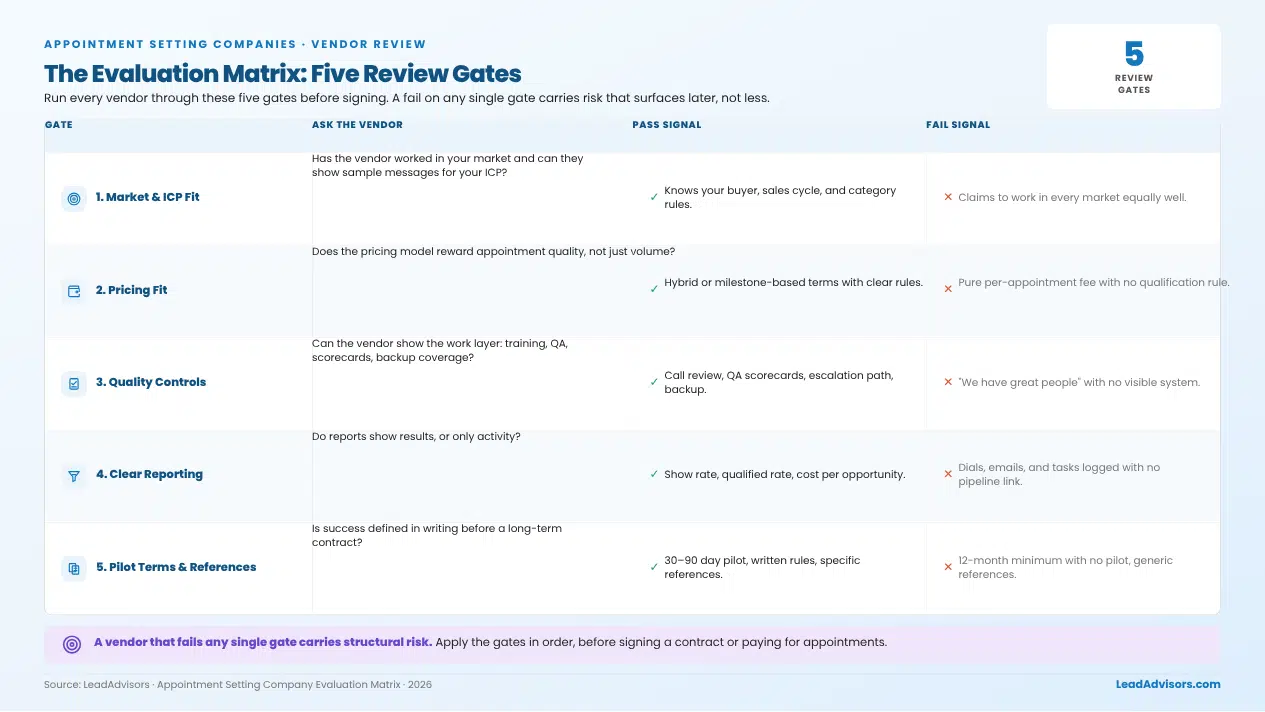
The Appointment Setting Company Evaluation Matrix compares five vendor models against five review gates.
Use it before signing a contract.
The five gates are:
- Market fit and ICP match
- Pricing fit
- Quality controls
- Clear reporting
- Pilot terms and reference checks
Gate 1: Market Fit And ICP Match
A vendor should know your buyer, market, and compliance needs. This supports the experience and trust signals that Google describes in its E-E-A-T quality rater guideline update, especially if appointment setting connects to a larger lead-generation services stack.
Ask:
- Has the vendor worked in your market?
- Can they explain your buyer’s pain in plain terms?
- Do they know your sales cycle?
- Can they show sample messages for your ICP?
- Do they know the rules in your category?
This matters most in:
- Financial services
- Healthcare
- Insurance
- Legal services
- Home services
- B2B SaaS
- Manufacturing
- IT and tech services
A generalist vendor may work for simple B2B outreach. But complex programs often need lead-generation outsourcing delivery models with tighter management.
Market-specific campaigns need more proof.
Gate 2: Pricing Fit
Appointment-setting pricing can create good or bad behavior.
The pricing model should reward appointment quality, not just volume.
Common pricing models, like those used in a lead generation vendor evaluation matrix, include:
- Monthly retainer
- Pay per appointment
- Pay per shown appointment
- Retainer plus bonus
- Pay per closed deal or revenue share
- Hybrid pricing
Pay-per-appointment can work if the rules are clear.
But paying per appointment without quality gates can push the vendor to book weak meetings.
Retainers can work when the scope is clear.
But retainers without milestones can hide weak results.
Hybrid pricing often creates a better fit. The vendor gets paid to run the system and earns more for agreed results. This is why buyers should understand the engagement models of BPO operators, agencies, and consultants.
Gate 3: Quality Controls
Quality controls separate operators from basic appointment setters.
Ask vendors to show the work layer.
Look for:
- Setter training
- Call review
- QA scorecards
- Call status tracking
- Script updates
- Objection coaching
- Backup coverage
- Replacement process
- Escalation path
- Weekly performance review
Do not accept “we have great people” as a quality system.
Great people still need management, QA, and feedback.
Gate 4: Clear Reporting
Reports should show results, not just activity.
Useful metrics, including transfer set rate versus show rate metrics, include:
- Appointment show rate
- Qualified appointment rate
- Appointment-to-opportunity rate
- Appointment-to-deal rate
- Cost per opportunity
- No-show rate
- Call status breakdown
- Lead source results
- Contact rate by group
- Speed-to-lead results
Weak metrics include:
- Dials made
- Emails sent
- LinkedIn connections
- Tasks logged
- “Positive replies” with no pipeline link
Activity matters. But it should connect to the results, especially when the plan depends on contact-rate optimization for outbound operations.
If a vendor cannot explain how appointments become opportunities, the reports are not strong enough.
Gate 5: Pilot Terms And Reference Checks
A serious vendor should define success before asking for a long contract.
Look for:
- 30- to 90-day pilot terms
- Written success rules
- Clear qualification rules
- Show-rate goals
- No-show process
- Reference calls
- Exit terms
- Clear scope
Reference calls should be specific.
Ask:
- What appointment show rate did you get?
- What share became qualified opportunities?
- How long did the ramp take?
- Who booked the meetings?
- What reports did you get?
- What quality issues came up?
- How did the vendor fix them?
- Would you hire the vendor again?
Generic references do not prove results.
Specific answers do.
Appointment Setting Companies Pricing: What You Are Really Paying For
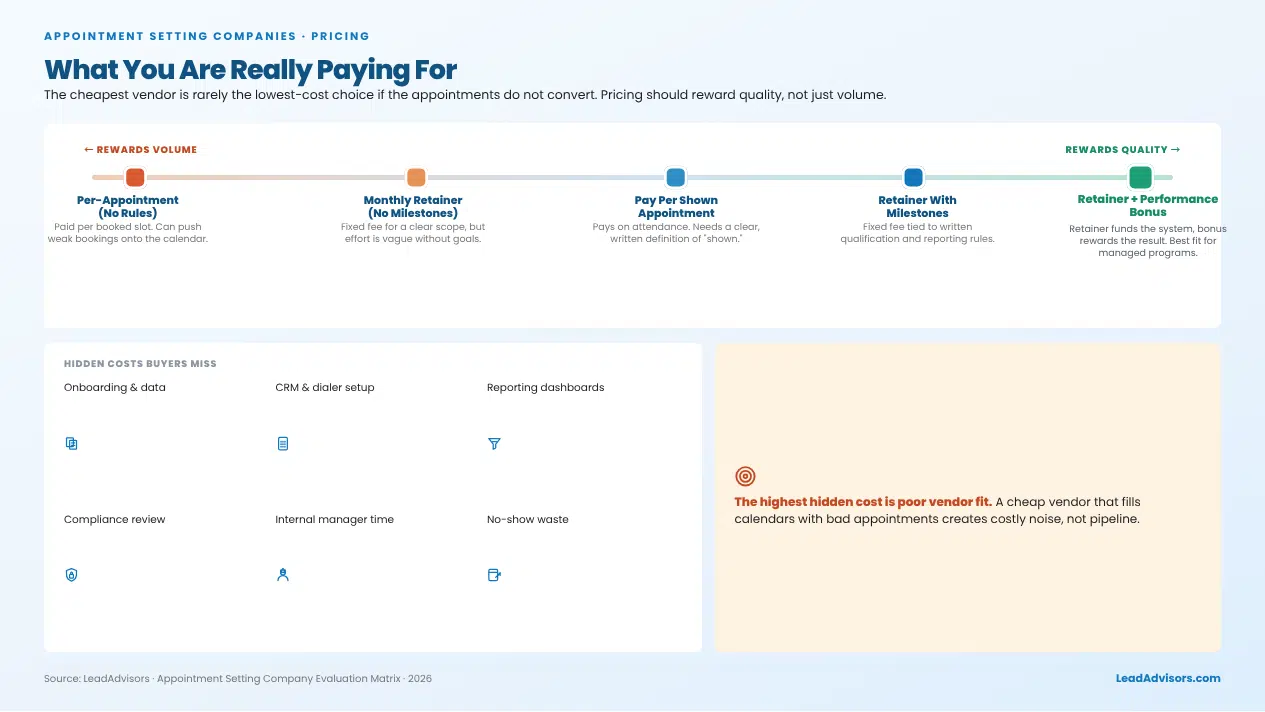
Appointment-setting pricing changes by model, market, and qualification depth.
The cheapest vendor is rarely the lowest-cost choice if the appointments do not convert.
Per-Appointment Pricing
Pay-per-appointment pricing charges for each booked meeting. It often overlaps with B2B telemarketing operations when phone outreach drives the appointment.
This model is common in appointment-setting outsourcing and lead-generation appointment-setting services.
It works when the appointment rules are clear.
For example:
- Buyer title
- Company size
- Budget range
- Pain point
- Location
- Timing
- Confirmation rule
The risk is volume over quality.
If the vendor gets paid for any booked slot, weak prospects can land on your calendar.
Monthly Retainer Pricing
Monthly retainers charge a fixed fee for a clear scope.
The scope may include setters, management, scripts, reports, outreach tools, and outbound dialing campaign operations.
This model works when the buyer wants steady work.
The risk is weak accountability.
A retainer needs milestones, not vague “effort.”
Pay Per Shown Appointment
Pay per-show appointment charges only when the prospect attends.
This can improve fit, but it still needs reminder rules and training for closers to receive appointments.
But it can create disputes.
You need a clear meaning for “shown.”
For example:
- Did the prospect stay for at least 10 minutes?
- Did the right decision-maker attend?
- Was the appointment qualified?
- Was the no-show due to the vendor or closer?
Define this before launch.
Retainer Plus Performance Bonus
This setup often works best for managed programs.
The retainer funds the system.
The bonus rewards results, especially when the vendor can show BPO contact strategy operations behind the appointment volume.
It can align both sides when the metrics are clear.
Hidden Costs
Buyers often miss hidden costs.
Common hidden costs include:
- Onboarding
- Data
- CRM setup
- Dialer technology selection
- Reporting dashboards
- Script writing
- Compliance review
- Internal manager time
- Sales team feedback time
- No-show waste
The highest hidden cost is poor vendor fit.
A cheap vendor that fills calendars with bad appointments creates costly noise.
Market-Specific Vendor Checks
Vendor fit changes by market.
A provider that works in one field may fail in another.
Financial Services
Financial services appointment setting requires compliance awareness and experience in the financial services vertical, lead generation.
TCPA, Do Not Call, consent records, state rules, mortgage-vertical lead-generation rules, and product limits can all matter.
The FTC’s Telemarketing Sales Rule guidance says sellers and telemarketers must keep internal Do Not Call lists. The FCC’s TCPA materials also show why consent and calling practices carry legal risk. The Federal Register’s TCPA one-to-one consent rule update explains why lead generators and comparison sites may need to change how they collect consent.
A vendor in this market should understand compliance review, call recording, consent, and escalation.
Do not treat compliance as a sales footnote.
Healthcare And Healthcare SaaS
Healthcare appointment-setting companies need to handle patient data, healthcare workflows, and healthcare vertical lead-generation standards.
HHS business associate contract guidance states that business associates may include companies that create, receive, maintain, or transmit protected health information for a covered entity. HHS also says that covered entities and business associates generally need contracts that include appropriate safeguards.
If a campaign touches protected health information, ask about BAAs, access controls, data handling, and the HIPAA Security Rule safeguards used to protect electronic health data.
For healthcare SaaS, the vendor should also know practice workflows, admin buyers, and long sales cycles.
B2B SaaS And Software Companies
B2B appointment setting for software companies needs more than cold calls. It should connect to the SaaS lead generation methodology.
Tech buyers often need mixed outreach, clear messages, strong research, and an IT-vertical lead-generation context.
For software companies, check:
- Persona fit
- Account research
- Multi-threading
- Email quality
- LinkedIn workflow
- Discovery questions
- Handoff notes
Generic “book a demo” outreach is not enough.
Manufacturing And Industrial
Manufacturing buyers often have longer sales cycles and group decisions. That makes manufacturing vertical lead generation experience useful during vendor review.
Appointment-setting companies need account targeting, not just more calls.
Look for experience with:
- Named accounts
- Distributor networks
- Plant managers
- Operations leaders
- Trade show follow-up
- Channel partner workflows
Home Services And HVAC
Appointment setting for HVAC companies and other home services firms has a different flow.
Speed-to-lead, local coverage, financing checks, call reminders, and after-hours handling matter.
The vendor should understand inbound and outbound appointment handling.
For home services and insurance vertical lead generation, poor reminders create wasted appointments, wasted calls, and missed estimates.
Agencies And White-Label Buyers
Agency operators need fulfillment that they can resell. This may include related insurance live-transfer operations when clients sell in insurance markets. For insurance campaigns, use CMS Medicare marketing guidelines and the NAIC state insurance department directory to check current federal and state rules.
The vendor must support:
- White-label reports
- Clear SLAs
- Client-safe messages
- Multi-account management
- Capacity planning
- Escalation workflow
For agencies, the wrong vendor can hurt the agency’s brand.
Red Flags That Should Disqualify Appointment Setting Companies
Some warning signs should stop the deal.
Marketing Red Flags
Watch for:
- “Guaranteed appointments”
- “Top appointment setting company” claims without proof
- Vague case studies
- No operator metrics
- Claims across every market
- Heavy branding with weak process detail
Strong vendors explain how they run the work.
Weak vendors sell outcomes without showing the system.
Pricing Red Flags
Watch for:
- 12-month minimum with no pilot
- Per-appointment pricing without qualification rules
- Hidden setup fees
- No cancellation terms
- Pressure to sign quickly
- Activity-based pricing with no result metrics
Pricing should make incentives clear.
If incentives are unclear, delivery will drift.
Operational Red Flags
Watch for:
- No sample reports
- No QA process
- No backup coverage
- No call review process
- No replacement rules
- No escalation path
- No market-specific references
If a vendor cannot show how quality is managed, they are asking you to trust hope.
Hope is not a system.
Reference Red Flags
Watch for:
- References who only say “they were great”
- References outside your market
- References who cannot explain metrics
- Refusal to provide relevant references
- No examples of problems and fixes
Good references include real friction.
Perfect references often hide detail.
Common Mistakes Buyers Make
Most appointment setting failures start before launch.
They start with buyer-side mistakes.
Mistake 1: Buying The Wrong Model
A small company may not need a managed operator.
A larger sales floor may outgrow a freelancer fast.
Match the model to the operation before choosing a vendor.
Mistake 2: Accepting Activity Reports
Dials and emails do not prove pipeline.
Ask for the show rate, qualified appointment rate, and appointment-to-opportunity rate.
Mistake 3: Skipping Pilot Terms
A pilot protects both sides.
It forces clear goals before a long contract.
Mistake 4: Ignoring Closer Capacity
Do not buy more appointments than your team can handle.
Unused appointments become no-shows, weak follow-up, and wasted spend.
Mistake 5: Treating Compliance As Website Copy
Compliance cannot be a bullet on a website.
Ask how the vendor handles consent, DNC, call recording, data, and escalation.
Mistake 6: Chasing The Cheapest Cost Per Appointment
A low cost per appointment can hide a high cost per opportunity.
Measure what happens after the appointment.
How LeadAdvisors Fits In The Appointment Setting Company Landscape
LeadAdvisors fits into the managed appointment-setting operator category with speed-to-lead infrastructure built into the model.
We build and run appointment-setting as part of a broader BPO and lead-generation system.
That includes appointment setters, campaign management, QA, reports, call reminders, contact rate work, and feedback loops.
LeadAdvisors is not a staffing firm.
We do not just provide lower-cost workers.
We build the system, run the campaign, and improve it against real metrics.
This model fits buyers who need:
- Managed offshore appointment-setting teams
- QA and reports
- Contact rate work
- Sales floor support
- White-label fulfillment
- Mixed-channel follow-up
- Clear visibility
It is not always the right model.
A freelancer or boutique vendor may better serve companies under $1M in revenue. Enterprise teams with mature in-house SDR leaders may only need overflow support.
Use the Appointment Setting Company Evaluation Matrix against LeadAdvisors the same way you use it against any vendor.
If the model fits, the next step is a strategy call.
If another model fits better, choose the model first.