The build-or-buy choice for lead generation has changed in 2026. Four public reports tell us why. Every operator weighing this decision should treat them as required reading.
The Bureau of Labor Statistics projects that US sales jobs will shrink through 2034. The April 2026 JOLTS report counted 7.6 million job openings against 3.0 million quits.
A November 2025 Stanford Digital Economy Lab study used ADP payroll data from millions of US workers. It found a 13 to 16 percent drop in jobs for workers aged 22 to 25. The drop hit AI-exposed roles, such as customer service reps.
The Federal Trade Commission released a report to Congress on January 6, 2026. It logged 2.6 million Do-Not-Call complaints in fiscal year 2025. Per-call fines now top out at $50,120.
Put together, these reports point to one trend. Sales talent is harder to find. It costs more to keep, and compliance risk has hit a new high.
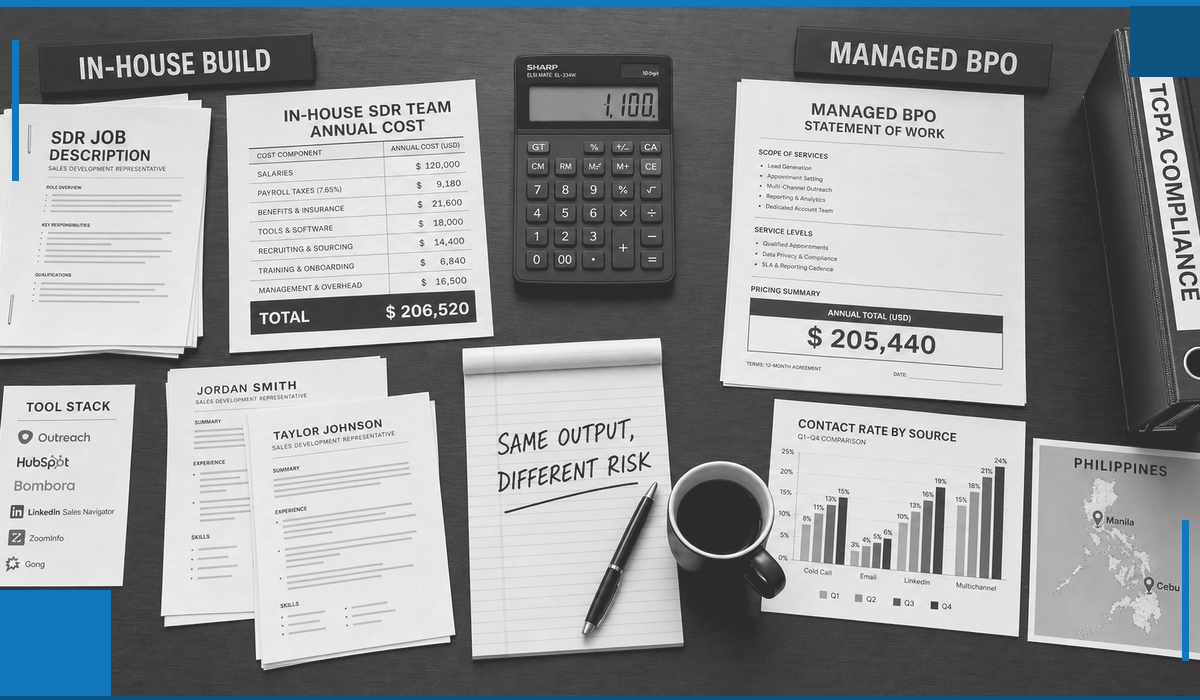
Inside this market, the math has shifted. An in-house two-SDR team now costs $206,520 per year, fully loaded. A managed program does the same work for $205,440, just $1,100 less.
Below, we cover the four lead generation outsourcing models. We break down the cost of each one. We score providers on six checks.
We pinpoint when the in-house build still wins. We close with how the next 24 months will shift the answer.


What Lead Generation Outsourcing Actually Means
Direct answer: Lead generation outsourcing hands prospecting, qualifying, and pipeline delivery to an outside provider. The provider runs the calls and cadences. Your closing team gets ready-to-work conversations, appointments, or live transfers.
What changes and what stays the same. The delivery model changes. The provider decides who runs the function, which tools they use, and how much it costs.
The output goal does not change. The provider must deliver a qualified pipeline to closers. The cost per output is fixed, and the SLA is in writing.
The bar is the same as for an in-house team. The only difference is where it lives. It sits in a contract, not a job description.
Three things lead generation outsourcing is not.
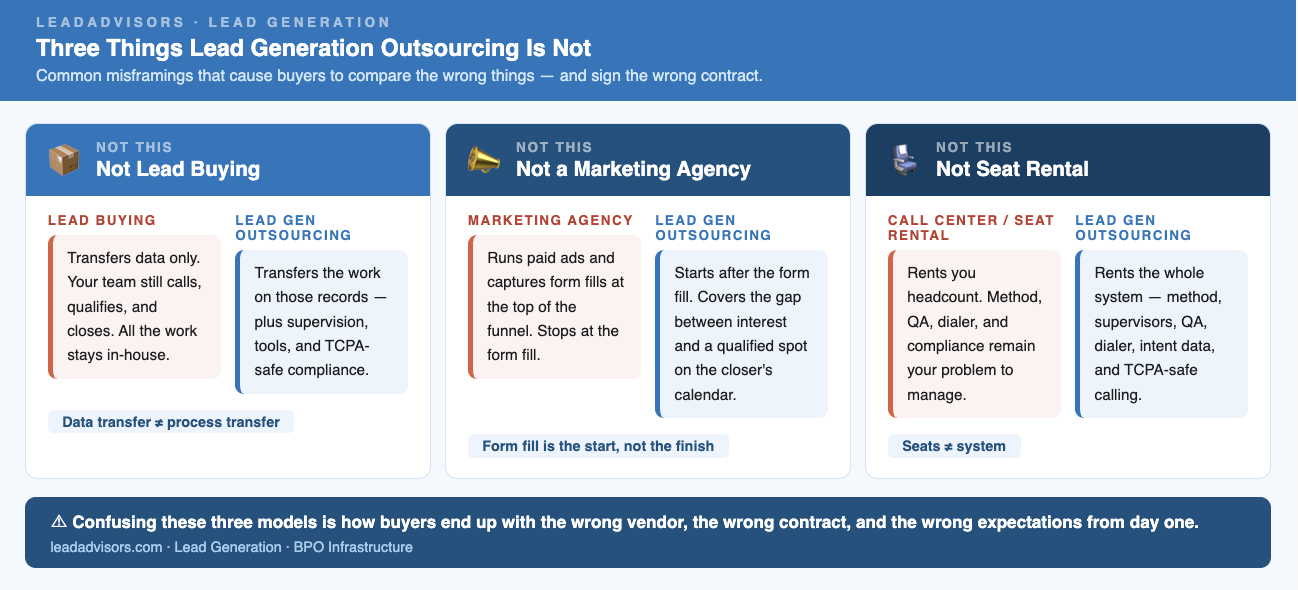
- Not lead buying. Buying records from an aggregator transfers data only. Your team still has to call, qualify, and close. Lead generation process outsourcing transfers the work on those records, plus the supervision, tools, and compliance.
- Not a marketing agency. A marketing agency runs paid ads and captures form fills at the top of the funnel. Outsourcing lead generation services starts after the form is filled out. It covers the gap between interest and a closer’s calendar.
- Not seat rental. A call center rents you seats. A b2b lead generation outsourcing program rents the whole system. That includes method, supervisors, QA, dialer, intent data, and TCPA-safe calling.
The Fully Loaded Cost Gap That Most Operators Miss
Most operators run the cost math wrong. They compare the SDR salary to the managed agent rate. The two are not the same shape: a salary is a single line item, but a managed rate is a full program cost.
The Bureau of Labor Statistics’ May 2024 occupational data set the median wage for wholesale and manufacturing sales reps at $66,780. For technical and scientific sales reps, it was $100,070. Entry-level SDR pay sits below both.
The full cost of a two-SDR team exceeds salary costs. Taxes, benefits, tools, management time, hiring, and ramp set the true cost per output.
Fully Loaded Annual Cost of a Two-SDR In-House Function
| Cost category | Annual amount |
| Two SDR salaries ($50,000 each) | $100,000 |
| Performance incentives (15% of base) | $15,000 |
| Employer payroll taxes (~12%) | $13,800 |
| Health insurance and benefits (two employees) | $16,000 |
| Sales engagement platform (Outreach/Apollo at $150/seat/month) | $3,600 |
| CRM licenses (HubSpot/Salesforce at $100/seat/month) | $2,400 |
| Dialer (Aircall/JustCall at $80/seat/month) | $1,920 |
| Intent data (Bombora/ZoomInfo at $1,500/month) | $18,000 |
| Recruiting (one replacement per 14 months at ~40% turnover) | $12,800 |
| Management overhead (20% ofthe sales manager’s loaded cost) | $18,000 |
| Training and ramp (60-day ramp at 60% productivity) | $5,000 |
| Total fully loaded annual cost | $206,520 |
Two SDRs at $50,000 base each ($100,000 total) actually cost the operator $206,520 per year fully loaded. That is $103,260 per SDR, or $49.65 per scheduled hour.
Most public cost research undercounts the real in-house figure by 40 to 60 percent. The eleven line items above are routinely left out.
Outsourced Equivalent at the Same Output Target
| Cost category | Monthly | Annual |
| Managed agent cost (2 agents × 160 hrs × $16/hr) | $5,120 | $61,440 |
| Lead acquisition (400 leads at $30) | $12,000 | $144,000 |
| Total managed program cost | $17,120 | $205,440 |
The two models land inside a $1,100 gap over twelve months. But the risk profile is different. The outsourced figure rolls up supervisors, QA, compliance, tools, hiring, and ramp into one fixed rate.
The in-house figure asks the operator to fund each item separately. Any slips are absorbed by the operator as well.
Where the economics favor outsourcing:
- Monthly lead volume below 500. In-house SDRs cannot stay busy at this volume. You pay them to sit idle. Managed programs scale to lead supply without that drag.
- No internal management layer. A two-SDR team without a sales development manager falls short of the benchmark. No one sets activity floors or coaches to a standard. Managed programs roll the supervisor, QA, and coaching layer into the rate.
- Regulated verticals. TCPA, CMS, FINRA, and HIPAA-adjacent rules need compliance know-how. In-house teams build that slowly and at high cost. Managed BPO providers already have it.
Where the economics favor in-house:
- Output above 1,000 qualified deliverables per month. Vendor margin and vendor management overhead grow at scale. Fixed in-house costs are spread across a higher volume more efficiently.
- Sales motions that need deep product knowledge. Enterprise B2B calls need technical depth at the qualifying stage. A managed provider cannot match it without heavy training costs.
The Four Lead Generation Outsourcing Models in 2026
Four different models share the label “lead generation outsourcing”. Treating them as the same is the most costly mistake in vendor evaluation. Each has a different output, cost structure, and fit.
Most top B2B lead-generation outsourcing companies run one or two of these models as core work. Spotting which model a provider runs is the first call, not the second.
Model 1: Managed Outbound Calling (BPO Contact Strategy)
A managed BPO runs trained outbound agents, dialers, supervisors, QA, and compliance. You supply the lead data. The BPO qualifies prospects against your brief and delivers live transfers or scheduled appointments.
This is the primary outsourcing model for sales lead generation in regulated verticals. Compliance must be in place before the first dial.
- Output: qualified live transfers or confirmed appointments.
- Pricing: managed rate per agent hour, or per qualified output.
- Best fit: operators with a lead source who cannot work at a good rate in-house. That includes internet leads, direct mail responses, or an aged CRM list.
Model 2: Appointment Setting Service
A special appointment setter calls cold prospects or warms up inbound leads. The setter runs a qualifying call and books a meeting with your sales team. The output is a calendar booking, not a live transfer.
- Output: confirmed appointments on the calendar.
- Pricing: per appointment, or monthly retainer tied to a volume target.
- Best fit: B2B motions that need a scheduled discovery or demo, not an immediate transfer: SaaS, professional services, consulting, and enterprise B2B.
Model 3: Exclusive Lead Generation (Owned Campaigns)
A provider runs paid search, paid social, or content campaigns under your brand. It produces leads that are owned exclusively by the operator, not leads sold through a shared aggregator pool.
- Output: form fills, inbound calls, or chat leads from your own branded campaigns.
- Pricing: monthly management fee plus ad spend.
- Best fit: operators that want their own lead flow but lack an in-house marketing team to run the campaigns.
Model 4: Fully Outsourced Pipeline (Campaign Through Qualified Handoff)
The provider handles the full stack in a single engagement. That covers campaign management, lead acquisition, outbound qualification, appointment setting, and pipeline reporting. This is the deepest form of outsource b2b lead generation.
It suits operators without an in-house pre-sales setup. It also fits operators whose full in-house build would top the managed program cost.
- Output: qualified pipeline delivered to closers, with full attribution reporting.
- Pricing: retainer covering all functions.
- Best fit: operators handing over the entire pre-sales function to an external team.
Whichever lead generation outsourcing company is on your shortlist, the first question is the same. Which of the four models do they actually run?
When to Outsource, When to Build, When to Hybrid
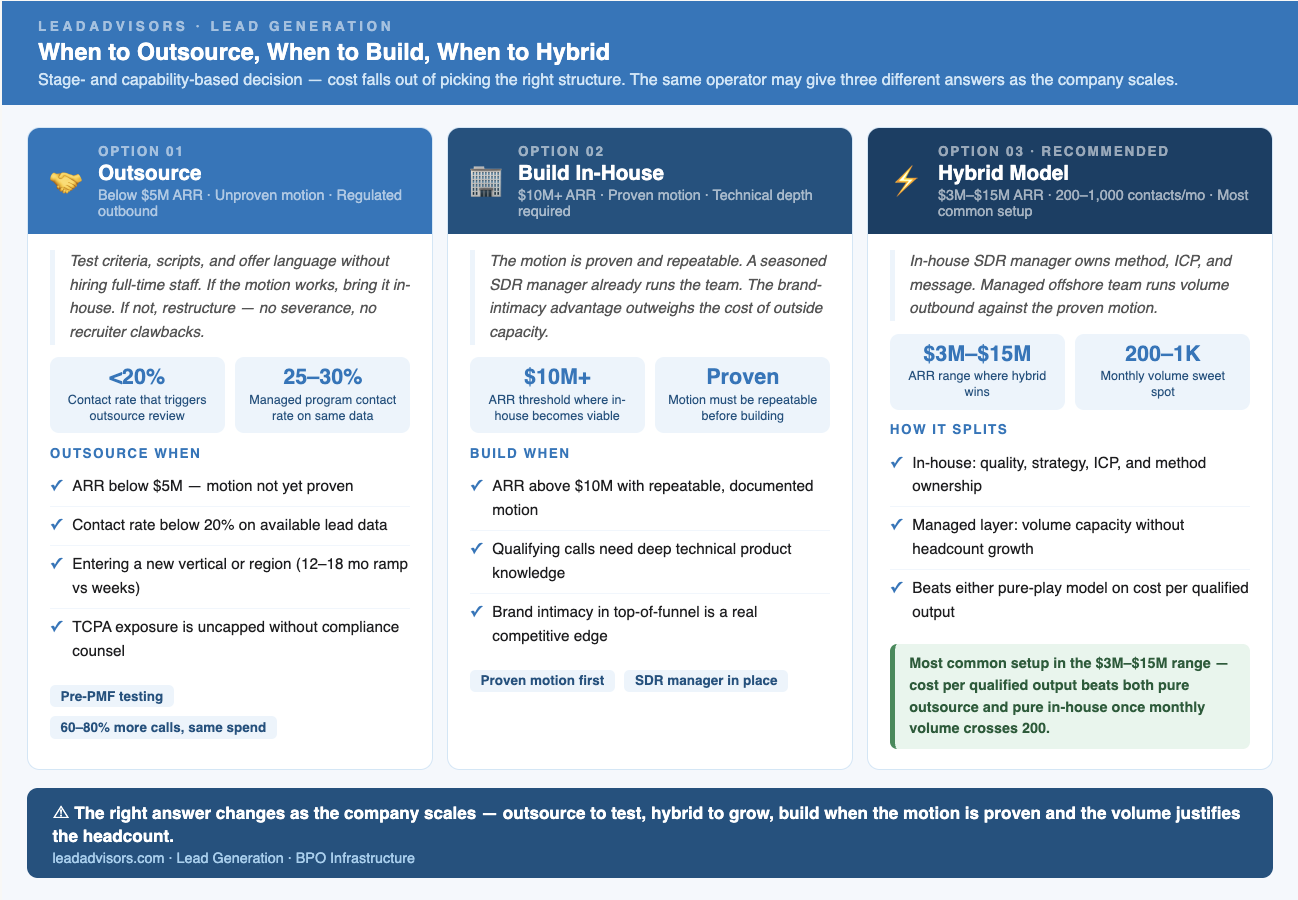
The in-house versus outsourced decision is a stage- and capability-based call. Cost comes from picking the right structure. The same operator may give three different answers as the company scales.
Outsourcing b2b lead generation looks different at $3M ARR than at $30M ARR.
Outsource lead generation when:
- The motion has not yet been proven, and ARR remains below $5M. Outsource before product-market-message fit. You can test criteria, scripts, and offer language without hiring full-time staff. If the motion works, bring it in-house. If not, restructure with a new provider. No severance, no recruiter clawbacks.
- Lead data is available, but the contact rate is below 20%. A managed program can work the same data at contact rates of 25-30%. That produces 60-80% more qualified calls from the same lead spend.
- You are entering a new vertical or region. Building compliance know-how and market sense in-house takes 12 to 18 months. A managed provider already in that vertical cuts the ramp to weeks. This holds for Medicare lead generation outsourcing, auto insurance lead generation outsourcing, solar lead generation services outsourcing, real estate lead generation outsourcing, telecom lead generation outsourcing, mortgage loan lead generation outsourcing, or industrial outsourcing lead generation.
- TCPA exposure is uncapped. Operators in regulated outbound without full-time compliance counsel carry real risk. Managed BPO operators in those categories carry that risk as a cost of doing business.
Build in-house when:
- ARR is above $10M with a proven, repeatable motion. A seasoned sales development manager already runs the team.
- Qualifying calls need deep technical product knowledge. An outside team cannot match that without heavy training costs.
- Top-of-funnel relationship quality is a real edge in your market. The brand-intimacy gap from an outside provider would cost you deals.
The hybrid model: what most $3M to $15M operators run
An in-house sales development manager owns the method, the ICP, and the message. A managed offshore team runs the volume outbound against that proven motion.
The in-house layer controls quality and strategy. The managed layer supplies capacity without growing headcount in lockstep.
This is the most common setup in the $3M to $15M range. It beats either pure-play model on cost per qualified output. That edge holds once monthly volume crosses 200 and stays below 1,000.
How to Evaluate a Lead Generation Outsourcing Partner
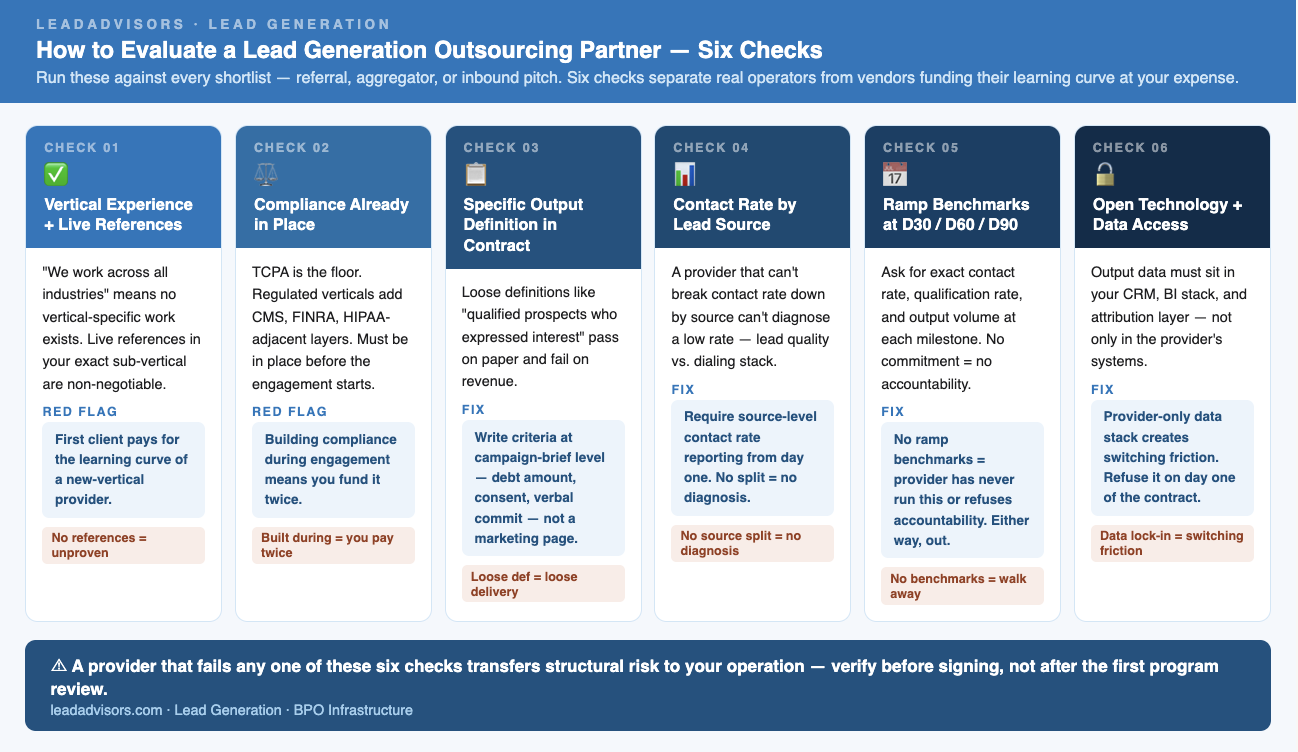
Six checks separate real operators from vendors that fund their learning curve at your expense. Run them against every shortlist of lead generation outsourcing companies. It does not matter whether the name came from a referral, an aggregator, or an inbound pitch.
- Documented vertical experience with live references. “We work across all industries” signals that no vertical-specific work has been built. Live references in your exact category, ideally by sub-vertical, are not negotiable. The first client covers the learning curve for a provider entering a new vertical.
- Existing compliance for the vertical. Every US outbound program runs under TCPA, and regulated verticals add CMS, FINRA, and HIPAA-adjacent layers on top. The provider must show this is already in place before the engagement starts. Building it during the engagement means you fund it twice.
- Specific qualified-output definition in the contract. Loose definitions like “qualified prospects who expressed interest” let providers ship outputs that pass on paper. Those outputs fail on revenue. Write criteria at the level of a campaign brief, not a marketing page.
- Contact rate reported by lead source. A provider that cannot break the contact rate down by source cannot diagnose a low rate. Is it a lead-quality problem, or a dialing-stack problem? That split tells you which lever to pull.
- Ramp benchmarks at day 30, day 60, and day 90. Ask for the exact contact rate, qualification rate, and output volume the program should hit at each milestone. A provider that will not commit, either has never run a program like this or refuses to take accountability. Either way, they are out.
- Open technology and data access. Output data must sit inside your systems (CRM, BI stack, attribution layer). A program whose data lives only in the provider’s stack creates switching friction. Refuse it on day one of the contract.
The First 30 Days: An Onboarding Protocol That Compresses Ramp
The first 30 days are when the qualifying calibration gets set. Programs that ship without it send the wrong leads for months. By the time anyone catches the problem, you have paid for a quarter of misqualified output.
Week 1: Brief and Criteria Documentation.
Before a single dial is placed, both sides write and sign off on the qualifying criteria. That covers the target prospect, qualifying signals, disqualifying responses, and transfer commitment language.
Most failed outsourcing engagements risk the provider misreading the brief. Yours has to drive the ramp instead.
Week 2: Script Development and Certification.
The qualifying script is built together. You bring product and market knowledge. The provider brings outbound structure and objection handling.
Both sides approve the script before live calling begins. Agents must pass a script certification before they touch the campaign.
Weeks 3 and 4: Supervised Ramp with Daily Feedback.
The first two weeks of live calling run under a daily feedback loop. You sample calls each day and return notes on qualification accuracy, script use, and objection handling. The provider adjusts the script, coaching, and agent assignment based on that feedback.
This loop cuts the industry-standard 45 to 60-day ramp down to 20 to 30 days.
Day 30: First Formal Performance Review.
Review four metrics against plan: contact rate, qualification rate, output volume, and QA score. Any miss triggers a written corrective action plan before month two begins. “We need more time” is not a valid reply after a 30-day supervised ramp.
Five Lead Generation Outsourcing Mistakes That Make the Investment Fail
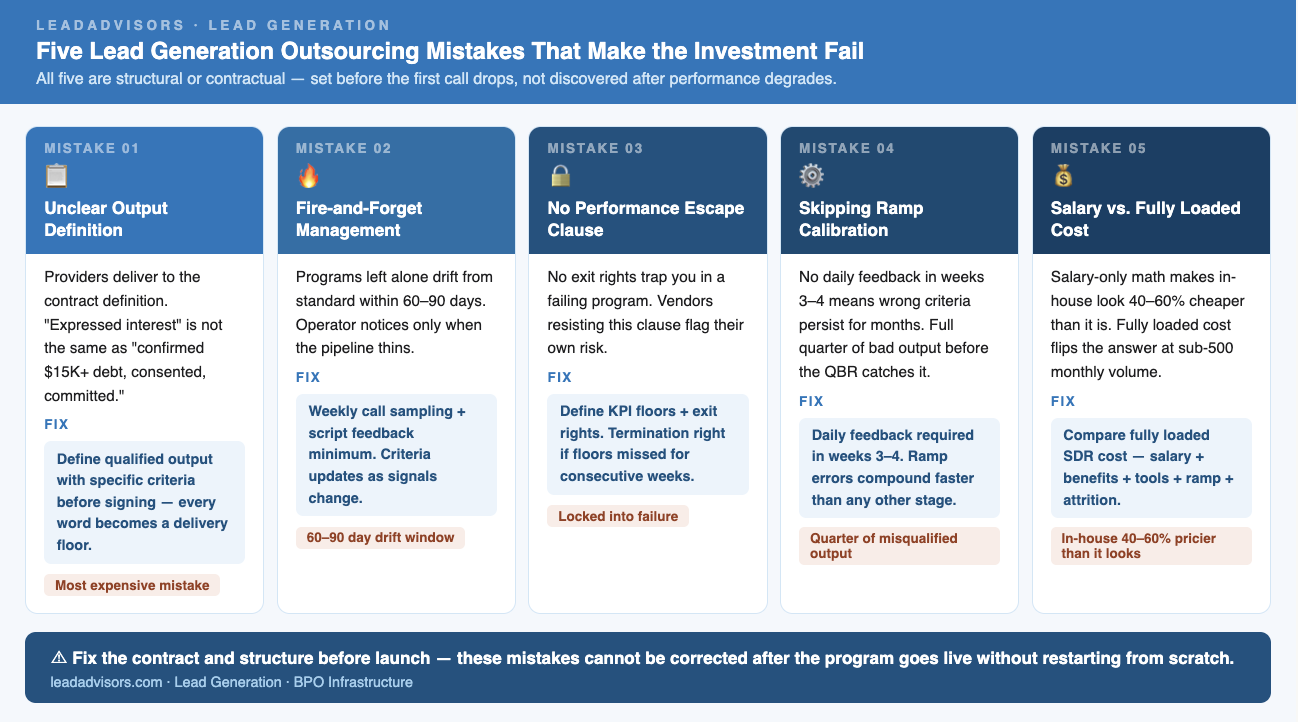
Five recurring mistakes account for most outsourcing lead generation engagements that underperform or fail.
- Unclear qualified-output definition. The most expensive mistake. An operator who defines qualified output as “someone who expressed interest” gets a very different delivery from an operator who defines it as “a prospect who confirmed $15,000+ in qualifying debt, consented to a specialist call, and verbally committed to the transfer.” Providers deliver according to the contract definition, so a loose definition means loose delivery.
- Treating the program as fire-and-forget. Outsourced lead generation needs steady operator engagement. Weekly call sampling, script feedback, and criteria updates keep it on track. Programs left alone drift from the standard within 60 to 90 days. The operator usually only notices when the pipeline thins later.
- No performance escape clause. A contract without termination rights traps you in a failing program. Spell out contact rate, qualification rate, and output volume floors. Add a clear exit right when those floors are missed for several weeks. Vendors that resist this clause are flagging their own risk.
- Skipping the ramp calibration. Operators who skip the daily feedback in weeks 3 and 4 ship against the wrong criteria. The criteria stay off for months. By the time the QBR catches the gap, you have paid for a quarter of misqualified output.
- Comparing the managed cost to the nominal SDR salary instead of the fully loaded SDR cost. Salary-only math makes in-house look 40-60% cheaper than it actually is. The fully loaded math flips the answer at sub-500 monthly lead volume. That is where most operators evaluating outsourcing actually sit.
Why the Philippines Has Become the Dominant Offshore Base
Outsourcing lead generation to the Philippines is now the default offshore choice for US operators. That includes financial services, insurance, healthcare, legal, and B2B sales. The public data shows why.
The Philippine IT-BPM industry closed 2025 on a strong run. It is on track to hit 1.9 million jobs and $40 billion in export revenue by the end of 2026. The industry added 80,000 jobs and $2 billion in revenue last year, per IBPAP’s December 2025 industry report.
IBPAP’s Roadmap 2028 targets $59 billion in revenue and 2.5 million FTEs by 2028. That is an industry CAGR of 10.4 percent. The OECD’s Economic Surveys: Philippines 2026 names BPO as a continued driver of Philippine growth in modern services.
That market depth runs through Manila, Cebu, Davao, and Clark. The market is deeper, more English-fluent, and better aligned with the US time zone than alternatives. It is also more commonly used to regulate vertical work.
Three operational gains stack up for lead-generation outsourcing programs in the Philippines. First, achieve contact-rate parity with US agents for direct-dial mobile data. Second, lower attrition than US SDR baselines.
Third, a TCPA-compliant infrastructure that does not need to be rebuilt from scratch.
Lead generation outsourcing programs in Cebu have absorbed a significant share of US outbound from financial services and insurance over the past 24 months. They have outpaced lead-generation outsourcing companies in India alternatives in the US-regulated outbound market. Time-zone fluency and familiarity with compliance matter most in that work.