In a lot of boardrooms, the sales outsourcing conversation starts with a simple-sounding prompt:
“Should we keep building sales in-house or buy the outcome?”
For operators, that question is rarely simple because the cost line in the P&L is clean (salary + tools), while the risk is not. When the motion is immature, the hidden costs show up as churn, missed ramp assumptions, an inconsistent pipeline, and compliance exposure.
That last one matters more in 2026 than most teams admit. The U.S. Do Not Call ecosystem is not hypothetical: the FTC’s biennial report to Congress on the National Do Not Call Registry (Jan 2026) notes more than 258 million numbers on the registry (FY 2025) and more than 2.6 million complaints in FY 2025.
This guide is for a COO, VP Sales, or founder who needs a decision framework that holds up under scrutiny. It clarifies what you’re buying (and what you’re not), compares fully loaded costs against an equivalent in-house build, explains the four outsourcing models, and shows what to demand in contracts and reporting so the engagement stays measurable.


What B2B Sales Outsourcing Actually Means
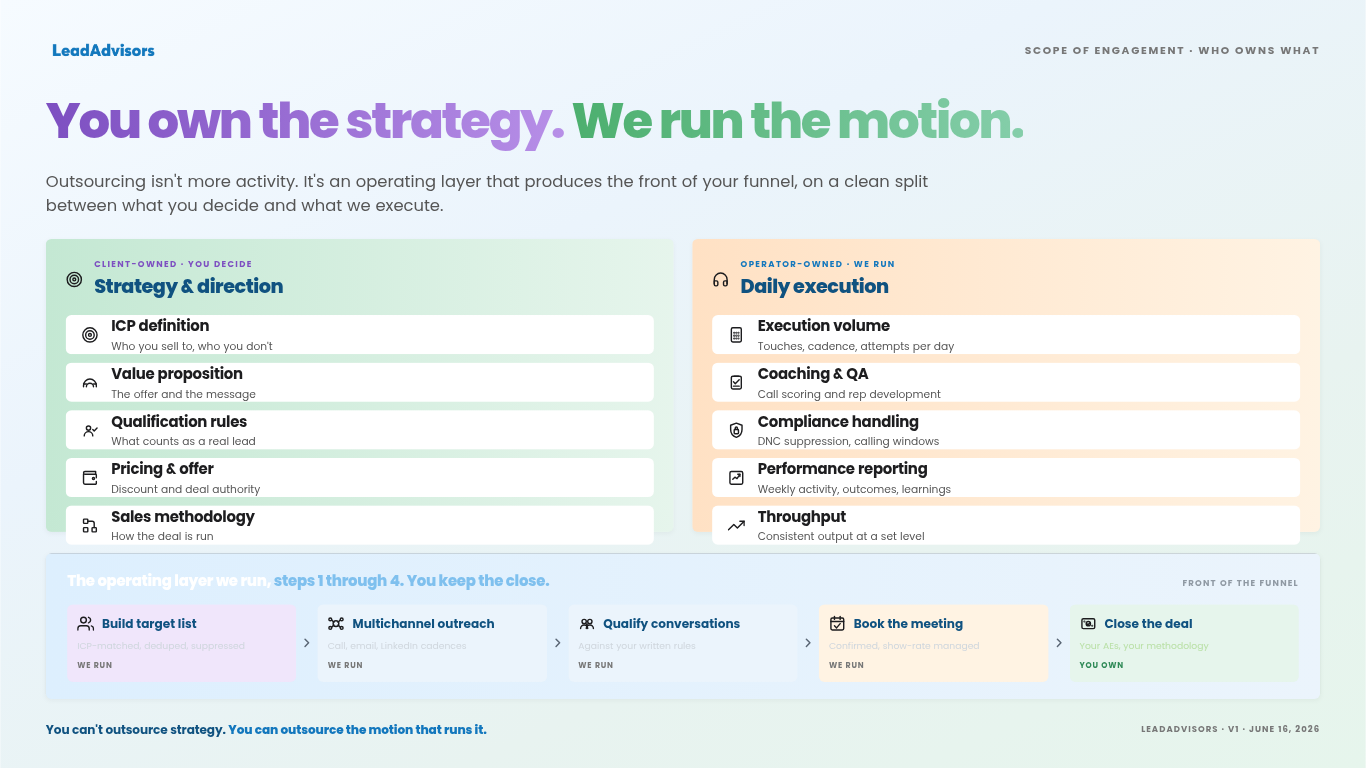
B2B sales outsourcing is when a company hires an external operator to run part (or all) of the revenue development motion, including prospecting, qualification, appointment setting, and sometimes closing, using the operator’s reps, management, compliance processes, and reporting. The client retains strategy, messaging direction, and (in most cases) the closing function. (If you want the service-layer overview, see BPO Services.)
Put differently: you’re not buying “more activity.” You’re buying an operating layer that can consistently produce the first 1-3 steps of your revenue funnel at a defined output level.
The three components that make outsourcing work (or fail)
Most outsourcing programs underperform for one of three reasons:
- Mis-scoped work: The buyer thinks they’re buying pipeline, but the provider is only contracted to deliver meetings. Or the buyer expects closing support, but the model is SDR-only.
- Weak definition of “qualified”: Without a written qualified output definition, performance debates turn into opinion. Qualifications must be measurable.
- No feedback loop: Outsourcing works when quality signals from AEs (accepted vs rejected, show rates, stage progression) feed back into targeting and scripting weekly.
The fix is not “a better vendor.” The fix is a clearer model, clearer metrics, and tighter process ownership.
What gets outsourced and what stays in-house
Most engagements outsource the front end of the funnel:
- building and working on a target list,
- running outreach sequences (calls/email/LinkedIn),
- qualifying early conversations,
- booking meetings for internal AEs to close.
In practice, this also includes operational work that internal teams often under-estimate:
- list hygiene and suppression logic,
- contact attempts and cadence management,
- QA scoring and coaching,
- and the reporting cadence that forces honest performance reviews.
Full-cycle outsourcing exists, but it’s a different product: it includes demos, proposals, and closing, and is usually tied to lower ACV or new-market entry.
A clean separation that helps operators manage expectations:
- Client-owned: ICP definition, value proposition, qualification rules, pricing/offer, sales methodology.
- Operator-owned: daily execution volume, coaching/QA, compliance handling, performance reporting, and throughput.
What sales outsourcing is not
Sales outsourcing isn’t just “an agency on commission.” Commission-only models often optimize for what gets credited rather than what closes cleanly and repeats predictably.
It’s also not a substitute for a working go-to-market strategy. If the positioning and qualification rules are unclear, outsourcing only adds to the confusion.
The Four B2B Sales Outsourcing Models – What Each One Covers
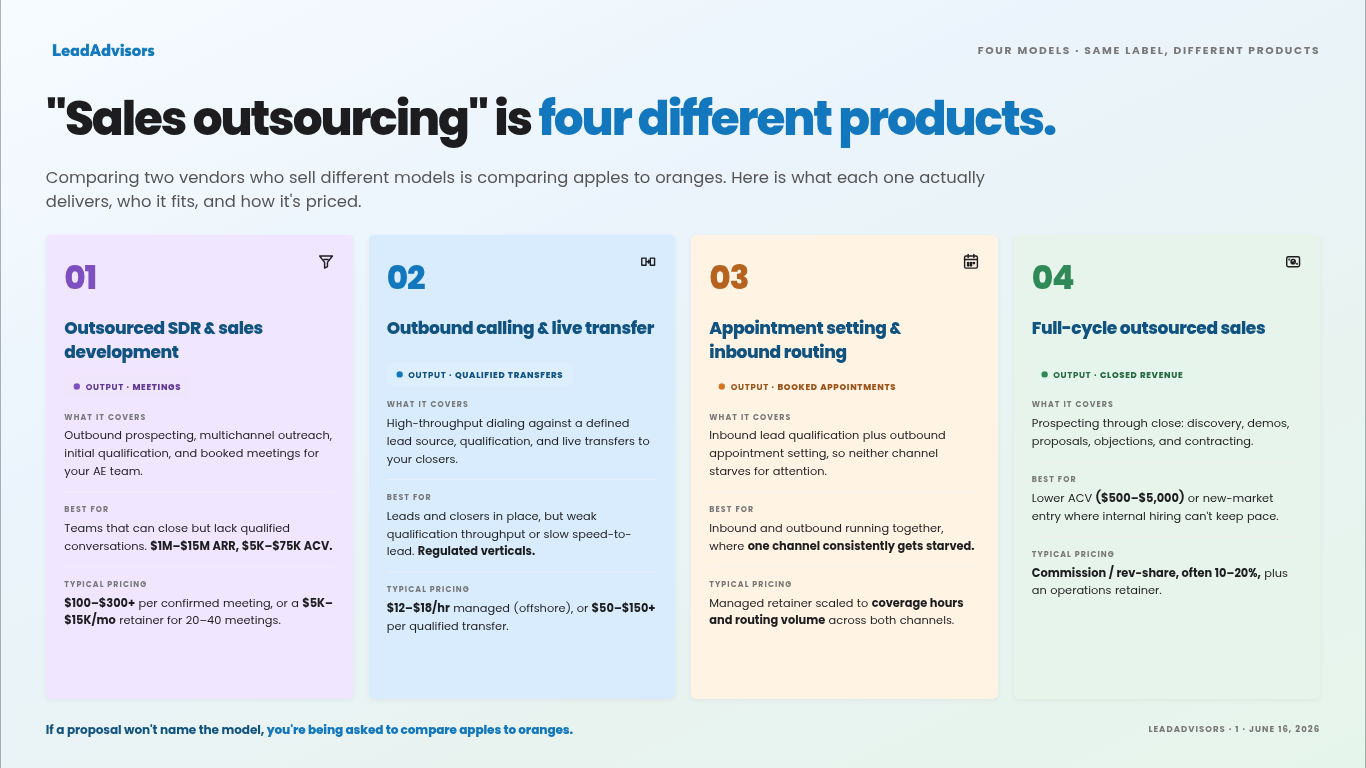
“Sales outsourcing” is a broad label. The mistake is comparing two vendors who sell different models as if they were interchangeable.
Model 1 – Outsourced SDR / sales development
What it covers: outbound prospecting, multichannel outreach, initial qualification, and booked meetings for your AE team. Output is meetings/opportunities, not closed revenue.
Best for: teams that can close, but don’t have enough qualified conversations. Common at $1M-$15M ARR and $5K-$75K ACV.
Typical pricing: per confirmed meeting ($100-$300+) or a retainer tied to volume ($5K-$15K/month for 20-40 meetings).
What to demand from the provider:
- a clear acceptance definition (what counts as accepted by your AE team),
- meeting confirmation and show-rate management,
- weekly targeting and script iteration,
- and visibility into activity (touches by channel, not just booked meetings).
Common failure mode (and how to prevent it): The provider hits the “meeting” number, but the pipeline doesn’t move because the meetings aren’t accepted or don’t show.
Prevent this by defining, in writing:
- What counts as an accepted meeting?
- What counts as a qualified conversation (before a meeting is booked),
- who owns confirmation, reschedules, and no-show recovery,
- and how the show rate will be measured (calendar invite acceptance, attendance, or AE confirmation).
If you’re pressure-testing output quality, this distinction matters: transfer set rate vs show rate.
If a provider can’t commit to those definitions, you don’t have an SDR program. You have a booking machine.
Model 2 – Outsourced outbound calling + live transfer (BPO contact strategy)
What it covers: high-throughput dialing against a defined lead source, qualification, and live transfers to closers.
Best for: teams with leads + closers but weak qualification throughput or slow speed-to-lead. Often used in regulated verticals where compliance operations are non-negotiable.
Typical pricing: an hourly managed rate ($12-$18/hr offshore) or a per-qualified transfer fee ($50-$150+).
If you’re evaluating this model specifically, compare how providers structure outbound calling and define a “qualified” live transfer.
Model 3 – Outsourced appointment setting with inbound routing
What it covers: inbound lead qualification plus outbound appointment setting, so your internal team isn’t forced to choose which channel gets attention.
Best for: companies running inbound + outbound where one channel consistently starves.
This model matters when your internal team is triaging instead of selling. If inbound lead follow-up is inconsistent, outbound conversion drops too because reps constantly switch context. Routing programs can stabilize throughput by separating:
- fast inbound response (speed-to-lead),
- deeper outbound qualification,
- and scheduling discipline.
Model 4 – Full-cycle outsourced sales
What it covers: prospecting through close (discovery, demos, proposals, objections, contracting). Output is closed revenue.
Best for: lower ACV ($500-$5,000) or for new market entry where internal hiring speed can’t keep up with the window.
Typical pricing: commission/rev-share (often 10-20%) plus an ops retainer.
Full-cycle outsourcing is also where governance matters most. If the provider is interacting directly with prospects through close, you need clarity on who owns pricing/discount authority, who owns legal/security review workflows, what happens to pipeline and CRM data if you exit, and how forecasting is handled.
Operator note: If a proposal says “outsourced sales” but won’t clearly name the model, assume you’re being asked to compare apples to oranges.
The Fully Loaded Cost Comparison – In-House Sales Team vs Outsourced
If you only compare salary to a retainer, an in-house will look cheaper almost every time. That’s a budgeting comparison, not an operating comparison. Operators who want a cleaner, defensible model often borrow the same logic used in loaded cost modeling and, for outbound motions, the performance lens behind outbound sales-floor economics.
Where the “savings” usually come from (and where they don’t)
When outsourcing is actually cheaper, it’s rarely because the provider’s hourly rate is low. It’s because the outsourced model collapses or transfers cost categories that internal teams carry:
- Recruiting + churn: internal SDR turnover is one of the biggest hidden drivers of cost and volatility. A managed program spreads that risk across the operator’s staffing pool.
- Management leverage: many teams hire SDRs before they have a manager who can coach, enforce process, and run QA. Outsourcing bundles a management layer into the price.
- Enablement and tooling: internal teams pay for sales engagement, dialers, data, and admin overhead. Managed programs often bundle this, or at least reduce redundancy.
- Faster time-to-output: if the revenue plan requires meetings this quarter, speed itself has economic value.
Where outsourcing is not automatically cheaper:
- When your ICP is undefined. You can’t outsource strategy. If the market and message are unclear, you’re paying to scale learning.
- When your data is bad. If the quality of contact data is poor, both internal and outsourced teams will struggle.
- When your product requires deep discovery. High ACV and complex qualification can narrow the gap.
The two comparisons that mislead most operators
Before we go deeper, avoid these common traps:
- Trap 1: Comparing one month of outsourcing to one month of payroll. Outsourcing is typically sold as a managed output with a ramp curve. Payroll is not the only internal cost line.
- Trap 2: Comparing outsourcing to a “perfect” in-house team. The relevant comparison is your expected internal performance at your current turnover, enablement maturity, and management capacity.
The reason the fully loaded model matters is simple: salary is a small part of the true cost of consistent production.
Quick check: Are you comparing the right outputs?
Before you run any spreadsheet, write down the output you actually need (accepted meetings, qualified transfers, opportunities created, or closed revenue). Then align the cost to that output, not to rep count.
Fully loaded annual cost of a three-SDR, one-manager in-house B2B sales function
A realistic model includes the costs that show up when the org is actually running:
| Cost category | Annual amount |
| Three SDR salaries ($50,000 each) | $150,000 |
| Sales manager salary ($90,000) | $90,000 |
| Performance incentives – SDRs (15%) and manager (20%) | $40,500 |
| Employer payroll taxes (~12% on all) | $33,660 |
| Health insurance and benefits (four employees) | $32,000 |
| Sales engagement platform ($150/seat/month × 4) | $7,200 |
| CRM licenses ($100/seat/month × 4) | $4,800 |
| Dialer ($80/seat/month × 3 SDRs) | $2,880 |
| Intent data (Bombora / ZoomInfo at $2,000/month) | $24,000 |
| SDR recruiting (one replacement per 14 months at 40% turnover) | $19,200 |
| Manager recruiting (one replacement every 2.5 years) | $11,200 |
| Ramp cost (60-day ramp at 60% productivity per SDR replacement) | $7,500 |
| Office and overhead allocation | $18,000 |
| Total fully loaded annual cost | $641,040 |
That’s $240,000 in salary, but $641,040 fully loaded, about $160,260 per SDR-equivalent per year.
Outsourced comparison for equivalent output
An example of a managed program engineered for comparable output:
| Cost category | Monthly | Annual |
| Managed program retainer (3 agents × 160 hrs × $16/hr) | $7,680 | $92,160 |
| Lead acquisition and data (ICP-matched contact data at $0.15/record, 2,000/mo) | $3,000 | $36,000 |
| Management fee (included in retainer) | $0 | $0 |
| Technology (included in managed rate) | $0 | $0 |
| Total outsourced program cost | $10,680 | $128,160 |
The caveat that closes the gap
In-house teams can outperform managed programs when product complexity is high, and SDR leadership can iterate on messaging weekly without delays. But that advantage only exists if the management layer and enablement system are real, not aspirational.
An operator-level way to think about it:
- If your team has a repeatable motion and a strong manager, it can be an in-house compound.
- If your team is constantly rebuilding, in-house feels like a leaky bucket. Outsourcing can reduce volatility by shifting the burden of hiring, scheduling, and coaching to a provider that handles it at scale.
When to Outsource vs Build In-House – The Decision Matrix
Treat this as a stage-and-execution-speed decision, not a philosophical one.
Outsource when
- You need answers fast. A 60-90 day program can validate whether your ICP, offer, and messaging generate qualified conversations without a 6-month hiring cycle.
- You have closers, but not enough qualified meetings. Pipeline volume is the constraint.
- Compliance risk is high. You need an operator with a real compliance system, because enforcement is active. (For context, see the FTC’s Do Not Call enforcement overview and the FCC enforcement actions feed.)
- You can’t afford ramp volatility. When churn is high, “cheaper salaries” don’t translate to cheaper outcomes.
If the constraint is top-of-funnel throughput (not closing), this decision also aligns with a broader lead-generation outsourcing strategy.
Build in-house when
- You already have the right manager. Without experienced SDR leadership, in-house teams rarely hit benchmarks.
- Qualification requires deep product knowledge. Especially at $30K+ in ACV and long-cycle motions.
- Your edge depends on internal iteration. If your competitive advantage is fast learning loops, you may want that capability in-house.
A simple scorecard that operators can use
If you want a fast, practical test, score each statement 1-5:
- We have a proven outbound message and ICP (not just a hypothesis).
- We can hire and ramp reps inside 60-90 days.
- We have a manager who can coach weekly and enforce the process.
- We can tolerate missed output for 1-2 quarters during the rebuild.
- Compliance and suppression requirements are well-defined internally.
If most scores are 3 or lower, outsourcing or a hybrid approach often produces a more stable near-term outcome.
If you only measure one thing
Track accepted output (not just booked output). The simplest test for whether outsourcing is creating leverage is whether AEs accept, show up, and convert the work into the pipeline.
The hybrid model (common at $3M-$12M ARR)
One internal owner runs ICP, messaging quality, and qualification rules. A managed team supplies execution volume, QA, and reporting discipline.
The Contract Provisions That Protect the Company
The contract is where operators reduce risk. Five provisions matter more than any sales pitch.
The hidden contract issue: what happens when the program is “okay” but not great
Most engagements don’t fail catastrophically. They stall at “good enough” output that keeps hope alive but misses the revenue plan. Your contract should create a forcing function:
- define floors,
- define timelines,
- and define what happens if the provider can’t recover.
This isn’t adversarial. It’s operational. A clear contract prevents relationship drift.
Provision 1 – Qualified output definition
Define “qualified” in writing (firmographics, role, pain signal, disqualifiers, and what counts as a kept meeting/accepted transfer).
Provision 2 – Performance floor + escalation timeline
Set floors (output volume, contact rate, qualification accuracy) with measurement windows and a required root-cause plan when performance drops.
Provision 3 – Data ownership and return
Your data and the generated prospect data remain yours. Require return/destruction timelines post-termination.
Provision 4 – Performance-based termination right
If floors aren’t met for a defined period, you need an exit without being trapped in term commitments.
Provision 5 – TCPA compliance indemnification
If you’re calling the U.S., operational failures that create TCPA exposure cannot be tolerated by the client.
Evaluating B2B Sales Outsourcing Providers – The Six Criteria
Use this to separate “good marketing” from “operational capability.”
Criterion 1 – Vertical experience + live references
Ask for two references in your vertical and request numbers (meetings/transfers delivered, close conversion, re-sign decision).
Criterion 2 – ICP/list-building methodology
Ask how lists are built, which data sources are used, and how they prioritize targets (signals, firmographics, exclusions).
Follow-up questions that expose capability:
- How do you handle duplicates across multiple data sources?
- How often do you refresh lists?
- What suppression rules do you apply (existing customers, recent inbound leads, DNC flags)?
- How do you document the consent chain or source provenance when compliance is at stake?
Criterion 3 – Compliance documentation
Request their consent verification approach, DNC suppression process, calling windows, and training artifacts.
Criterion 4 – Reporting transparency
Ask for a sample report that shows activity, outcomes, stage-by-stage conversion, QA trends, and learnings. If contact rates are low, the fix is usually a targeting, list, and process problem – not “more reps,” which is why operators often pair vendor evaluation with a contact rate optimization review.
Minimum reporting you should require
At a minimum, ask for weekly visibility into: attempts by channel, contact rate, qualified conversation rate, accepted output rate, and the top 3 learnings driving next week’s changes.
Criterion 5 – Script + iteration process
Who writes scripts? How often are revisions shipped? What is the calibration timeline to benchmark?
Criterion 6 – Commercial terms
Short initial term, clear escape clause, rate lock, data return, and compliance language.
Operator tip: if a provider insists on long lock-in, the buyer often ends up paying to “wait out” a contract rather than paying for performance. A short initial term with clear success metrics is usually the safer structure for the buyer.
B2B Sales Outsourcing by Vertical – What Changes
Financial services (debt settlement, mortgage, tax relief, insurance)
Compliance, consent chains, and disclosure requirements change the operating system. Providers without real vertical volume learn on your budget.
In these verticals, define at least three things before a program starts:
- the exact consent type required for each channel,
- What counts as a compliant call attempt window,
- and what documentation do you need preserved for auditability?
B2B SaaS
The qualifying conversation is discovery-heavy: decision mapping, champion building, and POC expectations. A provider who can “set meetings” may still fail if the quality of discovery is poor. If you’re mapping an outbound-to-demo motion, align this with a dedicated SaaS sales playbook.
Home services and solar
Residential contact strategy (time of day, cadence, state rules) and script psychology differ from B2B motions.
The practical implication: a provider who excels at B2B appointment setting may still underperform in residential-heavy outreach because the dialing infrastructure and timing strategy differ.