Your SDRs are making 45 dials a day. The connect rate is eight percent. About 12 percent of contacts turn into meetings. The math used to work. Now it does not.
You have heard the chorus. Phone is dead. Email is dead. Every channel is dead. Those take misses the point. Still, they signal a real issue. Many teams run the 2026 outbound the same way they ran it in 2019. Buyer behavior changed. Compliance did too.
Phone still drives outcomes in B2B outbound. However, phone-only does not. What changed is the phone’s role in the system. In 2026, the phone is the qualification channel. It is not the volume engine.
That is what this article covers. It is the phone-channel execution depth. The full system view lives in the companion outbound prospecting guide. Here you will see where the phone fits, what infrastructure matters, what TCPA and FCC changes mean, and what benchmarks to use. You will also get a clear build-versus-outsource filter.


Where B2B Phone Outbound Actually Sits in the Modern Motion
Outbound phone in 2026 does not work the way it did in 2019. What changed is not whether the phone can produce results. It can. What changed is the role phone plays inside a multi-channel sequence, the connect rate operators can expect, and the operational discipline required to make the channel produce a pipeline.
Phone Is the Highest-Converting Single Touch Type, When the Touch Lands
Cold connect rates are lower than in the pre-remote-work era, but the value of a live conversation did not drop. Connect rates on cold B2B phone outbound often land in the 6-12% range in 2026, lower than 2019 but stable over the last 18 months. The decline came from remote work, mobile spam filtering, and inbox saturation, pushing buyers toward text and email.
The floor stopped falling because the buyers who still answer the phone prefer it. The channel found equilibrium. When the call connects, it still moves deals faster than any other single touch because dialogue produces deeper qualification than text can.
Phone-Only Motions Don’t Work, Phone-as-Part-of-Sequence Motions Do
A B2B outbound motion that only uses phone in 2026 produces a fraction of what the same effort produces inside a coordinated multi-channel sequence. The buyer who does not answer on Day one may not answer on Day four either, but they might respond to a LinkedIn touch on Day two that primes the Day nine phone touch. The phone works inside a system.
The phone alone produces activity metrics that look fine on the dashboard but do not appear in pipeline coverage. This is the structural insight that broke most phone-only operations. They optimized harder within the wrong framework rather than changing it.
Phone Is Where Qualification Depth Actually Happens
Email, LinkedIn, and SMS produce engagement signals. Phone produces qualified meetings. The phone conversation is where the SDR confirms budget proximity, timing, decision authority, and pain specificity and depth that text-based qualification does not reach. The role of the phone in the modern motion is not volume. It is a qualification.
Operations that treat the phone as a volume channel, measuring dials per day without measuring conversation quality, run the phone in 2019 mode, while the rest of the motion is in 2026 mode. The math fails because the channel is not doing what it is structurally best at.
The Companion View
For the strategic framework, including ICP definition, list building, channel sequencing, and the build-versus-outsource decision for the entire prospecting function, see the companion outbound prospecting guide. This article covers the phone-channel execution depth that the framework references but does not expand.
TCPA and the January 2025 FCC One-to-One Consent Rule: What Changed for B2B Phone Outbound
B2B outbound phone compliance became materially stricter in early 2025. Most operators still do not fully understand what changed or how it affects their phone motion. The cost of getting this wrong is class-action exposure measured in millions. This section covers what changed, what it means operationally, and what compliance infrastructure modern phone outbound requires.
For a deeper legal/compliance breakdown, see TCPA compliance for outbound calling.
The FCC One-to-One Consent Rule in Plain Language
FCC materials describe a one-to-one consent approach. In short, prior express written consent for marketing robocalls or robotexts applies to one specific seller at a time, not multiple sellers, per the FCC fact sheet. For operators buying leads from aggregators, the practical impact is clear. Shared vendor consent is not the same as company-specific documentation.
The same FCC materials also discuss “logically and topically related” consent. That means the consent and the outreach should align with the context in which the consent was given.
Important operator update: the FCC later removed the one-to-one consent rule after a court decision nullified it, per the FCC update. So, do not rely on older summaries. Confirm the current rule state with counsel.
What This Changes for B2B Operations
B2B operations buying leads from aggregators can no longer assume vendor-level consent transfers cleanly into lawful outreach. The operator needs documented, company-specific consent when consent is the basis, or to operate under another lawful basis, and a program design that is defensible under the applicable rules.
For pure cold B2B outbound, many teams assume B2B-to-B2B calls are exempt from the operational discipline applied to consumer dialing. That assumption breaks down quickly when reps dial mobile numbers, sole proprietors, or business contacts whose numbers are treated as residential or personal in some contexts. The safe posture is to build compliance controls into the system rather than rely on rep judgment.
The Practical Compliance Requirements for B2B Phone in 2026
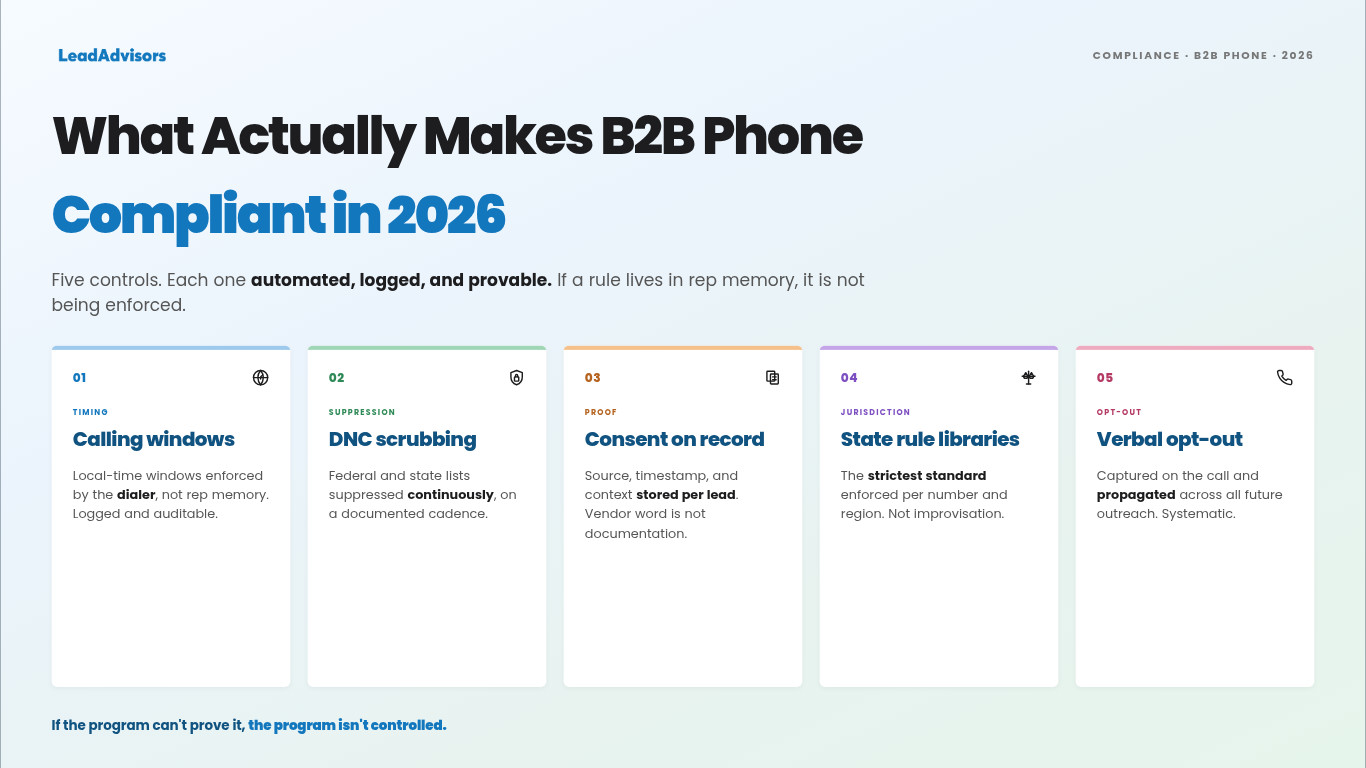
- Calling window enforcement. Build local-time calling windows into the dialer. If the rule is enforced by rep memory, it will not be enforced. Time zone logic needs to be automated, logged, and auditable.
- DNC suppression at both the federal and state levels. DNC list management is not a one-time scrub. It is a continuous suppression with a documented update cadence. If the program cannot prove when a list was scrubbed, it cannot prove the program is controlled.
- Consent documentation specific to your company. If you buy leads, you need the documentation. “The vendor said it is compliant” is not documentation. Store source, timestamp, and consent context on the record when consent is the basis for outreach.
- State-level rule enforcement. Multi-state dialing requires rule libraries, not improvisation. If your dialer cannot enforce the strictest applicable standard for a given number and region, you are relying on luck.
- Verbal opt-out capture. When a prospect opts out on a call, the opt-out needs to be captured and propagated across all future outreach. Opt-out control must be systematic, not manual.
What This Means Operationally
Phone outbound programs built for the pre-2025 environment often lack key controls. That creates risk at scale. In particular, multi-state dialing needs documented consent records where applicable, automated DNC suppression, local-time calling windows, state rule handling, and opt-out capture. Without those, the program is exposed.
Dialer Infrastructure: What Determines Whether Your Phone Motion Produces Conversations or Activity
Phone outbound performance is determined more by dialer infrastructure than by SDR talent. The same rep on the same list can produce radically different outputs depending on dialer mode, pacing rules, and answer detection.
For the broader tooling… see Sales Automation services.
Preview Dialer
Preview dialers show the prospect record before the dial. Reps research for 30 to 90 seconds, then initiate the call manually. Typical throughput is 40 to 60 dials per SDR per day. Preview is the best fit for Tier one, high-touch prospecting, where account context is the variable that wins. ACV justification is usually above $50,000. Below that, the research time compresses throughput enough that the unit economics break.
Power Dialer
Power dialers run sequential click-to-dial through a list with minimal research time. Typical throughput is 80 to 120 dials per SDR per day. Power dialers fit Tier two standard prospecting, where the sequence is the unit of effort, not the individual touch. ACV justification is commonly $10,000 to $50,000. This is the mode most B2B SaaS teams should default to when list quality and scripting are stable.
Predictive Dialer
Predictive dialers call multiple numbers simultaneously and route answered calls to available reps. Typical throughput is 150 to 250 dials per SDR per day, with the lowest research depth per call. Reps often have one to three seconds to orient before speaking. Predictive fits Tier three volume motions and high-volume appointment setting, where dial throughput matters more than account context. ACV justification is commonly below $10,000. TCPA risk is higher when the configuration results in dropped calls or poor controls.
Parallel Dialer (AI-Assisted)
Parallel or AI-assisted dialers are a newer category that resembles predictive dialers in throughput, but with smarter routing and machine detection. Many teams report 100 to 200 dials per SDR per day, with better connect quality than traditional predictive dialing, depending on configuration. These tools can fit ACVs from $15,000 to $75,000 when they increase qualified conversations rather than inflate activity. The category is evolving fast. Verify current capabilities against vendor documentation in 2026 before locking assumptions.
Match Dialer Mode to ACV and ICP, Not to Vendor Sales Pressure
The most common dialer mistake is picking the wrong mode for the economics. Predictive targeting of high-ACV Tier 1 accounts compromises conversation quality and reduces conversion rates. Previewing against low-ACV-volume motions compresses throughput and starves activity. The right dialer mode matches the per-call value to the per-call effort. A $5,000 ACV motion cannot afford 90 seconds of preview research. A $100,000 ACV motion cannot afford two seconds of orientation. For the sales-dialer infrastructure view, see Sales dialer setup and optimization.
For a deeper comparison, see predictive vs power vs preview dialers.
B2B Phone Outbound Benchmarks: What Good Looks Like in 2026
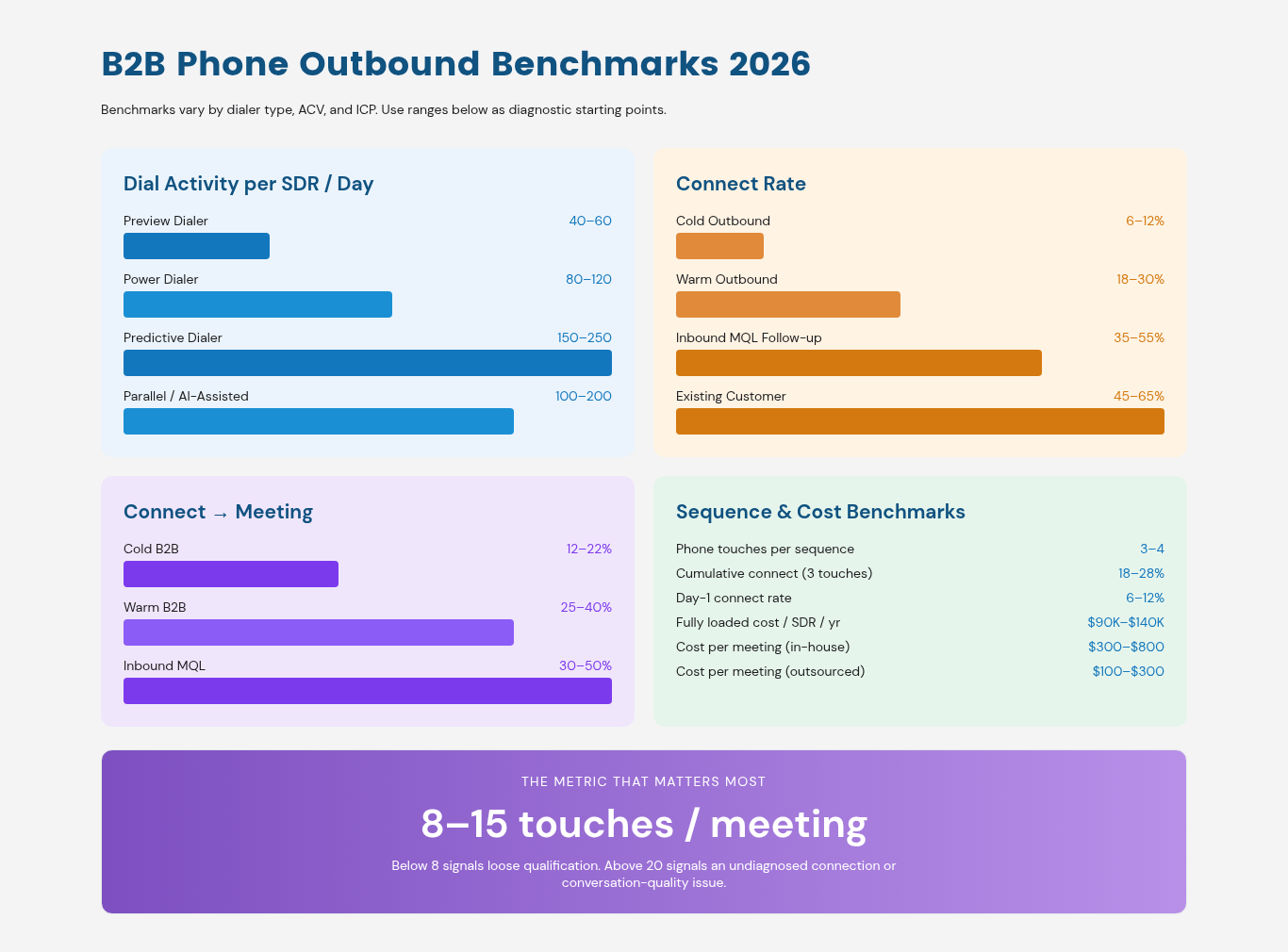
Phone-channel benchmarks vary by dialer type, ACV, and ICP. Use the ranges below as diagnostic starting points, then validate them against your vertical and your list quality.
Dial Activity Benchmarks per SDR per Day
- Preview dialer: 40 to 60 dials per day
- Power dialer: 80 to 120 dials per day
- Predictive dialer: 150 to 250 dials per day
- Parallel or AI-assisted dialer: 100 to 200 dials per day
Connect Rate Benchmarks
- Cold B2B outbound (no prior relationship): six to 12 percent
- Warm B2B outbound (prior touch, referral, or returning prospect): 18 to 30 percent
- Inbound MQL follow-up: 35 to 55 percent
- Existing customer outbound: 45 to 65 percent
If you want a system-level way to improve connects… see contact rate optimization.
Conversation Conversion Benchmarks (Connect to Meeting)
- Cold B2B connect-to-meeting: 12 to 22 percent
- Warm B2B connect-to-meeting: 25 to 40 percent
- Inbound MQL connect-to-meeting: 30 to 50 percent
Sequence Output Benchmarks
- Phone touches per SDR per sequence: three to four across a nine-touch multi-channel sequence
- Cumulative connect rate across three phone touches: 18 to 28 percent
- Single-touch phone connect rate (Day one): 6 to 12 percent
- Fully loaded cost per SDR per year: $90,000 to $140,000
- Cost per qualified meeting in-house: $300 to $800 at ACVs above $15,000
- Cost per qualified meeting outsourced: $100 to $300
The Phone-Specific Benchmark That Matters Most
Phone touches per meeting booked. A well-functioning phone motion produces one qualified meeting per eight to 15 phone touches across dial types. Below eight often signals loose qualification. A value above 20 usually signals a connection, list, or conversation-quality issue that the team has not diagnosed. The touches-per-meeting ratio is the cleanest leading indicator for phone-channel health.
Common B2B Phone Outbound Mistakes
Cost Benchmarks for B2B Phone Outbound
Five phone-specific mistakes consistently appear across underperforming B2B phone motions. They are distinct from the broader prospecting mistakes covered in /blog/outbound-prospecting/.
Mistake 1: Wrong Dialer Mode for the ACV and ICP
Dialer mode is an economic decision. Predictive against $50,000 ACV Tier 1 accounts compresses conversation quality and results in meetings that do not convert. Preview against $5,000 ACV-volume motions starve throughput. Match the dialer mode to the per-conversation value, not to vendor pressure.
Mistake 2: No Script Discipline or No Script Flexibility
Rigid scripts create robotic reps who cannot respond to signals. No scripts create inconsistency and missed conversion moments. The right structure is a documented call flow with required qualification questions and required commitment language, plus flexibility in the wording to keep reps human.
Mistake 3: No Conversation QA at Scale
Manual QA on 5 to 10 percent of calls yields sampled coaching that misses most patterns. Full-coverage QA, including AI-assisted QA where appropriate, produces consistent coaching on missed questions, weak commitments, objection handling, and compliance gaps.
For an ops-ready view… see AI-assisted call QA.
Mistake 4: Voicemail Drops Treated as Activity Instead of Conversion Infrastructure
Generic voicemails do not convert. Signal-specific voicemails sometimes do. If voicemail is not testable, it is noise. Standardize on one or two voicemail formats, track callbacks, and kill what does not move meetings forward.
Mistake 5: Speed-to-Lead Failure on Inbound MQLs
Inbound MQLs are the highest-intent call category in the funnel. Teams that prioritize outbound dialing while letting inbound sit in a 24-hour queue lose the most valuable conversations. The phone channel wins inbound when response time is measured in minutes, not hours. For the speed-to-lead breakdown, see Speed-to-lead.
Build an in-house phone outbound vs outsource to a B2B telemarketing partner
The choice between in-house and outsourced phone execution depends on ACV, stage, and management bandwidth. If you want a service-level view of what a managed program includes, see managed outbound calling and appointment setting.
If you want the role-level comparison… see B2B appointment setting and this guide to the appointment setter role.
Build in-house when
- ACV is above $25,000, and product complexity is high. Above this band, the per-conversation value justifies the investment in internal expertise.
- You have a real manager who can run the floor. Without floor management, in-house output collapses.
- Phone outbound is a strategic differentiator. If methodology and qualification depth are proprietary advantages, protect them.
Outsource when
- The phone motion is not validated. A 90-day program can test ICP and messaging before you commit to headcount.
- Management bandwidth is the constraint. Outsourced programs win when execution ownership exists outside your org chart.
- You need to test a new vertical or geography. Outsourcing is a faster validation loop.
- Compliance and QA infrastructure is the gap. If you do not have controls, you do not have a scalable program.
The hybrid model, most common at $3M to $15M ARR
In-house owns the ICP definition, script quality, and coaching. Outsourced execution provides phone-channel volume against the validated motion. This structure often produces the lowest cost per meeting at mid-market scale because strategy stays internal and execution scales externally.
What to look for in a B2B telemarketing partner
- Multi-channel sequencing capability (not phone-only)
- Documented compliance controls and opt-out handling
- QA coverage with weekly coaching outputs
- Reporting transparency by channel and ICP segment
- Contract structure that forces performance accountability
- Mid-engagement optimization, not “set and forget”
For related decision frameworks, see B2B sales outsourcing and the BPO services overview.
For cleaner reporting… use a documented outbound disposition taxonomy.
Frequently Asked Questions
Is B2B telemarketing still effective in 2026?
B2B telemarketing remains effective when executed as the phone-channel component of a multi-channel sequence rather than a standalone phone-only motion. Phone is still the highest-converting single-touch type in an outbound sequence. What changed since 2019 is the role the phone plays. It is the qualification channel within the system, not the volume channel running on its own. Programs that use the phone correctly produce a pipeline. Phone-only programs do not.
What’s the difference between B2B telemarketing and B2B cold calling?
The terms are used interchangeably in many teams. B2B cold calling usually refers to first-touch outbound calls to prospects without a prior relationship. B2B telemarketing typically refers to the broader phone function, including outbound follow-up, warm re-engagement, appointment setting, and inbound MQL handling. The operational requirements, dialer infrastructure, compliance, QA, and scripts apply to both.
How much does B2B telemarketing cost?
In-house costs often range from $90,000 to $140,000 per SDR per year, fully loaded, including salary, benefits, dialer, tools, and management overhead. The cost per qualified in-house meeting commonly ranges from $300 to $800 at ACVs above $15,000. Outsourced programs are often priced as monthly managed programs or per-meeting pricing, with many operators targeting $100 to $300 per qualified meeting, depending on ICP complexity and qualification depth.
What’s a good connect rate for B2B cold calling?
Cold B2B outbound connect rates are often in the 6-12% range in 2026. Warm outbound often lands in the 18 to 30 percent range. Inbound MQL follow-up can fall in the 35-55% range. The variable that moves the rate is sequence design and timing, not rep persistence on Day one.
When should a B2B company outsource outbound phone calls?
Outsource when the phone motion is not validated, and you need a 90-day test, when ACV is between $5,000 and $25,000, and management bandwidth is the constraint, when entering a new market where in-house ramp is slow, or when compliance and QA infrastructure requires expertise your team does not have. Built in-house above $10M ARR with a validated motion, ACV above $25,000, and an experienced sales development manager.
B2B telemarketing remains effective when executed as the phone-channel component of a multi-channel sequence rather than a standalone phone-only motion. Phone is still the highest-converting single-touch type in an outbound sequence. What changed since 2019 is the role the phone plays. It is the qualification channel within the system, not the volume channel running on its own. Programs that use the phone correctly produce a pipeline. Phone-only programs do not.
The terms are used interchangeably in many teams. B2B cold calling usually refers to first-touch outbound calls to prospects without a prior relationship. B2B telemarketing typically refers to the broader phone function, including outbound follow-up, warm re-engagement, appointment setting, and inbound MQL handling. The operational requirements, dialer infrastructure, compliance, QA, and scripts apply to both.
In-house costs often range from $90,000 to $140,000 per SDR per year, fully loaded, including salary, benefits, dialer, tools, and management overhead. The cost per qualified in-house meeting commonly ranges from $300 to $800 at ACVs above $15,000. Outsourced programs are often priced as monthly managed programs or per-meeting pricing, with many operators targeting $100 to $300 per qualified meeting, depending on ICP complexity and qualification depth.
Cold B2B outbound connect rates are often in the 6-12% range in 2026. Warm outbound often lands in the 18 to 30 percent range. Inbound MQL follow-up can fall in the 35-55% range. The variable that moves the rate is sequence design and timing, not rep persistence on Day one.
Outsource when the phone motion is not validated, and you need a 90-day test, when ACV is between $5,000 and $25,000, and management bandwidth is the constraint, when entering a new market where in-house ramp is slow, or when compliance and QA infrastructure requires expertise your team does not have. Built in-house above $10M ARR with a validated motion, ACV above $25,000, and an experienced sales development manager.
Conclusion
Phone works in B2B outbound when it sits inside a multi-channel sequence and runs on dialer infrastructure that matches ACV and ICP. The operators producing the pipeline are not the ones dialing harder. They are the ones who built the system, so the phone does what it is structurally best at, qualification depth that turns connects into meetings.
Compliance pressure increased in 2025. Most teams did not build the controls fast enough. That gap shows up later as program instability, vendor churn, and avoidable legal exposure.
The build-versus-outsource decision is stage math. It depends on ACV, team maturity, and whether you have floor management. If you want the strategic view of the full outbound system, including list building and sequencing, use the companion outbound prospecting guide.