
You spent $42,000 on leads last month. Contact rate: 11%. You switched vendors. New contact rate: 13%. Now you think outbound is broken.
It is not. In fact, the leads are fine. Your speed is the problem
MIT researchers tracked over 15,000 leads. They found that the odds of reaching someone drop by 10x after the first hour. By hour five, the lead is dead. Most floors call at hour three or four. Some wait until the next day. Then they blame the leads.
Speed-to-lead is the biggest lever that most sales floors do not track. This guide shows you the data behind the 5-minute rule.
- It explains why interest fades so fast.
- It breaks down what a real system looks like.
- It gives you a step-by-step audit.
- And it shows the exact math behind what slow response costs you.
No theory. No fluff. Just numbers and process.


What Is Speed-to-Lead?
Speed-to-lead is simple. It is the time between when someone fills out a form and when an agent makes the first call. You measure it in minutes or hours. It covers web forms, ad clicks, text replies, and inbound calls.
Here is what it is NOT:
- It is not the time from when you buy a lead to when you call. That adds delays on top.
- It is not the time for your first voicemail. A voicemail is a try, not a talk.
- It is not an average across all your leads. Averages hide the truth. A floor that calls 20% of leads fast and 80% at hour six looks okay on paper. It is not.
There are three numbers inside speed-to-lead. Most floors mix them up:
First-attempt speed is how quickly you dial after a lead comes in. This is what most people mean by speed-to-lead. The target is to keep online lead time under 5 minutes during work hours.
First-contact speed is how quickly you get a live person on the phone. This counts missed calls, wrong numbers, and voicemails. As a result, it can be much slower than the first attempt speed if your follow-up is weak.
Full cadence speed is how fast you run all your planned touches. Calls, texts, voicemails, and emails. This number shows if your floor runs a real system or tries hard.
Track all three. Most floors track none.
The Research – What the Data Says
The main study is from MIT. Dr. James Oldroyd tracked over 15,000 web leads and 100,000+ calls at six companies over three years. Harvard Business Review published the results in 2011. A survey from Northwestern’s Kellogg School covered 495 companies in 40+ industries. Both found the same thing: most companies are way too slow, even when they have the tools to be faster, according to the Lead Response Management study.
The Optifai Pipeline Study (2026) looked at CRM data from 939 companies. The GreetNow report (December 2025) reviewed 47 data points across industries. The results match the MIT study. In other words, nothing has gotten better.
Here is what the data shows:
Five minutes is a cliff. After 5 minutes, contact rates drop fast. By 30 minutes, the odds are a small fraction of what they were at the start. The steepest drop is in the first hour. Optifai and GreetNow data confirm this still holds. The average response time across all industries is now 47 hours.
More tries help, but only when they are fast. Floors that make 6+ call attempts reach far more leads than floors that make 1 to 3. But those tries need to happen in the first 24 to 72 hours. Spreading them over a week does not work.
Speed plus follow-through wins. Calling fast but quitting after one try does not work. Making six calls over two weeks does not work either. The best floors call in under 5 minutes and make six touches in 48 hours. The Blazeo 2026 report backs this up. Most leaders say fast response matters. But most of their own teams miss the mark.
LeadAdvisors sees the same pattern. Floors without a system land at a 5-12% contact rate. The same leads worked with a real setup – auto-dial, instant text, voicemail drop, 6-touch cadence – hit 25 to 40%.
As a result, that is a huge jump. A floor spending $40,000 a month on leads can go from 12% to 28% contact rate. It costs zero extra in ad spend. It just takes a better process.
Why Interest Fades So Fast
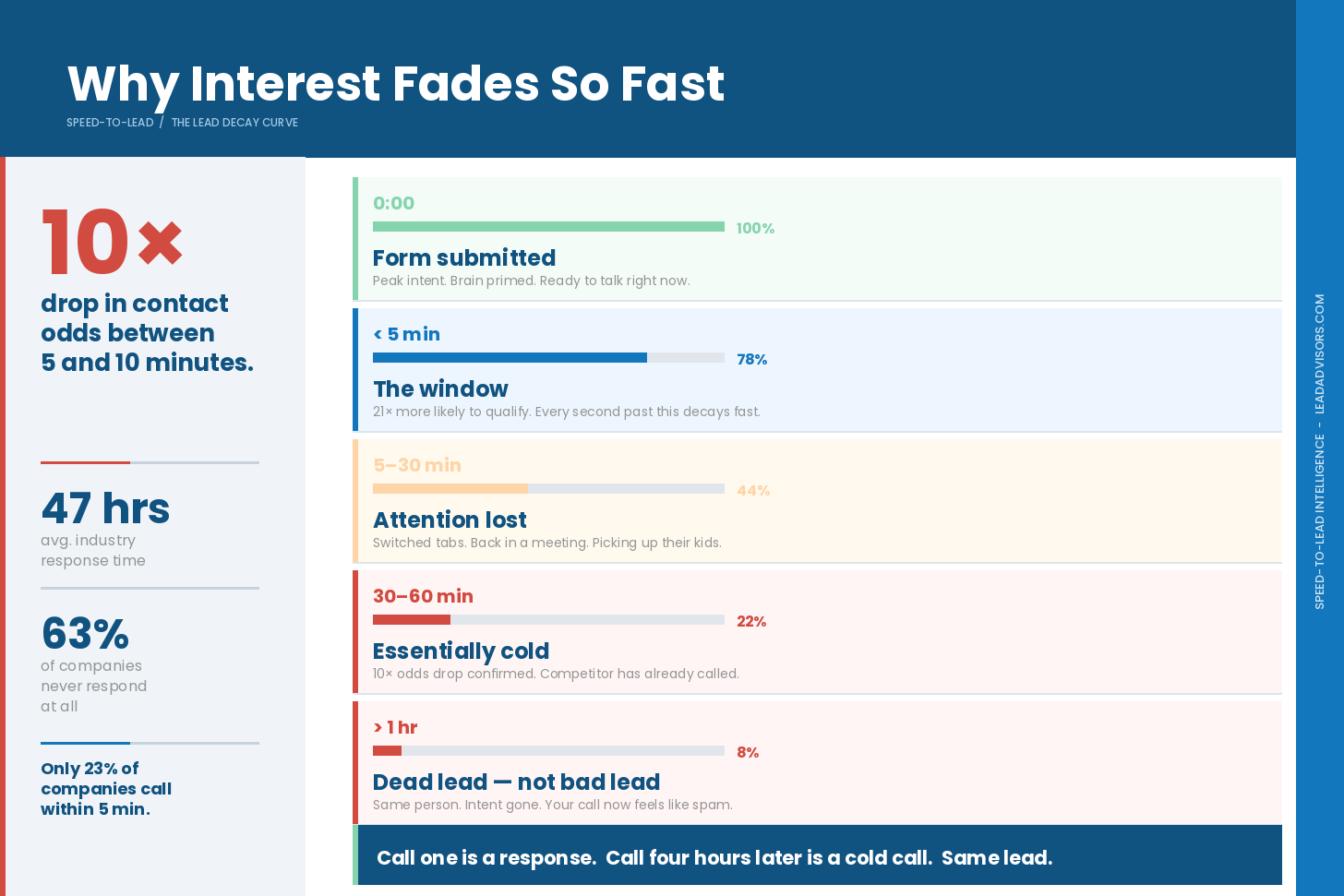
Every operator knows leads go cold. Most do not know why. Once you see the reason, fixing it becomes urgent.
The form fill is at peak interest. When someone asks for help with debt, a mortgage, or taxes, they are ready to talk right then. They chose to reach out. That feeling starts to fade the second they hit submit. They do not change their mind.
- Life gets in the way.
- They close the tab.
- They pick up their kids.
- They start dinner.
Consequently, four hours later, the feeling is gone. The person who was ready to talk is now annoyed by an unknown number.
A competitor has already called. In debt, tax, mortgage, and insurance, the same lead often goes to many buyers at once. If you call at hour four, someone else called at hour one. That prospect is now tired, wary, or signed up somewhere else. In other words, you are not fighting bad leads. You are fighting whoever called first.
The call loses meaning after a few hours. A call two minutes after a form fill makes sense. The person just asked for help. Someone is calling back. It feels natural. A call four hours later from an unknown number about a form they barely recall? That feels like spam. They have to think: what did I fill out? Why? Who is this? That mental work kills the talk before it starts. Call one is a response. Call two is a cold call. Same lead. Totally different outcome.
Texting raised the bar. People now expect fast replies to everything. Years of texting trained them. When someone fills out a form and gets no text within 60 seconds, it feels like the company doesn’t care. By the time a call comes hours later, that first impression is set. However, a quick auto-text changes this. It keeps the lead warm until an agent is free.
The Real Cost of Slow Response – The Math
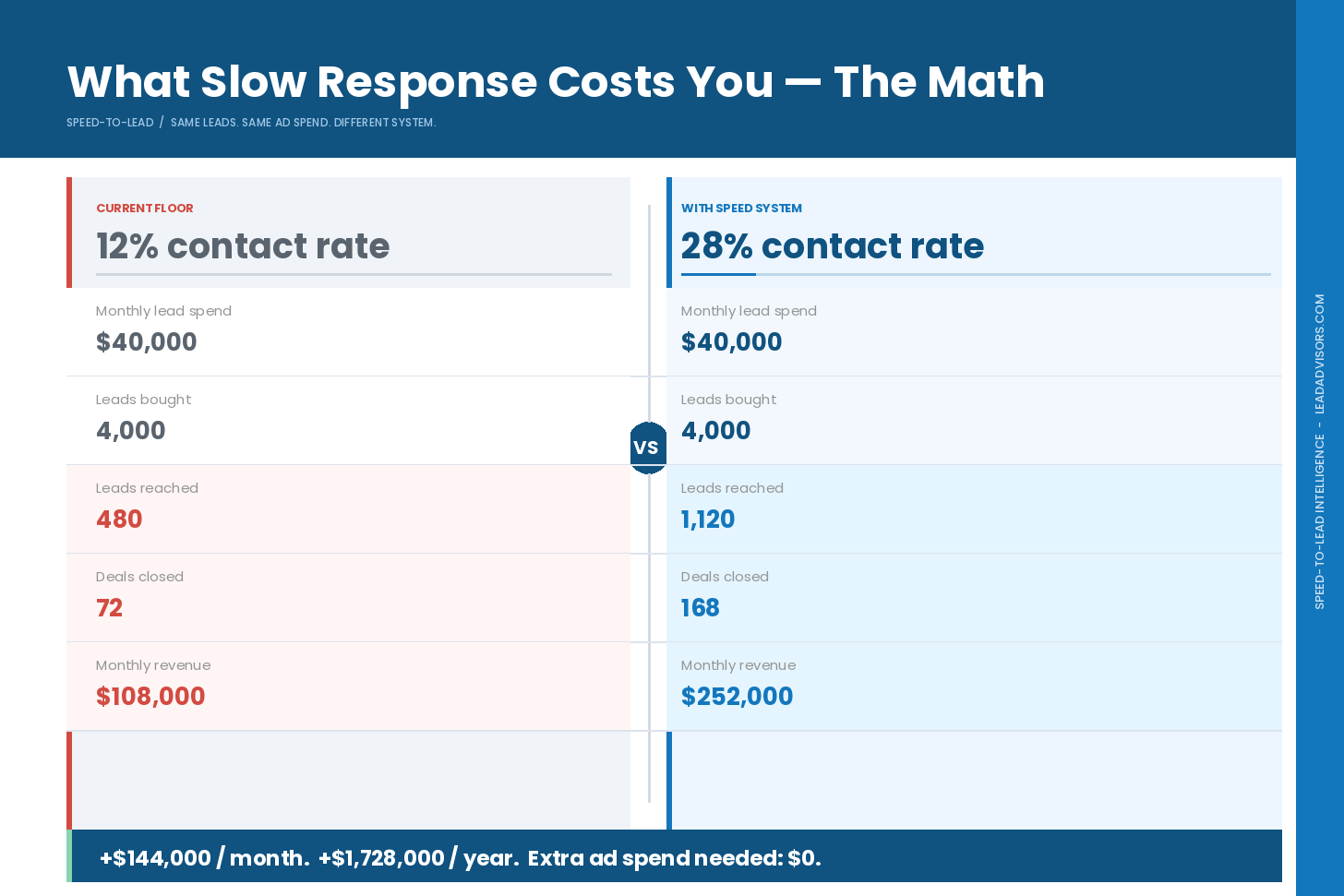
This is the part you send to your ops team. It turns “speed matters” into a dollar amount.
Baseline floor numbers:
| What | Number |
| Monthly lead spend | $40,000 |
| Cost per lead | $10 |
| Leads bought | 4,000 |
| Current contact rate | 12% |
| Leads reached | 480 |
| Close rate on reached leads | 15% |
| Deals closed per month | 72 |
| Revenue per close (debt settlement) | $1,500 |
| Monthly revenue | $108,000 |
Same floor with a speed-to-lead system:
| What | Number |
| Monthly lead spend | $40,000 (same) |
| Cost per lead | $10 (same) |
| Leads bought | 4,000 (same) |
| New contact rate | 28% |
| Leads reached | 1,120 |
| Close rate on reached leads | 15% (same) |
| Deals closed per month | 168 |
| Revenue per close | $1,500 (same) |
| Monthly revenue | $252,000 |
The gap:
- Extra closes per month: 96
- Extra monthly revenue: $144,000
- Extra yearly revenue: $1,728,000
- Extra ad spend needed: $0
The only change is how quickly and thoroughly the leads are worked.
- Same lead sources.
- Same ad budget.
- Same closers.
- The same $40,000 in lead spend makes $144,000 more per month with a real system.
Of course, these are sample numbers. Yours will differ. But the formula works with any inputs:
The formula: Money left on the table = (Target contact rate − Current contact rate) × Total leads × Close rate × Revenue per close. Plug in your own numbers. Most floors find the gap is bigger than they thought.
One more note: the close rate is held flat here on purpose. Furthermore, in real life, leads called faster also close at higher rates. The prospect is more ready. No competitor has set the tone. The true revenue gap is even wider than the math above.
Why Most Floors Are Slower Than They Think
The floors that need this fix the most are the ones that are most sure their timing is fine. Here is why.
The handoff delay. A lead hits the CRM. It sits in a queue. A supervisor assigns it in 20 minutes. The agent calls 45 minutes later. No one was slow on purpose. However, the total time is 65 minutes. That is 13x past the 5-minute mark. Auto-routing fixes this. The lead fires a dial the second it enters the system. No human step needed.
The timezone gap. A New York prospect fills out a form at 7:50 PM EST. Your floor closes at 5:00 PM PST, which is 8:00 PM EST. The lead sits all night. An agent calls at 9:00 AM PST the next day. That is noon EST. Response time: 16+ hours. The prospect asked for help before dinner. They heard back the next day after lunch. Because of this, if you run national campaigns, you need timezone-aware routing.
The “same day” trap. “Same day” can mean 2 minutes or 11 hours. The data does not care what day you called. Every extra minute lowers your odds. “Same day” as a goal hides the real numbers.
The one-call problem. A floor that calls once and marks the lead “worked” is not running speed-to-lead. One call to voicemail with no text and no follow-up is just one touch. The research is detailed: one touch is never enough, no matter how fast. Speed and follow-up are one system.
The blind spot. Most floors cannot tell you their speed-to-lead number. The CRM does not track the gap between when a lead came in and when someone dialed. They know they called. However, they do not know when. You cannot fix what you cannot see. For a broader look at how timing fits into a complete outbound prospecting strategy, see our full guide.
What a Real Speed-to-Lead System Looks Like
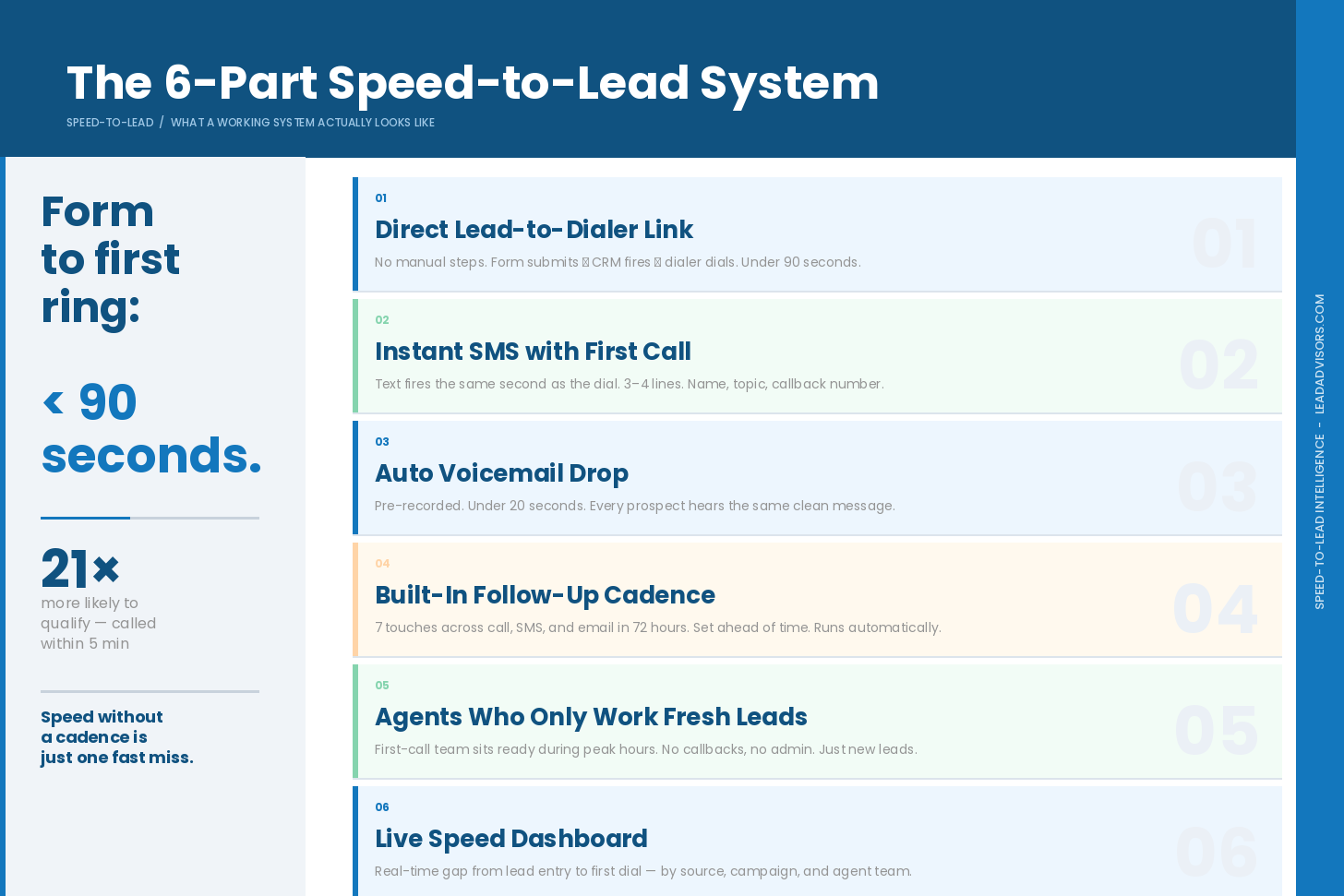
Here are the six parts of a working system. See what you have and what you are missing.
Part 1: Direct lead-to-dialer link
Leads must go straight from the source to the dialer. No manual steps. The form submits. The lead hits the CRM. The CRM fires the dialer. The dialer places the call. Total time from form to first ring: under 90 seconds.
In contrast, if your team gets leads by CSV, email, or spreadsheet and uploads them by hand, you will never hit the 5-minute mark. The process blocks it. The fix is not trying harder. It is fixing the setup.
Part 2: Instant text with the first call
The second the call goes out, a text should fire too. Keep it short. Three to four lines. Name your company. Say what they asked about. Give a callback number.
Specifically, the text does two things. First, the prospect sees it and knows who is calling. They are more likely to pick up. Second, if they miss the call, they can reply to the text. A text reply is a warm lead you can grab right away.
Part 3: Auto voicemail drop
If no one answers, drop a pre-recorded voicemail. The agent does not record one live. Keep it under 20 seconds. Mention what they asked about. Give a callback number. Use their first name if you have it. As a result, every prospect hears the same clean message, no matter which agent the system picked.
Part 4: Built-in follow-up plan
Leads that do not answer go into an auto sequence. Not reminders. Not the agent’s judgment. A real plan that spells out how many tries, how far apart, and on what channels.
Sample cadence for financial services leads:
- Try 1: Call + text (minute 0-5)
- Try 2: Call + voicemail drop (minute 30)
- Try 3: Call + text (hour 2)
- Try 4: Call (hour 5)
- Try 5: Call + text (day 2, morning)
- Try 6: Call + email (day 2, afternoon)
- Try 7: Call (day 3)
- Move to long-term nurture: Day 4+
This is not one-size-fits-all. Aged leads, warm referrals, and inbound calls each need their own plan. The key is the same: the plan is set ahead of time, runs on its own, and does not depend on the agent’s decisions. For a deeper look at what happens after Day 4, see our guide to lead nurturing automation.
Part 5: Agents who only work fresh leads
Speed-to-lead breaks when first-call agents also handle callbacks, inbound calls, and other tasks. The first-call job needs its own team. These agents sit ready during peak hours. Their only task is to grab new leads the instant they come in. Mixing fresh and old leads in one queue brings back the delays you built the system to fix. For floors using live transfer leads, separating first-touch agents from transfer closers is even more critical.
Part 6: Live speed dashboard
You need a dashboard that shows, in real time, how long it takes from lead entry to first dial. Break it out by lead source, campaign, and agent team. Without this, you will not spot slowdowns until they show up as a contact rate drop in next month’s report. That is four weeks too late.
Speed-to-Lead by Vertical – Why Timing Pressure Differs
The 5-minute rule applies everywhere. But the cost of missing it changes by vertical. It depends on how the prospect feels when they submit, how many competitors are chasing the same lead, and how fast the buying decision moves.
Debt Settlement
Debt almost always comes from a stress event. A collection call. A garnishment notice. A credit card bill that they cannot pay. A CFPB report found that nearly 1 in 13 consumers with a credit record had at least one account in debt settlement or credit counseling between 2007 and 2019, according to a CFPB consumer report. That is a massive market of people actively looking for help.
The moment they fill out a form, they are ready to talk. They want relief, and they want it explained now. Call them two minutes later, and they pick up. Call them five hours later, and the mood has shifted. By 3:00 PM, the person who was anxious and motivated at 10:15 AM has talked themselves out of it.
Tax Relief
Tax urgency runs on deadlines. Tax season (February through April) and IRS notice windows (30 days to respond) create short bursts where every competitor runs the same ads to the same people.
Shared leads in this vertical move fast. If a prospect had already enrolled with someone else before you called, that lead is gone. There is no second chance.
Mortgage and Refinance
Rate shoppers move quickly. A prospect who submits a refi inquiry at 10 AM is currently comparing lenders. By 2 PM, they have probably talked to two already. The first lender to call sets the rate expectation. Every call after that gets compared to the anchor. If you call at hour four, you are already behind.
Insurance
Open enrollment creates hard deadlines that do not wait for your floor. Prospects submitting during enrollment already know they need to decide. They have their own urgency. Your job is to show up in that window. Speed is the only thing that separates you from the next company.
Solar and Home Services
Seasonal events and weather drive submissions in clusters. A hail storm or a new incentive program creates a short burst of high-intent leads. These windows close faster than evergreen financial services inquiries. If you are slow, the moment passes.
How to Audit Your Floor’s Speed-to-Lead Performance
You have seen the data. You do not need more convincing. What you need is a way to find out how bad your current numbers actually are. Here is the process.
Step 1 – Pull your timestamp data
Open your CRM. Export three columns for every lead from the past 30 days: when the lead was created, when the first dial attempt happened, and when a live conversation occurred (if it did). If your CRM does not track the first dial attempt as its own field, that is your first problem. You cannot fix what you do not measure.
Step 2 – Calculate your median response time
Use the median. Not the average. A handful of instant auto-dials will pull your average down and hide the fact that most of your leads are getting called at hour three. The median tells you what the typical prospect actually experiences. While you are auditing, also benchmark your average handle time, as it directly affects how many fresh leads your agents can work per hour.
Step 3 – Segment by lead source and time of submission
Response times vary by source (internet vs. aged vs. inbound) and by when the lead came in. Leads submitted after 5 PM are almost always slower on every floor. Break the data apart. Find where the worst delays are. For example, an evening delay needs a different fix than a mid-day handoff delay.
Step 4 – Count total touches per unconverted lead
Pull 100 leads from the past 30 days that did not convert. Count how many contact attempts each one got. If the median is below four, your cadence problem is just as big as your speed problem.
Step 5 – Check your SMS coverage
How many leads got a text within 5 minutes of submitting? If you cannot answer that from your CRM data, your SMS is manual. Manual means inconsistent. Manual SMS is better than none. But only automated SMS scales.
Step 6 – Benchmark against your contact rate
Compare your response time data to your monthly contact rate by lead source. Leads that worked fastest should have higher contact rates. If you do not see that pattern, your tracking is too rough to spot the problem. Fix the tracking first. Everything else follows.
This audit takes 2 to 3 hours with clean CRM data. If the data is not clean, the audit itself shows you the gap.
Common Speed-to-Lead Mistakes – And What They Actually Cost
Most of these mistakes do not look like mistakes from the inside. They look like normal operations. That is what makes them expensive. Here are the five patterns that quietly kill contact rate on otherwise functional floors.
Mistake 1: Measuring average response time instead of median
Averages hide the truth. A few instant auto-dials pull the number down, while most leads sit for hours. As a result, the floor looks fast on paper. It is not. Track the median instead.
Mistake 2: Treating aged leads the same as internet leads
Fresh internet leads need a call within 5 minutes. Aged leads need something different. They are already days or weeks old. The play is structured around a high-frequency cadence in the first 48 hours after you buy the list. Not a single slow call that makes stale data even staler. Many floors get this backward. They call fresh leads slowly and burn through aged leads with no plan.
Mistake 3: Counting voicemails as contacts
A voicemail is not a contact. It is an attempt. If your floor reports 30% contact rate but counts voicemails, your real live conversation rate is much lower. Break your metrics apart: attempts, voicemails left, SMS sent, live conversations, qualified conversations. Each one has a different denominator. Misclassifying these also inflates your call abandonment rate, another hidden KPI most floors overlook.
Mistake 4: Building the cadence around agent availability instead of prospect behavior
Most cadences follow the agent’s schedule, not the prospect’s behavior. Leads that come in between 4 PM and 6 PM get called the next morning because the floor is closed. That is an ops problem, not a strategy. Fix it with extended hours for first-touch coverage. Use an offshore team for evening leads. Or set up automated SMS and voicemail drops that keep the lead warm until agents are back online.
Mistake 5: No SMS at all
If you only make calls, you are using one channel in a multi-channel world. Many prospects will not answer an unknown number. But they will reply to a text. A text reply is a warm re-engagement on the prospect’s terms. That is a completely different conversation from a cold pickup. Skipping SMS means a chunk of your workable leads never get contacted.
Speed-to-Lead and TCPA Compliance – What You Need to Know
Speed-to-lead and TCPA compliance are two different things. Mixing them up causes problems. Some floors move too slowly because they are overly cautious. Others move too fast without proper consent paperwork.
The FCC enforces the TCPA (47 U.S.C. § 227). It controls whether you can contact a prospect at all. That depends on how their information was collected and whether they gave proper consent for calls and texts under the TCPA rules. Speed-to-lead is separate. It controls how fast you act once you have that permission.
Critical 2025 update on one-to-one consent: In December 2023, the FCC passed a rule requiring one-to-one consent. Lead generators had to get written consent for each seller separately. This closed the “lead generator loophole.” But in 2025, the Eleventh Circuit Court of Appeals struck it down. The court ruled the FCC had overstepped. In August 2025, the FCC went back to its prior standard. The one-to-one rule is no longer in effect. Written consent with clear disclosure is still required. But sellers can again be grouped under a single consent form.
The FCC’s new opt-out rules require businesses to honor consent revocations sent “in any reasonable manner.” These originally took effect April 11, 2025. However, the FCC extended the deadline for the “revoke-all” provision for financial institutions and other affected businesses through at least early 2026. A further rulemaking is underway. Violations still carry statutory damages of $500 to $1,500 per call or text.
The bottom line: a properly consented lead can and should be called within 5 minutes. If the prospect filled out a form with clear disclosure naming your company, speed is not the compliance risk. Missing documentation is.
The operational takeaway: the faster your system dials new leads, the more critical it is to verify consent at the lead source level before the system fires. Automate the response. Do not automate the consent assumption.
Note: This section is informational context, not legal advice. Floor operators with TCPA exposure should consult qualified legal counsel regarding their specific lead acquisition and contact practices.
Frequently Asked Questions
What is speed-to-lead?
It is the time between when a prospect submits their information and when an agent makes the first call. In most outbound sales operations, it has a bigger impact on contact rate than lead source, lead quality, or script quality.
What is a good speed-to-lead time?
Under 5 minutes for internet leads during business hours. The MIT Lead Response Management study found that leads contacted within 5 minutes are 21 times more likely to qualify than those contacted at 30 minutes. The Optifai Pipeline Study (2026) supported this. Leads reached in under 5 minutes had a 32% close rate – 2.6 times higher than leads contacted after 24+ hours. Despite this, only 23% of companies respond within 5 minutes as of 2025-2026. And 78% of customers buy from whoever responds first. For leads that come in after hours, fire an automated SMS immediately and place the first call the moment your calling window opens.
Why does speed-to-lead matter so much?
Intent peaks at the moment of submission. It drops from there. The MIT study showed a 10x decline in contact rates between 5 and 10 minutes alone. Hours later, the prospect has moved on. Competitors may have already called. Your call feels like an interruption, not a response. The GreetNow 2025 report and Optifai 2026 study confirm the pattern still holds. The average response time across industries is 47 hours. 63% of companies never respond at all. A fast response catches the prospect while they still want to talk. Slow response means starting from scratch.
Does speed-to-lead apply to aged leads?
Yes, but the focus shifts. With aged leads, raw speed matters less. What matters is a concentrated multi-touch cadence. Deploy 6 to 8 contact attempts across call, SMS, and email within 48 to 72 hours of buying the list. Make the first call as early in the day as possible. But for data that is already days or weeks old, the cadence structure drives results more than the first-attempt speed.
How does speed-to-lead affect close rate?
It mainly affects contact rate – how many leads turn into live conversations. Close rate is measured against contacted leads, not total leads. Faster speed-to-lead means more conversations, not necessarily a higher close percentage. That said, prospects reached sooner tend to be in a higher-intent state. In practice, that often means modestly better close rates on the contacted pool, too.
Can I improve speed-to-lead without hiring more agents?
Partly. Automated routing, SMS, and voicemail drops work without any agent involvement. You can build a chunk of the first-touch system on automation alone. But a live conversation still requires a person. Automation handles the first 60 seconds. The agent handles the talk. If you do not have enough agents during peak submission hours, the contact rate will still suffer, no matter how good the automation is.
What is the difference between speed-to-lead and a dialing cadence?
Speed-to-lead is about the first call. How fast did you dial? A dialing cadence is the full sequence after that. How many attempts, how far apart, across which channels? You need both. Speed without a cadence means one fast call and then nothing. A cadence without speed means thorough follow-up on a lead whose interest has already faded. Once you do connect, the goal shifts to first call resolution, solving the prospect’s need in that single conversation.
It is the time between when a prospect submits their information and when an agent makes the first call. In most outbound sales operations, it has a bigger impact on contact rate than lead source, lead quality, or script quality.
Under 5 minutes for internet leads during business hours. The MIT Lead Response Management study found that leads contacted within 5 minutes are 21 times more likely to qualify than those contacted at 30 minutes. The Optifai Pipeline Study (2026) supported this. Leads reached in under 5 minutes had a 32% close rate – 2.6 times higher than leads contacted after 24+ hours. Despite this, only 23% of companies respond within 5 minutes as of 2025-2026. And 78% of customers buy from whoever responds first. For leads that come in after hours, fire an automated SMS immediately and place the first call the moment your calling window opens.
Intent peaks at the moment of submission. It drops from there. The MIT study showed a 10x decline in contact rates between 5 and 10 minutes alone. Hours later, the prospect has moved on. Competitors may have already called. Your call feels like an interruption, not a response. The GreetNow 2025 report and Optifai 2026 study confirm the pattern still holds. The average response time across industries is 47 hours. 63% of companies never respond at all. A fast response catches the prospect while they still want to talk. Slow response means starting from scratch.
Yes, but the focus shifts. With aged leads, raw speed matters less. What matters is a concentrated multi-touch cadence. Deploy 6 to 8 contact attempts across call, SMS, and email within 48 to 72 hours of buying the list. Make the first call as early in the day as possible. But for data that is already days or weeks old, the cadence structure drives results more than the first-attempt speed.
It mainly affects contact rate – how many leads turn into live conversations. Close rate is measured against contacted leads, not total leads. Faster speed-to-lead means more conversations, not necessarily a higher close percentage. That said, prospects reached sooner tend to be in a higher-intent state. In practice, that often means modestly better close rates on the contacted pool, too.
Partly. Automated routing, SMS, and voicemail drops work without any agent involvement. You can build a chunk of the first-touch system on automation alone. But a live conversation still requires a person. Automation handles the first 60 seconds. The agent handles the talk. If you do not have enough agents during peak submission hours, the contact rate will still suffer, no matter how good the automation is.
Speed-to-lead is about the first call. How fast did you dial? A dialing cadence is the full sequence after that. How many attempts, how far apart, across which channels? You need both. Speed without a cadence means one fast call and then nothing. A cadence without speed means thorough follow-up on a lead whose interest has already faded. Once you do connect, the goal shifts to first call resolution, solving the prospect’s need in that single conversation.
The Bottom Line
Speed-to-lead is not a theory. It is the single highest-leverage fix on most sales floors, and it costs nothing in extra ad spend.
The data is clear. Leads called within 5 minutes convert at 21x the rate of leads called at 30 minutes. The average floor calls at hour three. The average industry response time is 47 hours. Most floors do not even track the number.
If you read this far, you already know the gap exists. Here is what to do next:
Run the audit. Pull 30 days of CRM data. Calculate your median response time. Find out where the delays actually are.
Fix the biggest bottleneck first. For most floors, that is either the handoff delay (manual lead routing) or the lack of an automated first touch (no SMS, no voicemail drop).
Build the full system. Auto-routing, instant text, voicemail drop, a 7-touch cadence in 72 hours, dedicated first-call agents, and a live dashboard. That is the infrastructure that moves contact rate from 12% to 28% on the same leads.
The leads are not the problem. The speed is. Fix the speed, and the same budget produces a completely different result.