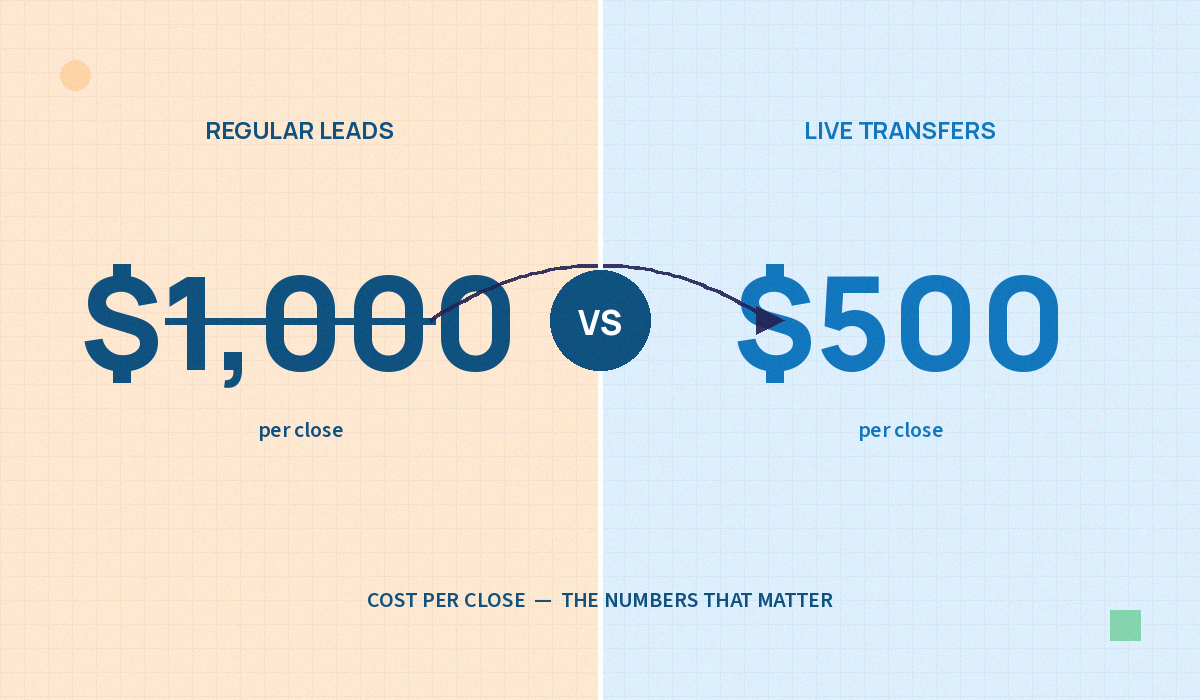
You’re paying $8-15 per internet lead. Contact rates sit at 18%. Your closers are idle half the day. They burn through bad numbers and voicemails. Then someone pitches you live transfer leads at 10x the cost – and you’re supposed to think that’s the better deal?
It might be. Not because of the cost per lead. Because of the cost per close.
We’ve facilitated over 3 million live transfers, and the pattern is always the same: warm prospects close faster.
Unbounce’s Conversion Benchmark Report puts the median website conversion rate at around 2.35%. Data from Salesfinity’s 2026 analysis of 3.5 million dials shows average cold call connect rates landing between 4% and 8%, depending on data quality. Our own data at LeadAdvisors shows live transfer campaigns converting at 15% to 30%, depending on the vertical and lead quality. That gap isn’t small. It’s a totally different sales motion.
At LeadAdvisors, our BPO Contact Strategy live transfer program is built on a simple premise: connect your closers only with prospects who are already engaged and ready to talk.
This article breaks down live transfer leads vs regular leads using the only thing that matters on a sales floor – the math. No fluff. No vendor spin. Just the numbers, the tradeoffs, and a framework to help you decide what belongs in your pipeline.

What’s the Difference? (Quick Definitions)
“Regular leads” covers internet form fills, aged data, pay-per-lead lists, and shared records. You buy them in bulk, load them into your dialer, and start working through the list. Most never pick up. The ones that do may not remember filling out a form three weeks ago.
Live transfers, also called live lead transfers or live call transfers, work differently. (For a full breakdown, see the ultimate guide to live transfer leads. A qualifying agent first talks to the prospect. They confirm intent and basic details. Then they hand the prospect off to your closer while the prospect remains on the line. The prospect is warm, pre-screened, and ready to talk. Both get called “leads.” The sales motion behind each is completely different.
The Metrics That Actually Determine Which Wins
Most floors compare live-transfer lead pricing to internet-lead CPL and stop there. That’s the wrong comparison. A $12 lead that never picks up costs more than an $85 transfer that closes.
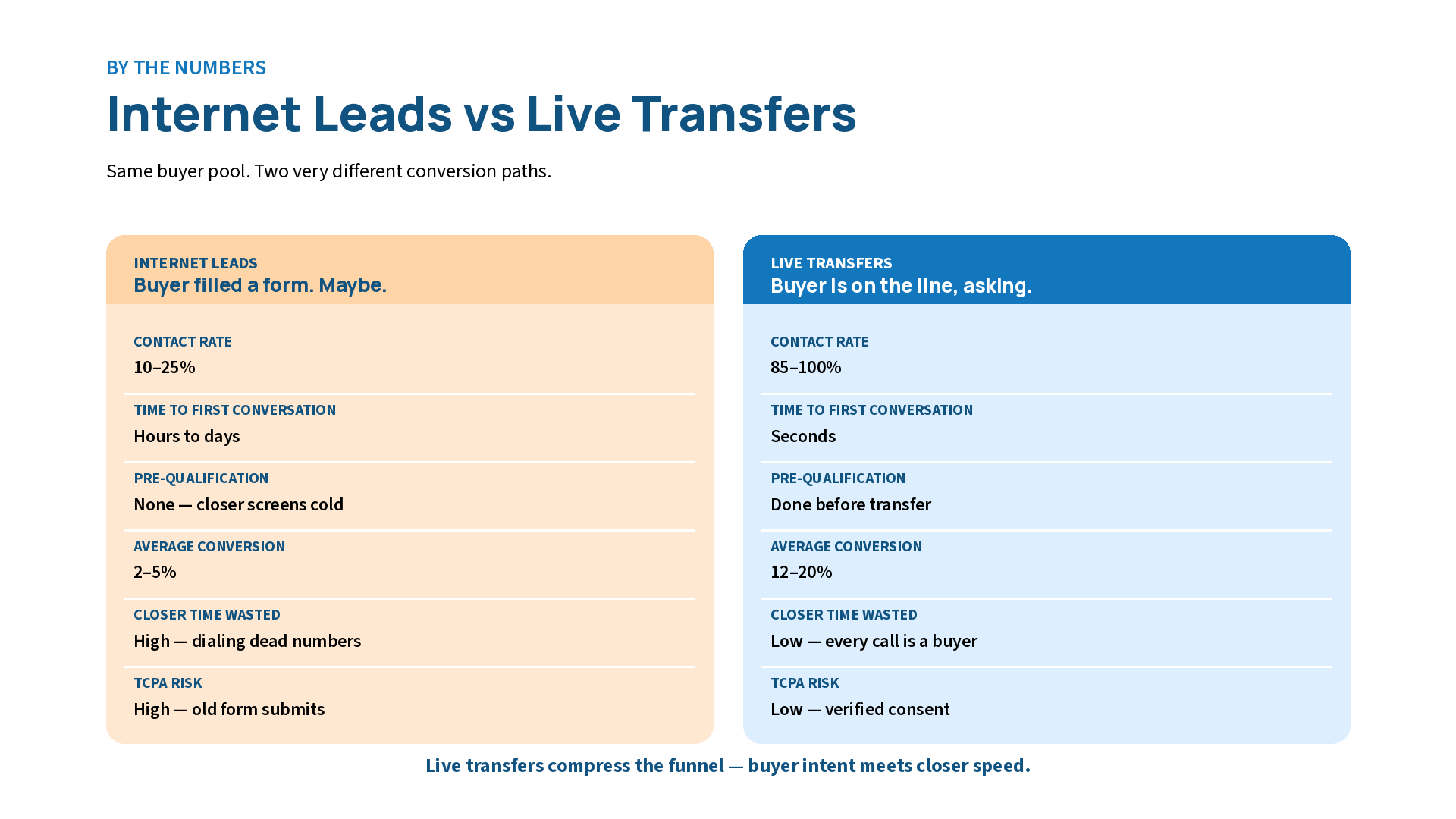
The metrics that matter are contact rate, qualification rate, closer utilization, and cost per close. Here’s how the two channels stack up:
| Metric | Internet / Aged Leads | Live Transfers |
| Contact Rate | 10-25% | 85-100% |
| Time to First Conversation | Hours to days | Immediate |
| Pre-qualification | None | Done before transfer |
| Closer Time Wasted on Bad Dials | High | Minimal |
| Speed-to-Pitch | Slow | Instant |
| Compliance Risk (TCPA) | Higher | Lower |
The Lead Response Management Study found that leads are 21x more likely to convert when contacted within five minutes. They’re 100x more likely to qualify than leads reached after 30 minutes. Teams that respond within 1 minute see up to a 391% increase in conversion rates. Live transfer calls deliver that speed by default. Your closers get real conversations, not voicemail loops. That alone changes the math on your floor – even before you factor in close rates.
The TCPA Compliance Advantage Nobody Talks About
This section is missing from every competitor comparison. Live transfers carry less TCPA risk than cold-dialing aged lists.
Why? The prospect either started the inquiry or gave clear consent during the qualifying call. The transfer is just the next step in that same conversation. It’s not a cold dial to a number that might be on a DNC list. There’s no gray area when it comes to consent.
The stakes have never been higher. TCPAWorld reports that TCPA lawsuits surged by nearly 95% in 2025 compared with the prior year. Class actions jumped 112% year-over-year. By early 2026, TCPA class action filings had quadrupled from just three years prior. February 2026 alone set a record with 211 new complaints. Research from ActiveProspect confirms that nearly 80% of all TCPA cases are now class actions.
A single TCPA violation carries a $500 penalty. Willful violations carry a penalty of up to $1,500 each. Class-action damages can reach the nine figures. For floors in debt settlement, tax relief, or mortgage, this compliance edge alone can justify the premium you pay for live lead transfers. It doesn’t remove all compliance duties. But it removes the riskiest part of the equation.
How to Calculate Your Real Cost Per Close (The Math)
This is the section that matters most. Forget CPL. Calculate your cost per close, and the comparison isn’t even close.
The formula:
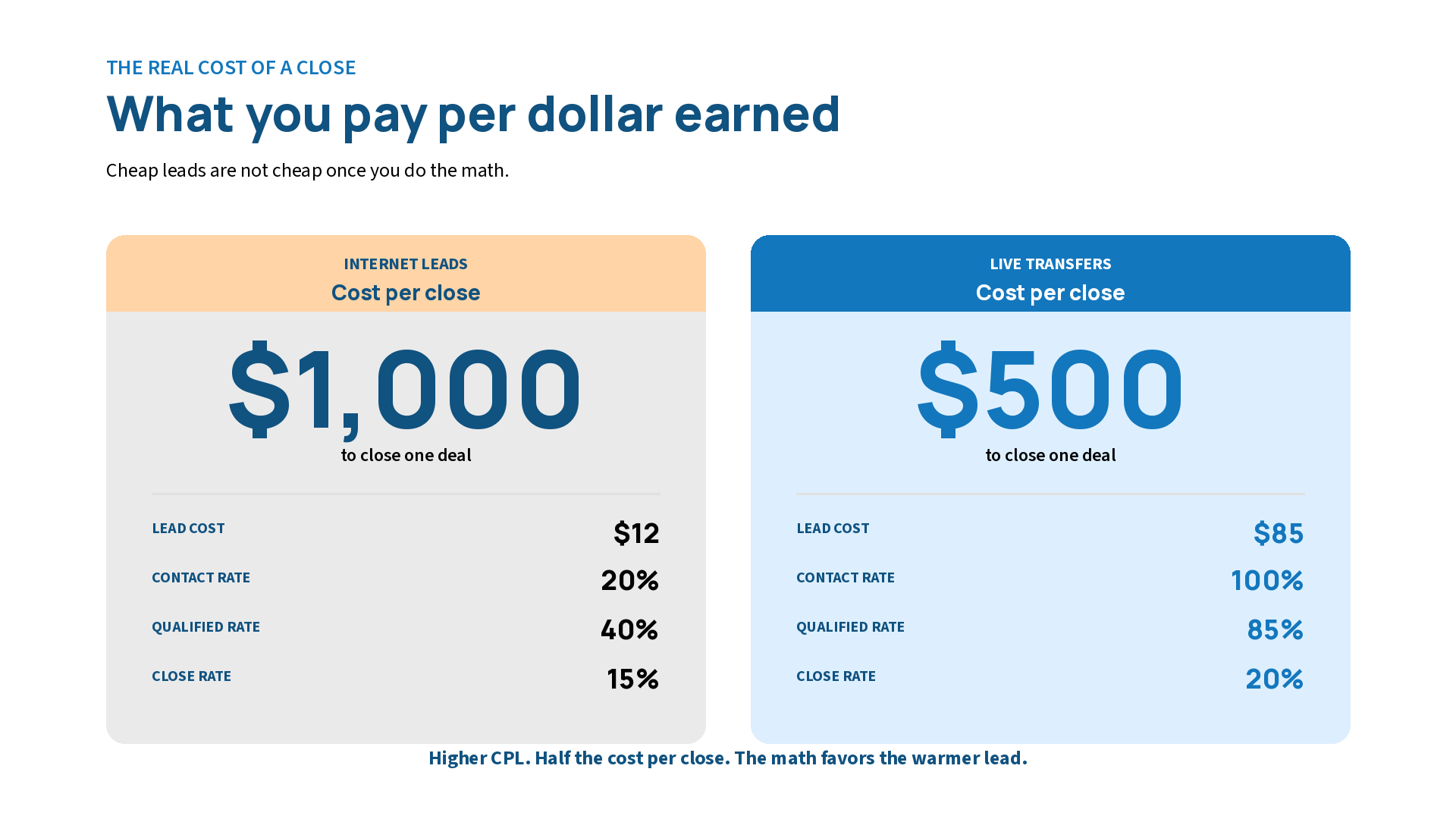
Cost Per Close = Cost Per Lead ÷ (Contact Rate × Qualification Rate × Close Rate)
Worked example – Internet Leads:
- CPL: $12
- Contact rate: 20%
- Qualification rate: 40% of contacts
- Close rate on qualified: 15%
- Cost per close = $12 ÷ (0.20 × 0.40 × 0.15) = $1,000
Worked example – Live Transfer Leads:
- Cost per transfer: $85
- Contact rate: 100% (they’re already on the line)
- Qualification rate: 85% (pre-screened, some still fall off)
- Close rate on qualified: 20% (warmer prospect, faster pitch)
- Cost per close = $85 ÷ (1.00 × 0.85 × 0.20) = $500
Your numbers will vary. Plug in your own rates. But the pattern holds: live transfers cost more per unit and less per close. That’s the math your ops team needs to see before picking a channel.
How Live Transfers Perform by Vertical
Not every live transfer lead performs the same. The math shifts based on vertical, ticket size, and how fast the prospect needs help. We’ve seen this firsthand across 3 million+ transfers. The verticals with the highest urgency and ticket size consistently see the biggest lift.
Debt Settlement: High ticket. High urgency. Prospects are in financial distress, so timing matters more than nurture. One close can cover dozens of transfer costs. This is where live lead transfers deliver the strongest ROI.
Tax Relief: Compliance-heavy with built-in IRS urgency. Prospect motivation runs high. Close rates on warm transfers beat aged data by a wide margin.
Mortgage / Refi: Rate-sensitive and competitive. Live transfers work best around trigger events like rate drops, refi windows, and pre-approval deadlines. Qualification criteria matter more here than in any other vertical.
Insurance, Real Estate, and Other Verticals
Insurance: Whether you’re buying auto, health, or life insurance leads, live transfers consistently produce a tighter cost-per-policy.
Industry benchmarks break down like this:
| Lead Type | Conversion to Policy | Cost Range |
| Shared leads | 2-5% | $10-30 |
| Exclusive leads | 5-10% | $20-60 |
| Live transfers | 12-20% | $60-200 |
For life insurance, exclusive leads cost $75-150. Live transfer life insurance leads run $80-200+ per transfer. Volume and closer capacity drive the profit.
The best live transfer insurance leads come from vendors who pre-qualify on coverage type, state, and budget – not just intent. Floors running auto insurance live transfer leads or health insurance live transfer leads should check qualification scripts and return policies closely. If you’ve seen mixed live transfer insurance leads reviews, the issue is almost always vendor quality – not the channel.
Real Estate: Live transfer real estate leads work best for teams that can take calls right away. Speed matters most in real estate. A five-minute delay can lose the deal.
Moving Services: Live transfer of moving leads and live transfers of moving leads are gaining ground. Moving companies want to cut wasted ad spend. The decision cycle is short. Prospects calling about a move are usually ready to book.
Personal Loans / MCA: Fast decision cycle. Live transfers speed up the pipeline. But the pre-qualification script has to be tight. A loose screen sends your closers bad prospects at a premium cost.
When Regular Leads Are Still the Right Call
Live transfers aren’t always the answer. Saying so is more honest than pretending otherwise.
Regular leads make more sense when:
- Budget is tight, and volume is the priority. You need 500 records to keep a dialer running. You can’t afford $85 per lead transfer. Internet leads keep the floor active.
- The product has a long nurture cycle. Some verticals like financial planning, B2B SaaS, and high-end real estate convert better through email and SMS sequences over weeks. Not a single phone call.
- You don’t have closers ready for real-time calls. Live transfer calls need someone to pick up right away. If your team isn’t staffed during calling hours, every transfer goes to waste.
- The ticket size doesn’t justify the cost. If your average deal value is under $500, the cost-per-close math may not favor live transfers unless your close rate is very high.
Why Live Transfers Fail (And How to Avoid It)
When floors say live transfers “didn’t work,” the problem is rarely the channel. It’s the setup.
The floor isn’t staffed for real-time calls. Transfers go to voicemail or sit on hold. The prospect hangs up. Fix it by scheduling closer shifts during your transfer window.
Your script isn’t built for a warm handoff. Your closer opens with a cold pitch when the prospect is already pre-sold. Rewrite the first 30 seconds. Acknowledge what the qualifying agent already covered.
The qualification bar is too low. The vendor sends anyone with a pulse. Tighten your requirements upfront. Set filters for minimum debt amount, state, income, or whatever matters in your vertical. Knowing which types of live transfer leads convert by qualification level helps you set tighter screens from day one.
There’s no return or credit policy. Bad transfers happen. Wrong number. Hang up before connection. Prospect is clearly not qualified. If your vendor doesn’t offer credits for bad transfers, find one that does.
When you read negative reviews or complaints about any live transfer lead provider, the root cause almost always traces back to one of these four issues.
Is Your Floor Ready for Live Transfers? A Quick Checklist
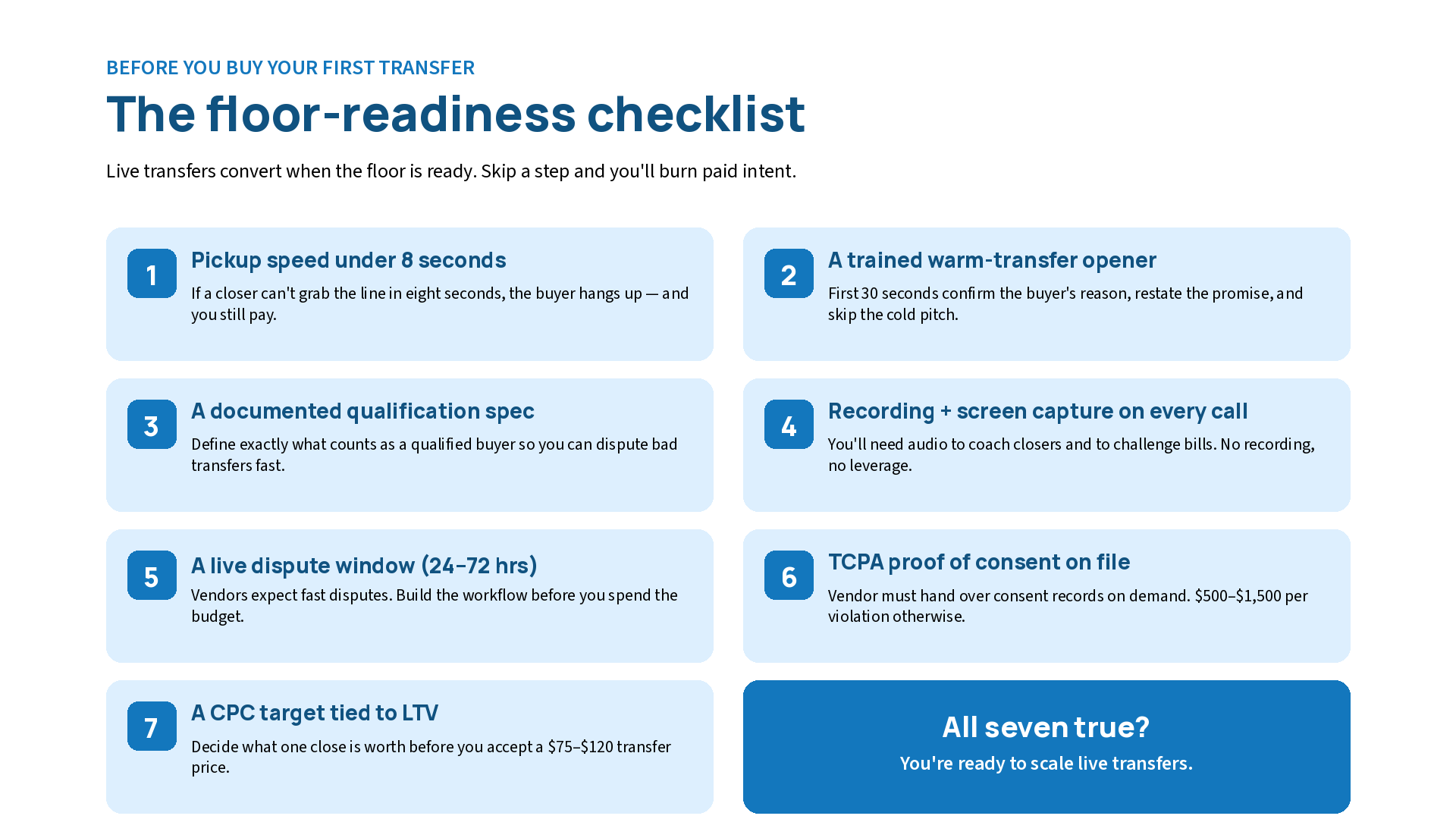
Before you commit budget, run through this quick check:
- [ ] Do you have closers available during standard calling hours (typically 8 am-8 pm EST)?
- [ ] Is your CRM set up to receive and log inbound warm calls?
- [ ] Do you have a closing script designed for a pre-qualified warm prospect (not a cold pitch)?
- [ ] Can you commit to a minimum daily or weekly volume to make a test campaign viable?
- [ ] Do you have a QA process to review calls and flag bad transfers?
- [ ] Is your vertical high-ticket enough that one close justifies 4-6 transfers?
- [ ] Do you have a system to track cost per close separately from cost per lead?
If you checked most of these, you’re ready to test. If not, fix the gaps first. Launching live transfers on a floor that isn’t ready is the fastest way to waste budget and write off the channel too early.
The Hybrid Approach – Running Both Channels
Most mature floors don’t pick one or the other. They run both. The key is to segment by closer tier, vertical, and floor capacity.
Early-stage floor (< 10 closers): Start with internet leads. Build your nurture system and train new closers. Add live transfers only for top performers on your highest-ticket vertical.
Growth-stage floor (10-40 closers): Split your team. Tier 1 closers take only live transfer calls. Tier 2 works on internet leads and re-engagement campaigns. Track CPA by tier each month. Shift budget based on results.
Enterprise floor (40+ closers): Run the full channel stack. Live transfers for primary conversion. Aged and internet leads for nurture and rehash. AI-powered drip for unconverted transfer follow-ups.
The key to running both is separate tracking, separate closer assignments, and separate KPIs. The moment you blend the data, you lose sight of what’s working. For a closer look at how to set this up, see how to build the best live transfer campaign.