Online retail has changed rapidly over the past 18 months. Paid ad costs keep going up. Google Shopping returns keep dropping. Meanwhile, ecommerce continues to grow as a share of U.S. retail. The Quarterly Retail E-Commerce Sales reports from the U.S. Census Bureau confirm the trend. So the fight for organic search visibility has gotten harder, not easier.
Most ecommerce founders know organic search is the long-term answer. However, three questions still stump them. First, what does an ecommerce SEO project include? Second, what should it cost in 2026? Third, how do you spot a real provider from one that sells reports?
This guide answers all three. First, we define the scope at each service tier. Next, we map current US pricing. Finally, we list the eight signs that predict real results. Every claim ties to research from the US government, academic, or industry sources from late 2025 to 2026.

What Makes Ecommerce SEO Different From Standard SEO
Ecommerce SEO differs from standard SEO in three ways. First, the site structure is more complex. Second, the keyword plan needs more layers. Third, revenue tracking matters more. Standard sites have hundreds of pages. Ecommerce sites have hundreds of thousands of product URLs. That scale changes everything. So the tech stack, the keyword plan, and the reports all work differently.
Four structural differences shape every ecommerce SEO engagement in 2026.
Scale of page count. Crawl budget and faceted navigation only become problems at scale in large catalogs. For example, research on web standards from the World Wide Web Consortium shows that crawl efficiency drops sharply once URL combinations exceed Google’s budget.
Transaction-intent keyword architecture. Three keyword layers must work together. Category pages target commercial queries. Product pages target long-tail buying queries. Meanwhile, blog content targets info queries that build topic authority. Without a plan, these layers compete for the same traffic.
Revenue tracking complexity. Ecommerce SEO tracks sales, not lead forms. For example, Census Bureau data through 2026 shows that most revenue comes from a small set of landing pages. Therefore, per-page revenue tracking is a must.
Seasonal and inventory shifts. Search demand changes with the season and with stock levels. Therefore, any plan that ignores these shifts will fall short.
What Ecommerce SEO Services Actually Include
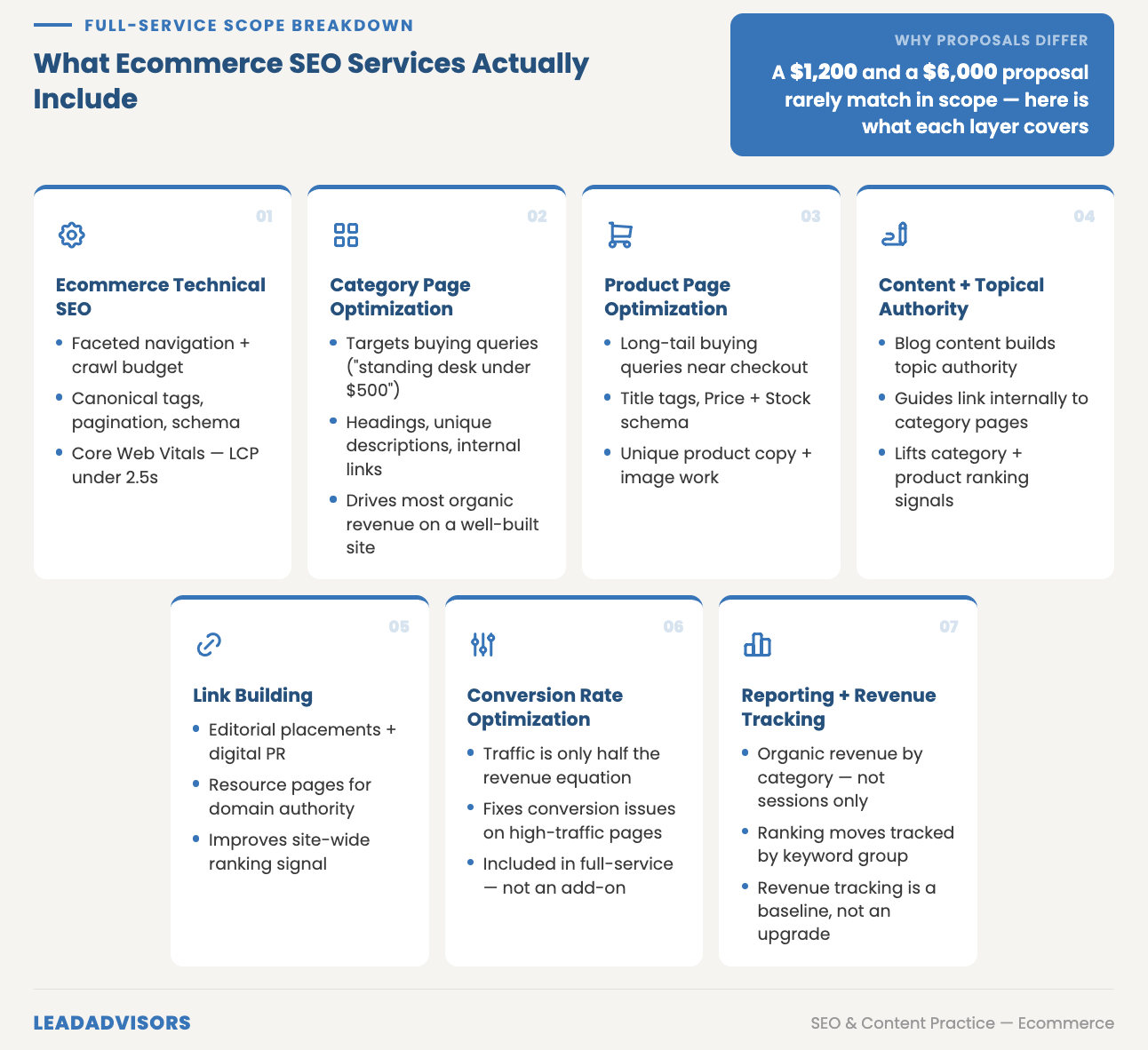
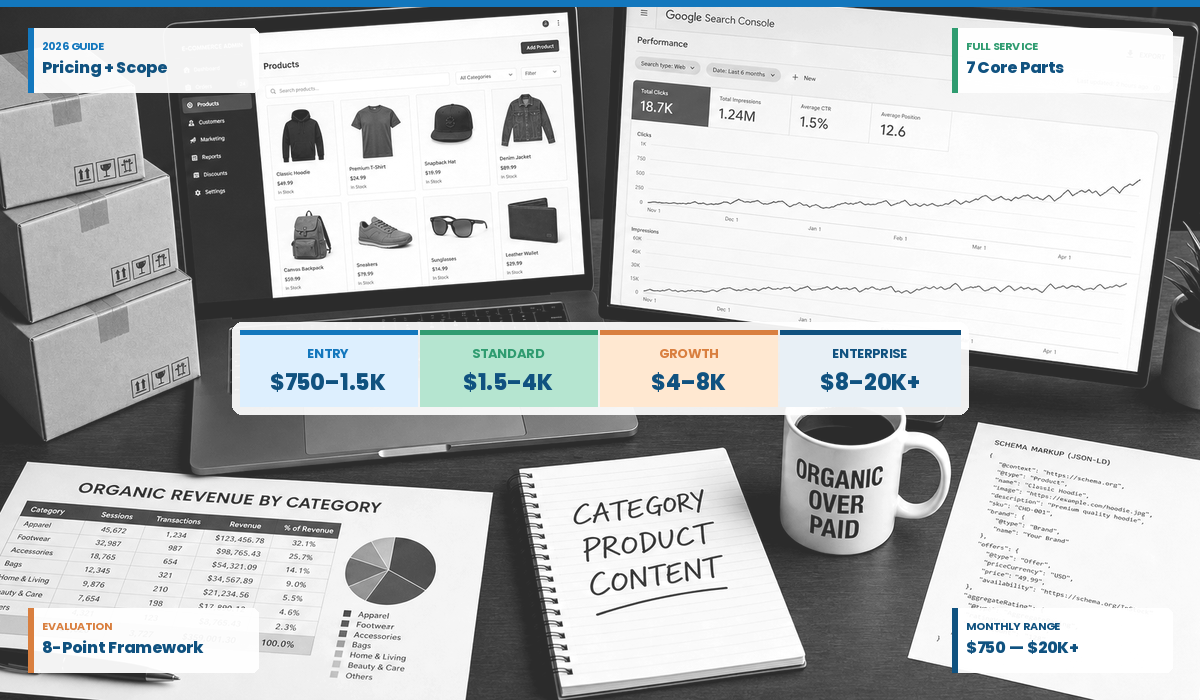
A full-service ecommerce SEO plan covers seven parts. So a $1,200 proposal and a $6,000 proposal rarely match in scope. Here is what each part covers.
Ecommerce technical SEO services. This layer covers faceted navigation, crawl budget, pagination, canonical tags, schema, and Core Web Vitals. For example, 2026 Core Web Vitals guidance from Web.dev shows that slow page loads hurt sales. Plus, mobile commerce research from the MIT Sloan School of Management confirms the same. A Largest Contentful Paint above 2.5 seconds drops mobile conversion rates.
Category page optimization. Category pages drive most of the organic revenue on a well-built site. They target buying queries like “women’s running shoes” or “standing desk under $500.” For example, the work covers headings, unique descriptions, internal links, and schema.
Product page optimization. Product pages target long-tail buying queries. They convert better than category pages because buyers are close to the checkout process. Therefore, this layer covers title tags, Price and Stock schema, unique product copy, and image work.
Content and topical authority. Blog content builds topic authority that lifts category and product page rankings. For example, a guide on “best standing desks for home offices” links to the standing desk category page. That internal link passes relevance and lifts the category’s ranking signal.
Link building. This layer builds domain authority through editorial placements, digital PR, and resource pages. The goal is to improve the site’s overall ranking signal, not just one page at a time.
Conversion rate optimization. Traffic is only half of the revenue equation. Therefore, the full-service tier also fixes conversion issues on high-traffic organic landing pages.
Reporting and revenue tracking. Monthly reports must show organic revenue by category, ranking moves by keyword group, and the work done that month. Reports that only show sessions and keyword counts are not ecommerce SEO reports. For example, the 2026 Pew Research Center digital consumer studies show that more buyers start their searches on organic search results. Therefore, revenue tracking is a baseline, not an upgrade.
Ecommerce SEO Services Pricing in 2026
Ecommerce SEO pricing changes with catalog size, competition, and scope. The ranges below reflect U.S. market data from late 2025 and 2026.
| Tier | Site scale | What is included | Monthly range |
| Entry | Up to 500 product pages | Technical audit, basic on-page, Google Business Profile (if applicable), and monthly reporting | $750–$1,500 |
| Standard | 500–5,000 product pages | Technical + category page optimization + 2–4 content pieces/month | $1,500–$4,000 |
| Growth | 5,000–50,000 product pages | Full technical + category + product page templates + content + link building | $4,000–$8,000 |
| Enterprise | 50,000+ product pages or multi-region | Full-stack, including international SEO, crawl architecture management, and PR-led link building | $8,000–$20,000+ |
Platform factors that affect pricing.
Shopify has URL and canonical issues on collection and product pages. Experienced Shopify agencies build the fixes into their standard process. However, new-to-Shopify agencies find these issues mid-project and bill them as extra scope.
WooCommerce is more flexible but needs more hands-on work. It also requires plugin setup, database tuning, and product category management. For example, industry research from 2026 ranks large WooCommerce catalogs among the most demanding SEO setups in the U.S. market.
What drives the price gap? Three factors explain most of the gap between a $1,500 and an $8,000 retainer. First, catalog size. A 200-page Shopify store is easy to manage. However, a 50,000-page catalog requires automation tools that small agencies can’t keep up with. Second, content output. Topic authority doesn’t build quickly without steady monthly content, third, link-building speed. High-competition niches need active link work. Meanwhile, low-competition niches may rank solely on content.
Project-based options. Some agencies also offer one-time projects. For example, a single ecommerce SEO audit runs $2,000 to $8,000. A category page sprint covering 20 to 50 pages runs $5,000 to $15,000. Plus, a 12-month content plan package runs $3,000 to $8,000. These options fit when your in-house team can run the work but needs outside strategy.
In-House vs Agency vs Freelance — The Fully-Loaded Cost Comparison
Most ecommerce founders compare a monthly agency fee to a freelancer’s hourly rate. However, that view overlooks the costs of management, tooling, and coordination. So the real gap shows up there.
| Model | Hard cost | Hidden costs | Fully-loaded monthly |
| In-house SEO specialist ($75K salary) | $6,250/mo | Payroll tax, benefits, tools, and management add about 70% | $10,600–$11,500/mo |
| Freelance SEO consultant ($125/hr, 10 hrs/mo) | $1,250/mo | No content, no link building, no technical implementation; client provides all | $1,250 + internal ops cost |
| Per-deliverable freelancer stack (consultant + writer + link builder) | $2,000–$4,500/mo | Coordination overhead, quality inconsistency, and no unified strategy | $2,500–$6,000/mo |
| Ecommerce SEO agency (standard tier) | $2,500–$5,000/mo | All-in: strategy, technical, content, link building, reporting | $2,500–$5,000/mo |
The in-house model costs more than the salary alone. For example, data from the U.S. Bureau of Labor Statistics Employer Costs for Employee Compensation series shows that full pay runs 30 to 45 percent above base for marketing roles. That gap covers payroll tax, benefits, time off, and overhead. A $75,000 SEO hire in a mid-cost market costs $105,000 to $115,000 per year. That is before tools, training, and management time.
For that same spend, a mid-market agency gives you a four-role team. That team has a strategist, a tech specialist, a writer, and a link builder. Therefore, the agency’s edge lies in the depth of its skills, not in headcount.
The freelance stack looks cheaper only if you value the cost of managing three to five contractors at zero. In real life, that cost is never zero. For example, 2026 case studies show that quality gaps, scheduling issues, and missing strategy all show up in freelance-stack projects.
The 8-Point Ecommerce SEO Evaluation Framework
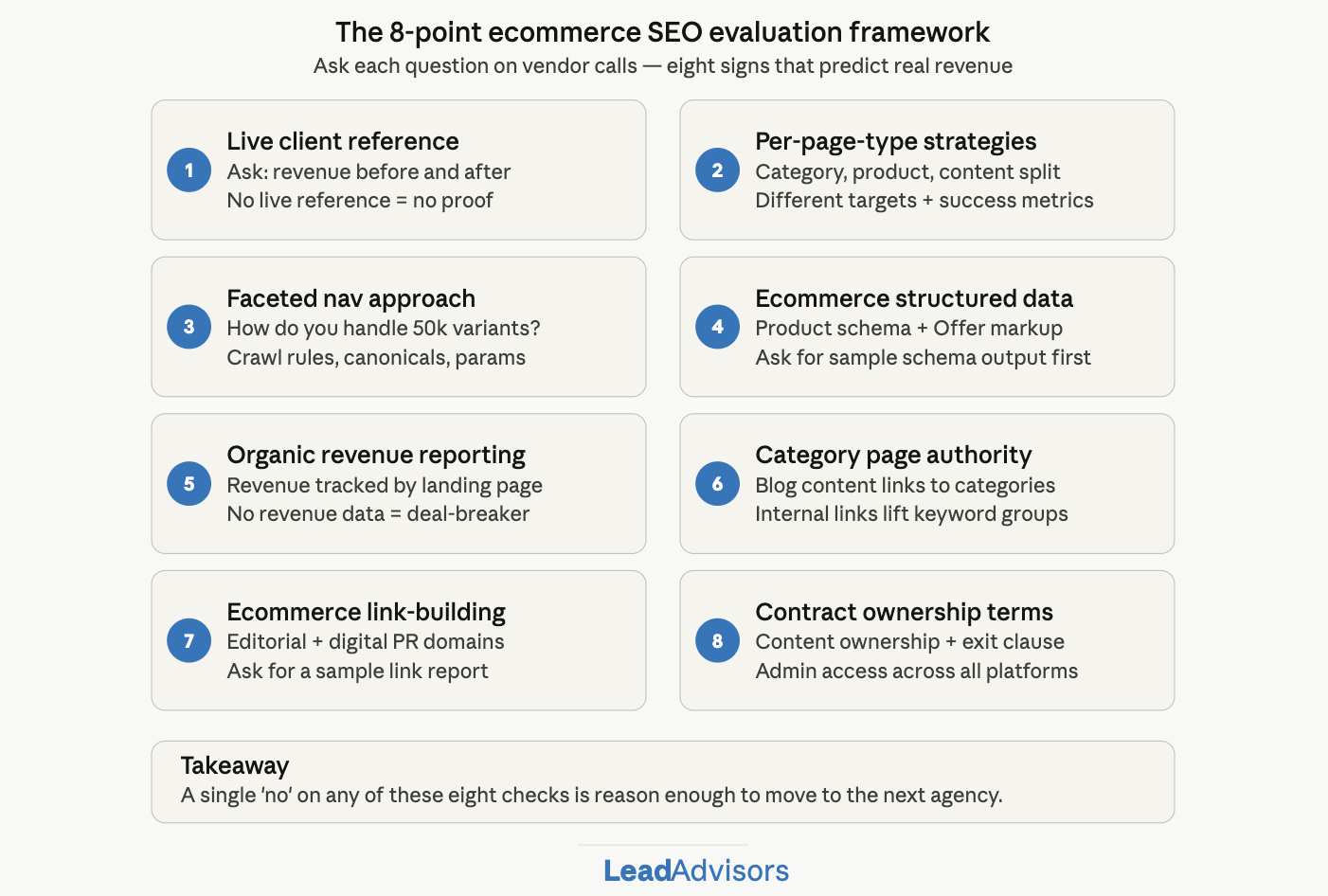
The eight signs below predict real revenue results better than any other check in the 2026 case studies. Ask each one a question during your vendor calls.
1. Can they put a live ecommerce client reference on the phone?
Ask for a named client reference who will take a call. Then ask that person three things. First, what did organic revenue look like before the work? Second, what does it look like now? Third, how long did the change take? If no live reference shows up, the agency has not proven ecommerce SEO experience.
2. Does the proposal address category, product, and content SEO separately?
A proposal that treats all ecommerce pages the same is a generic SEO plan in disguise. Therefore, look for three different page-type strategies in the proposal. For example, you should see different keyword targets, different content plans, and different success metrics.
3. Have they documented their approach to faceted navigation and duplicate content?
Ask this: how would you handle faceted navigation on a 50,000-variant catalog? A vague answer means they have not solved this at scale before. However, a specific answer is a strong sign. For example, look for clear talk about crawl rules, canonical setup, and parameter handling.
4. Do they produce ecommerce-specific structured data?
Product schema, Review schema, BreadcrumbList, and Offer markup all unlock rich results in Google search. Therefore, ask to see a sample of the schema output before you sign.
5. Does their monthly reporting include organic revenue by category?
Ask for a sample monthly report before you sign. The base bar is revenue tracking by landing page. If the report does not show organic revenue, the agency has not set up GA4 ecommerce tracking well. Therefore, that gap is a deal-breaker.
6. Does their content strategy build category page authority?
Ask how blog content supports category page rankings. A strong answer maps out an internal linking plan. For example, info content links to category pages, which builds a topic signal that lifts the whole keyword group.
7. Does their link-building methodology fit ecommerce?
Ecommerce link building uses tactics different from those in B2B link building. For example, the right tactics include editorial spots in consumer media, digital PR around product launches, and resource page placements on related sites. Therefore, ask for a sample link report showing the exact domains used.
8. Does the contract protect content ownership and platform access?
Three contract terms are non-negotiable. First, upon delivery, you own all content created for the project. Second, you keep admin access to platforms like Google Search Console, GA4, and rank trackers. Third, you never sign a yearly deal without a performance escape clause.
Platform-Specific Considerations — Shopify, WooCommerce, and Magento
Platform experience predicts ecommerce SEO success better than general SEO skills alone. Three platform patterns matter most.
Shopify SEO. Shopify’s /collections/ and /products/ URLs cause canonicalization issues when products appear in multiple collections. Therefore, your agency needs a written canonical plan before the project starts. Plus, Shopify’s JavaScript storefront stresses Core Web Vitals on product pages. For example, Google’s 2026 Core Web Vitals research links LCP to both rankings and sales.
WooCommerce SEO. WooCommerce on WordPress is the most flexible ecommerce platform. However, that flexibility makes it the hardest to optimize at scale. For example, product taxonomies, custom attributes, and WordPress archive pages all need careful setup. Otherwise, Google will index thousands of thin pages. Therefore, large WooCommerce sites need an agency with proven WordPress chops.
Magento and Adobe Commerce SEO. Magento is the most complex of the three platforms. It also creates the biggest technical SEO surface area. For example, faceted navigation, crawl budget across large catalogs, and layered navigation all pose issues in Magento. Therefore, agencies with Magento skills usually charge 20 to 40 percent more than standard rates because the work needs senior-level hands.
Practical takeaway. Before you shortlist any ecommerce SEO agency, check that they have current or recent clients on the same platform you run. Platform experience is not a bonus. It is a must-have so you do not pay for their learning curve.
What to Expect — The Realistic Ecommerce SEO Timeline
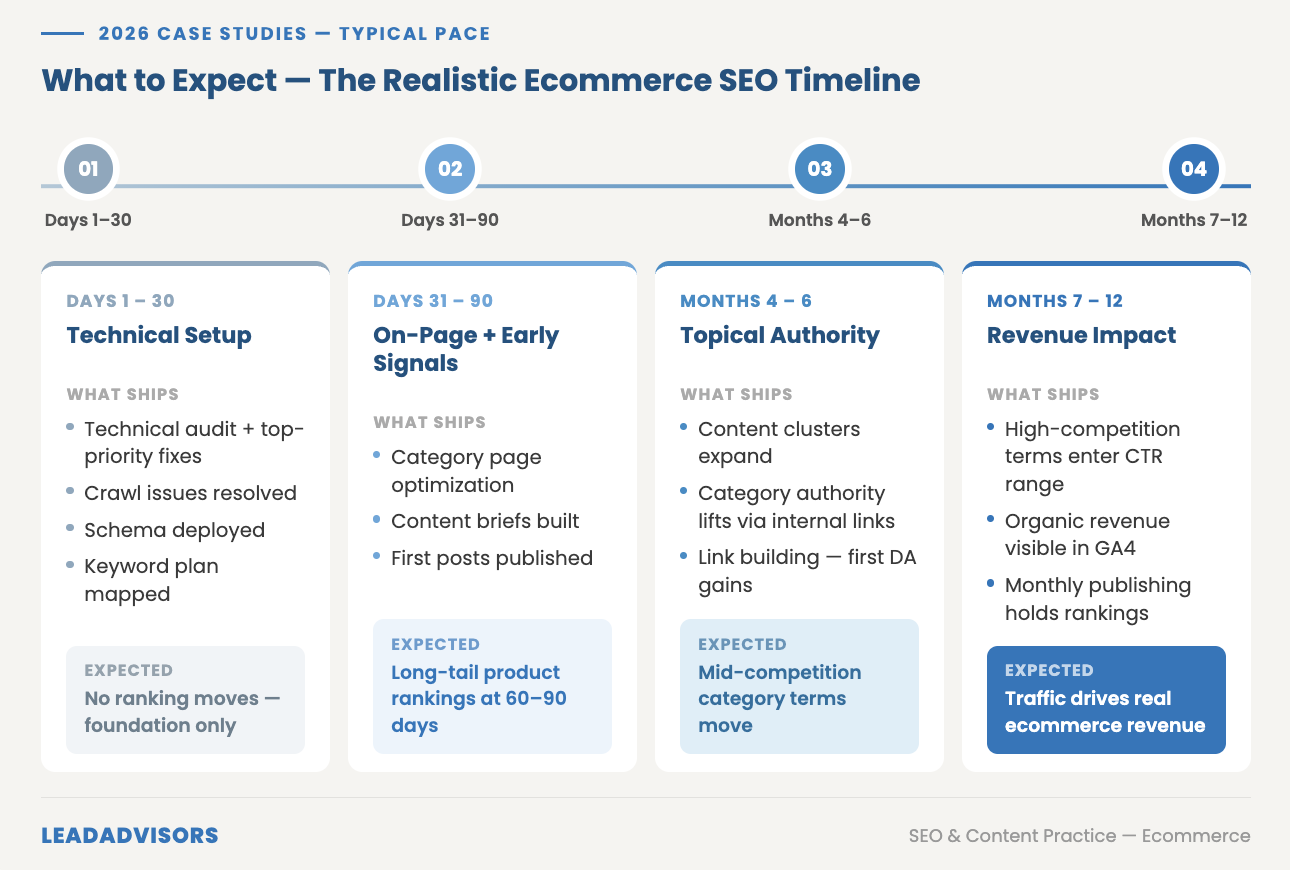
The timeline below reflects the typical pace of well-run projects in the 2026 case studies.
Days 1 to 30. Technical setup. First, we run the technical audit and ship the top fixes. We solve crawl issues, deploy the schema, and map the keyword plan. However, no ranking moves are expected during this phase.
Days 31 to 90. On-page work and early signals. Next, we optimize category pages, build content briefs, and publish the first posts. For example, long-tail product rankings often appear at the 60-90 day mark for low-competition terms.
Months 4 to 6. Topical authority compounding. Content clusters expand. Category page authority lifts through internal links. Meanwhile, link building creates the first gains in domain authority. Mid-competition category terms often move in this window.
Months 7 to 12. Revenue impact. High-competition category terms move into spots where click-through rates drive real traffic. Organic revenue shows up in GA4 ecommerce reports. Therefore, monthly publishing now maintains and grows rankings rather than building them from scratch.