The agency did not lose a client. It still hit a ceiling. That is when white-label SEO services often get considered.
At some point, clients ask for SEO services. It often starts with one request. Then it becomes a pattern. If the agency says yes, the client may move more budget over. If the agency says no, the client may hire another vendor.
The problem is not the idea of SEO. The problem is delivery.
Most agencies cannot hire a full SEO team for two new retainers. So white-label SEO looks like the fastest path. A partner does the work. The agency keeps the relationship. The client sees one brand.
That pitch is simple. The hard part is making it work day to day. Provider quality, pricing, contracts, and communication all need a clear plan. This guide covers each one.


What White Label SEO Services Actually Mean
White-label SEO services mean one company does the SEO work, but another company sells it under its own brand. These SEO white-label services are typically designed for agencies that want to add SEO capabilities without building an in-house team. A third-party team does the delivery. The agency presents the work as its own. See Semrush’s white-label SEO guide.
What white-labeling changes and what it does not
White-labeling changes the client-facing branding on deliverables – reports, audits, content briefs, and communications carry the agency’s name and logo, not the provider’s. It does not change the underlying work. The same technical audit that the provider would deliver under its own brand is redelivered under the agency’s brand.
What white-label SEO is not
It is not a licensing agreement in which the agency buys a framework and runs SEO in-house. It is not a referral arrangement where the agency sends the client to the provider and earns a commission. It is a full-delivery outsourcing model in which the provider performs the work, and the agency presents it as its own.
The two delivery models
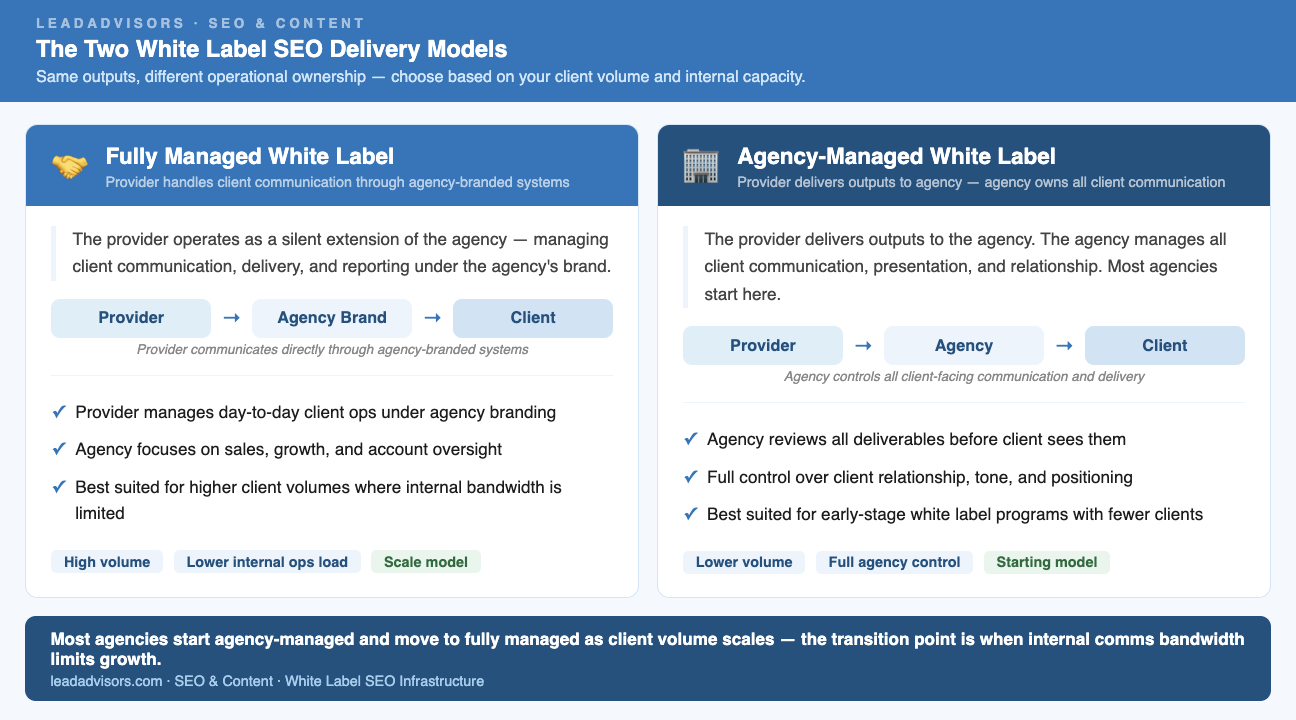
- Fully managed white-label: the provider manages the client relationship operationally, communicating with the client through the agency’s branded systems.
- Agency-managed white-label: the provider delivers outputs to the agency, and the agency manages all client communication. Most agencies start with agency-managed and move to fully managed as client volume scales.
What White Label SEO Services Include – The Full Scope
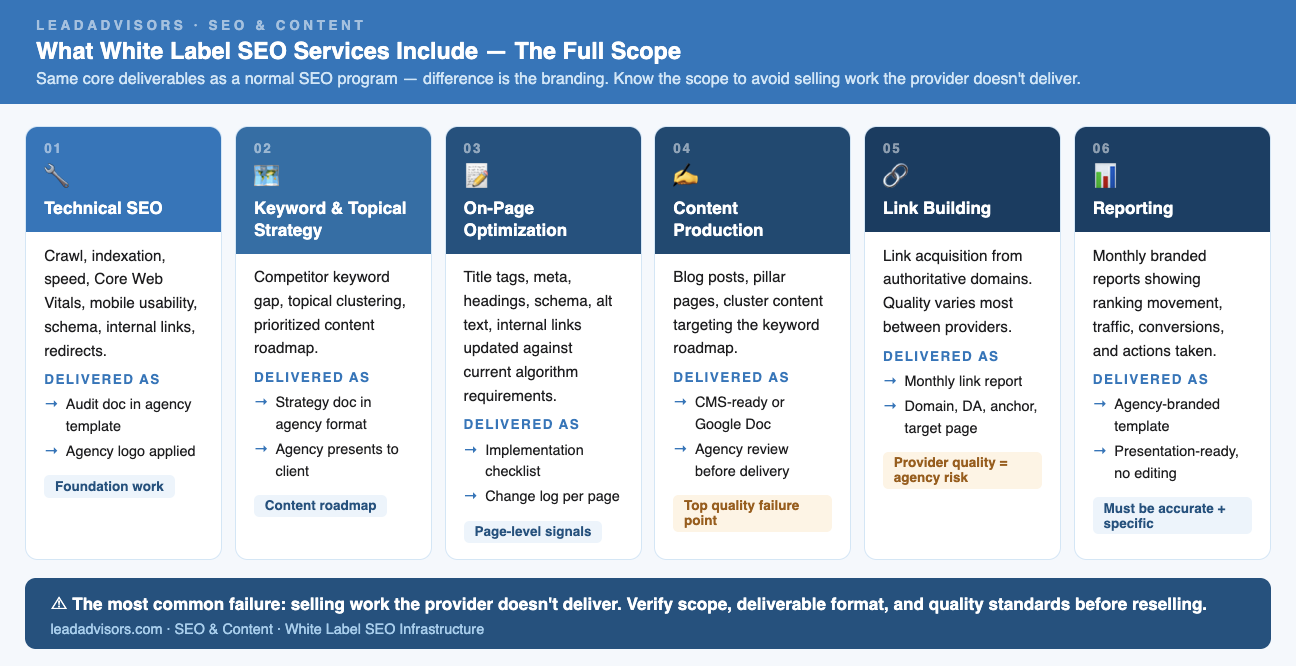
A white-label SEO engagement includes the same core parts as a normal SEO program. The difference is the branding. For white-label SEO services for agencies, knowing the full scope helps you avoid the most common failure: selling work the provider does not deliver.
Technical SEO
Crawl and indexation audit, site speed and Core Web Vitals, mobile usability, structured data implementation, internal link architecture review, and redirect management. Delivered as an audit document in the agency’s template with the agency’s logo. This work is often covered under a provider’s technical SEO offer, including white-label SEO audit services.
Keyword Research and Topical Strategy
Competitive keyword gap analysis, topical clustering, and a prioritized content roadmap. Delivered as a strategy document in the agency’s format. The agency presents this to the client as the content roadmap; the client does not need to understand every methodological detail to present it credibly.
On-Page Optimization
Updating existing pages against current algorithm requirements – title tags, meta descriptions, heading structure, schema, image alt text, internal links. Delivered as an implementation checklist and change log.
Content Production
Blog posts, pillar pages, and cluster content targeting the keyword roadmap. Delivered in the agency’s CMS format or as a Google Doc for agency review before client delivery. For a deeper breakdown of deliverables and tiers, see SEO content writing services in 2026. The most common white-label quality failure point – the provider’s content quality directly reflects on the agency’s brand.
Link Building
Link acquisition from authoritative domains. Delivered as a monthly link report in the agency’s template showing domain, DA, anchor text, and target page. For deeper detail on the process and risk, see our outsource link building and our link building service for examples of how a white-label provider packages and positions deliverables. See The HOTH’s white-label SEO reseller program. This is also where many white-label SEO reseller services differ most in quality. The link quality is entirely the provider’s responsibility – the agency cannot control or vet each placement independently at volume.
Reporting
Monthly performance reports in the agency’s branded template showing ranking movement, organic traffic, conversion events, and actions taken. Must be accurate, specific, and presentation-ready without agency editing.
White Label SEO Pricing – What Providers Charge and What Agencies Mark Up
White-label SEO pricing has two layers: the provider’s wholesale rate and the agency’s markup.
Wholesale Provider Pricing by Tier
| Tier | Scope | Provider Wholesale Rate |
| Entry | Technical audit + basic on-page, no content | $400-$750/month |
| Standard | Technical + 2-3 content pieces/mo + on-page | $750-$1,800/month |
| Growth | Full six-component, including link building | $1,800-$4,000/month |
| Enterprise | Multi-location, high content volume, aggressive links | $4,000-$8,000+/month |
Citation requirement: These ranges must be supported by late-2025-2026 industry sources (studies, surveys, or reports). If only directional ranges are available, label them as “commonly reported ranges” and cite the source explicitly.
Typical Agency Markup Ranges
Most white-label SEO resellers apply a 30-60 percent markup over wholesale. A $1,500/month wholesale package resells at $2,000-$2,400/month. A $3,500/month wholesale package resells at $4,500-$5,600/month. This answers the common question, “How much to mark up white-label SEO services?”
The appropriate markup depends on three factors: the value-added services the agency layers on top (client strategy sessions, reporting presentation, account management), the competitive pricing in the agency’s client market, and the agency’s client acquisition cost, which must be recovered before the engagement becomes profitable.
The Minimum Viable Margin
An agency reselling white-label SEO at a margin of less than 25 percent over wholesale is operating at risk. Account management, client communication, reporting review, and unanticipated scope discussions consume time that must be covered by margin. Below 25 percent, any client friction event erodes profitability on that account.
Pricing Transparency With Clients
The agency does not need to disclose that the SEO work is white-labeled. The ethical obligation is that the work delivered matches what was sold. The agency’s contract with the client should be written against the scope the provider delivers, not against a broader scope the agency implied but cannot fulfill.
Project-Based White-Label Pricing
Technical audits ($600-$2,500 wholesale), content strategy deliverables ($1,000-$3,000 wholesale), and one-time on-page optimization projects ($1,500-$5,000 wholesale) are available from most white-label providers as standalone project purchases – appropriate for agencies testing a provider before committing to a retainer.
The Five White Label SEO Resale Traps – And How to Avoid Each One
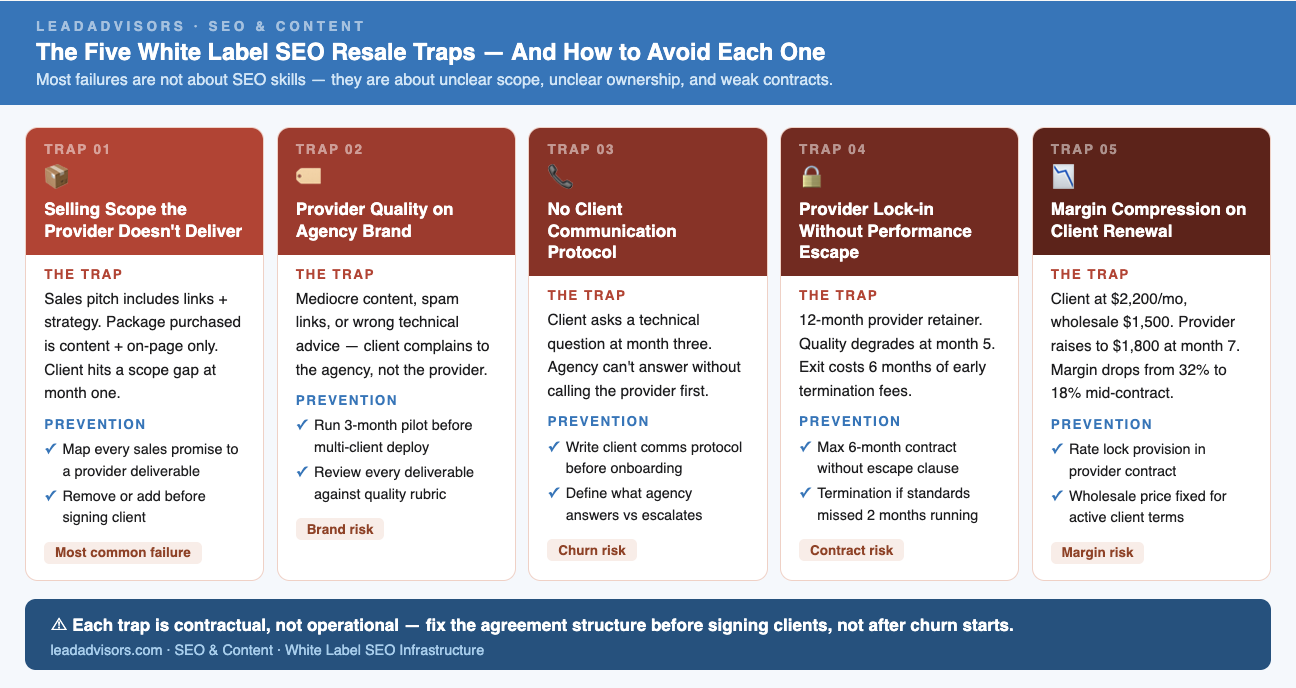
Most failures are not about SEO skills. They are about unclear scope, unclear ownership, and weak contracts. For more context, see Search Engine Journal’s breakdown of white-label SEO and content partnerships.
Trap 1 – Selling a Scope That the Provider Does Not Deliver
The most common white-label failure. The agency’s sales pitch includes link building, quarterly strategy reviews, and competitive reporting. The white-label package purchased includes content and on-page only. The client receives a scope gap after the first month.
Prevention: Before selling any white-label SEO package, map every element of the sales promise to a specific provider deliverable. If a deliverable cannot be mapped, either remove it from the pitch or add it to the provider package before signing the client.
Trap 2 – Provider Quality Reflected on Agency Brand
The agency’s brand is on the reports. When content quality is mediocre, a link is placed on a spam domain, or a technical recommendation is wrong, the client complains to the agency.
Prevention: Require a 3-month pilot period with new providers before committing to multi-client deployment. Review every deliverable in the pilot against a quality rubric before passing it to the client.
Trap 3 – No Client Communication Protocol
The agency signs a client, onboards them, and hands the operational work to the provider. Three months later, the client asks a technical question that the agency cannot answer without calling the provider.
Prevention: Establish a written client communication protocol before the first client is onboarded. Which questions can the agency answer directly? Which require provider input within 24 hours? Which are escalated to a provider strategy call?
Trap 4 – Provider Lock-in Without Performance Escape
The agency signs a 12-month white-label retainer. At month five, the provider’s quality has degraded. The agency cannot exit without a six-month early termination fee.
Prevention: Never sign a provider contract longer than six months without a performance escape clause specifying that if the provider misses a defined deliverable standard for two consecutive months, the agency may terminate with 30 days’ notice, without an early termination fee.
Trap 5 – Margin Compression on Client Renewal
The agency signs a client at $2,200/month with a $1,500/month wholesale cost, for a 32% margin. At month seven, the provider increases its wholesale rate to $1,800/month. The client is on a 12-month contract. The margin compresses to 18 percent for the remaining five months.
Prevention: Include a rate lock provision in the provider contract – wholesale pricing is fixed for the term of any client engagement active at the time of a provider price increase.
How to Evaluate a White Label SEO Provider – The Six-Question Vetting Framework
These questions are designed to surface execution quality and operational reliability – the two factors that determine whether a white-label partnership scales cleanly across multiple clients. If white-labeled reporting is part of the offer, this is a useful benchmark for common tooling and expectations in AgencyAnalytics’ white-label SEO software tool roundup.
Question 1: Can you show me five sample deliverables – audit, content piece, link report, monthly report, and keyword strategy – from a current white-label client?
Right answer: sample deliverables available immediately and without hesitation. Wrong answer: “We can customize our format for your brand” without showing what the base format looks like.
Question 2: What is your SLA for deliverable turnaround?
Right answer: specific timelines for each deliverable type – content delivery within five business days of brief approval, monthly report within three business days of the month end, technical audit within ten business days of access. Wrong answer: “We work to agreed timelines” without named standards.
Question 3: What is your link-building methodology, and can you show me the specific domains you have linked to for a current client?
Right answer: a named methodology and a sample link report showing real domains, real DA scores, and real anchor text. Wrong answer: “proprietary network” or generic DA40 sites with no topical relevance.
Question 4: What happens when a deliverable requires correction?
Right answer: a defined revision process with one round of revisions included within a defined timeframe. Wrong answer: “We always get it right the first time.”
Question 5: Do you provide a white-label reporting dashboard or only PDF reports?
For agencies managing more than 5 white-label SEO clients, an automatically updating live dashboard is operationally necessary.
Question 6: What are your contract terms – length, cancellation, and rate lock?
Right answer: month-to-month or short-term with defined cancellation notice, performance-based exit clause, and rate lock for the duration of active client engagements. Any answer that requires a 12-month commitment without a performance escape and rate lock is a commercial risk.
Setting Up the White Label SEO Client Relationship – What to Do in the First 30 Days
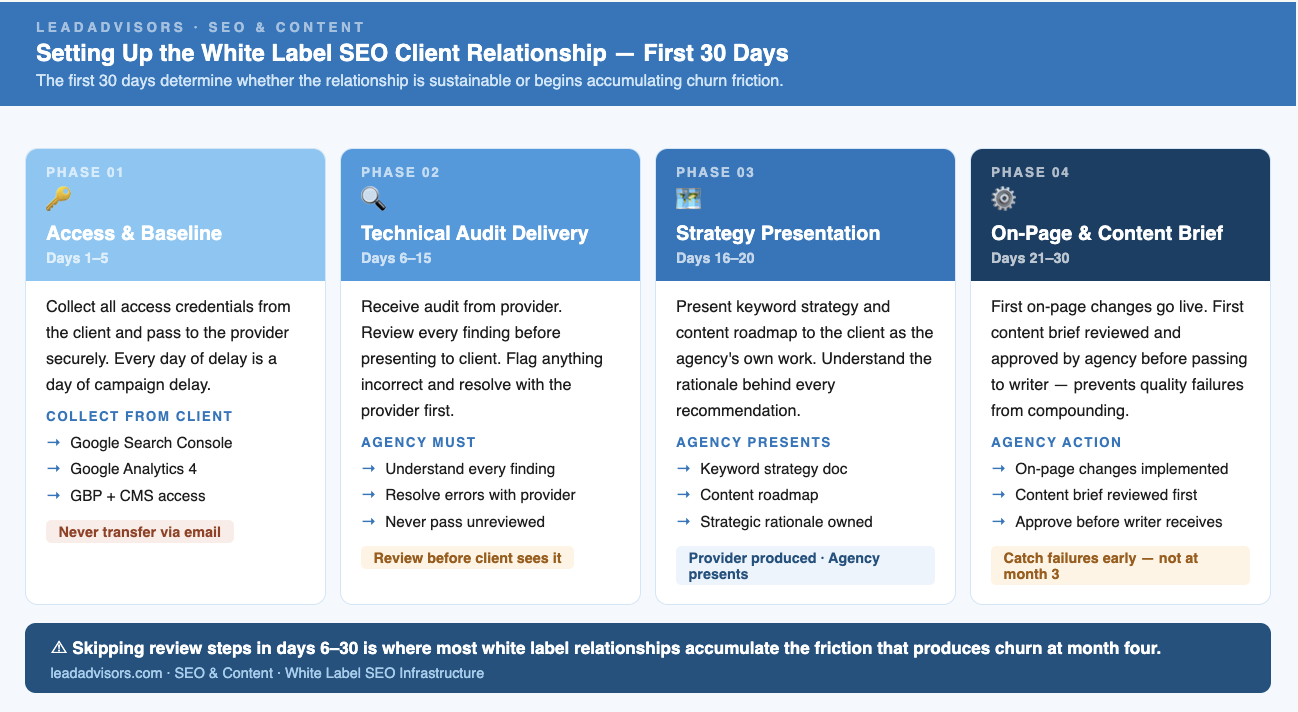
The first 30 days determine whether the client relationship is sustainable or begins to accumulate friction that leads to churn at month four.
Day 1-5 – Access and Baseline
Collect all required access credentials from the client: Google Search Console, Google Analytics 4, Google Business Profile (if applicable), and CMS access for on-page implementation. Pass all access to the provider through a secure credential transfer process – never via email. Every day of access delay is a day of campaign delay.
Day 6-15 – Technical Audit Delivery and Review
Receive the technical audit from the provider. Review it before presenting to the client – the agency should understand every finding well enough to explain it conversationally. Flag any finding that appears incorrect. Resolve with the provider before the client presentation. Never pass a deliverable to the client without reviewing it first.
Day 16-20 – Strategy Presentation
Present the keyword strategy and content roadmap to the client. The provider produced the document, but the agency presents it as its own work. The agency must understand the strategic rationale behind every recommendation.
Day 21-30 – On-page Implementation and Content Brief Approval
First on-page changes are implemented. The first content brief is reviewed and approved by the agency before passing to the content writer. The agency’s review at this stage prevents quality failures from compounding across multiple content pieces before they are caught.
White Label SEO vs Building In-House – When Each Makes Sense
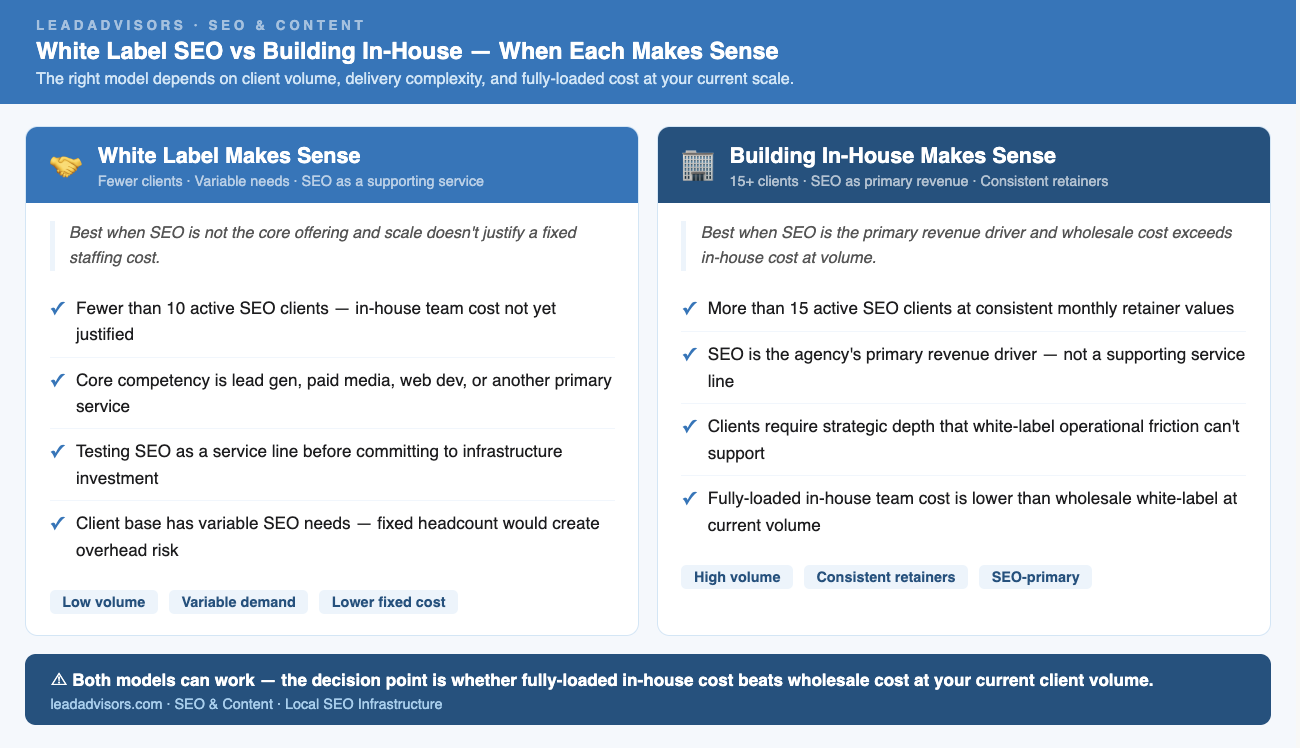
Both models can work. The right choice comes down to client volume, delivery complexity, and whether the fully-loaded in-house cost beats the wholesale cost at your current scale.
White-label makes sense when:
- The agency has fewer than ten active SEO clients
- The agency’s core competency is not SEO – it is lead generation, paid media, web development, or another service that SEO supports
- The agency wants to test SEO as a service line before committing to the infrastructure investment of an in-house team
- The agency’s client base has variable SEO needs that do not justify a fixed staffing cost
Building in-house makes sense when:
- The agency has more than fifteen active SEO clients at consistent monthly retainer values
- SEO is the agency’s primary revenue driver- not a supporting service
- The agency’s clients require a level of strategic depth that white-label operational friction cannot consistently support
- The fully-loaded cost of an in-house SEO team is lower than the wholesale cost of white-label delivery at the agency’s client volume
The break-even calculation:
The fully loaded cost of a three-person in-house SEO team (strategist, content writer, link builder) in a mid-cost US market is approximately $280,000- $360,000 annually. At a $2,500/month average client value and a 30 percent agency margin over wholesale, the white-label model breaks even against in-house at approximately 12 to 15 clients. Below that threshold, white-label is operationally and economically superior.