Leads come in. Closers are ready. The middle layer is the problem. That middle layer is the contact layer between the lead and the close.
When that layer is underbuilt, the symptoms are predictable:
- First attempts come late
- The follow-up is inconsistent
- Routing is sloppy
- QA is missing
- Closers sit idle
Then the business chases surface fixes. More leads. A new CRM. “More callers.” None of it holds if the contact system is still unstable.
A BPO contact strategy is the practice of building that middle layer into a system you can run and improve.
This is not a customer service model. It is the infrastructure that sits between your lead spend and your closers.
This matters most in outbound and hybrid lead programs in financial services, debt, mortgage, and insurance. In these verticals, the buyer is not asking, “How do I handle support tickets?” The buyer is asking: “How do I turn paid lead flow into qualified conversations without my sales floor doing amateur contact center work?”
In most orgs, this layer fails quietly because it is nobody’s “core function.” Marketing owns lead volume. Sales owns closing. The contact layer ends up as a shared responsibility, and shared responsibility becomes random execution.
The result is predictable:
- lead response depends on who is available, not on a system
- performance changes by day, by agent, and by lead source without a clear cause
- reporting becomes storytelling because dispositions are inconsistent
- The business buys more volume to cover a broader problem
If you are operating at scale, the middle layer must be built like an infrastructure layer. It has to be designed, staffed, measured, and adjusted. That is what the “BPO contact strategy” is named.


What a BPO Contact Strategy Actually Is
A BPO contact strategy is a managed contact system that sits between raw lead flow and your sales floor. A specialized outsourced team runs the contact layer as an operating system, not as a pile of calls.
It combines:
- operators (agents)
- multi-channel outreach
- QA and coaching loops
- reporting and disposition discipline
- routing logic that protects your closer queue
Think of it like this:
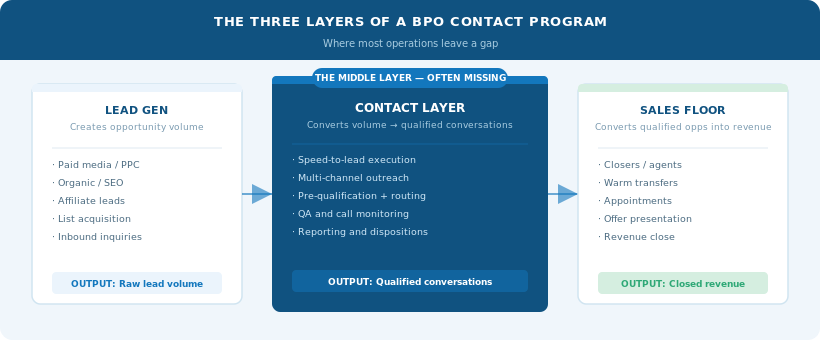
- Lead gen creates opportunity volume.
- Closers convert qualified opportunities into revenue.
- Contact strategy converts lead volume into qualified conversations with control and accountability.
If you skip the middle layer, your “sales process” turns into closers doing reach work. That is expensive, inconsistent, and hard to scale.
It is not:
- A call center definition
- a dialer license
- a single outbound campaign
- a “hire more callers” plan
It is the infrastructure layer responsible for:
- reaching leads at speed
- maintaining contact across multiple channels
- pre-qualifying and routing prospects
- delivering warm, ready-to-close conversations to closers
It answers operator questions:
- Are we contacting leads fast enough to compete?
- Are we working leads across channels, not just phone?
- Are we routing the right conversations to closers?
- Can we see daily performance without guessing?
- Do we have a feedback loop that improves outcomes week over week?
Distinguish it from three near misses:
- Hiring in-house dialers
- Buying a dialer tool
- Running a basic outbound campaign
Those can be parts of the system. They are not the system. A strategy has ownership, operating cadence, and accountability. Without those, activity happens and performance stalls.
A BPO contact strategy is the managed contact layer between lead spend and revenue. It is delivered by an outsourced operator team with speed-to-lead coverage, multi-channel outreach, QA, and reporting. The output is qualified conversations routed to your closers.
The keyword is managed. Managed means there is a cadence and an owner:
- daily visibility into contact outcomes and routing outcomes
- weekly adjustments based on measured bottlenecks
- QA that enforces qualification criteria and call handling standards
Without management, you can still generate dials. You cannot build repeatable outcomes.
The Core Components of a BPO Contact Strategy
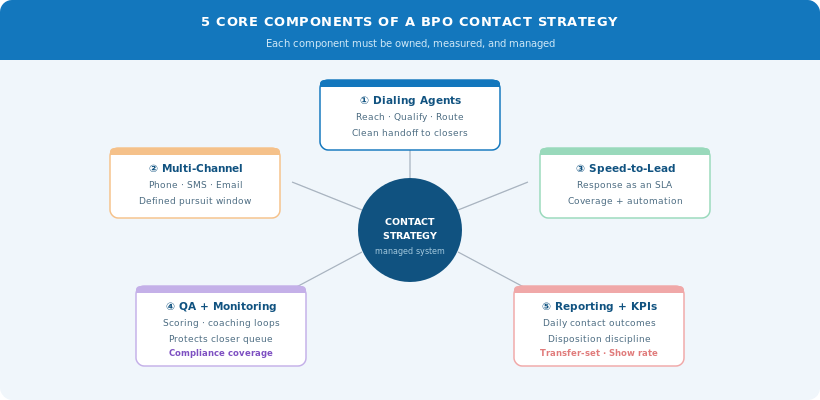
These components turn “we call leads” into a contact system you can run, measure, and improve.
Outbound Dialing Agents
This is the human layer: transfer specialists, appointment setters, and lead qualifiers.
Their job is simple:
- reach leads consistently
- qualify fast
- route to the correct outcome (transfer, appointment, nurture, disqualify)
In a real strategy, agents do not run on vibes. The role is defined by:
- Coverage: enough attempts and hours to reliably work volume.
- Control: consistent call handling and routing criteria.
- Clean handoff: transfers do not waste closers’ time.
What “clean handoff” means in practice:
- Your closers should know what to expect when a transfer hits their line.
- The lead should match the routing criteria you set (state, debt minimum, product fit, intent).
- The handoff should include the minimum context required for the closer to close.
If the handoff is noisy, closers stop trusting transfers. When that happens, the operation collapses. The contact layer’s first job is to protect the closer queue.
Operator detail that gets missed: the contact layer is not judged by how hard agents work. It is judged by how cleanly it routes. You can have high activity and still lose money if the routing criteria are loose and the sales floor gets flooded with bad transfers.
In operator terms, the dialing agents are executing three controlled actions:
- Reach: making enough attempts with the right timing windows to create connections
- Qualify: applying a simple rule set consistently (not “gut feel”)
- Route: sending the lead to the correct outcome with the correct handoff context
If any of those three actions is inconsistent, the rest of the system cannot stabilize.
For campaign setup, list structure, and pacing, see: How to Build a High-Converting Outbound Dialing Campaign.
Multi-Channel Outreach Infrastructure
Phone-only programs leave money on the table. A strategy builds channel coverage as infrastructure.
Most stacks include:
- phone
- SMS
- chat (only when it fits lead source and compliance profile)
The goal is controlled coverage with suppression and opt-out handling. Not spam.
Multi-channel matters because operators lose leads for operational reasons:
- The first attempt is late
- The second attempt never happens
- follow-up stops after a few days
- The lead would reply to SMS/email, but no one tested it
- The lead answers unknown numbers less often, but replies to a short SMS
A strategy does not “add channels.” It defines a system:
- What channel goes first
- What is the timing window
- What is the attempt count
- What messages are used
- When the lead is suppressed
- What happens after a connect, after a no-answer, and after an opt-out
A usable channel stack also clarifies ownership. If agents are “allowed” to text but no one owns message control, you end up with inconsistent compliance language, inconsistent brand voice, and no ability to measure which messages work.
Multi-channel also changes what “attempts” means. In many programs, “we tried” means three calls in one day, and then the lead is abandoned. A strategy defines a pursuit window that matches the lead’s buying behavior. Operators do not guess. They run a defined sequence, with defined stop rules.
If ringless voicemail is part of the warm-up layer, see: Ringless Voicemail Drops: How to Write RVM Scripts That Actually Get Callbacks (2026).
If automation is part of execution, see: Call Center Automation: What It Is, What It Covers, and How It Transforms Floor Performance (2026).
Speed-to-Lead Execution
Speed-to-lead is a system. It is not a reminder.
A strategy controls response time through:
- routing rules
- queue coverage
- staffing schedules
- automation triggers
Speed-to-lead breaks in predictable ways:
- coverage gaps (no one is assigned at the exact moment the lead arrives)
- queue overload (too many leads hit at once)
- routing mistakes (lead goes to the wrong team or sits unworked)
- process friction (manual steps between lead capture and first attempt)
A strategy fixes this by designing first contact like an SLA. That does not mean “call in five minutes because a blog said so.” It means: define the window you can consistently hit, build coverage to hit it, and measure it daily.
Practical implementation note: speed-to-lead is not only about the first dial. It is also about what happens after the first no-answer. If the system cannot generate a second and third attempt within the correct time window, you will still lose qualified conversations, even if the first dial is fast.
If you need the implementation breakdown, see: Speed-to-Lead: Why Calling a Lead Within 5 Minutes Changes Everything.
QA and Call Monitoring
QA keeps the system stable as it scales.
A practical QA layer includes:
- a scoring rubric
- routine call review (sampled or AI-assisted)
- coaching loops that correct script drift and routing mistakes
QA protects outcomes in two directions:
- It protects closers from noisy transfers.
- It protects operators by making performance measurable and coachable.
Most ops teams think of QA as “checking calls.” In a contact strategy, QA is a control system. It is where you catch:
- qualification criteria drifting
- disclosures being skipped
- disposition misuse that destroys reporting
- transfers happening too early or too late
QA is also where you protect message integrity across channels. If SMS and email are part of the stack, QA has to cover:
- What agents are allowed to send
- Which templates are used
- How opt-outs are handled
- whether the language matches compliance requirements
If closers do not trust transfers, the model collapses. QA keeps routing aligned to what your sales floor will actually close.
For deeper coverage, see: AI-Assisted Call QA: Why 100% Coverage Is Now the Floor Standard (2026).
Reporting and Disposition Tracking
You cannot improve what you cannot see. Reporting is the control layer.
Daily reporting should show:
- Contact outcomes by lead source and segment
- the flow (attempt -> contact -> qualify -> transfer/appointment)
- transfer-set rate vs. show rate
If dispositions are messy, reporting lies. Then decisions get made on bad data.
A strategy uses dispositions to answer operator questions fast:
- Which lead sources are contactable?
- Which segments need different timing windows?
- Which scripts create the cleanest transfers?
- Are we improving week over week?
- Are we routing too aggressively or too conservatively?
This is where the contact layer becomes an operating system. When reporting is clean, the business stops guessing and starts adjusting with intent.
Reporting also determines whether you can hold a provider accountable. If all you see is “dials” and “transfers,” you have no visibility into why outcomes changed. A strategy requires a minimum reporting spine:
- a stable disposition taxonomy
- daily rollups by lead source and segment
- visibility into routing outcomes (not just activity)
For disposition structure, see: Disposition Taxonomy for Outbound: How to Build Call Data You Can Actually Use.
For KPI accountability, see: Transfer-Set Rate vs. Show Rate: The Two KPIs Your BPO Vendor Should Be Held Accountable For.
Compliance Infrastructure
In debt, mortgage, and insurance, compliance is part of the operating system.
A strategy includes:
- consent and opt-out handling
- Do Not Call processes and suppression lists
- calling windows by region/state
- script governance and disclosure control
Compliance failures are not “legal issues.” They are operational failures. If you cannot scale compliance, you cannot scale volume.
A usable strategy also makes compliance practical. Operators should not have to guess which list is scrubbed, which numbers are suppressed, or what the current disclosure language is. Those are system decisions, not agent decisions.
For baseline rules, review the FTC’s Complying with the Telemarketing Sales Rule.
For deeper coverage, see: TCPA Compliance for High-Volume Outbound: What Every Sales Floor Owner Must Know Before the Next Dial.
How a BPO Contact Strategy Differs From Just Running a Dialing Campaign
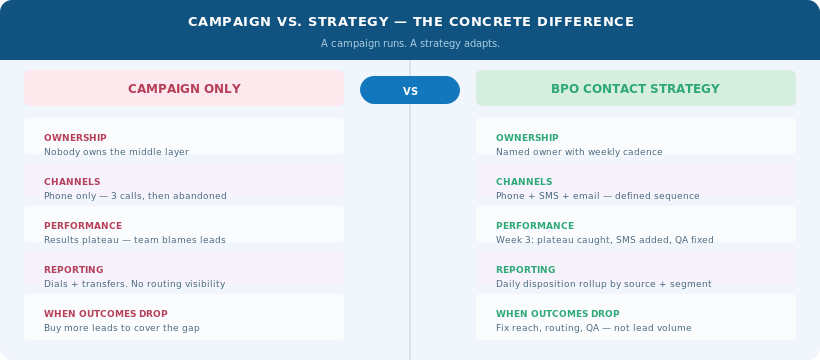
A dialing campaign is a tactic. It is a configured outbound push against a list.
A BPO contact strategy is the system that governs and improves the campaign over time. Coverage. Channel mix. QA. Reporting. Weekly iteration.
Concrete difference:
- A campaign runs.
- A strategy adapts.
Use a concrete scenario most operators recognize:
In a campaign-only setup:
- A company runs a dialing campaign for 90 days.
- Contact rate sits around 11%.
- The show rate sits around 40% of transfers.
- Nobody adjusts anything.
- Results plateau, and everyone blames the leads.
In a strategy setup:
- By week 3, the operation catches the plateau.
- An SMS sequence is added to cover the non-answers.
- The transfer qualification criteria have been tightened, so closers are no longer rejecting calls.
- Lead routing and call windows are retested.
- QA flags two call-handling mistakes that are killing conversions.
- The system improves without buying more leads.
If you want a simple test, ask this:
- Who owns the weekly changes that improve outcomes?
If the answer is “no one,” you do not have a strategy. You have activity.
Another operator test: if the program can only answer “how many calls did we make,” but cannot answer “what changed this week and why,” it is not being managed as a strategy.
When a Business Actually Needs a BPO Contact Strategy
You need this model when leads exist, closers exist, and the middle layer is failing.
Common situations:
- Contact coverage remains inconsistent.
- Closers are not receiving enough qualified conversations.
- Follow-up is phone-only, and multi-channel has never been tested.
- Quality is a black box (no QA, messy dispositions, no daily visibility).
What this looks like inside the business:
- Marketing says lead quality is the problem.
- Sales says transfers are the problem.
- Ops says reporting is the problem.
- Leadership buys more volume to compensate.
A contact strategy fixes the system between lead flow and the close, so those teams stop guessing.
A useful way to frame it: if you have “enough leads” and “enough closers” but revenue still lags, the missing piece is usually contact infrastructure. That is what this model solves.
This is also why many teams misdiagnose the problem as a lead quality issue. If your reach system is weak, even good leads will look “bad” because the business isn’t hitting them fast, often, or cleanly enough to produce connects.
What a BPO Contact Strategy Does Not Cover
Scope clarity prevents bad fits.
A BPO contact strategy:
- does not generate leads
- does not close deals
- does not fix your offer or pricing
It receives leads and produces qualified conversations and clean routing outcomes. That is the job.
If you buy the wrong thing, you will be disappointed. A contact strategy is not a replacement for demand gen or closer management. It is the operating layer that makes your existing demand and closers perform.
Scope clarity also protects implementation. When teams try to combine lead gen, closing, and contact operations into a single initiative, they lose control of the middle layer, and nothing gets measured cleanly. A contact strategy works best when input (lead flow) and output (qualified conversations) are defined.
How to Evaluate Whether Your Current Contact Infrastructure Is a Strategy or a Gap
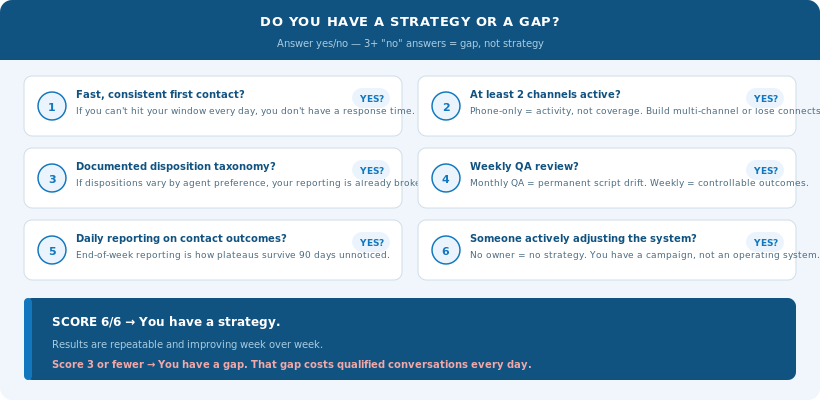
Answer yes/no:
- Do you contact new leads fast and consistently?
- “Fast” is not a slogan. If you cannot hit your window every day, you do not have a response time.
- Are you reaching leads across at least two channels?
- If your only channel is phone, you have not built coverage. You have built activity.
- Do you have a documented disposition taxonomy, and are agents using it consistently?
- If dispositions change based on agent preferences, reporting becomes useless.
- Do you review QA weekly?
- If QA is monthly or “when we have time,” script drift becomes permanent.
- Do you have daily reporting on contact outcomes and routing results?
- Waiting for end-of-week reporting is how plateaus live for 90 days.
- Is someone actively adjusting the system based on that data?
- If no one owns iteration, you do not have a strategy. You have a campaign.
If you answer “no” to more than three, you have a gap – not a strategy.
Operator reality: if outcomes change wildly by day, by agent, or by lead source without explanation, you are running activity. You are not running a system.
If you want a tighter diagnostic, look for these failure patterns:
- Closers complain more about transfer quality than about lead volume.
- The program cannot explain why the contact rate dropped last week.
- The org buys more leads whenever performance dips, instead of fixing reach and routing.
- There is no single owner for messaging, routing, and reporting.
Building One vs Using a Managed BPO Provider
Build vs buy is an infrastructure decision.
To build in-house, you need more than callers. You need:
- tools (dialer + multi-channel)
- hiring and training
- QA ownership
- compliance ownership
- reporting discipline
- an operating cadence for weekly improvement
A managed provider runs the operating layer while you provide leads and receive transfers or appointments.
The decision point is management capacity:
- If you already have supervisors, QA, compliance, and reporting discipline, you can build.
- If you do not, you will still need to build that layer. That is where most “in-house” builds fail.
This is also why “we hired two SDRs” does not solve the problem. Hiring adds activity. It does not add operating control unless you also build the management layer.
In other words, the hidden cost of “build” is not the agents. It is the supervision and control system. If you do not build that, you will keep paying for volume to cover the gap.
If you are comparing partner types, see: BPO Operator vs. Agency vs. Consultant: Why the Difference Defines Your ROI.
If you need the contact rate deep dive, see “Contact Rate Optimization: How to Fix Low Outbound Performance.”