Most outbound dialing campaigns fail before the first call goes out. Outbound still works. The problem is how most campaigns are built.
Here is what usually happens. Operators buy leads, load them into a dialer, assign agents, and wait. When the contact rate stays at 10% or 12%, the blame goes to lead quality or agents. In most cases, it is neither.
Effective outbound teams in 2026 focus less on dialing faster and more on dialing smarter. Speed does not fix bad targeting. And targeting is just one part of the problem. A high-converting outbound dialing campaign needs the right dialer, clean data, caller ID health, a warm-up sequence, a pre-qualification step, and a QA system. Each part builds on the one before it. If one part fails, the parts below it fail too.
The intelligent outbound market is hitting $8.69 billion this year as companies swap old-school robocalls for AI-powered systems. Growing at nearly 15% annually, the real opportunity now lies in smart, data-driven workflows rather than “mass dialing.” In 2026, the winners aren’t those who call the most people because they are the ones using precision timing to reach the right lead.
This article covers how to build an outbound dialing campaign that gets results. We go from setting a goal and picking a dialer all the way through compliance, QA, and the metrics that tell you what is wrong. For a deeper look, see our guide on contact rate optimization.


What an Outbound Dialing Campaign Actually Is
An outbound dialing campaign is not just a team of agents with a lead list. It is a full program with a clear goal, a clean contact list, a setup dialing system, a screening step, a compliance plan, and a reporting schedule.
Think of it like a machine. Each part is a gear. If one gear is missing or broken, the whole machine slows down, no matter how good the other parts are.
Most performance problems come from the campaign design, not the agents or the leads. A clear outbound call plan helps every call serve the business goal. It also keeps agents focused and consistent.
Campaign types relevant to financial services operations:
- Transfer campaigns: agents screen leads and hand them to closers in real time. This is the main model for debt settlement, personal loans, and mortgage operators.
- Appointment setting campaigns: agents screen leads and book a call for later, rather than transferring live.
- Follow-up and re-engagement campaigns: outreach to old or uncontacted leads using a set sequence. See our guide on live transfer leads for more.
Step 1: Define the Campaign Objective Before Touching the Dialer
Most campaigns get set up before anyone defines a clear goal. That is a mistake. The goal drives every other decision.
The campaign goal is not “make calls.” It is a set, measurable result. For financial services transfer campaigns, the goal is qualified transfers per day at an acceptable cost per transfer, not just total transfer count.
That one shift changes how pace, screening, and QA are set up.
The campaign objective determines:
- Which dialer type to use
- What screening criteria to set
- How to manage volume and call pace
- What counts as success or failure
Are you trying to have fewer, better calls or as many calls as possible? Those two goals need different setups.
Operator tip: Write the goal down and share it with the dialing team and the sales floor before the first call. If closers do not know what qualifies a transfer, the screening step cannot work properly.
Step 2: Choose the Right Dialer for the Campaign Type
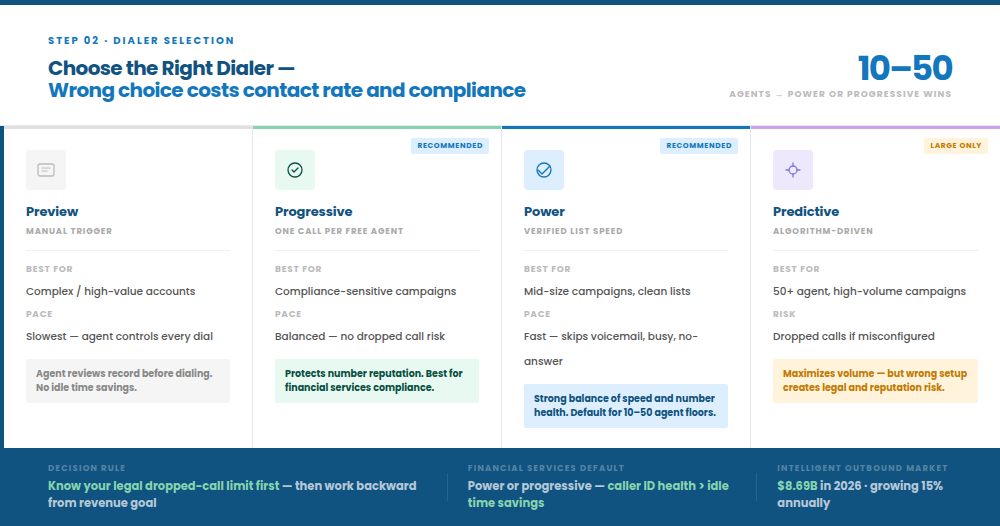
Picking the right dialer is one of the most important early steps. The wrong dialer can cause legal problems, low contact rate, or both.
Preview dialer: The agent looks at the contact record before calling. The agent starts the call by hand. This works best when prep time before the call matters, such as for complex or high-value accounts.
Progressive dialer: The system places one call when an agent is free. It balances speed with prep time. Good for campaigns where dropped calls are a legal risk.
Power dialer: The system dials through a list of free agents. It skips voicemails, busy signals, and no-answers. This works for mid-size campaigns where speed matters and the lead list is verified.
Predictive dialer: The system dials ahead of time when agents will be free. It uses math to cut idle time. But if it is set up wrong, it raises the rate of dropped calls. It works best for large campaigns with many agents. For smaller campaigns, a bad setup creates both performance and legal problems.
How to choose:
First, know your legal limits. Set your max dropped-call rate before you pick a pace model.
Second, work backward from your revenue goal. Figure out how many live conversations each agent needs per hour.
For most financial services transfer campaigns with 10 to 50 agents, a power or progressive dialer works better than a predictive dialer. Protecting caller ID health is worth more than cutting idle time at that size.
For more on managing a dialing team, see our guide on call center management.
Step 3: Build the Lead List and Data Infrastructure
The lead list sets the ceiling on contact rate before the campaign starts. No dialer, no warm-up, and no script can fix a bad list.
For financial services campaigns, a lead list is more than a spreadsheet. It needs verified phone numbers, written TCPA consent, state eligibility flags, basic qualification data like debt balance and income, and do-not-call filtering done at list build, not on dial day.
The “phone-only” agent is obsolete. Today, 66% of top contact centers blend SMS, email, and social media into their strategy. While the old standard was two or three tries, leaders now make 8 to 10 attempts to reach a lead. In 2026, campaigns without a multi-channel approach are at a disadvantage from day one.
Data quality standards that are non-negotiable:
Phone number check before loading. Focus on mobile numbers. Validate against carrier data.
TCPA consent chain per lead. This means the opt-in source, exact disclosure text, a timestamp, and an IP address. Pre-checked boxes and vague consent language do not count.
Do-not-call scrubbing at least build. Refresh it at least every 31 days. Real-time scrubbing is the current standard for high-volume campaigns.
State eligibility filtering is built into the list. Do not leave this for the screening call.
Lead age matters. The faster you call after a lead submits, the higher the contact rate. Lists older than 72 hours with no first contact have much lower right-party contact rates than fresh leads.
Contact data decays 22.5% per year, according to Prospeo. A clean list in January is missing nearly a quarter of its good contacts by December. Data hygiene is not a one-time task.
For more on lead sourcing and quality, see our guide on debt live transfer.
Step 4: Configure the Multi-Channel Warm-Up Sequence
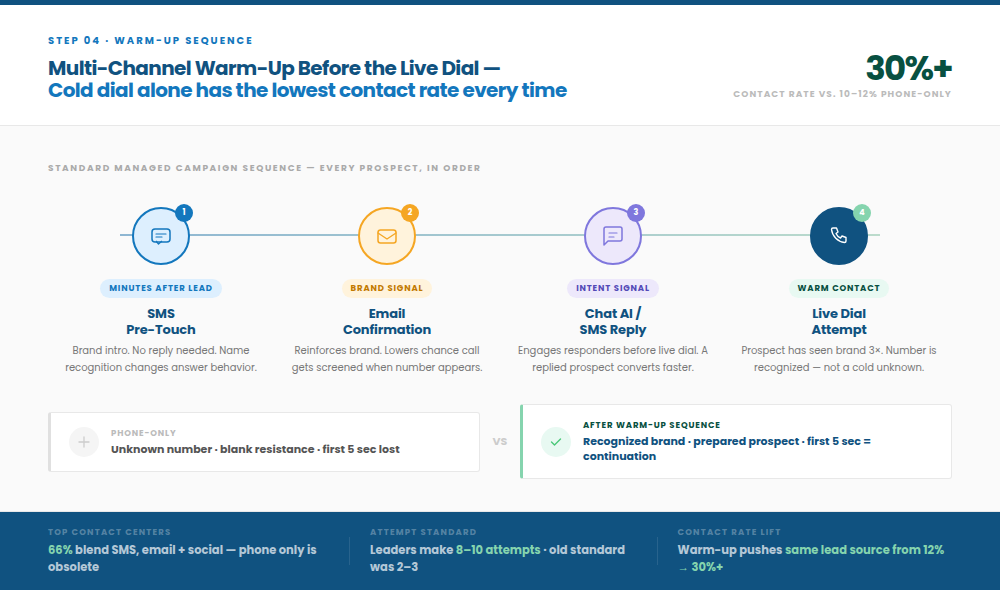
Phone-only campaigns are limited, no matter how good the dialer or list is. A prospect who gets an SMS before a call has context. A prospect who confirmed interest by email or chat before the dial is more likely to answer and stay on the line.
Cold dialing alone yields the lowest contact rate, no matter how well the rest of the setup is.
Real-time lead routing sends new leads to free agents the moment they enter the system, according to Readymode. But fast routing alone does not make up for the lack of a warm-up step.
Standard multi-channel warm-up sequence for a managed financial services outbound campaign:
- Touch 1: SMS pre-contact: Send minutes of lead submission. Introduce the brand and confirm why you are reaching out; no reply needed. The goal is name recognition before the call.
- Touch 2: Email confirmation: Builds brand recognition. Lowers the chance that the prospect ignores the call when the number shows up on their phone.
- Touch 3: Chat AI, or SMS reply handling: Engages prospects who respond before the live call. A prospect who has already replied is easier and faster to screen.
- Touch 4: Live dial attempt: By now, the prospect has had contact before. They are more likely to answer. The agent starts with context rather than from scratch.
The warm-up step does not replace screening. It improves the quality of the pool that screening works with. A screened prospect from a warm-up sequence is a faster, cleaner transfer than one who got a cold call and reluctantly stayed on.
The LeadAdvisors BPO Contact Strategy Campaign includes SMS pre-touch, email, and chat AI follow-up as standard steps, in addition to outbound dialing. This is part of why it pushes contact rate above 30% on the same lead sources that underperform in unmanaged campaigns.
For a full breakdown, see our guide on the best live transfer campaign.
Step 5: Pre-Qualification Script and Transfer Criteria
Pre-qualification is not a friendly check-in. It is a structured screening process. It confirms that the set criteria have been met before a transfer or appointment is made.
For debt settlement campaigns, the standard criteria are: minimum unsecured balance confirmed, state eligibility verified, hardship confirmed, and the prospect is available for the next call.
Every item should be in the script and treated as a hard gate. If the prospect does not confirm an item, the call does not go to transfer.
This seems obvious. But most low-performing campaigns treat the screening script like a suggestion. Agents ask the questions but transfer the call anyway. That is not screening. That is creating rejections.
Soft transfer vs. hard transfer:
Soft transfers: the dialing agent stays on the line during the handoff and introduces the prospect to the closer. This leads to more accepted transfers and a better experience for the prospect.
Hard transfers send the call to the closer with no introduction. They are faster and can handle higher volumes. But they also create more rejections and hang-ups at the moment of transfer.
For financial services campaigns, trust matters from the first second. Soft transfer is almost always the right call, even if it means fewer transfers per hour.
Daily script review: Review and update the screening script every day based on sales floor feedback. If closers say transferred prospects are not qualified or not interested, the script is not working as a gate. Fix it before the next shift, not at the next weekly meeting.
For help building and auditing screening scripts, see our guides on call center quality assurance and mock call scripts.
Step 6: Compliance Infrastructure Before Launch
Compliance is not something you set up after the campaign launches. Campaigns that go live without a full compliance plan carry legal and financial risk that grows with every call.
TCPA violations cost U.S. businesses over $200 million per year, according to NobelBiz. TCPA class action filings have jumped 95% year-over-year. Recent verdicts have exceeded $925 million. For financial services operators, this risk is very real.
Before any outbound dialing campaign goes live, confirm and document the following:
TCPA consent chain: Each lead must have written consent from the original opt-in source, the exact disclosure text, a timestamp, and an IP address. The consent must name the specific company making the call.
Do-not-call scrubbing: Run the national DNC list, state DNC lists where needed, your internal list, and the Reassigned Numbers Database. Do this before loading the list. Refresh on a set schedule. Real-time scrubbing is the standard for high-volume campaigns.
Call timing controls: Block calls outside of 8 a.m. to 9 p.m. local time for the person being called. Build time zone detection into the dialer. Do not leave this to agents.
State-specific disclosure: In two-party consent states like California, Florida, and Illinois, the call recording notice must be at the opening of the call. Put it in the script and check it through QA regularly.
Opt-out handling: Process every opt-out request fast, no matter how it comes in. If you dial someone after they opt out, that is a TCPA violation.
About 16 state privacy laws are now in effect, with more on the way, according to Convoso. New iOS call screening tools and carrier filters from providers like T-Mobile are also blocking and labeling more calls, especially from numbers the prospect does not know.
No dialing system guarantees compliance. That duty stays with the organization running the campaign.
QAcall tracks compliance language in real time, flags missed script items, and keeps an audit-ready call record. For financial services campaigns, this is the QA setup that protects you from legal exposure as the campaign grows. Learn more about QAcall →
Step 7: QA, Reporting, and the Daily Feedback Loop
The most common reason a well-built campaign breaks down over time is simple. There is no feedback loop between the dialing floor and the sales floor.
The contact rate can remain the same while transfer quality declines. Closers reject more transfers. The dialing team does not know until it shows up as a cost problem. By then, weeks of results are already gone.
QA infrastructure for a mid-size campaign (15–40 agents):
One QA monitor for every 10 to 12 agents. Daily call reviews with agent scores before the next shift. A weekly QA report is shared with sales floor management. Call outcome tracking per agent per session, including dials, contacts, screens done, transfers made, and rejections flagged.
Daily reporting cadence:
Live dashboards showing contact rate, transfer volume, transfer acceptance rate, average handle time, and calls per agent per hour. Campaign management should see these numbers at all times, not at the end of the day.
Good systems track call time windows, limit call attempts, manage opt-outs, and keep consent records. But all of that only works with feedback. If closers say a lead source or time window is sending weak prospects, the dialing team needs to know before the next shift.
The metrics that matter:
- Right-party contact rate: live conversations as a share of total leads dialed.
- Transfer acceptance rate: how many transfers sent get accepted by closers as qualified.
- Cost per qualified transfer: total campaign cost divided by accepted transfers, not all transfers.
- Speed to connect: time from lead submission to first live agent conversation.
- Agent talk time per hour: a signal of how well the dialer and list are working.
In 2026, a 5% to 15% connect rate is typical for outbound teams. Top performers hit 8% or more. Financial services and insurance teams often land between 3% and 8% due to call screening in those industries.
For more on tracking and team planning, see our guides on completion rate and workforce management call center.
Managed Outbound Dialing vs. Building In-House: The Structural Decision
Building a campaign in-house takes a lot of work. You need a verified lead list, a compliant dialer, a warm-up sequence, a screening script, a QA setup, a supervisor layer, and a daily report to the sales floor. Each of these takes time to build and tune. Most take longer than expected when built during a live campaign.
A BPO is an outsourced call center. These partners bring their own tools, systems, and know-how. They are a good fit for growing businesses that want results without having to build everything from scratch. BPOs can also scale up or down with demand and work across time zones.
The decision framework:
| Situation | Recommendation |
| Proven close process; need a team built around it | Enterprise Managed Campaign: client owns the platform; LeadAdvisors provides people, HR, QA, and supervisors |
| Have leads but low contact rate; no dialing setup | BPO Contact Strategy Campaign: LeadAdvisors runs everything from dialing through transfer delivery |
| Want to test the contact rate before full commitment | 7-agent pilot, 30 days, using your own lead sources |
| Have an internal team; need to fix a low-performing campaign | Contact rate audit: find which of the five root causes is the problem |
For more on the BPO model and how to pick the right partner, see our guides on business process outsourcing and BPO partner.