
The weekly report is pulled. It shows 4,847 calls placed and 34 disposition codes. Three agents are found using “No Answer – Callback Requested” for calls where the prospect picked up and said, “Call back later.” That is a contact, not a non-answer. The contact rate is now wrong. “Not Interested” is being applied to both unqualified prospects and qualified prospects who declined. The qualification rate is unusable.
The data exists. It is not usable.
Across hundreds of outbound programs managed by LeadAdvisors, the same pattern has been observed. Operations involving more than 25 disposition codes result in higher rates of agent miscoding. Operations with 15-20 structured codes produce cleaner data. The reason is not the agent’s ability. It is a taxonomy design. When too many codes overlap, agents are forced to guess. The data breaks before any report is run.
This guide covers how to build a clean taxonomy. It starts with the six categories needed on every floor. It ends with the CRM integration that operationalizes the data.

What a Call Disposition Is – And What It Is Actually For
A call disposition is the outcome code applied to a call record after a contact attempt. It is the single label used to describe what happened on that call. It also decides how the lead is routed next.
Dispositions serve four functions. All four must be supported at the same time by a well-designed taxonomy:
- Performance measurement. Disposition data serves as the source for all key metrics. That includes contact rate, qualification rate, transfer rate, call abandonment rate, DNC compliance, and lead yield by source. When codes are applied consistently by every agent, the contact rate can be extracted directly from the raw data. When codes overlap or are applied inconsistently, the reporting team is forced to fix the data manually. That process adds hours to every weekly reporting cycle.
- Lead routing. The disposition determines what happens to a lead after each call. The timing of that next action is critical to speed-to-lead. A “No Answer” lead is sent back into the cadence queue. A “Transferred” lead is moved into the closer pipeline. A “DNC – Requested” lead is suppressed and logged right away. Dispositions drive the routing logic. Every routing error is a disposition error.
- Compliance documentation. DNC requests and consent revocations must be logged at the call level. The disposition system is where that logging happens. In a TCPA audit or lawsuit, disposition records are treated as the primary proof of compliance. Under the TCPA, fines range from $500 to $1,500 per call. There is no cap on total liability. The largest TCPA class action settlement exceeded $925 million. Under the TRACED Act, the FCC can impose a fine of up to $10,000 per call for willful violations.
- Agent performance assessment. Disposition patterns reveal performance issues that team-level metrics hide. That includes outliers in average handle time. An agent with a high “No Answer” rate may be hanging up before voicemail picks up. An agent with a low “Not Qualified” rate may be sending bad leads to the closer queue. These patterns only show up when disposition data is reviewed at the agent level. A campaign-level report will not catch them.
All four functions need the same thing from the taxonomy. That is precision, consistency, and mutual exclusivity. Each outcome is mapped to one code. That code is applied the same way by every agent on every call.
The Anatomy of a Bad Disposition Taxonomy – And Why Most Floors Have One
Bad taxonomies are not built on purpose. They have grown over time. One problem at a time. One new code at a time, no master plan.
Here is how it happens. Agents are not separating voicemails from calls that just rang out. So a “No Answer – VM Left” code is added. Then a compliance officer requests separate DNC codes for federal and state lists. Two more codes are created. A manager wants callbacks tracked apart from general no-answers. Another code is added. A new vertical launches. Its own set of disqualification reasons is added.
Six months later, 34 codes are found in the dialer. Agents apply them differently. The reporting team spends three hours every Friday sorting the data into usable groups by hand.
Four problems are found again and again in broken taxonomies:
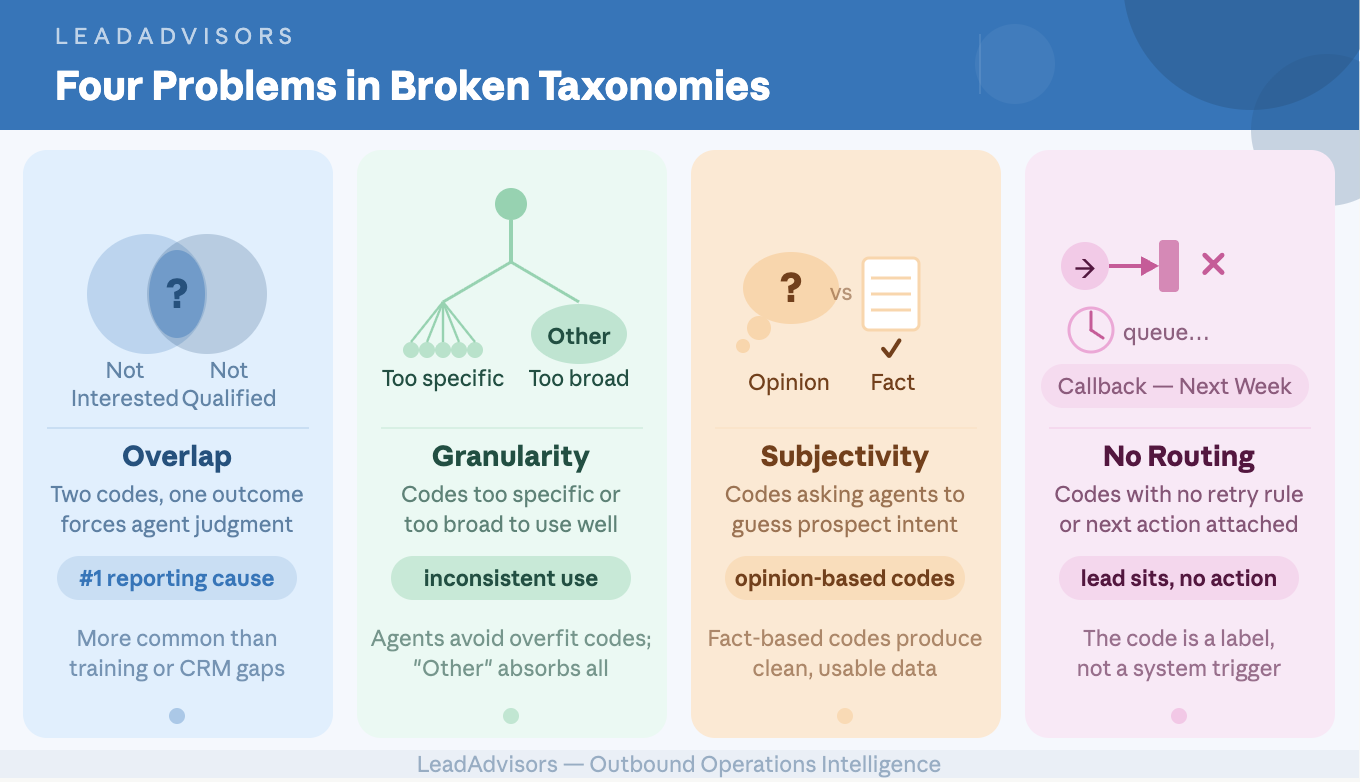
- Overlap. Two or more codes can be applied to the same call outcome. When “Not Interested” and “Not Qualified” are both available, a judgment call is forced on the agent. Different agents make different choices for the same scenario. Across the outbound floors audited by LeadAdvisors, disposition overlap is the most common cause of bad reporting data. It is more common than training gaps or CRM errors.
- Granularity mismatch. Some codes are too specific to be used consistently. “Not Interested – Has Representation – Called Before” is one example. Others are too broad to be useful. “Other” is the classic case. Neither type serves the reporting function.
- Agent subjectivity. Some codes ask the agent to read the prospect’s mind. “Interested But Not Ready” requires a guess about intent. “Callback Requested – Specific Date” describes a fact. The fact-based code produces clean data. The opinion-based code does not.
- No routing logic. Some codes appear as labels with no next action. If “Callback – Next Week” does not trigger a retry rule in the dialer or CRM, it is just a note. The lead sits in the queue. Nothing happens.
The Six Disposition Categories Every Outbound Taxonomy Needs
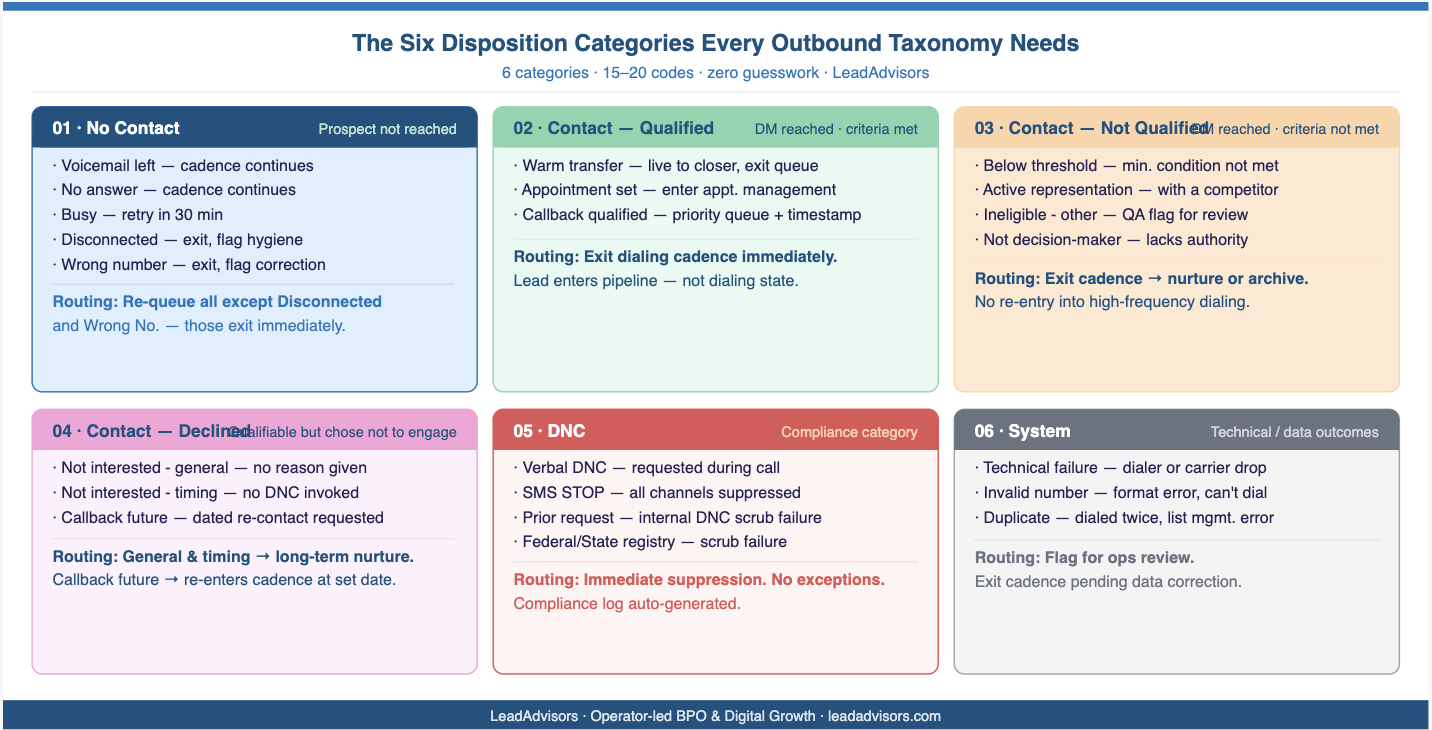
34 codes are not needed. Based on data from hundreds of outbound programs, six categories have been identified as encompassing all outcomes. Each category has its own sub-codes. Each sub-code has a routing rule. Each rule removes guesswork from the agent.
On floors where this 6-category structure with 15-20 total codes has been implemented, reporting accuracy has improved. Weekly report time has dropped. In some cases, Friday reporting was cut from three-plus hours to under 45 minutes.
Category 1 – No Contact
The prospect was not reached. The call produced no live conversation. Sub-codes within this category are distinguished by outcomes that carry different routing consequences:
- Voicemail left: The call was sent to voicemail, and a pre-recorded drop was deployed. The cadence is continued per schedule.
- No answer – no voicemail: The line rang with no pickup, and no voicemail was available. The cadence is continued per schedule.
- Busy: The line was found to be busy. A retry is scheduled within 30 minutes; the cadence resumes afterward.
- Disconnected: The number is determined to be out of service or unused. The lead is exited from the active cadence and flagged for list hygiene review.
- Wrong number: The call was connected to a person who confirmed this is not the prospect’s number. The lead has exited the active cadence and is flagged for list correction.
Routing rule: All No Contact sub-codes except Disconnected and Wrong Number are re-entered into the cadence queue according to the pre-built sequence. Disconnected and Wrong Number are immediately exited from the cadence.
Category 2 – Contact – Qualified
A live conversation was held with the decision-maker, and the prospect met the defined qualification criteria.
- Transferred – Warm: The prospect was qualified and transferred live to a closer. The lead is exited from the qualifying queue and entered into the closer pipeline.
- Appointment Set: The prospect was qualified, but a transfer was not possible at that time – a scheduled callback or appointment was booked. The lead is exited from the qualifying queue and entered into appointment management.
- Callback – Qualified: The prospect was reached and began qualifying, but a callback was requested to continue the process. The lead is exited from the active cadence and entered into the priority callback queue with a timestamp.
Routing rule: All Qualified sub-codes are immediately exited from the active dialing cadence. The lead is now in a managed pipeline state, not a dialing state.
Category 3 – Contact – Not Qualified
A live conversation was held with the decision-maker, but the prospect did not meet the defined qualification criteria.
- Below threshold: The prospect was determined not to meet the minimum qualifying condition (debt amount, tax liability, loan balance, etc.).
- Active representation: The prospect was already represented by or actively engaged with a competitor.
- Ineligible – other: The criteria were not met for a reason not covered by the above codes. A QA flag is generated for review to determine if a new sub-code is warranted.
- Not decision-maker: Contact was made, but the person on the line lacked the authority to make the relevant decision.
Routing rule: Not Qualified leads are exited from the active dialing cadence. Depending on the campaign parameters, they may be added to a long-term nurture sequence or archived. They are not re-entered into the high-frequency cadence.
Category 4 – Contact – Declined
A live conversation was held with a qualified or potentially qualifiable prospect who declined to continue. This category is distinct from Not Qualified – the prospect may have met criteria but chose not to engage.
- Not interested – general: Engagement was declined by the prospect without explanation.
- Not interested – timing: The timing was indicated as not right, but DNC was not requested.
- Callback – future: A future contact date was requested by the prospect without specifying a qualification issue. The lead is entered into a callback queue with a defined re-contact date.
Routing rule: Declined – general and Declined – timing are entered into a long-term nurture sequence. Callback – future is entered into a dated callback queue and re-entered into the active cadence at the specified date.
Category 5 – DNC
The prospect has invoked the right not to be contacted. This is a compliance category: immediate number suppression and compliance logging are triggered for every sub-code.
- DNC – Requested verbal: No further contact was verbally requested by the prospect during the call. The number is suppressed immediately.
- DNC – SMS STOP: The prospect responded to STOP via SMS. The number is suppressed across all channels immediately.
- DNC – Prior request: The lead was dialed, and the number was already on the internal DNC list – a scrubbing failure that requires QA investigation.
- DNC – Federal/State registry: The lead was dialed, and the number was found to be on a DNC registry at the time of dial – a scrubbing failure requiring compliance review.
Routing rule: Immediate suppression is triggered by all DNC sub-codes. No further attempts at contact are permitted under any circumstances. A compliance log entry is generated automatically.
Category 6 – System
These are technical outcomes that are not caused by prospect behavior – the call was not connected due to a system or data issue.
- Technical failure: The call was dropped or failed to connect due to a dialer or carrier issue.
- Invalid number: The number format was invalid and could not be dialed. The lead has exited the active cadence and is flagged for data correction.
- Duplicate: The lead was dialed twice in the same session due to a list-management error. It is flagged for list hygiene review.
Routing rule: System dispositions are flagged for operational review and exited from the active cadence while data is corrected.
The Mutual Exclusivity Rule – Why Every Call Must Have Exactly One Disposition
This is the most important rule in taxonomy design. Every call outcome must map to one code. Only one. No overlap. No ambiguity.
Mutual exclusivity breaks down in two ways. Both produce bad data.
Overlap failure. Two codes can both apply to the same outcome. “Not Interested” and “Not Qualified” are classic examples. A prospect does not meet the debt threshold. That same prospect says, “I am not interested anyway.” Which code is applied? When both are available, different agents pick differently. The result is that both codes contain a mix of outcomes. Neither one produces clean data.
The fix is simple. Clear rules are written for each code. “Not Qualified” is applied when a specific disqualifying reason is found. “Not Interested – General” is applied when the prospect declines without a clear disqualifying reason. If both are true, the rules state which code wins. The more specific code is usually chosen: Not Qualified, with the sub-reason.
Sequence failure. Two codes apply to different moments in the same call. The prospect first says, “Not interested.” The agent responds. The prospect then agrees to a callback. The correct code is “Callback – Future” – the outcome. Not “Not Interested” – the first reaction. When agents are trained on this logic, the failure is removed.
Every code in the taxonomy should come with three things. A definition. An example of when it applies. And an example of when it does not apply – the most common mix-up case. On floors where this type of documentation has been added, drops in agent miscoding have been seen within the first 30 days.
Disposition Codes by Vertical – What Changes Across Debt, Tax, Mortgage, and Insurance
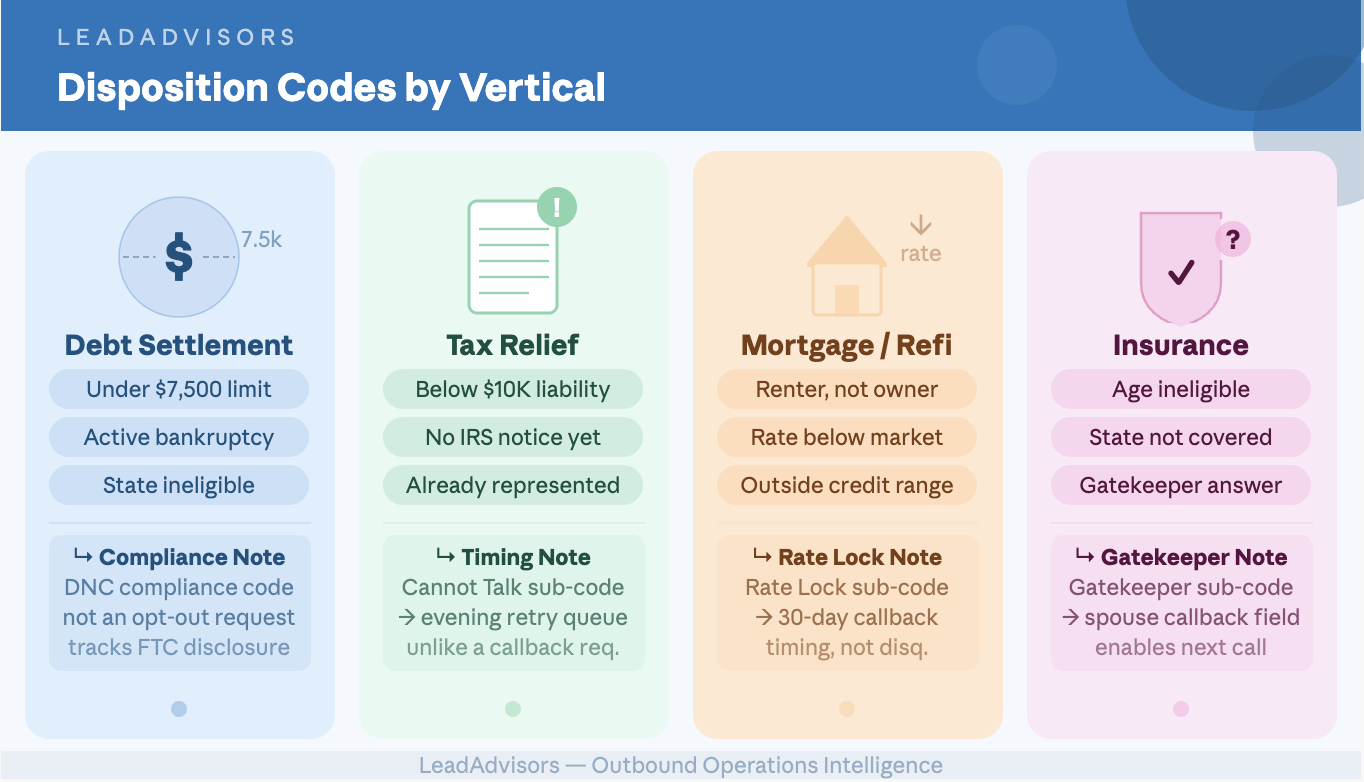
The six categories stay the same across verticals. What changes are the Not Qualified sub-codes? That is because each vertical has its own rules for what counts as “qualified.”
Debt Settlement
Not Qualified sub-codes: Below $7,500 unsecured threshold. Active bankruptcy. Current on all payments with no hardship. Already enrolled with another firm. The state is not eligible for the program.
Special compliance note: Debt settlement calls require QA monitoring of FTC-required disclosures. A compliance sub-code should be added within the DNC category. It captures calls where the agent missed disclosures. This is kept separate from standard DNC requests. That way, the QA team can distinguish between compliance failures and consumer opt-outs.
Tax Relief
Not Qualified sub-codes: Below $10,000 tax liability. No IRS or state notice received. Already represented by a CPA or attorney. Filing current with no delinquency. Business debt only (if the program is personal only).
Special note: Tax relief prospects often pick up while at work or in a meeting. A sub-code for “Reached – Cannot Talk Now – No Callback Requested” is recommended. It captures the prospect who picked up, confirmed identity, but could not continue. This is different from a callback request, which implies interest. The lead is then routed to an evening or weekend retry window instead of the standard daytime cadence.
Mortgage and Refinance
Not Qualified sub-codes: Renter, not homeowner. Not enough equity. Rate not motivating (current rate already below market). Credit range outside program limits. Recently refinanced.
Special note: Rate-sensitive campaigns need a “Rate Lock – Not Evaluating” sub-code. It captures prospects in a rate-lock period who cannot refinance without penalty. These leads are not disqualified. They are timing-sensitive. A dated callback queue with a re-contact trigger (30 days before the lock expires) has been found to work better than a standard nurture sequence.
Insurance
Not Qualified sub-codes: Age outside eligibility range. State not covered by the carrier and already enrolled in adequate coverage. Pre-existing condition outside underwriting guidelines. Decision-maker unavailable (household decisions require a spouse).
Special note: Insurance calls often produce “gatekeeper” outcomes. The person who answers is a household member, not the policyholder. A sub-code for “Gatekeeper – Spouse Callback” with a callback note field is recommended. It captures enough detail to personalize the next call, rather than starting over.
Disposition Taxonomy and CRM Integration – Making the Data Actionable
A taxonomy that lives only in the dialer produces reports. A taxonomy that is linked to the CRM produces action. Next steps are triggered. Lead status is updated. Leads are routed to the right queue. Compliance logs are created.
Industry research shows that sales teams spend an average of 3.4 hours per week on manual CRM data entry. Automated mapping can cut that time by up to 70%. When disposition codes are synced to CRM status fields, the errors caused by manual entry – estimated at a 1-3% error rate – are removed.
The Integration Requirements
Disposition-to-status mapping. Every code in the dialer is mapped to a lead status in the CRM. “Transferred – Warm” maps to “In Closer Pipeline.” This aligns the system with best practices in sales pipeline management. “DNC – Requested Verbal” maps to “Suppressed – DNC” with a timestamp. “Callback – Qualified” maps to “Priority Callback” with a scheduled task. This mapping must be set at the system level. It should not depend on agents manually updating CRM records.
Automated next-action triggers. Each disposition fires a specific action in the CRM:
- “Voicemail Left” triggers the next cadence attempt at the set interval
- “DNC – Requested Verbal” triggers instant suppression and a compliance log entry
- “Appointment Set” triggers a confirmation SMS and a calendar entry for the closer
- “Below Threshold” triggers entry into a nurture email sequence matched to the disqualifying reason
Disposition reporting dashboard. The CRM should display disposition data at three levels simultaneously: campaign, lead source, and agent. A dashboard that breaks down codes by agent is the key diagnostic tool. It shows which agents have high “Not Interested” rates. It shows those who have low “Transferred” rates relative to contact volume. These patterns point to training or performance issues.
For floors where the CRM setup is being built or rebuilt, the taxonomy and the CRM workflow should be treated as a single project. Not two. When the taxonomy is designed without integration, a labeling system is created that makes reports but drives no action. When the integration is built without the taxonomy, leads are routed incorrectly from day one.
How to Implement a New Disposition Taxonomy Without Breaking the Floor
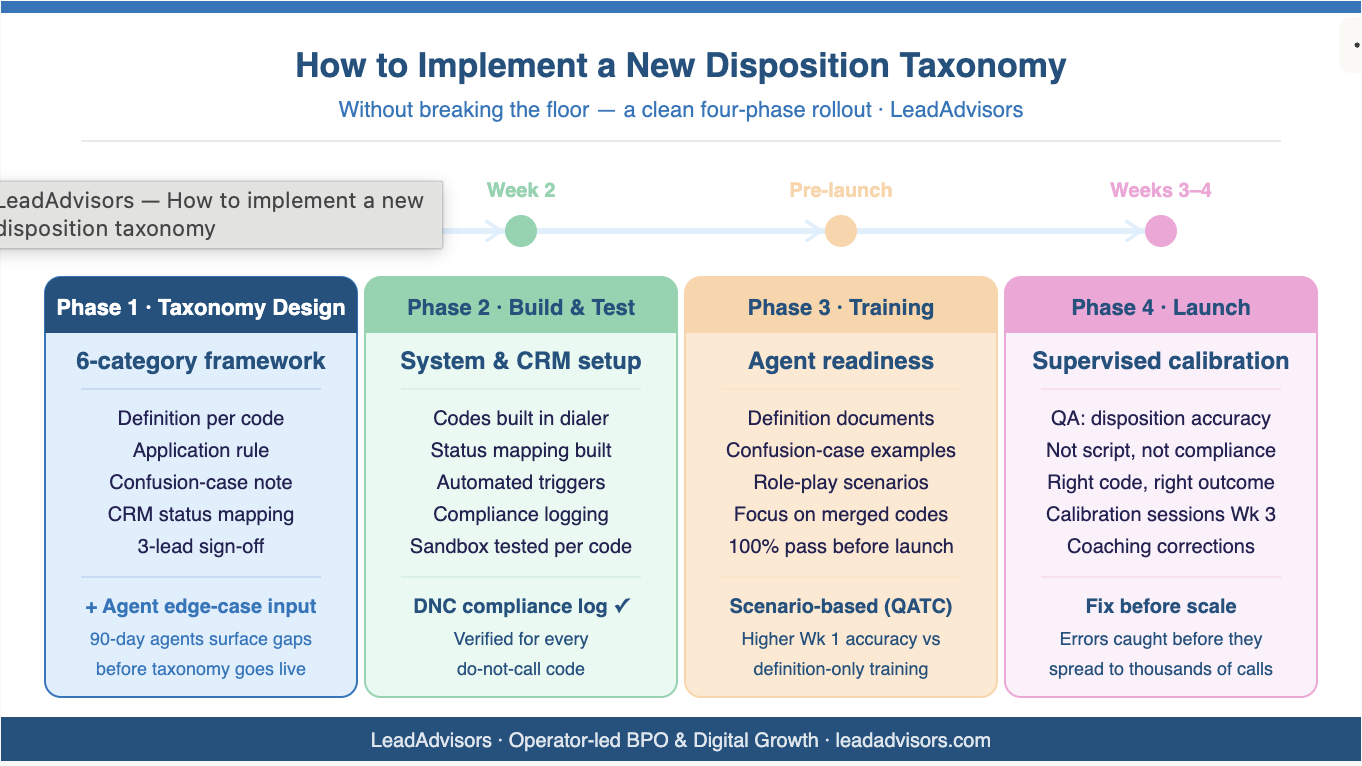
Switching to a new taxonomy on a live floor requires a plan. If old and new codes are mixed, the reporting baseline breaks down. A clean rollout is typically divided into four phases.
Phase 1 – Taxonomy Design (Week 1)
The full taxonomy is designed using the six-category framework. Three things are written for every code: a definition, an application rule, and a confusion-case note. Every code is mapped to a CRM status and a next-action trigger. Sign-off is obtained from the ops lead, the QA lead, and the compliance lead before anything is built.
At least one agent from each campaign should be included. Not to approve the design. But to surface edge cases. Agents who have worked the floor for 90 days know which call outcomes fall between the codes. Their input reveals the gaps before the taxonomy goes live.
Phase 2 – System Build and Testing (Week 2)
The new codes are set up in the dialer. The CRM integration is built: status mapping, automated triggers, and compliance logging. Every code is tested in a sandbox. The code is applied. The CRM status update is checked. The automated action is verified. For DNC codes, the compliance log entry is confirmed.
Phase 3 – Agent Training (Days Before Launch)
Every agent is trained on the new taxonomy. Definition documents and confusion-case examples are used. Role-play scenarios focus on the codes that replaced multiple older codes. These are the highest-risk points for mistakes. Every agent must apply each code correctly in training before launch.
On floors where this type of role-play training has been used – the kind of scenario-based approach backed by the Quality Assurance & Training Connection (QATC) – agents have been found to code calls far more accurately in week one than agents trained on definitions alone.
Phase 4 – Supervised Launch and Calibration (Weeks 3-4)
The new taxonomy is launched with QA sampling focused on one thing: disposition accuracy. Not compliance language. Not script adherence. It’s just whether the right code was applied to the right outcome. Calibration sessions in week three are used to find which codes are still being applied incorrectly. Coaching corrections are made before the errors spread across thousands of calls.
The Disposition Accuracy Audit – How to Evaluate Your Current Taxonomy
Before a taxonomy is redesigned, it should be audited. The goal is to find where bad data is being created. A 30-minute check across four areas has been found to reveal the problems.
Audit 1 – Code count and overlap test. All active codes in the dialer are listed. Codes that describe similar outcomes are grouped. If any group has more than three codes, there is overlap. If one code’s description sounds like another, mutual exclusivity is failing.
Audit 2 – Distribution analysis. The disposition breakdown for the last 30 days is pulled. Any code below 0.5% of total volume is likely redundant. Another code is capturing its outcomes. Any code above 40% is being used as a catch-all. That means it is too broad to be useful.
Audit 3 – Agent variance test. The code breakdown by agent for the same 30 days is pulled. Two agents on the same campaign should show similar patterns. If one has a 40% “Not Interested” rate and another has a 12% rate, the codes are not being applied consistently. The cause is either training or the taxonomy itself.
Audit 4 – Routing consequence check. For each code, one question is asked: What happens next? If the answer is “nothing” or “it depends on the agent,” the code is just a label. It does not trigger any action. Every code without a routing consequence is dead data.