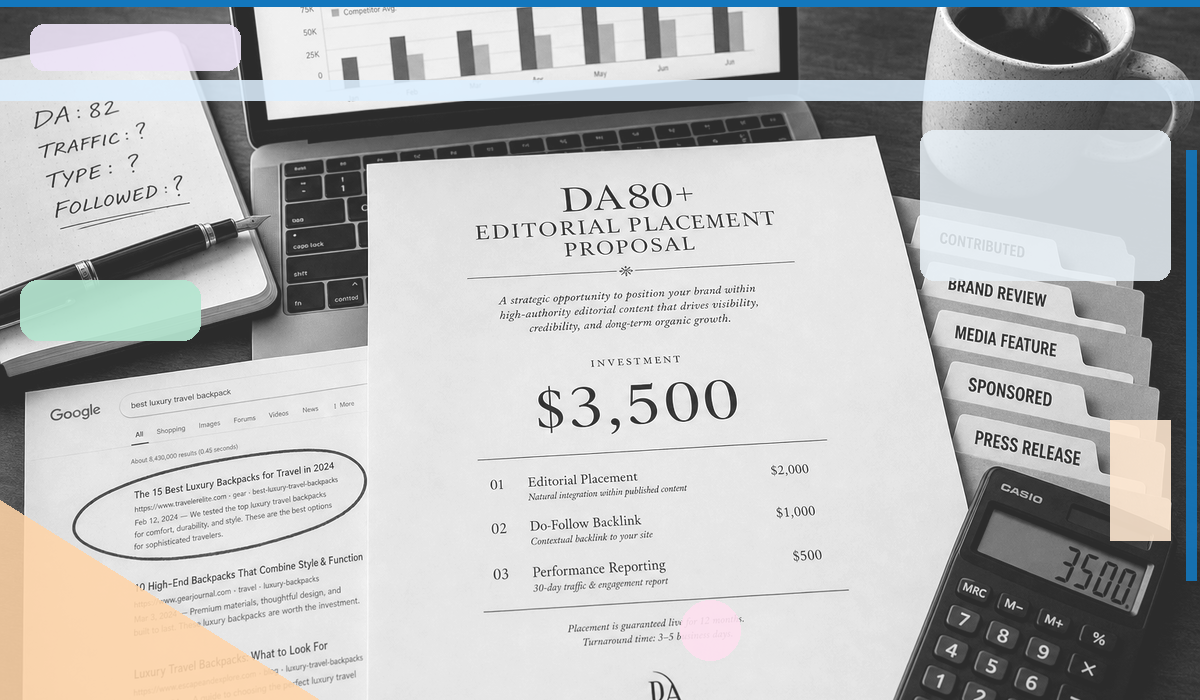
You received a proposal. An agency quoted $3,500 per editorial placement on DA80+ publications. The price is on the page. But is it fair? Is it too high? Is it a bargain? You can’t tell without more information.
Dozens of providers use the term “DA80+ editorial placement.” Prices range from $200 to $8,000 for what sounds like the same product.
According to a 2025 survey published by the Search Engine Journal, more than 61% of marketing decision-makers struggle to evaluate link-building proposals. Key quality indicators are rarely disclosed upfront. That confusion is not accidental. The term “editorial placement” covers five different products. Each has different quality signals. Each has a different price.
This guide explains all of it. By the end, you’ll know what a DA80+ editorial placement costs, what it produces, and how to evaluate any proposal before signing.


What Domain Authority Is and What DA80+ Actually Means
Domain Authority (DA) is a score created by Moz. It predicts how well a website will rank in search results. The scale runs from 0 to 100. It’s based on the number and quality of links pointing to that domain.
A DA80+ score puts a site in the top tier of all websites online. At this level, the site has built thousands of high-quality links through years of publishing and editorial coverage.
What DA80+ means in practice: Google treats content from these sites as highly credible. Links from DA80+ sites carry strong ranking weight. When a DA80+ publication mentions your company, that article usually ranks for your brand name within 30 to 60 days.
What DA80+ does not mean: A high DA score does not mean a site is credible. A DA80+ site could be a major media outlet with millions of readers. Or it could be a link network with no real audience. Both can score DA80+. The number alone won’t tell you which is which.
The Metric That Must Be Checked Alongside DA: Organic Traffic
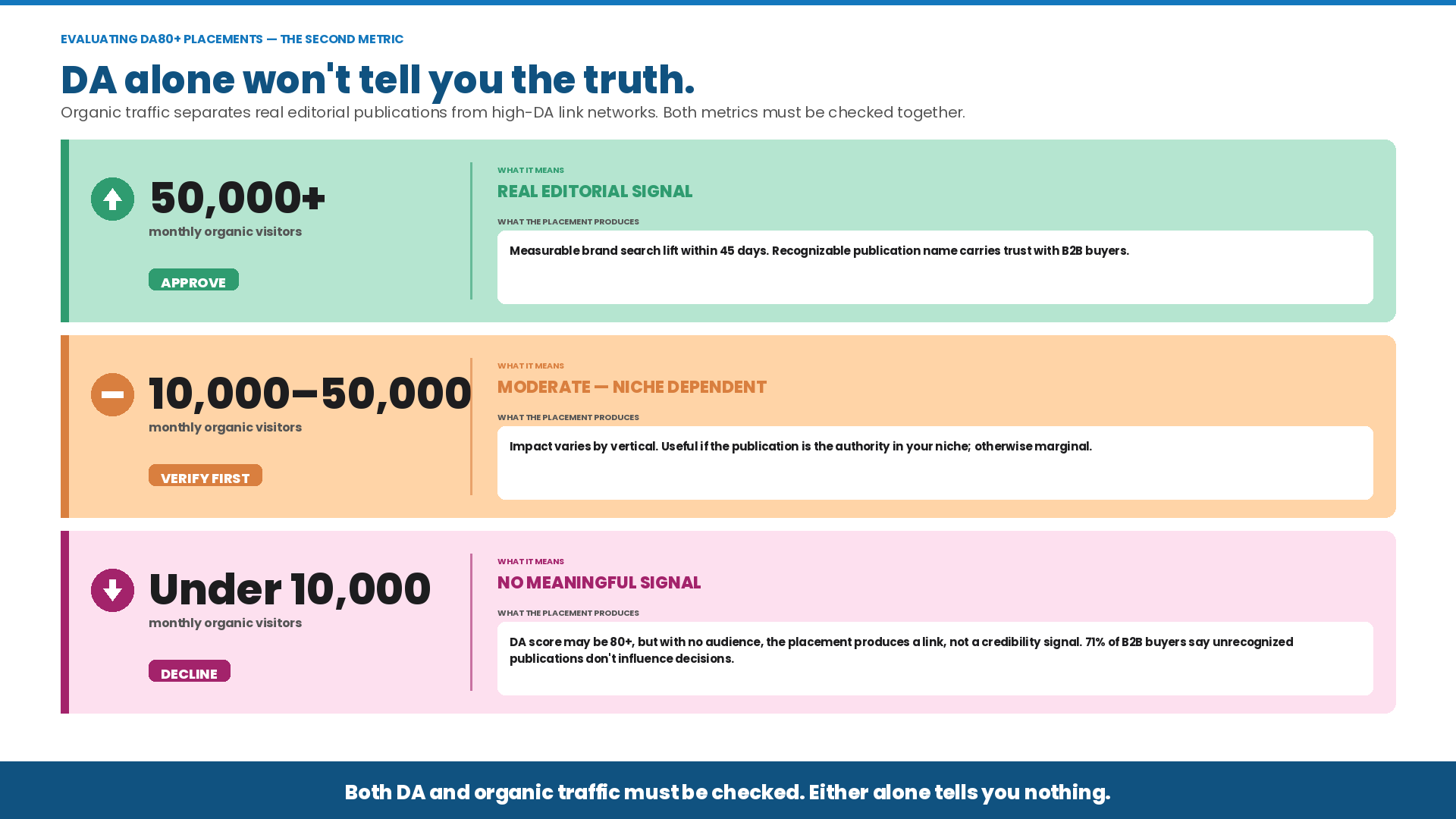
According to data compiled by Ahrefs in their 2025 State of Link Building report, organic traffic volume strongly predicts whether a placement will move brand search. Sites with 50,000 or more monthly visitors produced measurable brand search movement within 45 days. Sites with fewer than 10,000 monthly visitors produced no significant movement, regardless of their DA score.
What this means for any placement proposal:
- A DA80+ site with 50,000 or more monthly organic visitors is a real editorial publication with a real audience.
- A DA80+ site with 2,000 monthly visitors is technically high-authority but without meaningful readership.
- Both DA and organic traffic must be evaluated before approving any placement.
The Five Types of Editorial Placements
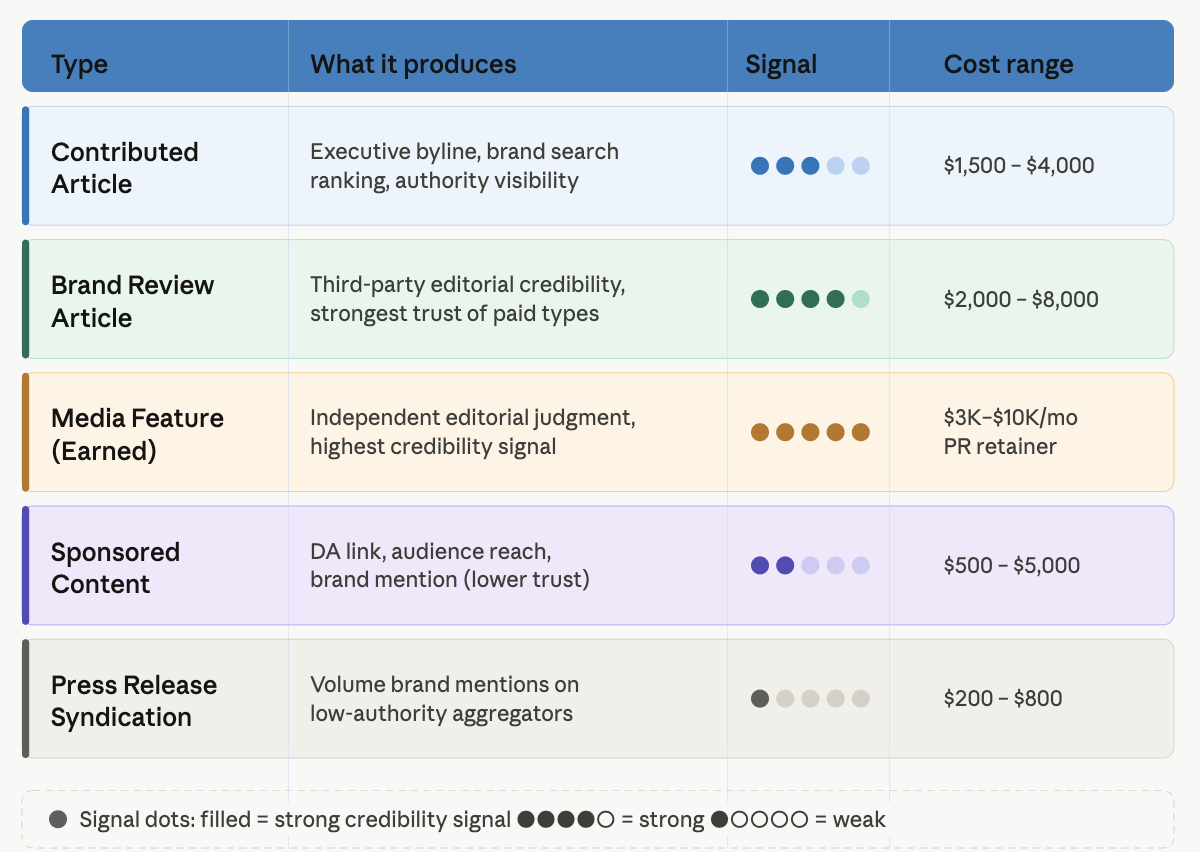
The term “editorial placement” refers to five different products. Each one produces a different credibility signal. Each carries a different price.
| Type | What It Produces | Cost Range |
| Contributed Article | Executive byline, brand search ranking, and authority visibility | $1,500 – $4,000 |
| Brand Review Article | Third-party editorial credibility, strongest trust signal of paid types | $2,000 – $8,000 |
| Media Feature (Earned) | Independent editorial judgment is the highest credibility signal | PR retainer $3,000 – $10,000/mo |
| Sponsored Content | DA link, audience reach, brand mention (lower trust due to label) | $500 – $5,000 |
| Press Release Syndication | Volume of brand mentions on low-authority aggregation sites | $200 – $800 |
Type 1: Contributed Article
You write an article, usually 800 to 1,500 words. It goes up under your executive’s byline on a recognized publication. The editorial team reviews it before it goes live. It builds visibility and creates a ranked article in brand search results.
The piece is labeled “contributed” or “opinion.” The cost range is $1,500 to $4,000 per placement for DA80+ publications. This works best for companies that want a named executive to build a publishing record on high-authority sites.
Type 2: Brand Review Article
The publication’s editorial team writes the article, not you. They evaluate your product or service independently. This carries a stronger signal of trust than a contributed article, because the publication authored it.
These are also known as affiliate editorial reviews or brand editorial reviews. The cost range is $2,000 to $8,000, depending on the publication. This is right for companies where prospects are researching but finding no independent validation.
Type 3: Media Feature (Earned Coverage)
A journalist covers your company as part of a broader story. You can’t buy this directly. It carries the strongest credibility signal because it’s fully independent. PR retainers of $3,000 to $10,000 per month are needed to pursue this, and no placements are guaranteed. This works for companies with a real news angle: a funding round, a product launch, or a strong business outcome.
Type 4: Sponsored Content
The article is published on a recognized site but labeled as “sponsored,” “advertiser content,” or “partner content.” You control what it says. It produces a DA link, audience reach, and a brand mention. The credibility signal is lower because readers can see the sponsored label. Cost range is $500 to $5,000 per placement. This is right for companies focused on reach and link equity over editorial credibility.
Type 5: Press Release Syndication
You write a press release and send it through a wire service. It gets published to hundreds of aggregation sites. Agencies often mislabel this as an editorial placement. It produces brand mentions across mostly low-authority sites. Prospects who research your company won’t find these credible. Cost range is $200 to $800 per release. This is for announcements and news, not brand credibility.
Before you approve a placement, confirm the type. A $3,500 quote for a brand review on a DA85 site with 200,000 monthly visitors is a strong value. A $3,500 quote for a contributed article on a DA82 site with 8,000 monthly visitors is an overpay. The number alone doesn’t answer the question. For a deeper look at how these types compare, see our guide to sponsored content, press releases, and guest posts.
Why the Price Range Is So Wide
Four variables determine where a placement falls in the $1,500 to $8,000 range.
Publication Tier and Audience Recognition
Forbes has a DA of around 95 and more than 100 million monthly visitors. A solid trade publication might have a DA of 82 and 50,000 monthly visitors. Both qualify as DA80+. But the difference in brand search impact and prospect recognition is significant.
According to a 2025 Nielsen Trust in Advertising report, 71% of B2B buyers said coverage on a publication they recognized influenced their decision to pursue a vendor. Coverage on a site they didn’t recognize had no measurable impact on purchase intent.
Placement Type
Brand review articles cost more than contributed articles at the same publication tier. The publication’s editorial team creates the content. That production cost and the independent credibility it creates are priced in.
Writing Included vs. Separate
A $2,500 quote that includes professional writing is a different product from a $2,000 quote in which you supply the article. Writing a 1,200-word piece that meets DA80+ editorial standards typically costs $400 to $900 when sourced separately.
Link Terms and Republication Rights
Whether the link is followed or nofollow matters, so does whether you can republish the article on your own site. These terms affect the full value of your investment.
Red flags in any proposal, regardless of quoted price:
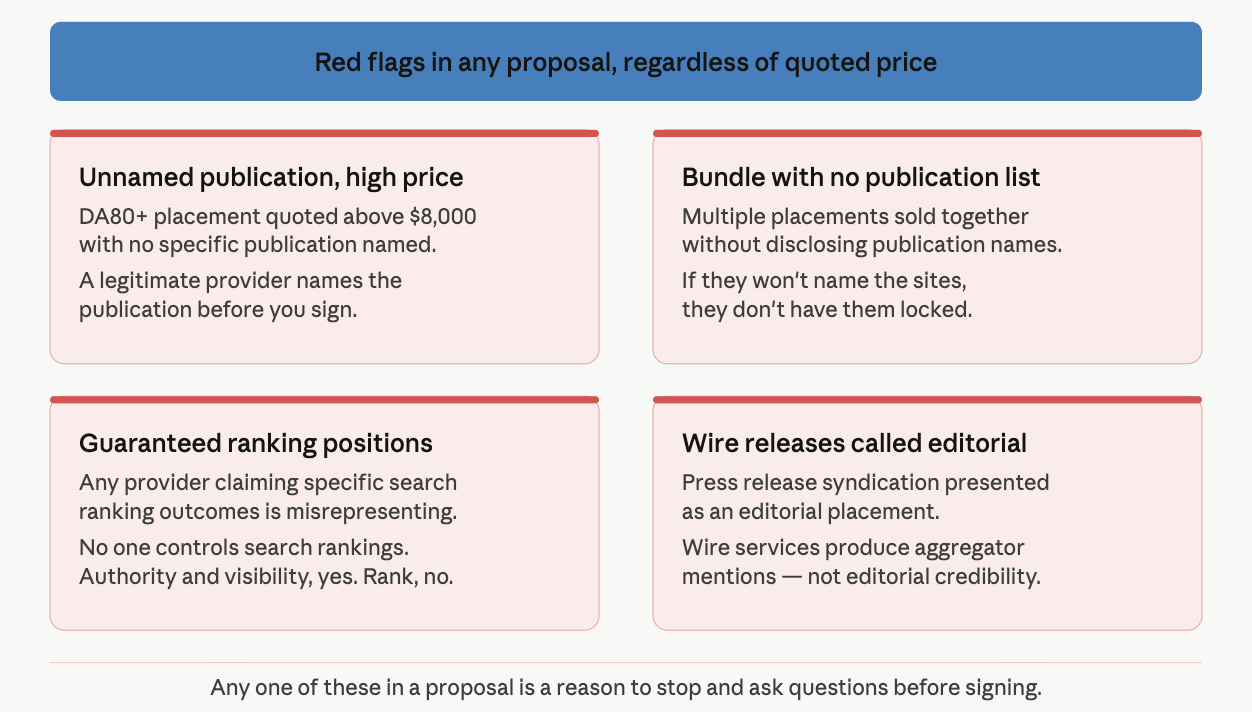
- A DA80+ placement quoted above $8,000 with no specific publication named
- A bundle of multiple placements without publication names disclosed before signing
- A guarantee of specific ranking positions: no legitimate provider can guarantee search rankings
- Wire service press releases are described as editorial placements
How to Evaluate a Specific Publication Before Approving a Placement
Five criteria help you evaluate any publication before committing to the budget.
Organic Traffic Volume and Trend
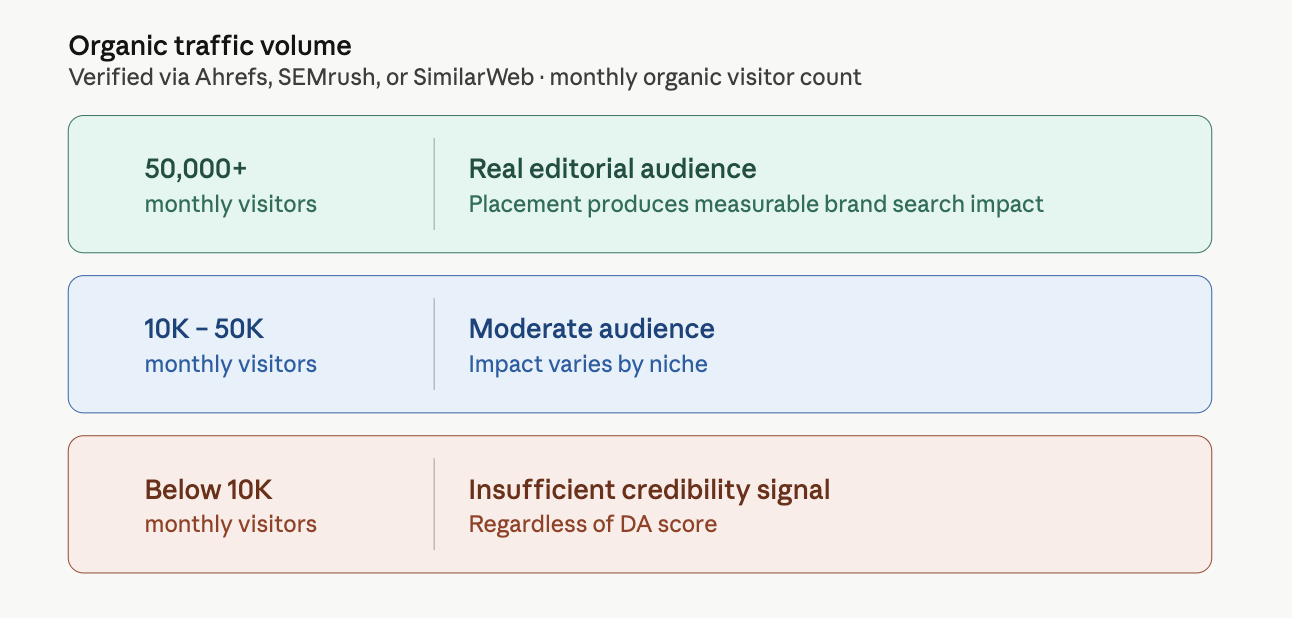
Tools such as Ahrefs, SEMrush, and SimilarWeb are used to verify monthly organic visitor counts.
- 50,000+ monthly organic visitors: Real editorial audience. Placement produces measurable brand search impact.
- 10,000 to 50,000 monthly visitors: Moderate audience. Impact varies by niche.
- Below 10,000 monthly visitors: Insufficient credibility signal regardless of DA score.
Prospect Recognition Test
Show the publication name to someone who represents your actual buyer. If they recognize and respect it, the placement carries credibility. If they don’t, the placement produces a link but no brand trust with the people who matter.
Editorial Standards Visible in Existing Content
Read ten articles in the publication. Well-sourced, edited, substantive content signals real editorial standards. Thin or keyword-stuffed articles signal a link network or content farm, regardless of the DA score. Strong publications follow E-E-A-T principles: experience, expertise, authoritativeness, and trustworthiness.
Disclosure and Labeling Practices
Check how the publication labels contributed content, sponsored content, and independent editorial. Clear disclosure practices signal higher credibility. Vague or missing labels are a warning sign.
Existing Coverage of Companies in the Same Vertical
Has the publication covered recognized companies in your industry before? If yes, it signals authority in that space. That context makes your coverage more credible to prospects who are researching.
The ROI Calculation: What a DA80+ Placement Produces Over 12 Months
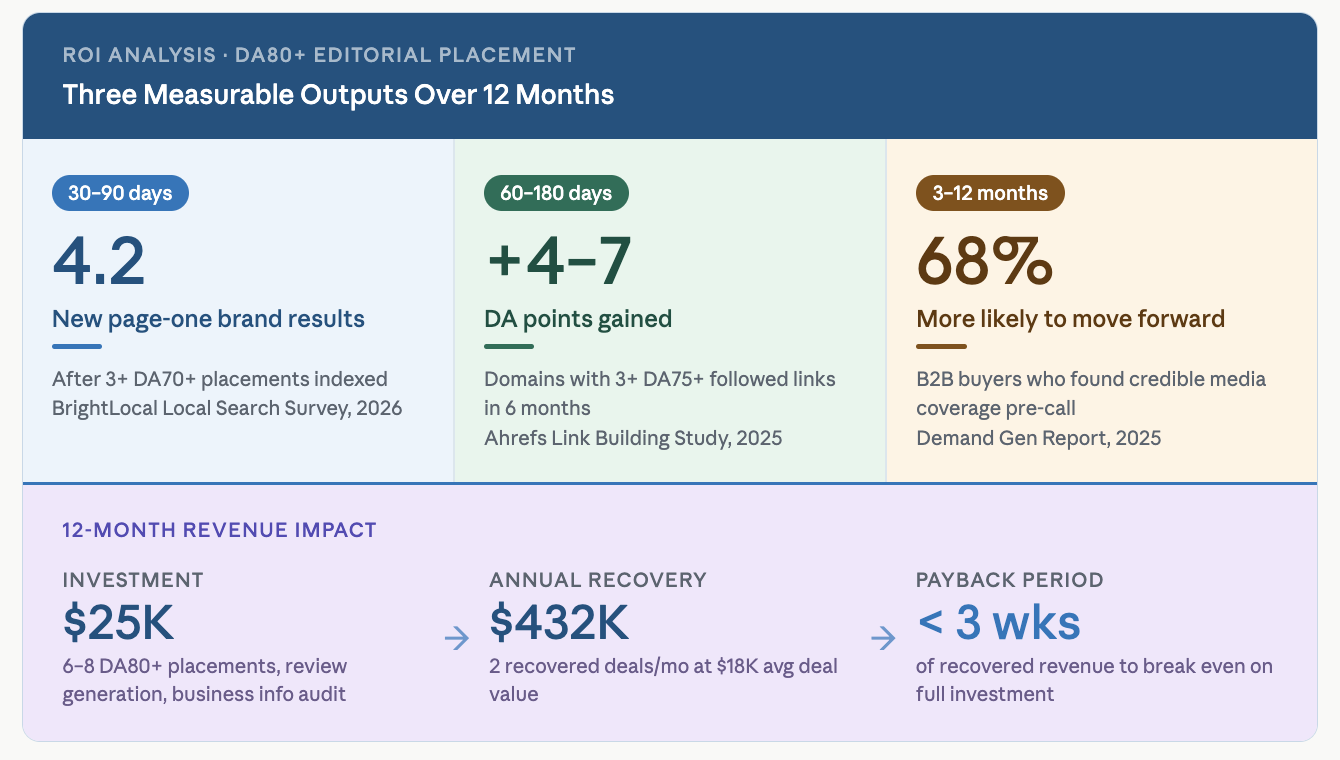
A successful DA80+ editorial placement, as part of a broader SEO strategy, produces three measurable outputs. Each one is trackable.
Brand Search Result Improvement (Measurable in 30 to 90 Days)
Within 30 to 60 days of indexing, the placement article typically ranks for your brand name. According to a 2026 analysis by BrightLocal’s Local Search Industry Survey, businesses that secured three or more editorial placements on DA70+ publications saw an average of 4.2 new branded search results on page one within 90 days of the final placement going live. Check this by searching your company name in an incognito browser before and after the placements are indexed.
Domain Authority and Link Equity (Measurable in 60 to 180 Days)
A followed link from a DA80+ publication passes link equity to your domain. Ahrefs’ 2025 Link Building Study found that domains that acquired three or more DA75+ followed links within six months saw an average DA increase of 4 to 7 points within 180 days. The value compounds. Each placement strengthens your domain authority and builds long-term brand equity. That improves rankings for all your content, not just brand name searches.
Conversion Rate Improvement on Brand-Researched Prospects (Measurable in 3 to 12 Months)
Prospects who search your company name before reaching out convert at higher rates when they find credible editorial results. According to a 2025 Demand Gen Report survey, 74% of B2B buyers search a vendor’s name before their first sales call. Of those, 68% said finding credible media coverage made them more likely to move forward.
A $25,000 brand credibility investment covering 6 to 8 DA80+ placements, review generation, and a business information audit that recovers 2 lost deals per month at an $18,000 average deal value, produces $432,000 in annual revenue recovery. The payback period is under three weeks of recovered revenue.
What to Ask Before Signing a Placement Proposal
Use these six questions to evaluate any editorial placement proposal before committing to the budget.
| Question | Right Answer | Wrong Answer |
| Can specific publication names be provided before signing? | Yes, with DA and organic traffic data attached. | “A network of DA80+ publications.” |
| Is this contributed content, a brand review, sponsored content, or press release syndication? | A specific type with labeling practices explained. | “An editorial placement.” |
| Is writing included in the quoted price? | Clearly stated either way. | Vague or omitted. |
| What is the publication’s organic traffic? | A specific number from Ahrefs, SEMrush, or SimilarWeb. | Estimated or unverified. |
| Are the links followed or nofollow, and what are the republication rights? | Followed the link and confirmed. Republication rights specified. | Unclear or omitted. |
| Is a placement report provided confirming publication and indexing? | Yes: URL, publication date, and indexing status confirmed. | No formal confirmation process. |