Your pipeline is stalling because your funnel was built for a single buyer, not a committee. Paid search is running, content is published, outbound is sending, and meetings are still being booked. But deals die when security, finance, and procurement enter the room.
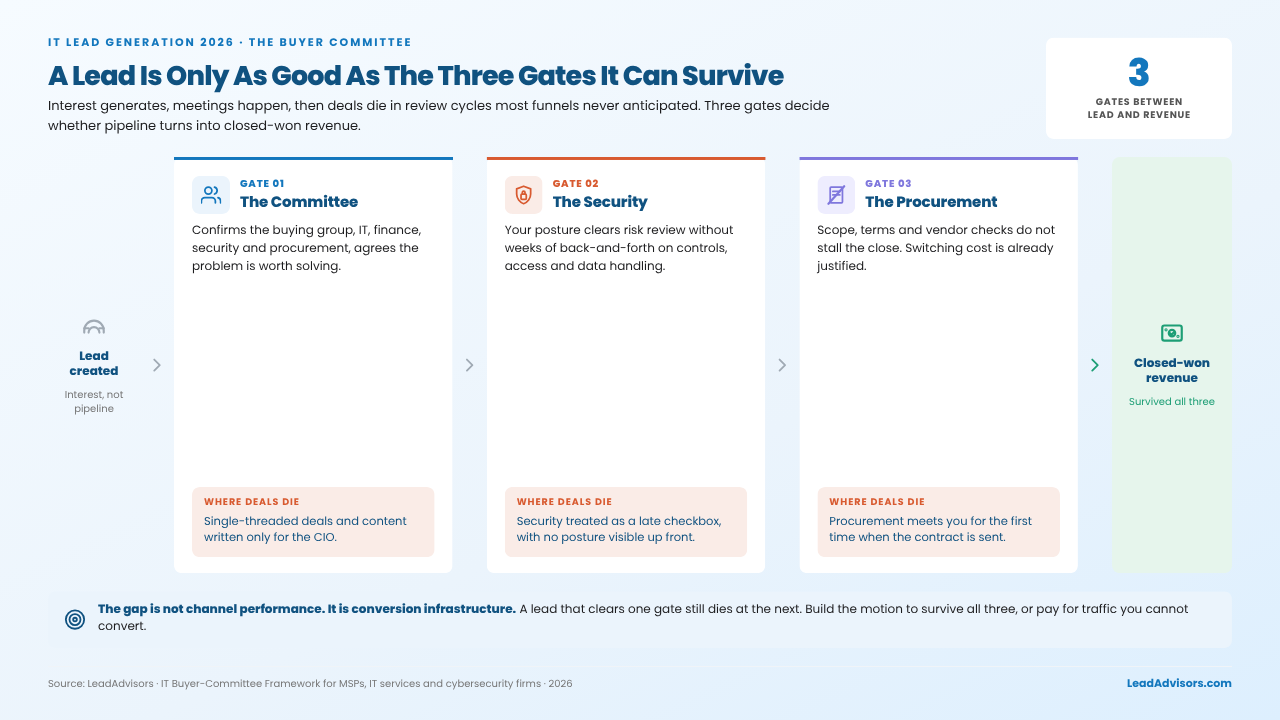
The 2026 IT buying motion runs through three gates, not one. The committee gate requires the full buying group to agree that the problem is worth solving. The security gate demands that your posture clear risk review without weeks of back-and-forth. The procurement gate means scope, terms, and vendor risk checks cannot stall the close.
If your funnel is optimized for the first click, you will keep generating interest that never becomes revenue. A lead is not good because it filled out a form. A lead is good if it survives all three gates and moves toward a closed win.


How IT Buying Behavior Shifted Between 2022 and 2026
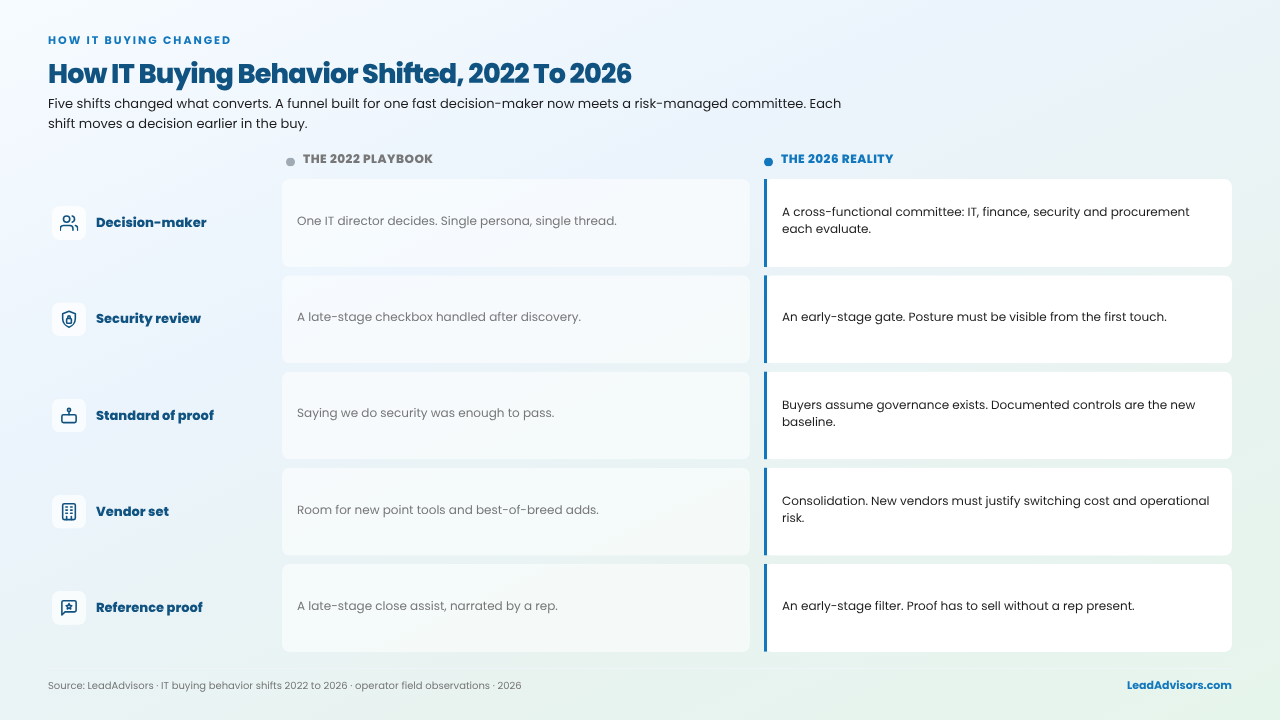
Operators running lead generation for IT companies are dealing with an evaluation process that is slower, more risk-managed, and more committee-driven than most “lead gen” playbooks were built for.
Five shifts matter because they change what converts.
Shift 1: Buying Committees Got Bigger and More Cross-Functional
IT services purchases are rarely “one person decides.” Even mid-market deals pull in technical, financial, security, and operational stakeholders.
In practice, here is what shows up on real deals:
- IT leadership evaluates capability and architecture fit
- Finance evaluates total cost and budget tradeoffs
- Security evaluates risk, controls, and vendor maturity
- Procurement evaluates contract structure, terms, and vendor viability
When your marketing only speaks to “IT director pain,” you miss the people who can stop the deal.
What this changes in practice:
- Your content has to speak to multiple roles, not one persona
- Your sales motion has to be multi-threaded early, not single-threaded late
- Your follow-up and nurture have to survive handoffs between stakeholders over months
Shift 2: Security Is Now an Early-Stage Gate, Not a Late-Stage Checkbox
If you sell MSP services, cybersecurity services, or any IT service that touches systems, networks, data, or compliance, security evaluation is part of the buying process, not an add-on.
Government procurement guidance makes the direction obvious. The U.S. Department of Energy’s “Cybersecurity Considerations for Procurement” guidance is a clear example. It calls out bringing cybersecurity in from the start to reduce risk later.
For IT services operators, the implication is simple. If you wait to “handle security” after discovery, you are already late. Your posture needs to be visible from the first touch.
What security stakeholders usually want early:
- What you access, what you store, and what you never touch
- Your control stack (MFA, least privilege, monitoring, logging, incident response)
- Your third-party risk posture (subprocessors, remote access tools, data handling)
- Your audit artifacts, or equivalent proof paths
Translation for IT lead generation:
- If your first impression is only “capability,” you will lose later on “risk”
- If your content does not surface posture and process, security stakeholders will assume you do not have it
Shift 3: AI Raised the Baseline for “Proof,” Not Just “Speed”
AI is accelerating research, but it is also amplifying uncertainty. Buyers can gather more information faster, but they still need validation.
The World Economic Forum’s Global Cybersecurity Outlook 2026 shows how quickly security governance expectations are moving. It notes a jump in the number of organizations assessing AI tool security from 2025 to 2026, signaling that evaluation and governance are becoming standard operating procedure rather than optional.
That trend matters even if you do not “sell AI.” Buyers now assume governance exists. They will ask:
- How do you control access across your team
- How do you ensure consistency across delivery
- How do you handle incidents, audits, and reporting
If you cannot answer those in a credible, documented way, you will get treated like a vendor, not a partner.
For IT services, this means:
- Buyers will ask more questions earlier
- “We do security” is not a differentiator; documented controls are
Shift 4: Vendor Consolidation Is Compressing the Consideration Set
Mid-market and enterprise IT teams are actively trying to reduce vendor sprawl. That creates two pressures at once:
- Buyers prefer integrated partners that they can standardize on
- New vendors must justify switching costs and operational risk
This is where generic “we do everything” positioning fails.
If you want to win in a consolidation environment, you need to be explicit about:
- What you replace
- What you integrate with
- What you own operationally
- What your customer does not have to manage anymore
Shift 5: Reference and Peer Proof Move Earlier
Because buyers prefer to self-serve, proof has to exist without a rep narrating it. That means your reference engine, case studies, and third-party validation do more of the selling than they did two years ago.
The practical shift is that reference is no longer a late-stage “close assist.” It is an early-stage filter.
If your site has no credible proof path, your leads will look like this:
- requests for pricing, then silence
- “Send info,” then no follow-up
- early calls that never turn into a second meeting
IT Lead Generation Channels That Work in 2026
There is no single best channel for IT sales lead generation. The right mix depends on ACV, buyer type, and whether you sell MSP services, IT consulting, cybersecurity, or IT staffing.
The channels below consistently show up in real IT buying paths.
Channel 1: Technical Content Marketing and SEO
This is the core inbound engine for IT lead generation because buyers research before they talk.
The goal of content is not traffic. The goal is shortlist placement.
The easiest way to align content with the buying committee is to build a content set that maps to roles:
- IT leadership: architecture, migration plans, tooling choices, delivery models
- Security: controls, risk posture, security implementation, vendor access boundaries
- Finance and procurement: ROI logic, scope clarity, contract models, delivery accountability
When you do this well, you do not just rank for “IT lead generation.” You rank for the real research queries that happen before vendor contact.
What works in 2026:
- Implementation guides written at an operator level
- Security and compliance pages that answer stakeholder questions
- Honest comparisons and “when we are not a fit” sections
- Verticalized pages that match how buyers search (healthcare IT, manufacturing IT, financial services IT, and so on)
Execution rules:
- Content must be written for committee roles, not just “the CIO”
- The first screen must answer the question and show proof
If you need help building the SEO engine behind this, see LeadAdvisors SEO services.
To turn “content” into rankings and demand, the missing layer is usually brand-authority SEO, compounding link equity, and proof that makes your pages credible in competitive SERPs.
Channel 2: Analyst, Association, and Industry Publication Coverage
For higher-ACV IT services, credibility and de-risking are a sourcing mechanism. Third-party coverage creates shortlists.
Treat coverage as a distribution channel for proof, not branding.
The asset types that tend to convert into IT services:
- a credible case study with constraints, timeline, and outcome
- a security posture overview that security teams can accept as a starting point
- a comparison that helps a buyer justify why “switching” is worth the risk
The win condition:
- Your name shows up where the buyer already trusts the filter
Channel 3: Targeted Outbound to Named Account Lists (ABM)
Outbound works for high-ACV IT services when built around account intelligence, role mapping, and a conversion infrastructure that can withstand long cycles.
Outbound that works in IT is not volume-first. It is precision-first.
Minimum viable outbound for IT services:
- Pick a narrow ICP (vertical, size, stack)
- map the likely committee roles
- lead with one problem you can prove you solve
- follow with proof artifacts, not a calendar link
What fails:
- Generic “IT services lead generation” sequences sent to one contact
What works:
- One account, multiple stakeholders, role-specific messaging
- A posture-first follow-up track for security and procurement
If you need IT-trained outbound capacity, appointment setting for B2B teams is the fastest way to add meetings without having to hire and train a full SDR pod.
If your outbound motion is already running but contact rates are low, outbound calling support is often the lever that stops the pipeline from leaking at the first touch.
Channel 4: Reference Customer Programs (Structured)
Reference is a channel and a conversion lever.
In IT, reference is not “nice to have.” It is often the only way to de-risk switching.
Build it like a system:
- Maintain a bench of reference-ready customers by use case and vertical
- Rotate references to avoid fatigue
- Turn reference stories into content assets that show process, not just outcomes
If you want this to scale, the reference system needs a simple operating rule:
- One reference story becomes three assets (case study, sales deck proof slide, security-ready implementation summary)
Channel 5: Conferences and Local IT Events
Events work when the prospect already knows you. They are not a cold-start engine anymore.
The conversion model is:
- Content creates awareness and trust
- outbound and nurture the warm account
- Events convert the warm account into multi-threaded meetings
Use events for:
- Converting “research-stage” buyers into conversations
- Deepening trust with procurement and security stakeholders
Channel 6: Community and Peer Network Engagement
Communities are where IT buyers validate decisions. Engagement here is slow, but it compounds.
If you are serious about community, treat it like a long-term trust asset.
What works:
- consistent presence from practitioners
- answering questions with constraints, not hype
- sharing implementation insights without turning every comment into a pitch
Rule:
- Show up as a practitioner, not as an ad
The Conversion Infrastructure That Determines IT Lead Conversion
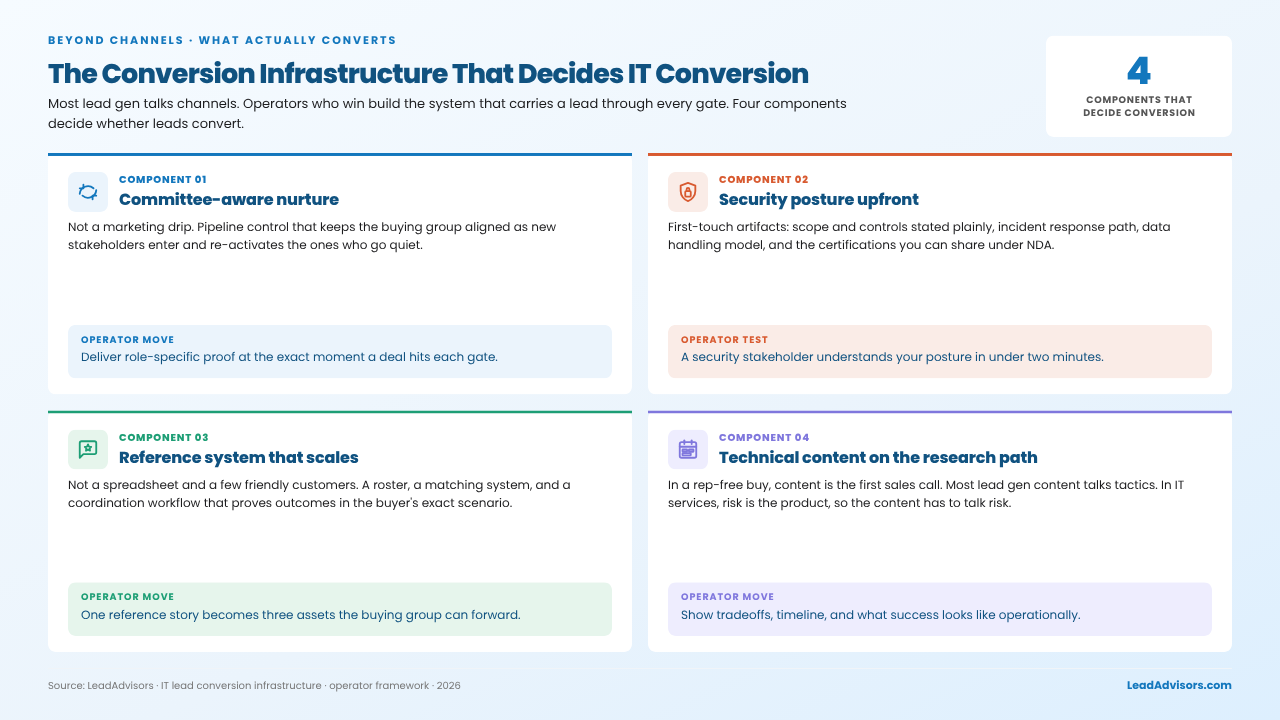
Most IT lead generation companies talk about channels. Operators who win focus on conversion infrastructure.
Four components decide whether your leads convert.
Component 1: Multi-Touch Nurture Built for Buying Committees
If you stop at a short nurture sequence, you will lose the deal to time and committee drift.
In IT services, nurture is not a marketing drip. It is pipeline control.
Your nurture should be designed to do two things:
- Keep the buying group aligned as new stakeholders enter
- Keep proof available at the exact moment the deal hits a gate
Examples of “gate content”:
- security posture overview
- reference-ready implementation story
- scope and delivery model one-pager
Your nurture has to:
- Deliver role-specific proof
- Keep a multi-month evaluation moving forward
- Re-activate stakeholders who go quiet
Component 2: Security and Compliance Posture That Surfaces Upfront
This is where most IT services lead gen breaks.
You need “first-touch” artifacts such as:
- Security overview page that states the scope and controls plainly
- Incident response posture and escalation path
- Data handling model (what you access, what you store, and what you do not)
- Any relevant certifications, audits, or third-party assessments you can share under NDA
Tie this back to procurement reality: the U.S. Department of Energy’s cybersecurity procurement guidance treats cybersecurity involvement as an early procurement decision point, not a late-stage review.
If you want a simple operator test, it is this:
- Could a security stakeholder land on your site and understand your posture in under two minutes?
If the answer is no, you are paying for traffic you cannot convert.
Component 3: Reference Infrastructure That Scales
A reference program is not a spreadsheet and a few friendly customers.
It is:
- A process
- A roster
- A matching system
- A coordination workflow
Without it, you will lose late-stage deals to competitors that can prove outcomes in your buyer’s exact scenario.
Reference execution that works:
- Pre-brief the reference with the buyer context
- Make the call about operational reality, not marketing claims
- Follow with a written implementation summary, and the buying group can forward it internally
Component 4: Technical Content That Matches the Research Path
In a rep-free world, your content is the first sales call.
Your content has to do the job a rep used to do:
- clarify tradeoffs
- explain implementation risk
- show timeline and resourcing
- show what “success” looks like operationally
This is where most “lead generation services” content fails. It talks about tactics. It does not talk about risk.
In IT services, risk is the product.
IT Lead Generation Benchmarks in 2026
Benchmarks vary widely by ACV, vertical, geography, and service type. Use benchmarks to diagnose, not rationalize.
Here is the operator’s way to benchmark:
- Stage conversion rates (lead to qualified opportunity, opportunity to close)
- Cycle time by ACV band
- Security gate pass-through (how often you clear security review once it starts)
- Reference conversion (close rate for deals that complete references)
If you track only CPL, you will optimize for cheap leads that do not survive committee and security review.
Add one more benchmark that operators miss:
- Time-to-multi-thread: how long it takes you to get more than one stakeholder engaged in the deal
If it takes you 60 days to multi-thread, you are losing deals to internal politics, not competitors.
Common IT Lead Generation Mistakes
Mistake 1: Running a 2020 Demand Gen Playbook in a 2026 Buying Environment
If your model assumes fast cycles and a single buyer, your conversion will be compressed as soon as procurement and security enter the process.
The visible symptom is “more leads, same revenue.”
The cause is that you are optimizing for the wrong outcome. You are optimizing for meetings, not for gate clearance.
Mistake 2: Treating Security as a Late-Stage Conversation
Security is now a marketing problem and a sales problem because it is part of qualification.
If your security posture is not visible, buyers will assume it is weak.
Mistake 3: Single-Threading the Deal
One champion is not enough. Multithread early, or you will get blocked late.
If you want one sentence to guide your sales process, use this:
- If procurement does not know you exist until the contract is sent, you are late.
Mistake 4: Paid Search Dependency Without Trust Infrastructure
Paid can capture intent, but it cannot replace proof. If your site does not show posture and references, you will pay for traffic you cannot convert.
Paid works best in IT when:
- It is paired with technical content that answers research questions
- It routes buyers into proof assets, not just lead forms
Mistake 5: Generic Outbound to IT Stakeholders
If your outbound cannot speak to security, procurement, and operational risk, you will not get past the first reply.
Generic outbound gets replies. It does not get deals.
If you are deciding whether to build internally or outsource SDR execution, read In-House SDR vs. Outsourced BPO.
Build In-House Vs Outsource IT Lead Generation
This is the question behind “Is lead generation worth it?” for most operators. It is worth it when the system is built to match the buying environment.
Build In-House When
- You have internal technical SMEs who can produce real technical content
- You have sales leadership capable of multi-threading committee deals
- You can maintain a reference program with real operational ownership
If you do not have these, outsourcing “lead gen” will not fix the problem. It will scale the problem.
Outsource When
- You need a pipeline now, and your internal SDR function is not IT-trained
- You need technical content volume beyond internal capacity
- You need coordinated execution across SEO, outbound, and nurture
Outsourcing works when it plugs a capability gap, not when it replaces accountability.
If you are weighing outsourcing, start with outsourcing lead generation to see where it helps, where it falls short, and what a hybrid model looks like in practice.
The Hybrid Model (Common at Mid-Market Scale)
In-house owns:
- positioning
- technical SME knowledge
- reference relationships
Outsourced teams own:
- outbound execution
- production capacity
- campaign coordination
The reason hybrid wins is simple. The highest-leverage inputs stay internal. The throughput gets scaled.
If your bottleneck is speed and consistency, sales automation can tighten response time, routing, and follow-up so leads do not die between form fill and the first real conversation.