Most “best lead generation companies” lists create the wrong shortlist.
They compare data tools, marketing agencies, pay-per-lead vendors, AI platforms, and managed operators as if they solve the same problem.
That mistake burns the budget. The wrong vendor can produce leads that never answer, appointments that never show, or reports that hide weak conversion.
The fix is category-first evaluation.
This guide shows how to match the vendor model to your sales motion, then test each company against operational depth, reporting, compliance, and pilot performance. Start with the foundational lead generation framework before comparing vendors.


Why “Best Of” Lists Mislead Most Buyers
Most “best lead generation companies” articles fail because they rank vendors based on incompatible models.
A data provider is not a managed dialing operation. A marketing agency is not a pay-per-lead vendor. An AI tool is not a substitute for QA, supervisors, scripts, compliance, and reporting.
That creates false confidence.
Sponsored Rankings Distort the Market
Many vendor comparison pages are built around affiliate relationships, paid placements, or vendor-submitted information. The FTC endorsement and testimonial guidance are a useful reminder that commercial relationships need clear disclosure.
That does not make every list useless. However, it means buyers should not treat a generic ranking as due diligence.
Reviewers Usually Miss Operator Metrics
Most reviewers evaluate vendor websites, pricing pages, case studies, and sales materials.
Operators evaluate different signals:
- Contact rate
- Qualified rate
- Show rate
- Transfer quality
- Opportunity-to-deal conversion
- Cost per closed deal
- Compliance process
- QA cadence
- Supervisor coverage
- Reporting transparency
Those metrics expose whether a vendor is building a pipeline or reporting activity.
Category Mismatch Causes Bad Buying Decisions
A company with no internal outbound team should not buy only a data platform.
A sales-led B2B company should not choose a general marketing agency if it needs dedicated setters, call QA, and daily contact-rate reporting.
A high-compliance financial services buyer should not choose a pay-per-lead vendor without tight TCPA, DNC, consent, and lead-source documentation in place.
Therefore, category fit comes before vendor fit.
The Five Vendor Categories Most Buyers Confuse
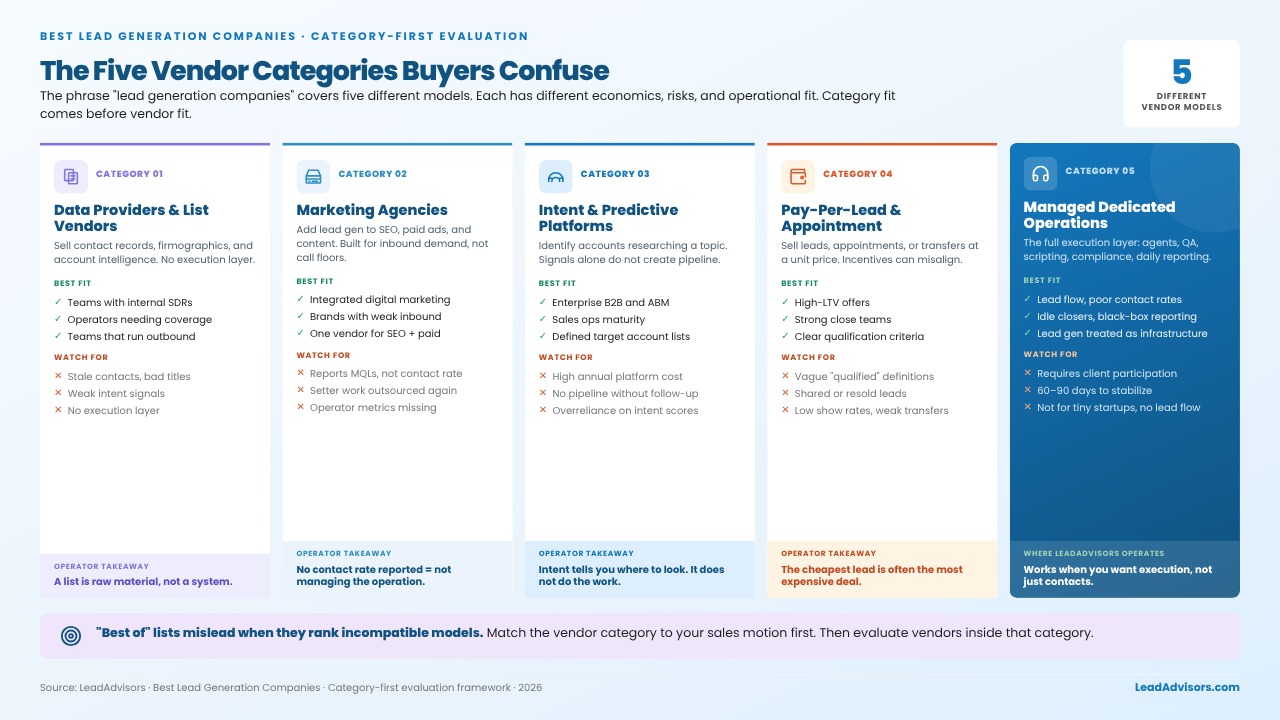
The phrase “lead generation companies” covers five different vendor categories.
Each category has different economics, risks, and operational fit.
1. Data Providers and List Vendors
Data providers sell contact records, firmographic data, and account intelligence.
They help internal teams find prospects. However, they do not run the lead generation operation for you.
Examples include contact data platforms, sales intelligence tools, and list vendors. Buyers should separate this category from the software tools category for lead generation.
Best fit:
- Companies with internal SDRs or sales reps
- Teams that already know how to run outbound
- Operators that need better data coverage
Common risks:
- Stale contacts
- Bad job titles
- Poor email accuracy
- Weak intent signals
- No execution layer
Operator takeaway: A list is not a lead generation system. It is a raw material.
2. Marketing Agencies Offering Lead Gen
Marketing agencies often add lead generation to a broader service mix.
They may run SEO, paid ads, landing pages, email campaigns, content, and conversion tracking. That can work when the buyer needs a full inbound demand system or needs to understand how to generate leads at scale.
However, many agencies are not built to manage outbound call floors, appointment setters, live transfers, or daily QA.
Best fit:
- Companies that need integrated digital marketing
- Brands with weak inbound demand
- Teams that want one vendor for SEO, paid media, and conversion assets
Common risks:
- Lead gen is a service line, not the core operation
- Reporting focuses on MQLs, traffic, or form fills
- SDR or setter execution may be outsourced again
- Operator metrics may be missing
Operator takeaway: If the vendor cannot report contact rate, qualified rate, and show rate, it is not managing the full lead-generation operation.
3. Intent Data and Predictive Lead Platforms
Intent platforms identify accounts that may be researching a topic, category, or competitor.
They are useful for mature B2B teams with an account-based marketing infrastructure. However, signals alone do not create a pipeline. Gartner’s B2B buying research also shows why buyers need the right mix of digital and human interaction across complex sales journeys.
Someone still has to turn the signal into outreach, conversations, qualification, and sales opportunities.
Best fit:
- Enterprise B2B sales teams
- ABM programs
- Companies with sales operations maturity
- Teams with defined target account lists
Common risks:
- High annual platform cost
- Overreliance on intent scores
- Weak execution after account identification
- No pipeline without sales follow-up
Operator takeaway: Intent data tells you where to look. It does not do the work.
4. Pay-Per-Lead and Pay-Per-Appointment Vendors
Pay-per-lead vendors sell leads, booked appointments, transfers, or qualified opportunities at a unit price.
This model can work when the qualification definition is tight, and the buyer has strong unit economics.
However, it can also create misaligned incentives. The vendor gets paid for volume. The buyer gets paid only when leads convert.
Best fit:
- High-LTV offers
- Buyers with strong close teams
- Companies that can absorb quality variance
- Campaigns with clear qualification criteria
Common risks:
- Vague “qualified lead” definitions
- Shared or resold leads
- Low show rates
- Poor transfer quality
- Incentives that reward volume over revenue
Operator takeaway: The cheapest lead is often the most expensive closed deal.
5. Managed Dedicated Lead Generation Operations
Managed dedicated operations provide the full execution layer.
That can include agents, supervisors, QA, scripting, multi-channel follow-up, daily reporting, compliance workflows, and performance reviews. This is the operating layer behind the fundamentals of lead generation outsourcing.
This is the category LeadAdvisors operates in.
Best fit:
- Companies treating lead generation as infrastructure
- Mid-market and enterprise teams
- Buyers with existing lead flow but poor contact rates
- Sales floors with idle closers
- Agencies that need white-label fulfillment
- Operators that need daily visibility
Common risks:
- Requires client participation
- Needs clear scripts, feedback loops, and list quality checks
- Takes 60–90 days to reach stable performance
- Not ideal for very small startups with no lead volume
Operator takeaway: Managed dedicated operations work when the buyer wants execution, not just contacts.
The Lead Generation Vendor Evaluation Matrix
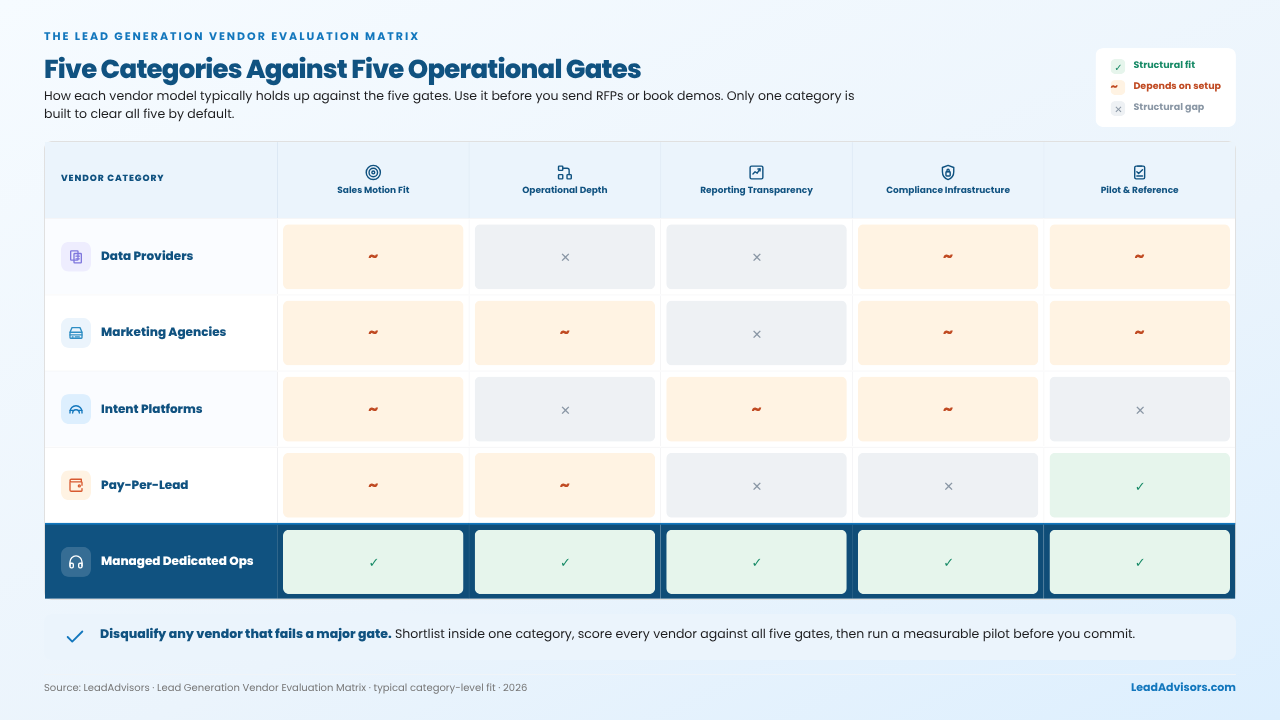
The Lead Generation Vendor Evaluation Matrix compares vendor categories against five operational gates.
Use it before you send RFPs, book demos, or compare proposals.
Gate 1: Sales Motion Fit
The vendor must match how your company sells.
Transactional home services operate on a different model than enterprise SaaS. A mortgage campaign needs different compliance controls than a B2B manufacturing campaign. A legal intake operation needs different scripting than a roofing appointment campaign.
That is why vendor selection should begin with the operational distinctions among operators, agencies, and consultants.
Ask:
- Is the sale inbound, outbound, or multi-channel?
- Is the buyer B2B or B2C?
- Is the sales cycle days, weeks, or months?
- Does the offer require phone, SMS, email, chat, or all four?
- Does the vendor understand the vertical?
If the vendor cannot explain your sales motion, it cannot build the right system.
Gate 2: Operational Depth
Strong lead generation requires more than reps making calls.
You need a system.
That system includes:
- Agent hiring
- Training
- Roleplay
- Script control
- Supervisor coverage
- QA reviews
- Compliance monitoring
- Reporting
- Feedback loops
- Campaign iteration
For managed operations, ask about the supervisor-to-agent ratio, QA cadence, training process, ramp plan, and agent attrition management.
Recent BLS occupational data can help validate labor assumptions when comparing in-house staffing against outsourced teams.
Gate 3: Reporting Transparency
The vendor should report the metrics that expose performance.
At a minimum, weekly reporting should include:
- Dials or touches
- Contact rate
- Qualified rate
- Booking or transfer rate
- Show rate or transfer acceptance
- Opportunity conversion
- Cost per qualified opportunity
- Cost per closed deal when data is available
Volume alone is not reporting.
The same discipline applies after capture, where CRM platforms for lead management should show lead status, ownership, and follow-up outcomes.
If a vendor reports “1,200 leads delivered” but not contact rate, show rate, or opportunity conversion, the report is incomplete.
Gate 4: Compliance Infrastructure
Compliance is not a footnote on a proposal.
It is an operating discipline.
This matters most in financial services, healthcare, insurance, legal, home services, solar, and consumer outbound campaigns. Use TCPA compliance for outbound operations as a baseline before a vendor touches phones or SMS.
Ask how the vendor handles:
- TCPA consent
- DNC scrubbing
- Time-of-day rules
- Call recording disclosure
- SMS compliance
- Data source documentation
- Industry-specific rules
- Incident response
- Agent training
The FCC telemarketing and robocall resources outline federal concerns that outbound teams need to understand.
The FTC Telemarketing Sales Rule guidance covers key obligations for sellers and telemarketers, including Do Not Call requirements.
For healthcare campaigns, use HHS OCR HIPAA guidance to check privacy and data-handling claims.
For financial services campaigns, use CFPB compliance resources to check consumer-finance claims and vendor oversight expectations.
Gate 5: Pilot and Reference Validation
A serious vendor should accept measurable pilot terms.
The pilot does not need to prove the entire long-term forecast. However, it should show ramp quality, operational discipline, and early conversion signals.
Define success before launch.
Pilot criteria may include:
- Contact rate target
- Qualified conversation target
- Appointment or transfer volume
- Show rate
- Lead acceptance quality
- Reporting cadence
- QA completion
- Compliance documentation
Then, validate references.
Do not ask, “Were they good?”
Ask:
- What was the ramp timeline?
- What contact rate did they reach?
- What reporting did you receive?
- What broke during onboarding?
- How fast did they fix issues?
- What would you change if you were to restart?
Red Flags That Expose Weak Lead Generation Vendors
Bad vendors usually fail in predictable ways.
The warning signs appear before the contract is signed.
Vague Qualified Lead Definitions
If “qualified” is not defined, the vendor owns the interpretation.
That creates conflict.
A qualified lead should include clear criteria, such as geography, budget, need, authority, timing, consent, and vertical-specific requirements.
Reports That Highlight Volume Without Conversion
Lead volume is not the pipeline.
A vendor can deliver hundreds of leads that never answer, never show, or never convert.
Therefore, reporting must connect activity to sales outcomes.
Single-Channel Execution Sold as Multi-Channel
Some vendors claim multi-channel capability but only run dialer campaigns.
Real multi-channel execution includes coordinated phone, SMS, email, chat, and retargeting logic when the sales motion requires it.
Ask to see the reporting by channel.
Junior Delivery Behind Senior Sales Pitches
The sales call may feature senior operators.
However, the actual campaign may be handed to junior agents with weak supervision.
Ask who will run the account after the signature.
Resistance to Pilot Structure
Vendors confident in their operation should accept a measurable pilot.
A vendor pushing only annual commitments before performance validation may be protecting revenue, not your pipeline.
Generic References
Weak references sound positive but lack numbers.
Strong references can discuss ramp time, contact rate, qualified rate, reporting quality, and issue resolution.
Unrealistic Ramp Promises
Managed operations usually need time to stabilize.
A 30-day pilot can show direction. However, a full steady-state read often needs 60–90 days, depending on vertical, list quality, training, and sales feedback.
Lead Aggregation Without Disclosure
Some pay-per-lead models sell the same lead to several buyers.
That hurts speed, trust, and conversion.
Ask whether leads are exclusive, shared, aged, or recycled.
Compliance Vagueness
If a vendor cannot explain TCPA, DNC, recording disclosure, consent, or vertical rules, stop the evaluation.
Compliance failures can create costs beyond the loss of the pipeline.
Discount Pressure Before Validation
Discounts are not proof.
If the vendor pushes a long-term contract with an expiring discount before a pilot, treat that as a warning sign.
The Vendor Selection Sequence
Strong vendor selection follows a sequence.
Do not skip steps.
Step 1: Document the Sales Motion
Start with the operating reality.
Define:
- ICP
- Buyer persona
- Offer
- Average contract value
- Sales cycle
- Current lead sources
- Contact rate
- Qualified rate
- Show rate
- Close rate
- Compliance requirements
Without this baseline, vendor comparison becomes guesswork.
Step 2: Choose the Vendor Category
Next, decide which category fits.
Do you need data, software, inbound demand, booked appointments, or managed execution?
This decision should happen before vendor demos.
Step 3: Build a Shortlist Inside the Category
Compare similar vendors.
Do not compare a data provider against a managed BPO operator. Do not compare a pay-per-lead seller against an SEO agency. Those models have different economics.
Build a shortlist of three to five vendors inside the chosen category.
Step 4: Run the Five-Gate Evaluation
Score each vendor against:
- Sales motion fit
- Operational depth
- Reporting transparency
- Compliance infrastructure
- Pilot and reference validation
Disqualify vendors that fail any major gate.
Step 5: Run a Measurable Pilot
Set pilot rules before launch.
A managed dedicated pilot may include two to seven agents for 30 days. A pay-per-lead pilot may include a fixed number of leads. An appointment-setting pilot may track booked appointments and the show rate.
For a deeper build-versus-buy context, compare in-house SDR teams versus outsourced BPO operations.
The pilot should produce enough data to judge direction.
Step 6: Commit Based on Performance
Do not buy the best pitch.
Buy the best operating result.
The final contract should reflect pilot performance, ramp expectations, reporting access, compliance duties, and exit terms.
The Operator Metrics That Expose Vendor Performance
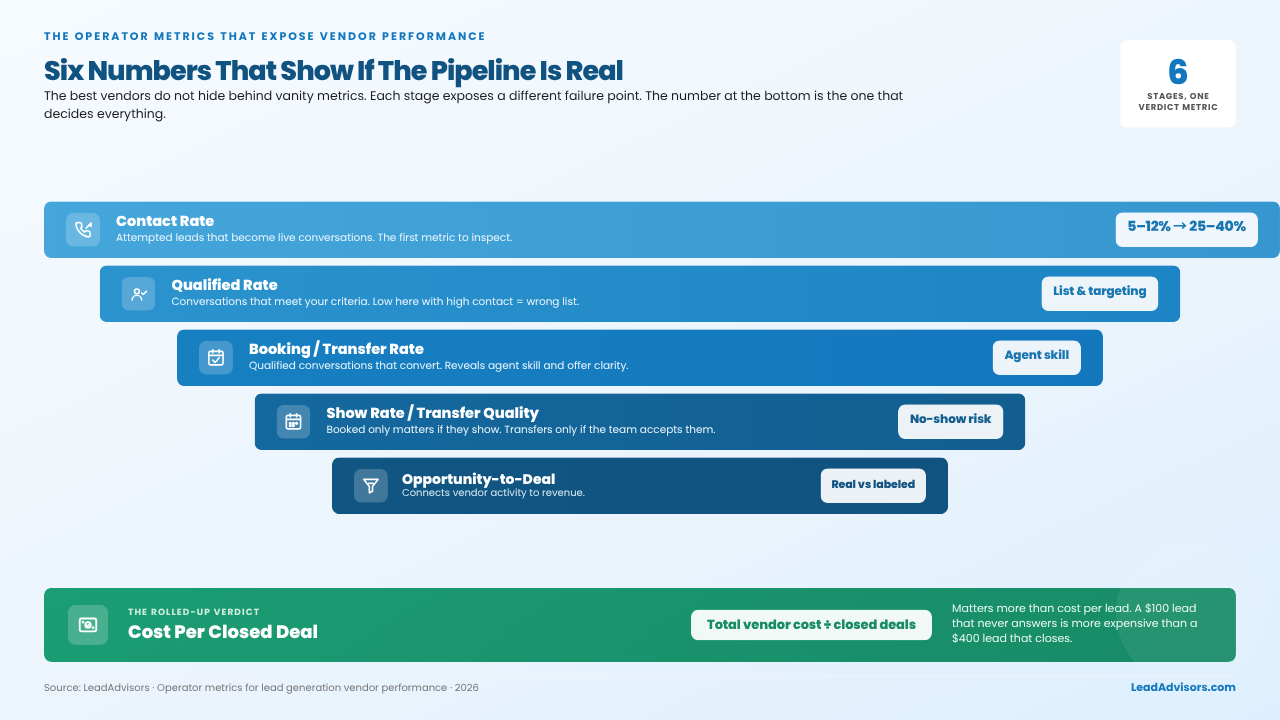
The best lead generation companies do not hide behind vanity metrics.
They report the numbers that show whether the pipeline is real.
Contact Rate
Contact rate measures the percentage of attempted leads that turn into live conversations.
It is the first operational metric to inspect.
If your contact rate is 5–12%, most of your lead spend is not reaching a person. If the operation can move that rate toward 25–40%, the same lead budget can produce more conversations without buying more leads.
Use the contact rate framework for outbound operations to diagnose that gap.
Recent contact center market data from Grand View Research can support claims about the growing contact center software market.
Qualified Rate
Qualified rate measures the percentage of conversations that meet your criteria.
This metric exposes discipline in list quality, targeting, scripting, and qualification.
A high contact rate with a low qualified rate may mean the list is wrong.
Booking or Transfer Rate
This metric shows how many qualified conversations become booked appointments or live transfers.
It reveals agent skill, offers clarity, handles objections, and assesses script quality.
Show Rate or Transfer Quality
Booked appointments only matter if prospects show.
That is the gap that outsourced appointment-setting operations should close.
Live transfers only matter if the receiving team accepts the quality.
Therefore, the show rate and transfer quality must be tracked.
Opportunity-to-Deal Conversion
This is the metric that connects vendor activity to revenue.
It also exposes whether the vendor is sending real opportunities or weak leads with good labels.
Cost Per Closed Deal
Cost per closed deal is the rolled-up metric.
It compares vendor spend against actual revenue outcomes.
Formula:
Total vendor cost ÷ closed deals from vendor pipeline = cost per closed deal.
This matters more than cost per lead. It is also the metric that decides whether the B2B sales outsourcing methodology is producing revenue or only activity.
Pricing Models and What They Actually Cost
Lead generation pricing depends on the vendor category.
Do not compare models without context.
Data Provider Pricing
Data providers often charge annual contracts based on seats, credits, records, or data depth.
Costs can range from several thousand dollars per year to six figures for larger teams.
Current public pricing pages, such as ZoomInfo pricing information, can help validate the software cost range before final publication.
However, the buyer still needs people and systems to run outreach.
Marketing Agency Retainers
Marketing agencies may charge monthly retainers for SEO, paid media, content, landing pages, or campaign management.
This can work for inbound demand.
However, make sure the retainer includes the specific lead-generation work you need.
Intent Platform Contracts
Intent data and predictive platforms often fit larger B2B teams.
They can be expensive because they support ABM, account prioritization, and sales intelligence.
The cost only makes sense when the buyer has the team to act on the data.
Pay-Per-Lead
Pay-per-lead pricing looks simple.
You pay for each lead delivered.
However, the true cost depends on the quality of qualifications, exclusivity, contactability, show rate, and close rate.
For example, a $100 lead that never answers is more expensive than a $400 lead that closes.
Pay-Per-Appointment
Pay-per-appointment vendors charge for booked meetings.
This can align better than raw leads. However, the show rate matters, especially in B2B appointment-setting operations.
If the vendor gets paid for bookings but not for held appointments, the buyer bears the no-show risk.
Managed Dedicated Operations
Managed dedicated operations often use hourly, monthly retainer, or hybrid pricing.
The buyer pays for the operating system: agents, supervision, QA, reporting, and optimization.
This model usually fits teams that need consistent lead handling, daily visibility, multi-region operational coverage across time zones, and multi-channel execution.
Performance-Based or Hybrid Models
Some vendors use base fees plus performance incentives.
This can work when attribution is clear, and both sides agree on what counts as a qualified result.
However, long sales cycles can make attribution harder. Recent Google Analytics attribution documentation is useful for checking how conversion credit is assigned across touchpoints.
For general lead-generation definitions and channel context, Salesforce lead-generation guidance can provide basic market explanations.
Industries Where Vendor Selection Matters Most
Some industries punish poor vendor selection more quickly than others.
That usually happens because compliance, sales cycle length, ticket size, or technical qualification is harder.
Financial Services
Financial services lead generation carries heavy compliance risk.
Buyers need clear consent records, TCPA discipline, DNC controls, accurate disclosures, and careful vendor oversight.
This includes debt, tax, lending, mortgage, and financial advisor campaigns. For category-specific context, use financial services lead generation methodology.
Operator takeaway: Do not choose a financial services lead-generation vendor without proof of compliance.
Healthcare
Healthcare lead generation requires careful attention to privacy, claims, consent, and patient communications.
HIPAA, healthcare advertising rules, and platform restrictions can change how campaigns are built. The HHS HIPAA for professionals resource should support claims about privacy and covered data.
Operator takeaway: Generic vendors often learn healthcare lead generation under compliance overlay after mistakes. That is too late.
Manufacturing and Industrial
Manufacturing sales cycles are often long and committee-driven.
Prospects may involve procurement, engineering, operations, finance, and executives.
The vendor must understand manufacturing lead generation and committee-based buying, technical qualification, and long-cycle attribution.
Operator takeaway: A vendor built for short-cycle SMB sales may fail in manufacturing.
B2B SaaS and Technology
B2B SaaS varies by segment.
SMB SaaS, mid-market SaaS, and enterprise SaaS need different targeting, messaging, and qualification.
The vendor must match the segment and the SaaS lead-generation methodology that best fit its ACV, buying committee, and sales cycle.
Operator takeaway: “B2B lead gen” is too generic. Ask which B2B motion the vendor is familiar with. For technology buyers, compare against the IT vertical’s lead-generation playbook.
Home Services
Home services include roofing, HVAC, solar, plumbing, pools, windows, bath remodeling, and related categories.
These markets often depend on speed-to-lead infrastructure for inbound response, appointment setting, financing qualification, local trust, and seasonal demand.
Operator takeaway: The best home services lead generation companies understand both lead response speed and appointment quality.
Real Estate
Real estate lead generation depends on speed, trust, local targeting, and follow-up discipline.
Realtors and brokerages should evaluate exclusivity, lead source, nurture cadence, CRM integration, and real estate lead generation methodology.
Operator takeaway: Real estate leads lose value fast when follow-up is slow.
Legal Services
Legal lead generation has strict concerns around advertising, intake, and jurisdiction.
Mass tort, personal injury, and local legal campaigns need a clear compliance review before any legal SEO and lead generation campaign goes live.
Operator takeaway: If the vendor cannot explain legal intake boundaries, it should not touch the campaign.
AI Lead Generation Companies and Tools: Where They Fit
AI lead generation tools can improve speed, research, personalization, scoring, routing, and follow-up.
Google’s helpful, reliable, people-first content guidance is still the standard for keeping AI-assisted content useful.
However, AI does not remove the need for an operating system.
AI can support:
- Lead scoring
- Data enrichment
- Email personalization
- Chat follow-up
- SMS sequencing
- Call QA
- Conversation summaries
- CRM routing
- Reporting
However, AI cannot replace:
- Sales motion fit
- Human qualification
- Compliance judgment
- QA calibration
- Supervisor coaching
- Client feedback loops
- Cost-per-closed-deal analysis
Therefore, evaluate AI lead generation companies as part of the system, not as the whole system.
Common Mistakes Buyers Make
Most vendor failures start before launch.
They usually happen when buyers skip the BPO contact strategy for outbound operations.
Mistake 1: Buying by Price Alone
Low cost per lead does not mean low cost per sale.
Always calculate the cost per closed deal.
Mistake 2: Skipping the Category Diagnostic
Do not shortlist vendors until you know which category they fit into.
Category mismatch creates bad comparisons. It also causes buyers to confuse the sales development services category with broader marketing support.
Mistake 3: Trusting Generic Rankings
Rankings can be useful for discovery.
They should not replace operational due diligence.
Mistake 4: Running Pilots Without Success Criteria
A pilot without predefined metrics creates argument, not clarity.
Define success before launch.
Mistake 5: Expecting Full Performance in 30 Days
A 30-day pilot can show whether the vendor is disciplined.
However, many managed campaigns need 60–90 days to stabilize.
Mistake 6: Ignoring Compliance
Compliance is not just a legal issue.
It affects scripts, data, dialing rules, SMS, disclosures, training, and reporting.
Mistake 7: Buying One Vendor Across Incompatible Motions
A vendor that works for roofing may not work for enterprise SaaS.
A vendor that works for real estate may not work for healthcare.
Match the vendor to the motion.
How LeadAdvisors Fits in the Matrix
LeadAdvisors operates in the managed, dedicated lead-generation operations category.
We build and run the execution layer behind lead conversion. That includes managed offshore teams, contact rate optimization, QA, reporting, speed-to-lead systems, and multi-channel follow-up.
This model fits companies that already have lead flow but need better execution.
It is especially relevant when:
- Leads are going unworked
- The contact rate is too low
- Closers are idle
- CPA keeps climbing
- Reporting is a black box
- Internal labor costs are too high
- The buyer needs offshore infrastructure
- The campaign requires phone, SMS, email, and chat
However, managed dedicated operations are not the right fit for every buyer.
If a startup has no lead flow, no sales process, and a small budget, a data tool or small agency may be a better first step.
If an enterprise team already has SDRs but needs account signals, an intent platform may be a better fit.
If a company only needs software, it should evaluate lead generation tools rather than managed operations. If it needs execution, reporting, and QA, the vendor conversation changes.
Insurance buyers should also validate category fit against the insurance vertical lead generation methodology before selecting any vendor.
That is the point of the matrix.
The right vendor is the one that fits the operation.