
Most law firms do not lose SEO ROI because rankings fail. They lose it after the click.
Calls go unanswered. Forms sit too long. Reviews create doubt. Intake teams ask the wrong questions.
The firm paid for visibility. However, the system behind that visibility never converted demand into consultations.
That gap gets expensive in legal search. One missed inquiry into personal injury, divorce, criminal defense, or business litigation can mean a lost retainer.
SEO for lawyers has to be more than just content and keywords. It needs authority, local proof, compliant messaging, reviews, and intake infrastructure. Rankings start the opportunity. Operators convert it into signed clients.
This guide shows the operating model that makes it work.

What Is SEO for Lawyers?
SEO for lawyers improves a law firm’s visibility in Google Search, Google Maps, AI search, and other discovery channels.
The goal is simple. Qualified prospects should find the firm when they search for legal help.
In practice, law firm SEO includes:
- Keyword research for practice areas and locations
- Google Business Profile optimization
- Local landing pages for cities, counties, and offices
- Practice-area pillar pages
- Attorney bio optimization
- Legal directory listings
- Review acquisition and response workflows
- Technical SEO and schema markup
- Link building from credible legal and business sources
- Content that answers legal questions without creating compliance risk
- Conversion tracking from search visit to signed client
The mistake is treating SEO as only a marketing channel. For lawyers, SEO is also an intake, reputation, and trust system.
For example, a visitor searching “personal injury lawyer near me” is not browsing casually. They may compare three firms in the same hour.
A visitor searching “how long does divorce take in California” may be months away from hiring counsel. That research path needs the SEO methodology for divorce and family law firms, not a generic legal blog calendar.
A business owner searching “commercial litigation attorney Los Angeles” may need proof before booking a consultation. That is where geo-targeted SEO services and brand authority work together.
Each search has a different urgency, risk, and conversion behavior. Therefore, the SEO strategy has to match the searcher’s stage.
Why Legal SEO Is Different From Normal SEO
Legal SEO combines local intent, high-value cases, state bar advertising rules, multi-platform reputation, and intake speed.
Generic SEO playbooks miss this.
Legal Search Is Hyperlocal
Most commercial legal queries carry jurisdictional intent.
Someone searching for a criminal defense lawyer, divorce lawyer, personal injury lawyer, probate lawyer, or DUI lawyer usually needs local counsel. They need someone licensed and active in a specific city, county, or state.
That changes the ranking strategy.
A national “personal injury lawyer” page is not enough. The firm needs a structure that maps:
- Practice area
- City
- County
- Office location
- Attorney coverage
- Court or jurisdictional relevance
- Google Business Profile proximity
- Review depth in that market
Local SEO for lawyers is not just adding a city name to a page title. It starts with local SEO fundamentals for hyperlocal businesses and builds local proof.
Google needs to understand the firm’s relevance. The prospect needs to trust it.
Legal Content Carries Compliance Risk
Law firm websites cannot use the same copy style as ecommerce, SaaS, or home services brands.
State bar advertising rules can restrict:
- Outcome claims
- Testimonials
- Comparative language
- “Specialist” claims
- Unsupported superlatives
Words like “best,” “top,” “expert,” or “guaranteed” can create risk. Past case results may also need disclaimers.
In addition, multi-state firms may need to follow stricter rules. The safest operating rule is simple: do not copy a competitor’s legal copy because it ranks.
Competitor copy can rank while still creating ethical risk.
Legal Buyers Compare Reputation Before They Call
Lawyers are reviewed across more platforms than most businesses.
Common platforms include:
- Avvo
- Martindale-Hubbell
- Justia
- FindLaw
- Lawyers.com
- Yelp
- Better Business Bureau
- State bar profiles
- Local and county bar directories
The search result is no longer just the firm’s website. It is the whole brand surface.
If a firm ranks in the local pack but has weak third-party profiles, revenue leaks. The same happens when a negative complaint thread ranks for the firm name.
Intake Decides Whether SEO Produces Revenue
Rankings drive calls and form fills. However, calls and forms do not pay the firm.
The intake operation has to:
- Answer quickly
- Qualify the matter
- Avoid legal advice from non-attorneys
- Capture the right facts
- Run conflict checks
- Book the consultation
- Follow up when the prospect does not schedule
- Report outcomes by source, practice area, and campaign
This is where most legal SEO ROI dies.
The firm paid to rank. It earned the click. Then the operational handoff broke.
The Legal SEO + Intake Stack
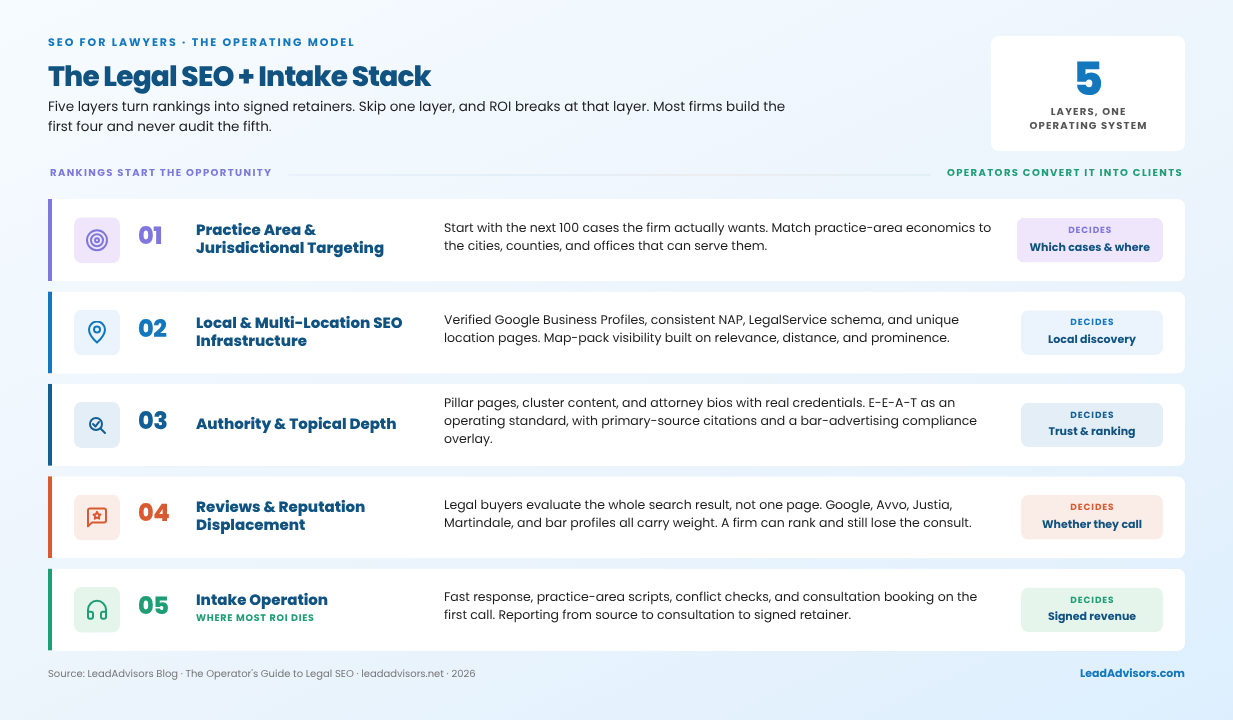
The Legal SEO + Intake Stack is a five-layer operating model. It turns rankings into signed retainers.
Skip one layer, and ROI breaks at that layer.
Layer 1: Practice Area and Jurisdictional Targeting
Decide which cases the firm wants more of. Then decide where those cases should come from.
A personal injury firm does not need the same SEO structure as an estate planning firm. A family law firm does not need the same intake motion as a criminal defense firm.
Start with the next 100 cases the firm actually wants.
Key decisions include:
- Which practice areas generate the strongest economics?
- Which cities or counties matter most?
- Which office locations can support those markets?
- Which attorneys can support the content?
- Which pages need attorney review before publication?
- Which keywords show immediate hiring intent?
- Which keywords support longer research cycles?
Layer 2: Local and Multi-Location SEO Infrastructure
Local SEO for lawyers supports map pack visibility and high-intent discovery. Google says local rankings rely on relevance, distance, and prominence.
The core infrastructure includes:
- Verified Google Business Profiles
- Correct primary and secondary GBP categories
- Complete services and practice areas
- Consistent NAP across legal directories
- Location pages with unique local content
- LocalBusiness, LegalService schema, Attorney, and Organization schema, where appropriate
- Review acquisition and response workflows
- Local citations from bar associations, chambers, and community organizations
For multi-office firms, each location page needs unique proof. That is the same logic behind SEO infrastructure for multi-office firms.
Copy-paste pages with swapped city names do not build trust. Strong location pages include the attorneys at that office, local practice areas, parking details, proximity to courts, and clear intake paths.
Layer 3: Authority and Topical Depth
Legal SEO authority comes from depth, accuracy, and trusted signals.
Strong law firm content should include:
- Practice-area pillar pages built around the pillar and cluster content model
- Cluster content around common legal questions that show how topic clusters compound authority
- Attorney bios with education, bar admissions, publications, and practice focus
- Case results were permitted and properly disclaimed
- Legal directory profiles
- Editorial placements through legal and business media
- Primary-source references to statutes, courts, agencies, and bar rules
E-E-A-T is not a formatting checklist for lawyers. It is an operating standard.
Experience shows up in practical explanations. Expertise shows up in accurate legal concepts. Authority shows up in citations, credentials, and third-party proof. Trust shows up in transparency, disclaimers, and claim discipline.
Layer 4: Reviews and Reputation Displacement
Legal buyers do not evaluate one page. They evaluate the search result.
A law firm can rank and still lose the consultation. Weak review profiles, unresolved complaints, thin directory listings, and negative content can create doubt.
The review and reputation layer should cover:
- Google review velocity and response process
- Avvo, Justia, Martindale-Hubbell, FindLaw, and state bar profile completeness
- Negative review response templates reviewed for privilege risk
- Review request timing after appropriate client milestones
- No incentives for reviews unless cleared by ethics counsel and platform rules
- Brand search monitoring for firm-name review queries
- Displacement content when negative results sit on page one, using the brand reputation displacement methodology
Trust is not built only on the firm’s website. It is built across the whole search surface.
That includes online reputation management for service businesses and auditing what appears when prospects search your firm name.
Layer 5: Intake Operation
This is the layer most legal SEO content ignores.
Search demand has a shelf life. Personal injury prospects may call multiple firms after an accident. Criminal defense prospects may hire whoever answers first.
Family law prospects may research for weeks. Then they act quickly once ready.
Operator-grade intake includes:
- Fast response to calls and forms
- Phone, SMS, and email follow-up
- Intake scripts by practice area
- Clear boundaries for non-attorney intake staff
- Conflict-check information before sensitive facts are collected
- Calendar booking during the first conversation
- Follow-up sequences for unbooked prospects
- QA review of intake calls
- Reporting from source to consultation to signed retainer
The firm should not only ask, “Are we ranking?”
It should also ask:
- How many organic visitors called?
- How many calls were answered?
- How fast did intake respond?
- How many calls became consultations?
- How many consultations became signed clients?
- Which practice areas produce the best signed-client economics?
- Which locations rank but fail to convert?
That is how SEO becomes an operating system instead of a traffic report.
Practice Area and Jurisdictional Targeting
Pick the practice areas where search demand, economics, attorney experience, and jurisdictional opportunity line up.
Then build around the markets where the firm wants the next 100 cases.
Not all legal keywords are equal. Some keywords bring urgent calls. Others bring long research cycles.
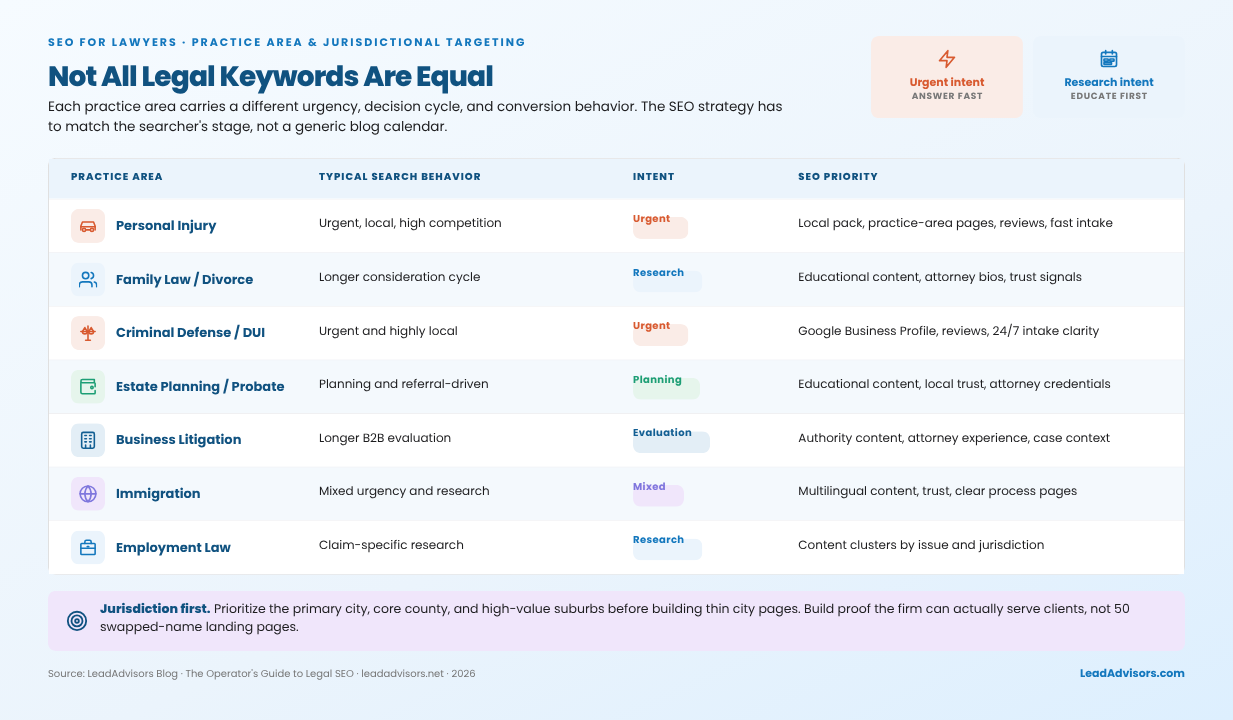
Some bring low-value matters. Others bring cases the firm cannot ethically or operationally handle.
Before building pages, define the case portfolio.
| Practice area | Typical search behavior | SEO priority |
| Personal injury | Urgent, local, high competition | Local pack, practice-area pages, reviews, fast intake |
| Family law/divorce | Longer consideration cycle | Educational content, attorney bios, trust signals |
| Criminal defense / DUI | Urgent and highly local | Google Business Profile, reviews, 24/7 intake clarity |
| Estate planning/probate | Planning and referral-driven | Educational content, local trust, and attorney credentials |
| Business litigation | Longer B2B evaluation | Authority content, attorney experience, case context |
| Immigration | Mixed urgency and research | Multilingual content, trust, and clear process pages |
| Employment law | Claim-specific research | Content clusters by issue and jurisdiction |
The best SEO strategy for personal injury lawyers will not be the same as that for divorce lawyers. The searcher’s urgency, risk tolerance, and decision cycle are different.
Jurisdiction matters too.
A firm should usually prioritize:
- Primary city
- Core county
- Nearby high-value suburbs
- Secondary office markets
- Statewide informational content
Do not build 50 thin city pages before the home market is strong. Build proof that the firm can actually serve clients.
If the firm needs external execution, operator-grade local SEO services should support the market plan rather than replace it.
Local SEO for Lawyers
Local SEO is often the highest-value SEO layer for law firms. The local pack, Google Maps, and proximity signals shape high-intent legal searches.
A prospect searching “DUI lawyer near me” is showing commercial intent. The same is true for “divorce lawyer in Los Angeles” or “personal injury attorney in Houston.”
The firm needs to appear where that prospect is already looking.
Google Business Profile Optimization
Treat the Google Business Profile like a conversion asset, not a directory listing.
Optimize:
- Primary category
- Secondary categories
- Services
- Business description
- Photos
- Office address and service areas
- Hours and after-hours coverage
- Q&A
- Review responses
- Appointment or contact links
For law firms, category selection matters. “Attorney” is broad. “Personal injury attorney” or “Family law attorney” may match the firm better when accurate.
Legal Directory Consistency
NAP consistency still matters. Google compares signals across the web. Prospects do too.
Audit:
- Avvo
- Martindale-Hubbell
- Justia
- FindLaw
- Lawyers.com
- State bar profile
- County bar profile
- BBB
- Local chamber pages
- Local sponsorship pages
Every mismatch creates friction. That is why directory listings management for local rankings belongs in the local SEO workflow.
Wrong phone numbers, old addresses, inconsistent attorney names, and duplicate listings can weaken trust.
Location Pages
Strong law firm location pages should include:
- Office address
- Unique local intro
- Attorneys at that location
- Practice areas served from that office
- Driving directions and parking
- Nearby court or jurisdictional relevance
- Local reviews or testimonials were permitted
- Clear call and consultation CTA
- LegalService schema markup
Thin city pages are not a strategy. They are a liability.
Authority, E-E-A-T, and Topical Depth for Law Firm SEO
For lawyers, E-E-A-T is built through attorney credentials, accurate legal content, primary sources, reviews, and third-party authority.
It cannot be faked with keyword stuffing.
Google’s helpful content guidance asks whether content shows first-hand expertise and real value. Legal pages need more discipline because the stakes are higher.
Build authority with the assets below.
Attorney Bios That Prove Expertise
Each attorney’s bio should include:
- Bar admissions
- Education
- Practice focus
- Court admissions were relevant
- Publications
- Speaking engagements
- Professional associations
- Awards are only given when substantiated
- Case experience where allowed
- Disclaimers were required
Attorney bios are not filler pages. They are trust assets.
Practice-Area Pillar Pages
Each major practice area should have a comprehensive page that explains:
- Who the service is for
- Common legal issues
- State or jurisdictional rules where relevant
- Process timeline
- Documents or facts the prospect may need
- What happens during a consultation
- How the firm evaluates fit
- FAQs
- Attorney review or author attribution
The content should be practical. However, it should not give legal advice beyond the firm’s approved scope.
Cluster Content
Cluster content supports the pillar by answering specific questions.
Examples include:
- “How long do I have to file a personal injury claim?”
- “What happens after a DUI arrest?”
- “How is custody decided in divorce?”
- “What does probate cost?”
- “When should a business hire litigation counsel?”
These articles build topical depth and support long-tail search. They also help prospects self-qualify before calling.
Primary-Source Citations
Use primary sources where possible:
- State statutes
- Court websites
- State bar rules
- Government agencies
- Google Search Central
- FTC endorsement guidance
- ABA ethics resources
- Official legal aid or court self-help pages
Secondary sources can support context. Primary sources build trust.
Bar Advertising Compliance Overlay
SEO copy that ignores lawyer advertising rules can create an ethics risk. Compliance review is not a final polish step.
It is part of the content system.
Every state has its own lawyer advertising rules. The exact requirements vary, but the risk categories are consistent. The ABA Model Rule 7.1 standard is a useful baseline because it prohibits false or misleading communications about legal services.
Watch for:
- Guaranteed outcomes
- Unsupported superlatives
- Comparative claims
- “Expert” or “specialist” claims without certification
- Testimonials and endorsements, including review claims covered by the FTC’s endorsement and review guidance
- Past results without required disclaimers
- Fee claims without context
- Attorney-client relationship confusion
- Claims that imply results are typical
Review legal SEO content before publishing when it touches:
- Case results
- Settlement amounts
- Practice-area claims
- Attorney credentials
- Testimonials
- Superlatives
- State-specific legal rules
- Calls to action that could imply legal advice
Safe operating standard:
- Cite the actual rule when discussing state law
- Avoid outcome guarantees
- Avoid “best” unless substantiated and permitted
- Use “experienced,” “established,” or “trusted” only when supportable
- Add required attorney advertising notices where applicable
- Add past-results disclaimers where needed
- Confirm content with ethics counsel before publishing
A law firm should not publish legal SEO content like a roofing company or SaaS brand. The compliance overlay is part of the product.
The Intake Operation: Where Legal SEO ROI Is Decided
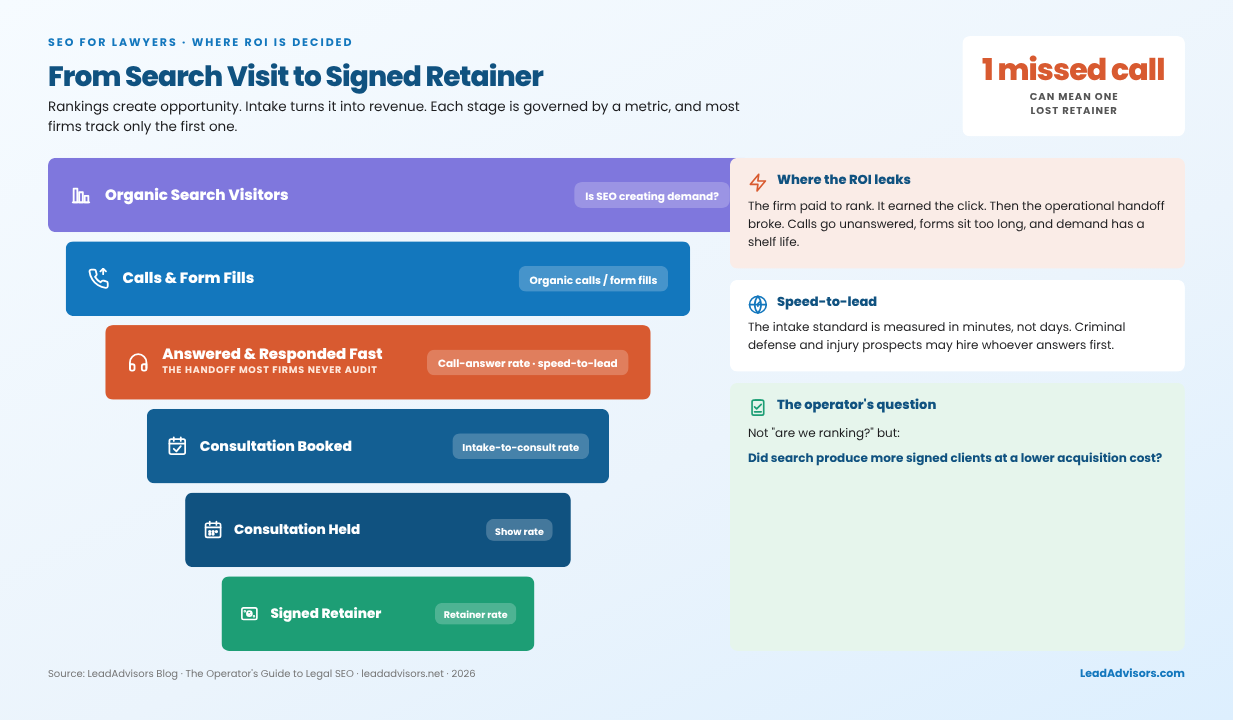
Rankings create opportunity. Intake turns that opportunity into revenue.
If intake is slow, inconsistent, or unmeasured, SEO ROI breaks after the click.
Most law firms under-measure the handoff. They know rankings have improved. They may know traffic has increased.
However, they often do not know how many organic calls were answered. They may also not know how many consultations resulted in signed retainers.
That is the gap.
Speed-to-Lead
Legal prospects are time-sensitive.
A car accident victim may call several firms. For that market, the personal injury lawyer SEO playbook only works when intake answers fast.
A criminal defense prospect may need help immediately. A family law prospect may wait for weeks, then act fast.
The intake standard should be measured in minutes, not days. Harvard Business Review’s lead response research showed how quickly the value of online leads drops when teams respond late. That is why the speed-to-lead infrastructure that converts inbound calls matters.
For inbound calls, the first question is simple:
Did someone answer?
For form fills, ask:
How quickly did someone respond by phone, SMS, or email?
Intake Scripting
Legal intake scripts need more control than ordinary sales scripts.
They should collect:
- Name and contact information
- Practice area
- Incident or issue date
- Location or jurisdiction
- Opposing party names for conflict checks
- Urgency level
- Basic case fit information
- Consultation availability
- Preferred contact method
They should not:
- Give legal advice
- Promise outcomes
- Quote definitive fees unless approved
- Ask for privileged details before conflict checks
- Create confusion about the attorney-client relationship
Consultation Booking
The best intake motion books the consultation during the first contact.
“Someone will call you back” is where leads go cold.
The system should include managed inbound intake operations and:
- Live calendar access
- SMS confirmation
- Email confirmation
- Reminder sequence
- No-show follow-up
- Source tracking
- Outcome tagging
Intake Metrics That Matter
Track these by source, practice area, and location:
| Metric | What does it tell you |
| Organic calls | Whether SEO is creating demand |
| Call-answer rate | Whether the firm is capturing demand |
| Form response time | Whether web leads are worked quickly |
| Intake-to-consultation rate | Whether the intake qualifies and books well |
| Consultation show rate | Whether reminders and fit are working |
| Consultation-to-retainer rate | Whether the firm closes qualified matters |
| Search-to-retainer rate | Whether the full SEO + intake system works |
If the firm tracks only rankings, the broken layer remains hidden.
AI Search, AI Overviews, and SEO for Lawyers in 2026
AI search is changing how prospects research legal questions. However, the core requirement is the same. Google’s own guidance says AI features in Search still rely on the fundamentals of helpful, reliable content.
Trusted, structured, source-backed content wins. Google’s guide to generative AI features on Search reinforces the same point: strong SEO fundamentals still matter.
Google AI Overviews, ChatGPT, Perplexity, and other answer engines are pushing legal SEO beyond blue links.
Prospects may ask:
- “What should I do after a car accident?”
- “How do I choose a divorce lawyer?”
- “What questions should I ask a criminal defense attorney?”
- “What does probate cost in my state?”
- “Is this law firm legitimate?”
AI systems are more likely to surface clear, structured, well-sourced content. Trusted entity signals also matter.
That means firms need to know how to earn citations in Google AI Overviews, answer engine optimization fundamentals, and ranking in generative AI search engines built into the content system.
Law firms should prepare for AI search by building:
- Clear answer sections aligned with user-friendly legal information principles
- FAQPage schema
- Attorney and Organization schema
- Strong author bios
- Primary-source citations
- Consistent brand mentions
- Complete review profiles
- Legal directory authority
- Content that answers questions directly before selling
AI SEO for lawyers is not a separate trick. It is disciplined information architecture, E-E-A-T, and authority building applied to answer engines.
Metrics That Matter and Metrics That Do Not
Legal SEO reporting should measure signed-client economics, not vanity metrics.
Traffic can rise while revenue stays flat. Rankings can improve while calls go unanswered. Form fills can increase while consultation quality drops.
Deprioritize:
- Total organic traffic without intent breakdown
- Total keyword count without commercial value
- Domain Authority as a standalone KPI
- Bounce rate without call tracking context
- Impressions without conversion movement
Prioritize:
- Local pack visibility by target market
- Rankings for commercial-intent practice-area terms
- Organic calls
- Organic form fills
- Call-answer rate
- Speed to first response
- Intake-to-consultation rate
- Consultation-to-retainer rate
- Cost per signed client
- Lifetime value by source
The operating question is not “Did SEO improve?” A better report aligns with what an operator-grade SEO report contains and with the monthly SEO reporting standard for operators.
The question is:
Did the search produce more signed clients at a lower acquisition cost?
Common Mistakes That Kill Law Firm SEO ROI
Most law firm SEO failures come from a small set of repeatable mistakes. Fixing them requires operational discipline, not more blog volume.
1. Hiring a generic agency with no legal vertical experience
Legal SEO has compliance, review, jurisdictional, and intake complexity. A generic playbook can miss all four.
2. Targeting practice areas the firm cannot support
Ranking for medical malpractice, mass torts, or business litigation does not help if the firm cannot handle those matters.
3. Building thin city pages
Swapping city names across dozens of pages does not create local authority. It creates weak content.
4. Ignoring reviews outside Google
Legal buyers compare Avvo, Martindale-Hubbell, Justia, FindLaw, state bar profiles, and Google.
The full reputation surface matters.
5. Writing copy that creates a bar advertising risk
Outcome guarantees, unsupported “best” claims, and careless testimonial language can create problems.
That risk remains even when the page ranks.
6. Measuring traffic instead of signed clients
Traffic is only useful when it becomes qualified conversations and retained matters.
7. Separating SEO and intake vendors
When marketing and intake operate separately, the handoff breaks. The same issue shows up in appointment-setting operations for service businesses.
SEO reports show progress. Intake reports show activity. Nobody owns the revenue gap.