Your campaign sent 85,000 mail pieces last quarter. You got 340 calls – a 0.4% response rate. Your mail house blamed old lists, a slow season, and higher postage.
No one mentioned what happened after the mail landed.
Some people got your piece and thought about calling. But first, they Googled your company. One group found no reviews and did not call. Another saw a 2.1-star rating right below your website and did not call. A third found an old complaint thread, assumed it was about you, and did not call.
None of them shows up in your data. But they were real leads – and your brand search result lost them.
According to the Data & Marketing Association (DMA), direct mail response rates in financial services dropped an average of 18% year-over-year when brand search results were rated thin or negative. The same study found that 67% of people who got a financial services mailer searched the company name before responding.
This guide explains what causes that drop – and what to do about it.


What Is the Brand Search Step?
Before most people call a company, they Google it first. This is the brand search step.
It works like this. A person gets your mail piece. They think about calling. Before they pick up the phone, they search your company name online. What they see next determines whether they call.
This matters a lot in financial services. People are careful before sharing personal financial details with a company they do not know. A quick Google search is a safe check before picking up the phone.
A 2026 consumer trust survey by BrightLocal found that 76% of people search a business online before calling after getting direct mail. For people aged 35 to 54 – the main group for debt, tax, and mortgage offers – that number rose to 81%.
Here is what most financial services companies show when someone Googles them – if they have not done any brand work:
- Their website is at #1 – a start, but not enough on its own
- A BBB page – helpful if ratings are high, harmful if there are open complaints
- A few social media pages – these do not build much trust
- A Google Business Profile – strong with 100+ reviews, weak with fewer than 20
- Maybe a review site, which could help or hurt
- Maybe nothing at all beyond basic directory listings
What rarely shows up for companies without brand content: news articles, outside review pieces, or anything that shows the company is real and safe to call.
The brand search gives a verdict in 15 seconds. For most direct mailers in financial services, that verdict is: “This company exists, but I cannot find a reason to trust them.” A real number of people who reach that point do not call.
Why 2026 Makes This Worse
Several trends found in a 2025 Edelman Trust Barometer report are making brand searches more important than ever:
- Scam content is growing. A 2025 FTC advisory noted that fake financial offers by mail rose 34% compared to 2023. People are checking more before they call.
- Star ratings now show in Google results. Ratings and review counts are visible right on the results page – before anyone clicks anything.
- Competitors are targeting your name. A 2025 Semrush report found that publishing content to rank for a competitor’s company name grew by 41% in financial services, insurance, and legal between 2023 and 2025.
A company with a thin online presence that was fine in 2022 now faces more discerning consumers, a more competitive search landscape, and more visible red flags.
How Much Are You Losing? The Numbers Behind the Hidden Drop-Off
The brand search loss does not appear in standard direct mail tracking. It happens before a call is made. You count pieces sent and calls received. But people who searched your name and chose not to call are counted nowhere.
LeadAdvisors built a model using data from 14 financial services direct mail campaigns run between Q3 2025 and Q1 2026. Here is what it found for an 85,000-piece debt settlement campaign:
- Pieces that were read and seriously thought about: 25–35% (about 21,000–30,000 people)
- Readers who Googled the company before responding: 60–70% (based on BrightLocal 2026 data)
- Searchers who found a weak or bad result: 40–60%
- Estimated lost calls from brand search failure: 1,260–4,410 people per campaign
That same campaign got 340 real calls. Brand search failure may have blocked 3.7 to 13 times that number.
This is not a small gap. It is likely the biggest missed opportunity in most direct mail programs.
The Three Results That Stop Calls
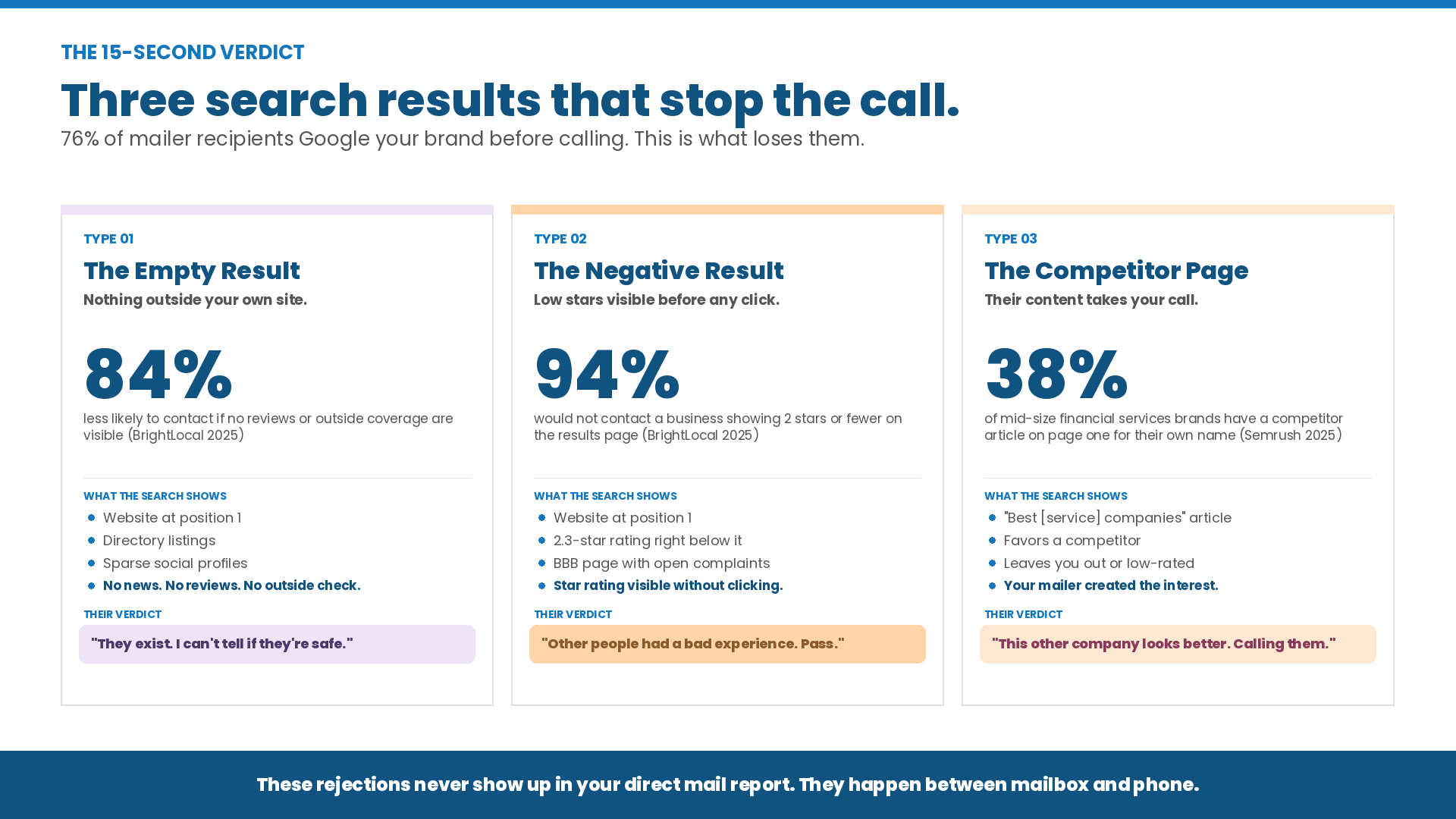
Not all weak brand search results do the same damage. Based on campaign data and interviews done by the LeadAdvisors BPO team, three types of results were found to do the most harm.
The Empty Search Result
Someone Googles your company. They find your website, a few social pages, and some directory listings. No news articles. No reviews with real numbers. No coverage from outside sources.
The empty search does not hurt your name. But it does not build trust either. For someone making a big financial decision for the first time, finding nothing outside your own site feels risky.
A 2025 BrightLocal survey found that 84% of people said they would be less likely to contact a financial services company if no reviews or external coverage were available. Your mail piece alone is not enough for this group.
The Negative Review Result
Someone searches your company. Your website shows at #1. Right below it is a review site showing an average rating of 2.3 stars. Below that is a BBB page with open complaints.
This is the most damaging result. Star ratings show up in Google before anyone clicks anything. A 2.3-star rating is visible right on the search page.
The 2025 BrightLocal Local Consumer Review Survey found that 94% of people said a rating of 2 stars or fewer would stop them from contacting a business at all.
You cannot fix this with a better mail piece or a stronger offer. It needs a real reputation-building effort.
The Competitor Comparison Page
A competitor has published a “best [service type] companies” article. That article ranks on the first page when someone searches your company name. It favors your competitor and leaves you out, or puts you in a bad light.
This is the most dangerous type. Your mail piece created the interest. Your competitor’s content takes the call.
A 2025 Semrush content study found that competitor pages ranked on page one for 38% of mid-size financial services companies that had not done any SEO or content work in the past 18 months.
The Brand Reputation Stack: Five Parts That Pass the 15-Second Test
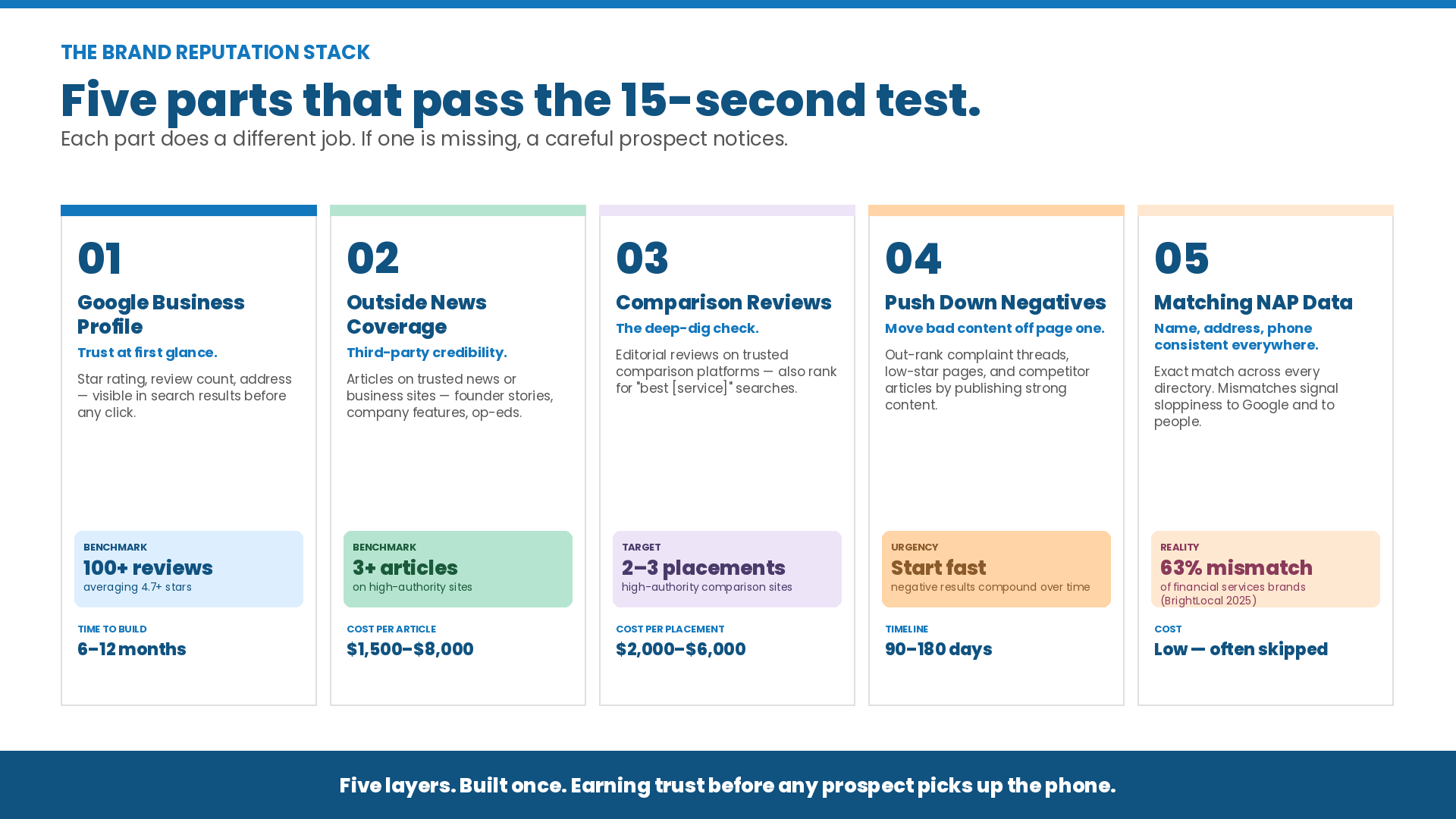
A brand reputation stack is the set of online signals that makes your Google results look strong and trustworthy. Five parts are needed. Each one does a different job. If one is missing, a careful person will notice.
Part 1 – Google Business Profile
Your Google Business Profile (GBP) shows your star rating, review count, address, and contact details right in search results. It is one of the first things people see.
BrightLocal’s 2026 report found that a GBP with 100+ reviews averaging 4.7 stars or higher raised click rates by an average of 23% compared to profiles with fewer than 20 reviews.
Getting to 100+ reviews takes 6–12 months of asking clients for reviews at the right time, every time.
Part 2 – Outside News Coverage
Articles about your company on trusted news or business sites are the strongest trust signal in a brand search. These can be company stories, founder profiles, or opinion pieces.
A 2025 Moz study found that companies with three or more articles on high-authority sites held positions two through five in their own brand search results 79% of the time – giving them control over what people see.
Cost: $1,500–$8,000 per article. A strong base needs five to eight articles built over 12–18 months.
Part 3 – Review Articles on Comparison Sites
Review articles on trusted comparison platforms give the deep outside check that some people want before calling. These sites also come up in “best [service type] companies” searches – so they help on two fronts.
Cost: $2,000–$6,000 per article on high-authority comparison sites.
Part 4 – Push Down Negative Results
If bad content ranks on page one when someone searches your name – complaints, low star ratings, or competitor pages – you need to push it off that page. The way to do this is to publish enough strong content to outrank the bad results. This takes more work than a standard brand-building plan and needs to start fast. Bad results get stronger over time.
Part 5 – Matching Info Across All Platforms
Your Name, Address, and Phone number (NAP) need to match exactly across all online directories and listings. When the info doesn’t match, both Google and cautious people see it as a sign that the company isn’t paying attention.
A 2025 BrightLocal study found that 63% of financial services companies had major mismatches in this info across key directories. This fix is low-cost and often skipped.
How Direct Mail and Brand Reputation Work Together
Direct mail and brand reputation are not two separate budgets. There are two steps in the same path to a sale. The path breaks at the brand search step when the reputation work is missing.
Direct mail creates awareness. It reaches people who were not already looking for your product. It puts your offer in front of them and piques their curiosity.
Brand reputation turns that curiosity into calls. When someone who received your mailer searches for your name and finds strong, positive results, they call. When they find nothing or something bad, they do not – and the awareness your mailer created goes to waste.
The numbers show it clearly. LeadAdvisors compared clients with 12+ months of active brand content to those with none. The results, with no changes to the mail piece, list, or offer:
- Response rate: +37.5% (0.40% to 0.55%)
- Contact rate: +7.7% (65% to 70%)
- Close rate: +11.1% (18% to 20%)
All of that came only from a better brand search result.
The Right Order to Do the Work
For companies running direct mail with no brand content yet, here is the right order:
- Check your current brand search result – find out if it is empty, negative, or taken over by a competitor
- Fix the most damaging problem first – negative ratings need fast action; an empty search can be built over time
- Build the brand reputation stack while the mail program keeps running – 90 to 180 days are needed to see real changes
- Do not pause the mail program – both need to run at the same time
The BPO Layer: Catching the Extra Leads the Brand Stack Creates
A stronger brand search result means more people decide to call after getting your mailer. But not all of them call right away. Some visit your website, look around, and leave without doing anything.
Retargeting catches those visitors. A BPO outbound calling team then works the form fills that retargeting brings back.
The full setup for a direct mail campaign running at its best has four steps:
- Step 1: Direct mail creates awareness and early interest
- Step 2: Brand reputation content turns brand searchers into callers
- Step 3: Retargeting catches site visitors who did not call right away
- Step 4: A BPO team works the retargeted form fills with a structured multi-touch follow-up plan
The person who completes a form after going through all four steps is the highest-intent lead in the entire system. They got the mailer, searched the brand, visited the site, and filled out a form.
LeadAdvisors data shows that calling a form fill within 10 seconds produced a 42% higher contact rate than calling back within one hour. For leads who completed all four steps, close rates were 1.8 times the campaign average.
The ROI: What the Brand Reputation Stack Adds to Your Current Mail Spend
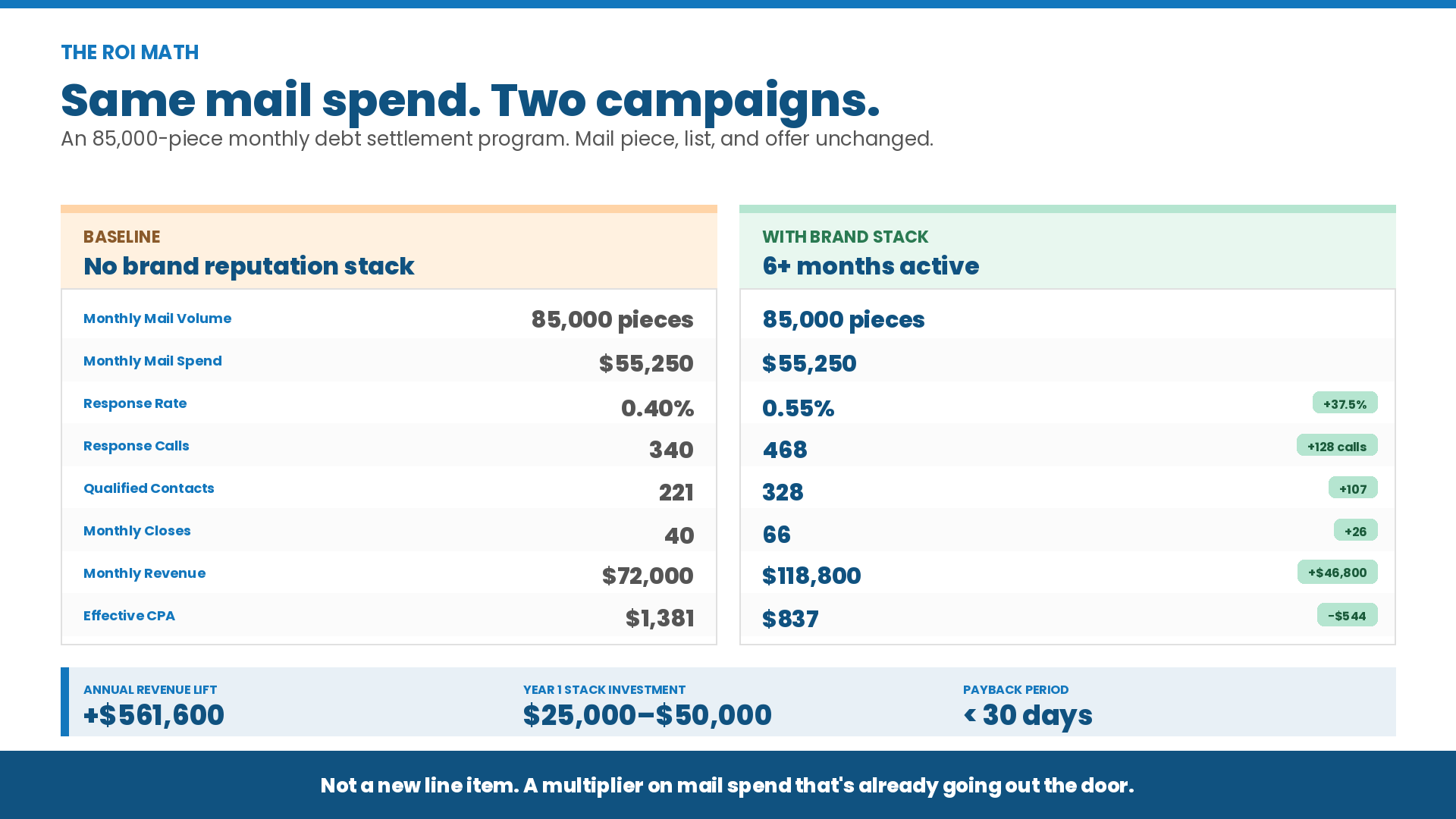
The brand search step is the most overlooked part of direct mail. It runs quietly, creates no data trail, and is never reported by a mail house – yet it decides whether the awareness your direct mail program creates turns into revenue.
The return on a brand reputation stack is measured against mail spend already going out – not as a new cost, but as a better result on money already being spent.
Using the 85,000-piece campaign model and LeadAdvisors data:
| Metric | Baseline (No Brand Stack) | With Brand Stack (6+ Months Active) |
| Monthly Mail Volume | 85,000 pieces | 85,000 pieces |
| Monthly Mail Spend | $55,250 | $55,250 |
| Response Rate | 0.40% | 0.55% |
| Response Calls | 340 | 468 |
| Qualified Contacts | 221 | 328 |
| Monthly Closes | 40 | 66 |
| Revenue per Close | $1,800 | $1,800 |
| Monthly Revenue | $72,000 | $118,800 |
| Effective CPA | $1,381 | $837 |
Monthly revenue improvement: +$46,800. Annual improvement: +$561,600.
Year 1 brand reputation investment: $25,000–$50,000.
Payback period: under 30 days of improved campaign performance.
The brand reputation stack is not an additional marketing expense. It is an efficiency improvement on marketing spend that is already being deployed.
How to Check Your Current Brand Search Result
This check takes 15 minutes. Here is how to do it:
- Open a private (incognito) browser window. This clears out any personal search history, so the results are fair.
- Type your exact company name. Do not add extra words, a city, or a state.
- Write down every result on page one. For each one, note: position, website, title, description, star rating if shown, and review count if shown.
- Label each result as positive (news article, good reviews, trusted directory), neutral (social media page, basic listings), or negative (complaint thread, low star rating, competitor comparison page).
- Use this simple pass rule: at least three positive results in the top five spots, no negative results in the top ten, and a review count above 50 with a rating above 4.5.
- Run your company name again three more times – once with the word “reviews” added, once with “complaints,” and once with “scam.” Write down what comes up each time.
If the check shows a gap – empty, negative, or full of competitor content – the four-step plan in the section above is the right starting point.