Most B2B cold calling teams do not have a script problem first. They have an operating problem.
The list is weak. The caller ID looks risky. The cadence is random. Meetings get booked, but no one confirms them. Then the team blames the opener and rewrites the script again.
That cycle burns leads, caller hours, and pipeline. Worse, it hides the real constraint: contact rate infrastructure.
B2B cold calling works in 2026 when six components work together: data quality, contact-rate infrastructure, conversation architecture, objection handling, meeting conversion, and attribution. This is the B2B Cold Calling Operating Model. LeadAdvisors runs this same framework to turn cold outbound activity into a measurable pipeline.

What Is B2B Cold Calling?
B2B cold calling is outbound phone outreach to business prospects who have not requested the call.
The goal is not to close a deal on the first call. The goal is to start a relevant business conversation, qualify the fit, and move the right prospect to a scheduled meeting, a transfer, or the next step.
In plain terms, B2B cold calling means calling a decision-maker, operator, owner, manager, or department lead at a business for a clear reason.
That call should still sit within a larger outbound prospecting execution methodology, where phone, email, LinkedIn, and follow-up work target the same ICP.
What B2B Cold Calling Is Not
B2B cold calling gets confused with several adjacent motions.
It also supports the broader sales prospecting operating model when teams need phone activity to create qualified sales conversations.
- B2C cold calling: Consumer-facing calling has a different compliance reality. TCPA, DNC, wireless number rules, and consumer protection issues carry a higher risk.
- Warm calling: Warm calls are made to prospects who have already shown intent. They may have downloaded content, attended an event, or asked for information.
- Inbound sales calling: Inbound calls come from prospects who contacted the company first.
- Appointment setting: Appointments can be scheduled via phone, email, LinkedIn, SMS, and chat. Cold calling is one channel within that motion, typically supported by the appointment-setter role when the team separates prospecting from closing.
- B2B telemarketing: B2B telemarketing operations are broader. They can include cold calls, warm calls, follow-up calls, surveys, and nurture activity.
This distinction matters because each motion has different metrics.
For example, a warm inbound call should convert better than a cold outbound call. If a team judges cold calling against inbound close rates, it will misunderstand the channel.
Is B2B Cold Calling Effective In 2026?
Yes. B2B cold calling is effective when it is run with strong targeting, accurate data, caller ID discipline, clear conversation architecture, and fast meeting follow-up.
However, it fails when teams treat it as a volume game.
That is why cold calling should not operate separately from the cold email outreach operating model (the email side of cold outbound).
Recent cold calling reports show the same pattern. Average teams struggle with low connect and meeting rates. Better teams improve performance through targeting, timing, direct dials, multi-touch follow-up, and tighter call operations.
Teams comparing internal SDRs, vendors, and BPO partners should also understand how B2B sales outsourcing operations affect cost and management models.
SalesHive’s 2025 benchmark analysis places the average B2B cold-call conversion rate at around 2-3%, while stronger teams reach 5-8% or more. Cognism’s 2026 cold calling report analyzed more than 200,000 calls and reported an overall cold calling success rate of 11.3% for 2025. The exact benchmark depends on how the report defines success, but the pattern is clear: better systems outperform raw dial volume.
Government and telecom activity also show why infrastructure matters. The FCC continues tightening robocall mitigation and caller identity rules. A 2026 Federal Register rule requires Robocall Mitigation Database filers to keep information accurate and current, with penalties for false or stale filings. In other words, the outbound calling environment continues to move toward verified identity, better call labeling, and stricter provider accountability.
So, the channel is not dead. It is more operational.
The B2B Cold Calling Operating Model
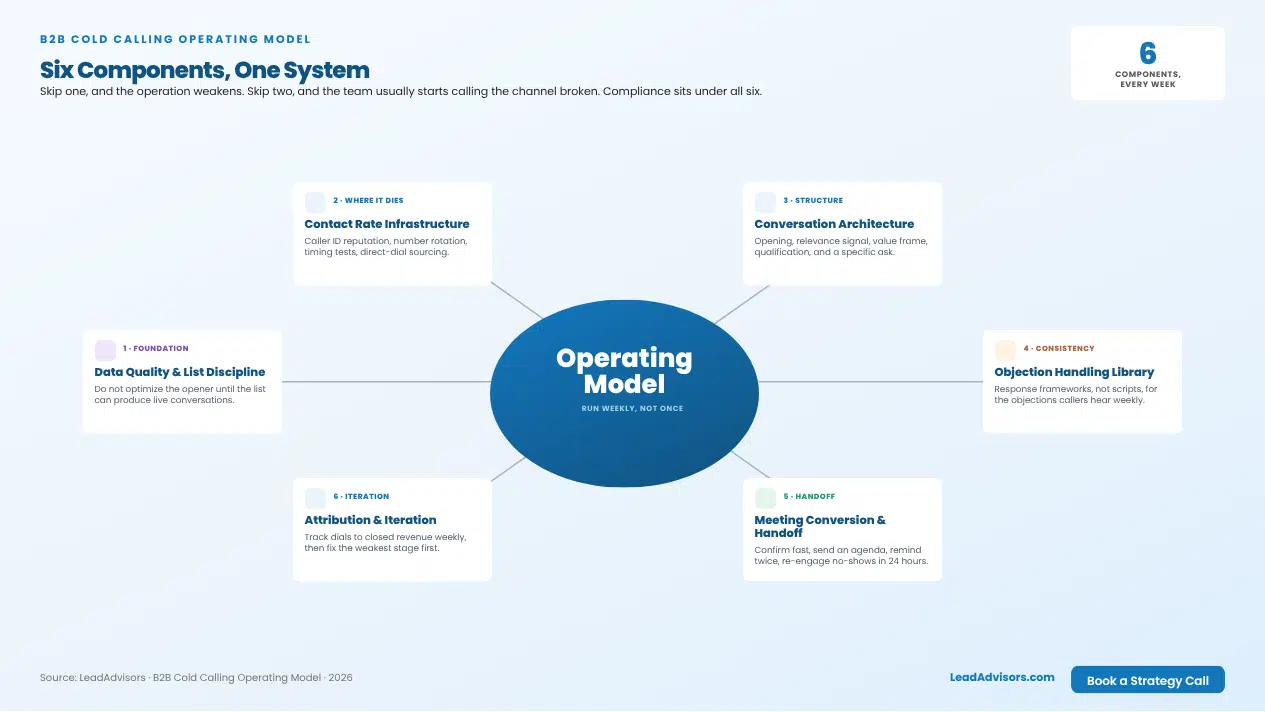
The B2B Cold Calling Operating Model has six components.
Compliance sits under every component, so operators should pair this model with a TCPA compliance framework for outbound calling.
Skip one, and the operation weakens. Skip two, and the team usually starts calling the channel broken.
1. Data Quality And List Discipline
Bad data kills cold calling before the first word of the script is spoken.
The team can have trained callers, good talk tracks, and strong offers. However, if the list contains incorrect numbers, outdated titles, misfits, and unverified direct dials, the campaign becomes an activity theater.
Strong list discipline includes:
- ICP firmographic filters
- persona and role filters
- direct-dial verification
- main-line versus direct-line separation
- geographic filters
- industry exclusions
- customer suppression lists
- active opportunity suppression
- do-not-contact suppression
- recent disqualification suppression
- quarterly re-validation
Data decay matters because B2B contacts change roles, companies, numbers, and responsibilities. Therefore, a list that looked strong six months ago can become a low-connect list today.
Operator rule: do not optimize the opener until the list can produce live conversations.
2. Contact Rate Infrastructure
Contact rate infrastructure is where most B2B cold calling actually dies.
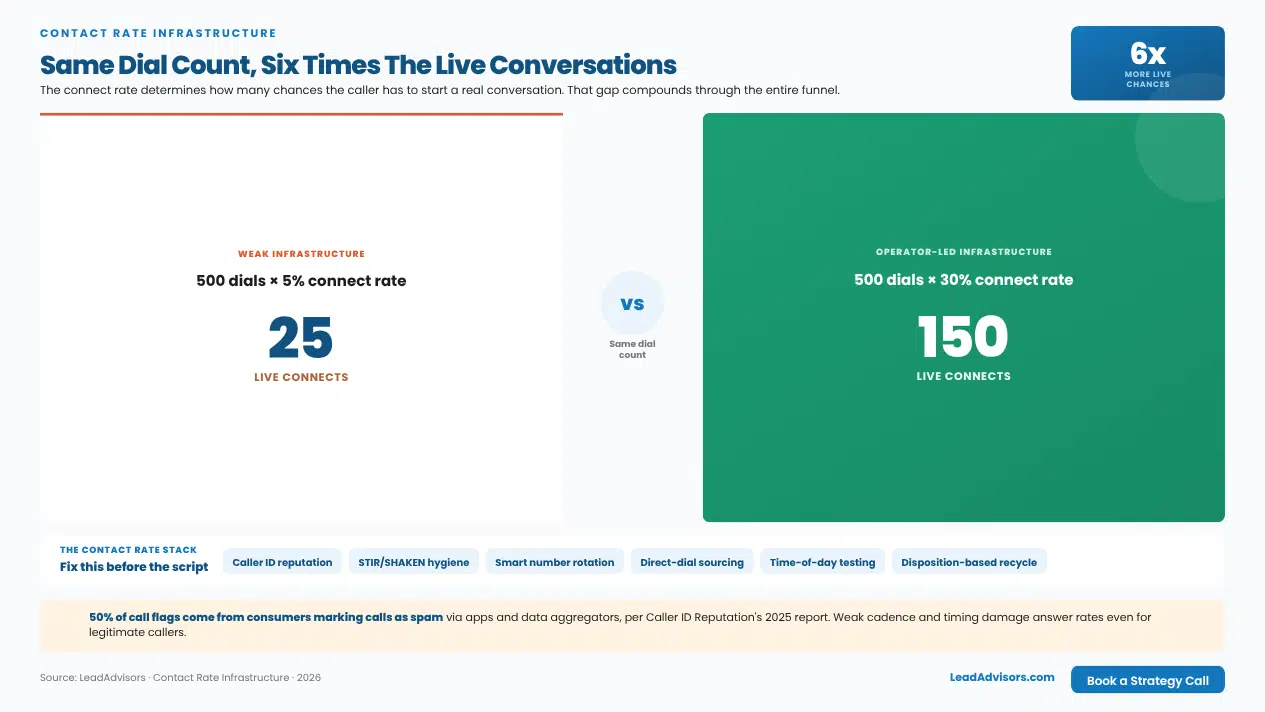
The connect rate determines how many chances the caller has to start a real conversation. A team with a 5% connect rate needs six times the dial volume of a team with a 30% connect rate to create the same number of live conversations.
That gap compounds through the funnel.
Example:
- 500 dials at a 5% connect rate = 25 connects
- 500 dials at a 30% connect rate = 150 connects
- Same dial count
- Six times more live chances
That is why contact rate infrastructure matters more than script polish at the beginning.
A strong contact rate optimization methodology gives the team a way to diagnose answer-rate problems before rewriting the talk track.
The stack includes:
Dialer choice also matters, which is why teams need a dialer technology selection guide before scaling call volume.
- local presence where appropriate
- caller ID reputation monitoring
- STIR/SHAKEN and number registration hygiene
- smart number rotation
- time-of-day testing
- day-of-week testing
- attempt cadence
- direct-dial sourcing
- multi-channel warming before the call
- disposition-based recycle rules
Caller ID reputation is now a real operating constraint. Caller ID Reputation’s 2025 report found that 50% of call flags were due to consumers marking calls as spam via apps and data aggregators. That means an aggressive cadence, poor timing, and weak list hygiene can damage answer rates, even for legitimate companies.
The FCC’s 2025 call branding and caller identity work also points in the same direction. Providers and regulators want clearer caller identity. For B2B cold calling teams, that means number trust is no longer optional infrastructure.
The same logic applies to outbound dialing campaign operations where list prep, pacing, and disposition rules shape the result.
3. Conversation Architecture
A B2B cold-calling script only helps after the infrastructure is in place.
The better model is a conversation architecture. It gives callers a structure without forcing robotic delivery.
A strong B2B cold call usually has five parts:
- Opening: Identify yourself and ask for brief permission.
- Relevance signal: Explain why this business, role, or account is worth calling.
- Value frame: Tie the call to a specific business problem.
- Question or qualification: Confirm whether the pain exists.
- Ask: Request a specific next step.
The structure matters because prospects decide fast.
Generic openers create resistance. Specific relevance creates permission to continue.
Weak opener:
“Hi, how are you today?”
Stronger opener:
“Hi, this is Alex from LeadAdvisors. I know this is out of the blue. Do you have 30 seconds for why I called?”
That is not a copy-paste script. It is a principle. The caller earns a small window, then uses that window well.
4. Objection Handling Library
Improvisation creates inconsistent calls.
That is why operator-led cold calling teams build objection-handling libraries. These are not word-for-word scripts. They are response frameworks.
The library should cover the objections callers hear every week:
- “Not interested.”
- “Send me information.”
- “We already have a vendor.”
- “Not the right time.”
- “I am not the decision-maker.”
- “No budget.”
- “Call me next quarter.”
- “How did you get my number?”
- “Take me off your list.”
Each response should include:
- What the objection usually means
- How to acknowledge it
- What question to ask next
- When to disengage
- How to record the outcome
For example, “send me information” is often a soft no. However, it can become useful if the caller qualifies the request.
The caller can say:
“Happy to send something. What would be most useful: pricing context, how the model works, or examples of how teams use it?”
Now the prospect must clarify intent.
5. Meeting Conversion And Handoff
Cold calling does not end when the prospect says yes.
That is where many teams lose ROI. They book the meeting, then let the process drift.
Meeting conversion needs its own workflow:
- Book the meeting during the call
- Confirm by email within five minutes
- Include a clear agenda
- Send calendar details with the right time zone
- Remind the prospect 24 hours before
- Remind the prospect one hour before
- Prepare the closer with call notes
- Reschedule no-shows within 24 hours
- attempt up to three re-engagement touches
The handoff matters because a booked meeting is not yet in the pipeline. It becomes a pipeline only when the right person shows up and moves into a real sales process.
Warm-transfer motions also need training closers to receive warm transfers, so the closer does not waste the intent created by the caller.
Fast confirmation works the same way as speed-to-lead infrastructure because response time protects buyer intent.
6. Attribution And Iteration
Cold calling needs weekly management.
Without attribution, the team cannot defend spending or improve performance.
Track the funnel by stage:
- dials
- connects
- conversations
- qualified conversations
- meetings booked
- meetings held
- opportunities created
- closed revenue
Then break performance down by:
- caller
- list source
- industry
- persona
- time of day
- day of week
- attempt number
- opener
- value frame
- objection type
This is where the operation improves.
If connections are low, fix the data and the caller ID. If conversations are low, fix the opening and relevance. If meetings are low, fix the ask and objection handling. If show rates are low, fix confirmation and reminder workflows.
This review cadence belongs within BPO contact strategy operations, where teams run callers, data, cadence, and handoff as a single operating system.
B2B Cold Calling Statistics And Benchmarks To Watch
Benchmarks vary by source, industry, and definition. Some reports define success as a live conversation. Others define it as a booked meeting.
Still, these ranges give operators a working baseline.
Core Metrics
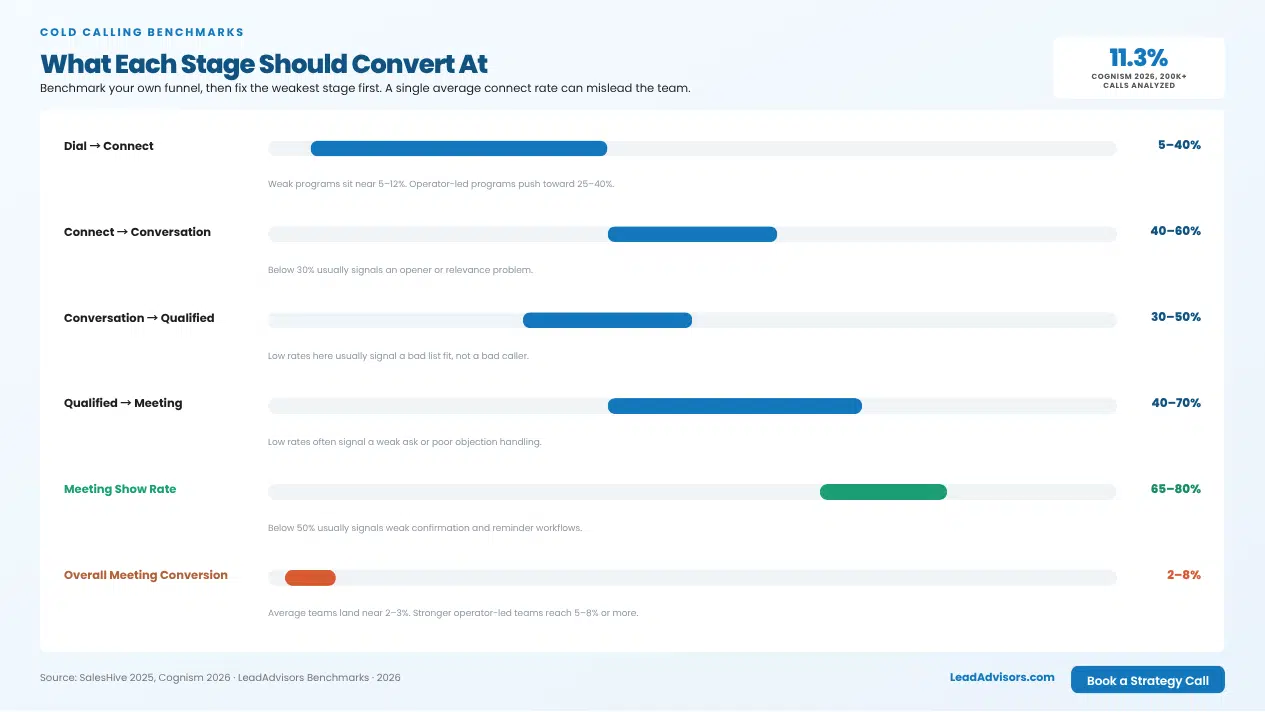
- Dial-to-connect rate: Often 5-12% in weak or average operations. Operator-led programs can push toward 25-40% with stronger infrastructure in place.
- Connect-to-conversation rate: Target 40-60%. Below 30% usually signals opener or relevance issues.
- Conversation-to-qualified rate: Target 30-50%. Low rates usually signal a bad list fit.
- Qualified-to-meeting rate: Target 40-70%. Low rates often signal weak ask structure or poor objection handling.
- Meeting show rate: Target 65-80%. Below 50% usually signals weak confirmation.
- Cold call conversion rate: Many 2025 benchmark reports place average meeting conversion near 2-3%, with stronger teams reaching 5-8% or more.
Teams should also separate the transfer-set rate versus the show rate because booked meetings and held meetings diagnose different operational problems.
Why Benchmarks Differ
Benchmarks change based on:
- market
- offer
- ACV
- seniority
- region
- data source
- direct-dial availability
- caller skill
- brand recognition
- compliance limits
- meeting definition
Therefore, a single “average connect rate” can mislead the team.
The better move is to benchmark your own funnel, then improve the weakest stage first.
When the weakest stage has already damaged the campaign, use a structured process to relaunch failing outbound campaigns rather than just changing the script.
Modern Cold Calling Techniques For B2B Sales In 2026
Modern B2B cold calling is not about harder pressure. It is about better timing, better data, and cleaner execution.
For smaller teams, the same discipline applies to outbound operations for small businesses, where every caller hour must yield measurable learning.
Use Multi-Channel Warming
Calls perform better when the prospect has seen the company before.
That does not mean spam every channel. It means to coordinate the sequence.
Example cadence:
- Day 1: email with a specific pain point
- Day 2: call attempt one
- Day 4: LinkedIn view or connection
- Day 5: call attempt two
- Day 8: email with proof or use case
- Day 10: call attempt three
- Day 14: final value-led follow-up
The call should feel less random because the account has context.
If the goal is meetings, align the sequence around a clear B2B appointment-setting methodology rather than treating each channel as a separate task.
Call Around Availability Windows
Time of day still matters. Early morning and late afternoon often work because calendars have fewer internal meetings. Mid-week can also outperform Monday morning or Friday afternoon.
Still, do not treat any benchmark as universal. Test by role, time zone, and seniority. Then shift dialing blocks toward windows that produce qualified conversations.
Use AI For Research, Not Replacement
AI can help with account research, persona pain mapping, call prep, call summaries, CRM notes, QA review, and coaching insights.
However, it should not replace human judgment in high-value B2B conversations. Use AI to prepare the caller, not to flood prospects with generic outreach.
Keep The Script Flexible
The best B2B cold calling script is not a script in the traditional sense.
It is a structure:
- who you are
- why you called
- Why it matters now
- What problem do you solve
- What question do you need answered
- What is the next step that makes sense
That structure keeps the call consistent. However, the caller still needs to listen.
B2B Cold Calling Laws And Compliance Considerations
B2B cold calling is legal in many contexts, but it is not regulation-free.
Compliance depends on the country, state, number type, technology used, consent status, and industry. Therefore, teams need legal review before scaling outbound.
United States
In the U.S., TCPA rules focus heavily on autodialed calls, prerecorded or artificial voice messages, wireless numbers, consent, and consumer protection. The FCC’s unwanted robocalls guide states that robocalls include calls made with an autodialer or prerecorded or artificial voice message. It also states that prior consent is required for certain prerecorded telemarketing calls and autodialed or prerecorded calls or texts to wireless numbers.
B2B callers still need to manage:
- DNC requests
- opt-outs
- wireless number risk
- consent records
- call recording laws
- industry-specific rules
- accurate caller identity
- vendor oversight
The 2024 FCC one-to-one consent rule also became a major issue for lead generators. In early 2025, the Eleventh Circuit vacated the FCC’s one-to-one consent rule, and the FCC later removed the requirement from its rules. Still, the episode shows that consent rules can change fast.
GDPR And International B2B Cold Calling
GDPR applies to B2B cold calling when personal data is processed for outreach in the EU or the UK.
Teams may need a lawful basis, opt-out handling, data minimization, retention controls, and country-specific review. The UK also has PECR rules. Canada has CRTC and CASL-related considerations. EU markets vary by country.
The safe operator rule is simple: do not treat international B2B calling as one global rulebook.
B2B Cold Calling Services: When To Outsource
Many buyers searching for b2b cold calling are evaluating B2B cold-calling services, agencies, or outsourced appointment-setting.
Separate phone-only vendors from outsourced appointment-setting operations that manage list quality, outreach, booking, and handoff in one process.
Outsourcing works when the vendor brings infrastructure the client lacks: trained callers, supervisors, QA, reporting, dialer management, caller ID discipline, list feedback, meeting confirmation, multi-channel follow-up, and compliance controls.
That is why buyers should understand the appointment setting services category before comparing price per caller or price per meeting.
How To Choose B2B Cold Calling Services
Ask how the agency verifies data, manages caller ID reputation, handles DNC and opt-out requests, coaches callers, confirms meetings, reports daily performance, and responds when connect rates drop.
The right partner should talk about operations before scripts.
Use an appointment-setting company evaluation matrix and a broader lead-generation vendor evaluation matrix to compare channel mix, management depth, reporting, compliance, and vertical fit.
If the sales pitch starts and ends with “we have great callers,” keep digging.
Best Tools For Cold Calling B2B Leads
The best tool depends on the campaign type. Most teams need data, verification, dialer, CRM, and QA tools.
Use preview dialing for tier-1 named accounts, power dialing for controlled volume, and predictive dialing only when compliance and abandonment rules are tightly managed.
The wrong dialer creates either wasted research or careless volume.
B2B Cold Calling Alternatives
B2B cold calling is not the only outbound channel. Cold email, LinkedIn outreach, compliant SMS, paid search, retargeting, webinars, referrals, SEO, and speed-to-lead workflows can all support the pipeline.
However, the best alternative is often orchestration rather than replacement. That orchestration should support a broader customer acquisition strategy framework instead of treating cold calling as an isolated activity target.
Phone-only campaigns usually underperform compared to multi-channel systems because other channels provide context before the live conversation.
Common Mistakes That Kill B2B Cold Calling ROI
Most failures come from repeated operational mistakes:
- Optimizing scripts before contact rate: If the connect rate is 5%, fix data, direct dials, caller ID, timing, and cadence first.
- Calling bad-fit accounts: A poor ICP fit leads to polite rejection, even when the caller sounds strong.
- Ignoring caller ID reputation: Spam labels reduce trust before the prospect answers.
- Using the wrong cadence: Most cold sequences need a controlled attempt range of 14-21 days, with timing variation and respect for opt-out.
- Making vague meeting asks: Specific options beat “Would you like to connect sometime?”
- Letting booked meetings go cold: Send the calendar invite, agenda, and reminder fast.
Unit Economics That Actually Hold Up
B2B cold calling should be judged by economics, not dial volume.
It should connect to the larger lead generation services stack and B2B sales funnel architecture so the team can see where calls create pipeline and where the funnel leaks.
Track cost per dial, connect, conversation, qualified conversation, meeting booked, meeting held, opportunity, and closed deal.
Labor cost matters. The U.S. Bureau of Labor Statistics’ sales occupations data helps teams benchmark labor. BLS also reported May 2024 wages for wholesale and manufacturing sales representatives, including $66,780 for representatives excluding technical and scientific products and $100,070 for technical and scientific products. Customer service representatives had a median hourly wage of $20.59 in May 2024.
Those numbers do not equal SDR cost on their own. Still, they show why in-house calling can become expensive once salary, management, software, training, QA, benefits, and turnover are included.
That is where outsourced BPO and lead generation outsourcing can make sense.
In-House Versus Outsourced
In-house teams provide greater control over strategic enterprise accounts and complex sales motions.
Outsourced teams can win when the company needs faster launches, lower labor load costs, managed QA, offshore infrastructure, supervisors, reporting, multi-channel execution, and appointment setting at scale.
This overlaps with the sales development services category because SDR execution includes calls, emails, qualification, and meeting creation.
Hybrid models often work best: keep tier-1 strategic accounts in-house, then use an operator-led BPO partner for tier-2 and tier-3 volume. A practical in-house SDR versus outsourced BPO review should compare control, management load, speed, infrastructure, and cost per qualified meeting.