Most B2B companies do not have a real sales funnel. They have a diagram, a CRM pipeline, and leads from different places.
When conversion drops, marketing blames sales. Sales blames lead quality. Leaders ask for more pipeline, but no one knows which stage is broken.
As a result, money gets wasted. Closers sit idle. Attribution stays weak. Handoffs leak revenue before the team sees the pattern.
A B2B sales funnel should work like a clear operating system. Every stage needs an owner, entry rules, exit rules, metrics, and handoff rules.
This guide explains the B2B Sales Funnel Architecture. LeadAdvisors uses this framework to turn funnel theory into a clear revenue movement.

What Is a B2B Sales Funnel?
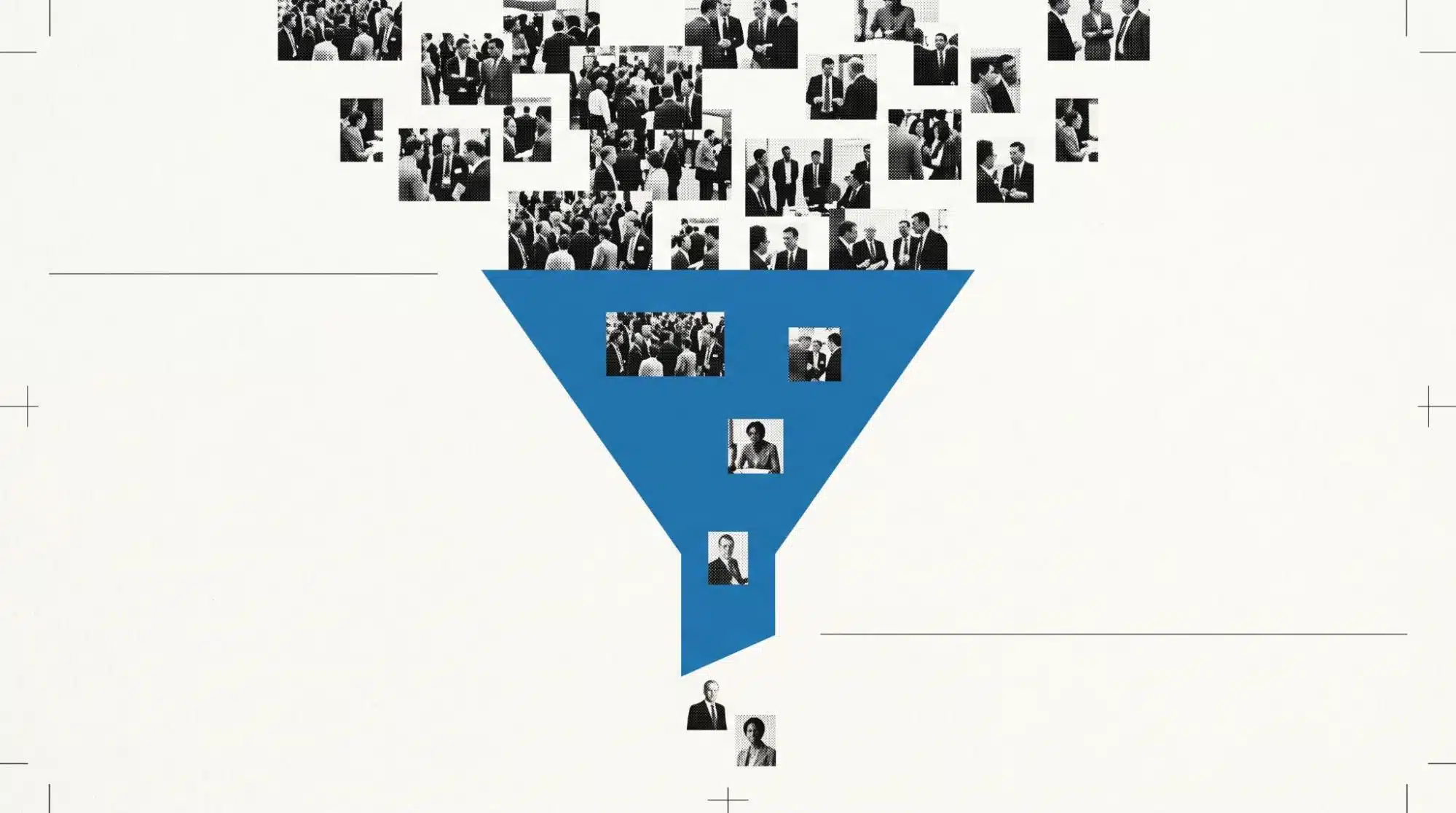
A B2B sales funnel is the system that moves target accounts from first awareness to closed revenue.
It defines each stage, owner, entry rule, exit rule, metric, and handoff point. In simple terms, it shows how marketing demand becomes a qualified pipeline and signed customers.
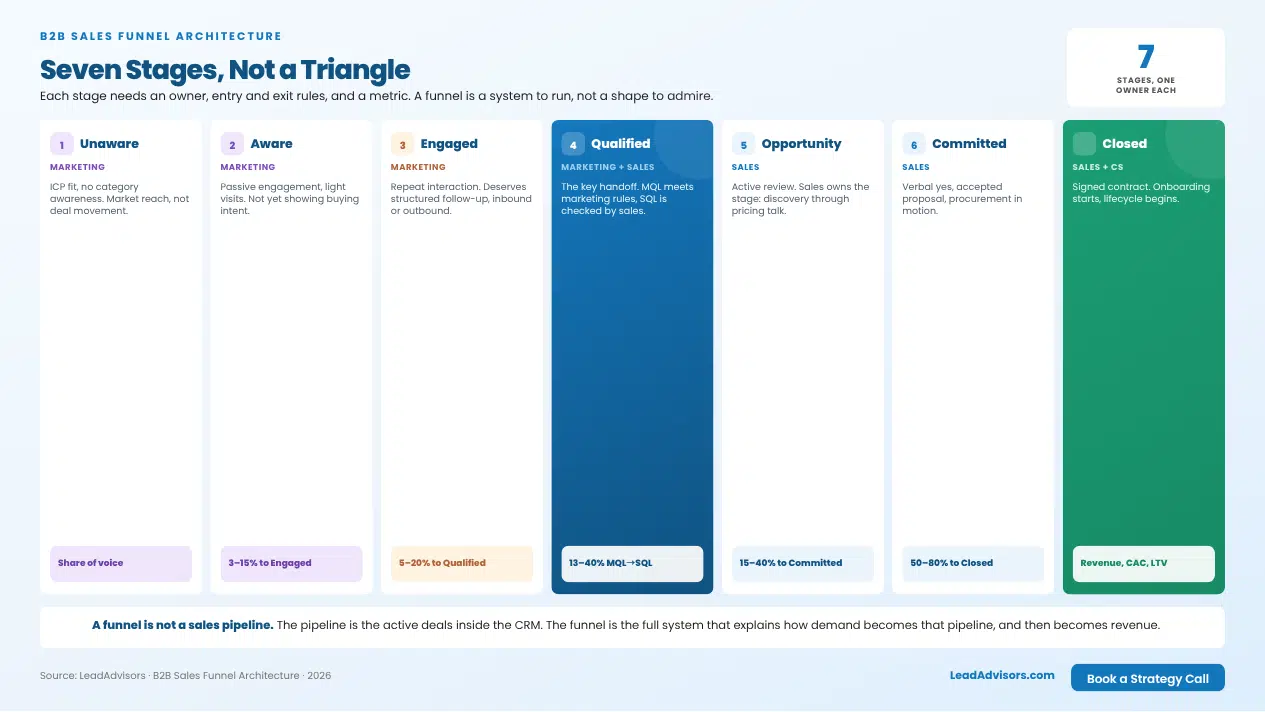
The seven B2B sales funnel stages are:
- Unaware
- Aware
- Engaged
- Qualified
- Opportunity
- Committed
- Closed
This is not the same as a sales pipeline. A sales pipeline tracks active opportunities inside the CRM. A B2B sales funnel explains how those opportunities get created, qualified, worked, measured, and closed.
This matters because B2B buying has become more complex. The 2025 6sense B2B Buyer Experience Report found that typical B2B purchases involve more than 10 people and take close to a year. It also found that buyers often compile vendor shortlists before talking to sales.
That means a B2B sales funnel cannot rely on lead volume alone. It needs stage-level tracking, clean handoffs, fast response, and attribution that shows how buying groups move.
For the upstream view, compare this sales funnel against the broader lead funnel architecture. The lead funnel explains demand capture before sales ownership begins.
Why Most B2B Sales Funnels Fail
Most B2B companies do not fail because they lack a funnel diagram. They fail because the diagram never became an operating infrastructure.
The usual pattern is simple. Marketing generates leads. Sales works with some of them. The CRM shows the pipeline. However, no one can explain which stage is breaking.
The team cannot answer basic questions:
- How many prospects move from engaged to qualified?
- How fast do sales respond to MQLs?
- Which MQLs become SQLs?
- Which sources create real opportunities?
- Where does time-in-stage expand?
- Which handoff creates the largest drop-off?
- Which stage has no clear owner?
As a result, teams debate opinions rather than diagnose the system. Stage-level visibility matters because it shows where prospects enter, where they stall, and who owns the fix.
Teams also need sales cycle length and stage progression data. Otherwise, they cannot tell whether a delay is a funnel issue or a sales-cycle issue.
The B2B Sales Funnel Architecture
The B2B Sales Funnel Architecture is a seven-stage framework. Each stage has a clear job, owner, metric, and rule.
The same logic applies to a customer acquisition strategy framework. Acquisition creates demand, but the funnel decides whether that demand becomes revenue.
Stage 1: Unaware
Unaware prospects match your ICP, but they do not yet know your company or category.
This stage is about market reach. Marketing owns it through brand building, education, content, events, social posts, and search.
Entry rules: ICP fit, problem fit, and no company or category awareness.
Exit rules: brand awareness, category awareness, website visits, branded search, or content engagement.
Main metrics: branded search, direct traffic, category awareness, and share of voice.
Many ICP-fit prospects stay unaware for months or years. Treat this stage as market reach, not deal movement.
Stage 2: Aware
Aware prospects know the company, category, or problem exists. However, they have not shown strong buying intent yet.
Entry criteria: passive brand engagement, category recognition, light website visits, or content exposure.
Exit criteria: repeat engagement, newsletter signup, webinar attendance, direct site return, or deeper content consumption.
Main metric: aware-to-engaged conversion rate.
A common benchmark range is 3% to 15%, depending on brand strength and content quality. Teams should validate this against their own acquisition sources.
Stage 3: Engaged
Engaged prospects interact with the brand repeatedly. They are not qualified yet, but they show signals that deserve structured follow-up.
This is where many B2B marketing and sales funnels break. Teams often treat prospects as either “aware” or “ready for sales.” That leads to weak handoffs and poor lead quality.
Entry criteria: multiple site visits, content downloads, email engagement, webinar participation, retargeting engagement, or outbound conversation acceptance.
Exit criteria: form fill, demo request, contact request, sales reply, or clear buying signal.
Main metric: engaged-to-qualified conversion rate.
A typical operator range is 5% to 20%. The range depends on the offer, ICP fit, sales motion, and intent scoring.
This stage also matters for outbound. A prospect may never convert inbound. However, outbound can convert engaged accounts into qualified conversations.
That is where a sales prospecting operating model matters. Prospecting turns target accounts and raw demand into qualified conversations.
Stage 4: Qualified
Qualified prospects have moved from interest to lead status. This is the key handoff point in the funnel.
An MQL meets marketing rules. An SQL has been contacted and checked by sales.
Entry rules: inbound form, outbound reply, ICP match, intent signal, and persona fit.
Exit rules: sales accepts the lead, creates an opportunity, or disqualifies the lead with a reason.
Main metrics: MQL-to-SQL rate, speed-to-lead, and completed dispositions.
If MQL-to-SQL conversion drops, check lead rules, source quality, response speed, and disposition data.
Stage 5: Opportunity
An opportunity is an active sales review. Sales now owns the stage.
Entry rules: sales accepts the lead, discovery happens, and an opportunity is created.
Exit rules: proposal request, verbal yes, pricing talk, contract review, or closed lost.
Main metrics: opportunity-to-committed conversion rate, time-in-stage, meeting completion rate, and proposal rate.
A common benchmark range is 15% to 40%.
Stage 6: Committed
Committed prospects have shown a clear buying signal.
Entry rules: verbal yes, accepted proposal, procurement started, contract review, or final approval.
Exit rules: signed contract, closed lost, or stalled past the limit.
Main metrics: committed-to-closed conversion rate, procurement cycle length, legal review time, and forecast accuracy.
A typical benchmark range is 50% to 80%.
Stage 7: Closed
Closed prospects have signed and become customers. This is the terminal stage of the B2B sales funnel.
Entry criteria: signed contract, executed order, or confirmed purchase.
Exit criteria: onboarding starts, delivery handoff completes, and the customer lifecycle begins.
Main metrics: closed-won rate, revenue by source, CAC, LTV, payback period, and expansion potential.
Closed revenue should feed back into funnel measurement.
If the drop-off occurs on the website, use the conversion funnel optimization methodology to inspect landing pages, forms, calls to action, and buyer friction points.
B2B Sales Funnel Vs. Sales Pipeline
A B2B sales funnel and a sales pipeline are related. However, they are not the same thing.
A sales funnel is the full architecture from awareness to closed revenue. It shows how prospects move through defined stages.
A sales pipeline is the list of active deals that sales is working on now.
| Area | B2B Sales Funnel | B2B Sales Pipeline |
| Main question | How does demand become revenue? | Which deals are active now? |
| Scope | Awareness of closed customers | Qualified opportunities to close |
| Owner | Marketing, sales, RevOps | Sales |
| Metrics | Stage conversion, velocity, attribution | Deal value, probability, close date |
The pipeline is downstream of the funnel. If the funnel breaks, the pipeline eventually dries up.
When pipeline volume depends on new demand, use the foundational lead generation framework to separate demand creation from sales execution.
Marketing-to-Sales Handoff
The marketing-to-sales handoff is the riskiest point in a B2B sales and marketing funnel. This is where ownership changes and blame often start.
A strong handoff needs three things:
- Clear MQL definition
- Clear SQL definition
- Enforced service level agreement
An MQL should meet agreed qualification rules, not just download a PDF. Strong criteria include ICP fit, persona fit, engagement behavior, intent signal, source quality, and problem alignment.
An SQL should mean sales validated the lead. Common checks include real pain, fit, influence, timing, budget logic, and a scheduled next step.
Every MQL also needs a clear disposition: contacted, not contacted, qualified, disqualified, no response, wrong fit, wrong timing, re-nurture, or suppress.
Without this loop, marketing cannot improve lead quality. Sales also cannot prove why leads failed.
If the handoff includes warm follow-up, connect the process to lead nurturing automation. Automation should support handoff discipline, not replace it.
Speed-to-Lead: The Handoff Metric Most Teams Underbuild
Speed-to-lead measures how fast sales respond after a prospect raises a hand.
It matters because buyer attention decays quickly. Older lead response studies found large conversion advantages for fast follow-up. Recent 2026 speed-to-lead benchmark summaries still point to the same pattern: teams with formal response SLAs meet response targets more often than those without.
The operator takeaway is simple. Knowing the five-minute rule is not enough. You need infrastructure that enables a fast response.
That includes instant routing, rep availability rules, SMS alerts, CRM task creation, backup owner logic, call scripts, disposition tracking, and follow-up cadence.
For LeadAdvisors, this connects directly to the sales funnel and automation work. The goal is faster contact, cleaner routing, and fewer unworked leads.
Teams that cannot hit response windows need speed-to-lead infrastructure. Fast response requires routing, ownership, and backup coverage.
B2B Sales Funnel Metrics That Actually Matter
B2B sales funnel metrics should show movement, quality, speed, and revenue. Lead volume alone does not diagnose the system.
Track these core metrics:
- Stage conversion from aware to closed
- MQL-to-SQL rate
- Speed-to-lead
- Time-in-stage
- Pipeline velocity
- Cost per stage progression
- Revenue attribution by source
For phone-based operations, connect funnel metrics to call center operator metrics. Dials, connects, talk time, transfer rate, and show rate all affect stage movement.
Pipeline velocity shows how fast a qualified pipeline becomes revenue.
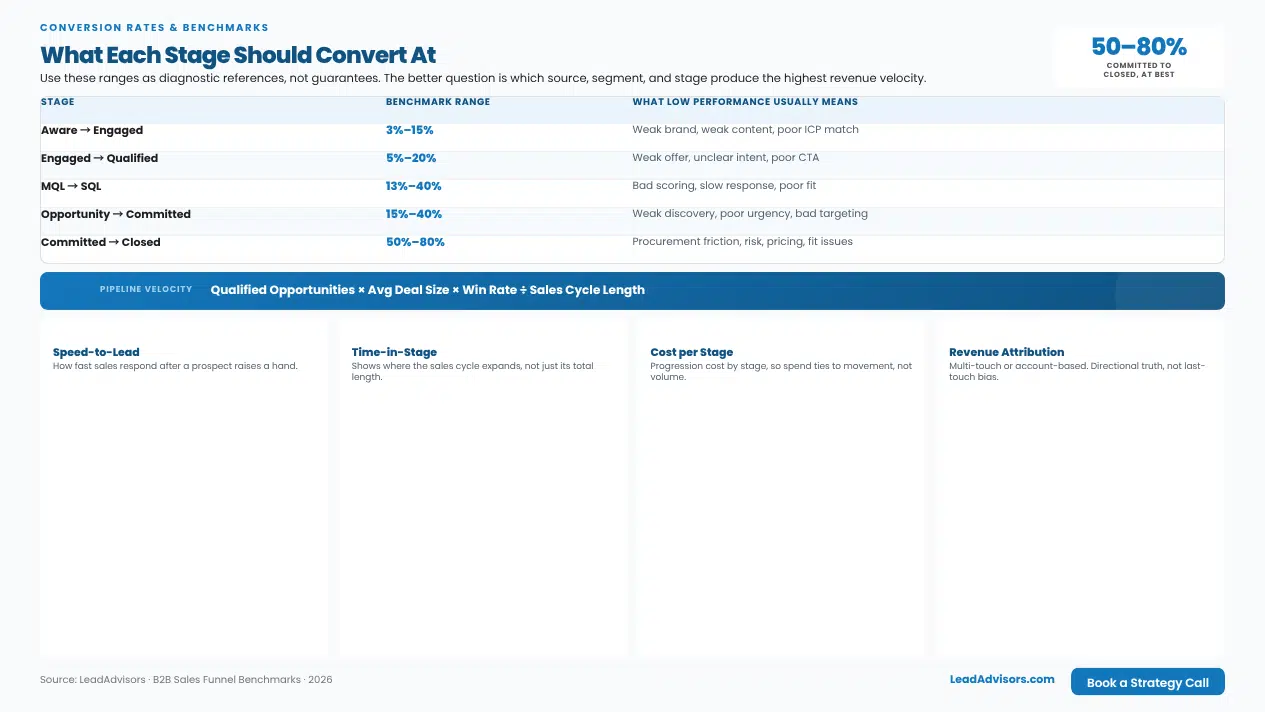
Pipeline Velocity = Number of Qualified Opportunities × Average Deal Size × Win Rate ÷ Sales Cycle Length
A team can improve velocity by increasing qualified opportunities, raising average deal size, improving win rate, or shortening the sales cycle. Each lever needs a different operating fix.
If contact quality is the bottleneck, use contact rate optimization methodology. A better contact rate can improve the pipeline without increasing lead spend.
B2B attribution is imperfect. Track first touch, last touch, multi-touch, W-shaped attribution, account-based influence, campaign source, and content influence. The goal is directional truth.
B2B Sales Funnel Conversion Rates and Benchmarks
Benchmarks help operators spot abnormal performance. However, they should not replace internal cohort data.
Use ranges as diagnostic references, not guarantees.
| Stage | Typical Benchmark Range | What Low Performance Usually Means |
| Aware to Engaged | 3%–15% | Weak brand, weak content, poor ICP match |
| Engaged to Qualified | 5%–20% | Weak offer, unclear intent, poor CTA |
| MQL to SQL | 13%–40% | Bad scoring, slow response, poor fit |
| Opportunity to Committed | 15%–40% | Weak discovery, poor urgency, bad targeting |
| Committed to Closed | 50%–80% | Procurement friction, risk, pricing, fit issues |
Several 2025 and 2026 B2B benchmark reports show wide variation by industry, deal size, channel, and sales motion. Compare First Page Sage conversion benchmarks with MarketJoy pipeline conversion data before treating any number as universal.
A strong B2B sales funnel dashboard should segment each stage by source, campaign, industry, company size, persona, sales motion, deal size, and region.
The better question is not “what is the average B2B sales funnel conversion rate?” It is: which source, segment, and stage produce the highest revenue velocity?
For vendor comparisons, use a lead generation vendor evaluation matrix. It helps separate data vendors, appointment setters, managed operators, and full-service programs.
B2B Sales Funnel Template
Use this B2B sales funnel template to audit the operating system:
- Unaware: Marketing owns ICP-fit accounts with no awareness. Metric: share of voice.
- Aware: Marketing owns passive awareness. Metric: aware-to-engaged conversion.
- Engaged: Marketing owns repeat engagement. Metric: engaged-to-qualified conversion.
- Qualified: Marketing and sales share MQL-to-SQL movement. Metric: handoff conversion.
- Opportunity: Sales owns an active evaluation. Metric: opportunity-to-committed conversion.
- Committed: Sales owns the final decision. Metric: committed-to-closed conversion.
- Closed: Sales and CS own the handoff. Metric: revenue, CAC, and LTV.
If the team needs outsourced execution, map the template against the lead generation services stack. Each service category supports a different funnel gap.
How to Build a B2B Sales Funnel
Building a B2B sales funnel means designing and operating rules first. Do not start with software. Start with stage logic.
Step 1: Define the ICP
Define industry, company size, revenue range, team size, pain point, trigger event, buying committee, and disqualifiers.
If the team still needs to demand before designing the funnel, start with a tactical lead-generation methodology.
Step 2: Define the Seven Stages
Document each stage name, entry criteria, exit criteria, owner, conversion metric, time-in-stage benchmark, and required CRM fields.
Step 3: Define MQL and SQL Rules
Marketing commits to lead quality. Sales commits to response and disposition.
For outsourced programs, compare handoff ownership with lead generation outsourcing. Outsourcing changes execution, but it should not remove accountability.
Define MQL threshold, SQL threshold, response SLA, disqualification reasons, re-nurture rules, and escalation path.
Step 4: Build the Follow-Up Cadence
A lead without follow-up is not a pipeline. Build a sequence across calls, SMS, email, voicemail, retargeting, re-nurture, and re-engagement.
Outbound teams should also define how outbound prospecting will be executed. The cadence should match ICP, channel, buying signal, and handoff rules.
Step 5: Build the Dashboard
A B2B sales funnel dashboard should show stage volume, conversion, MQL-to-SQL rate, speed-to-lead, time-in-stage, pipeline velocity, cost per stage, and revenue by source.
If email is one channel, document the operating model for cold email outreach. Email should feed stage movement, not vanity replies.
Step 6: Review Weekly, Monthly, and Quarterly
Use a simple cadence: daily lead flow, weekly conversion, monthly cohort analysis, and quarterly stage calibration.
B2B SaaS Sales Funnel Considerations
A B2B SaaS sales funnel needs the same operating logic. However, the stages may include product behavior.
A B2B SaaS funnel may include website visits, content engagement, trial signups, product activation, product-qualified leads, sales-qualified opportunities, and expansion opportunities.
PLG companies should not force every buyer into a sales-led funnel. Instead, they should use product usage as qualification data.
Key B2B SaaS metrics include signup-to-activation rate, activation-to-PQL rate, PQL-to-SQL rate, trial-to-paid rate, expansion rate, net revenue retention, and sales-assisted conversion.
For SaaS teams, align the funnel with SaaS-specific sales methodology. SaaS funnels often need product usage, activation, and expansion signals.
SaaS demand teams should also compare stage logic with the SaaS lead-generation methodology. Trial quality matters more than raw signup count.
Enterprise Sales Funnel Considerations
Enterprise B2B funnels need more account-level logic. The buying group is larger. Procurement takes longer. Attribution is harder.
Forrester reported in 2026 that 64% of business buyers at the manager level and above were Millennials or Gen Zers in its 2025 Buyers’ Journey Survey. These buyers bring more self-guided research into B2B buying.
That changes the funnel. Enterprise teams should track account engagement, buying committee coverage, multi-contact activity, procurement stage, legal stage, executive sponsor status, consensus risk, and competitive risk.
A traditional lead-only funnel misses much of this activity. The Consensus 2026 B2B Buyer Behavior Report also reinforces the need for stronger tracking of buying-committee behavior.
Enterprise teams with outbound or SDR support should map build-versus-buy decisions through in-house SDR versus outsourced BPO. Capacity affects whether funnel SLAs can actually run.
Common B2B Sales Funnel Failures
B2B sales funnel performance usually breaks down at predictable points.
Undefined Stage Criteria
The CRM has stages, but reps interpret them differently. One rep marks a deal as an opportunity after a first call. Another waits until a proposal. Forecasting becomes unreliable.
Fix it by documenting entry and exit criteria.
Weak Marketing-to-Sales Handoff
Marketing creates MQLs. Sales ignores or rejects them. No one tracks why.
Fix it with MQL and SQL definitions, response SLAs, and disposition reporting.
When meetings are the core handoff, use a B2B appointment setting methodology to define qualification, booking, confirmation, and show-rate rules.
Slow Speed-to-Lead
Prospects raise their hand. Sales respond too late.
Fix it with routing, alerts, backup ownership, and automated follow-up.
If the team cannot staff the response layer internally, evaluate outsourced appointment setting. The goal is coverage, speed, and qualified meetings.
Missing Stage Diagnostics
The team tracks total leads and closed revenue. However, it cannot see the stage drop-off.
Fix it with stage-to-stage reporting.
Call-heavy teams should align funnel diagnosis with call center sales pipeline management. Pipeline hygiene depends on dispositions and stage rules.
Attribution Blindness
Last-touch reports get all the credit. Top-of-funnel work gets cut. Pipeline drops later.
Fix it with multi-touch or account-based attribution. Buyer behavior summaries from Corporate Visions show why self-guided buying activity can be undercounted when attribution is too narrow.
Pipeline Coverage Gaps
Sales does not have enough qualified opportunity value to hit the target. Many revenue teams use a 3x-4x pipeline coverage target. However, the right number depends on win rate, deal cycle, and forecast quality.
Fix it by monitoring coverage early.
If appointment vendors are part of the plan, use an appointment setting company evaluation matrix before buying meetings. Vendor type changes the risk profile.
Closer Capacity Mismatch
Marketing creates more leads than sales can handle. Lead age, contact rates drop, and sales blame quality.
Fix it with capacity planning and queue rules.
This is also where the sales development services category fits. SDR work needs capacity, scripts, data, QA, and reporting.
Sales Cycle Extension
Deals take longer. Leaders demand faster closing. However, no one knows which stage expanded.
Fix it with time-in-stage reporting.
If the process spans calling, email, and appointment setting, evaluate B2B sales outsourcing operations. Outsourced sales should still follow your funnel definitions.
Product-Market Fit Signal Confusion
Late-stage conversion drops. The team assumes closers need training. Sometimes the real issue is pricing, positioning, product fit, or risk.
Fix it by reading committed-to-closed conversion as a market signal.
For phone-led acquisition, connect the late-stage signal to B2B telemarketing operations. Poor contact quality can create a weak late-stage fit.
B2B Sales Funnel Examples
Here are three practical examples.
Example 1: Lead Generation Sales Funnel
A B2B lead generation sales funnel may look like this: ICP account identified, cold outbound or content engagement, reply or form fill, MQL created, SDR qualifies, appointment set, sales opportunity created, proposal, and closed won or lost.
The key metric is not total leads. It is appointment quality and opportunity creation.
For industrial buyers, manufacturing lead generation for long-cycle B2B needs extra attention to stakeholder fit, risk, and procurement timing.
Example 2: B2B SaaS Sales Funnel
A B2B SaaS funnel may look like this: organic search visit, guide download, trial signup, product activation, PQL created, sales conversation, paid plan, and expansion.
The key metric is activation quality. A large signup pool means little if users never reach value.
For technical buyers, IT vertical lead generation should account for long research cycles, security reviews, and the influence of buying committees.
Example 3: Enterprise BPO Funnel
An enterprise BPO funnel may look like this: target account identified, pain signal appears, brand search or content engagement, contact rate audit offered, discovery call, pilot proposal, procurement review, signed pilot, and expansion after performance proof.
The key metric is operational fit. The buyer needs proof that the provider can manage people, QA, reporting, and execution.
In regulated markets, healthcare vertical lead generation needs compliance-aware intake, clear qualification, and careful routing.
Financial buyers require vertical-specific funnel logic. Use financial services lead generation to map trust, compliance, and contact strategy.
For insurance campaigns, insurance vertical lead generation should separate constraints by carrier, agency, buyer, and compliance.
B2B Sales Funnel Diagram: What to Use Instead of the Triangle
Most B2B sales funnel diagrams use an inverted triangle. That visual is easy to understand, but it hides the operating reality.
A better B2B sales funnel diagram should show seven stages, each with a stage owner, entry and exit criteria, conversion range, time-in-stage, handoff point, and failure signal.
Use a horizontal flow or stage architecture map. Do not treat the triangle as the model. The funnel is not a shape. It is a system.
AI can support that system when the rules are clear. Use AI-assisted lead generation for scoring, routing, enrichment, and prioritization.
B2B Sales Funnel Best Practices
Use these best practices to improve B2B sales funnel management:
- Define stages in writing.
- Assign one owner per stage.
- Separate MQL and SQL clearly.
- Track speed-to-lead.
- Require disposition for every MQL.
- Measure time-in-stage.
- Segment conversion rates by source.
- Use pipeline velocity, not only lead volume.
- Review handoff quality monthly.
- Recalibrate stage definitions quarterly.
- Use attribution as directional truth.
- Build dashboards around decisions, not vanity metrics.
The best B2B sales funnel is the one your team can diagnose.
When the problem is process design, connect funnel fixes to business process improvement methodology. Funnel repair is often an operations issue.
How LeadAdvisors Operates B2B Sales Funnel Engagements
LeadAdvisors operates a B2B sales funnel as a revenue infrastructure.
We do not treat funnel work as a diagram exercise. We define the stages, build the handoff rules, connect the follow-up system, and track metrics that indicate whether the operation is working.
The work can include seven-stage funnel architecture, entry and exit criteria, MQL and SQL definitions, disposition tracking, speed-to-lead workflows, CRM routing, SMS and email follow-up, appointment setting, contact rate optimization, QA, reporting, dashboards, and quarterly calibration.
This fits best when a company has real lead flow, real sales capacity, and real revenue pressure.
It does not fit every company. Sub-$1M companies may need basic sales validation first. Large enterprise teams with mature RevOps may only need targeted support.
For multi-channel teams, LeadAdvisors connects funnel work to sales development, appointment setting, lead generation, and reporting. The operating model should show who owns each stage before more spending enters the system.