Most sales teams do not have a lead problem. They have a prospecting system problem.
The list looks full, the cadence runs, and the dashboard shows activity. However, closers still sit idle because the team reaches the wrong people, follows up via a single channel, or books meetings without proper qualification.
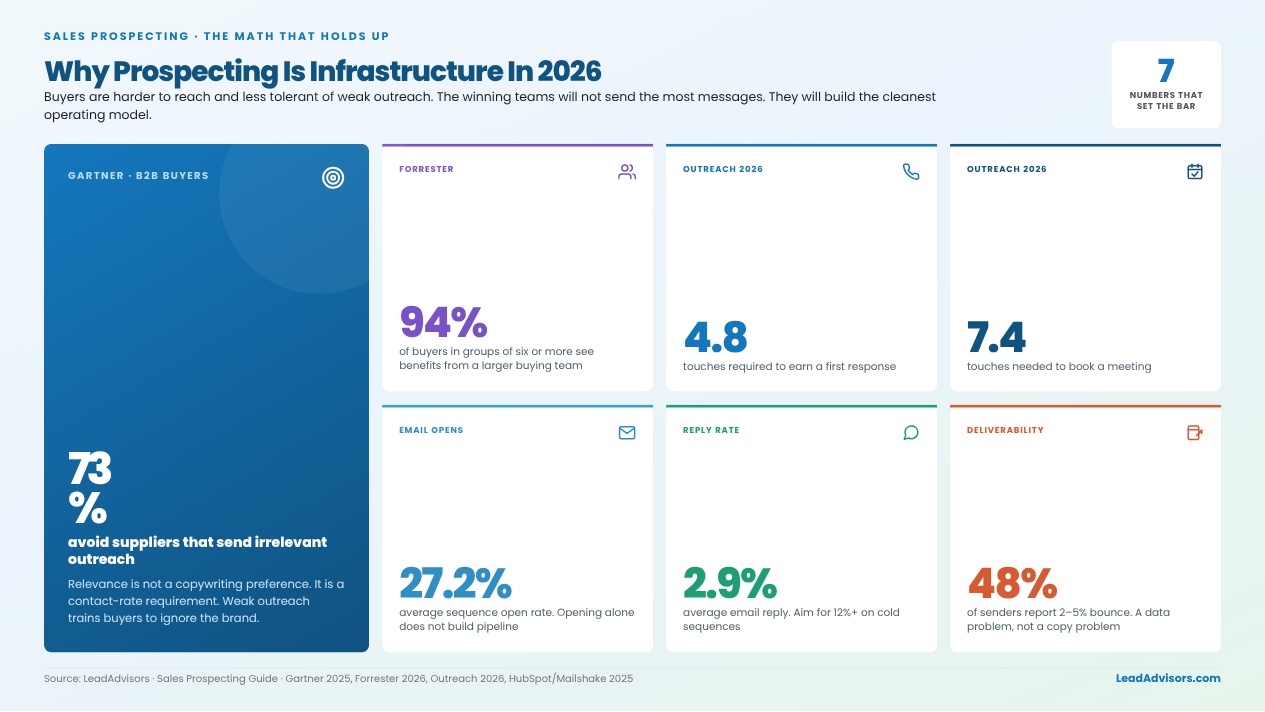
That gap gets expensive fast. Gartner reported that 73% of B2B buyers avoid suppliers that send irrelevant outreach. Weak prospecting not only misses opportunities. It trains buyers to ignore the brand.
Sales prospecting fixes that when it runs as an operating discipline. The system integrates ICP definition, list quality, channel orchestration, cadence design, qualification depth, and reporting into a single pipeline engine.


What Is Sales Prospecting?
Sales prospecting is the process of identifying potential buyers, researching their fit, contacting them through the right channels, and qualifying them for a sales conversation.
In simple terms, prospecting in sales answers four questions:
- Who should we contact?
- Why should they care now?
- Which channel gives us the best chance to reach them?
- Are they qualified enough for sales time?
A sales prospect is not just any contact in a database. A real prospect fits your ideal customer profile, has a relevant pain, and has a reason to engage.
That distinction matters.
A list of names is not a prospecting system. A cold email sequence is not a prospecting system. A sales prospecting tool is not a prospecting system.
The system is the way your team turns account selection, data quality, outreach, qualification, and handoff into a predictable pipeline.
Sales Prospecting Vs. Lead Generation
Sales prospecting and lead generation are connected, but they are not the same function.
Lead generation creates or captures demand. Use the foundational lead-generation framework to separate demand capture from prospecting. It may come from SEO, paid ads, content, referrals, webinars, or direct mail.
Sales prospecting turns target accounts or raw demand into qualified opportunities. Teams that need a broader view of acquisition can also map prospecting to lead generation at scale.
For example, a form fill from a paid ad is lead generation. Calling that lead in seconds, qualifying the pain, confirming fit, and booking the right next step is prospecting.
Cold outreach to a named account also counts as prospecting. For the channel-specific version, use the outbound prospecting execution depth guide. So is re-engaging old leads that never reached a closer.
The operating question is simple: did the activity create a qualified opportunity, or did it only create motion?
Why Sales Prospecting Still Matters In 2026
Sales prospecting matters because buyers are harder to reach and less tolerant of weak outreach.
B2B buyers now research before they talk to sales. They compare vendors, read reviews, check brand credibility, and ignore generic messages.
Forrester’s 2026 business buying research reported that GenAI is changing B2B buying behavior. It also found that buying groups are getting larger and procurement has more influence.
The report noted that 94% of buyers in groups of six or more see benefits from larger buying teams, including better validation and stronger approval paths.
That changes prospecting.
A rep cannot rely on one generic pitch. A prospecting team has to understand the account, the buying group, the trigger, and the handoff path.
Gartner’s 2025 B2B buying survey also found that buyers avoid irrelevant outreach. Therefore, relevance is not a copywriting preference. It is a contact-rate requirement.
Good prospecting also shows where the customer acquisition strategy and prospecting fit inside the full revenue system.
Good prospecting helps sales teams:
- Find accounts that match the ICP
- Reach buyers across more than one channel
- Qualify real pain before booking time
- Protect closers from weak meetings
- Lower wasted spend on leads that never get worked
- Improve pipeline visibility
For LeadAdvisors, this is the operator view. Prospecting is not a motivational sales activity. It is infrastructure.
The Sales Prospecting Operating Model
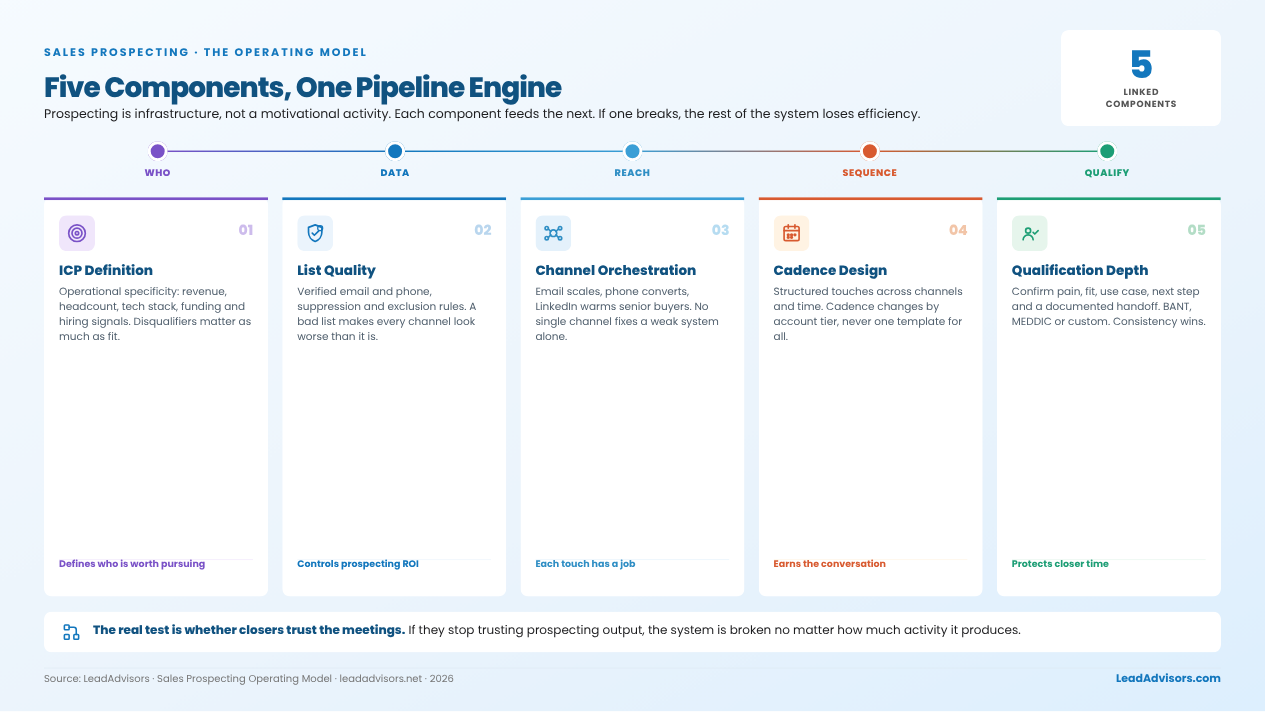
The Sales Prospecting Operating Model has five components.
Each component supports the next one. If one breaks, the rest of the system loses efficiency.
1. ICP Definition With Operational Specificity
The ICP defines which companies are worth pursuing.
A vague ICP creates bad prospecting. “Mid-market SaaS companies” is not enough. It gives reps too much room to guess.
A stronger ICP includes:
- Revenue range
- Employee count
- Geography
- Industry
- Tech stack
- Hiring signals
- Funding signals
- Pain indicators
- Disqualifiers
In B2B sales prospecting, disqualifiers matter as much as fit criteria.
A company may look attractive but still be wrong for the campaign. It may be too small, too regulated, too slow to buy, or already locked into another vendor.
Operators define those limits before outreach starts.
2. List Quality as an Operating Discipline
List quality controls prospecting ROI.
A bad list makes every channel look worse. It lowers contact rates, raises bounce rates, wastes rep time, and creates false conclusions about the offer.
The best sales prospecting strategy starts with data hygiene.
That includes:
- Verified email addresses
- Valid phone numbers
- Correct company names
- Accurate titles
- Current employment data
- Suppression lists
- Existing customer exclusions
- Open opportunity exclusions
- Do-not-contact rules
Email data matters because deliverability is fragile. HubSpot’s 2025 sales statistics cited Mailshake data showing that 48% of cold email senders reported bounce rates between 2% and 5%.
Another 15% exceeded 6%, putting campaigns at risk.
That is not a copy problem. It is a data and process problem.
Operators review the list quality before they blame the channel.
3. Channel Orchestration Across The Cadence
Sales prospecting works better when channels support each other.
Email can scale. Phone creates live conversations. LinkedIn helps with context and senior buyers. SMS can work in consent-based workflows.
Direct mail can support high-value accounts.
However, no channel fixes a weak system by itself.
Outreach’s 2026 cold outreach data found that 4.8 touches were required to receive a first response. It also found that 7.4 touches were needed to book a meeting.
The same report found that multi-channel outreach drove higher response rates than email-only sequences.
That is the reason channel orchestration matters.
The goal is not to send more messages. The goal is to create a sequence where each touch has a job.
4. Cadence Design
A sales prospecting cadence is the structured sequence of outreach touches across channels and time. It should connect to the B2B prospecting lead funnel architecture before the team writes the first message.
Most teams get this wrong by copying platform templates.
A strong cadence changes by account tier.
For example:
- Tier 1 accounts may need 15 to 25 touches over 60 to 90 days.
- Tier 2 accounts may need 10 to 15 touches over 30 to 45 days.
- Tier 3 accounts may need 6 to 10 touches over 14 to 21 days.
The logic is simple.
High-value accounts deserve more research, more personalization, and more patience. Lower-value accounts need a faster and more standardized motion.
Running the same cadence across every account creates waste.
It burns top accounts with weak outreach. It also spends too much time on accounts that cannot support the cost.
5. Qualification Depth
Prospecting does not end when someone replies.
It ends when the team confirms whether the prospect should be added to the sales pipeline.
Qualification protects a closer time. It also protects the brand.
A qualified prospect should have:
- A clear pain
- A fit with the ICP
- A relevant use case
- A next-step reason
- A documented handoff
- A known disqualifier check
Teams can use BANT, MEDDIC, or a custom framework. The framework matters less than consistency.
The real test is whether closers trust the meetings.
If closers stop trusting prospecting output, the system is broken.
The Sales Prospecting Process Step By Step
A practical sales prospecting process has seven steps:
- Define the outcome: booked meetings, qualified opportunities, re-engagement, or named-account pipeline.
- Build the ICP and account list using firmographics, technographics, intent signals, job postings, funding events, and market triggers.
- Segment accounts by tier and persona before outreach starts.
- Choose the channel mix based on buyer behavior, account value, and compliance risk.
- Write each cadence touch with a purpose, not a repeated message.
- Qualify the conversation by checking pain, fit, urgency, decision path, and disqualifiers.
- Review list quality, contact rate, reply rate, qualified opportunity rate, show rate, cost per qualified opportunity, and handoff quality weekly.
Activity metrics help manage the floor. Outcome metrics prove whether prospecting works.
Channel-Specific Reality For B2B Sales Prospecting
Each channel has a role.
The mistake is treating a single channel as the entire strategy.
Phone Prospecting
Phone prospecting still matters because live conversations reveal urgency faster than email. Teams that rely on voice should understand B2B telemarketing operations before scaling call volume.
It works best when supported by clean data, compliant dialing rules, strong scripts, and good disposition tracking. The dialing layer also requires a dialer technology selection for outbound prospecting as volume increases.
For regulated outreach, teams must be careful. The FCC explains that the TCPA requires consent for many prerecorded, artificial-voice, autodialed, or text-based outreach scenarios. Build TCPA compliance into the workflow for outbound operations before launch.
The FCC also confirmed that AI-generated voices in robocalls count as artificial voices under the TCPA.
That matters for AI sales prospecting.
AI can assist research, prioritization, coaching, and workflow. However, teams still need compliance controls when automation touches calls or texts.
Email Prospecting
Email is the scale channel.
It works well for education, context, and follow-up. It performs poorly when teams use weak data and generic templates.
Outreach’s 2026 sales sequence guidance reported an average sequence email open rate of 27.2% across its customers.
It also reported an average email reply rate of 2.9% and a benchmark of at least 12% for replies to cold prospecting sequences.
These numbers show why email needs context. Opening alone does not create a pipeline.
Email should support the cadence, not carry the whole campaign.
LinkedIn Prospecting
LinkedIn helps teams research accounts, identify stakeholders, and warm up outreach.
It is useful for senior B2B buyers who may ignore calls from unknown numbers or cold emails.
A strong LinkedIn for sales prospecting process includes:
- Profile research
- Buying committee mapping
- Trigger monitoring
- Thoughtful connection requests
- Low-pressure follow-up
- Sales Navigator list building
However, automation risk is real. Teams should avoid aggressive LinkedIn automation that creates account restrictions or damages trust.
SMS Prospecting
SMS can work in the right context.
It is best for inbound leads, re-engagement, appointment confirmation, and workflows where consent exists.
It is risky as a first touch in cold, especially in consumer-facing or regulated markets.
The FCC states that robocall and robotext rules include consent requirements. It also notes that consumers must have clear ways to stop unwanted calls and texts.
For operators, the rule is simple. Treat SMS as a controlled channel, not a shortcut.
Video Prospecting
Video sales prospecting can work for high-value accounts.
It adds a human signal. It also proves that the message was not fully automated.
Use it for:
- Named accounts
- Senior buyers
- Complex products
- Account-specific audits
- Personalized walkthroughs
The tradeoff is time. A real video takes effort. That makes it a Tier 1 or Tier 2 tactic, not a high-volume default.
Direct Mail And Offline Touches
Direct mail can work when the account value supports the cost.
It can interrupt the pattern in a crowded digital market.
Use it for:
- Enterprise sales prospecting
- ABM campaigns
- Large buying committees
- High contract values
- Strategic accounts
Direct mail should connect to the cadence. It should not sit apart from the outreach plan. In phone-heavy motions, it should also align with outbound dialing campaign operations.
Where AI Fits In Sales Prospecting
AI for sales prospecting is useful, but it does not replace operating discipline.
Use AI for account research, persona mapping, trigger detection, call summaries, CRM cleanup, lead scoring, email draft support, and performance review.
Using ChatGPT for sales prospecting can help with research prompts, call prep, and message variations. However, operators should review every output.
The sequence should stay clear: define the ICP, use AI to enrich and prioritize, check data quality, run the cadence, review outcomes, and improve the system.
AI should make the prospecting system sharper. It should not turn bad targeting into faster spam.
Sales Prospecting Tools: What Actually Matters
Sales prospecting tools help teams execute the system. They do not create the system.
Most teams need a CRM, a sales engagement platform, a data provider, an email verification tool, LinkedIn Sales Navigator, a dialer, and a reporting dashboard.
The best sales prospecting software depends on the motion. A SaaS team should match tools to SaaS sales operations and prospecting, not to a generic list of tools.
Before comparing tools, define the market, channel mix, data validation rules, compliance requirements, QA owner, success metric, and sales handoff.
Cadence Design: The Detail Most Teams Skip
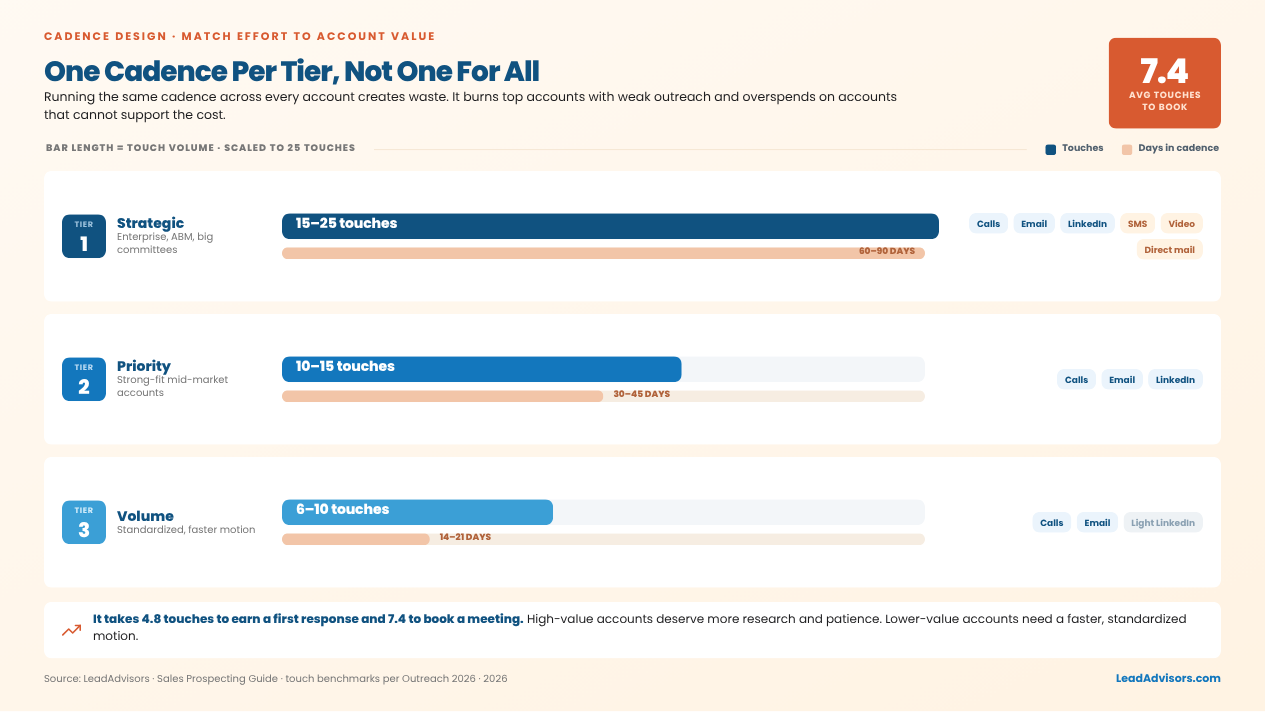
Cadence design is where prospecting becomes operational.
A good cadence defines:
- Number of touches
- Channel order
- Timing between touches
- Message angle
- Persona variation
- Exit rules
- Branch logic
- Follow-up after engagement
For example, a standard B2B sales prospecting cadence may run for 21 to 45 days. If the motion is SaaS-specific, the cadence should also reflect the SaaS lead-generation methodology.
It may include:
- 4 to 6 calls
- 4 to 6 emails
- 2 to 3 LinkedIn touches
- 1 SMS touch where consent exists
- 1 video or direct mail touch for high-value accounts
Outreach’s 2026 cold outreach research found that responses often need multiple touches. It also found that sales executives require more than seven touches on average before engaging.
That does not mean every account needs more volume.
It means the cadence needs enough structure to earn the conversation.
Inbound Vs. Outbound Prospecting
Inbound and outbound prospecting are different operating disciplines.
Inbound prospecting starts with a demand that has already raised a hand. The job is speed, routing, qualification, and follow-up. That means the team needs speed-to-lead infrastructure for inbound prospecting before it needs more scripts.
Outbound prospecting starts with a named account or target buyer. The job is relevant, timing, channel mix, and persistence. For managed dialing motions, the work should follow a BPO contact strategy for outbound operations.
Mixing both motions on the same team can create problems.
Inbound work needs immediate response. Outbound work needs consistent cadence execution. When the same rep owns both at the same time, one of the motions usually suffers.
A better structure is:
- Dedicated inbound coverage for speed-to-lead
- Dedicated outbound coverage for named accounts
- Shared qualification rules
- Shared CRM standards
- Separate performance metrics
Smaller teams may not have enough headcount for full separation. In that case, use time blocks.
Protect inbound response windows and outbound cadence windows. Then connect replies to lead-nurturing automation and the prospecting handoff so no engaged prospect drops off after the first contact.
Do not let urgent inbound work erase outbound discipline.
Metrics That Measure Sales Prospecting Success
The most important prospecting metrics connect activity to revenue.
Calls, emails, and LinkedIn touches matter. However, they only measure effort.
Track contact rate, email reply rate, positive reply rate, conversation rate, qualified opportunity rate, show rate, opportunity-to-close rate, pipeline created, and revenue closed from the prospecting source.
Also track quality controls: bounce rate, bad number rate, DNC suppression, duplicate accounts, disqualified meetings, no-show rate, and handoff completeness.
Cost per qualified opportunity is one of the cleanest metrics. It shows whether the system produces sales-ready opportunities at a cost the business can support. It also clarifies sales cycle structure and where prospecting fits before leaders judge ROI.
Unit Economics By Sales Motion
Prospecting economics change by company stage, deal size, and sales cycle.
A small company with a low ACV cannot afford the same cost per opportunity as an enterprise vendor. A manufacturing company with a long sales cycle may tolerate higher prospecting costs because the deal value is larger. That is where manufacturing lead generation and committee-based buying change the math.
Use these as operating ranges, not guarantees: sub-$1M ARR should stay lean, $1M to $5M ARR can test hybrid prospecting, $5M to $25M ARR can support dedicated inbound and outbound systems, and $25M to $100M+ ARR usually needs named-account prospecting, ABM, intent data, and buying-group mapping.
The real test is LTV/CAC. However, the math has to be measured by cohort. A single good month does not prove the system.
Build Vs. Buy: Where Sales Prospecting Belongs
The build vs. buy decision is not only about cost. It should compare in-house SDR teams versus outsourced BPO operations with the same quality and reporting standards.
It is about operational fit.
Build In-House When
Build your own prospecting team when:
- The sales motion requires deep product knowledge
- SDR-to-AE development is strategic
- The company has strong sales leadership
- The volume supports management overhead
- Compliance or security requires internal control
- The team can manage QA, data, coaching, and reporting
In-house works when leadership already knows how to run the function. It also helps to understand the sales development services category before deciding what should stay internal.
Without that expertise, the company pays for mistakes through bad data, weak meetings, and rep churn.
Use Managed Prospecting When
Managed sales prospecting services are a fit when the company needs B2B sales outsourcing operations rather than another unsupported rep seat.
Managed sales prospecting services fit when:
- The company has leads but a low contact rate
- The team lacks dialing floor infrastructure
- Multi-channel follow-up is inconsistent
- Closers are idle
- Speed-to-lead is poor
- Reporting visibility is weak
- The business needs faster launch capacity
This is where LeadAdvisors’ operator model fits.
We are not a staffing firm. We build and run managed infrastructure around contact rate, qualification, QA, reporting, and follow-up.
Use A Hybrid Model When
Hybrid works when the company retains some control while outsourcing specific execution.
Common patterns include:
- Inbound stays internal, and outbound is managed.
- Enterprise ABM stays internal; Tier 3 prospecting is managed.
- Strategy stays internal; execution support is managed.
- Closers remain internal, and appointment setting follows the B2B appointment-setting methodology.
Hybrid works best when ownership is clear. If the meeting-setting layer sits outside the company, use outsourced appointment-setting operations to define the quality bar.
If no one owns the handoff, the model breaks.
Common Sales Prospecting Failures
Most prospecting failures are predictable. They usually come from weak operating controls:
- Fuzzy ICP: vague targeting leads to weak lists, incorrect accounts, and inconsistent qualification.
- Bad data: bad emails, bad numbers, duplicate records, and outdated titles waste the campaign. Use the contact rate framework for outbound operations before changing the offer.
- Single-channel dependency: email-only or phone-only prospecting limits reach.
- Generic cadences: platform templates are starting points, not strategy.
- Weak qualification: unqualified meetings damage the closer’s trust.
- Activity metrics only: calls and emails do not prove revenue impact.
- No feedback loop: closers must report meeting quality so the front end can improve.
Sales Prospecting Best Practices For 2026
The best practices in sales prospecting are practical. They also vary by vertical, especially when teams apply financial services lead-generation methodology or insurance-vertical lead-generation rules.
They are not tricks.
Use this checklist:
- Define the ICP before choosing tools.
- Build disqualifiers into the list process.
- Validate email and phone data before launch.
- Segment accounts by tier.
- Match cadence length to account value.
- Use email, phone, and LinkedIn together.
- Keep SMS consent-based and controlled.
- Use AI for research and workflow support.
- Review cadence performance monthly.
- Track cost per qualified opportunity.
- Protect closers from weak meetings.
- Document every handoff.
- Review compliance rules before automation.
- Adapt qualification depth for healthcare lead generation under compliance overlay when medical or regulated data is involved.
- Use the IT vertical lead generation playbook when the buying group includes technical evaluators.
This is how to improve sales prospecting without adding noise.
How LeadAdvisors Operates Sales Prospecting
LeadAdvisors runs prospecting as an operating system.
We build the infrastructure that turns leads and target accounts into qualified conversations. That includes managed offshore teams, multi-channel follow-up, automation support, QA, reporting, and contact rate optimization.
The work usually connects to one of four service pillars:
- BPO services
- Lead generation consultancy
- Sales funnel and automation
- SEO and content
For sales prospecting, the operating model includes multi-region prospecting operations across time zones when coverage spans markets.
For sales prospecting, the operating model includes:
- ICP and campaign criteria
- List preparation and suppression rules
- Phone, email, SMS, and LinkedIn workflows
- Speed-to-lead execution
- Appointment setting and live transfer support
- Agent QA, coaching, and agent attrition management in prospecting operations
- Daily reporting
- Weekly performance review
- Monthly optimization
The goal is not more activity.
The goal is a cleaner path from lead or account to qualified opportunity.
That is the difference between prospecting as a tactic and prospecting as infrastructure.