Your cold email outreach may be failing before prospects read the first line.
The problem is not always the template. Weak domains, bad lists, thin personalization, slow replies, and poor attribution turn outreach into activity without a pipeline.
As a result, teams keep changing subject lines while deliverability, targeting, and follow-up stay broken.
The fix is an operating model. The Cold Email Outreach Operating Model connects deliverability infrastructure, list quality, sequence design, copy, response handling, and attribution. This guide shows how to build that system and run cold email as part of a broader outbound prospecting execution methodology.


What Is Cold Email Outreach?
Cold email outreach is an unsolicited B2B email sent to a prospect who has not opted in. The goal is to start a sales conversation.
It is not permission-based email marketing (adjacent category). Email marketing targets people who subscribed, downloaded a resource, filled out a form, or joined a list.
Cold email targets named prospects or accounts. In most B2B campaigns, it uses work email addresses and a clear business reason for contact.
That difference changes the operating model.
Cold email needs:
- Separate sending infrastructure.
- Careful prospect targeting.
- Clean unsubscribe handling.
- List validation.
- Low-volume sending.
- Strong personalization.
- Fast response handling.
Email marketing requires permission-based list growth, segmentation, lifecycle nurturing, and a newsletter or campaign cadence.
Cold email starts conversations with new prospects. Email marketing nurtures people already in the audience. Once a prospect engages, lead nurturing automation for warm follow-up becomes the next system.
That warm path may include email nurture campaigns for engaged leads, but those campaigns should not be confused with cold outbound.
Cold email is also not spam. A compliant cold email campaign uses a real sender, clear identity, truthful subject lines, relevant targeting, and an easy opt-out path.
In the United States, the FTC CAN-SPAM compliance guide says commercial email must avoid deceptive subject lines, identify the sender, include a valid physical address, and provide a clear opt-out method. In Europe, GDPR creates a higher bar. B2B outreach may require legitimate-interest and direct-marketing review, country-specific review, and careful data sourcing.
Why Most Cold Email Outreach Fails
Most cold email outreach fails before the prospect reads the copy.
The common diagnosis is weak writing. However, the real failure often starts earlier. The sending domain may be new. The inbox may be unwarmed. The list may contain invalid emails. The offer may target the wrong persona. The sequence may keep sending after a reply. The team may respond too slowly when a prospect shows interest.
That is why template hunting rarely fixes cold email. If the campaign has already failed, use a diagnostic process for relaunching failing outbound campaigns before rewriting every email.
A template can improve one message. It cannot repair sender reputation, list quality, suppression rules, response handling, or attribution.
The Cold Email Outreach Operating Model
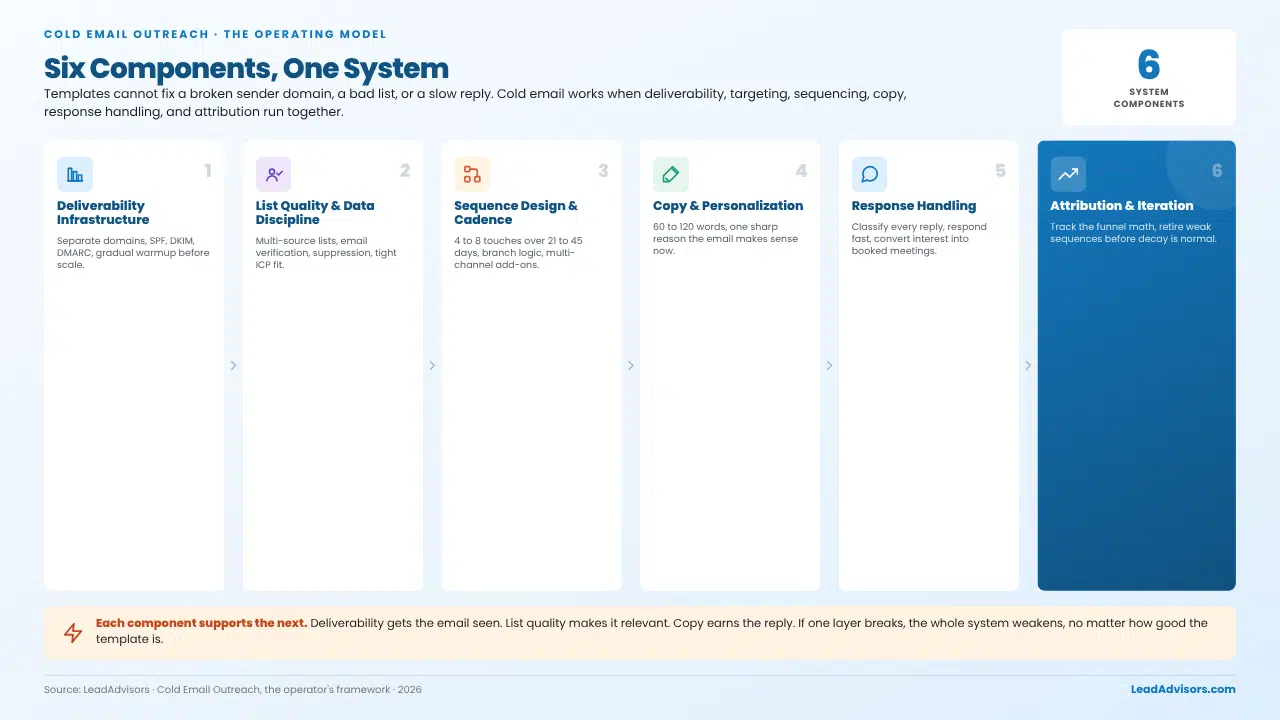
The Cold Email Outreach Operating Model has six components:
- Deliverability Infrastructure.
- List Quality and Data Discipline.
- Sequence Design and Cadence Structure.
- Copy and Personalization Layers.
- Response Handling and Conversion Discipline.
- Attribution and Iteration Cadence.
Each component supports the next one.
Deliverability gets the email seen. List quality makes the message relevant. Sequence design controls timing and fatigue. Copy gives the prospect a reason to respond. Response handling turns replies into meetings. Attribution shows what to fix next.
If one component breaks, the entire system weakens.
Deliverability Infrastructure Comes First
Deliverability is the first layer of cold email performance.
If the email never reaches the inbox, subject lines and templates do not matter. Google’s email sender guidelines require all senders to authenticate email with SPF or DKIM. Bulk senders must use SPF, DKIM, and DMARC. Google also says authenticated messages are less likely to be rejected or marked as spam.
Cold email now needs infrastructure before scale.
Use Separate Sending Domains
Do not send a cold email from the primary business domain.
The primary domain supports client emails, invoices, calendar invites, password resets, and internal communication. Cold email risk should not sit on that same domain.
Operator-grade programs use alternate domains. For example, a company with company.com may use getcompany.com, companymail.com, or trycompany.com.
Each domain needs proper DNS setup and controlled sending volume. This protects the main brand domain from the risk of cold outreach.
Set Up SPF, DKIM, And DMARC
SPF, DKIM, and DMARC help receiving mail servers verify that the sender is allowed to send for a domain. Google’s Workspace guidance explains that SPF helps prevent outgoing email from being marked as spam, while DKIM helps protect a domain against spoofing.
A cold email outreach system should check these before sending:
- SPF record exists.
- DKIM is active.
- DMARC is configured.
- Sending tools align with the domain.
- Tracking domains do not break trust signals.
- Reply inboxes receive and handle responses.
Without this setup, the campaign starts with weak sender trust. A DMARC policy and reporting setup also helps receiving servers decide what to do when messages fail SPF or DKIM.
Warm Up Domains Before Scaling
Email warmup builds sender history over time.
New domains should not jump into high-volume outreach. A practical warm-up plan starts small and increases volume as engagement signals remain healthy.
Warmup does not guarantee inbox placement. However, skipping warmup increases risk.
Monitor Sender Health
Cold email deliverability needs active monitoring.
Track bounce rate, spam complaint rate, reply rate, inbox placement, domain reputation, mailbox reputation, unsubscribe rate, and sequence-level performance.
If bounce rates rise, pause the campaign. If complaints rise, review targeting and message relevance. If replies drop, review list quality, offer, and sequence fatigue.
Cold email teams should also use contact rate optimization methodology when phone follow-up is part of the sequence.
List Quality Is The Performance Multiplier
List quality decides who receives the message.
A strong list improves reply rates, meeting quality, and conversion. A weak list creates bounces, complaints, bad-fit meetings, and misleading reporting.
Cold email outreach for lead generation starts with data discipline and should fit the wider lead generation services stack.
Build Lists From Multiple Sources
No single B2B data source is perfect. Most operators combine several sources, then verify and filter the output.
Common sources include Apollo, ZoomInfo, Cognism, LinkedIn Sales Navigator, Clay, industry directories, job postings, company websites, first-party CRM data, and intent data platforms.
The point is not to collect the largest list. The point is to build the most relevant one.
A smaller list with a strong ICP fit beats a large list with a weak fit. This is also where lead generation outsourcing can help when the internal team lacks data operations capacity.
Verify Emails And Suppress Bad Records
Email verification reduces bounce risk.
A cold email operation should verify addresses before adding them to the sequence. It should also re-verify old lists because people change jobs, companies change domains, and inboxes close.
Suppress:
- Current customers.
- Active opportunities.
- Recent disqualified leads.
- Prior bouncers.
- Unsubscribed contacts.
- Do-not-contact records.
- Personal email addresses.
- Competitor employees.
- Contacts outside the target geography.
This protects compliance, sender reputation, and sales relationships.
Filter For ICP Fit
Cold email outreach works best when the targeting is narrow.
For LeadAdvisors-style outbound, ICP filters may include revenue range, employee count, industry, geography, team size, hiring signals, tech stack, ad spend, existing sales motion, and pain indicators.
For example, Mike cares about idle closers and CPA. Diana cares about visibility, QA, and loaded cost. James cares about conversion and brand trust. Lisa cares about white-label fulfillment.
SaaS teams should adapt this process to the SaaS lead-generation methodology, as the ARR stage changes the channel mix.
Sequence Design Controls Timing And Fatigue
A cold email outreach sequence is the planned series of touches sent over time.
It should connect to the broader sales prospecting operating model, not feel like random follow-up.
Most B2B cold email sequences use 4 to 8 email touches over 21 to 45 days. That range gives prospects several chances to respond without creating endless follow-up.
A simple sequence may include:
- First email: relevant problem and short ask.
- Follow-up: different value angle.
- Proof email: case study, metric, or operational example.
- Objection email: likely concern.
- Breakup email: close the loop.
Sequence length should depend on the account value.
Tier-1 named accounts justify deeper research, more touches, and more channels. Tier-2 ICP-fit accounts need 5 to 8 touches. Tier-3 broader-fit accounts need shorter sequences and stricter stop rules.
Use Branch Logic
Branch logic changes the sequence based on prospect behavior.
If a prospect replies, stop the sequence. If a prospect asks for a later date, create a follow-up task. If a prospect says “wrong person,” route to the right contact. If a prospect unsubscribes, suppress the record.
Automation without logic creates spam at scale.
Add Phone And LinkedIn When It Fits
Cold email should not always run on its own.
Phone and LinkedIn can support the sequence when the account value justifies it. Cold email also works beside B2B telemarketing operations when the account value supports a phone-led touch.
Use phone calls when the account has high value, the role is phone-friendly, urgency matters, or email engagement is weak. The team also needs clear rules for selecting dialer technology.
When the phone becomes a primary channel, the sequence should align with outbound dialing campaign operations.
Copy And Personalization Produce Replies
Copy matters after deliverability and targeting are in place.
A strong cold outreach email is short, specific, and easy to answer. It does not try to close the deal in one message. It tries to earn a response.
Use A Simple Structure
A strong cold outreach email usually has five parts:
- Subject line.
- Relevant opening.
- Problem statement.
- Value frame.
- Low-friction ask.
Keep the email between 60 and 120 words when possible. Short emails work better when they are genuinely relevant.
Personalize By Account, Persona, And Trigger
Personalization should come from a real signal.
Account-level personalization connects to the company. Persona-level personalization connects to the role. Trigger-level personalization connects to timing.
Good personalization does not need a long paragraph. It needs one sharp reason why the email makes sense now.
Use Templates As Frameworks, Not Scripts
Cold email outreach templates can help with structure. They should not become copy-paste assets.
A useful framework is simple:
- Noticed the signal.
- Business problem.
- Operational angle.
- Small ask.
The template is only the pattern. The inputs still need account-specific detail.
Use AI With Quality Control
AI can support account research, persona mapping, trigger detection, first-draft personalization, sequence variation, reply classification, objection responses, and reporting summaries.
However, AI does not fix a weak strategy. It can also create generic praise, incorrect company facts, fake familiarity, repeated sentence patterns, and claims that do not align with the offer.
Ask one question before sending: Would this sentence make sense to this buyer at this company right now?
If the answer is no, rewrite it.
Cold Email Outreach Tools And Platforms
Cold email outreach tools help manage sending, sequencing, personalization, tracking, and replies.
They do not replace the operating model. A tool can automate bad outreach as easily as good outreach.
Most cold email systems include sending platforms, warmup tools, verification tools, data providers, CRM systems, personalization tools, deliverability monitoring, calendar booking, and reporting dashboards.
Common sending platforms include Instantly, Smartlead, Lemlist, Mailshake, Apollo, Outreach, and Salesloft. If the team needs prospecting plus qualification, compare those tools with the sales development services category.
Common data and enrichment tools include Apollo, ZoomInfo, Cognism, LinkedIn Sales Navigator, Clay, and UpLead. Common verification tools include NeverBounce, ZeroBounce, Bouncer, and Clearout.
Tool status changes often. Verify pricing, features, and platform policies before publication. Use an email automation tools comparison only after you define the workflow that the tool must support.
How To Choose A Platform
Choose tools based on the operation, not the trend.
Ask:
- Can the platform manage multiple domains and inboxes?
- Does it support reply detection?
- Does it pause sequences after replies?
- Does it integrate with the CRM?
- Can it manage suppression lists?
- Does it support A/B testing?
- Can it report by persona, vertical, and sequence?
- Does it make compliance easier?
The best cold email outreach platform is the one your team can operate consistently.
Should You Use A Cold Email Outreach Agency?
A cold email outreach agency can help when the company lacks internal outbound expertise. However, buyers should evaluate the agency like an operating partner.
A lead generation vendor evaluation matrix helps compare vendors by process, data, reporting, and accountability.
Ask how the vendor protects sender reputation, verifies data, handles suppression lists, writes personalization, manages replies, updates the CRM, reports cost per meeting, and handles compliance.
Cold email outreach services should show process depth. Use an appointment-setting company evaluation matrix when the vendor also handles meeting booking.
If the service includes booking and qualification, compare it to the appointment-setting services category.
Response Handling Turns Replies Into Meetings
Cold email outreach does not end when the prospect replies.
That is where conversion starts, especially when the campaign supports a B2B appointment setting methodology.
A slow or weak response wastes the outreach investment and puts pressure on the appointment setter role to recover lost momentum.
Classify Every Reply
Reply classification helps the team take the right next step.
Use categories like positive reply, soft positive, later, referral, not interested, wrong person, out of office, unsubscribe, and compliance request.
Each category needs a workflow. A positive reply needs fast booking. A referral needs outreach to the new contact. An unsubscribe needs suppression.
Respond Fast
Speed matters after a prospect replies.
Operator-grade teams reply within business hours when possible. They also use calendar links, clear time options, prepared objection responses, and speed-to-lead infrastructure.
The same handoff rules apply when teams move from email replies to live conversations, including training closers to receive warm outbound.
Teams comparing in-house booking with outsourced appointment setting operations should judge the handoff process, not just reply volume.
Unit Economics That Hold Up
Cold email outreach should be measured by pipeline math.
It should also connect to the company’s customer acquisition strategy framework.
Open rates are not enough. A campaign can have high opens and a weak pipeline. It can also have modest opens and strong meeting quality.
Track:
- Sent emails.
- Delivered emails.
- Bounce rate.
- Open rate.
- Reply rate.
- Positive reply rate.
- Meeting booking rate.
- Meeting show rate.
- Qualified opportunity rate.
- Cost per meeting.
- Cost per qualified opportunity.
- Closed-won revenue.
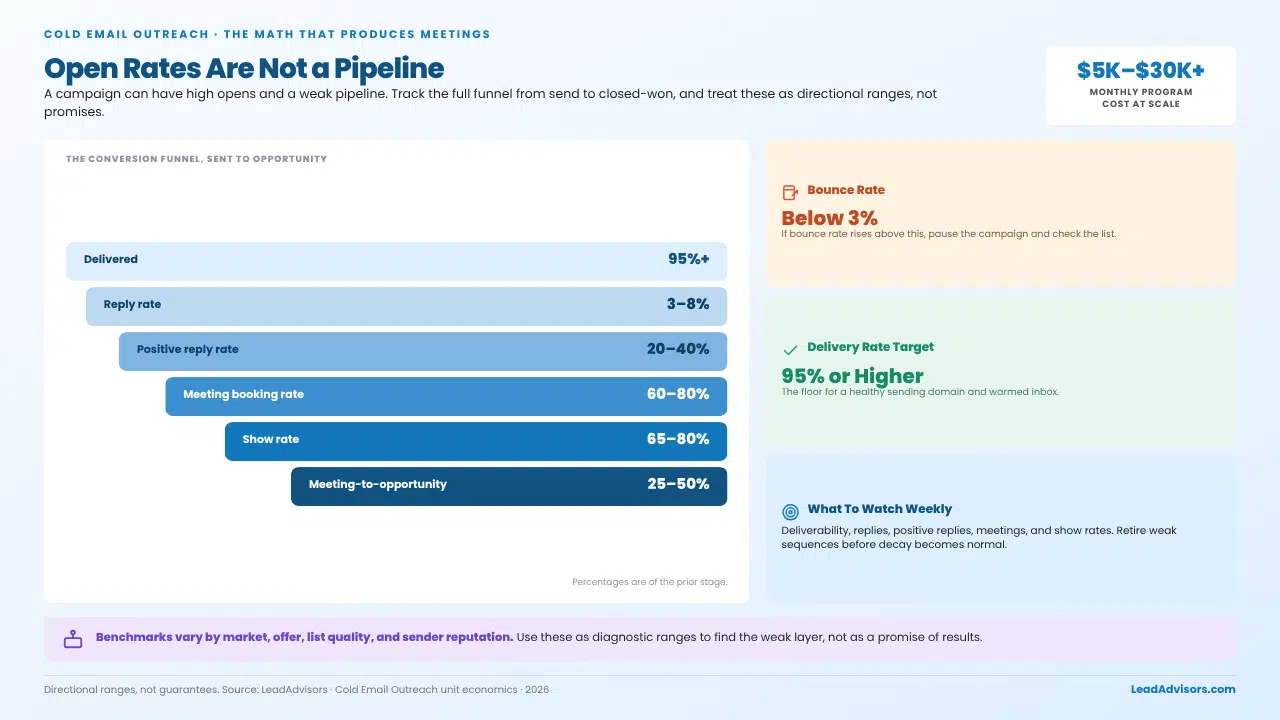
Benchmarks vary by market, offer, list quality, and sender reputation. However, many operators use these directional ranges:
- Delivery rate: 95% or higher.
- Bounce rate: below 3%.
- Reply rate: 3% to 8%.
- Positive reply rate: 20% to 40% of replies.
- Meeting booking rate: 60% to 80% of positive replies.
- Show rate: 65% to 80%.
- Meeting-to-opportunity rate: 25%-50%.
Treat these as diagnostic ranges, not promises.
A serious operation may cost $5,000 to $30,000+ per month, depending on scale. That is why leaders should compare cold email staffing against the in-house SDR and outsourced BPO cost models.
Common Mistakes That Kill Cold Email ROI
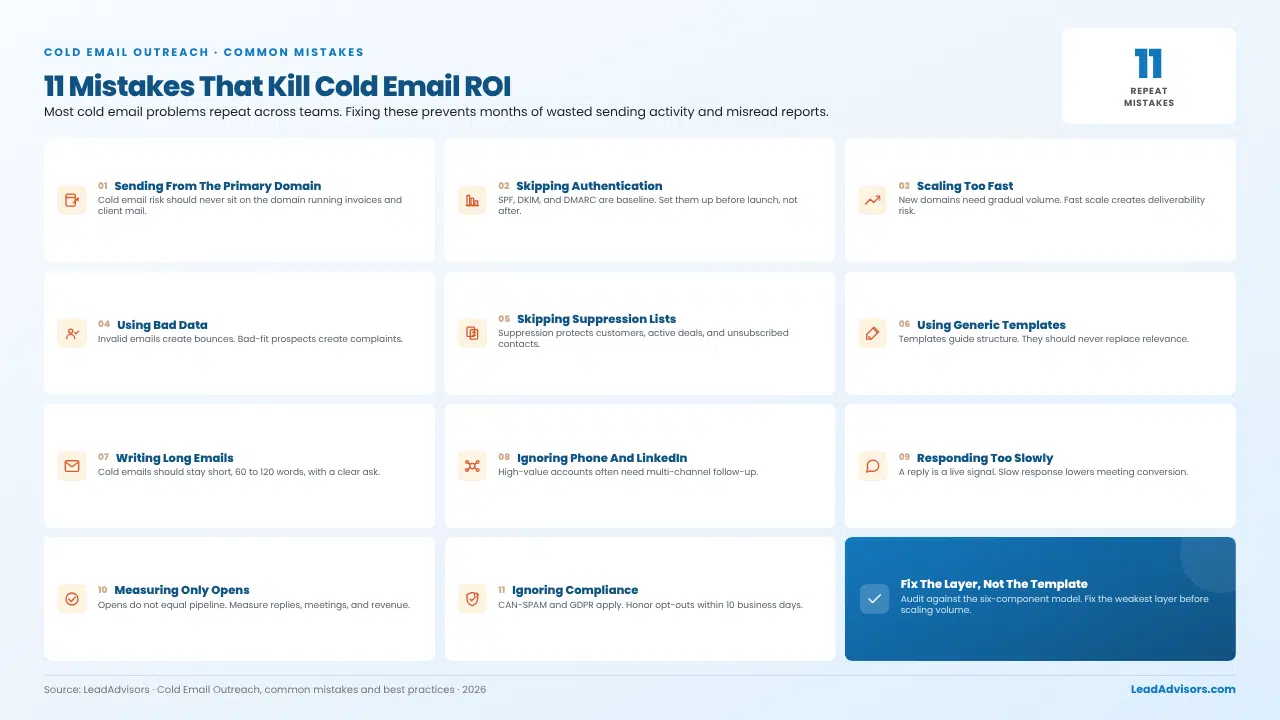
Most cold email problems repeat.
Fixing these issues prevents months of wasted activity.
1. Sending From The Primary Domain
Cold email should not risk the company’s main domain. Use separate domains for outbound.
2. Skipping Authentication
SPF, DKIM, and DMARC are baseline requirements. Set them up before launch.
3. Scaling Too Fast
New domains need a gradual sending volume. Fast scale creates deliverability risk.
4. Using Bad Data
Invalid emails create bounces. Bad-fit prospects create complaints and low reply rates.
5. Skipping Suppression Lists
Suppression lists protect customers, active deals, unsubscribed contacts, and the brand.
6. Using Generic Templates
Templates can guide structure. They should not replace relevance.
7. Writing Long Emails
Cold emails should be short. The prospect needs a clear reason to respond.
8. Ignoring Phone And LinkedIn
Email is one channel. High-value accounts often need multi-channel follow-up.
9. Responding Too Slowly
A reply is a live signal. Slow response lowers meeting conversion.
10. Measuring Only Opens
Open rates do not equal pipeline. Measure positive replies, meetings, opportunities, and revenue.
11. Ignoring Compliance
Cold email must comply with CAN-SPAM, GDPR, platform rules, and TCPA compliance for outbound (adjacent framework) when phone or SMS enters the workflow. The FTC also notes in its CAN-SPAM business guidance that opt-out requests must be honored within 10 business days.
Review common email marketing mistakes to avoid when the same team manages both cold and opted-in emails.
Cold Email Outreach Best Practices For 2026
Cold email outreach in 2026 rewards operators, not spammers.
Use this checklist:
- Build domains, inboxes, SPF, DKIM, DMARC, and monitoring before copy.
- Start with the best ICP segment.
- Use account, persona, or trigger-based relevance.
- Keep most emails between 60 and 120 words.
- Add a phone number, LinkedIn profile, or video for high-value accounts.
- Stop sending after a reply.
- Review deliverability, replies, positive replies, meetings, and show rates weekly.
- Retire weak sequences before performance decay becomes normal.