Lead generation services should create a qualified pipeline. Too often, they create activity that your team cannot use.
A vendor sends form fills when your closers need booked calls. Another book meeting without qualification. Another sells prospect lists when the real issue is contact rate, speed-to-lead, or sales follow-up.
That mismatch burns budget. It also makes buyers blame lead generation when the real problem is service category fit. In 2026, buyers research later, move faster, and expect proof before they speak to sales.
This guide provides the operator framework: eight lead-generation service categories, pricing models, ARR-stage fit, vendor gates, and selection logic to prevent wasted spend.
Start with the foundational lead-generation framework if you need a broader category definition before comparing services.


What Are Lead Generation Services?
Lead generation services are outsourced or managed programs that create sales opportunities for a business. They can include inbound and outbound lead generation services, appointment setting, live transfers, lead qualification, lead nurturing, list building, and account-based marketing.
The key question is not “Do we need lead generation services?”
The better question is:
What operational deliverable do we need?
Common deliverables include:
- Website form fills
- Demo requests
- Qualified sales appointments
- Live transferred calls
- ICP-matched prospect lists
- Qualified inbound leads
- Nurtured warm leads
- Named-account engagement
Each deliverable requires a different system. As a result, each service has different pricing, staffing, risk, and time-to-value.
Recent buyer behavior makes this distinction more important. Forrester’s 2026 Buyer Insights research, based on more than 17,500 global buyer decisions, notes that AI is reshaping how buyers research vendors before speaking with sales. HubSpot’s 2026 marketing data also reports that nearly 70% of marketers say leads now arrive later in the buying process because buyers do more AI-assisted research.
That means lead generation services must do more than create activity. They must match the buyer’s stage, intent, and sales motion. Google Search Central’s guidance on helpful, reliable, people-first content also reinforces the need for experience, expertise, authoritativeness, and trust.
For teams still building the basics, tactical execution methodology for lead generation helps separate channel tactics from service category selection.
What Most Buyers Conflate
“Lead generation services” sounds like one category. In practice, it hides several different jobs.
For example:
- “We need more form fills,” points to inbound demand generation.
- “We need meetings on the calendar,” points to appointment setting.
- “We need cold accounts worked” points to outbound prospecting.
- “We need interested buyers on the phone now,” points to live transfers.
- “We need faster follow-up on inbound leads,” points to lead qualification.
- “We need old leads warmed up,” points to lead nurturing.
- “We need better contact data” points to database building.
- “We need enterprise account penetration” points to ABM.
These are not interchangeable.
A company with idle closers does not need a 12-month content program as the only fix. It needs contact rate, qualification, and appointment or transfer volume. Meanwhile, a B2B SaaS company with a long sales cycle may need inbound content, lead scoring, and nurturing before it needs live transfers.
This is where many business lead generation services fail. The vendor sells what it offers. The buyer buys the wrong operational output.
The fix is to define the service by the job it must perform. If the sales floor is idle, the job may be live transfers, appointment setting, or outbound follow-up. If the website has traffic but few conversations, the job may be conversion optimization, lead qualification, or speed-to-lead. If the sales team has no one to contact, the job may be list building and outbound prospecting.
This is also why “best lead generation services” is the wrong starting point. A vendor can be strong in one category and weak in another. A strong SEO lead-generation services partner may not run a good call-center lead-generation program. A strong appointment-setting team may not build enterprise ABM. A strong list vendor may not manage follow-up.
Before you compare providers, write one sentence that defines the outcome: “We need qualified appointments with CFOs at $10M-$50M companies,” or “We need live transfers from homeowners requesting roofing estimates.” That sentence turns a vague buying process into an operating requirement.
The Lead Generation Services Stack
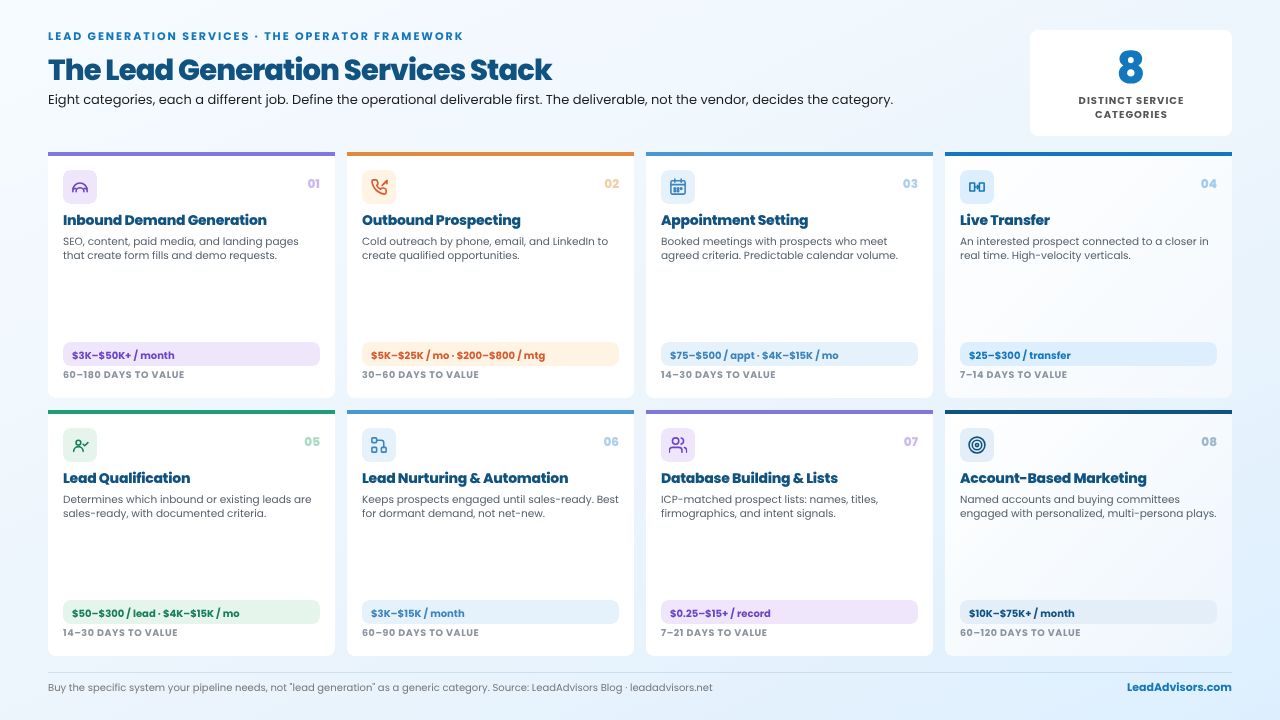
The Lead Generation Services Stack separates the market into eight categories.
Use it before comparing lead-generation service companies, agencies, or local providers.
If the next step is vendor comparison, use the lead generation vendor evaluation matrix after you define the service category.
1. Inbound Demand Generation Services
Inbound demand generation services create demand through channels such as SEO, content, paid media, organic social, email marketing, webinars, and conversion-focused landing pages.
Deliverable: Form fills, demo requests, content downloads, quote requests, and other inbound signals.
Common pricing: $3,000 to $50,000+ per month, depending on scope.
Time-to-value: 60 to 180 days for content-led programs. Paid media can show signals in 14 to 30 days.
Best fit: Companies with a longer horizon and a clear website conversion path.
Common risks:
- Slow content ramp
- Weak attribution
- Low conversion from traffic to pipeline
- AI search is reducing clicks for generic content
- No follow-up team to work inbound leads
Inbound lead generation services work best when the company can convert demand after it appears. Traffic alone is not a pipeline.
Inbound content should also map into lead funnel architecture and stage progression so traffic, conversion, qualification, and sales follow-up work as one system.
2. Outbound Prospecting Services
Outbound prospecting services create opportunities through cold outreach. Teams use phone, email, LinkedIn, SMS, and other channels to engage target accounts.
Deliverable: Qualified opportunities or qualified meetings.
Common pricing: $5,000 to $25,000 per month per dedicated rep or program. Some vendors charge $200 to $800 per qualified meeting.
Time-to-value: 30 to 60 days to reach a stable operating rhythm.
Best fit: Companies with a clear ICP, defined offer, and closer capacity.
Common risks:
- Poor list quality
- Weak messaging
- Deliverability issues
- TCPA and consent exposure for phone and SMS
- LinkedIn automation limits
- No real qualification standard
Outbound lead generation services work when the offer, data, cadence, and handoff are built together. One weak layer breaks the system.
For deeper execution planning, compare the sales prospecting discipline and operating model with the depth of outbound prospecting execution before choosing a provider.
Outbound programs should also define contact rate optimization for outbound operations before volume targets are approved.
3. Appointment Setting Services
Appointment setting services focus on booked meetings. They may use inbound leads, outbound lists, event lists, or aged databases.
Deliverable: Scheduled appointments with prospects who meet agreed criteria.
Common pricing: $75 to $500 per appointment, or $4,000 to $15,000+ per month for a managed setter.
Time-to-value: 14 to 30 days.
Best fit: Sales teams that need predictable calendar volume.
Common risks:
- High no-show rates
- Weak qualification
- Vendor incentive to book volume over quality
- Poor confirmation process
- No closer coverage
Lead generation and appointment setting services should include qualification rules. Otherwise, the team may get meetings that look good in reports but never make it into the pipeline.
Teams buying booked meetings should compare B2B appointment-setting methodologies with appointment-setting service models and pricing before approving pay-per-appointment terms.
4. Live Transfer Services
Live transfer services connect an interested prospect to a closer in real time. This model is often used in financial services, mortgages, debt, tax, loans, insurance, and other high-velocity verticals.
Deliverable: Live calls that meet defined criteria.
Common pricing: $25 to $300 per transfer, depending on vertical and qualification depth.
Time-to-value: 7 to 14 days when the campaign has supply and routing ready.
Best fit: Sales floors with closers ready to answer calls immediately.
Common risks:
- Transfer quality variance
- TCPA exposure
- Recycled leads
- Weak consent documentation
- Closers missing calls
- Poor call disposition tracking
The FCC continues to enforce rules related to robocalls, telemarketing, and the TCPA. Its 2026 enforcement page shows active orders, cease-and-desist letters, and notices tied to calling practices. Any pay-per-call lead-generation services program requires consent, documentation, routing controls, and vendor accountability.
Review live transfer services methodology and verified live transfer services and compliance before you route paid calls to a closer floor.
Phone-led programs also require documented, TCPA-compliant outbound lead generation prior to launch.
5. Lead Qualification Services
Lead qualification services take inbound or existing leads and determine which ones are sales-ready.
Deliverable: Qualified leads with documented fit, need, timing, budget, or custom criteria.
Common pricing: $4,000 to $15,000+ per month per dedicated qualifier, or $50 to $300 per qualified lead.
Time-to-value: 14 to 30 days.
Best fit: Companies with inbound demand but weak follow-up.
Common risks:
- Slow speed-to-lead
- Inconsistent qualification notes
- Poor CRM hygiene
- No routing rules
- Sales and marketing disagree on lead quality
Qualified lead generation services need clear definitions. BANT, MEDDIC, custom scoring, and vertical-specific rules all work. Vague “qualified lead” language does not.
For inbound programs, pair lead-qualification methodology with speed-to-lead infrastructure to enable sales to respond while buyer intent is still active.
6. Lead Nurturing and Automation Services
Lead nurturing services keep prospects engaged until they become sales-ready. They often use email, SMS, retargeting, CRM workflows, and content sequences.
Deliverable: Re-engaged leads, sales-ready hand raises, and warmer pipeline.
Common pricing: $3,000 to $15,000 per month, depending on automation and content scope.
Time-to-value: 60 to 90 days.
Best fit: Companies with long sales cycles or large cold databases.
Common risks:
- Poor deliverability
- Weak segmentation
- Generic content
- No sales follow-up
- Attribution confusion
Automation is not the same as execution. A workflow can send messages. It cannot fix weak offers, bad data, or poor handoffs.
Use lead-nurturing and automation services for dormant demand, not for net-new prospecting.
7. Database Building and List Services
Database building services create prospect lists that match your ICP.
Deliverable: Names, emails, phone numbers, titles, firmographics, technographics, and intent signals.
Common pricing: $0.25 to $15+ per record, or platform subscriptions that can run thousands per year.
Time-to-value: 7 to 21 days for custom list builds. Platform access is faster.
Best fit: Teams that already have outbound execution capacity.
Common risks:
- Contact decay
- Invalid data
- Poor ICP matching
- Compliance concerns
- Buying lists without a campaign plan
Tools like ZoomInfo, Apollo, Cognism, LinkedIn Sales Navigator, and HubSpot can support list building and CRM execution. Salesforce’s 2026 lead generation tools guide makes the same distinction, grouping tools into capture, scoring, enrichment, CRM, and engagement. However, they are infrastructure. They do not manage lead generation services by themselves.
If you need external execution, compare the list of work against outsourced lead-generation delivery models and lead-generation consultant engagement models before assigning ownership.
8. Account-Based Marketing Services
ABM services target named accounts and buying committees. They combine personalized content, outbound ads, intent data, and multi-persona engagement.
Deliverable: Account engagement, meetings, and pipeline inside named target accounts.
Common pricing: $10,000 to $75,000+ per month.
Time-to-value: 60 to 120 days.
Best fit: Enterprise sales motions with complex buying committees and higher ACV.
Common risks:
- Weak account selection
- Attribution disputes
- Overbuilt programs
- Slow sales cycles
- Poor sales and marketing coordination
ABM is not a shortcut. It is a coordination layer for companies that already know their target accounts and can work with them with discipline.
Gartner’s B2B buying journey research shows why this matters: complex purchases require useful information across digital and human touchpoints, not only more sales activity.
Lead Generation Services Cost: What You Actually Pay For
Lead generation service costs depend on the deliverables, the vertical, and the pricing model.
The pricing model matters because it shapes vendor behavior.
Monthly Retainer
A monthly retainer pays for a defined scope. It is common for inbound demand generation, outbound programs, SEO lead generation services, and full-service lead generation marketing services.
Typical range: $3,000 to $50,000+ per month.
Best when: Scope is clear, and the buyer needs ongoing execution.
Risk: The vendor may optimize for effort instead of outcomes.
Per-Lead Pricing
Per-lead pricing charges for each lead that meets the agreed criteria.
Typical range: $20 to $500 per lead.
Best when: Lead criteria are tight and verifiable.
Risk: Vendors may optimize for volume over quality.
Per-Appointment Pricing
Per-appointment pricing charges for booked meetings.
Typical range: $75 to $500 per appointment.
Best when: Appointment rules, no-show rules, and qualification standards are clear.
Risk: The vendor may book weak meetings to meet volume targets.
Per-Transfer Pricing
Per-transfer pricing charges for live calls.
Typical range: $25 to $300 per transfer.
Best when: Closers can answer in real time.
Risk: Missed calls destroy economics.
Performance-Based Pricing
Performance-based pricing charges based on opportunities, deals, or revenue.
Typical range: Variable.
Best when: Attribution is clear.
Risk: Attribution disputes can break the relationship.
Hybrid Pricing
Hybrid pricing combines a base fee with performance incentives.
Examples:
- Retainer plus appointment bonus
- Retainer plus qualified opportunity bonus
- Per-lead pricing plus monthly minimum
- Per-transfer pricing plus quality thresholds
Hybrid structures often work best because they balance vendor stability with outcome accountability.
There is one more pricing point operators should check: what happens after delivery. A $150 appointment is not cheap if only 20% show up. A $60 lead is not expensive if it becomes a qualified opportunity at a lower CPA than paid search. A $10,000 monthly retainer can work if it produces clean reporting, better handoff, and repeatable opportunity flow.
So, compare pricing at the unit economics level. Track cost per contacted lead, cost per qualified appointment, cost per live conversation, cost per qualified opportunity, and cost per closed deal. That view exposes whether the service is improving the operating model or just adding activity to the dashboard.
Those numbers should roll into the operator metrics for lead generation before the buyer expands spend.
Build vs. Buy vs. Hybrid
Lead generation is not only a cost decision. It is an operating decision.
Build In-House When
Building in-house works when:
- The company has $25M+ revenue
- Product knowledge is complex
- Lead generation is a strategic talent pipeline
- Leadership has run SDR or demand teams before
- The company can support 10+ dedicated headcount
- Compliance or security makes outsourcing difficult
This model gives control. However, it also creates management, hiring, tooling, training, and attrition costs.
Buy Outsourced Lead Generation Services When
Outsourced lead generation services work when:
- The company lacks internal lead gen expertise
- Speed matters
- Multi-channel execution is needed
- Volume changes month to month
- The buyer wants cost predictability
- The team needs a managed operator, not more software
This model works well for companies that need execution capacity fast.
For sales-led programs, compare the outsourced model against B2B sales outsourcing operations and B2B telemarketing operations before deciding whether the work belongs in-house.
Use Hybrid When
A hybrid is often the strongest model.
For example:
- Keep brand, offer, and content strategy in-house.
- Outsource outbound prospecting.
- Buy database tools.
- Use a managed team for appointment setting.
- Keep enterprise ABM close to sales leadership.
- Outsource qualification when inbound volume exceeds internal capacity.
The best model depends on operational maturity, not preference.
If the decision is between internal SDRs and managed operators, compare loaded cost, management drag, and ramp risk for in-house SDR teams versus outsourced BPO.
Lead Generation Service Tier Architecture by ARR Stage
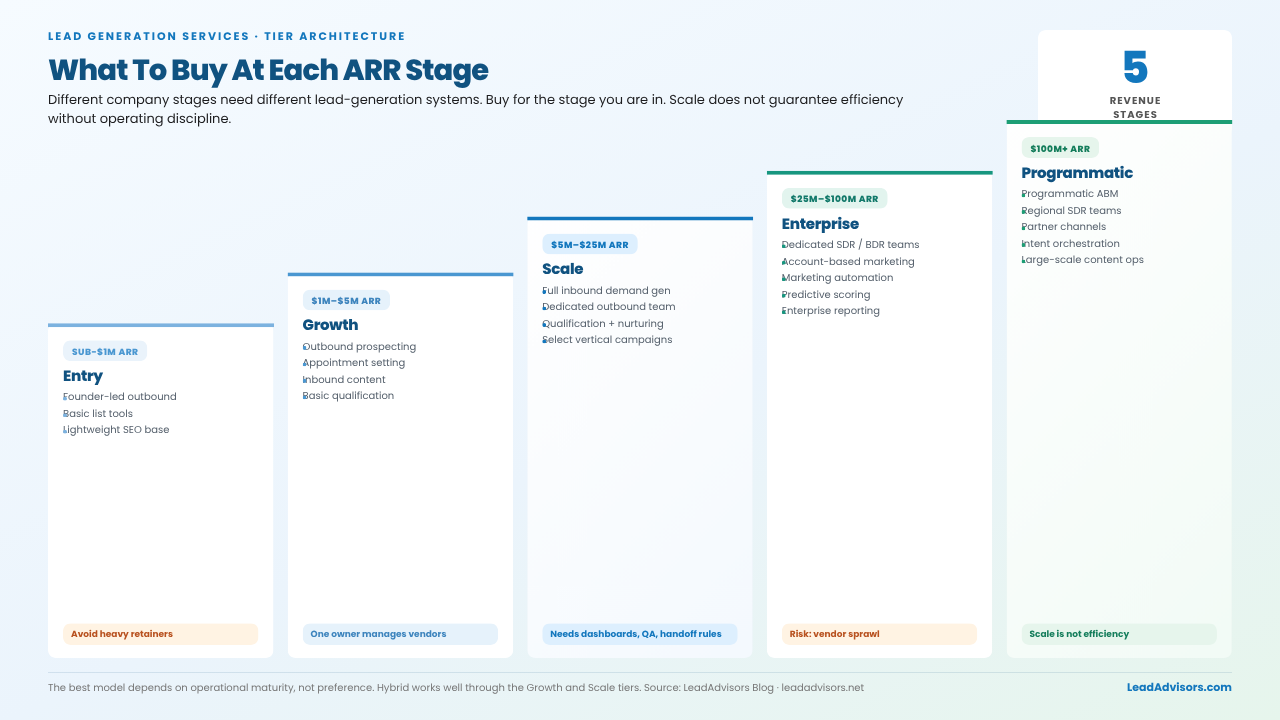
Different company stages need different lead generation systems.
Sub-$1M ARR: Entry Tier
At this stage, companies usually need simple execution.
Best-fit services:
- Founder-led outbound
- Basic list tools
- Lightweight SEO foundation
- Select appointment setting tests
- Simple landing pages
Avoid heavy retainers. The budget can disappear before the system proves ROI.
$1M-$5M ARR: Growth Tier
At this stage, the company needs a repeatable pipeline.
Best-fit services:
- Outbound prospecting
- Appointment setting
- Inbound content
- Basic lead qualification
- CRM cleanup
- Paid search or paid social tests
Hybrid often works well here. One internal owner should manage vendors.
$5M-$25M ARR: Scale Tier
At this stage, pipeline gaps become operating constraints.
Best-fit services:
- Full inbound demand generation
- Dedicated outbound team
- Appointment setting
- Lead qualification
- Lead nurturing
- Select vertical campaigns
This stage needs dashboards, QA, and clear handoff rules.
At this stage, many operators also need a BPO contact strategy for outbound operations, so that outreach, qualification, and reporting fall under a single operating cadence.
$25M-$100M ARR: Enterprise Tier
At this stage, complexity increases.
Best-fit services:
- Dedicated SDR or BDR teams
- ABM
- Marketing automation
- Predictive scoring
- Enterprise reporting
- Specialized vendors
The risk is vendor sprawl. Too many tools and agencies can create attribution disputes.
$100M+ ARR: Programmatic Tier
At this stage, lead generation becomes a portfolio.
Best-fit services:
- Programmatic ABM
- Regional SDR teams
- Partner channels
- Intent orchestration
- Large-scale content operations
- Enterprise demand generation
Scale does not guarantee efficiency. Without operating discipline, scale creates waste.
Multi-location and distributed teams should also evaluate multi-region operations across time zones before expanding coverage.
Vertical-Specific Considerations
Lead generation services change by industry. Compliance, sales cycle, buyer trust, and contact method all matter.
Financial Services
Financial services lead generation needs strong compliance controls.
This includes debt, tax, mortgage, loans, and financial advisors.
Strong-fit services:
- Live transfers
- Appointment setting
- Lead qualification
- Speed-to-lead programs
Watchouts:
- TCPA compliance
- Consent documentation
- State rules
- Recycled leads
- Vendor source quality
The FCC’s TCPA and robocall enforcement activity makes documentation important. Buyers should know where leads came from and how consent was captured.
Use financial services lead-generation methodology and insurance-vertical lead generation when the campaign involves regulated offers, consent records, or phone-based qualification.
Healthcare and Medical
Healthcare lead-generation services require a discipline around privacy.
Strong-fit services:
- Inbound demand generation
- Appointment setting with trained reps
- Lead qualification under proper agreements
- Patient re-engagement when compliant
Watchouts:
- HIPAA
- PHI handling
- Business Associate Agreements
- State privacy rules
- Platform access controls
HHS states that the HIPAA Privacy Rule protects medical records and individually identifiable health information. HHS also provides guidance on business associate contracts when required. Any vendor handling protected health information needs the right safeguards.
Healthcare buyers should evaluate healthcare lead generation in accordance with HIPAA requirements before routing patient or PHI-adjacent data into any sales workflow.
B2B SaaS
SaaS lead generation services depend on the sales motion.
Strong-fit services:
- Inbound demand generation
- Outbound prospecting
- Lead qualification
- Nurturing automation
- ABM for enterprise SaaS
Watchouts:
- Long buying committees
- PLG and sales-led handoff
- Free-trial quality
- Attribution complexity
Forrester’s 2026 buyer research notes that buying groups are larger and GenAI now shapes vendor research. SaaS companies need content and outbound that answer late-stage questions, not just generic awareness.
SaaS teams should connect this service mix to SaaS-specific lead generation methodology and SaaS sales operations and lead generation.
IT, MSP, and Cybersecurity
IT lead generation services and MSP lead generation services need technical credibility.
Strong-fit services:
- LinkedIn lead generation services
- Cold email lead generation services
- Outbound B2B lead generation services
- Content-led demand generation
- Webinars and technical guides
Watchouts:
- Long trust cycle
- Technical buyer skepticism
- Security review
- Weak generic messaging
Managed services lead generation works when the offer speaks to risk, uptime, cost, compliance, and internal IT capacity.
Use the IT vertical lead generation playbook when the buying committee includes IT leadership, security, finance, and procurement.
Home Services
Home services lead generation includes roofing, HVAC, plumbing, restoration, solar, pest control, pools, remodeling, and other local service categories.
Strong-fit services:
- Local SEO
- Paid search
- Speed-to-lead
- Appointment setting
- Call center lead generation services
Watchouts:
- Geographic targeting
- Missed inbound calls
- Seasonal demand
- Financing qualification
- Review visibility
Home services SEO lead generation can create demand. However, call handling and appointment speed often decide ROI.
For local operators, home services lead generation should integrate SEO, paid media, call handling, and appointment setting into a single conversion path.
Legal Services
Legal lead generation services require careful messaging.
Strong-fit services:
- SEO
- Local SEO
- Content marketing
- Intake qualification
- Call handling
Watchouts:
- Bar advertising rules
- State restrictions
- Intake quality
- Case type fit
- Referral and solicitation rules
Lawyer lead generation services should focus on trust, qualification, and compliant intake.
Legal teams should review legal vertical lead generation before using any intake or advertising model that touches state-level rules.
Manufacturing and Industrial
Manufacturing lead generation services usually support long buying cycles.
Strong-fit services:
- Inbound content
- Technical SEO
- ABM
- Trade-show follow-up
- Outbound prospecting to named accounts
Watchouts:
- Committee buying
- Long sales cycles
- Technical product education
- Distributor relationships
Per-lead pricing often fits poorly here. A small number of qualified accounts can matter more than lead volume.
For industrial buyers, manufacturing lead generation and committee-based buying fit better than volume-first lead acquisition.
How To Choose Lead Generation Services
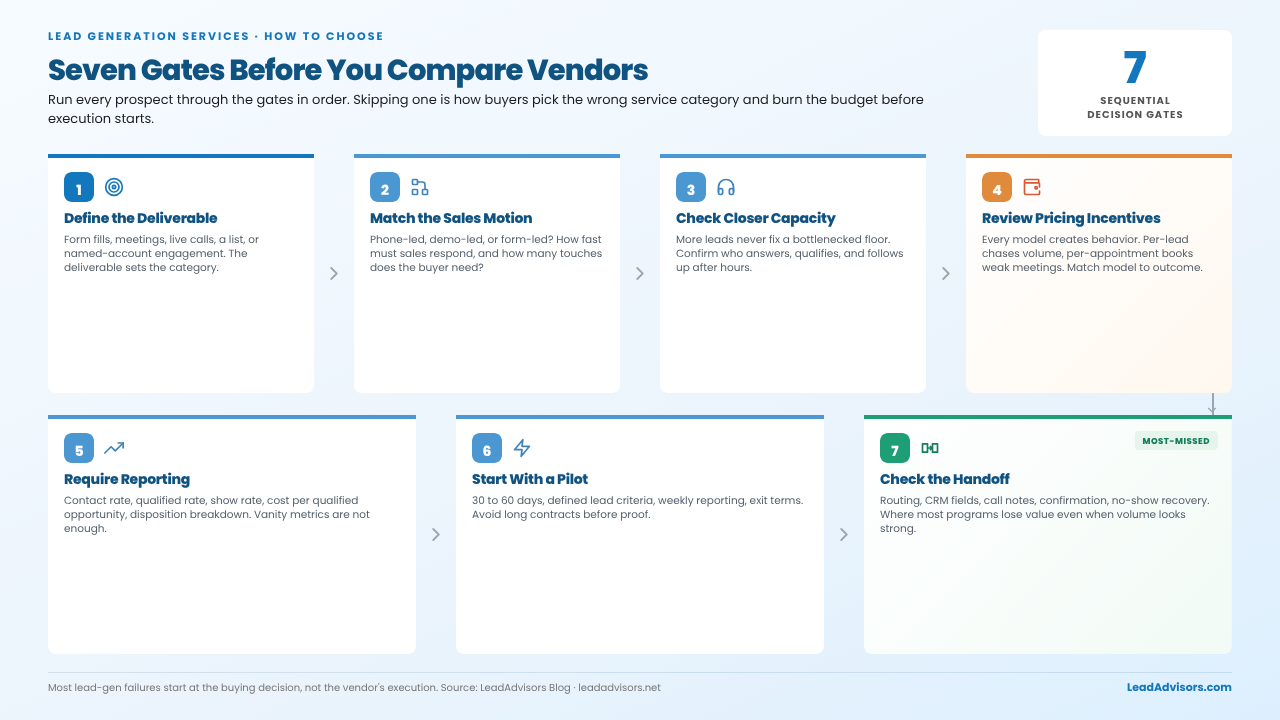
Use these gates before comparing vendors.
Gate 1: Define the Deliverable
Do you need:
- Form fills?
- Meetings?
- Live calls?
- Qualified opportunities?
- A prospect list?
- Nurtured leads?
- Named-account engagement?
Start there. The deliverable determines the service category.
This is also where the customer acquisition strategy framework helps connect lead generation to revenue targets, sales capacity, and budget allocation.
Gate 2: Match the Service to the Sales Motion
A high-ticket B2B sale needs a different system than a home services call.
Ask:
- How fast does sales need to respond?
- How many touches does a buyer need?
- Does the buyer require education?
- Is the sale phone-led, demo-led, or form-led?
- Does compliance restrict outreach?
Gate 3: Check Closer Capacity
More leads do not fix a bottlenecked sales floor.
Before buying volume, confirm:
- Who answers calls?
- Who works appointments?
- Who qualifies inbound leads?
- What happens after hours?
- What is the no-show recovery process?
- What does sales enter in the CRM?
Idle closers need a contact rate. Overloaded closers need qualification and routing.
Gate 4: Review Pricing Incentives
Every pricing model creates behavior.
Per-lead vendors may chase volume. Per-appointment vendors may book weak meetings. Retainer vendors may report activity. Performance-only vendors may avoid hard markets.
Choose the model that matches the outcome.
Gate 5: Require Reporting
Operator-grade reporting should show:
- Dials
- Connects
- Contact rate
- Qualified lead rate
- Appointment set rate
- Show rate
- Transfer set rate
- Cost per qualified opportunity
- Opportunity-to-deal conversion
- Disposition breakdown
- Daily and weekly trend lines
Vanity metrics are not enough.
Gate 6: Start With a Pilot
A pilot reduces risk.
Good pilot structures include:
- 30 to 60 days
- Clear success metrics
- Defined lead criteria
- Daily or weekly reporting
- Exit terms
- Quality review process
Avoid long contracts before proof.
If meetings are the first test, compare the pilot against outsourced appointment setting operations so the buyer can evaluate booked meetings, show rate, and a closer handoff together.
Gate 7: Check the Handoff
The handoff is where many lead generation programs lose value. A form fill must route to the right rep. A booked appointment must include notes, confirmation, and no-show recovery. A live transfer must reach a closer who can answer now. A qualified lead must carry enough context for sales to continue the conversation.
Ask the vendor to show the exact handoff path before launch. Review CRM fields, dispositions, routing rules, call notes, and escalation steps. If the handoff is vague, the campaign will create friction even when lead volume looks strong.
The handoff should also map to the sales development services category when SDRs, BDRs, appointment setters, or lead qualifiers share ownership.
Common Mistakes Buyers Make
A single bad call, a weak ad, or a missed follow-up does not cause most lead-generation failures. They usually start earlier, when the buyer chooses a service that does not match the actual operating problem.
Use the mistakes below as a pre-purchase checklist. If any of them show up before launch, fix the buying decision before you ask a vendor to execute.
1. Buying the Wrong Service Category
This is the biggest failure point.
A company that needs appointment may buy more leads. A company that needs live calls may buy a prospect list.
The service may work. The fit is wrong.
2. Treating Tools as Services
Lead generation tools support execution. They do not replace it.
Software can store data, automate messages, and score leads. However, people still need to build the offer, run the cadence, qualify responses, and manage handoff.
3. Ignoring Contact Rate
Contact rate determines whether lead spend turns into conversations.
LeadAdvisors sees this problem often on sales floors. Companies keep buying new leads while existing leads go unworked, under-called, or poorly routed.
The fix is not always more leads. Often, it is better speed-to-lead, better dialing strategy, better follow-up, and better QA.
4. Picking by Price Alone
Affordable lead generation services are not always bad. However, cheap lead generation services can become expensive when they create low-quality volume.
Look at cost per qualified opportunity, not just cost per lead.
5. Skipping Vertical Fit
Financial services, healthcare, legal, SaaS, manufacturing, and home services all behave differently.
A generalist vendor may not understand compliance, buyer friction, or sales cycle reality.
6. Buying More Leads Without Sales Capacity
If closers cannot answer, call back, qualify, and follow up, more leads create waste.
Lead generation should match the team’s ability to work on the output.
7. Accepting Weak Reporting
Reports should expose the operating truth.
If the report only shows “leads delivered” or “emails sent,” it is not enough. Buyers need conversion, quality, and handoff metrics.
8. Signing Long Contracts Without Proof
Long contracts can make sense after validation. They are risky before validation.
Start with a pilot when possible.
9. Forgetting Brand Search
Buyers research before they talk to sales.
If a prospect searches your company and finds nothing credible, conversion suffers. This matters for inbound, outbound, paid media, and appointment setting.
LinkedIn’s B2B Intelligence Hub also reflects how influence, trust, content, and measurement shape B2B marketing performance.
10. Expecting One Vendor to Do Everything
Some vendors can manage several categories. Few can operate all eight at high depth.
Choose based on category strength, not broad claims.
How LeadAdvisors Operates Lead Generation Services
LeadAdvisors is an operator-led BPO and digital growth company. We build and run the infrastructure that connects marketing spend to a qualified pipeline.
We operate across five categories in the Lead Generation Services Stack:
- Inbound demand generation
- Outbound prospecting
- Appointment setting
- Live transfers
- Lead qualification
We do not position LeadAdvisors as the best fit for every category.
- For ABM, a specialist agency may be a better fit.
- For complex lead-nurturing automation, a marketing automation implementation partner may be a better fit.
- For large-scale database building, platforms like ZoomInfo, Apollo, Cognism, or LinkedIn Sales Navigator may be a better fit.
Our operating strength lies in execution, contact rate, BPO scale, speed-to-lead, appointment setting, live routing, QA, and reporting.
That means we fit buyers who need:
- Managed offshore teams
- Contact rate optimization
- Appointment setters
- Transfer specialists
- Lead qualification
- Multi-channel follow-up
- Daily operating visibility
- A pilot before a larger commitment
The framework applies to LeadAdvisors the same way it applies to any vendor. If the service category fits, evaluate us through the gates. If it does not fit, choose the operator built for that category.