Starting a call center looks simple: buy software, hire agents, and start dialing. That is the problem. Most founders treat it as a phone setup project, only to discover they have built a costly operating system with no stable output.
The pain shows up fast. Supervisors are missing. QA is thin. Compliance is reactive. Agents ramp slowly. Meanwhile, a proper build often needs 90–180 days to reach baseline productivity.
The solution is to run the build-vs-buy decision first. This guide shows how to start a call center, what infrastructure you need, and when call center outsourcing fundamentals make a managed or hybrid model the better path.

What “Starting a Call Center” Actually Means
Starting a call center can mean four different things. Each model has different costs, risks, timelines, and management requirements.
1. In-House Call Center
An in-house call center serves an existing company. The team handles inbound support, outbound follow-up, appointment setting, retention, sales calls, or collections. If you are weighing internal sales capacity against a managed floor, use in-house SDR teams vs outsourced BPO operations as the closer comparison.
This model often starts with 5–50 seats. It can work when the company has enough volume to justify dedicated agents, supervisors, QA, and reporting. If the channel expands beyond voice, review the definitional difference between call centers and contact centers.
Small floors carry a hidden cost problem. The management layer does not shrink just because the team is small. You still need a supervisor, a dialer, a CRM, a QA process, reporting, compliance rules, recruiting, and training.
2. BPO Operator Launch
A BPO operator’s launch means the call center is the business. It sits inside the broader BPO category, where call centers fit.
This model requires more than agents. You need sales, operations, legal, payroll, client onboarding, QA, reporting, compliance, account management, and enough capital to run before client revenue stabilizes. A founder may start with 10–25 seats, but the business usually needs 75+ seats before overhead makes sense.
The operator vs agency vs consultant distinctions matter here. Buyers are paying for execution, not advice.
3. Virtual or Remote Call Center
A virtual call center uses distributed agents rather than a single physical floor. Agents may work from home while supervisors manage performance through cloud software, call recordings, QA tools, dashboards, and daily coaching.
This model reduces facility cost. However, it increases the requirements for supervision, security, and visibility. Remote teams need controls for availability, device access, data security, schedule adherence, internet reliability, QA calibration, and escalation handling.
Remote does not mean lightweight. It means the operating system must be visible in software.
4. Hybrid Call Center
A hybrid model combines a physical core team with remote agents. This is common once teams grow past 25 seats.
For example, supervisors and QA may sit in one location while remote agents handle overflow, off-hours coverage, or specialized campaigns. Hybrid teams work when reporting and QA are strong. Without those layers, they fragment fast.
Call Center Setup Requirements
A call center setup needs more than phones and agents. Most founders overspend on software and underspend on the operating layer. That is the wrong order.
Software supports the floor. It does not run the floor.
Telephony and Dialer Infrastructure
Your dialer controls how calls move through the operation. Outbound floors need pacing, compliance controls, local time rules, and list management. Inbound teams need routing, IVR, queue management, and call recording.
For outbound floors, the selection of dialer technology affects contact rate, agent talk time, and compliance exposure. If Five9 is part of the stack, confirm the depth of the Five9 platform configuration before live dialing.
Choose the operating model before the dialer. An inbound support floor does not require the same setup as a telemarketing or lead-generation floor.
CRM and Case Management
The CRM is the system of record. Agents need a single place to view leads, accounts, tickets, dispositions, notes, status changes, and next steps.
The workflow matters more than the logo on the software. A basic CRM with clean dispositions beats a powerful CRM with messy data.
At minimum, track lead source, call attempts, contact status, disposition, appointment status, transfer status, conversion outcome, agent, campaign, and follow-up date. Without this data, you cannot manage contact rate, conversion rate, or productivity.
Workforce Management
Workforce management infrastructure controls staffing, schedules, adherence, and intraday coverage. It becomes critical at 15+ seats.
A missed call window does not come back. A lead that sits too long loses value. A queue that waits too long damages customer experience. Therefore, managers need to know who is scheduled, who is logged in, who is available, and which campaigns need more coverage.
QA and Reporting
QA should start with agent one. Waiting until 25 agents creates quality debt.
A practical QA system follows call center QA best practices and includes call recording, evaluation rubrics, compliance scoring, script checks, coaching notes, calibration sessions, and supervisor follow-up. Modern teams may add an AI-assisted call QA infrastructure, but AI does not replace human calibration.
Reporting turns the floor from a black box into a managed system. Use the operator metrics framework for call center performance to track dials, connects, contact rate, talk time, wrap time, transfer rate, appointment rate, conversion rate, cost per acquisition, QA score, attendance, adherence, and productivity.
For outbound teams, contact rate is often the first constraint. Use the contact rate framework for operational ROI to diagnose speed, cadence, list hygiene, and follow-up structure.
Compliance and Security Infrastructure
Compliance is not a launch checklist. It is a daily operating discipline.
Outbound teams need consent rules, DNC scrubbing, calling windows, opt-out handling, disclosures, recording controls, and state-specific requirements. Start with TCPA compliance for outbound operations before any high-volume campaign.
The Federal Trade Commission explains that telemarketers must comply with the National Do Not Call Registry rules. The FCC also maintains guidance on Do Not Call under the TCPA framework.
If agents handle payments, the PCI Security Standards Council describes PCI DSS as the standard for environments that store, process, or transmit payment data. If agents handle health information, HHS states that business associates may include entities that perform services involving protected health information for covered entities.
Remote and hybrid floors also need secure access, device controls, time tracking, and desktop monitoring for distributed agents. NIST’s Cybersecurity Framework 2.0 gives a useful structure for managing identity, access, monitoring, response, and recovery.
Operational Leadership
The first call center hire should not always be an agent. In many builds, the first hire should be an operator.
You need someone who can run supervisor ratios, agent ramp, QA calibration, attendance, coaching, reporting, compliance habits, huddles, and escalation paths.
A dialer will not coach agents. A CRM will not fix call control. A dashboard will not manage attendance. Operators run the floor.
How Much Does It Cost to Start a Call Center?
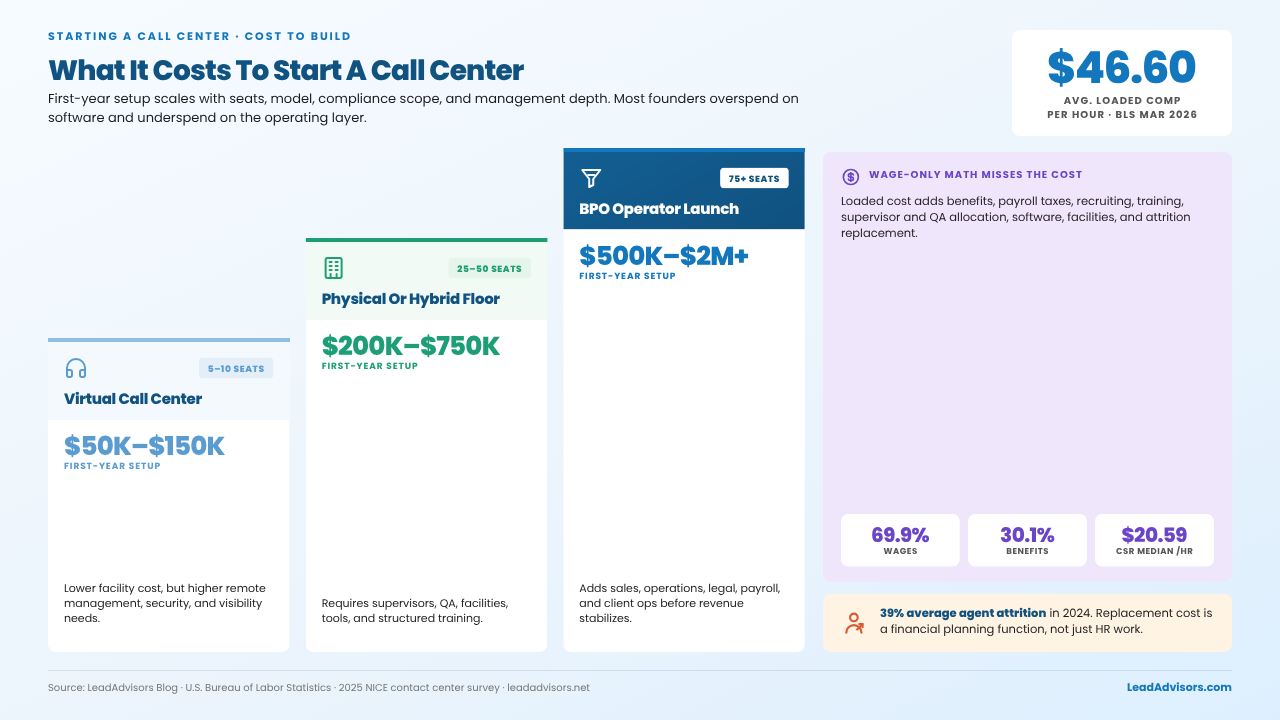
The cost to start a call center depends on size, location, model, compliance scope, and management depth.
A small virtual call center may cost less upfront because it avoids facility buildout. However, it still needs software, recruiting, training, supervision, QA, reporting, and security controls.
Planning ranges:
| Call center model | Typical first-year setup range | Notes |
| 5–10 seat virtual call center | $50K–$150K before full labor load | Lower facility cost, higher remote management needs |
| 25–50 seat physical or hybrid floor | $200K–$750K | Requires supervisors, QA, facilities, tools, and training |
| 75+ seat BPO operator launch | $500K–$2M+ | Requires management, sales, legal, payroll, and client ops |
Founders often calculate agent cost as an hourly wage. That is too narrow. The loaded cost methodology for call center agents includes base pay, benefits, payroll taxes, recruiting, training, supervisor allocation, QA allocation, software, facilities, HR, IT, attrition replacement, and compliance overhead.
The Bureau of Labor Statistics reported that private industry compensation costs averaged $46.60 per hour worked in March 2026. Wages accounted for 69.9% of employer costs. Benefits accounted for 30.1%. That means wage-only math misses a major part of the expense.
BLS reports that customer service representatives had a median hourly wage of $20.59 in May 2024. However, call center roles cost more after taxes, benefits, supervisors, software, and facilities.
Offshore call center staffing operations can reduce direct labor costs. However, they add complexity in management, training, legal, payroll, and cross-border operations. If the Philippines is on the shortlist, study the Philippines as an offshore call center geography.
Attrition also belongs in the model. A 2025 NICE survey on modern contact centers reported an average 2024 agent attrition of 39%. It also found that 58% of respondents said unmanaged agent attrition had increased. That is why agent attrition management in call center operations is a financial planning function, not just HR work.
Build vs. Buy: The Decision Framework
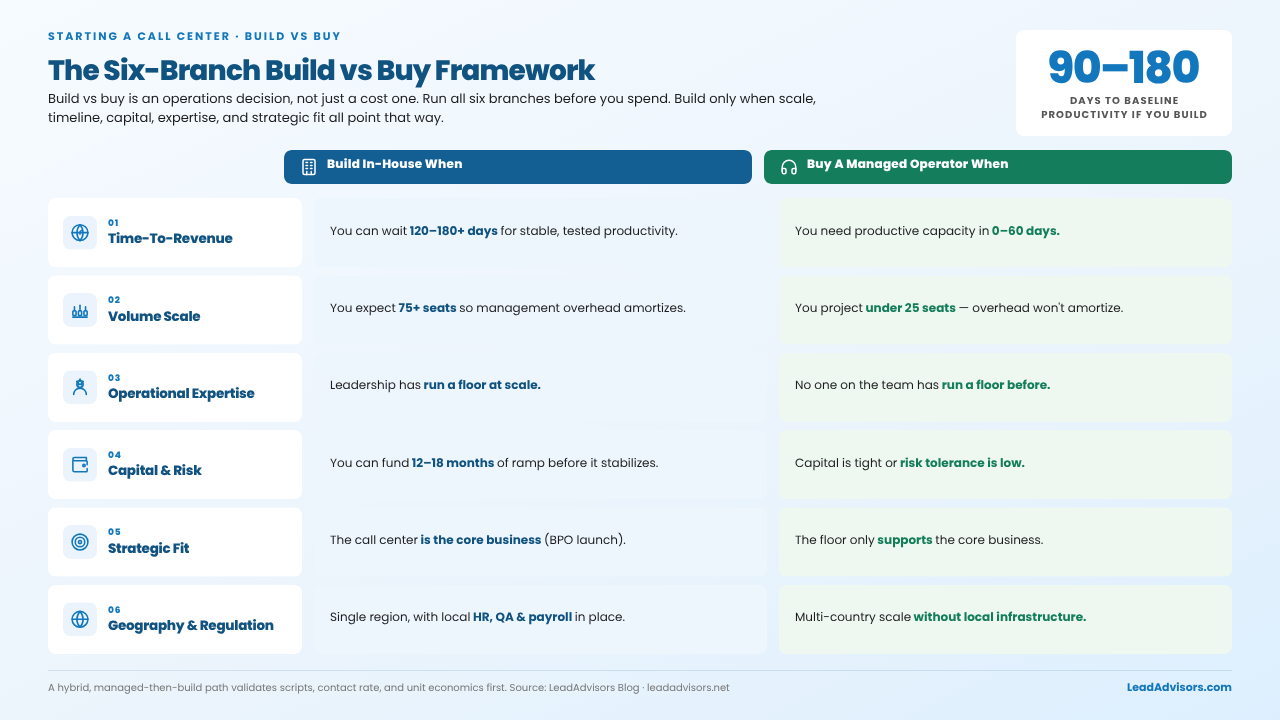
The build-vs-buy decision is not only a cost question. It is an operations question.
Build when scale, timeline, capital, expertise, and strategic fit all support ownership. Buy when speed, risk control, QA, and management complexity matter more than owning the floor.
Use this six-branch framework before you spend money.
1. Time-to-Revenue Tolerance
If you need productive capacity in 0–60 days, a managed operator usually wins. Building from scratch rarely produces stable productivity that fast.
If you have 60–120 days, managed still has the edge. A new build may still be in the process of being hired, configured, trained, and tested.
If you can wait 120–180+ days, building becomes more realistic. Even then, the other branches must support it.
2. Volume Scale
Small floors struggle with overhead. Under 25 seats, managed operations often make more sense because supervision, QA, reporting, and compliance do not amortize well.
Between 25 and 75 seats, a hybrid model often works best. You may use a managed operator to prove scripts and unit economics while building internal capability.
At 75+ seats, the build can become more attractive if the operator layer is strong.
3. Operational Expertise
If no one on the leadership team has run a call center floor at scale, do not build first. Use a managed operator or hire experienced call center leadership before hiring agents.
Call centers fail when founders treat them like staffing projects. They are performance systems.
4. Capital and Risk
Building requires capital before return. You may carry 12–18 months of hiring, software, training, and management costs before the operation stabilizes.
If capital is tight, managed operations reduce fixed-cost exposure. If capital is available but risk tolerance is low, a managed-then-build path can work.
5. Strategic Fit
If call center capability is the core business, you may need to build it eventually. That applies to BPO operator launches.
However, if the call center capability supports the core business, buying may be a smarter move. Many companies do not need to own a floor. They need a higher contact rate, a lower CPA, faster follow-up, or more qualified conversations.
6. Geography and Regulation
Multi-country operations are harder than single-region teams. Starting a call center in Mexico, India, Pakistan, Jamaica, the Dominican Republic, or the Philippines entails navigating labor regulations, payroll requirements, tax considerations, data controls, and management complexities.
For cross-border scale, multi-region operational coverage becomes part of the model. If you do not have local HR, QA, payroll, supervision, and escalation paths in place, use a managed BPO partner.
Decision Patterns
Build when you expect 75+ seats, can wait 120–180+ days, have experienced leadership, can fund the ramp, and need the call center as a strategic capability.
Use a managed operator when you need capacity fast, project fewer than 75 seats, lack floor leadership, need QA from day one, or want lower fixed-cost risk.
Use a hybrid model when you need speed and future ownership. A managed operator can validate scripts, contact rates, staffing needs, and conversion economics before you build internal capacity.
This path prevents the most expensive mistake: building infrastructure before proving the operating model.
How to Start a Call Center Business Step by Step
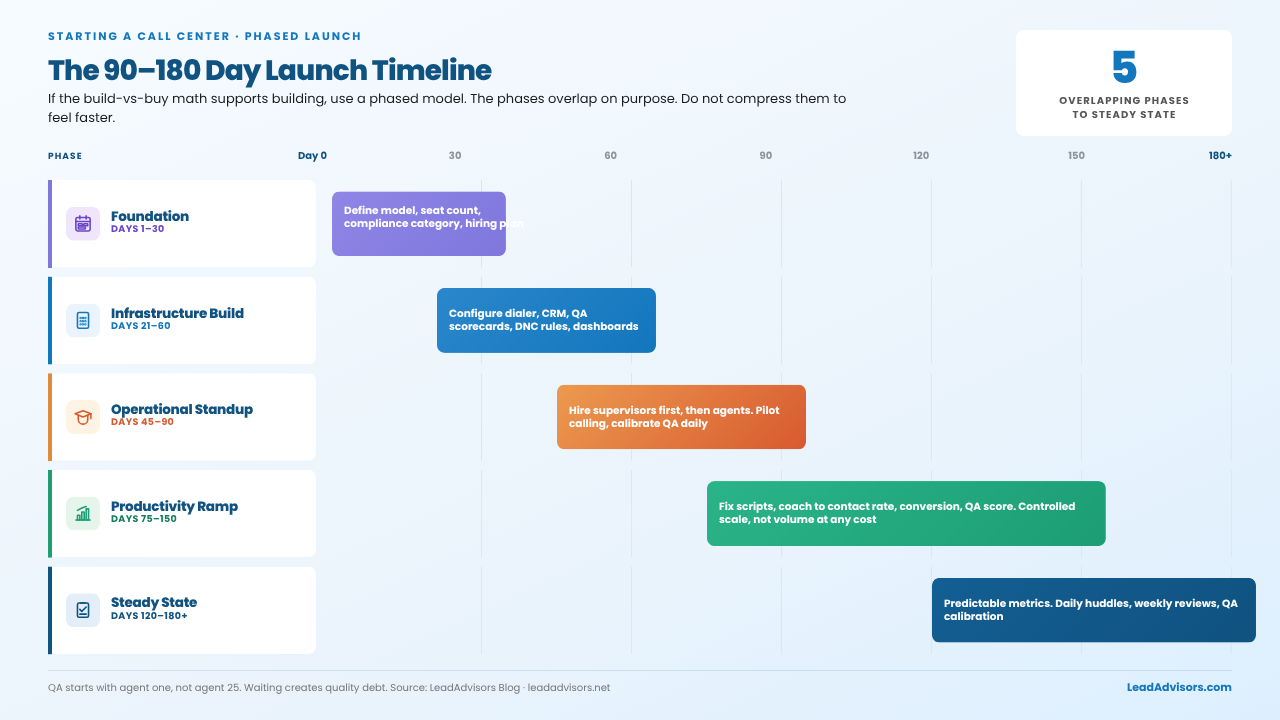
If the build-vs-buy math supports building, use a phased launch model. Do not compress the phases to feel faster.
Phase 1: Foundation, Days 1–30
Define the call type, target customer, seat count, revenue model, pricing model, location, compliance category, data rules, hiring plan, and supervisor structure.
If you are launching a BPO call center, define the offer. Appointment setting, customer support, live transfers, lead qualification, technical support, and back-office support all need different scripts, KPIs, and compliance controls.
Also set business registration, insurance, banking, payroll, vendor contracts, data processing terms, compliance counsel, and security requirements.
Phase 2: Infrastructure Build, Days 21–60
Configure the dialer, CRM, call recording, QA scorecards, reporting dashboards, dispositions, user roles, time zone calling rules, DNC workflows, opt-out handling, security access, and the training environment.
Do not let vendors define the workflow. Define the workflow first. Then configure the tools to support it.
Phase 3: Operational Standup, Days 45–90
Hire supervisors before agents where possible. Then hire agents in controlled batches.
Use call center agent training methodology to build product knowledge, compliance language, CRM use, objection handling, dispositions, escalations, QA standards, roleplay, and certification into the launch.
Start with controlled pilot calling. Review calls daily. Calibrate the QA rubric. Fix scripts quickly. If a managed partner is involved, the BPO onboarding methodology should define the first 30-, 60-, and 90-day periods.
Phase 4: Productivity Ramp, Days 75–150
The first productive period is not a steady state. Agents may reach only partial productivity. Scripts will need edits. Supervisors will find gaps. Data quality issues will surface.
Focus on contact rate, conversion rate, QA score, attendance, talk time, wrap time, disposition quality, coaching, list quality, and source performance.
The goal is controlled scale, not volume at any cost.
Phase 5: Steady State, Days 120–180+
Steady state begins when the floor runs with predictable metrics. At this point, call center management infrastructure should be visible in daily huddles, weekly reviews, QA calibration, compliance audits, attrition tracking, and hiring pipeline management.
The operating question changes from “are we functioning?” to “how do we improve?” The gap becomes even clearer when scaling call center operations past 200 seats.
How to Start a Virtual Call Center From Home
You can start a virtual call center from home, but it still needs structure. A laptop and phone line are not enough.
At minimum, you need a cloud phone system or dialer, CRM, call recording, headset, reliable internet, backup internet, secure device, script, disposition rules, QA checklist, schedule, and data security policy.
For a solo founder, this can work as a small test. Once you add agents, the model changes. You need supervision, training, payroll, QA, reporting, and compliance rules.
You cannot run a serious call center for free. You may test demand with low-cost tools, but a real operation needs paid systems, secure data handling, compliance controls, and trained people.
A safer pilot includes one supervisor, two to five agents, one campaign, one script, one CRM workflow, one dashboard, and a daily QA review.
How to Run a Call Center After Launch
Running a call center means managing the daily operating rhythm. Strong floors win through cadence.
Every day, supervisors should review attendance, login time, queue status, dials, connects, contact rate, transfers, appointments, QA issues, escalations, system problems, and coaching needs.
Every week, review trends by agent, lead source, script, QA pattern, compliance miss, show rate, conversion rate, attrition risk, adherence, and campaign profitability. Reports matter only when they change behavior.
Review the business model every month. Ask whether the floor is profitable, the contact rate is improving, agents are staying, supervisors are overloaded, QA scores are stable, compliance risks are controlled, and clients or internal teams are getting value.
This is where operators separate from staffing firms. The goal is not to keep seats filled. The goal is measurable output. If the business needs booked meetings rather than an owned floor, outsourced appointment-setting operations may be the direct path.
Compliance and Regulatory Reality
Compliance needs to be built into the floor. This section is operational planning guidance, not legal advice. Work with qualified compliance counsel before launching outbound or regulated campaigns.
Outbound consumer calling in the U.S. can trigger compliance requirements under the TCPA, FCC, and FTC. Your operation should document consent source, DNC scrubbing, calling windows, opt-out handling, recording disclosure, caller ID rules, script language, complaint handling, and vendor responsibilities.
Call recording laws vary by state. Some states require one-party consent. Others require all-party consent. Do not rely on agent memory. Add disclosure language to scripts and verify it through QA.
Healthcare calls may require HIPAA controls, business associate agreements, audit logs, access limits, and breach procedures. Payment calls may require PCI DSS controls. Many call centers avoid recording sensitive payment data through pause-and-resume recording or secure payment capture tools.
Security is not only an IT issue. Agents may access customer, payment, health, or sales data. Therefore, identity, device access, monitoring, response, and recovery belong in the operating model.
Common Failure Patterns in Call Center Startups
Most call center failures are predictable.
Founders underestimate the time-to-revenue gap. They expect a 30–60-day ramp, only to discover that real productivity often takes 90–180 days.
They buy software before designing operations. If the workflow, QA rubric, reporting needs, and compliance rules are unclear, the software setup will reflect that confusion.
They hire agents before supervisors. Without leadership, the floor develops habits that are hard to reverse.
They skip QA at launch. Early QA catches script issues, compliance misses, training gaps, and agent behavior problems.
They treat compliance as paperwork. Compliance is how the floor behaves every day, not a folder.
They build before validating demand. A 50-seat floor can burn cash if the campaign does not work. Prove the script, offer, contact rate, conversion rate, and unit economics first.
Finally, they built when buying was the right answer. Some companies do not need to own a call center. They need more qualified conversations, faster follow-up, stronger QA, and a higher contact rate.
How LeadAdvisors Operates the Build-vs-Buy Path
LeadAdvisors runs managed call center operations for companies that need execution, not just headcount.
We are not a staffing firm. We manage campaigns, QA, reporting, supervisors, and daily performance. The goal is not to provide bodies at a lower cost. The goal is to build the operating layer that turns leads into qualified conversations.
LeadAdvisors supports managed offshore teams, dedicated BPO campaigns, transfer specialists, appointment setters, customer support, back-office support, QA, reporting, contact rate optimization, and sales funnel support.
The build-vs-buy conversation comes first. Some companies should build because they have scale, capital, leadership, and a long enough timeline. However, many companies should start with a managed or hybrid model to gain speed, QA, and reporting while reducing operational risk.
A managed-then-build path can also work. LeadAdvisors can run the floor while the client validates the model, learns the operating numbers, and later decides what to build internally.
Book a strategy call before you spend on infrastructure. Run the build-vs-buy math against your actual volume, timeline, team, and risk.