Small business operators usually compare outbound call center vendors on hourly cost, then wonder why the pipeline does not move.
On a small scale, one wrong assumption burns the entire month. If your program runs at an 8 percent contact rate, a thousand dials becomes about 80 real conversations. Closers wait, good leads age out, and the vendor reports “activity” while revenue stays flat.
This guide shows what drives higher contact rates in 2026, how pricing models affect unit economics, when outsourcing fits your stage, and the questions that separate vendors that generate revenue from those that create noise.

Why Contact Rate Matters More Than Hourly Cost at Small Business Scale
Contact rate determines outbound call center ROI at every scale, but small business operators feel the impact most because their budget runway is shorter. A three-times difference in contact rate compounds faster when the monthly spend is limited.
Hiya’s State of the Call report notes that 86% of unknown calls go unanswered, which is why identity and trust signals (not just dial volume) determine outcomes.
The Contact Rate Math at Small Business Scale
Scenario: $5,000 monthly outbound call center spend, 2,500 dial attempts per month, qualification rate of 18 percent of contacts.
Industry typical vendor (8 percent contact rate):
- 200 connected conversations
- 36 qualified leads
- Cost per qualified lead: $139
Operator-led BPO (30 percent contact rate):
- 750 connected conversations
- 135 qualified leads
- Cost per qualified lead: $37
Same monthly spend produces 3.75x more qualified leads at the higher contact rate. The pricing comparison appears identical until the contact rate is included in the analysis.
Why Contact Rate Compounds Differently at Small Business Scale
Larger operations absorb low contact rates with volume. A 500-agent operation at a 9% contact rate can still produce enough total connects to hide inefficiency within scale.
Small business operations have no volume to hide the problem. If your team has limited closer capacity and your list is small, a low contact rate becomes the bottleneck that defines growth.
What Drives Contact Rate Differences
Three factors account for most of the gap between industry-typical and operator-led programs.
Call trust also has an infrastructure layer. The FCC’s STIR/SHAKEN overview explains how caller ID authentication works and why signed calls are part of efforts to reduce spoofing and improve trust in the voice channel.
- Multi-channel orchestration. Phone-only operations cap out. Adding SMS and email to a structured cadence increases surface area and reduces friction from unknown numbers by naming the company before the next call attempt.
- Speed-to-lead infrastructure. A call two minutes after a form fill is a response. A call four hours later is a cold call. Same lead. Different outcome.
For the operator breakdown, see our speed-to-lead operator framework.
- List quality and dialing intelligence. Time-of-day optimization, time zone routing, caller ID controls, compliant cadence patterns, and basic number validation determine whether the list can be worked at all.
If you want to go deeper on the levers, start with our contact rate optimization framework.
What Small Business Operators Should Ask Vendors
- What is your contact rate by program type? If they cannot answer with ranges, they do not measure it.
- What multi-channel infrastructure do you run? Phone-only produces phone-only ceilings.
- What is your median speed-to-lead time? Median, not average.
Hourly rate comparison without contact rate comparison produces vendor decisions disconnected from revenue outcomes. Small business operators should make the contact rate the qualifying question.
A Simple Contact Rate Scorecard You Can Run in One Week
Small business operators do not need a 90-day study to diagnose whether an outbound program is structurally capable of higher contact rates. You need consistent inputs and a scorecard you can review daily.
Use this quick audit to separate list problems, cadence problems, and infrastructure problems:
- Right-party contact rate: of all contacts, what percent are actual decision-makers? A low right-party rate usually means list quality or targeting is wrong.
- Answer rate by time block: morning, midday, late afternoon. If one block is twice as strong, your dial strategy is leaving volume on the table.
- Unknown-number friction proxy: compare answer rate on the first attempt vs the second attempt after an SMS or email touch. If the second attempt jumps, the issue is trust, not script.
- Speed-to-lead median: measure the median, not the average. A few fast responses can hide a slow operational reality.
If a vendor cannot provide these numbers within a week, the program is not being managed as an operation. It is being run as labor.
Outbound Call Center Pricing Reality for Small Businesses in 2026
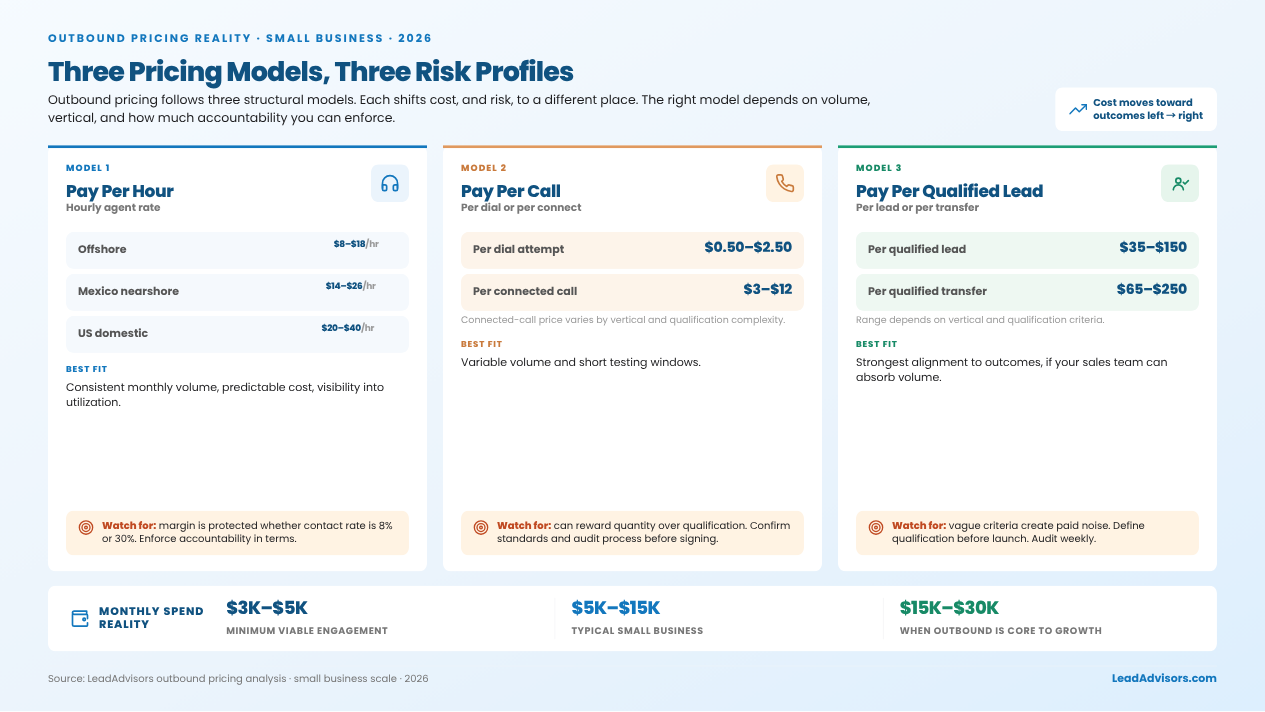
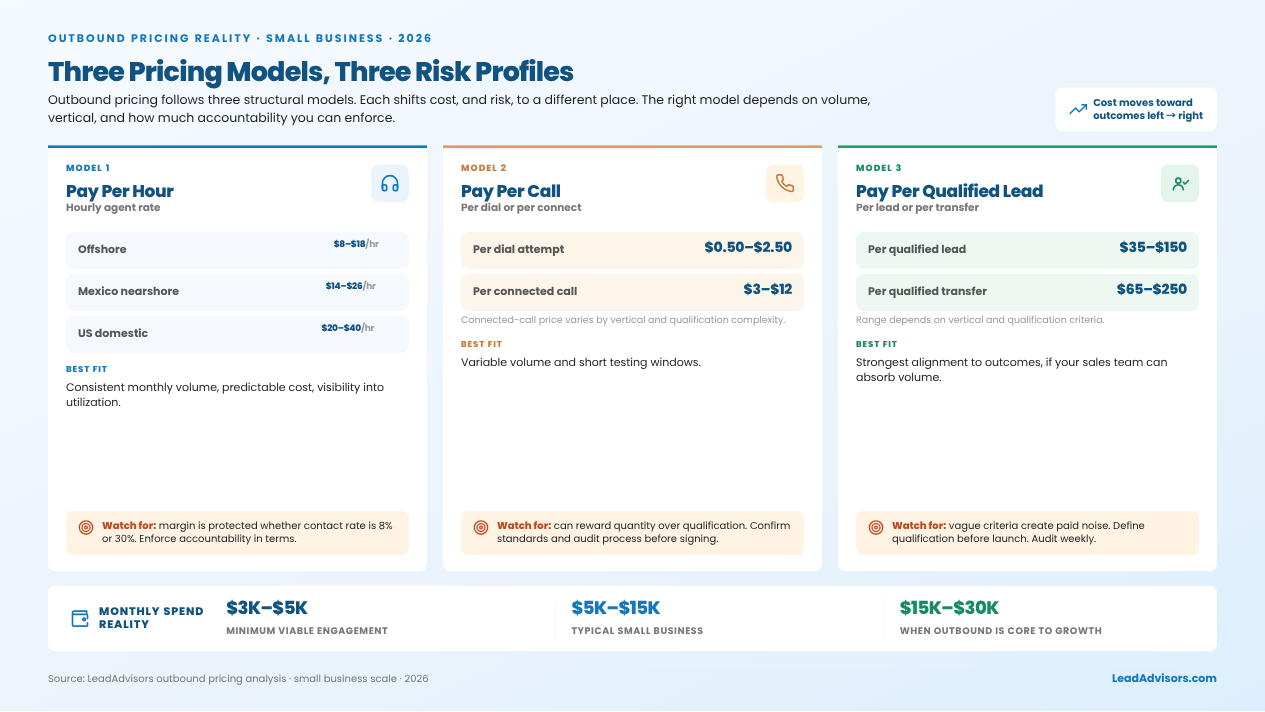
Outbound call center pricing for small businesses follows three structural models, each producing different unit economics. The right model depends on volume, vertical, and growth trajectory.
Model 1 – Pay Per Hour (Hourly Agent Rate)
Vendor charges a flat hourly rate per agent allocated to the campaign.
Cost range:
- $8 to $18 per hour offshore
- $20 to $40 per hour US domestic
- $14 to $26 per hour, Mexico nearshore
Best fit: consistent monthly call volume, predictable cost structure, and visibility into utilization.
Watch for: hourly pricing protects vendor margin without aligning to outcomes. If the vendor is paid the same at an eight percent and a thirty percent contract rate, you must enforce accountability through reporting and terms.
Model 2 – Pay Per Call / Per Connect
Vendor charges per dial attempt or per connected call.
Cost range:
- $0.50 to $2.50 per dial
- $3 to $12 per connected call, depending on vertical and qualification complexity
Best fit: variable volume and short testing windows.
Watch for: per-call models can reward quantity over qualification. Confirm qualification standards and audit process before you sign.
Model 3 – Pay Per Qualified Lead or Per Transfer
Vendor charges per qualified lead or qualified transfer.
Cost range:
- $35 to $150 per qualified lead
- $65 to $250 per qualified transfer, depending on vertical and criteria
Best fit: strongest alignment to outcomes, if your sales team can absorb volume.
Watch for: vague criteria create paid noise. Define qualification criteria before launch. Audit weekly.
Total Monthly Spend Reality at Small Business Scale
- Minimum viable engagement: $3,000-$5,000 monthly. Below this band, account management overhead consumes the spend.
- Typical small business engagement: $5,000 to $15,000 monthly.
- Upper-end small business: $15,000 to $30,000 monthly when outbound is core to growth.
If you are deciding whether to build internally, use this in-house benchmark: loaded cost per call center agent.
Pricing model selection depends on operational maturity and risk tolerance. Operators who price only the hourly rate usually underprice the real cost of failure.
What to Ask for in a Pricing Proposal (So You Can Compare Apples to Apples)
Two proposals can both say “$8,000 per month” and still describe two completely different operational realities. Before you compare vendors, ask for these proposal details in writing:
- Dedicated vs shared staffing. Are agents dedicated to your program, or shared across multiple programs during the same shift?
- Channel scope. Phone only, or phone plus SMS and email. If SMS is included, who pays for carrier fees and compliance tooling?
- Dialer and data tooling. Does pricing include the dialer, local presence, call recording, spam label monitoring, and number validation, or will those be add-ons later?
- Reporting cadence. Weekly scorecard, daily activity snapshots, and call review process. If reporting is optional, outcomes will be optional as well.
- Quality assurance. How calls are graded, how often coaching happens, and what happens when agents miss the qualification definition.
This is the fastest way to prevent a low-cost proposal from becoming the most expensive program you run.
When Outbound Call Center Services Make Sense for Small Businesses
Outbound call center services make sense for small businesses when the operation has product-market fit, lead flow capacity, and closer capacity but lacks the infrastructure to convert lead flow into a qualified pipeline at scale.
Operation Profile 1 – Service Business With Inbound Inquiries Going Unworked
The service business generates 200 to 800 inbound inquiries monthly. Internal capacity contacts 40-60% within 24 hours. The rest go cold.
Outsourcing is a good fit when speed-to-lead infrastructure is missing. Contact attempts within minutes change the math before any script change happens.
Investment math: $4,000 to $8,000 monthly outsourced cost often shows ROI in 60 to 90 days when capacity is closer.
Operation Profile 2 – Operation Buying Leads Without Follow-Up Infrastructure
Small businesses buy 200 to 800 leads monthly. Follow-up is slow, inconsistent, or phone-only. Closing rate stays low because leads age fast.
Outsourced outbound with multi-channel orchestration contacts 65 to 85 percent of purchased leads in many programs, which turns the same lead spend into more conversations.
This is the same pattern you see in most lead generation outsourcing programs when follow-up infrastructure is the limiting factor.
Operation Profile 3 – B2B Operation With Defined ICP and Cold Outbound Need
B2B operation has a defined ICP and a named account list, but no internal SDR bandwidth to run outbound consistently.
Outsourced appointment setting against named accounts can produce qualified meetings at investment levels below in-house ramp costs.
That is the core trade-off covered in our B2B appointment-setting guide.
When Outbound Call Center Services Do NOT Make Sense for Small Businesses
Outbound does not fix product-market fit. It scales the offer. If the offer is broken, outbound scales fail.
Outbound also does not fix closer capacity. If your sales team cannot absorb leads, lead aging becomes the bottleneck.
If you are deciding whether to hire or outsource at this stage, use this build-vs-buy lens: in-house SDR vs outsourced BPO.
A Practical Build vs Outsource Checklist at Small Business Scale
If you are on the fence, use these yes/no questions. Three or more “no” answers usually mean outsource first, then build later.
- Do you have a sales manager who can coach calls daily? If not, outsourced operations often outperform because coaching is built into the model.
- Do you already have dialer infrastructure and compliant SMS tooling? If not, your first 60 days will be tool setup, not pipeline.
- Can you respond to inbound inquiries in under five minutes during business hours? If not, your biggest ROI lever is infrastructure, not headcount.
- Do you have a clean list and a defined ICP? If not, pay for strategy and list intelligence before you pay for labor.
The goal at this stage is not to “own the function.” It is to establish benchmarks for contact rate, right-party contact, and cost per qualified lead that you can later replicate in-house.
What Small Business Operators Should Evaluate When Comparing Vendors
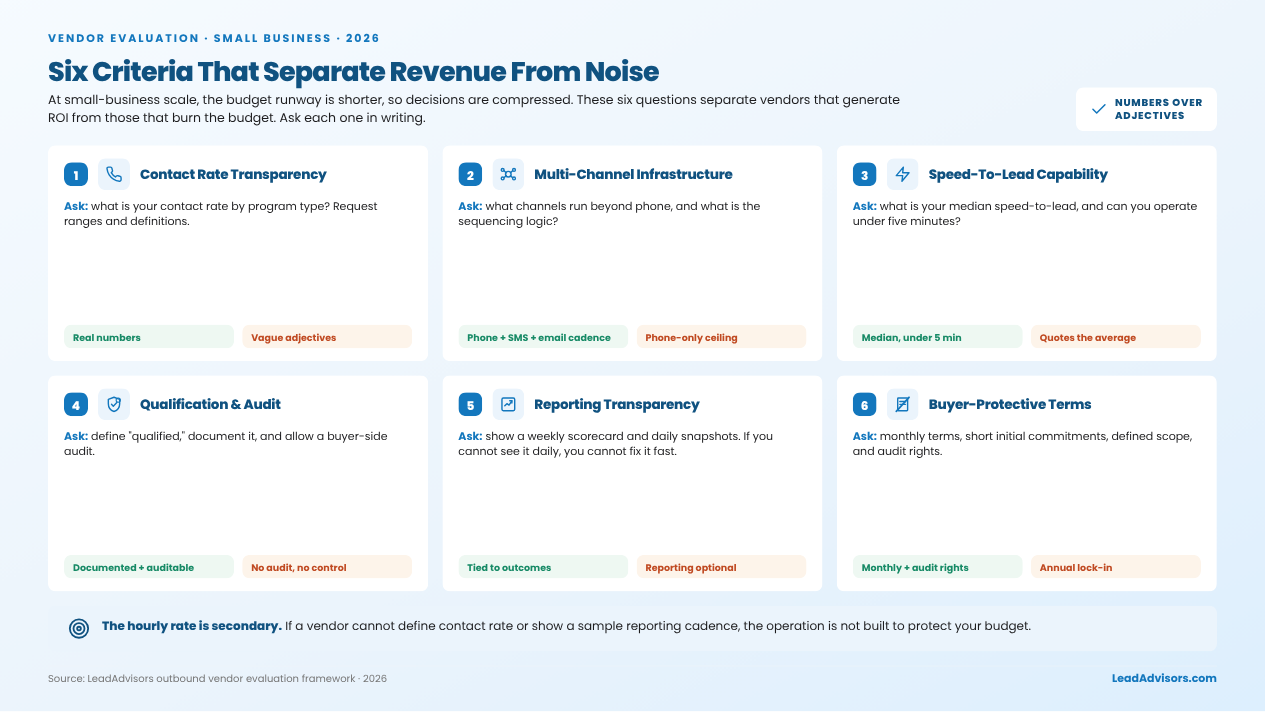
Vendor evaluation at a small-business scale requires the same diligence as enterprise vendor evaluation, but decisions are compressed because the budget runway is shorter. Six criteria separate vendors that will generate ROI from those that will burn through the budget.
Quick Checklist
- Contact rate transparency (and definition)
- Multi-channel sequencing (not phone-only by default)
- Median speed-to-lead reporting
- Documented qualification criteria
- Weekly reporting tied to outcomes
- Buyer-protective contract terms
Criterion 1 – Contact Rate Transparency
Ask: What is your contact rate by program type? Ask for ranges and definitions.
Strong vendors answer with real numbers. Weak vendors answer with adjectives.
Criterion 2 – Multi-Channel Infrastructure
Ask: what channels are included beyond phone, and what the sequencing logic is.
Criterion 3 – Speed-to-Lead Capability
Ask: what is your median speed-to-lead, and whether you can operate under five minutes.
Criterion 4 – Qualification Standards and Audit Process
Ask: define “qualified,” document it, and allow a buyer-side audit. If you cannot audit, you cannot manage.
Criterion 5 – Reporting Transparency
Ask: show weekly reports and daily snapshots. If you cannot see it daily, you cannot fix it fast enough. Use a reporting scorecard, such as call center metrics that tie activity to outcomes, to diagnose issues within the first 30 days.
Criterion 6 – Contract Terms That Protect Small Business Buyers
Look for monthly terms, short initial commitments, a defined scope, reporting obligations, and audit rights.
Avoid annual lock-ins at the discovery stage.
Common Mistakes Small Business Operators Make With Outbound Call Centers
Five mistakes consistently arise when small business operators first engage with outbound call center vendors. Recognizing the patterns up front prevents most of them.
Mistake 1 – Selecting Vendor on Hourly Rate Without Contact Rate Analysis
An hourly rate without a contact rate context is meaningless. A $12-per-hour vendor at an 8% contact rate can cost more per qualified lead than a $20-per-hour vendor at a 30% contact rate.
Fix: contact rate is the qualifying question. The hourly rate is secondary.
Mistake 2 – Engaging Outbound Before Product-Market Fit
Outbound amplifies the offer. If the offer does not convert in direct selling, the outbound sales fail.
Fix: prove conversion first. Then scale.
Mistake 3 – Underinvesting Closer Capacity Before Engaging Outsourced Outbound
Outbound can produce volume faster than a small sales team can absorb. Then, qualified leads age and performance collapse.
Fix: calibrate outbound to closer capacity. Add closers before adding volume.
Mistake 4 – Signing Long-Term Contracts at the Discovery Stage
Small businesses need to change quickly. Long contracts lock you into the wrong program.
Fix: buy flexibility. Discounts should follow growth, not lock-in.
Mistake 5 – Treating Outbound as Marketing Spend Instead of Operational Investment
Outbound is operations. It produces a qualified pipeline. Measure it with operational metrics.
Fix: track cost per qualified lead, right-party contact rate, transfer quality, and downstream close rate.
If you are using outbound telemarketing as part of your motion, compliance is part of operating discipline. FTC’s guidance on complying with the Telemarketing Sales Rule (TSR) serves as the baseline reference for disclosures, prohibitions on misrepresentation, and do-not-call obligations.
Mistake 6 – Treating Scripts as the Primary Lever
Many small-business teams assume the script is the reason for low contact rates. Scripts matter, but the big gains usually come from the operational layer.
If your first touch is an unknown number calling a cold lead hours after the inquiry, the script is fighting the laws of physics. When speed-to-lead, channel sequencing, and list intelligence are correct, scripts become a conversion lever, not a rescue plan.