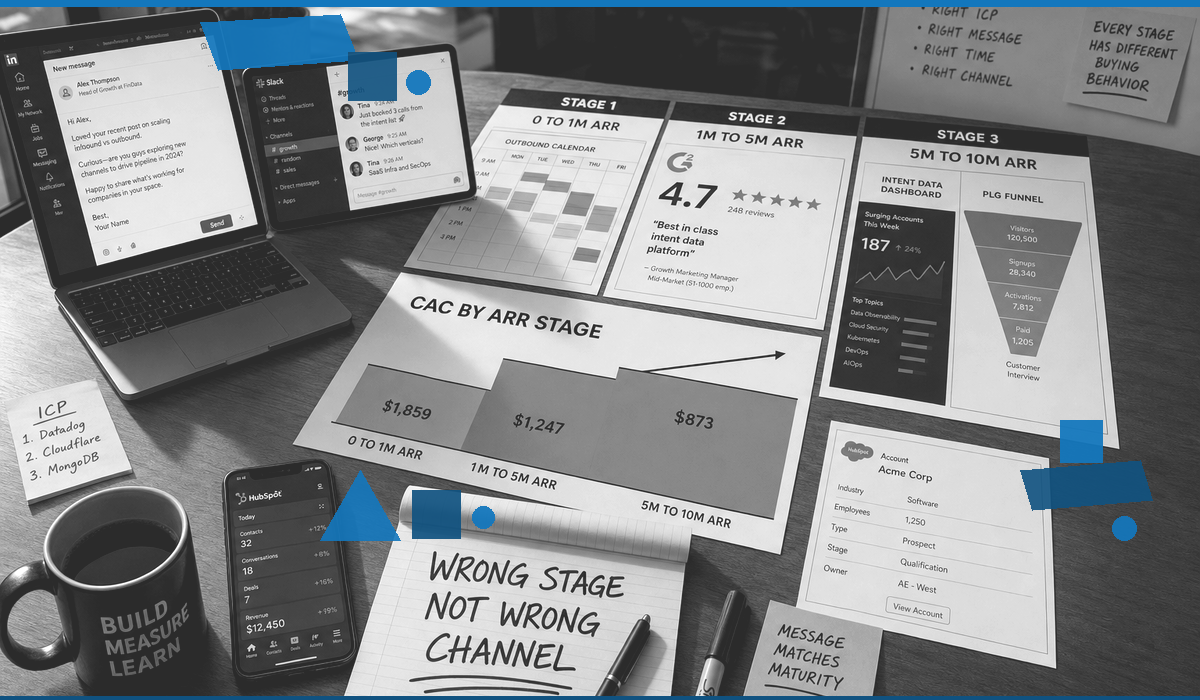
Picture a SaaS founder at $1.8M ARR. The team ran content for six months. The result: 1,200 monthly blog visitors and four trial signups. They ran Google Ads for 90 days. They spent $18,000 and closed two paying customers at an ACV of $900. That puts CAC at $9,000 on a $900 product. The math is broken. Is the channel wrong, or is the execution wrong?
That founder is not alone. SaaS lead generation in 2026 looks nothing like the 2022 playbook. The buyer journey is now mostly self-directed. A March 2026 Gartner survey of 646 B2B buyers found 67 percent now prefer a rep-free buying experience. 45 percent used AI during a recent purchase. Stanford HAI’s 2026 AI Index Report puts organizational AI adoption at 88 percent. SaaS buyers now research, shortlist, and disqualify vendors before any sales call.
For most founders, the answer is not “run more channels.” It is to match the channel mix to the ARR stage, the ACV, and the ICP. This guide maps SaaS lead generation by stage. What works at each ARR level? What does it cost in 2026? How to combine channels so each one reinforces the others.

SaaS Lead Generation by ARR Stage: Why Channel Selection Depends on Where You Are
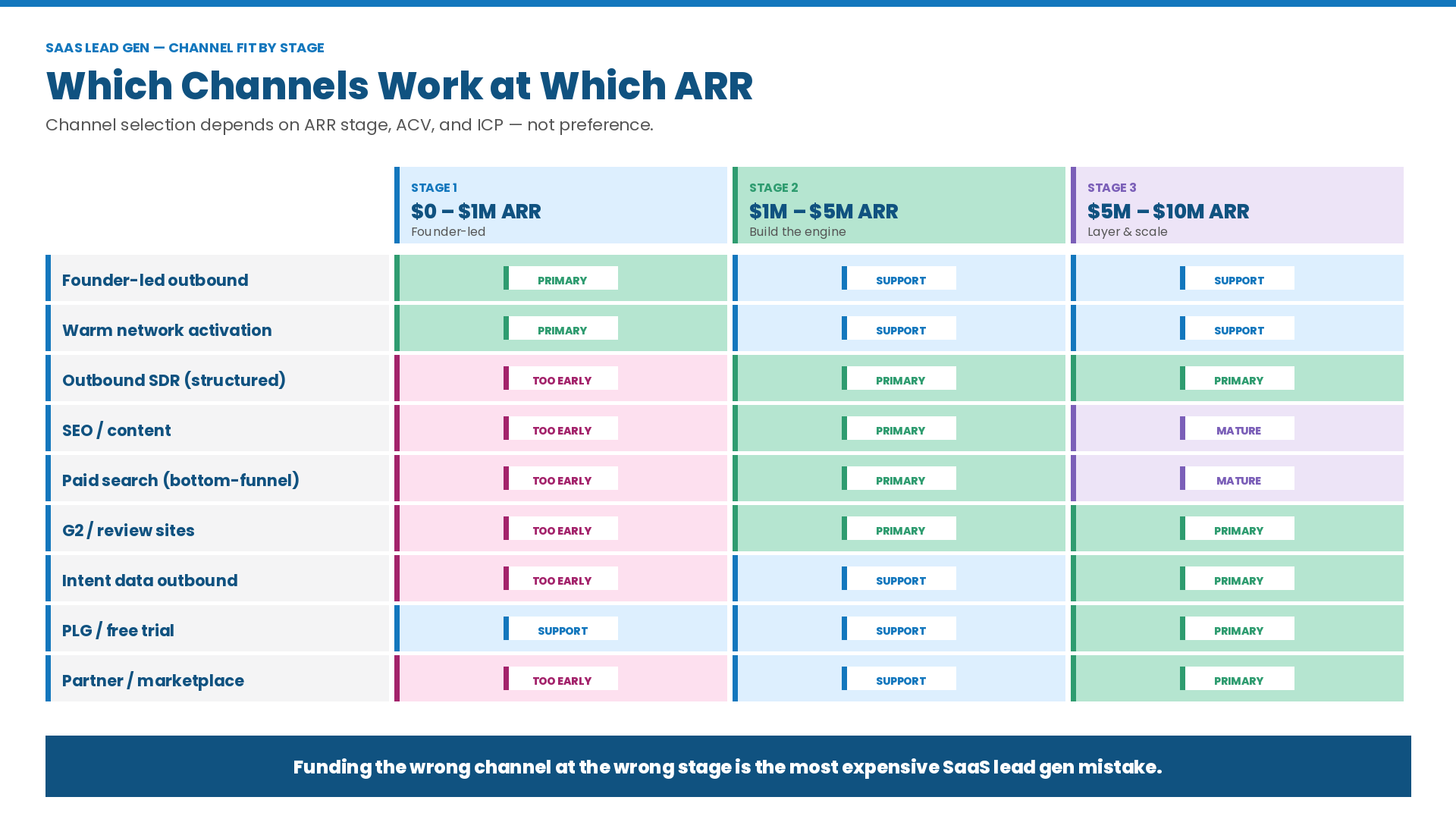
Direct answer. SaaS lead generation channel selection depends primarily on ARR stage, ACV, and ICP. Early-stage SaaS ($0 to $1M ARR) generates leads most efficiently through founder-led outbound and direct network activation. Growth-stage SaaS ($1M to $5M ARR) layers in content, paid search, and structured outbound sequences. Scale-stage SaaS ($5M to $10M ARR) adds PLG overlays, partner channels, and outbound driven by intent data.
Why stage matters more than channel preference
Every SaaS lead generation channel has an efficiency threshold. Below that volume, the channel’s fixed costs push CAC too high for the company’s ACV.
Content marketing takes 6 to 18 months to generate real organic traffic. A program launched at $500K ARR will reach $2M ARR before content drives primary-source pipeline. The investment makes sense only if other channels fund growth during the ramp.
Paid search in competitive SaaS categories costs $15-$80 per click. At a 2 to 5 percent landing page conversion rate, the cost per trial signup runs $300 to $4,000 before any sales qualification. At $2,000 ACV and a 15 percent trial-to-paid rate, the cost per customer from paid search runs $2,000 to $26,000. One end pays back. The other end burns cash.
Outbound SDR prospecting has a fixed cost floor: a loaded SDR plus tools. Below $5,000 ACV, the SDR model rarely hits an acceptable LTV/CAC.
Knowing which channels work at which stage prevents the most expensive SaaS lead generation mistake: funding channels that cannot pay back at the company’s current scale.
Stage 1 ($0–$1M ARR): Founder-Led SaaS Lead Generation
For ARR below $1M, the most efficient SaaS lead-generation channels are founder-led outbound, warm-network activation, and community presence. None of them requires fixed-cost infrastructure. All of them produce immediate ICP feedback.
Founder-led outbound
The founder sends 20-40 personalized messages per week to ICP-matched decision-makers via LinkedIn and email. Outreach-to-first-conversation conversion lands at 5 to 15 percent. That is far above what a trained SDR hits on cold outreach. The founder has domain authority. The founder can handle objections on the spot. A scripted sequence cannot match that.
Direct network activation
Personal introductions through advisor, investor, and operator networks convert to first conversations at 30-60%. That is roughly ten times the cold outbound rate. Work the warm network first. Cold outbound infrastructure comes after.
Community presence
Show up in Slack communities, LinkedIn groups, and industry forums where the ICP gathers. Prospects who self-identify as in-market come to you. This is the earliest form of SaaS content-driven lead generation. It produces higher-intent leads than paid acquisition because the prospect sought you out.
What to avoid at this stage
Paid advertising with ARR below $1M almost always pushes CAC above the LTV/CAC ceiling. There is too little conversion data to optimize targeting. Too little volume to test the creative. Too little brand presence to convert top-of-funnel traffic. Per the Federal Reserve Banks’ 2025 Small Business Credit Survey, early-stage small businesses that spend on channels before achieving product-market fit report cash flow strain. The same pattern holds in SaaS. Paid spend ahead of PMF is the most common cause of premature burn.
Stage 2 ($1M–$5M ARR): Building the Multi-Channel B2B SaaS Lead Generation Engine
At $1M to $5M ARR, the company has enough customer data to define the ICP. It has enough revenue to fund channel experiments. The build order that compounds:
Priority 1: Structured outbound sequences
Swap founder-led ad-hoc outreach for a multi-channel sequence: phone, email, LinkedIn. Run it through a dedicated SDR or a managed outbound program. Autobound’s 2026 benchmarks from 100+ SaaS teams put healthy reply rates at 15-25%. At $5,000 to $15,000 ACV, a two-SDR team running 20 to 40 qualified meetings per month pays back if the close rate hits 20% or higher.
Priority 2: SEO and content with intent targeting
Launch a content program built on keyword research with proof of commercial intent. Content compounds. Posts you publish in month three drive organic traffic in month twelve and beyond. Target three to four real posts per month against clusters with documented search volume. Expect real traffic by month twelve. Expect the primary-channel pipeline by month twenty-four.
Priority 3: Targeted paid search
At $1M to $5M ARR, paid search should focus on bottom-of-funnel queries: branded terms, competitor terms, and high-intent comparison queries. Broad category terms in competitive SaaS verticals carry CPCs that rarely pay back below $15,000 ACV.
Priority 4: Review and comparison of site presence
G2, Capterra, and GetApp listings with active review programs produce inbound trial requests from late-stage buyers. A G2 listing with 50+ positive reviews and active response management converts at higher rates than most paid channels. Buyers reading G2 reviews are picking the vendor, not the category.
Marketing budget reference point
According to Searchlab’s B2B Marketing Statistics 2026 report, SaaS companies invest 11-15% of revenue in marketing. A $3M ARR SaaS at 12% is about $30,000 per month. That budget rarely funds all four priorities well. Sequence them.
Stage 3 ($5M–$10M ARR): Intent Data and PLG Overlay
At $5M to $10M ARR, the company has enough data to run advanced demand generation. Intent signals prioritize prospecting. PLG mechanisms cut trial-to-paid friction. Partner channels extend reach without scaling spend.
Intent data-driven outbound
Account-level intent platforms flag companies actively researching the problem the product solves. They flag them before any trial or form fill. SDRs who reach out to intent-flagged accounts hit meeting conversion rates two to three times higher than cold outreach to no-signal accounts. Above $5M ARR with a defined ICP and a working outbound motion, intent data is the highest-leverage outbound upgrade available.
PLG overlay
If the product supports a free tier or trial, a PLG motion adds a second pipeline source: product-qualified leads. Per ProductLed’s 2026 PLG predictions, PQLs convert better than MQLs in nearly every SaaS vertical. Product engagement is a stronger buying signal than a form fill. PLG adds to outbound. It does not replace it.
Partner and integration channels
Marketplace listings on Salesforce AppExchange, HubSpot Marketplace, and Zapier produce inbound leads at near-zero marginal cost once the partnership is set up. Partner-sourced leads close at higher rates than outbound-sourced leads. The partner’s endorsement cuts evaluation friction.
The forward signal
Per Gartner’s Future of Sales 2026 forecast, 75 percent of B2B purchases will flow through digital self-service by 2027. Scale-stage SaaS companies without a digital buying surface (interactive demos, transparent pricing, self-serve onboarding) will lose deals to the ones that built it.
SaaS Lead Generation CPL Benchmarks by Channel: The 2026 Numbers
Cost per lead varies by ACV, ICP, and channel. The ranges below cover B2B SaaS companies targeting SMB-to-midmarket ICPs in 2026. They blend data from Directive Consulting’s 2026 B2B Marketing Budget Benchmarks, the TripleDart 2026 benchmark report, and the Autobound 2026 outbound study.
| Channel | CPL range | Cost per opportunity | Notes |
| Founder-led outbound | $0–$50 (time only) | $200–$800 | Highest quality, limited scale |
| SDR outbound (in-house) | $150–$400 | $800–$2,500 | Fully loaded SDR ÷ leads produced |
| Outsourced appointment setting | $75–$200 | $400–$1,500 | Per confirmed meeting at the defined criteria |
| Paid search (branded + comparison) | $50–$300 | $500–$3,000 | Varies by competitive density |
| Paid search (broad category) | $200–$2,000 | $2,000–$20,000 | Often unprofitable below $15K ACV |
| SEO / content (organic) | $5–$50 (production) | $100–$500 | Low CPL at scale, long ramp |
| G2 / Capterra (review sites) | $30–$150 | $300–$1,500 | High intent, faster close |
| LinkedIn ads | $100–$500 | $1,000–$5,000 | Strong ICP targeting, high CPL |
| PLG (free trial/freemium) | $5–$30 | $50–$300 | Best CPL at scale, product investment required |
| Partner/integration channels | $0–$50 | $100–$600 | Near-zero marginal CPL once established |
The LTV/CAC ceiling for each channel
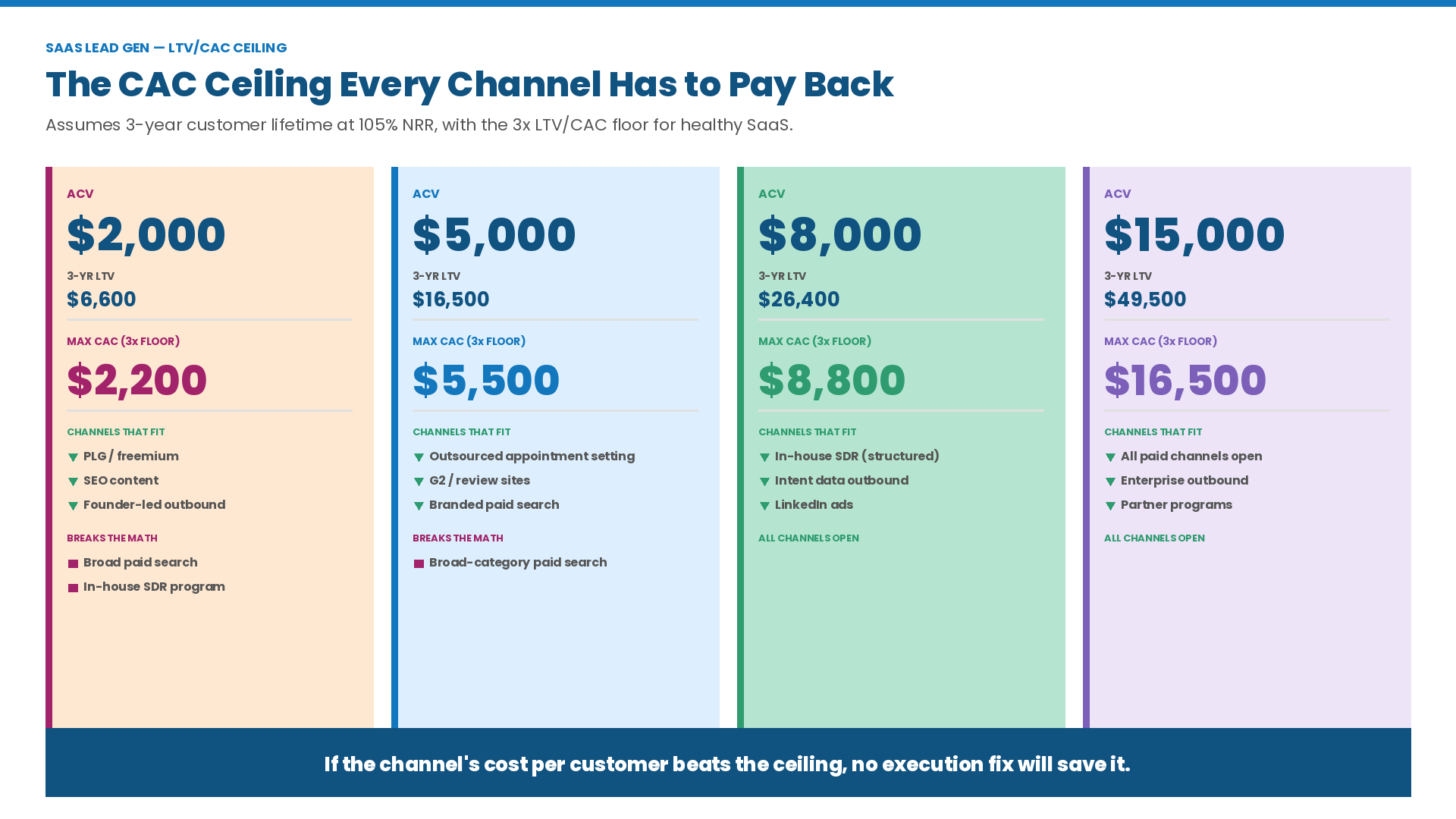
A SaaS company with $8,000 ACV and a three-year customer lifetime has an LTV of about $26,400 at a 105% NRR. At the 3x LTV/CAC floor, the maximum acceptable CAC is $8,800. Any channel that pushes cost-per-customer above $8,800 will not pay back at that ACV. Clean execution cannot fix it. Broad-category paid search in competitive SaaS verticals often blows past $8,800 CAC, even with ACV below $10,000. That is a channel selection problem, not an execution problem.
The SaaS Lead Generation Tech Stack by Stage
The right stack scales with ARR. Over-investing in advanced tools before the motion works wastes budget on capabilities the team cannot use. Under-investing creates manual work that caps output below the pipeline target.
Pre-$1M ARR (minimal viable stack)
LinkedIn Sales Navigator, a basic sales engagement platform, HubSpot free CRM, and Google Analytics. Total: $150-$200 per month.
$1M–$5M ARR (growth stack)
A professional sales engagement platform at $100 to $150 per seat per month, HubSpot Professional or Salesforce Essentials for CRM and pipeline tracking, an A/B testing tool for landing pages, an active G2/Capterra profile with review management, and LinkedIn Insight Tag for retargeting. Total: $1,500 to $3,500 per month for a two-SDR team.
$5M–$10M ARR (scale stack)
An intent data platform at $2,000 to $5,000 per month, enterprise sales engagement at $150 to $200 per seat per month, Salesforce Sales Cloud with revenue-operations configuration, conversation intelligence, and multi-touch attribution. Total: $8,000 to $18,000 per month.
The single most impactful technology investment at any stage
CRM configuration. A well-configured CRM captures lead source, channel attribution, and conversion stage at every touchpoint. That data is the foundation of every channel efficiency decision. A poorly configured CRM produces attribution you cannot trust. Then every channel budget decision is a guess.
Common SaaS Lead Generation Mistakes That Produce High CAC
Mistake 1: Running broad paid search before the funnel converts
Broad keyword paid search below $5M ARR usually pushes CPL too high for sub-$15,000 ACV. The traffic is real. The landing page conversion rate, the trial activation rate, and the trial-to-paid rate are not. Fix the funnel before scaling paid acquisition.
Mistake 2: Content investment without keyword intent targeting
Publishing blog content without targeting keywords with real commercial or informational search volume results in traffic from topics that buyers do not search for. A content program should start with keyword research. Find the queries the ICP runs during evaluation. Target those queries first. Adjacent content comes later.
Mistake 3: Treating all channels as interchangeable
A G2 lead is in late-stage evaluation. A content lead is in the early stages of research. An outbound lead has no prior awareness of the product. Running all three through the same nurture sequence and response cadence drops conversion on all three. Each one needs a different treatment.
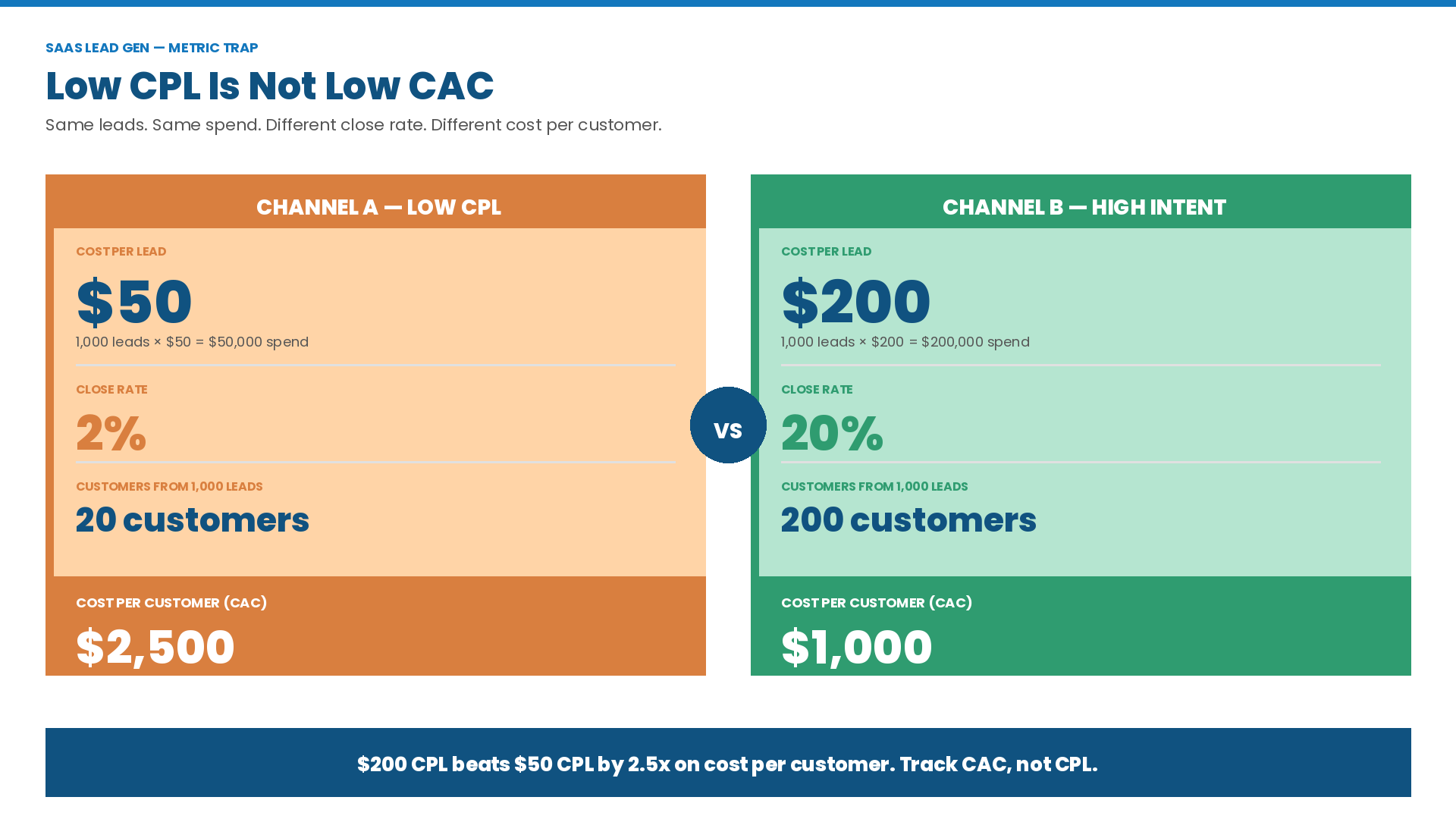
Mistake 4: Measuring CPL instead of CAC
Cost per lead is an activity metric. CAC is the business metric. A channel that produces leads at $50 CPL and closes 2 percent has a $2,500 CAC. A channel that produces leads at a $200 CPL and closes 20% of them has a $1,000 CAC. If you optimize for CPL without tracking close rate, you will keep picking high-volume, low-intent channels over high-intent ones.
When to Outsource SaaS Lead Generation
Outsourcing SaaS lead generation makes sense at three inflection points.
Pre-motion validation
Before you hire a full in-house SDR team, run a 90-day outsourced appointment setting program. Test whether the ICP definition, value proposition, and outbound messaging produce conversations at acceptable rates. If they do, build in-house. If they do not, restructure without severance liability.
Capacity gap
At $1M to $5M ARR, the company often needs more qualified pipeline than the current team can produce. The ARR is not yet high enough to justify adding full-time SDRs. A managed outbound program adds capacity without permanent headcount.
New market entry
When the company expands into a new vertical or geography, the ICP behavior, competitive landscape, and qualification criteria all shift; an outsourced program in the new market validates the motion. Then the company invests in dedicated in-house headcount for the new segment.
The hybrid model is the most common configuration between $2M and $8M ARR: one in-house sales development manager owns methodology, one outsourced program runs volume. This is operator work. Running the dialing floor, the QA, and the multi-touch sequences across phone, SMS, and email is not a strategy deck. The leads you already paid for need to be worked.