If your closers spend a big chunk of the day prospecting, you have a simple problem: the front end of your sales process is understaffed.
On busy days, closers talk to real prospects and move deals forward. On slow days, they dial numbers, leave voicemails, and follow up with people who never answer. That swing is more expensive than it looks because you are paying closer-level wages for work that a lower-cost role can often handle.
That is what an appointment setter is for. A setter sits at the top of the funnel and does the work that gets conversations started: making first contact, quickly qualifying, and booking the next step. When the setter role is working, closers spend more time in real sales conversations and less time “working a list.”
This guide breaks down:
- What an appointment setter actually does day to day
- What the role really costs (not just salary)
- The decision framework for when to hire in-house vs outsource
If you are already leaning toward outsourcing, start with:


What an Appointment Setter Actually Does
An appointment setter reaches out to leads by phone, SMS, email, or all three. Their job is to qualify the lead and advance it to the next step.
That next step is usually one of these:
- a meeting on a closer’s calendar
- a live transfer to a closer
The goal is not to close the deal. The goal is to consistently get qualified conversations in front of your closers without burning up closer time on early-stage outreach.
Where the role sits in the funnel
Most sales floors blend three different jobs into one seat: prospecting, qualification, and closing. The appointment setter role is the “seam” that lets you separate those jobs.
A setter is responsible for the first part of the process:
- reaching the lead while the intent is still warm
- asking the minimum questions needed to confirm fit
- getting a real commitment for the next step (time on the calendar or transfer)
Then the closer takes the next stage: discovery, objection handling, and closing.
What the day-to-day work looks like
In most outbound programs, the work is repeatable. A setter follows the same process each day and improves performance over time through better scripts, lists, and follow-up.
A setter will:
- work the next lead in the list
- follow a clear follow-up plan (calls, voicemail, SMS, and email)
- If speed is the issue, read: Speed-to-lead
- Ask key questions that help decide if the lead is a fit
- confirm the “next step” outcome (appointment, callback, or transfer)
- Book the next step and send basic reminders when needed
- Log every attempt and result in the CRM
- If your notes and reporting are messy, read: Disposition taxonomy
- Honor do-not-call requests and follow basic compliance rules
- For outbound compliance basics, read: TCPA compliance
If you want to see how this fits into a full managed setup, start with: BPO services
What “qualifying” usually means (in plain English)
Qualification is not a long interview. In many verticals, it is 60 to 180 seconds of confirming basics like:
- What the prospect is trying to solve
- whether they match your key thresholds (budget, size, timeline, location, or a hard requirement)
- whether they are willing to take the next conversation
A great setter does this without sounding like a form. They keep it short, clear, and respectful.
What appointment setters do not do?
Most appointment setters do not close deals or negotiate prices. They also typically do not handle deeper objections.
Suppose a prospect is arguing about pricing, shopping competitors, or asking for a custom package; that is the closer’s lane. Once the lead is qualified and agrees to the next step, the closer takes over.
Appointment Setter vs SDR vs BDR: A Simple Way to Tell
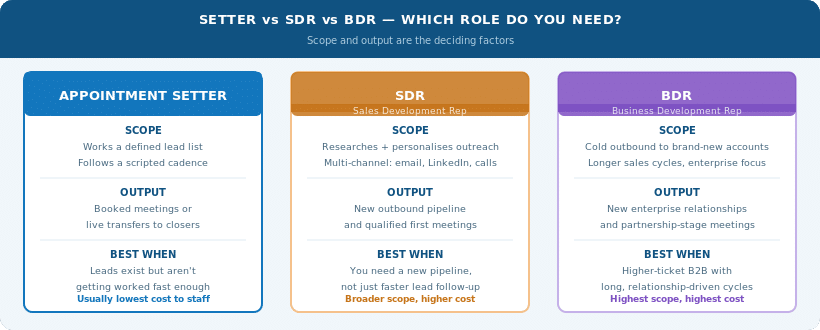
These job titles can be confusing. The cleanest way to compare them is by scope (how much they own) and by output (what they deliver).
Appointment Setter
A setter works a defined lead list and books meetings (or live transfers). This is the right role when you already have leads, but your team isn’t working them fast enough, or the leads are getting stale.
SDR (Sales Development Rep)
An SDR usually goes broader. They research prospects, personalize outreach, and use multiple channels, including email, LinkedIn, and calls. This is common when you need a new outbound pipeline, not just faster lead follow-up.
BDR (Business Development Rep)
A BDR is often focused on cold outbound to brand-new accounts, which often have longer sales cycles. This role is common in higher-ticket B2B and enterprise environments.
Why the distinction matters for hiring and cost
When teams call everything “SDR,” they often end up overpaying for the problem they are trying to solve. If your need is simple appointment coverage and a faster workup, an appointment setter role is usually the right starting point and is typically cheaper to staff and manage.
What an In-House Appointment Setter Costs: The Fully Loaded Number
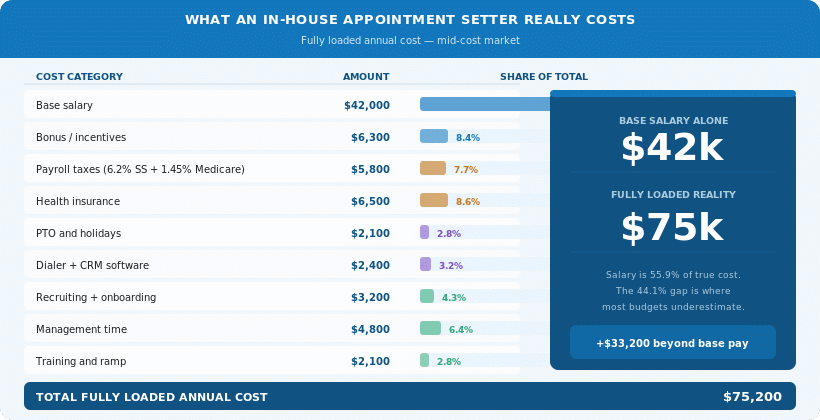
A $42,000 salary is not the full cost. The real cost also includes payroll taxes, benefits, software, management time, and hiring and training.
Payroll taxes matter. In 2026, the IRS employer guidance lists the employer Social Security tax rate as 6.2% and the employer Medicare tax rate as 1.45%.
Benefits matter too. BLS reporting for 2025 shows that employer costs include both wages and benefits.
If you want the full line-by-line math, see: Loaded cost comparison
Example fully loaded annual cost (mid-cost market):
The productivity reality (why “hourly cost” is misleading)
Even great setters are not on live calls for all 8 hours. Admin work, CRM updates, internal huddles, and follow-up reduce talk time. That means your effective cost per productive outbound hour is higher than it looks on paper.
This is also why hiring “one setter” without a process often fails. The role needs:
- a defined lead flow
- a cadence
- basic QA and coaching
- clean tracking
Without those, the setter is busy, but the calendar stays light.
Appointment Setter Models: In-House, Freelance, and Outsourced
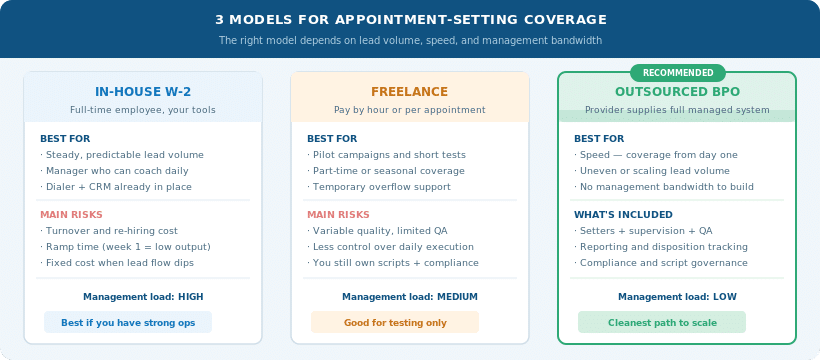
There are three common ways to get appointment-setting coverage. The best model depends on lead volume, how fast you need coverage, and how much management bandwidth you want to spend running the function.
Model 1: In-house W-2
You hire a full-time employee who uses your tools and works only your leads. This can work well when you have steady lead flow and a manager who can coach and track daily activity.
Best for:
- stable lead volume (enough work to keep the seat busy)
- a clear qualifying script and offer
- a team that already has dialer + CRM workflows in place
Main risks:
- turnover and re-hiring
- Ramp time (you will not get full output in week one)
- fixed cost even when lead flow dips
Model 2: Freelance
You pay an independent setter by the hour or per appointment. This can be a good fit for short tests, seasonal pushes, or one-off campaigns.
Best for:
- pilot campaigns
- businesses that only need part-time coverage
- temporary overflow support
Main risks:
- variable quality and limited QA
- Less control over daily execution
- You still own compliance, scripts, and tracking
Model 3: Outsourced BPO
A provider supplies the setters, supervision, QA, reporting, and the operating system around the role. This is often the best fit when you need speed, do not want to build a dialing team in-house, or prefer a managed system instead of “one hire.”
To compare partner types, read: BPO operator vs agency vs consultant
A simple decision rule
If you have plenty of leads and strong in-house management, hiring can make sense. If you need coverage fast, your lead volume is uneven, or you do not want to build the full operating system, outsourcing is usually the cleaner path.
What to Look for When Hiring an In-House Appointment Setter
Good candidates are usually simple to spot. The job is phone-heavy, so communication and consistency matter.
Look for someone who:
- speaks clearly and keeps energy on calls
- stays calm when people push back
- logs work cleanly in the CRM
- can follow a script without sounding robotic
Interview questions that reveal real skill
Here are a few quick ways to test for the traits that matter:
- Ask them to do a 60-second roleplay opener.
- Give them one common objection and see if they stay calm.
- Ask them how they would document the outcome of a call in the CRM.
- Ask what they do when a lead does not answer after three attempts.
If they can do those things well, they will usually do fine in the seat.
Appointment Setter Performance Benchmarks: What “Good” Looks Like
Benchmarks change by lead type and industry, but you still need a starting point. The point of benchmarks is not to “blame the setter.” It is to show where the system is breaking: list quality, contact rate, script, qualification, or commitment close.
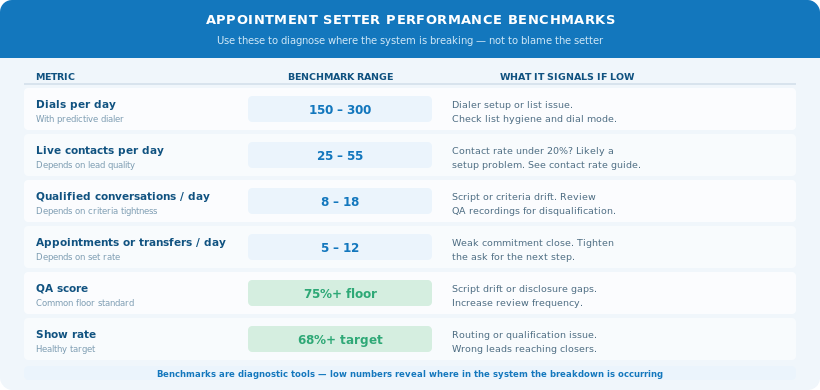
| Metric | Benchmark Range | Notes |
| Dials per day | 150 to 300 | Higher with a predictive dialer |
| Live contacts per day | 25 to 55 | Depends on lead quality |
| Qualified conversations per day | 8 to 18 | Depends on the criteria |
| Appointments or transfers per day | 5 to 12 | Depends on set rate |
Quality matters too. Many teams track QA and the show rate.
- QA score: 75%+ is a common floor
- Show rate: 68%+ is a healthy target
- If this is weak, read: Transfer-set rate vs show rate.
If your contact rate is under 20%, it is often a setup problem. Use this guide: Contact rate optimization
Appointment Setting Scripts: What Works (and Why)
A script should guide the call. It should not sound like a speech.
A strong script usually has four parts:
- a clear opener (who you are and why you are calling)
- a short set of fit questions (the minimum you need to qualify)
- simple answers to common pushback (not long speeches)
- a clear ask for the next step (calendar time or transfer)
The most common script mistake
The mistake is trying to “sell” too early. A setter does not need to win the whole deal. A setter needs to win a small commitment: “Yes, that is worth a short conversation.”
If your setter is getting hung up on, tighten the opener. If they are getting vague “with maybe later,” tighten the commitment.