Hiring an SEO expert in 2026 has become the fastest way to burn $50,000 without moving the needle.
This high-stakes gamble leaves many operators paying for “work” that yields zero real growth. You lose an entire year watching qualified leads stagnate while receiving hollow reports on backlinks and technical tickets. The real danger is the realization, twelve months in, that you never had a way to measure if the vendor was prioritizing the right tasks, leaving you with a $50,000 mistake and zero progress to show for it.
The only way to break this cycle is to stop buying on pitches and start buying on a proven methodology. This article provides the definitive buyer framework to help you evaluate, vet, and contract with SEO experts, ensuring you hire for capacity and outcomes rather than theater.

Quick Answer: How To Hire An SEO Expert In 2026
Here is the buyer framework in the most direct form:
- Pick the hiring model before you pick a provider. Consultant, boutique agency, full-service agency, or in-house. The wrong model fails even with a competent provider.
- Run a five-part vetting process. Technical, content, links, reporting, and references. Do not skip any part.
- Demand proof of work, not promises. Ask for real artifacts, anonymized Search Console outcomes, sample reports, and decision rationale.
- Buy methodology and capacity. Deliverable lists do not matter if the provider cannot explain prioritization and measure outcomes.
- Use buyer-protective contract terms. Performance checkpoints, scope floors, clear reporting requirements, termination rights, and asset ownership.
If you do those five things, you will eliminate most low-quality SEO providers in four to eight hours. You can do it before you spend a dollar on a long retainer.
The Four SEO Hiring Models and When Each One Fits
Most SEO buyer mistakes start with choosing the wrong model for the operation’s actual needs. The four models deliver different outcomes at different price points. If your growth depends on location-based demand, treat that as a first-order requirement. It changes the SEO system you need. If you operate in multiple markets, the same rule applies. That is why it helps to understand Local SEO Services before you choose a hiring model.
Similarly, if you operate in multiple markets, you should understand SEO for Multiple Locations before selecting a model.
Model 1: Individual SEO Expert or SEO Consultant
This is a single experienced practitioner working as a consultant or solo operator. The consultant typically provides strategy, audits, prioritization, and guidance. Execution is handled either by your internal team or by contractors the consultant coordinates.
What you usually get
- Technical audit and prioritization
- Content strategy and topic roadmap
- On-page quality standards and editorial guidance
- Measurement plan, dashboards, and reporting structure
Fits best when
- You already have writing capacity and a developer
- You need senior direction, not a production factory
- You want a second brain for prioritization, not a vendor to “do everything”
Does not fit when
- You have no internal execution capacity
- Your site needs significant technical and content work simultaneously
- You want volume output, not just direction
Model 2: Boutique SEO Agency (3 to 15 People)
A smaller agency that blends strategy and execution, often with senior practitioners directly involved. Many strong boutique agencies specialize, either by discipline (technical SEO, content SEO, link acquisition) or by industry.
What you usually get
- A real strategy plus ongoing execution
- Moderate content production volume
- Link acquisition with a defined quality bar
- Faster iteration because decision-makers are close to the work
Fits best when
- You need multi-disciplinary execution, but still want senior attention
- You have a mid-market budget and want accountability
- Your website is large enough to need real systems, not “SEO packages”
Does not fit when
- You need high throughput (for example, ten plus articles per month, plus aggressive link work)
- You have enterprise complexity across multiple web properties
Model 3: Full-Service SEO Agency (15+ People)
A larger agency offering technical SEO, content production, link acquisition, and analytics infrastructure under one engagement. These agencies can run multiple workstreams at once.
What you usually get
- Multi-disciplinary teams working in parallel
- Higher content production throughput
- Dedicated account management and process
- Systems for QA, reporting, and sprint planning
Fits best when
- Your operation is scaling aggressively and needs execution at volume
- Your vertical is competitive, and you need sustained capacity
- You want one vendor relationship for the SEO stack
Does not fit when
- You need senior practitioner attention on every decision, and the agency is highly layered
- Your budget is below the structural minimum for the scope you expect
Model 4: In-House SEO Team Build
You hire SEO talent directly, then build internal production capacity and cross-functional systems. In-house can be the highest control option, but it requires sustained investment and management maturity.
What you usually get
- Tight alignment to business priorities
- Faster cross-functional execution if your company already ships well
- Institutional memory and compounding improvement
Fits best when
- Organic search is a core growth engine
- You can fund the team for twelve to twenty-four months
- You have the internal discipline to manage performance and output
Does not fit when
- The budget is unstable
- You cannot coordinate dev, content, and analytics work internally
Model Selection Filter (Use This Before You Talk To Anyone)
- If you have no developer support and no content production, a strategy-only consultant is usually the wrong first hire. You need execution.
- If you need technical improvements plus consistent content output, boutique agencies often produce the best ROI for mid-market operators.
- If you need heavy content volume plus sustained link acquisition, you are likely in full-service or hybrid territory.
- If organic is a top-two revenue channel, in-house or hybrid often wins out in the long term.
The Six SEO Buyer Mistakes That Produce $50,000 Losses
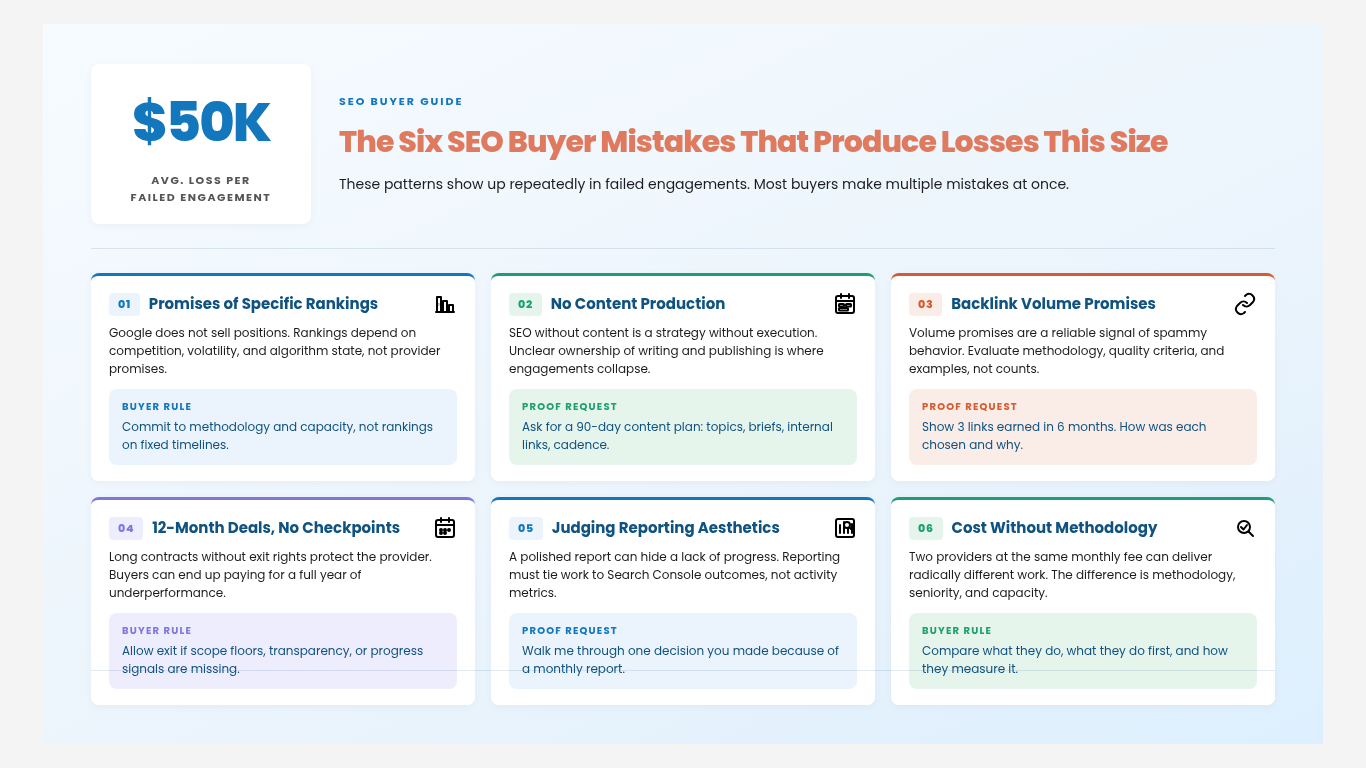
These mistakes recur in failed engagements. Most buyers make multiple mistakes at once.
Mistake 1: Hiring on Promises of Specific Rankings
If a provider promises “page one rankings in ninety days,” they are selling certainty that does not exist. Rankings depend on competition, search volatility, algorithm updates, and your website’s current state. Google’s SEO Starter Guide is clear on the point. SEO helps search engines understand your content, and it helps users decide whether to visit. It is not a product that sells a guaranteed position.
Buyer rule: a credible provider commits to methodology and capacity. They do not guarantee specific rankings on fixed timelines.
Mistake 2: Buying SEO Without Content Production Capability
SEO without content production is a strategy without execution. If your provider is not producing content, you need a clear plan for who writes, edits, publishes, and refreshes. “We will handle SEO, you handle content” is often where engagements fail. If you need a done-for-you content engine (briefs, writers, editorial QA, and publish-ready drafts), start with SEO Content Writing Services.
Proof request: ask for a ninety-day content plan with topics, briefs, internal links, and publishing cadence. If they cannot deliver a coherent plan, you are buying ideas, not systems.
Mistake 3: Hiring Based on Backlink Volume Promises
Backlinks still matter, but volume promises are a reliable signal of spammy behavior. The buyer should evaluate link acquisition methodology, quality criteria, and examples, not counts.
Proof request: “Show me three links you acquired for clients in the last six months. Explain how each was earned, why it was chosen, and what quality standards you enforce.”
Mistake 4: Signing Twelve-Month Contracts Without Performance Checkpoints
Twelve-month contracts protect the provider. They do not protect the buyer. If there are no checkpoints and no termination rights tied to delivery and transparency, you can end up paying for a year of underperformance.
Buyer rule: the contract must allow you to exit if scope floors are not met, reporting is not transparent, or progress signals are missing at defined checkpoints.
Mistake 5: Evaluating Providers on Reporting Aesthetics
SEO reporting often substitutes activity metrics for outcomes. A slick report can hide a lack of progress. Use outcomes and decision-making as the standard.
Search Console exists specifically to measure search traffic and performance and help site owners identify issues. If reporting does not tie work to Search Console outcomes, you are not measuring the right system. See Google Search Console.
Proof request: “Show me an anonymized monthly report and walk me through one decision you made because of it.”
Mistake 6: Evaluating Cost Without Evaluating Methodology
Two providers can charge the same monthly fee and deliver radically different work. The difference is methodology, seniority, and capacity.
Buyer rule: compare providers by (1) what they do, (2) how they decide what to do first, and (3) how they measure whether it worked.
The Vetting Framework: Questions That Separate Real SEO Providers From Marketing Firms
Most providers can produce a credible pitch. The vetting framework separates real SEO capability from marketing capability that happens to sell SEO. If you are comparing delivery accountability across models, this can help frame the discussion: BPO Operator vs Agency vs Consultant.
The Buyer Scorecard (Information Gain)
Use this simple scorecard during evaluation. Rate each area from zero to five:
- Technical capability
- Content production methodology
- Link acquisition methodology
- Reporting transparency and measurement
- Contract safety and buyer protections
Interpretation
- 22 to 25: strong. This provider likely has real systems in place and can explain their decisions.
- 16 to 21: mixed. Requires careful scoping and stronger contract protections.
- 15 or below: high risk. Most buyers who get burned end up here.
Question Set 1: Technical SEO Capability
Ask: “Walk me through how you diagnose and prioritize technical SEO issues on a five-hundred-page site with declining organic traffic.”
Strong answers include:
- How they evaluate crawlability and indexation
- How do they diagnose rendering issues
- How they use performance metrics like Core Web Vitals as part of prioritization
- How they evaluate internal linking and information architecture
- How they translate findings into an implementation plan
Weak answers sound like:
- tool names without decisions
- generic checklists without prioritization
- “We handle technical SEO” with no detail
If you want to double-check what “technical SEO” scope looks like in practice, review Technical SEO Services.
Question Set 2: Content Production Methodology
Ask: “Show me three pieces of content you produced in the last six months. Explain how each was researched, how the topic was selected, and what it produced in traffic and conversions.”
Strong answers include:
- intent analysis and SERP review, not just keyword volume
- a clear briefing process
- editorial QA and revision standards
- How do they refresh content based on performance data
Weak answers include:
- “We publish X posts per month” with no quality system
- content examples without outcomes
- AI-scaled content with minimal human review
If your business is product-led or transaction-led, add ecommerce proof requirements, not just blog proof. This is where Ecommerce SEO Services changes what “good” looks like.
If your bottleneck is not rankings but conversion path leakage, coordination with Content Marketing Services matters.
Most buyers also skip the hard part, verifying who actually writes and who actually edits, so it helps to review how SEO Content Writing Services is structured before you sign a scope.
Question Set 3: Link Acquisition Methodology
Ask: “Describe your link acquisition process. What percentage of links are editorial placements? Show me three links you acquired.”
Strong answers include:
- clear quality criteria (relevance, editorial standards, real sites)
- Examples of earned links
- An explanation of how links work aligns with content and business goals
Weak answers include:
- volume promises
- Refusal to share examples
- vague statements like “we have partners”
For a clear benchmark on what legitimate delivery includes, review Link Building Services.
Question Set 4: Reporting Transparency
Ask: “Show me a sample monthly report you send to clients. Walk me through how you measure progress at the three, six, and twelve-month marks.”
Strong reports include:
- Search Console performance changes tied to specific pages and intent clusters
- commercially relevant keyword movement
- lead attribution or conversion proxy metrics
- a separation of activity from outcomes
Weak reports focus on:
- number of tasks completed
- number of links built
- keyword counts with no business relevance
Question Set 5: Client References and Sustained Performance Data
Ask: “Provide three references from engagements that lasted at least twelve months.”
This is a high-leverage step. Most weak providers cannot provide long-term references that confirm transparency and sustained quality of work.
Section close: Running all five sets quickly eliminates most providers. It is the fastest path to avoiding the $50,000 mistake.
SEO Pricing Reality in 2026: What Different Investment Levels Actually Produce
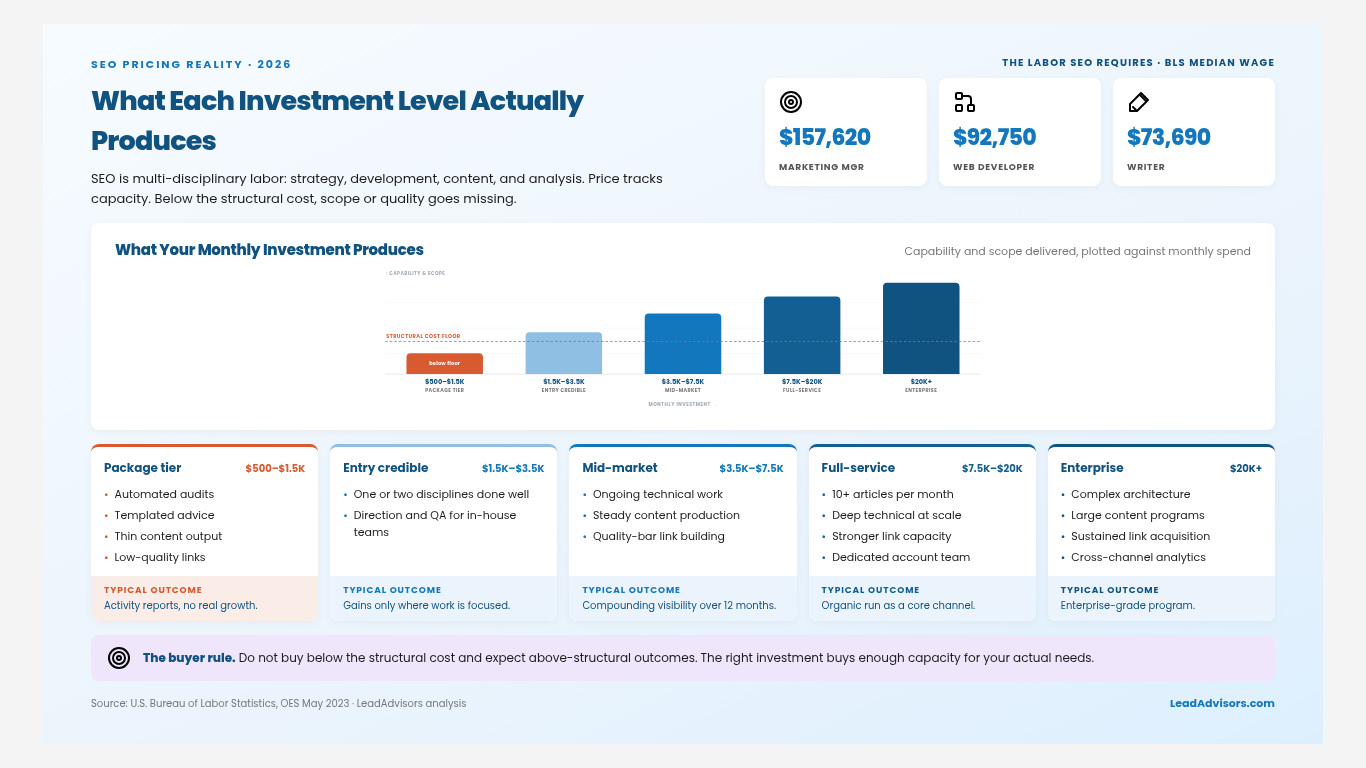
SEO pricing follows a structural relationship between investment level and capability delivered below the structural cost, scope, quality, or both. If your internal conversation is really “build pipeline without increasing ad spend,” this is a related buyer lens: Lead Generation Outsourcing.
Structural Cost, Explained (With Government Data)
You do not need to build your SEO team in-house to understand structural cost. You just need to understand that SEO delivery requires real labor across strategy, development, coordination, content, and analysis.
U.S. government labor benchmarks show that marketing leadership, web development, and professional writing are not low-cost labor markets. For example:
- Marketing managers have a six-figure median annual wage, according to the BLS overview of Advertising, Promotions, and Marketing Managers.
- Web developers and digital designers also have high median wages, according to BLS data.
- Writers and authors also have a meaningful median wage, based on BLS data.
This is not a claim that all SEO must be built in the U.S. It is a claim that competent labor has a real cost. When someone sells “full SEO” for a price that cannot buy the hours, they replace real work with automation, templates, and low-quality link packages.
$500 to $1,500 Monthly
This is the “SEO package” tier. At this level, the math rarely supports competent multi-disciplinary work.
What buyers usually receive:
- automated audits
- templated recommendations
- thin content output
- low-quality link volume
- minimal account management
Outcome typical: activity reports without meaningful organic growth.
$1,500 to $3,500 Monthly
This is often the lower bound for credible SEO output, depending on scope.
Best fit:
- one or two disciplines done well (technical plus on-page, or content plus light technical)
- Companies with internal dev or content capacity who need direction and QA
Outcome typical: measurable improvements in the addressed discipline, with limits elsewhere.
$3,500 to $7,500 Monthly
This is the mid-market tier where you can often sustain multi-disciplinary work:
- Ongoing technical improvements
- consistent content production at moderate volume
- link acquisition with a real quality bar
For a concrete example of how scope and deliverables are packaged at this tier, see Monthly SEO Packages.
Outcome typical: meaningful improvements in organic visibility and commercially relevant traffic when executed well, with compounding results over twelve months.
$7,500 to $20,000 Monthly
This is full-service SEO at scale:
- higher content volume (often ten plus articles per month)
- deeper technical work for larger sites
- stronger link acquisition capacity
- dedicated account management and process
Best fit: competitive verticals and high-growth operations that treat organic as a core channel.
$20,000+ Monthly
Enterprise SEO. This tier typically includes:
- complex technical architecture
- large content production programs
- sustained high-quality link acquisition
- advanced analytics and cross-channel integration
Section close: The right investment is the one that buys enough capacity for your actual needs. Do not buy below the structural cost and expect above-structural outcomes.
Contract Structure: The Terms That Protect SEO Buyers
Most SEO contracts protect the provider. Buyer-protective contracts prevent the most common failure modes.
Element 1: Performance Benchmarks With Termination Rights
Define checkpoints at three, six, and twelve months. The goal is not to guarantee outcomes. The goal is to require transparency and clear progress signals, and to preserve your right to exit if delivery is not real.
Examples of checkpoint standards:
- scope completion (content delivered, technical fixes executed, link work performed to quality bar)
- reporting transparency (Search Console, outcomes, decisions)
- early progress signals (indexation improvements, content performance lift, ranking movement on relevant terms)
Element 2: Monthly Termination Rights or Short Initial Commitment
Prefer:
- month-to-month with a thirty-day notice, or
- a six-month initial term with explicit renewal
Avoid auto-renewal traps and long notice periods.
Element 3: Documented Scope With Activity Floors
Vague scope language is where quality disappears. Your contract should specify:
- content cadence and quality standards
- technical audit cadence and implementation workflow
- link acquisition methodology and quality standards
- Who does what, and what tools and reporting are included
Element 4: Reporting and Communication Requirements
Define:
- reporting cadence (monthly minimum)
- KPI set (what matters at three, six, and twelve months)
- monthly review call structure
- escalation path when issues arise
Element 5: IP and Asset Ownership
All content, technical work, and assets produced during the engagement should remain yours. You should be able to keep and reuse work if the relationship ends.