
Ringless voicemail drops are one of the most underused channels in outbound sales. According to the 2026 Consumer Texting Behavior Report by EZ Texting, 87% of consumers check a new text within 15 minutes. Voicemail alerts trigger the same urgency. That makes them one of the highest-engagement alert types on mobile. Yet on most floors, RVM scripts are treated as an afterthought.
The numbers tell the story. Generic RVM drops on financial services campaigns get 3% to 8% callback rates. Floors that use optimized scripts with neural voice tools like ElevenLabs hit 12% to 18% on the same leads. The tech is the same. The difference is the script, the voice, the timing, and whether the drop is part of a structured multi-touch sequence or sent once and forgotten.
Most floors treat voicemail drops like a checkbox. Something is sent to the team so they can mark the lead as touched. The prospect hears a flat, generic message. It opens with “Hi, this is a message for [NAME].” It gets deleted before the second line.
This guide covers what separates a drop that gets deleted from one that gets a callback. Script structure, voice standards, cadence timing, TCPA compliance, and vertical-specific language are all broken down below.

What Is a Ringless Voicemail Drop?
A ringless voicemail drop, also called an RVM drop, sends a recorded message straight to a prospect’s voicemail. The phone never rings. A notification appears. The prospect finds a message waiting, as if a call was missed. But no call ever connected.
According to 2025 SellCell voicemail data, 97% of business calls go to voicemail. 2026 ConsumerAffairs research shows Americans check their phones 205 times per day. Most respond to alerts within minutes. That pattern makes RVM drop a high-value touch – when the script is done right.
RVM drops serve three roles in an outbound cadence:
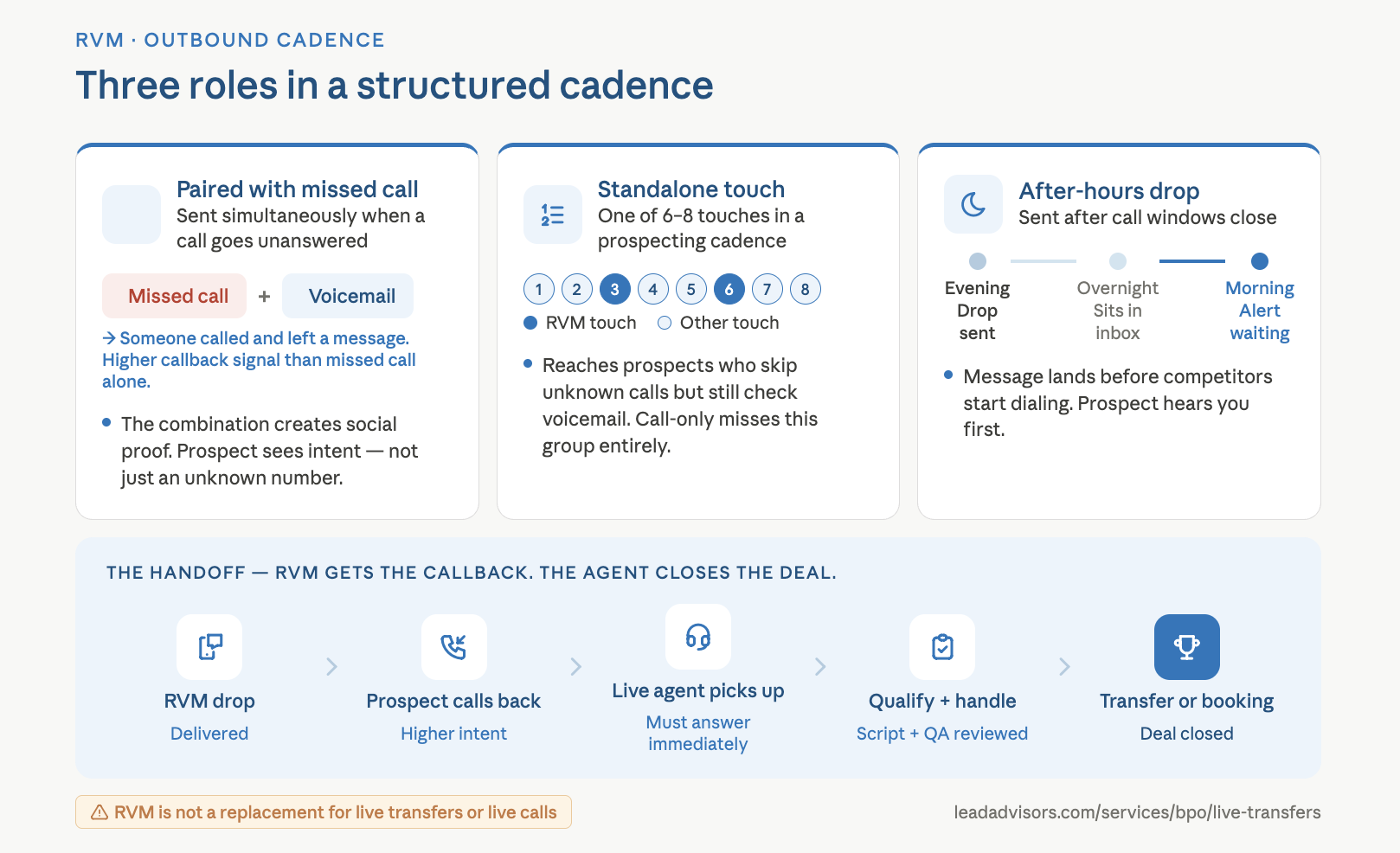
- Paired with a missed call. When an outbound call goes unanswered, an RVM drop is sent simultaneously. The prospect sees a missed call and a voicemail. That combo – someone called and left a message – gets more callbacks than a missed call alone.
- Standalone touch. As one of 6 to 8 touches in a structured outbound prospecting cadence, a standalone RVM reaches people who skip unknown calls but still check voicemail. Call-only outreach misses this group entirely.
- After-hours drop. When sent after call windows close, the prospect wakes up to a voicemail alert. The message lands before competitors start dialing in the morning.
RVM drops are not a replacement for live transfers or live calls. A prospect who calls back still needs a live agent to pick up, qualify them, and handle the conversation. The RVM gets the callback. The agent closes the deal.
Why Most RVM Scripts Fail – The Four Structural Problems
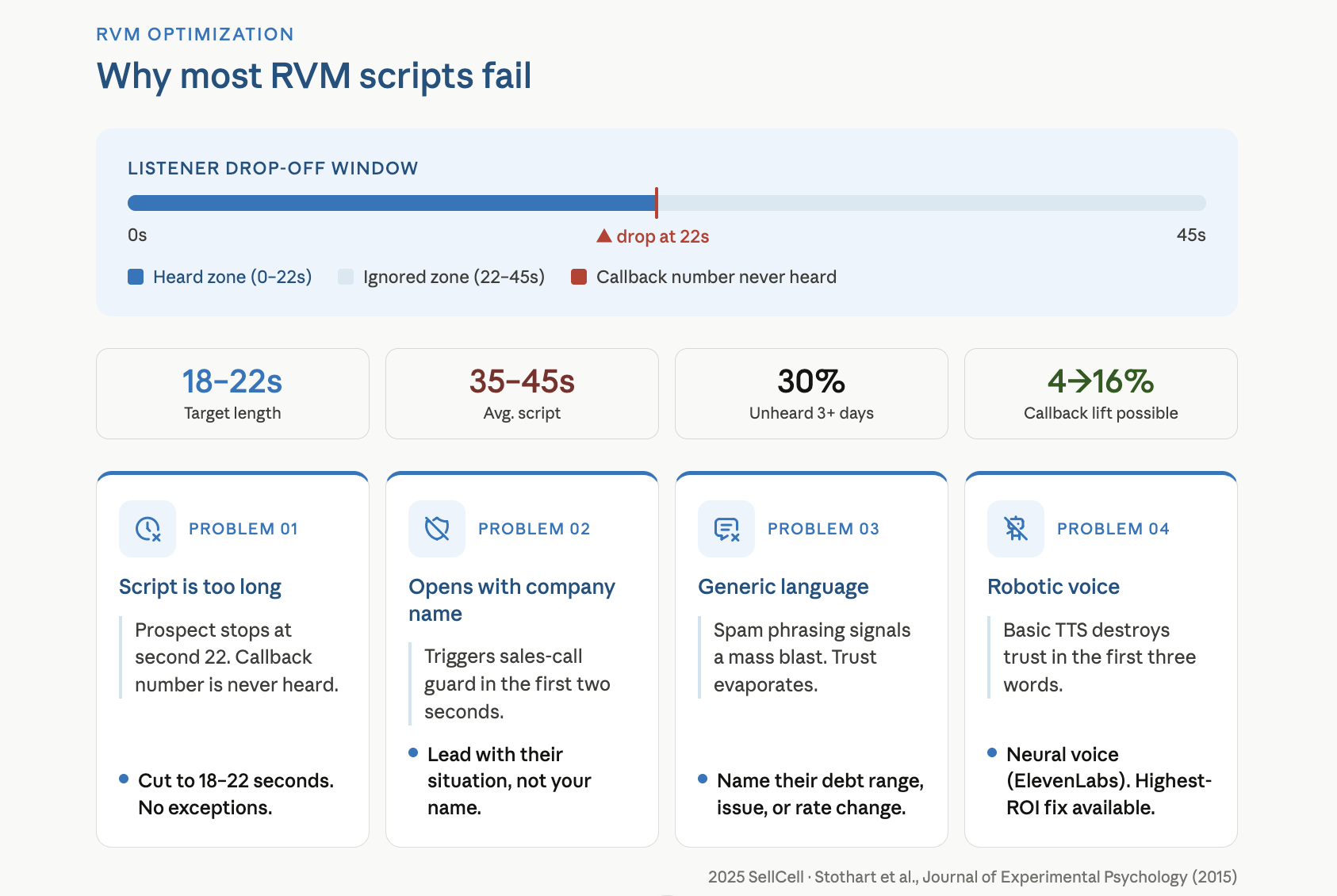
The gap between a 4% and 16% callback rate on the same leads comes down to two things: script quality and voice production. Tech, timing, and list quality are secondary. Four problems are seen again and again.
Problem 1 – The Script Is Too Long
According to 2025 SellCell voicemail data, 30% of voicemails go unheard for up to 3 days. Most are listened to for 20 to 25 seconds before being deleted. But most RVM scripts run 35 to 45 seconds. Too much gets packed in – the context, the offer, the company name, a number, and a reason to call back.
The prospect stops at second 22. The callback number is never heard.
The fix: Keep scripts to 18-22 seconds. If it can’t be said in 22 seconds, it’s too much.
Problem 2 – It Opens with the Company Name
“Hi, this is Jason from XYZ Debt Relief.” That line tells the prospect this is a sales call they didn’t ask for. The guard goes up right away.
The fix: Start with the prospect’s situation. Say why the call matters to them before you name the company.
Problem 3 – The Language Is Generic
“I’m calling about an important financial matter.” That is spam language. It could apply to anyone. It tells the prospect that this message was blasted to thousands of people.
The fix: Name the specific thing that makes this prospect a fit. The debt range. The tax issue. The rate change. Make the message feel personal, not broadcast.
Problem 4 – The Voice Sounds Robotic
A synthetic voice from a basic text-to-speech tool kills trust fast. The first three words set the tone. A robotic voice tells the prospect no human placed this call.
Research in the Journal of Experimental Psychology (Stothart, Mitchum, & Yehnert, 2015) found that even short phone alerts break focus. In voicemail playback, that window is even smaller. Trust is formed in the first few seconds. A cheap synthetic voice triggers doubt – and the message gets deleted.
The fix: Use neural voice tools. Platforms like ElevenLabs now produce voices that sound like real people. This is the single highest-ROI change most floors can make to their RVM program.
The Anatomy of a High-Callback RVM Script
A strong RVM script has five parts in a set order. Each part has a clear job. Remove or rearrange any part, and callback rates drop.
Component 1 – The Pattern Interrupt (Seconds 0-3)
The first three seconds decide if the prospect keeps listening or deletes. Do not open with “Hi.” It is the most common spam opener. It signals a sales call right away.
Use a line that sparks curiosity about the prospect’s own situation instead.
Example: “Your debt balance may qualify for a reduction program most people don’t know about.”
This creates instant relevance. It hints at specific knowledge. It builds enough curiosity to hold attention for the next line.
Component 2 – The Credibility Signal (Seconds 3-8)
Next, the caller is briefly named. No full pitch is needed. One line that frames the caller as a specialist tied to the prospect’s situation is enough.
Example: “This is Sarah with the enrollment team at [Company Name] – we work with people carrying over $10,000 in unsecured debt.”
The company is named without leading with it. A role is set. A qualifying condition filters the prospect in a single line.
Component 3 – The Specific Offer (Seconds 8-15)
State what the prospect gets by calling back. Not what the company does – what the prospect walks away with. Be specific.
Example: “Based on your balance range, there may be options to cut what you owe by a large amount – without hurting your credit score the way you might think.”
This builds curiosity (how much could be cut?). A common fear is addressed (credit score). And it feels like the caller knows something specific about this person.
Component 4 – The Callback Instruction (Seconds 15-19)
Give the number clearly. Repeat it once. Don’t say “you can reach me at.” Say “call me back directly at.” The word “directly” makes it feel personal.
Example: “Call me back directly at [number] – [number]. I’ll be available until 6 pm today.”
A time limit is added. This creates urgency without pressure.
Component 5 – The Close (Seconds 19-22)
One line that restates the value of calling back. Keep it simple.
Example: “Even if it’s not the right fit, the call takes three minutes, and I’ll tell you exactly where you stand.”
The barrier is lowered (“just three minutes”). The call is framed as helpful, not salesy. Value is promised even if the prospect says no.
Full Assembled Script – 21 Seconds
“Your debt balance may qualify for a reduction program most people don’t know about. This is Sarah with the enrollment team at [Company]. We work with people carrying over $10,000 in unsecured debt. Based on your balance range, there may be options to cut what you owe without hurting your credit the way you’d think. Call me back directly at [number] – [number] – I’ll be available until 6 pm today. Even if it’s not the right fit, it takes three minutes, and I’ll tell you where you stand.”
Read at a normal pace: 20 to 22 seconds.
Voice Production – Why ElevenLabs Changed the RVM Game
The script decides what gets said. The voice decides if the prospect believes a real person said it.
Until recently, three options existed for RVM voice work:
- Record a human agent – quality varies, takes time, changes by agent
- Use basic text-to-speech – fast and cheap, but robotic and trust-killing
- Hire a voice actor – high quality, but costly and slow to scale
Neural voice tools like ElevenLabs changed this. Voice audio is now built from typed text. On mobile, voicemail playback sounds like a real person. Script versions for different verticals, offers, or cadence stages can be made and tested in minutes – not hours.
ElevenLabs Settings That Matter for RVM
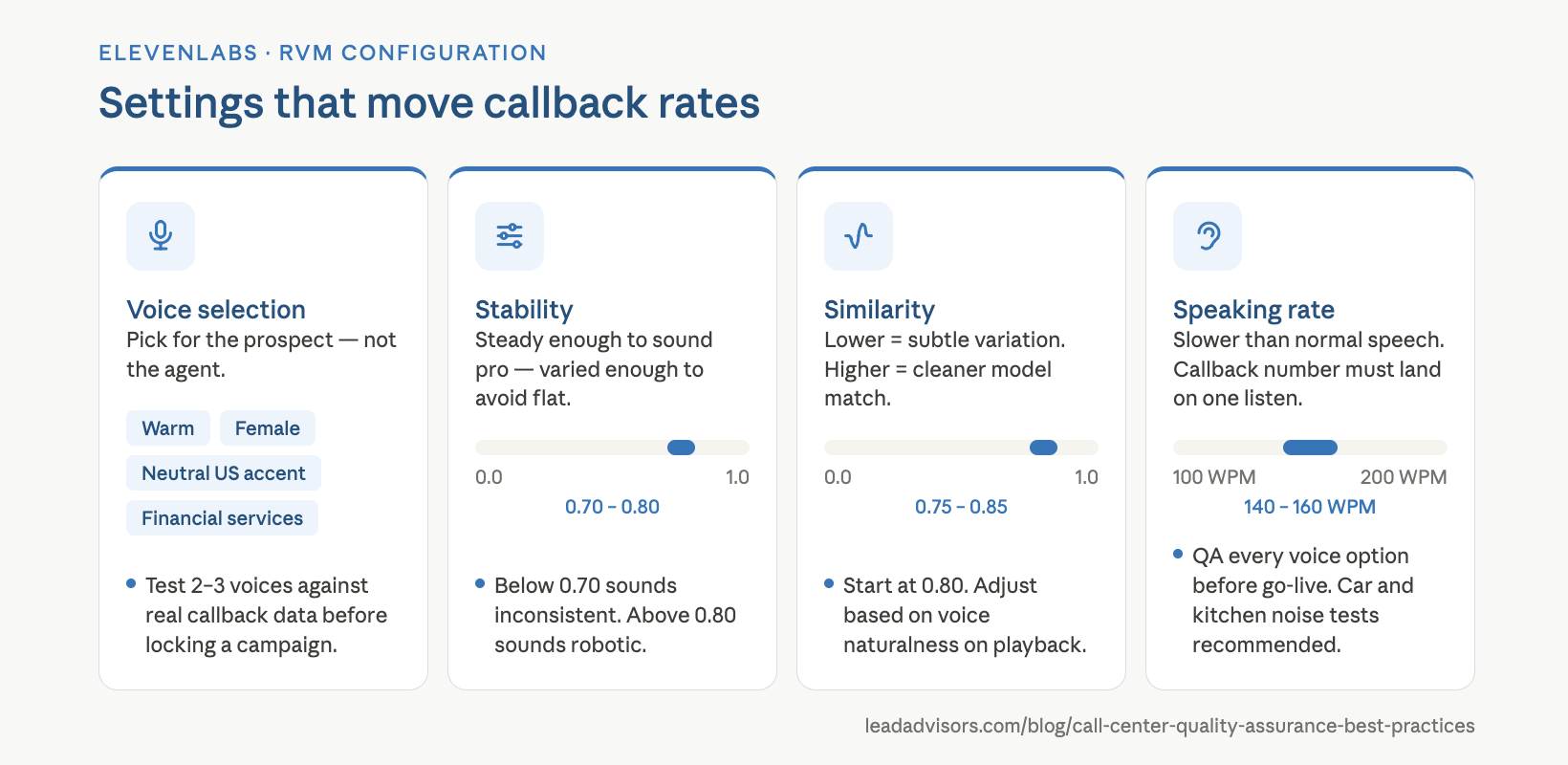
- Voice selection. Pick a voice that fits the prospect – not the agent. A warm, professional female voice with a neutral American accent tends to outperform other styles in financial services. Test two to three options against real callback data before picking one for the campaign.
- Stability (0.70-0.80). This controls how steady the voice sounds across lines. A range of 0.70 to 0.80 hits the sweet spot – steady enough to sound pro, varied enough to avoid sounding flat.
- Similarity (0.75-0.85). This controls how closely the output matches the voice model. Lower values add subtle variation. Higher values give a cleaner match.
- Speaking rate (140-160 WPM). Slightly slower than normal speech. This helps in noisy settings such as a car or a kitchen. The callback number needs to be audible on a single listen. A structured quality assurance review should be run on every voice option before it goes live.
SSML Pause Insertion
A 0.5 to 0.8 second pause should be added before the callback number. Another pause goes between the first and second read of the number. This gives the prospect time to process without lengthening the script.
In ElevenLabs, this is done with <break time=”0.6s”/> in the SSML markup.
RVM Timing Within the Cadence – When to Drop and When Not To
A perfect script with great voice work can still fall flat if it’s sent at the wrong time. Timing is the third variable – after script and voice – that drives callback rate.
Where RVM Fits in the Standard Cadence
Based on frameworks used in contact rate optimization and speed-to-lead systems, this placement gets the best results:
| Attempt | Channel | RVM Role |
| 1 | Call + SMS | No RVM – first attempt is a live connection attempt |
| 2 | Call + RVM drop | First voicemail drop – companion to second call attempt |
| 3 | Call + SMS | No RVM – avoids voicemail fatigue on consecutive touches |
| 4 | Call + RVM drop | Second voicemail drop – different script angle from attempt 2 |
| 5 | Call + SMS | No RVM |
| 6 | Call + email | No RVM |
| 7 | Standalone RVM | Final touch before moving to nurture – last voicemail |
Use two RVM drops max in a 7-touch cadence. More than two causes voicemail fatigue. The prospect stops listening before the number is reached.
Best Time of Day
RVM drops get the most callbacks between 5:30 pm and 7:30 pm in the prospect’s local time. This catches people in transition – commuting, making dinner, winding down. They are more likely to check voicemail and have time to call back.
InsideSales.com (now XANT) found, through its Lead Response Management research, that the 4 pm to 5 pm window is the best for contact. The gap was 164% compared to the worst time slots. Late-afternoon and evening outreach beats morning calls across financial services.
Times to avoid:
- Early morning – prospects are rushed and won’t call back.
- Mid-morning – work mode, low callback chance
- After 8 pm – outside courtesy norms and TCPA safe harbor in most states
RVM Scripts by Vertical – Language That Works
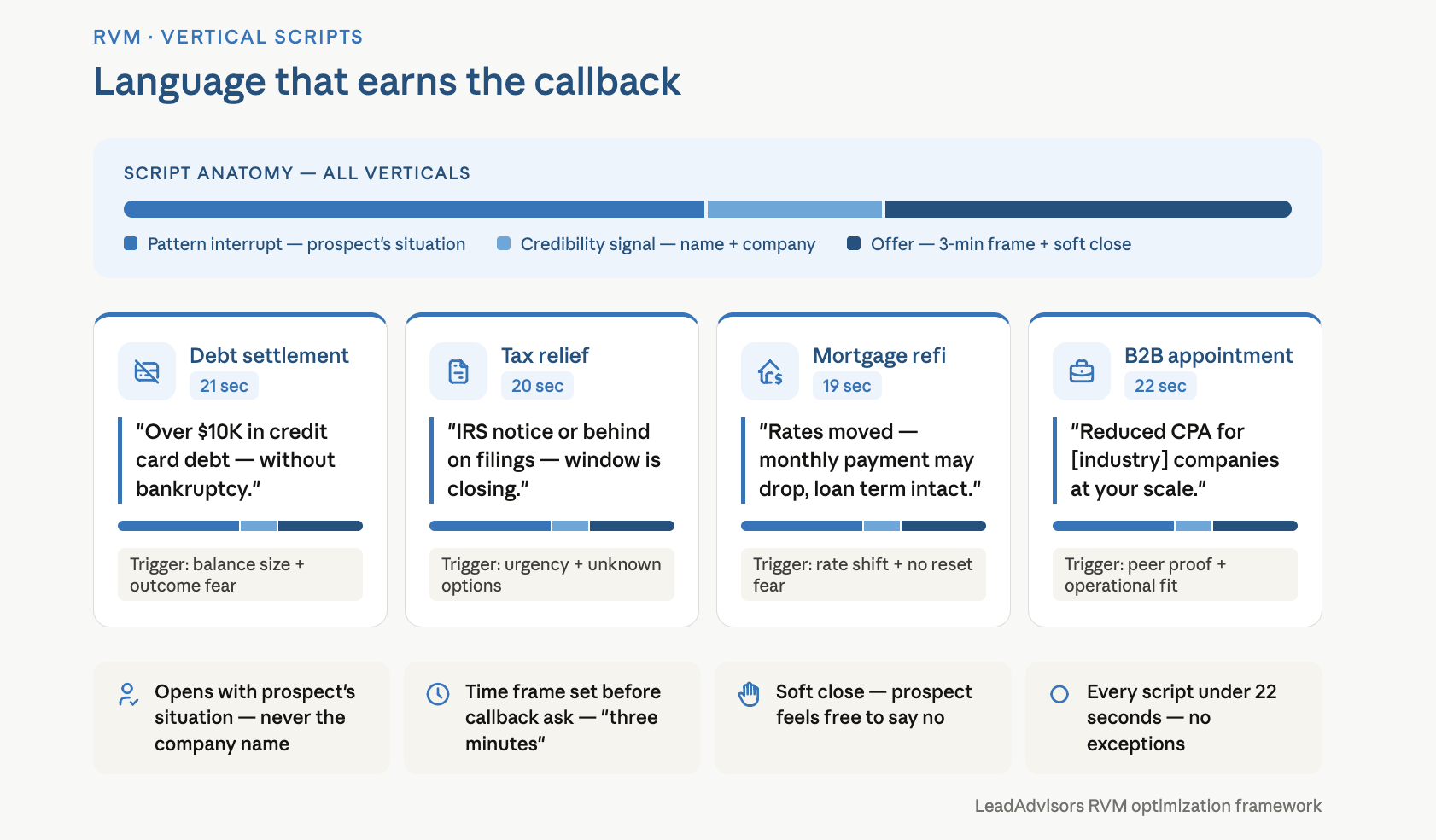
Each part of the script – the pattern interrupt, credibility signal, and offer – needs language tied to the vertical. Generic scripts get generic results. Vertical-specific scripts get better callbacks because the prospect hears their own situation described.
Debt Settlement RVM Script (21 Seconds)
“Most people with over $10,000 in credit card debt don’t realize they may qualify for a program that can cut that balance significantly – without bankruptcy. This is [Name] with [Company] – I specialize in debt resolution for people in your situation. Call me back at [number] – [number] – I’ll tell you in three minutes whether you qualify and what the realistic reduction looks like. Available until 6 pm.”
Tax Relief RVM Script (20 Seconds)
“If you’ve received a notice from the IRS or you’re behind on tax filings, there are options most people don’t know about – and the window to act before the IRS takes further steps is shorter than most people think. This is [Name] with [Company]. Call me back directly at [number] – [number]. Takes three minutes. I’ll tell you exactly what options exist for your situation.”
Mortgage Refi RVM Script (19 Seconds)
“Rates have moved enough in the last few weeks that homeowners in your area may be able to reduce their monthly payment by more than they’d expect – without resetting their loan term. This is [Name] with [Company]. Call me back at [number] – [number] – I can run your specific scenario in about three minutes and tell you whether a refi actually makes sense right now.”
B2B Appointment Setting RVM Script (22 Seconds)
“I’m reaching out because we’ve helped several [industry] companies in [region] reduce their cost per acquisition by a significant margin – and based on what I know about operations at your scale, the conversation is worth three minutes of your time. This is [Name] with [Company]. Call me back at [number] – [number]. I’ll be direct about whether this is relevant for you or not.”
The Consistent Elements Across All Four
Every script opens with the prospect’s situation – not the company name. A time frame is given before the callback ask (“three minutes”). Every script ends with a soft close – the prospect feels free to say no. Every script is under 22 seconds.
RVM Compliance – What the Law Actually Requires
RVM drops sit in a gray area under TCPA compliance. The rules depend on how courts and the FCC classify the tech. That debate is still active.
Here is where things stand based on current FCC guidance and court rulings.
Landline Delivery
Standard TCPA rules apply. Prior express written consent is required for commercial voicemail messages sent to landlines.
Mobile Delivery
This is where it gets complex. Some courts have treated RVM as a “call” under TCPA. That means prior written consent is needed. Other courts have ruled differently because the phone never rang. As of 2026, the FCC has not issued a final rule.
The FCC’s 2022 Declaratory Ruling (FCC-22-85) stated that ringless voicemails to wireless phones need consent. They are treated as “call” under the TCPA, with prerecorded voice. The FCC’s robocall consumer guide backs this up.
The Safe Position
Treat RVM drops to mobile numbers the same as autodialed calls. Get prior express written consent through the lead form before any RVM is sent. This is the safe play. It holds up no matter how the debate is resolved. It gives the strongest compliance and QA posture.
Also, every RVM script must include the company name and a callback number. These are required for commercial prerecorded messages. Leaving either out creates a separate risk.
For legal guidance on your RVM setup, talk to a qualified attorney who knows current FCC rules. What’s outlined here is operational context – not legal advice.
Measuring RVM Performance – The Metrics That Matter
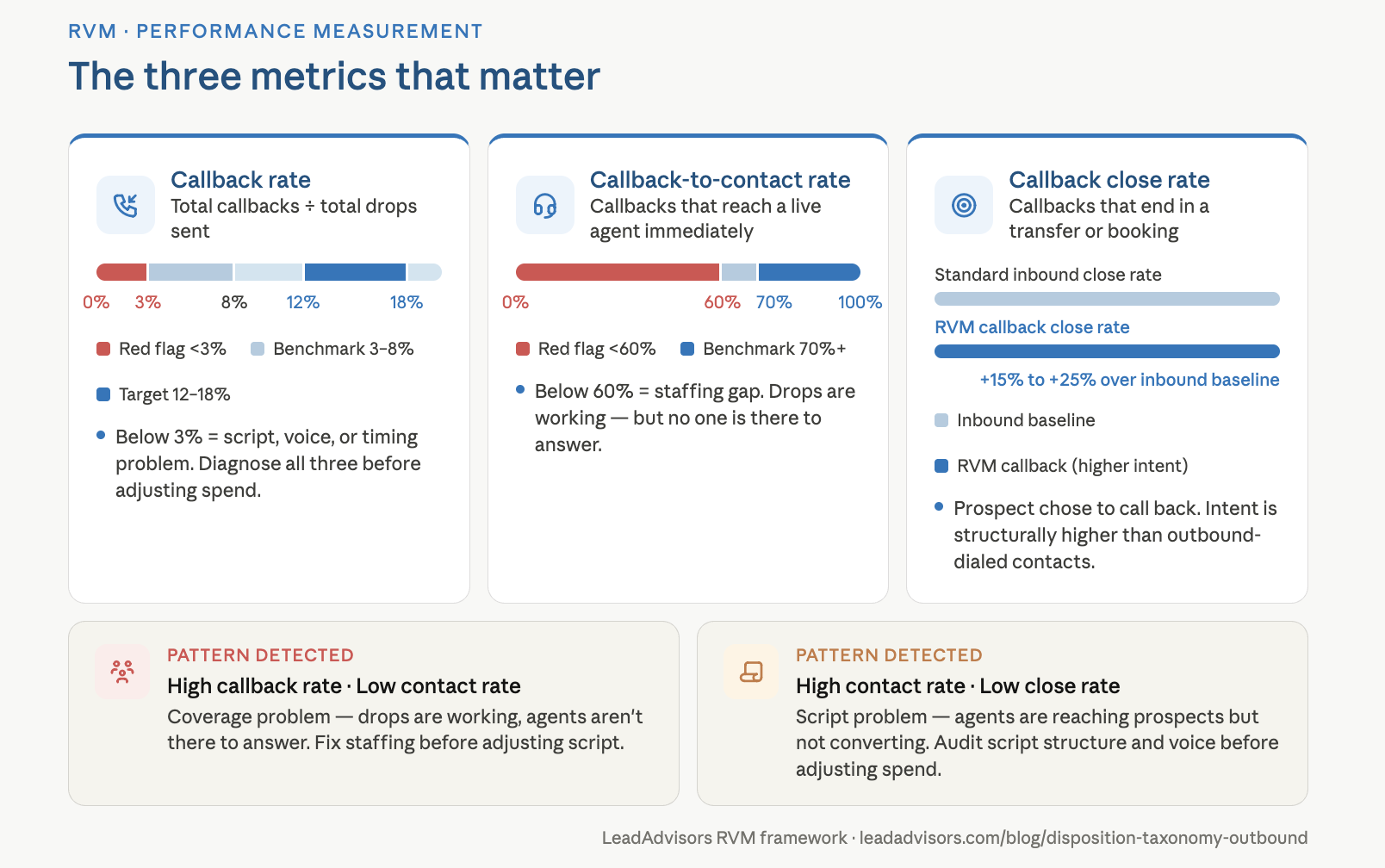
Three metrics show if an RVM program is working.
Callback Rate
Total callbacks divided by total drops sent.
- Benchmark: 3% to 8% is normal for generic scripts on financial services campaigns
- Target: 12% to 18% with strong scripts, good voice work, and smart timing
- Red flag: Below 3% points to a script, voice, or timing problem
Callback-to-Contact Rate
Of callbacks received, how many reach a live agent right away?
- Benchmark: 70%+ for floors with dedicated callback coverage
- Red flag: Below 60% means a staffing gap – drops are working, but no one is there to answer.
Callback Close Rate
Of callbacks that reach an agent, how many end in a qualified transfer or booking?
- Benchmark: 15% to 25% higher than standard inbound close rates
- Why: The prospect chose to call back. Their intent is higher than someone reached through outbound dialing.
All three should be tracked separately. A proper disposition taxonomy is needed to separate RVM callbacks from other inbound calls. High callback rate with low contact rate = coverage problem. High contact rate with low close rate = script problem.