Picture this. Six weeks of vendor evaluation. Internal approvals locked in. Budget signed off. Then legal gets looped in. They ask for the SOC 2 Type II report. The vendor sends back a four-bullet “Security Overview” PDF. Legal declines. Deal dead.
Nobody on the ops side saw it coming. They never do.
This happens a lot at companies with revenue above $10M. It’s especially common in healthcare, financial services, insurance, and legal. The Barracuda Networks 2025 Data Breach Report counted 3,322 U.S. data breach incidents in 2025. That’s up 4% from the year before. Cyberattacks drove 80% of them. Third-party vendors are a top entry point for attackers. Enterprise legal teams know this.
Here’s the frustrating part: most BPO vendors who fail compliance review aren’t running unsafe operations. They’ve built real practices – DNC list management, agent training, and access controls. But they never put any of it into the format required by a legal checklist. Enterprise buyers don’t see a difference. Can’t prove it? Doesn’t count.
This guide covers seven documents enterprise buyers usually require before approving a BPO engagement. For each one, you’ll see what it is, why legal wants it, and what it means when a vendor can’t produce it.


Why Your Legal Team Gets the Final Say
Here’s a mistake that trips up many procurement conversations: outsourcing the work doesn’t shift the liability.
Once you hand customer data to a BPO vendor, you’re still legally responsible for what happens to it. Their security breach can become your regulatory problem. Their failure to act can trigger your notification obligations.
The A-LIGN 2026 Compliance Benchmark Report surveyed over 1,000 compliance professionals. Audit pressure is climbing. Third-party vendor oversight keeps coming up as the weakest link. The SecurityScorecard 2025 Global Third-Party Breach Report backed that up. In 1,000 real breach cases, attackers deliberately targeted vendors. Those vendors had trusted access already.
For a financial services company outsourcing outbound calling, the exposure is wide. It covers how the vendor stores customer data, whether agents are TCPA-trained. Whether data practices create GLBA or state-privacy-law exposure. Whether a vendor breach pulls the client into a regulatory inquiry. A signed contract doesn’t change any of that.
Why Good BPO Vendors Still Fail This Test
The Secureframe 2026 Compliance Statistics Report found that 69% of organizations can’t verify whether their vendors meet required standards. That number makes sense once you see how most BPO operations grow.
They react to problems. A client complaint comes in, and they fix it. When an audit risk surfaces, they deal with it. Over time, they build solid security controls and training programs. But they rarely document any of it in a third-party-verified format. So when procurement runs the assessment, the vendor gets screened out. Not because they operate badly. Because there’s no paper trail.
To enterprise buyers, that difference doesn’t matter.
The 7 Documents on Most Enterprise Compliance Checklists
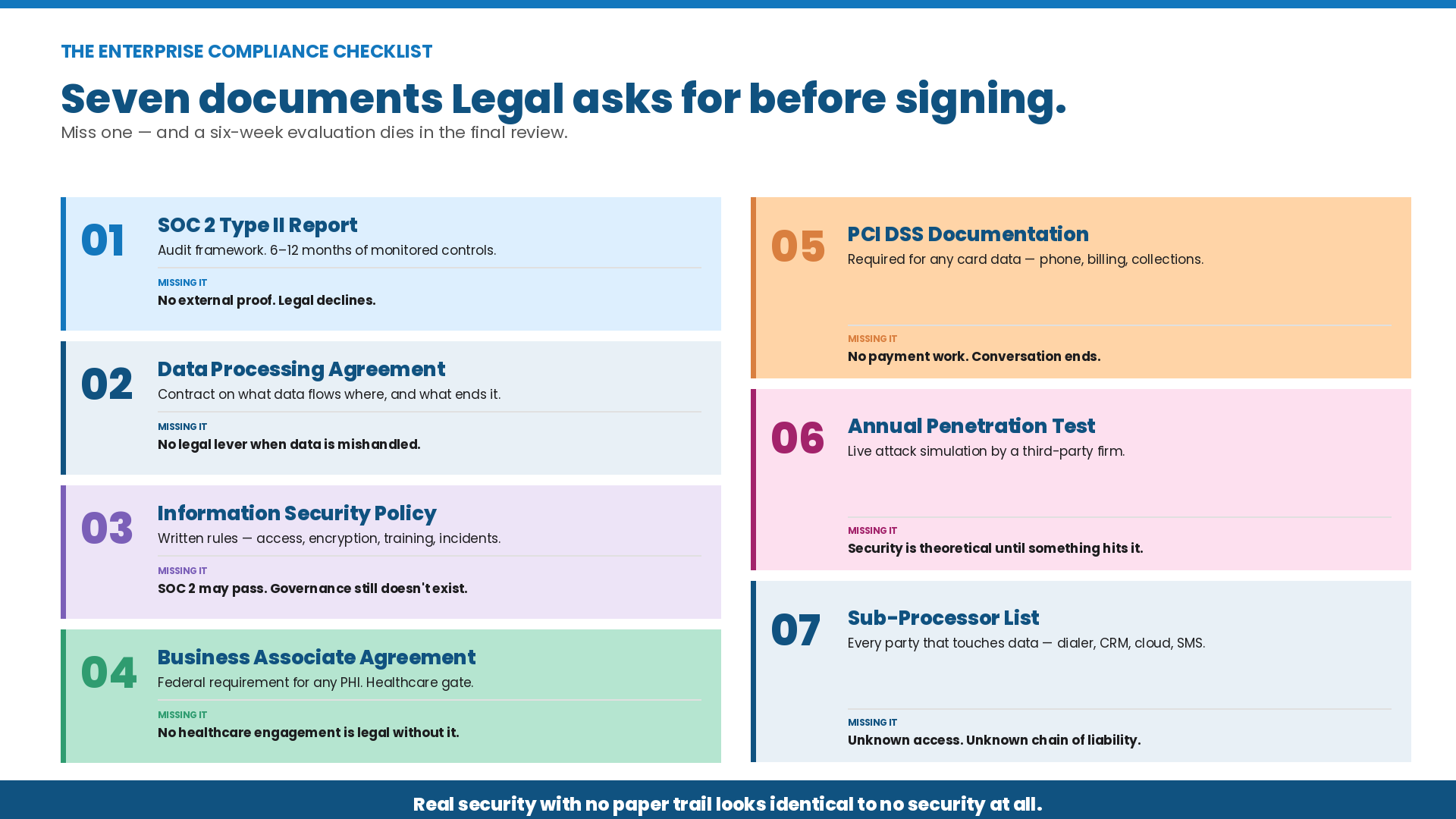
Not every buyer uses the same list. But these seven show up often enough that missing one can stall the whole engagement.
1. SOC 2 Type II Report
SOC 2 is an audit framework from the American Institute of CPAs. It covers five areas: security, availability, processing integrity, confidentiality, and privacy. Enterprise procurement wants the Type II version. The gap between Type I and Type II is bigger than it sounds.
Type I confirms that controls were in place on a specific date. Type II means an independent auditor watched those controls for 6 to 12 months straight and confirmed they held up. A vendor still working toward SOC 2, or one with only a Type I, hasn’t met procurement’s requirements.
A Deloitte-cited survey in CG Compliance’s 2026 guidance found that 85% of clients weigh SOC 2 when selecting vendors. At the enterprise level, it’s not a bonus – it’s a basic requirement.
Without it, Legal has no external audit data. There’s no way to tell a secure but undocumented vendor from one with real problems. They typically decline.
2. Data Processing Agreement (DPA)
A DPA is the contract that specifically covers data. It spells out what the vendor can process, for what purposes, under what security rules, who else gets access, and what happens when the contract ends.
GDPR requires one for EU personal data. CCPA requires something similar for California residents. But most enterprise legal teams now require one regardless of the data source. It’s standard due diligence.
Without a signed DPA, there’s no legal tool to enforce vendor data handling. A master services agreement describes expectations. It doesn’t replace enforcement language when something goes wrong.
A vendor that can’t share a DPA template has either never worked at enterprise scale or never had legal review their vendor relationships.
3. Information Security Policy
Any vendor handling enterprise data needs a written security policy. It should cover who can access which systems, how data is classified, which encryption standards apply, how incidents are handled, what employees can and can’t do, and what training is required.
SOC 2 auditors assess whether security controls are effective. But those controls are supposed to enforce a specific requirement. That’s the security policy. A vendor can hold SOC 2 certification without a real written policy. The audit exists. The governance doesn’t.
Security that lives in people’s heads walks out the door when those people do.
4. Business Associate Agreement (BAA): Healthcare Campaigns
If a BPO touches Protected Health Information, a signed BAA is required by federal law. PHI is a broader category than many vendors realize. Health insurance outreach, Medicare, final expense insurance, and medical billing all qualify.
HHS.gov is clear about what a BAA must cover: permitted uses of PHI, required safeguards, and breach notification obligations. ValorGlobal cites research that puts the average cost of a healthcare data breach at $9.23 million per incident. That’s why the legal bar here is so high.
A vendor that doesn’t know what a BAA is, or won’t sign one, is either new to healthcare or has been operating in it without the legal basics. Enterprise healthcare buyers can’t work with either.
5. PCI DSS Documentation: Payment Handling
Any BPO that handles credit or debit card data needs PCI DSS compliance documentation. This covers phone payments, billing support, and collections. There’s no way around it.
Every party in the payment chain has compliance obligations. A BPO without PCI compliance exposes both the vendor and the client. That means card brand penalties, regulatory fines, and breach liability. No PCI documentation means no payment work. That’s usually the end of the conversation.
6. Penetration Test Report
Once a year, a qualified third-party security firm runs a live attack simulation against the vendor’s systems. They use the same methods real attackers use. The report covers what they found and what was fixed.
SOC 2 shows what security controls look like on paper. A pen test shows whether they hold under pressure. The A-LIGN 2026 Compliance Benchmark Report found a direct link between regular pen testing and passing enterprise vendor reviews.
A vendor with documentation but no test history has described their security without ever checking it. Whether it holds under a real attack is unknown. Enterprise legal teams don’t like unknowns.
7. Sub-Processor List
The BPO vendor doesn’t operate alone. Their cloud host touches the data. So do the dialer, the CRM, the AI quality-scoring platform, and the SMS gateway. Enterprise buyers want a full list – and proof that formal agreements are in place across the whole chain.
A SOC 2 certification covers only the vendor’s own environment. It says nothing about the other platforms running inside their operation. Legal needs to see the full picture. A vendor who can’t produce this list either doesn’t know who has access to client data or hasn’t set up agreements with those parties. Both are governance problems.
What Gets Added by Industry
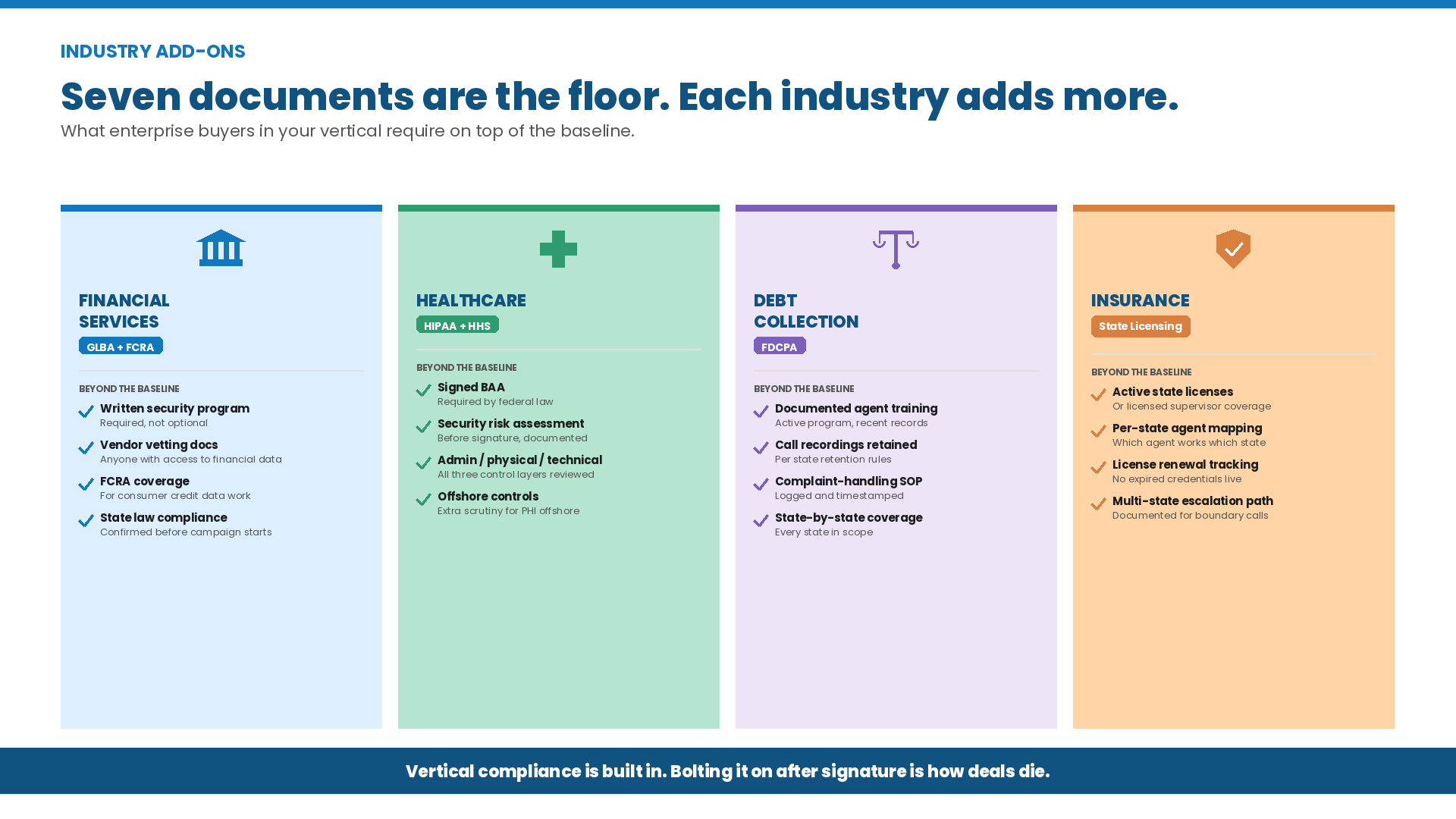
Those seven documents are the floor. Specific industries add more on top.
Financial services companies subject to GLBA are required to have their vendors maintain a written security program. They also need to document how they vet anyone with access to private financial data. The Fair Credit Reporting Act adds another layer for BPOs handling consumer credit data. Whether it applies to a specific campaign should be confirmed with legal before the engagement starts.
Healthcare clients go beyond the BAA. HIPAA requires covered entities to complete a formal security risk assessment of their Business Associates before signing a contract. That’s a documented review of the vendor’s administrative, physical, and technical controls. The HIPAA Journal’s December 2025 guidance is clear: this has to happen before signatures. For offshore teams handling health data, the offshore staffing compliance overview covers the extra steps.
The FDCPA covers debt collection campaigns. Enterprise buyers want documented agent training, maintained call recording and complaint-handling processes, and confirmed coverage for state-level rules across every campaign state.
Insurance work adds licensing. Agents selling insurance must hold an active state license or work under a licensed supervisor. Enterprise insurance buyers want to know how the vendor handles this across every state where campaigns run.
What It Looks Like When a Vendor Is Actually Ready
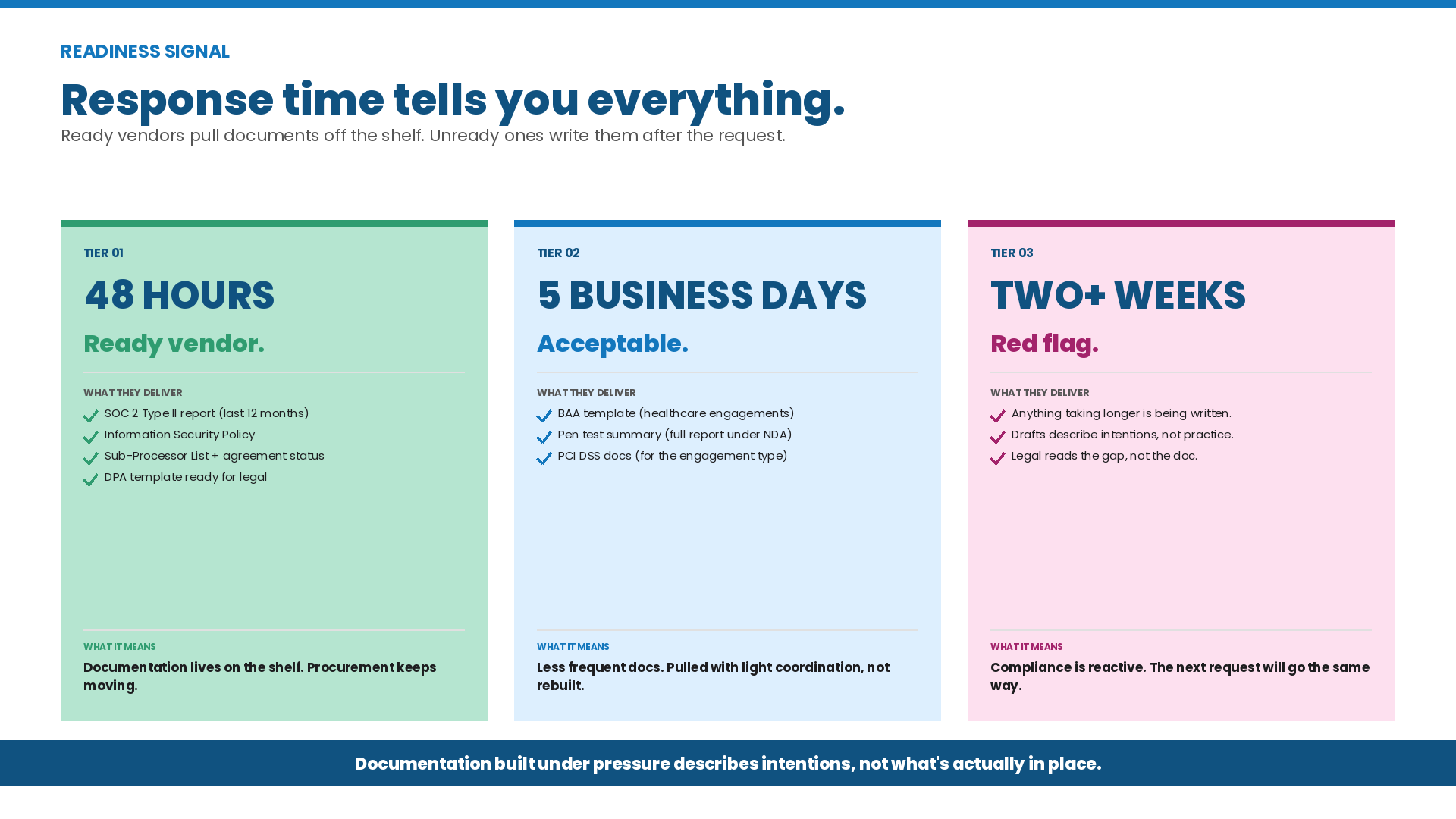
Vendors that sail through enterprise compliance review share one thing: the documents were ready before anyone asked. They’re not building anything. They’re pulling it off the shelf.
Within 48 hours: current SOC 2 Type II report (issued in the last 12 months), written information security policy, sub-processor list with agreement status for each party, and a DPA template ready for legal review.
Within five business days: pre-drafted BAA template for healthcare work (needs signatures), the most recent pen test summary with the full report available under NDA, and PCI DSS documentation for the engagement type.
Available on request: employee security training records, incident response and breach notification procedures, and vendor management documentation.
Response time is a real signal. A vendor who sends that package in 48 to 72 hours keeps it current as part of normal operations. One who needs two or three weeks is writing it fresh. Documentation built under pressure tends to describe intentions rather than what’s actually in place.
How to Read the Documents Once You Have Them
Getting the documents is step one. Checking whether they hold up is a different task.
For the SOC 2 Type II report, check the issue date first. Anything older than 12 months is expired for enterprise purposes. Then check scope – does it cover the trust service criteria for your engagement? Security is the minimum. Confidentiality is important when sensitive data is involved. Look at the qualified opinions section for red flags. Those marks that the auditor found deficient. Make sure the system description matches the infrastructure that will actually handle your data.
For the DPA, processing purposes should be specific. “As needed to provide services” is too vague. Sub-processor obligations need to be spelled out. So do notification requirements if those relationships change. GDPR sets a 72-hour deadline for breach notification. That timeline should be explicit. Check end-of-contract provisions too – what happens to the data, when, and is a written certification required?
For the information security policy, check the last updated date first. An untouched policy for over a year is a maintenance issue. It should list specific technical standards, not just general ideas. And there should be a named person responsible for it. Policies without owners go stale.
Getting Your Compliance Package in Order Before Anyone Asks
Year one is about foundations. Bring in a SOC 2 auditor for the Type I assessment. You get formal certification and a clear picture of what needs fixing before the Type II cycle starts. At the same time, draft the core documents: security policy, incident response plan, and acceptable use policy. Get those through legal review. Get DPAs signed with your current sub-processors.
The year one-to-year-two period is where the real work happens. The SOC 2 Type II audit requires a 6- to 12-month observation window. Use that stretch to schedule the first annual pen test, build the sub-processor list, and draft the BAA template for healthcare work.
After that, keep a simple maintenance routine: SOC 2 Type II renewal each year, pen test each year, security policy review each quarter, and the sub-processor list updated whenever the tech stack changes.
Starting from scratch, full enterprise compliance readiness takes 18 to 24 months and requires real investment in legal and security resources. What it gets you is access to procurement conversations that most BPO vendors are never invited to.