Most B2B content programs look busy but do not create a clear pipeline. Teams publish blogs, post on LinkedIn, and report traffic. But they still cannot prove which content generated good leads, helped close deals, or reduced costs.
That gap gets expensive. Without a real B2B content marketing strategy, publishing becomes busywork. Sales gets little useful content. Leaders see weak tracking. Search also gets harder as AI summaries change how buyers research vendors.
The fix is a simple system. A strong B2B content strategy connects buyer research, topic planning, production, distribution, tracking, and review. That system is the B2B Content Marketing Operating Model.


What B2B Content Marketing Strategy Actually Is
A B2B content marketing strategy is a plan for creating content that helps generate qualified leads and sales.
It answers five simple questions:
- Who are we trying to reach?
- What problems do they need to solve before they buy?
- Which topics should we own?
- How will content reach buyers beyond the blog?
- How will we measure pipeline impact?
That matters because many teams confuse strategy with production.
An editorial calendar is not a strategy. It is content calendar operational hygiene.
SEO content is not the full strategy. It is one way buyers find you.
LinkedIn content is not the full strategy. It is one way to share ideas.
Email nurture is not the full strategy. It is one follow-up tool.
A real content strategy connects search, buyer questions, sales content, reach, and results.
The key metric is simple: revenue from content versus the money spent on it.
Traffic, rankings, and engagement still matter. However, they are early signs. The bigger question is whether content created good leads, helped deals, or lowered costs.
Tracking will never be perfect because B2B sales take time. Still, some tracking is better than none. The point is to make content spend easy to defend.
The B2B Content Marketing Operating Model
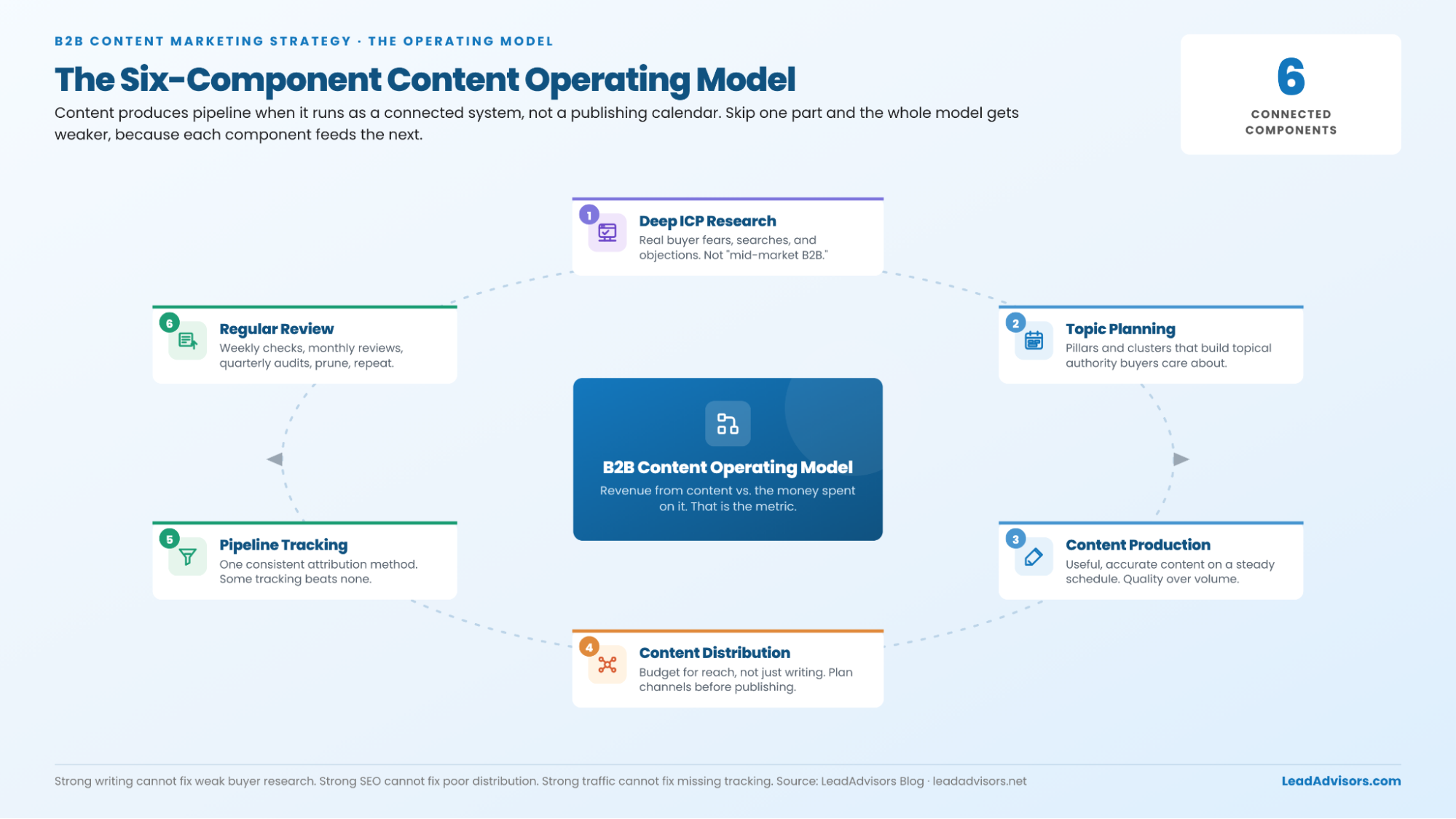
The B2B Content Marketing Operating Model has six parts:
- Deep ICP research
- Topic planning
- Content production
- Content distribution
- Pipeline tracking
- Regular review
Skip one part, and the system gets weaker. Strong writing cannot fix weak buyer research. Strong SEO cannot fix poor distribution. Strong traffic cannot fix missing tracking.
The model works because each part supports the next.
Component 1: Deep ICP Research
Most ICP documents are too broad to guide content. “Mid-market B2B companies” does not tell a writer what the buyer fears, searches, or needs to trust.
Useful ICP research includes:
- Company details
- Buyer roles
- Pain points
- Search habits
- Sales objections
- Real questions from calls, demos, support tickets, and search data
A Growth CEO may care about trust gaps. An Ops Builder may care about repeatable systems. An Agency Operator may care about delivery.
Each buyer needs different proof. So the strategy must match each pain point to the right content.
Content also feels more real when it uses actual buyer problems, not surface-level definitions.
Component 2: Topic Planning
Topic planning turns random ideas into a clear content system.
The goal is not to publish every keyword from a tool. The goal is to own the topics your buyers care about. That starts with the foundational case for content marketing and moves into topic ownership.
A strong topic plan includes main topics, support pages, search intent, content gaps, internal links, update needs, and AI search needs.
This is where pillar content strategy for topical authority matters.
Pillar work also requires a pillar-and-cluster content architecture, so each page has a clear job.
The cluster layer supports topic clustering and the compounding of topical authority over time.
As the library grows, the same structure becomes a content hub architecture methodology.
Google’s Search Central guide on creating helpful, reliable, people-first content says content should satisfy readers. A clear topic plan helps by avoiding thin, disconnected articles.
It also supports AI search. Google’s guide on AI features in Search says AI search helps people understand topics and explore links. So B2B content needs clear definitions, clear sections, strong sources, and original ideas.
Generic content gets summarized. Useful frameworks get referenced.
Component 3: Content Production
Content production is where the plan becomes real content. The process should start with keyword research methodology, and keyword clustering and intent mapping before writers get briefs.
Publishing more is not the goal. The goal is to publish useful, accurate content on a steady schedule.
That system needs industry writers, clear editing rules, expert input, design help, human AI review, compliance checks, SEO content production at scale, and evergreen content strategy and refresh discipline.
Google’s guide on AI-generated content and Search quality says quality matters more than how the content is made. AI helps by turning expert knowledge into clear content. It hurts when it creates bland summaries with no real insight.
For finance, healthcare, legal, and other sensitive topics, content also needs expert review, strong sources, and careful claims.
Component 4: Content Distribution
Content that does not get shared does not create a pipeline.
Most B2B teams spend too much on writing and too little on reach. They publish the article, share it once on LinkedIn, send one email, and move on.
That is not a real distribution plan.
A real B2B content distribution plan includes SEO, AI search, LinkedIn, email, sales content, communities, guest posts, PR, paid promotion, syndication, reuse, and localization.
Plan distribution before writing.
For example, a pillar article can become a LinkedIn carousel, sales one-pager, newsletter section, video script, webinar outline, guest post angle, and content syndication asset.
That is how one content asset becomes a system. The next step is tactical execution of content promotion, so the asset reaches buyers beyond the blog.
Strong operators also plan content repurposing across channels before publishing.
For global buyers, content localization for international B2B keeps the message clear in each market.
The rule is simple: budget for reach, not just writing.
Component 5: Pipeline Tracking
Content tracking is messy. That does not make it optional.
B2B buyers read articles, compare vendors, ask peers, attend webinars, and speak with sales. One page rarely creates the deal alone.
Common models include:
- First touch: Which content first brought in the account?
- Last touch: Which content came before the conversion?
- Multi-touch: Which pages helped across the journey?
- Influence: Which content helped deals already in progress?
Tools can help, but they do not replace a clear method. If the team changes the method every month, the reports become useless.
Track pipeline, good leads, assisted conversions, deal speed, and closed revenue over time. This is how content moves from a marketing task to a revenue system.
Component 6: Regular Review
Content strategy is not a one-time plan.
Search behavior changes. Competitors publish. AI search changes how answers appear. Sales objections shift.
A strong review plan includes weekly checks, monthly content reviews, quarterly audits, update planning, a yearly ICP review, and content-pruning discipline to support portfolio health.
Monthly SEO reporting quality checklist work should sit inside the broader SEO reporting discipline. It should show what changed, what helped the pipeline, what needs updates, and what should be removed.
This is where growth compounds: coverage first, quality second, authority third.
Content Types and Their Pipeline Function
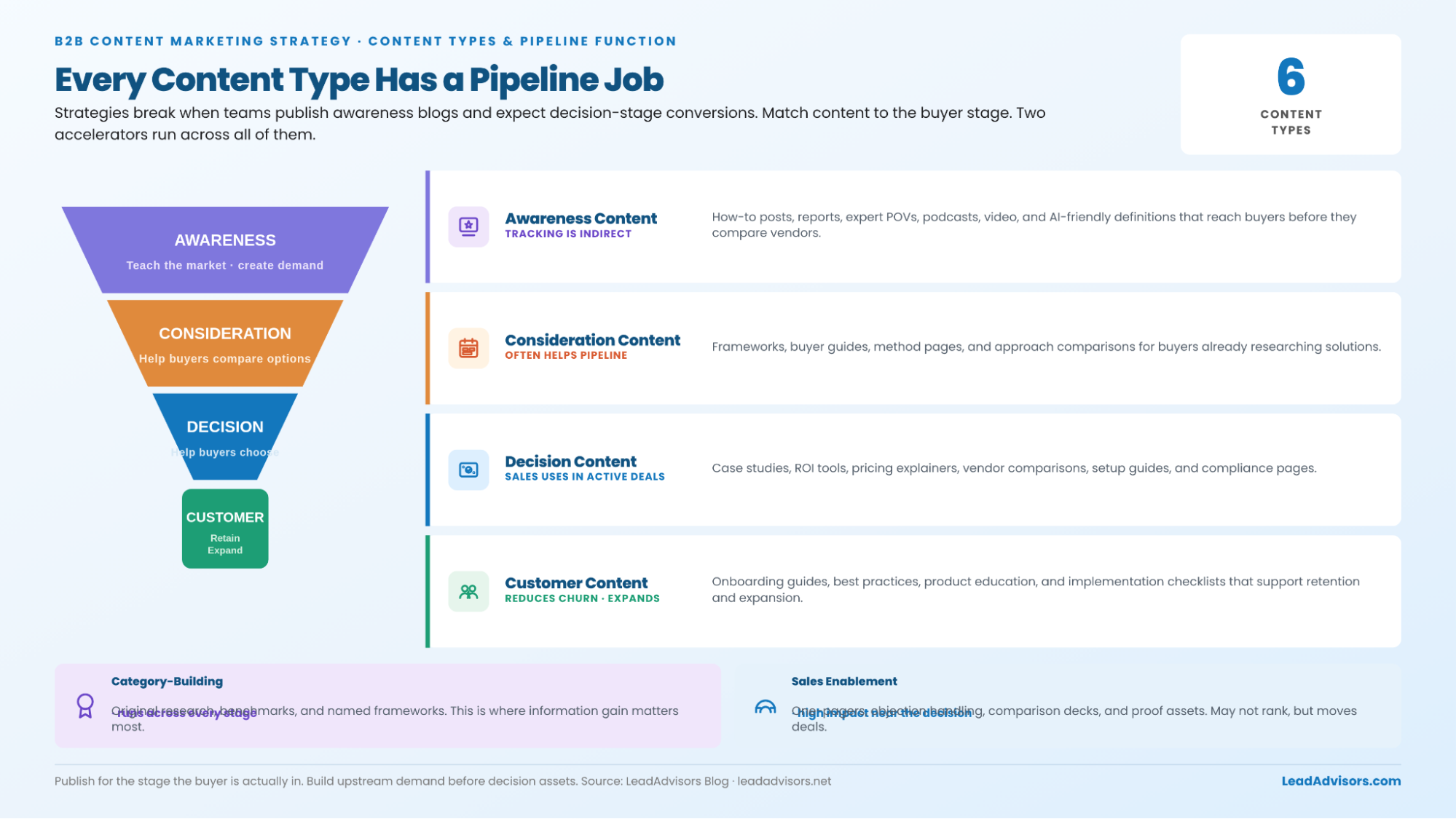
B2B content types produce different pipeline outcomes.
This is where many strategies break. Teams publish awareness blogs and expect decision-stage conversions. Or they build sales enablement assets without upstream demand.
Each content type has a job.
Awareness-Stage Content
Awareness content reaches buyers before they compare vendors. Examples include how-to posts, reports, expert posts, podcasts, YouTube videos, and AI-friendly definitions.
Its job is to teach the market and create demand. Tracking is usually indirect.
Consideration-Stage Content
Consideration content helps buyers compare options. Examples include frameworks, buyer guides, method pages, approach comparisons, and B2B content marketing strategy examples.
This stage often helps the pipeline because buyers are already researching solutions. The B2B Content Marketing Operating Model fits here because it shows what a serious strategy should include.
Decision-Stage Content
Decision content helps buyers choose a vendor or path. Examples include case studies, ROI tools, pricing explainers, vendor comparisons, setup guides, and compliance pages.
Sales teams should use this content in active deals.
Customer-Stage Content
Customer content supports retention and expansion through onboarding guides, best practices, product education, customer success content, and implementation checklists.
This content can reduce churn, increase adoption, and support expansion revenue.
Category-Building Content
Category-building content creates authority through original research, benchmarks, industry reports, named frameworks, and market analysis.
This is where information gain matters most. A named framework gives the market language to describe a problem.
Sales Enablement Content
Sales enablement content helps closers move deals forward through one-pagers, objection-handling content, comparison decks, ROI worksheets, and customer proof assets.
This content may not rank in search, but it can have a high pipeline impact near the buying decision.
Distribution Reality: Where B2B Content Actually Gets Read
B2B content does not live only on the blog.
Buyers discover ideas through search, LinkedIn, newsletters, AI summaries, communities, podcasts, sales conversations, and peer recommendations.
That means the content plan needs a distribution plan.
SEO and Organic Search
SEO remains a strong distribution channel for evergreen B2B content.
However, search is changing. Pew Research Center’s 2025 analysis of Google AI summaries and search clicks reported that 58% of Google users in its March 2025 browsing study conducted at least one search that produced an AI-generated summary.
Pew’s 2026 research on Americans and AI search summaries also reported that 60% of U.S. adults say they read AI summaries at the top of search results.
That does not kill SEO. It changes the job.
Content now needs to rank, satisfy readers, and be citation-worthy in AI-assisted search.
LinkedIn is the main B2B social distribution channel for many companies.
Company pages support positioning. Executive profiles often create more trust and reach because people engage with people.
A strong LinkedIn content strategy repurposes core assets into short posts, carousels, founder POVs, and sales-support content. The goal is qualified attention, not vanity engagement.
Email and Newsletters
Email is an owned distribution channel. That matters because search and social algorithms change.
For B2B content, newsletters work best when they summarize useful insights, point readers to deeper assets, and support the sales cycle.
Sales Distribution
Sales teams are a distribution channel.
If a buyer asks about ROI, send the unit economics section. If a buyer asks about implementation, send the build-vs-buy section. Content should make sales conversations easier.
Paid Amplification
Paid distribution can extend content reach through LinkedIn ads, retargeting, paid search, sponsored newsletters, and native placements.
The operator question is not “organic or paid?” It is “Which distribution mix gets this asset in front of the right ICP?”
The AI Search Layer Changing B2B Content Strategy
AI search is now part of B2B content strategy.
Stanford HAI’s 2026 AI Index Report reports that generative AI adoption is spreading quickly, with 53% of the population adopting within three years.
Pew’s 2026 research on AI summaries in everyday search behavior also shows that AI summaries are becoming a normal part of search behavior.
B2B buyers use AI tools to summarize categories, compare vendors, understand frameworks, and prepare questions before speaking with sales.
That changes the content structure.
What Changes
B2B SEO content strategy now requires clear definitions, direct answers, structured lists, schema markup, original frameworks, expert review, credible authorship, source-backed claims, and consistent brand mentions.
This is where the E-E-A-T framework for content authority comes into play.
Content also needs to answer engine optimization fundamentals, so answers are structured clearly.
For broader AI discovery, teams should understand how to optimize generative engines for AI search.
Google visibility also depends on earning citations in Google AI Overviews.
Brand visibility depends on the brand citation strategy in AI search.
What Does Not Change
The fundamentals still matter.
You still need ICP research. You still need topical authority. You still need useful content. You still need distribution. You still need attribution.
AI search does not replace strategy. It raises the bar for clarity and authority.
The Zero-Click Reality
AI summaries can reduce clicks.
Pew’s 2025 study on AI summaries and lower search-result click behavior found that Google users were less likely to click links when an AI summary appeared. It also found that users rarely clicked the sources cited in those summaries.
That creates a new measurement challenge.
Some content influence may happen before the click. Buyers may see your framework, brand, or definition in an AI-assisted answer. Then they may return later through branded search, direct traffic, or sales outreach.
Therefore, content teams need to track more than last-click conversions.
Unit Economics That Hold Up at B2B Content Marketing Scale
B2B content marketing ROI depends on time horizon, attribution model, and channel comparison.
Content usually does not behave like paid search. Paid channels can create faster feedback. However, content can compound longer when the system works.
The practical question is whether content creates a qualified pipeline at a lower blended cost over time.
The Time-to-ROI Reality
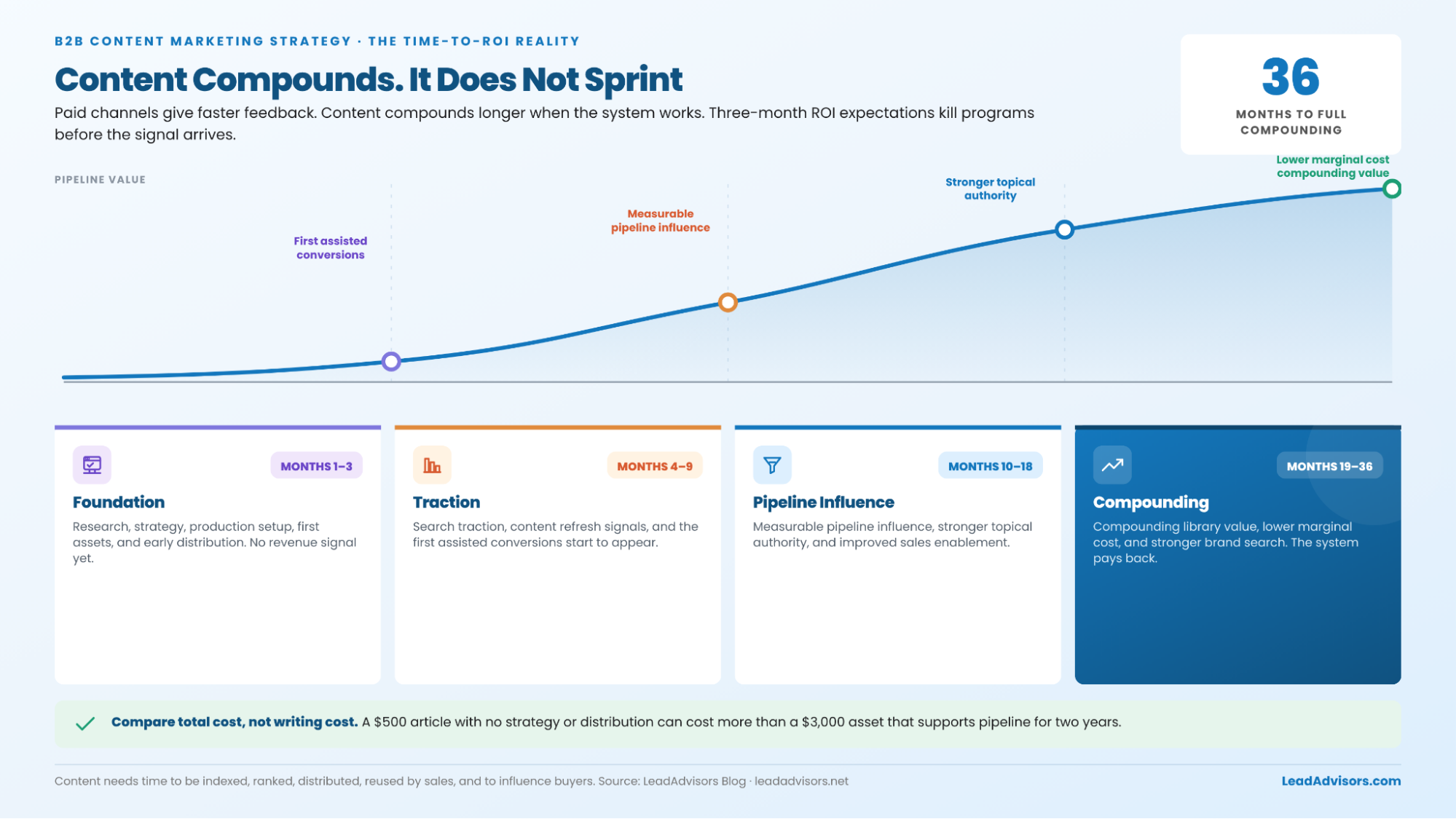
A realistic content timeline often looks like this:
- Months 1-3: Research, strategy, production setup, first assets, early distribution
- Months 4-9: Search traction, content refresh signals, first assisted conversions
- Months 10-18: Measurable pipeline influence, stronger topical authority, improved sales enablement
- Months 19-36: Compounding library value, lower marginal cost, stronger brand search
This is why three-month ROI expectations kill content programs early.
Content needs enough time to be indexed, ranked, distributed, reused by sales, and influence buyers.
The Cost Structure
Operator-grade B2B content operations include strategy, writing, editing, SME interviews, SEO review, design, distribution, analytics, and refresh work.
The total cost depends on volume, vertical complexity, compliance needs, and distribution depth.
The mistake is comparing only the writing cost. A $500 article with no strategy, distribution, or attribution can be more expensive than a $3,000 asset that supports a pipeline for two years.
The Metrics That Matter
Track metrics in layers:
- Top of funnel: impressions, rankings, organic sessions, AI visibility, social reach, and newsletter clicks
- Middle of funnel: returning visitors, content-assisted form fills, demo page visits, sales content usage, and branded search lift
- Pipeline: content-attributable opportunities, assisted pipeline, cost per qualified opportunity, influenced revenue, sales cycle impact, and deal size correlation
The report should not lead with vanity metrics. It should lead with business movement.
Build vs Buy vs Hybrid: The Content Operations Decision
The right content operating model depends on the company’s stage, complexity, and internal expertise.
For software companies, SaaS vertical content marketing changes the content mix.
Those teams may also need SaaS-specific SEO methodology when product-led search matters.
In industrial markets, manufacturing lead generation methodology changes the buyer journey.
Regulated categories require healthcare lead generation to meet compliance or financial services lead generation standards before content goes live.
There is no universal answer.
Build In-House When
Build in-house when content is a core strategic function, and the company has enough scale to support it.
This usually fits when:
- The company has $25M+ revenue or strong funding
- Product or category knowledge is hard to outsource
- The team can hire editorial leadership
- SMEs are available for interviews
- Content is tied to category creation
- The company can wait 12-18 months for the team to mature
In-house gives control. However, it also creates salary, tooling, management, and hiring costs.
Outsource When
Outsource when speed, expertise, and operational capacity matter more than building from scratch.
This often fits when:
- The company has no senior content operator
- The vertical requires specialist writers
- Content volume changes month to month
- Compliance-aware review is needed
- The company needs a 60-90 day ramp
- Leadership wants a predictable monthly cost
Outsourcing fails when there is no internal owner. A vendor still needs direction, access, feedback, and accountability.
Use Hybrid When
A hybrid often works best. The internal team owns strategy, positioning, and SME access. The external partner supports production, SEO, design, distribution, and reporting.
Common Mistakes in B2B Content Marketing Strategy
Most B2B content failures come from a small set of mistakes:
- Publishing Without Distribution: If the article does not reach search, LinkedIn, email, sales, and relevant communities, it will not create enough qualified attention.
- Skipping ICP Research Depth: Generic ICPs produce generic content that misses the buyer’s real language, pain points, objections, and evaluation process.
- No Topical Authority Architecture: Random topics do not compound. Pillars, clusters, internal links, and hubs make the library stronger over time.
- Copying Consumer Marketing Playbooks: B2B buyers need help understanding risk, comparing options, and defending decisions.
- No Pipeline Attribution: Attribution need not be perfect. It needs to be consistent.
- Expecting Immediate ROI: Killing a program after 90 days usually means stopping before the system has enough signal.
- Ignoring AI Search: Content needs structure, clarity, authority signals, and original frameworks.
- Over-Investing in Production: More articles do not solve weak distribution. Often, fewer assets with stronger promotion work better.
- No Sales Enablement Content: If sales never use the content, the strategy is missing a high-value distribution channel.
- Ignoring Content Refresh: Refresh old data, improve examples, add internal links, and remove outdated claims.
B2B Content Marketing Strategy Checklist
Use this checklist before building or rebuilding a content program:
- Define the ICP, buying committee, pain points, and buying triggers.
- Build a question inventory from sales and search data.
- Choose 5-15 pillar topics and supporting clusters.
- Map content to awareness, consideration, decision, and customer stages.
- Define distribution before production.
- Create sales enablement assets from core content.
- Add E-E-A-T proof through authorship, sources, and examples.
- Use schema where appropriate.
- Track content-assisted pipeline.
- Review monthly, then refresh or prune quarterly.
This is the practical version of a B2B content marketing strategy template.
B2B Content Marketing Strategy Examples
Here are three practical examples:
- Growth CEO: The buyer’s problem is trust. The strategy should include branded search audit methodology, authority placements, comparison content, and proof assets that improve conversion after prospects search the brand.
- Ops Builder: The buyer’s problem is structure. The strategy should include process guides, operating models, reporting templates, and governance content that proves the company can run a repeatable engine.
- Agency Operator: The buyer’s problem is fulfillment. The strategy should include white-label service pages, partner enablement assets, and evidence that a single partner can support multiple accounts.