Healthcare lead generation helps healthcare teams turn prospects into booked visits, calls, demos, or sales meetings.
It is not one simple marketing plan.
The term covers two jobs. The first is patient acquisition for clinics, care groups, and telehealth teams. The second is B2B healthcare lead generation for companies that sell to hospitals, payers, pharma teams, healthcare IT buyers, staffing teams, and medical device teams.
Both need traffic. But traffic is not the main limit.
The main limit is the system behind the lead.
Healthcare lead generation only works when the team can respond fast. It also needs to qualify leads, send them to the right person, track each step, and follow the rules. That means HIPAA, healthcare ad rules, CMS rules, state ad rules, FDA rules, and TCPA rules for calls or texts.
LeadAdvisors treats healthcare lead generation as a full system. Channels bring in demand. Intake turns that demand into booked visits or meetings. Compliance protects the business. Reports show which leads were added to the pipeline.
That is the difference between buying leads and building a lead engine.


The Two Healthcare Lead Gen Motions Most People Conflate
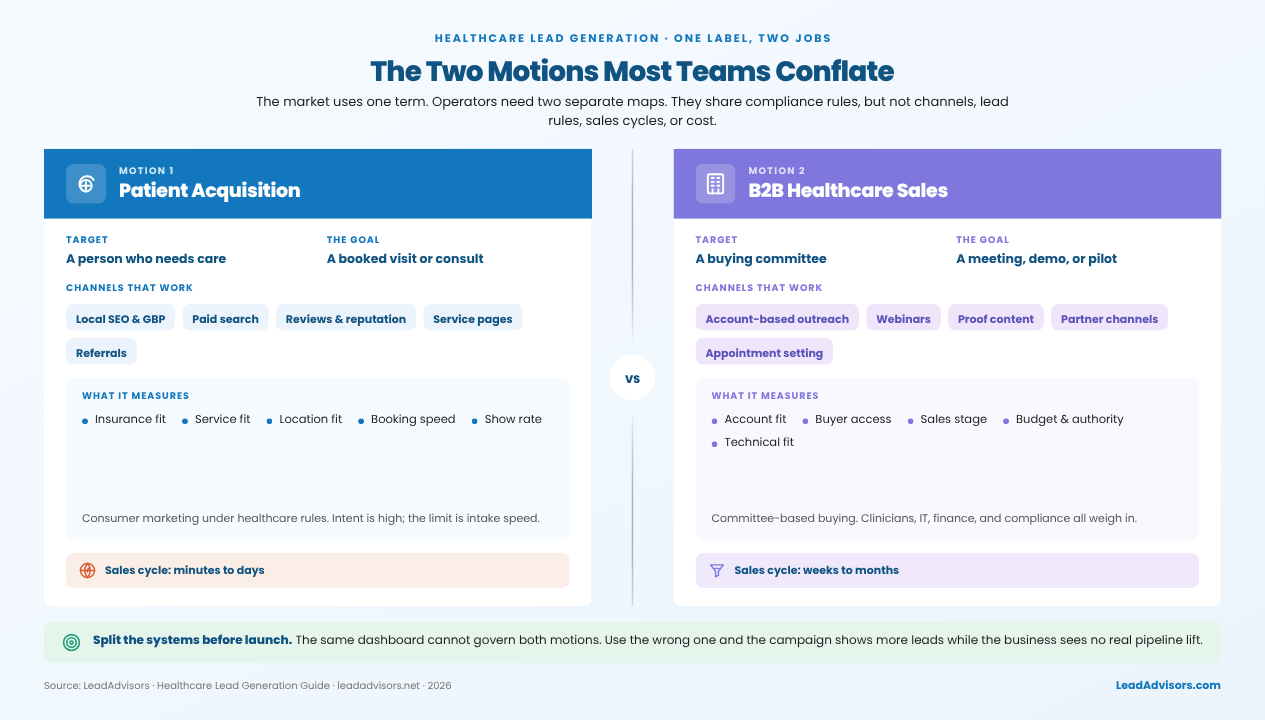
Healthcare lead generation covers two motions: patient acquisition and B2B healthcare sales. They share compliance rules. But they do not use the same channels, lead rules, sales cycles, or costs.
Most healthcare lead generation companies make one mistake early.
They use one playbook for every healthcare audience.
That creates a weak plan. A dental office does not need the same system as a software company that sells to hospitals. A medical device company does not qualify leads the same way a telehealth clinic does. A home health provider does not sell like a healthcare IT vendor.
The market uses one label: healthcare lead generation.
Operators need two separate maps.
Motion 1: Patient Acquisition
Patient acquisition is healthcare marketing for people who need care. The target is a person looking for a provider, treatment, consultation, or service.
The goal is usually a booked visit, a consult, a screening, or a completed intake form.
The channel mix often includes operator-grade local SEO services, healthcare-vertical SEO methodology, Google Business Profile work, paid search, reviews, referrals, and safe follow-up.
Provider groups also need strong service pages. A primary care group may need SEO methodology for physician practices. A dental group may need an SEO methodology for dental practices.
Groups with many offices need SEO infrastructure for multi-location healthcare organizations before they build more location pages.
However, patient acquisition is not complete when someone fills out a form.
The lead still needs fast contact through speed-to-lead infrastructure for inbound response. The intake team needs to check insurance, service fit, location, need, and open time slots. Then it has to book the visit and reduce no-shows with safe follow-up.
That is where many medical lead generation campaigns lose money.
Motion 2: B2B Healthcare Sales
B2B healthcare lead generation targets healthcare buyers, stakeholders, or buying groups.
The goal is usually a sales meeting, a demo, an RFP entry, a pilot, or an account-based talk.
The buying process is slower. It may include clinicians, buyers, IT, compliance, finance, and leaders. In hospitals and health systems, medical devices may also undergo value review before purchase.
B2B healthcare sales lead generation usually needs account-based outreach, webinars, proof content, partner channels, and B2B appointment-setting operations.
The team needs to know the account type, buyer role, buying stage, budget, compliance needs, and business pain points.
That is closer to manufacturing-led generation and committee-based buying methodologies than to consumer healthcare marketing.
Why The Split Matters
The split matters because the wrong motion produces the wrong lead.
Patient acquisition measures visit fit, insurance fit, treatment fit, location fit, and booking speed.
B2B healthcare sales measures account fit, buyer access, sales stage, budget, authority, need, and technical fit.
As a result, the same dashboard cannot govern both motions.
Healthcare lead generation services need to split these systems before launch. If not, the campaign may show more leads while the business sees no real pipeline lift.
That is why teams need a foundational lead-generation framework before adding more channels.
The Healthcare Lead Generation Compliance Stack
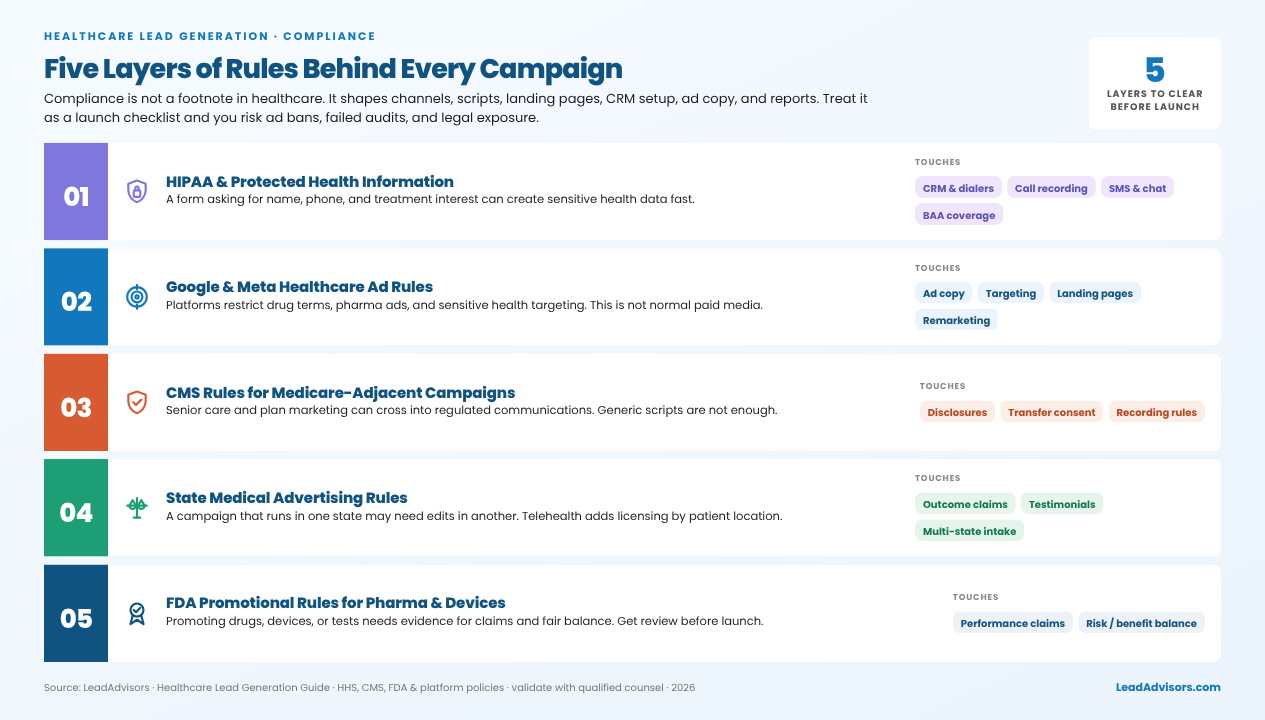
Healthcare lead generation runs under five layers of rules. Teams that treat these rules as a launch checklist risk ad bans, failed audits, bad handoffs, and legal problems.
Compliance is not a footnote in healthcare.
It shapes channels, intake scripts, landing pages, CRM setup, call recording, texts, ad copy, remarketing, and reports.
For outbound teams, TCPA compliance must be in place before call volume grows.
This is why healthcare lead generation needs a working system, not just a list of tactics.
Layer 1: HIPAA And Protected Health Information
HIPAA matters when healthcare campaigns collect or use protected health data.
That can happen fast.
A form that asks for a name, phone number, and treatment interest may create sensitive health data. A recorded call that includes symptoms, diagnosis history, insurance details, or treatment needs can also create protected data.
HHS explains that the HIPAA Security Rule establishes national standards for protecting electronic health information. These rules apply to covered entities and business associates. In late 2024, HHS OCR also proposed updates to strengthen cybersecurity protections for ePHI, as threats to health data continue to rise.
That matters because the marketing stack is often bigger than the clinical stack.
CRM tools, dialers, call recording, SMS tools, chatbots, analytics, AI assistants, and reports may all touch lead data. This also affects how teams compare in-house SDR teams versus outsourced BPO operations.
If those systems handle health data, the team needs HIPAA review and Business Associate Agreement coverage where required.
That is an operations problem, not a marketing problem.
Layer 2: Google And Meta Healthcare Advertising Rules
Healthcare paid media does not run like normal paid media.
Google and Meta restrict many healthcare topics. Google’s Healthcare and medicines advertising policy limits the use of prescription drug terms, pharma ads, and other healthcare topics. Meta’s Health and Wellness advertising policy also limits sensitive health ads.
This affects ad copy, landing page claims, targeting, remarketing, and account health.
Safe paid search and social need more than a media buyer. They need a campaign build that starts with claims, targeting rules, consent, and intake.
Layer 3: CMS Marketing Rules For Medicare-Adjacent Campaigns
Medicare and Medicare Advantage marketing adds another layer.
CMS maintains Medicare marketing guidelines for Medicare Advantage plans, drug plans, and related groups. CMS also issued the Contract Year 2026 policy and technical changes for Medicare Advantage and Part D in April 2025.
This matters because senior care and plan marketing can cross into regulated communications. Teams need to watch disclosures, allowed outreach, transfer consent, recording rules, and plan rules before launch.
Layer 4: State Medical Advertising Rules
State medical boards can also regulate healthcare ads.
Common risks include misleading claims, promises of outcomes, testimonials, specialist titles, before-and-after images, and disclosure rules.
A campaign that works in one state may need edits before it runs in another. Telehealth adds more complexity because provider licensing can depend on the patient’s location.
Multi-state programs also need multi-region operational coverage when intake and follow-up span time zones.
Layer 5: FDA Promotional Rules For Pharma And Medical Devices
FDA rules matter when a campaign promotes prescription drugs, medical devices, tests, or regulated healthcare products.
The FDA’s Digital Health Center of Excellence and guidance for artificial intelligence-enabled medical devices matter when software claims move toward clinical use.
Medical device campaigns need evidence to support performance claims. Pharma campaigns need careful handling of uses, risks, benefits, and a fair balance. If claims relate to clinical results or regulated products, obtain regulatory review before launch.
Patient Acquisition Channels That Work In Healthcare
Patient acquisition is a consumer marketing subject to healthcare regulations. The right mix combines local SEO, patient education, reputation, compliant paid search, and intake follow-up.
The mix should start with intent. Patients search for care when they need it, compare providers when the risk feels high, verify a provider’s reputation, and expect a fast response.
Local SEO And Google Business Profile
Most patient searches have local intent. People search for a doctor, dentist, clinic, specialist, or treatment near them.
That makes Google Business Profile, reviews, directory accuracy, and location pages important.
For multi-location groups, each office needs correct hours, insurance, phone routing, services, and provider details. Local SEO is an operations task, not only a content task.
Healthcare SEO And E-E-A-T
Healthcare content sits inside a YMYL category. Google says its systems aim to reward helpful, reliable, people-first content, not content made only to manipulate rankings. Google also explains that E-E-A-T added “Experience” to expertise, authoritativeness, and trustworthiness in its quality rater guidance. The framework is not a direct ranking score, but it helps define what strong healthcare content should prove.
For healthcare SEO, that matters.
Content should show medical accuracy, clear sourcing, visible authorship, updated claims, and operational detail. Generic agency copy does not create trust for patients or providers.
For deeper trust-building, use the E-E-A-T framework Google applies to YMYL content.
For AI search visibility, connect the content strategy to answer engine optimization fundamentals. It should also support earning citations in Google AI Overviews for YMYL content.
Patient education content should answer questions about fit, visit, payment, and next steps. That helps patients decide. It also helps intake teams receive better-fit inquiries.
Reviews And Reputation
Healthcare reviews carry more weight than ordinary service reviews.
A patient is not just choosing convenience. They are choosing trust.
That means reputation management needs structure. The practice needs a review request process, response guidelines, escalation rules, and privacy-safe language. Public responses should never confirm a patient relationship.
Use online reputation management methodology to structure the system. For lower-trust or reputation-recovery cases, apply negative-review management in service-based businesses before pushing more paid traffic.
Otherwise, spending can amplify a trust problem.
Paid Search And Paid Social
Paid search can work well in healthcare because search intent is direct.
However, a compliant setup matters.
Ad copy should avoid outcome guarantees, unsupported claims, restricted terms, and misleading urgency. Landing pages should include accurate service details, required disclosures, and a clean intake path.
Paid social is more sensitive. Meta and similar platforms restrict targeting and personalization around health conditions. That makes creative, audience structure, and landing page review critical before launch.
Paid channels can scale qualified patient leads. But they should not run ahead of compliance and intake capacity.
Patient Intake And Speed-To-Lead
Patient acquisition channels drive calls and form fills. Intake converts them into booked appointments and held visits.
Healthcare lead generation usually fails in the gap between inquiry and appointment.
If calls go unanswered, forms sit overnight, or follow-up stops after one attempt, the campaign leaks revenue. That is an intake problem, not a traffic problem.
Speed-To-Lead
Patients in active research mode often contact more than one provider.
The first team to respond with a clear next step has an advantage. That is why speed-to-lead matters in healthcare.
The intake team needs a clear response rule: call new form fills within minutes, retry non-responders, route urgent cases, document outcomes, and escalate unclear cases.
If the team cannot maintain that pace in-house, outsourced appointment setting for healthcare intake operations can help cover the workload.
HIPAA-Compliant Intake Infrastructure
Intake calls and form responses can capture health information.
That means the tools matter.
Voice systems, call recording, CRM, SMS, chat, and reporting need a healthcare review. If a vendor touches a health context, the organization needs to know whether BAA coverage or a different configuration is required.
The intake operation also needs training.
Agents need to know what to ask, what not to ask, how to document, and when to escalate. They also need scripts that match the service line.
Insurance, Scope, And Capacity
Patient intake should verify insurance before booking when it affects eligibility.
It should also confirm the scope of care.
A spine surgeon’s office does not benefit from booking general orthopedic cases that need referral. A behavioral health provider does not benefit from booking cases outside licensure, payer, or program fit.
Capacity matters, too.
Marketing should know the provider’s availability before spending on scales. If the practice cannot book new patients for six weeks, additional leads may create frustration rather than growth.
For teams with heavy inbound volume, managed inbound intake operations can separate patient response from overloaded front-desk work.
B2B Healthcare Lead Generation Channels
B2B healthcare sales need fewer channels and better execution. The goal is qualified meetings with the right accounts, not more generic MQLs.
B2B healthcare buyers do not move like consumer patients.
The American Hospital Association’s Fast Facts on U.S. Hospitals, 2026, reports that there are 6,100 hospitals in the United States, including 5,121 community hospitals. That scale shows why healthcare selling often depends on segmentation, account tiers, and stakeholder mapping.
They research risk. They ask stakeholders. They compare vendors. They involve compliance, finance, procurement, and IT. A single lead rarely closes the deal alone.
That means the campaign has to map the buying committee.
Medical Device And Equipment Lead Generation
Medical device lead generation usually involves clinical and operational stakeholders.
The buying committee may include:
- clinicians
- value analysis committee members
- supply chain
- biomedical engineering
- finance
- procurement
- executive sponsors
Capital equipment can take months or years. Consumables may move faster, but they still need proof, contracting, and clinical fit.
Channels that work include trade media, clinical evidence content, conference follow-up, KOL relationships, targeted outbound, and account-based campaigns.
The sales motion should not chase every hospital.
It should define the right account tier, service line, buying trigger, and stakeholder path.
Healthcare IT And Software Lead Generation
Healthcare software lead generation needs technical and compliance proof. The AMA’s 2026 Physician Survey on Augmented Intelligence found that physician use of AI reached 81%, more than double the 2023 rate, underscoring how quickly healthcare technology evaluation is moving.AMA 2026 Physician Survey on Augmented Intelligence
The buyer may include a CIO, CMIO, CFO, clinicians, procurement, and a privacy or security officer. The product may also need EHR integration, workflow validation, and security review.
That changes the content.
A generic software demo is not enough. The campaign needs workflow proof, security documentation, implementation clarity, and ROI logic.
B2B healthcare technology lead generation should also use nurture.
Many buyers are not ready now. But they may be ready after a budget cycle, an EHR project, a security review, or a staffing constraint.
Pharma Services, CRO, CMO, And Consulting
Pharma services and healthcare consulting require authority. Buyers check risk, compliance, science fit, and proof of execution.
Account-based outbound can work, but the message must speak to the therapy area, business pain, trial stage, rule pressure, or launch need.
Healthcare Lead Generation Unit Economics
Healthcare lead generation economics depend on motion, specialty, sales cycle, capacity, and compliance cost. Generic CPL benchmarks do not tell the full story.
Cost per lead is not the main number.
A cheap lead that does not book, qualify, show, or close is expensive. A higher-cost lead that becomes a retained patient or a qualified enterprise opportunity can be profitable.
Healthcare teams need to track the full path.
Patient Acquisition Metrics
Patient acquisition should track:
- cost per lead
- contact rate
- booked appointment rate
- show rate
- cost per acquired patient
- insurance fit
- service-line fit
- lifetime patient value
- provider capacity
Primary care may tolerate a different CPA than fertility, cosmetic surgery, addiction treatment, or specialty surgery. Cash-pay and high-LTV services can often support higher acquisition costs. Insurance-heavy practices may need tighter economics.
The reporting should connect the lead source to the appointment status and patient value.
Otherwise, the team optimizes for form fills.
B2B Healthcare Sales Metrics
B2B healthcare should track:
- target account engagement
- qualified meeting rate
- stakeholder coverage
- sales cycle stage
- cost per qualified opportunity
- pipeline value
- close rate
- average contract value
- time to close
The average contract value can vary widely. Medical device consumables, healthcare IT platforms, staffing engagements, and consulting deals all operate under different economic models.
This is why how to generate leads at scale should not mean “add more channels.” It should mean building a system that produces a measurable, qualified pipeline.
Attribution Problems
Healthcare attribution is messy.
Patient referrals, word-of-mouth, reviews, local search, paid search, and provider reputation often interact before someone books. B2B deals can involve months of touches across many stakeholders.
HIPAA constraints can also limit tracking that marketers use in other verticals.
That means reporting should be practical, not perfect.
Daily reports should cover volume and response. Weekly reports should cover qualification and appointment movement. Monthly reports should connect source, cost, and outcome. Quarterly reviews should include compliance and channel ROI.
For outbound-heavy programs, the contact rate framework for outbound operations helps distinguish lead-quality problems from follow-up problems.
Common Failures That Kill Healthcare Lead Gen ROI
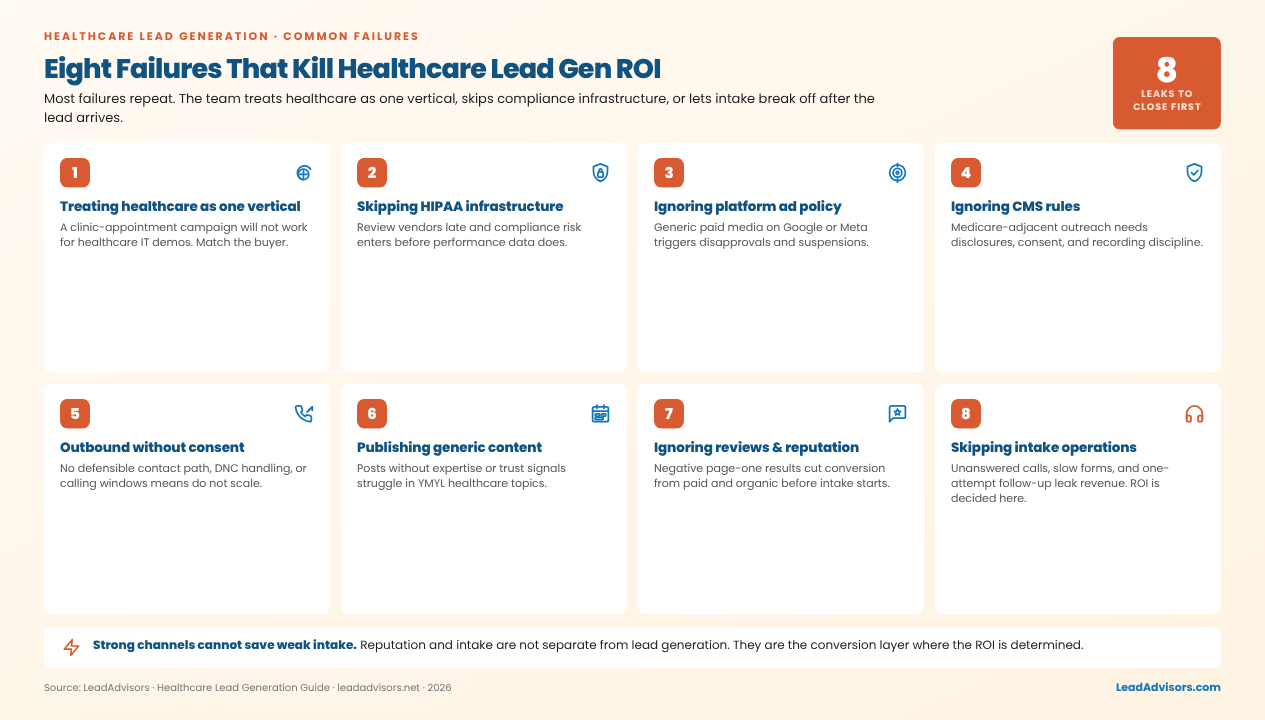
Most healthcare lead generation failures repeat. The team treats healthcare as a single vertical, skips compliance infrastructure, or lets intake break off after the lead arrives.
1. Treating Healthcare As One Vertical
Patient acquisition and B2B healthcare are different motions.
A campaign built for clinic appointments will not work for healthcare IT demos. A medical-device sales motion will not work for acquiring dental patients.
The strategy has to match the buyer.
2. Skipping HIPAA Infrastructure
Marketing automation, CRM, SMS, dialers, call recording, AI tools, and reporting systems can all touch the health context.
If the team does not review vendors and workflows early, compliance risk enters the campaign before performance data does.
3. Building On Platforms Without Healthcare Policy Awareness
Google and Meta have restrictions on healthcare advertising.
A generic paid media setup can trigger disapprovals, suspensions, or poor delivery. Healthcare campaigns need policy-aware ad copy, landing pages, targeting, and certification checks where required.
4. Ignoring CMS Rules In Medicare-Adjacent Verticals
Medicare-adjacent campaigns need extra review.
Disclosure language, permitted outreach, agent or broker rules, recording requirements, and transfer consent can all affect execution. Generic senior-care scripts are not enough.
For comparison, regulated verticals outside healthcare face similar constraints. The financial services lead generation playbook and the insurance vertical lead generation methodology demonstrate why compliance must shape the channel plan early on.
5. Running Outbound Without Consent Discipline
Outbound can work in B2B healthcare and select patient re-engagement cases.
However, phone and SMS require consent discipline, DNC handling, calling windows, script review, and documentation.
If the team cannot defend the contact path, it should not scale the channel.
6. Publishing Generic Healthcare Content
Healthcare content needs trust.
Google’s quality systems reward helpful, reliable, people-first content. For healthcare, that means accurate claims, credible sources, medical review when needed, and clear author or organizational trust signals.
Generic blog posts without expertise will struggle in YMYL topics.
7. Ignoring Reviews And Reputation
Healthcare reviews affect conversion.
Practices that do not operate review acquisition and response protocols lose trust before intake starts. Negative results on page one can also reduce conversion from paid and organic traffic.
Reputation is not separate from lead generation.
It is part of the conversion layer.
8. Skipping Intake Operations
Strong channels cannot save weak intake.
If calls go unanswered, forms sit too long, insurance is not verified, or follow-up stops after one attempt, the campaign leaks revenue.
Intake is where the ROI for healthcare lead generation is determined.