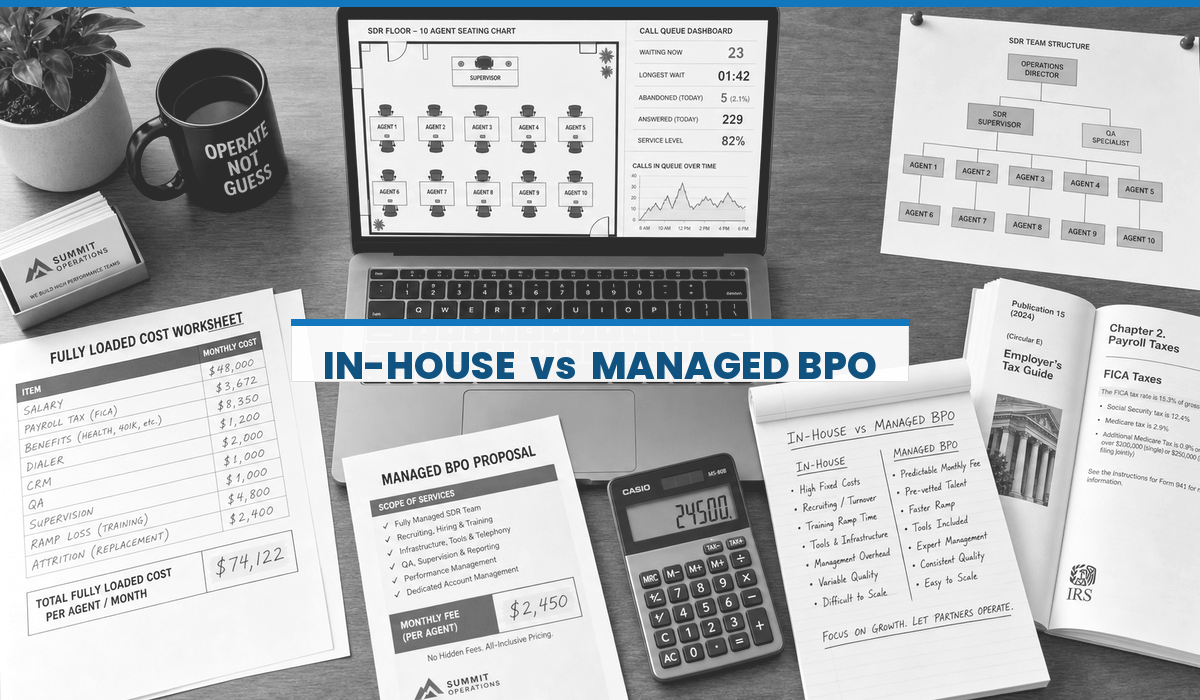
A choice is often made between building an in-house SDR team and using a managed BPO program. It is usually treated as a simple comparison: salary vs. monthly fee. That comparison is often found to be incomplete.
One rep rarely powers a full outbound contact program. It is usually run as a 5–25+ agent operation with a dialer, QA, supervision, reporting, and compliance rules. When that full system is priced in, the “cheaper” option is often changed.
This post focuses on cost math and the decision framework. It is not a basic guide to outsourcing. Direct answers are provided early:
- Is managed BPO usually cheaper than a salary? No. The monthly fee is often higher than the base salary.
- Is managed BPO often cheaper than a fully-loaded in-house cost? Yes, once payroll taxes, benefits, tools, ramp loss, churn replacement, QA, and supervision are counted.
- What should the decision be based on? It should be based on total monthly cost at scale, time-to-output, compliance burden, QA visibility, and coverage stability.
For U.S. payroll tax baselines, employer Social Security (6.2%) and Medicare (1.45%) rates have been stated in IRS Publication 15 (Circular E), Employer’s Tax Guide, which totals 7.65% as a common minimum baseline for employer FICA.


Why the Surface-Level Cost Comparison Is Wrong
The most common mistake is comparing base salary to the BPO monthly fee. That comparison often makes the in-house look cheaper at first because one line item is being compared to a bundled program.
In-house is often underpriced because these costs are missed or understated:
- Employer payroll taxes (U.S. baseline often starts at 7.65% for FICA; see IRS Publication 15)
- Benefits and paid time off
- Equipment and seat setup
- Dialer licensing, phone infrastructure, and call recording
- CRM admin time and reporting
- Lead data costs (lists, enrichment, validation)
- Contact rate is often capped by list quality and hygiene.
- Management and supervision overhead
- QA staffing and call monitoring
- Attrition replacement (recruiting + onboarding + coverage gaps)
- Ramp loss (early output is not full)
This section is calibration, not persuasion. The goal is to compare the right numbers before a decision is made.
The Fully-Loaded Cost of an In-House Outbound Contact Team
A 10-agent baseline is used because most outbound programs become “real operations” at this size. At 10 seats, management, QA, and reporting cannot be treated as side work.
1) Base salary per agent
Base pay varies by location and scope:
- U.S.-based SDR vs offshore dialing agent
- Pipeline SDR vs dialing/transfer specialist
- Regulated vs non-regulated scripts
Because ranges vary, a range is usually more honest than a single number.
2) Employer burden (taxes + benefits)
Two layers are usually added:
- Payroll taxes
In the U.S., employer Social Security (6.2%) and Medicare (1.45%) rates are stated by the IRS in Publication 15, totaling 7.65% as a common minimum baseline for employer FICA. - Benefits + PTO
Benefits should be modeled as a percentage range, because plans vary by company and state.
3) Management and supervision
At 10 agents, supervision is not optional. A lead or supervisor is usually required to:
- enforce attendance and schedules
- run coaching and QA feedback loops
- keep scripts consistent
- correct dispositions and routing issues early
If supervision is not staffed, “cheap” headcount is often bought at the cost of inconsistent output.
4) Dialer and tech stack
Outbound output is driven by infrastructure. A basic stack usually includes:
- dialer
- call recording and storage
- CRM access and workflows
- reporting dashboards
- (when used) SMS and email tooling
Dialer mode choice is often a hidden driver of both performance and compliance. See Predictive vs Power vs Preview Dialer for a practical breakdown.
5) QA staffing and monitoring
QA is often treated as “nice to have.” In regulated or high-volume programs, QA is a cost of staying stable:
- Script drift is caught earlier
- Bad dispositions are reduced
- compliance mistakes are prevented before they scale
6) Recruiting, attrition, and ramp loss
Attrition is not just replacement cost. It creates:
- empty seats (coverage gaps)
- paid training time
- lower early output
- Management time spent on rehiring instead of coaching
Ramp loss is often the highest hidden cost because productivity is rarely full on day one.
How to present the in-house number:
Loaded monthly cost per seat (steady-state) should be shown, plus a separate ramp/attrition variance layer.
The Fully-Loaded Cost of a Managed BPO Program
Managed BPO pricing often looks expensive next to salary. The comparison changes when the fee is compared to the fully-loaded in-house number.
What the managed BPO fee typically includes
In many managed programs, the monthly fee bundles:
- agent labor
- HR and payroll administration
- supervision and team leads
- QA and call monitoring (in full-managed programs)
- reporting cadence and performance routines
- workforce scheduling and coverage control
What it typically does not include
These items are often still owned by the client:
- CRM licenses and internal admin work
- lead list and enrichment costs
- Final script approval and compliance sign-off
Common pricing models
Pricing is usually structured as:
- per-seat monthly retainer (common for managed programs)
- hourly rates plus management fees
- hybrid/performance structures (less common and often more complex)
The right model is the one that matches your operating needs: stable headcount, predictable output, and clear reporting.
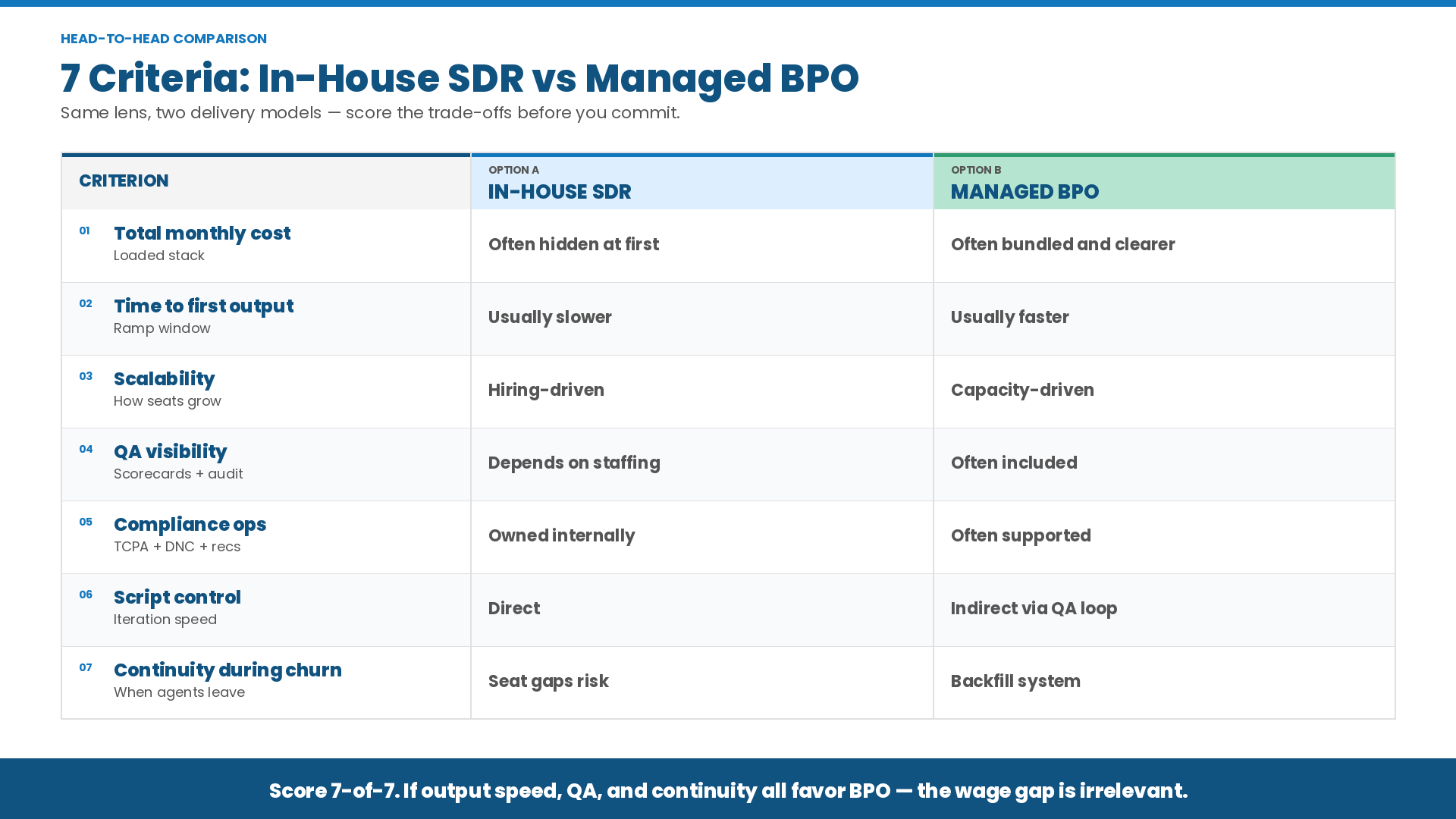
Head-to-Head: 7 Criteria That Actually Drive the Decision
1) Total monthly cost at 10 agents
The comparison is only meaningful after payroll taxes, benefits, tooling, management, QA, and ramp loss are priced on the in-house side. Otherwise, the base salary is being compared to a full operating system.
2) Time to first productive agent
In-house is often delayed by recruiting and ramp-up. Managed programs often start faster because the team, supervision, and tooling already exist.
Speed-to-output is often tied to follow-up speed. See Speed-to-Lead for why fast first-call timing changes conversion math.
3) Scalability
In-house scaling is often limited by hiring cycles and training bandwidth. Managed scaling is often capacity-driven, but contract terms can affect how quickly scale-down happens.
4) QA and performance visibility
In-house visibility depends on whether QA and reporting are staffed. Managed programs often include QA, but visibility still needs active review, scorecards, and cadence.
5) Compliance management
In-house teams own the operational work. Managed programs can reduce the operating burden, but legal liability is usually still owned by the client.
6) Control over script and agent behavior
In-house control is direct. Managed control is usually run through QA loops, coaching cadence, and escalation paths. The result is often stable, but it is not “walk-the-floor” control.
7) Attrition risk and coverage continuity
In-house churn often creates seat gaps and ramp resets. Managed programs often absorb attrition and preserve headcount continuity, which protects output.
Who Should Build In-House
In-house is often the better fit when:
- Offshore HR and management infrastructure already exists
- Compliance processes are specialized and tightly controlled internally
- Training requires long onboarding and institutional knowledge
- The scale is high enough to spread overhead
Who Should Use a Managed BPO Program
Managed BPO is often the better fit when:
- Productive output is needed quickly
- QA and supervision are not staffed internally
- The contact rate is low due to infrastructure gaps, not just the lead volume
- Compliance operations need structure and monitoring
The Hybrid Model — When You Run Both
Hybrid models work when:
- High-touch accounts are handled in-house
- High-volume contact work is handled through a managed program
- Segmentation rules are clear, and reporting is not blended
The Comparison Table
| Criteria | In-House | Managed BPO |
| Total monthly cost (loaded) | Often hidden at first | Often bundled and clearer |
| Time to output | Usually slower | Usually faster |
| Scalability | Hiring-driven | Capacity-driven |
| QA visibility | Depends on staffing | Often included |
| Compliance ops | Owned internally | Often supported |
| Script control | Direct control | Indirect control (QA loop) |
| Continuity during churn | Seat gaps risk | Backfill system (often) |
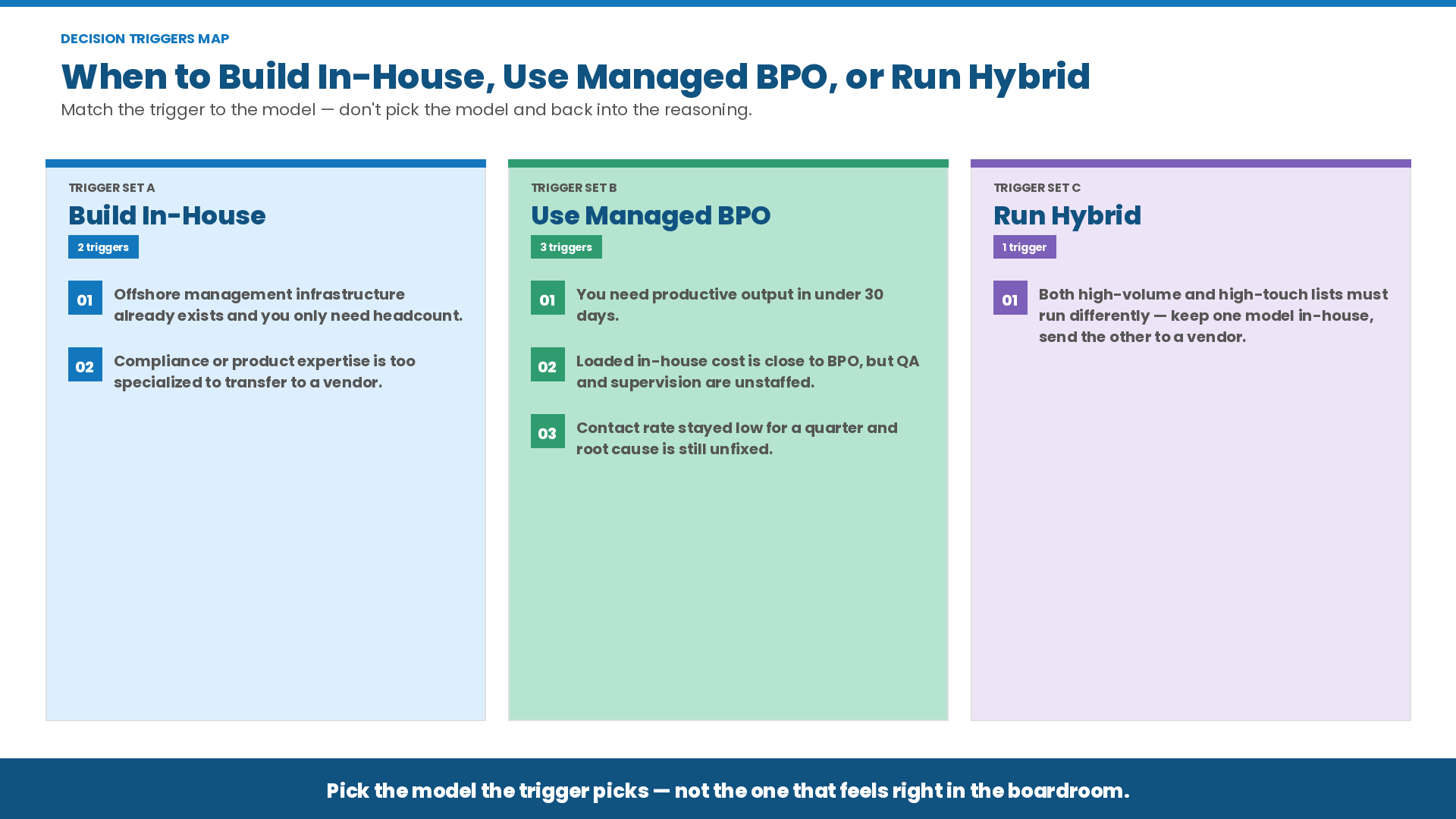
How to Make the Call for Your Program
Three triggers that often point to managed BPO
- Productive output is needed in under 30 days.
- The loaded in-house estimate is close to a managed program, but QA and supervision are not staffed internally.
- The contact rate has stayed low for a quarter or more, and the root cause has not been fixed.
Two triggers that often point to in-house
- Offshore management infrastructure already exists, and only headcount is needed.
- Compliance or product expertise is too specialized to transfer quickly.
One trigger for hybrid
Both a high-volume list and a high-touch list exist and must be run differently.