Most SEO audits do not fail because teams lack data. They fail because the report gives every issue the same weight.
That creates shelfware. A $2,500 to $15,000 audit becomes a PDF nobody owns, while rankings stay flat, competitors keep moving, and revenue pages remain blocked by fixable technical, content, authority, or trust gaps.
This guide shows what an operator-grade SEO audit should do. It uses the SEO Audit Quality Checklist to score eight layers, separate urgent fixes from noise, and turn findings into a P0/P1/P2 action list with owners, effort, evidence, and next steps. LeadAdvisors uses this standard before strategy, content, or technical execution begins.
Goal: find what matters, fix it first, and prove performance moved with data clearly.


What an SEO Audit Actually Is And What It Isn’t
An SEO audit is a structured, point-in-time review of a site’s organic search health. It should end with a prioritized list of fixes, not a raw dump of findings.
A good audit checks technical health, content quality, keyword targeting, authority signals, structured data, AI search visibility, analytics, and trust signals.
It answers three questions:
- Can search engines crawl, render, index, and understand the site?
- Does the content match the right search intent?
- Can the business prove enough authority and trust to compete?
That last question matters more in 2026.
Google’s Search Essentials explains the basic requirements for appearing in Search. However, Google also notes that meeting technical requirements does not guarantee crawling, indexing, or ranking. In other words, technical access is only the floor.
An audit should move past access and diagnose performance.
What an SEO Audit Is Not
An SEO audit is not a general website audit.
A general website audit may cover UX, accessibility, design, CRO, brand consistency, and conversion paths. Those areas matter. However, an SEO audit is narrower in scope. It focuses on organic search performance.
For broader website health auditing beyond SEO, use a different scope.
An SEO audit is also not a technical SEO execution.
A technical SEO audit identifies crawlability, indexability, Core Web Vitals, redirects, canonicals, and architecture issues. Technical SEO execution fixes those problems. The audit is the diagnosis. Technical SEO execution and tactical fixes are the treatment.
It is not ongoing SEO maintenance either.
Ongoing SEO maintenance cadence tracks drift after the audit. It monitors rankings, traffic, indexation, links, content decay, and technical regressions. The audit gives the baseline. Maintenance keeps the system from sliding backward.
Finally, an SEO audit is not a ranking report.
Rank tracking shows where keywords sit. An SEO audit explains why they sit there and what can be fixed.
The Direct Answer
An SEO audit is a scored diagnosis of a website’s ability to earn organic visibility. A complete SEO audit checks technical health, content, keywords, authority, structured data, AI visibility, analytics, and E-E-A-T signals.
The output should be a prioritized action list.
If the deliverable does not tell you what to fix first, it is not finished.
The SEO Audit Quality Checklist: Eight Layers That Define a Complete Audit
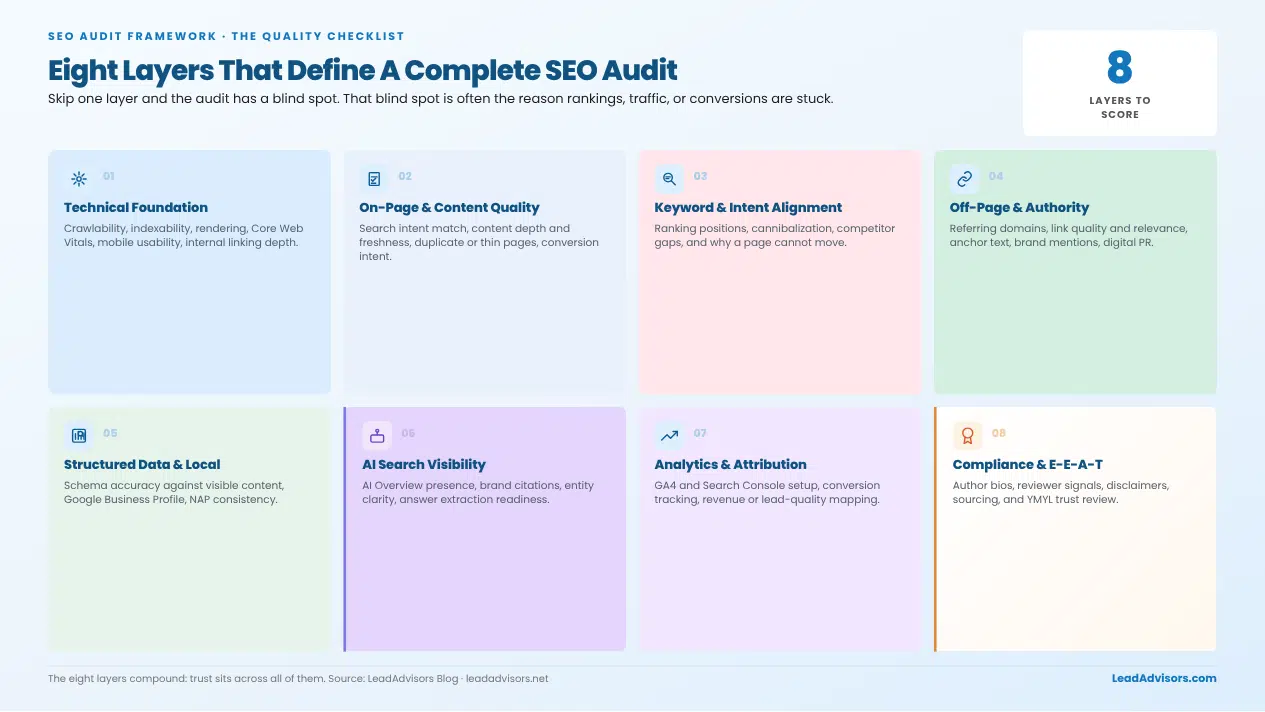
The SEO Audit Quality Checklist is the eight-layer framework that separates an operator-grade audit from a crawler export.
Skip one layer and the audit has a blind spot.
That blind spot is often the reason rankings, traffic, or conversions are stuck.
Layer 1: Technical Foundation
The technical foundation is the access layer.
If search engines cannot crawl, render, or index the right pages, the rest of the audit has limited value.
Check:
- Crawlability
- Indexability
- Robots.txt rules
- XML sitemap accuracy
- Canonical tags
- Redirect chains
- HTTPS coverage
- JavaScript rendering
- Mobile usability
- Internal linking depth
- Orphan pages
- Core Web Vitals
Core Web Vitals are still part of the operator checklist. Google describes Core Web Vitals as real-world user experience metrics for loading performance, interactivity, and visual stability. As of the INP rollout, the core metrics are LCP, INP, and CLS.
Use current Web Vitals thresholds:
- LCP should be 2.5 seconds or less.
- INP should be 200 milliseconds or less.
- CLS should be 0.1 or less.
- Measurements should use the 75th percentile across mobile and desktop.
This layer should produce clear severity calls.
A noindex tag on a revenue page is not equal to a missing alt attribute on an old blog image.
Layer 2: On-Page And Content Quality
On-page and content quality show whether each page deserves to rank for its target query.
Check:
- Title tags
- Meta descriptions
- H1 and H2 structure
- Keyword placement
- Search intent match
- Content depth
- Content freshness
- Duplicate content
- Thin content
- Internal links
- Page-level conversion intent
The audit should not ask, “Does this page mention the keyword?”
That is too shallow.
It should ask, “Does this page satisfy the reason behind the query better than the pages ranking above it?”
For example, a page targeting “SEO audit services” should not read like a beginner tutorial. That user likely wants scope, pricing, deliverables, proof, and next steps.
A page targeting “how to do an SEO audit” needs a process, tools, examples, and a checklist.
The audit should score that difference.
Layer 3: Keyword And Search Intent Alignment
Keyword alignment shows whether the site is competing for the right searches.
Check:
- Current keyword rankings
- Page 1, page 2, and page 3 opportunities
- Keyword cannibalization
- Branded versus non-branded traffic
- Competitor keyword gaps
- Intent mismatch
- Keyword difficulty realism
- Topic cluster coverage
This is where many audits get weak.
They list keywords. However, they do not explain why the page cannot move.
A real audit connects keyword movement to page quality, authority, internal linking, technical access, and SERP intent.
For example, a blog post may rank position 9 for “website SEO audit.” The issue may not be word count. It may be that the SERP favors tools, templates, and service pages.
In that case, the fix is not “add 500 words.” The fix is to match the intent layer with a stronger tool explanation, a report sample, a CTA, and a comparison angle.
Layer 4: Off-Page And Authority Signals
Authority signals show whether the market trusts the site enough to rank it.
Check:
- Referring domains
- Link quality
- Link relevance
- Toxic backlink patterns
- Anchor text distribution
- Brand mentions
- Digital PR footprint
- Competitor backlink gaps
- Unlinked mentions
- Citation quality
Backlinks still matter. However, the audit should not treat all links as equal.
A relevant editorial link from a respected industry site carries more value than a low-quality directory link.
Anchor text distribution and backlink profile health also matter. Over-optimized anchors can create risk. Weakly branded anchors can show poor brand authority.
The audit should compare authority against actual competitors.
If the top three pages have stronger topical authority, deeper content, and better links, the fix may require work on brand authority. Metadata changes will not close that gap alone. This is where anchor text distribution and backlink profile health need a separate review.
Layer 5: Structured Data And Local Signals
Structured data helps search engines understand the page. Local signals help location-based businesses compete where proximity and trust matter.
Check:
- Article schema
- FAQPage schema, where still useful outside the deprecated rich result use
- Organization schema
- LocalBusiness schema
- Product or Service schema
- Review schema compliance
- Google Business Profile completeness
- NAP consistency
- Local citations
- Rich result eligibility
Google’s 2026 documentation updates note that FAQ rich results are being deprecated in Google Search. That does not make FAQ content useless. It means the audit should separate content value from rich-result eligibility.
Structured data must also match visible page content. Google’s AI search guidance says structured data should reflect what users can actually see on the page.
That rule belongs in every SEO site audit.
If the markup says one thing and the page says another, the issue is trust.
Layer 6: AI Search And Answer Engine Visibility
AI search visibility is now part of the audit.
It is not optional for commercial-intent queries.
In 2025, Pew Research Center found that users who saw a Google AI summary clicked a traditional result in 8% of visits. Users who did not see an AI summary clicked a traditional result in 15% of visits. Pew also found that users clicked a link inside the AI summary in only 1% of visits.
That changes how operators should audit visibility.
A site can still rank and lose clicks if an AI-generated answer satisfies the query first.
Check:
- AI Overview presence for target keywords
- Whether the brand gets cited
- Whether competitors get cited
- Clear answer formatting
- Entity clarity
- Author and reviewer signals
- Structured definitions
- Short answer blocks
- Source quality
- Topical authority
This layer should not chase gimmicks. It should connect AI visibility work to earning citations in Google AI Overviews and source-level clarity.
Google’s 2025 guidance for AI experiences says the same fundamentals still matter: helpful content, accessible pages, accurate structured data, and content that matches what users see. That is also why answer engine optimization fundamentals belong in the audit conversation.
So the audit question is simple:
Can an AI system confidently extract, summarize, and cite this page?
If not, improve clarity, sourcing, structure, and authority.
Layer 7: Analytics, Tracking, And Attribution Health
Analytics health shows whether the team can prove the fixes worked.
An audit without measurement is only an opinion.
Check:
- Google Analytics 4 setup
- Google Search Console verification
- Conversion events
- Form tracking
- Call tracking
- CRM attribution
- UTM consistency
- Landing page reporting
- Revenue or lead-quality mapping
- Dashboard accuracy
This layer catches silent failures.
A page may gain traffic but send low-quality leads. Another page may have lower traffic but stronger pipeline value.
The audit needs to separate rankings from business outcomes.
That is especially important for B2B, BPO, financial services, legal, healthcare-adjacent, and other high-trust verticals.
The goal is not more traffic. The goal is better-qualified demand.
Layer 8: Compliance And E-E-A-T Signals
E-E-A-T is the trust layer.
Google says its systems use many factors to identify helpful content. Those factors can demonstrate experience, expertise, authoritativeness, and trustworthiness. Google also states that trust is the most important member of the E-E-A-T family.
For an SEO audit, this means trust signals need their own layer.
Check:
- Clear author names
- Detailed author bios
- Relevant credentials
- Reviewer names, when needed
- Update dates
- Editorial policy
- Fact-checking process
- About page
- Contact page
- Privacy policy
- Terms pages
- Secure HTTPS
- Source citations
- First-hand examples
- Real screenshots or process evidence
- YMYL disclaimers
- Industry compliance language
YMYL content needs stricter review, especially when audits touch financial services, SEO, and compliance requirements.
That includes finance, health, legal, insurance, lending, debt, tax, and healthcare-adjacent content. Legal pages also need legal-vertical SEO under the bar advertising rules when the firm’s claims, intake language, and attorney bios are reviewed.
For these pages, a weak author box is not a minor issue. Unsupported claims can reduce trust. Missing disclaimers can create risk. Thin sourcing can weaken credibility. Use the E-E-A-T framework for content authority to review these trust signals.
Experience also needs proof.
Do not just say the team has run SEO audits. Show how the audit works. Use screenshots, scoring examples, report samples, and before-and-after fix lists.
That is how the page moves from generic advice to people-first content.
The Layer Interaction Reality
The eight-layer compound.
A strong technical foundation lets content get indexed. Strong keyword alignment gives content the right target. Authority signals help the page compete. Analytics prove whether execution worked.
However, trust sits across every layer.
A technically clean site can still underperform if its YMYL content has no author, no reviewer, and no sourcing.
A content-rich site can still lose if its analytics are broken.
A brand with strong backlinks can still struggle if pages target the wrong intent.
That is why a complete SEO audit needs scoring, not just observations.
Types Of SEO Audits By Purpose
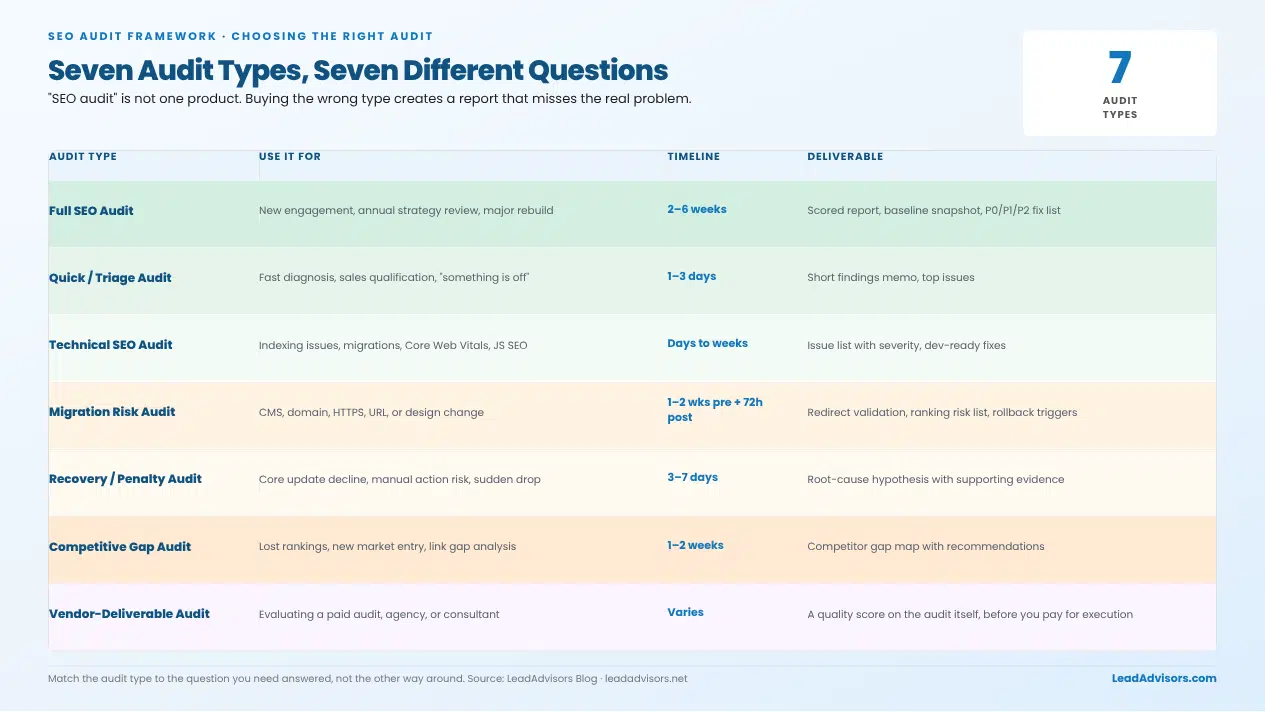
“SEO audit” is not one product. The right audit depends on the question you need answered.
Buying the wrong audit creates a report that misses the real problem.
Full SEO Audit
A full SEO audit covers all eight layers. It is especially useful for enterprise-scale SEO for large site architectures, where templates, sections, and governance rules affect thousands of URLs.
Use it for:
- New SEO engagement kickoff
- Annual strategy review
- Major site rebuild
- New leadership review
- Large performance decline with unclear cause
Timeline: usually 2 to 6 weeks.
Deliverable: scored report, baseline snapshot, and P0/P1/P2 fix list.
This is the right audit when the business needs a complete view.
Quick Or Triage Audit
A quick SEO audit focuses on the highest-signal issues.
Use it for:
- Fast diagnosis
- Sales qualification
- Budget-limited review
- Early vendor evaluation
- “Something is off” situations
Timeline: 1 to 3 days.
Deliverable: short findings memo with top issues.
A free SEO audit tool can support this step. However, a tool scan is not the same as an operator review.
Technical SEO Audit
A technical SEO audit focuses on crawlability, indexability, rendering, performance, architecture, and technical blockers.
Use it for:
- Indexing issues
- Site migrations
- Core Web Vitals problems
- Large crawl waste
- JavaScript SEO concerns
- Redirect or canonical problems
Timeline: several days to several weeks.
Deliverable: technical issue list with severity and developer-ready fixes.
A technical SEO audit service should include evidence of issues, affected URLs, business impact, and implementation notes.
Migration Risk Audit
A migration risk audit protects organic traffic during changes to a platform, domain, design, or URL.
Use it for:
- CMS migration
- Domain change
- HTTPS migration
- URL restructuring
- Site redesign
- Brand consolidation
Timeline: pre-migration review 1 to 2 weeks before launch, followed by a post-launch review within 48 to 72 hours.
Deliverable: redirect validation, indexation monitoring, ranking risk list, and rollback triggers.
Recovery Or Penalty Audit
A recovery audit diagnoses sudden drops in traffic or rankings.
Use it for:
- Core update decline
- Manual action risk
- Sudden indexation loss
- Backlink toxicity concerns
- Major content quality decline
- Algorithmic visibility loss
Timeline: 3 to 7 days for initial diagnosis.
Deliverable: root-cause hypothesis with supporting evidence.
Google’s core update guidance tells site owners to assess whether content is helpful, reliable, and people-first. That makes content quality and E-E-A-T central to recovery audits.
Competitive Gap Audit
A competitive gap audit compares your site against named competitors.
Use it for:
- Lost rankings
- New market entry
- Content cluster planning
- Link gap analysis
- Authority benchmarking
- Enterprise SEO planning
Timeline: 1 to 2 weeks.
Deliverable: competitor gap map with specific recommendations.
This audit should explain what competitors have that you do not.
That may include pages, links, topical depth, schema, authority, or better intent matching.
Vendor-Deliverable Audit
A vendor-deliverable audit checks the quality of another audit.
Use it when:
- You paid for an SEO audit.
- You received a generic report.
- You are evaluating an SEO consultant.
- You are renewing an agency contract.
- You need a second opinion before spending on execution.
This is the audit type most buyers do not know to ask for.
It protects the budget.
A weak audit can create months of low-impact work. A strong vendor-deliverable audit shows which findings are real, which are generic, and which should be ignored.
How To Evaluate An SEO Audit You Paid For
A good audit makes decisions easier. A bad audit creates more work for the team that bought it.
Use five checks to separate real analysis from a template dump.
Check 1: Does It Score Anything?
A real SEO audit scores severity.
It should explain which issues are urgent, which are important, and which can wait.
If every finding has the same weight, the audit skipped the hard part.
Finding issues is easy. Deciding what matters is the work.
Check 2: Are Findings Specific To This Site?
Generic findings are a warning sign.
Weak audit language sounds like this:
- “Improve meta descriptions.”
- “Build more backlinks.”
- “Create quality content.”
- “Fix technical SEO issues.”
Strong audit language names the exact evidence.
It includes:
- Specific URLs
- Specific keywords
- Specific competitors
- Specific crawl issues
- Specific revenue or conversion impact
- Specific owner recommendations
A finding that could apply to any site is not an analysis.
Check 3: Does It Cover All Eight Layers?
Many SEO audit tools are crawler-first.
That is useful, but incomplete.
A crawler can surface broken links, missing tags, duplicate titles, and redirect chains. However, it cannot fully judge brand authority, buyer intent, E-E-A-T, AI visibility, or business impact.
A real SEO website audit covers the full system.
Technical issues matter. They are not the whole audit.
Check 4: Does It Connect Findings To Business Outcomes?
“This page has a missing H1” is a finding.
“This page ranks position 8 for a high-intent keyword and has three fixable on-page gaps” is an analysis.
The difference matters.
SEO teams do not have unlimited capacity. The audit should protect that capacity.
A missing H1 on a low-value page may not matter. A weak title, thin content, and missing schema on a revenue page may be a P1.
Check 5: Is There A Path From Findings To Action?
A useful SEO audit report ends with execution.
Every major finding should include:
- Priority tier
- Affected URLs
- Business impact
- Effort estimate
- Owner
- Recommended next step
- Success metric
If the team cannot start from the report tomorrow, the audit will not be done.
For evaluating SEO consultants and engagement models, ask for a redacted audit sample before signing.
Good vendors should be able to show how they think.
Audit Tools And What They Actually Tell You
SEO audit tools are useful. However, tool output is raw material, not the audit.
No single tool covers every layer.
Free SEO Audit Tools
A free SEO audit tool can help with first-pass checks.
It may identify:
- Missing titles
- Duplicate meta tags
- Broken links
- Page speed issues
- Basic mobile issues
- Some crawl problems
- Basic on-page gaps
This satisfies the fast-scan intent behind searches like “free SEO audit,” “free website SEO audit,” and “SEO audit tool free.” For a fast scan, use the free automated site audit tool as a starting point.
However, free tools usually miss the hardest questions.
They rarely explain:
- Which issue matters most
- How the issue affects revenue
- Whether the page matches intent
- Whether the brand has enough authority
- Whether the audit is complete
- Who should own the fix
Use free tools for triage.
Do not use them as the final diagnosis.
Crawler Tools
Crawler tools simulate how a search engine crawls a site.
They answer:
- What is broken?
- What is blocked?
- What is duplicated?
- What is too deep?
- What redirects badly?
They do not answer whether the content deserves to rank. For content-layer tooling, use an on-page SEO analysis tool comparison to choose the right support workflow.
Rank Tracking Tools
Rank trackers show keyword movement.
They answer:
- Where do we rank?
- What moved?
- Which pages gained or lost visibility?
They do not explain why the movement happened.
Use them with content, link, and technical data.
Backlink Analysis Tools
Backlink tools show authority patterns.
They answer:
- Who links to us?
- Which links look risky?
- Which competitors have stronger authority?
- What anchor text patterns exist?
They do not prove content quality.
They also do not replace human judgment.
Analytics And Search Console
Google Analytics and Search Console provide ground-truth performance data.
They answer:
- Which pages get clicks?
- Which queries drive impressions?
- Which pages convert?
- Where did traffic change?
- Which technical issues does Google report?
This layer should anchor the audit. It should also connect to SEO reporting and measurement methodology before execution starts.
Third-party estimates are useful. First-party performance data is stronger.
AI Visibility Tools
AI visibility tools track citations and the presence of answer engines.
They answer:
- Does the brand appear in AI answers?
- Which competitors get cited?
- Which pages are citation-ready?
- Which queries trigger AI summaries?
This category is still maturing.
Therefore, use it as directional evidence. Pair it with manual query sampling and source review. SaaS audits should also account for SaaS-specific SEO methodology when product pages, comparison pages, and signup paths drive the pipeline.
From Findings To Action: The Prioritization System
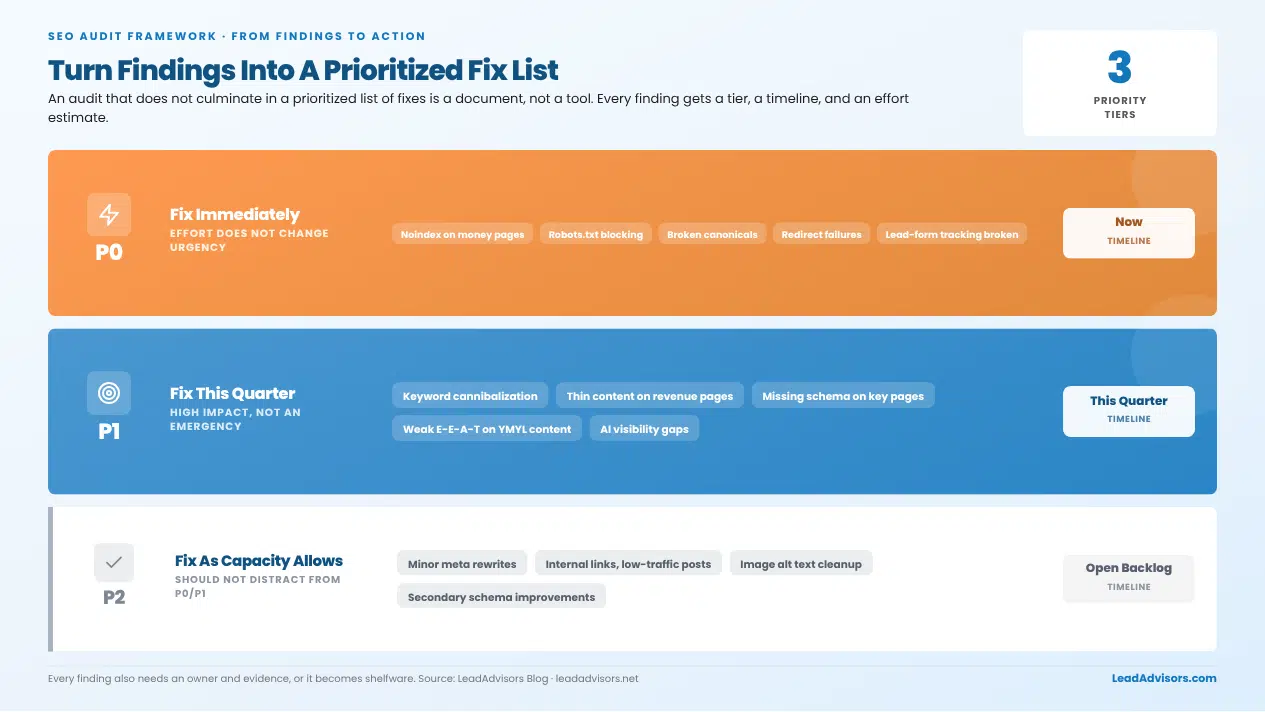
An SEO audit that does not culminate in a prioritized list of fixes is a document, not a tool.
Use P0, P1, and P2 tiers.
P0: Fix Immediately
P0 issues block performance now.
Examples:
- Noindex tags on money pages
- Robots.txt blocking key sections
- Broken canonicals on revenue pages
- Sitewide redirect failures
- HTTPS or security issues
- Severe Core Web Vitals failures on high-value pages
- Analytics tracking is broken on lead forms
- Manual action risk
These issues get fixed first.
Effort does not change urgency.
P1: Fix This Quarter
P1 issues are high impact but not emergencies.
Examples:
- Keyword cannibalization on high-value terms
- Thin content on revenue pages
- Missing schema on key pages
- Weak E-E-A-T on YMYL content
- Toxic backlink cleanup
- Poor internal linking to priority pages
- Content decay on ranking pages
- AI visibility gaps for commercial queries
These issues should be included in the quarterly execution plan.
They often create the biggest ranking gains after P0 blockers are removed.
P2: Fix As Capacity Allows
P2 issues are lower-impact or lower-urgency.
Examples:
- Minor meta description rewrites
- Internal links on low-traffic posts
- Image alt text cleanup
- Low-priority content refreshes
- Formatting fixes
- Secondary schema improvements
P2 work still matters.
However, it should not distract from the execution of P0 and P1.
Effort Versus Impact
Each finding needs an effort estimate.
Use simple labels:
- Low effort: hours
- Medium effort: 1 to 3 days
- High effort: multi-team or multi-week work
Then sequence work by impact and effort.
High-impact, low-effort fixes go first inside each tier.
That builds momentum.
Ownership Assignment
Every finding needs an owner.
Use categories like:
- Developer
- SEO lead
- Content writer
- Editor
- Designer
- Analytics owner
- Outreach lead
- Compliance reviewer
Findings without owners become shelfware.
The audit should prevent that.
Common Mistakes That Turn SEO Audits Into Shelfware
Most audits fail after delivery. The findings may be right, but the operating system is missing.
1. No Prioritization
A list of 200 findings is not useful on its own.
Without severity, the team treats everything as optional.
2. No Owner Assignment
A task without an owner is not a task.
It is a suggestion.
3. Auditing Once And Never Again
A single audit becomes stale.
Sites change. Competitors move. Google updates systems. Content decays.
Run full audits annually. Run triage reviews quarterly. Then use the monthly SEO reporting quality checklist to keep fixes tied to performance.
4. Skipping AI Search
AI summaries are already changing click behavior.
Pew’s 2025 data shows lower traditional result clicks when AI summaries appear.
That does not mean SEO is dead. It means audits need to check citation readiness and answer extraction.
5. Treating Technical Findings As The Whole Audit
Technical SEO is one layer.
It is not the full audit.
Content, authority, analytics, and trust can block growth even when the crawl is clean.
6. No Baseline
Without a baseline, the team cannot prove improvement.
Capture rankings, traffic, conversions, indexation, Core Web Vitals, and key issue counts before execution starts.
7. Generic Findings
Generic findings create low trust.
Teams ignore reports that feel like they were copied from a template.
8. No Re-Audit Scheduled
Re-audits create accountability.
They show whether the P0 and P1 fixes happened. They also show whether those fixes moved the right metrics.
9. Ignoring Business Context
Not every SEO issue has the same business value.
Fix revenue pages first. Then fix support pages, old blogs, and low-impact assets. For B2B teams, the audit should also support the B2B content marketing operating model that turns findings into production priorities.
10. Confusing The Audit With Strategy
An audit diagnosis.
Strategy decides what to build next.
The audit should feed the strategy. It should not replace it.
SEO Audit Report Format
A strong SEO audit report should be built for execution.
The format matters because teams need to act on it.
Include these sections:
- Executive summary
- Scope and audit type
- Baseline metrics
- Eight-layer findings
- P0/P1/P2 fix list
- Owner assignments
- Effort estimates
- Evidence links
- Affected URLs
- Success metrics
- Re-audit date
Sample SEO Audit Report Table
| Priority | Finding | Evidence | Impact | Owner | Effort | Success Metric |
| P0 | Money page blocked by noindex | URL list + source check | Page cannot rank | Developer | Low | Page indexed |
| P1 | The YMYL article lacks an author and a reviewer | Page review | Trust gap | Editor | Medium | Bio + review added |
| P1 | Keyword cannibalization across 3 URLs | GSC + SERP review | Ranking dilution | SEO lead | Medium | One target URL improves |
| P2 | Missing meta descriptions on old posts | Crawl export | Low CTR risk | Content writer | Low | Metadata completed |
This is the Notion-paste format.
It turns an SEO audit report into a work queue.