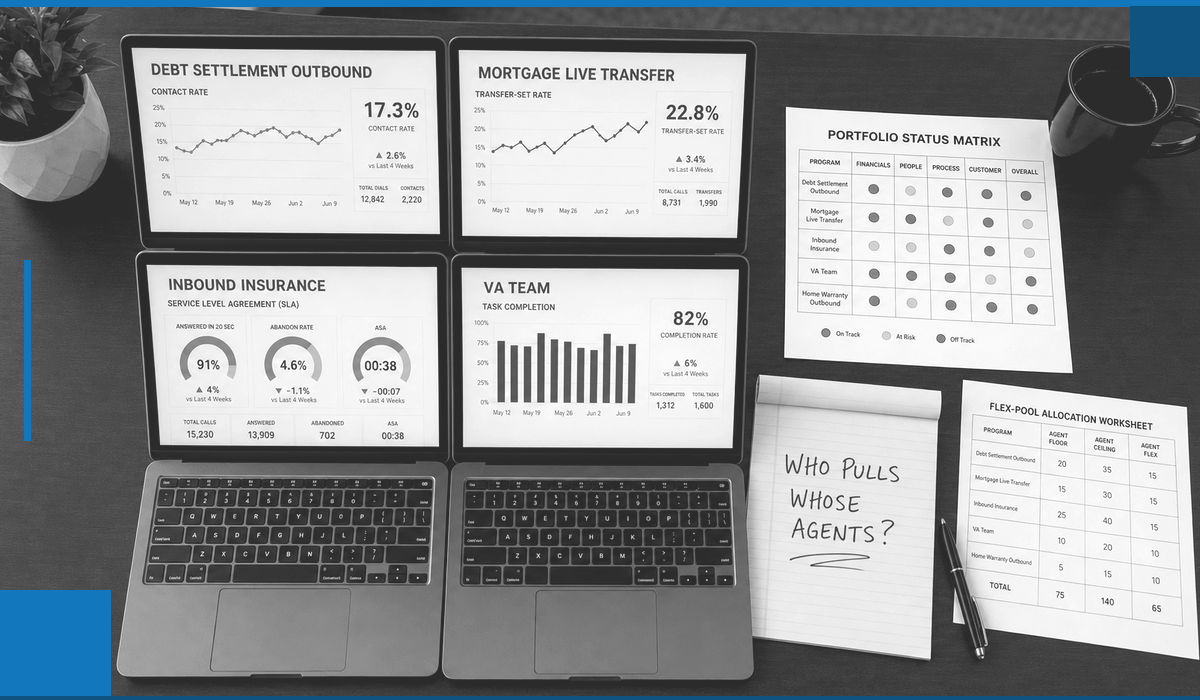
By month seven, the pattern was hard to explain. An ops team ran four BPO programs at once: debt settlement outbound, mortgage live transfer, inbound support for an insurance unit, and a virtual assistant team for back-office work. Each program looked fine on its own. The portfolio view did not. When mortgage volume spiked, the debt settlement contract rate dropped. When inbound support hit a staffing crunch, the VA team’s SLA slipped. Four programs that ran cleanly on their own kept fighting over the same shared resources.
The direct answer: Enterprise BPO management is not single-program work done four or eight times. It is a portfolio problem. BPO programs share agents, supervisor time, QA hours, and dialer systems. Without clear allocation, every shared resource gets fought over. One program spikes, and the rest lose. The fix is structural.
This guide covers the framework that prevents the failure modes single-program reviews miss. Six parts: resource allocation, program independence, tiered governance, vertical separation, new-program intake, and the portfolio dashboard.

Why Multi-Program BPO Management Is a Different Problem
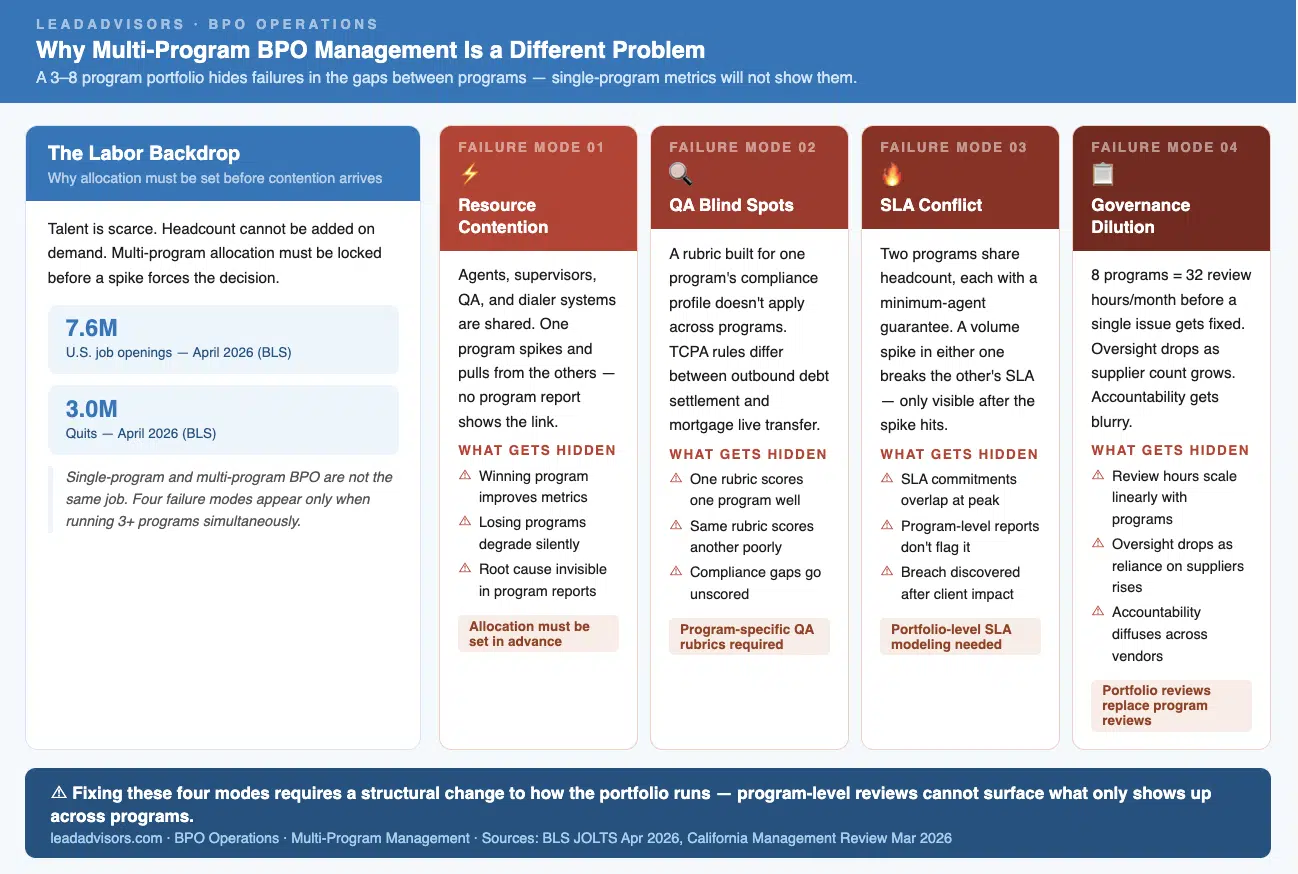
Single-program and multi-program BPO are not the same job. A three-to-eight program portfolio hides failures in the gaps between programs. Single program metrics will not show them.
The labor backdrop matters. The U.S. Bureau of Labor Statistics reported 7.6 million job openings in April 2026. Quits hit 3.0 million that same month. Talent is scarce. Headcount cannot be added on demand. Allocation must be set before contention occurs.
Four failure modes show up only in multi-program environments.
Resource contention
Agent capacity, supervisor time, QA coverage, and dialer systems are all shared. One BPO program spikes. It pulls resources from the others unless allocation is set. The winning program shows better metrics. The losing programs show worse metrics. Neither program report shows the link.
QA Blind Spots
A QA rubric built for one program’s compliance profile does not apply across many programs. Outbound debt settlement carries different TCPA disclosure rules than mortgage live transfer. One rubric rates one program well, and the other rates it poorly.
SLA Conflict
Two programs may share headcount, each contracting a minimum-agent guarantee. A volume spike in either one breaks the other’s SLA. Program-level reporting will not show it until the spike hits.
Governance Dilution
A weekly ops call per program scales linearly. Eight programs add up to thirty-two review hours per month. That is, before a single issue gets fixed. A March 2026 study in California Management Review found the same pattern in vendor-heavy operations. As reliance on outside suppliers grows, oversight drops. Accountability gets blurry.
Fixing these four modes takes a structural change to how the portfolio runs. No more program reviews.
The Multi-Program Resource Allocation Model
Explicit allocation prevents resource contention. Every shared resource gets assigned to programs in set quantities. This happens before any program launches. Moving resources between programs takes a documented process, not casual borrowing.
Agent Capacity Allocation
Each BPO program gets a floor and a ceiling. The floor is the minimum number of dedicated agents needed to run cleanly. The ceiling is the maximum the program can absorb without waste. Agents between the floor and the ceiling form a flex pool. The flex pool can be loaned to other programs during periods of high volume. A written sign-off is required.
Say Program A needs 15 dedicated agents and Program B needs 12. Total headcount is 35. The remaining 8 agents form the flex pool. Say Program A asks for 4 flex agents during a lead surge. Those agents come from the flex pool. Program B’s protected count is not touched. The flex pool is the only resource that moves between programs without an escalation.
Supervisor Allocation
Supervisors in a multi-program BPO are allocated across programs rather than per program. A 1:10 supervisor-to-agent ratio does not mean one supervisor per program. It means one supervisor for every 10 agents, regardless of which program they work in. The allocation model assigns a primary supervisor to each program. It names the backup. It also sets the escalation path. The path applies when a program issue comes up while the primary is busy.
QA Bandwidth Allocation
Human QA review capacity is finite. The allocation sets how many human-reviewed calls each program gets per week. Programs in regulated verticals receive a larger share than those in lower-complexity verticals. Regulated verticals include financial services, healthcare-adjacent, and debt collection. The National Institute of Neurological Disorders and Stroke makes the same point in clinical research. Review quality depends on calibration to the specific context. Raw review volume is not enough.
Dialer Infrastructure Allocation
A shared dialer holds shared resources. The list: concurrent call capacity, caller ID rotation pools, and compliance suppression lists. Each one needs explicit allocation. A caller ID flagged for Program A stays out of Program B’s pool. The rule applies when programs serve different demographics. Or when they use different consent chains. The same dialer can run many programs. The same number cannot.
The Program Independence Framework: What Cannot Be Shared
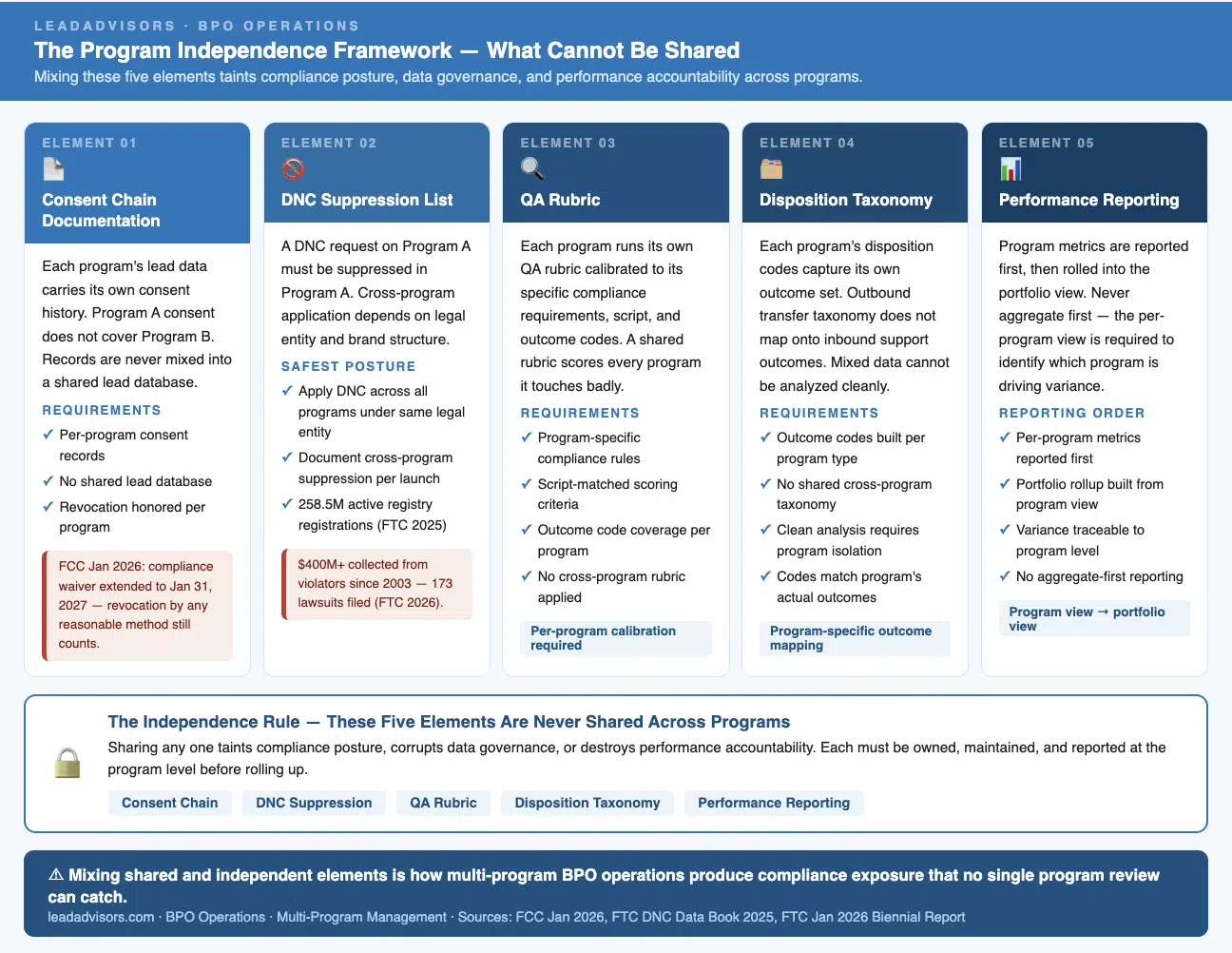
Some resources are shared and allocated. Others must be owned by each BPO program individually. Mixing them taints compliance posture, data governance, and performance accountability.
Each program owns its own five elements independently.
Consent Chain Documentation
Each program’s lead data carries its own consent history. A consent document for Program A’s dialing does not cover Program B. Records are kept separately for each program. They do not get mixed into a shared lead database. The TCPA Consent Order remains in effect. The FCC’s 2026 order pushed the compliance waiver to January 31, 2027. The waiver does not weaken the duty to honor revocation. Revocation by any reasonable method still counts.
DNC Suppression List
A consumer who requests DNC on Program A must be suppressed in Program A. Does that DNC carry to other programs? It depends on the legal entity and brand structure. The FTC’s National Do Not Call Registry Data Book for Fiscal Year 2025 reported 258.5 million active registrations. The report also logged more than 2.6 million DNC complaints in the year. The FTC’s 2026 biennial report to Congress confirmed that 173 lawsuits have been filed against telemarketers since 2003. Nearly $400 million has been collected from violators. Safest posture: apply DNC requests across all programs under the same legal entity. Document the cross-program suppression for each program before launch.
QA Rubric
Each program runs its own rubric calibrated to its specific compliance requirements. The rubric also covers the program’s script and outcome codes. A single cross-program rubric scores every program it touches badly.
Disposition Taxonomy
Each program’s disposition codes capture its own set of outcomes. A taxonomy built for outbound transfer does not map onto inbound support outcomes. Mixed disposition data cannot be analyzed cleanly by the program.
Performance Reporting
Each program’s metrics are reported first. Then they are rolled up into the portfolio view. Do not aggregate program-level data into a single aggregate first. The per-program view comes first. Otherwise, you cannot tell which program is driving the variance.
The Governance Cadence That Scales Without Fatigue
Governance is the most common point of multi-program failure. A one-program model does not work for eight. A redesign is required.
Multi-tiered supply chain research from Stanford Graduate School of Business shows the same pattern in supplier networks. The buyer sees only the immediate supplier. Oversight quality drops as the network deepens. The fix is a tiered review structure. Overhead scales with program status, not with program count.
Tier 1: Daily Automated Monitoring (No Meeting, All Programs)
Every program gets a daily automated dashboard review. The review checks set metric thresholds. Thresholds are set per program. A metric that falls outside the threshold triggers an automated alert. The alert goes to the program’s ops contact. It also goes to the portfolio-level ops manager. Alerts with a severity below a set threshold are resolved at the program level. The resolution window is 24 hours. No escalation needed.
Tier 2: Weekly Ops Call (Green: 30 minutes; Yellow: 60 minutes)
Programs that meet or exceed the target on all metrics receive a 30-minute weekly ops call. The call covers status, upcoming priorities, and pending action items. Some programs fall below the threshold on one or more metrics. After two days in a row, the call jumps to 60 minutes. The longer call adds a root cause review and a corrective action plan. A program that stays Yellow for three weeks moves to Tier 3. It stays there until it returns to Green.
Tier 3: Daily Check-In (Red Programs Only)
Programs with critical failures get a daily 30-minute check-in. The check-in replaces the weekly format until the crisis is resolved. Critical failures include three patterns. Contact rate below floor for more than five business days. Compliance flag rate above threshold. SLA breach. Red status triggers portfolio-level escalation to senior operations leadership.
Monthly Portfolio Review (All Programs, 90 minutes)
A single monthly session covers all programs. Each program gets 5 to 10 minutes. Green programs are status confirmation only. Yellow and Red programs get a deeper root cause discussion. Resource allocation and budget decisions happen here, not in individual program calls.
Quarterly Business Review (Senior Leadership, All Programs)
One QBR covers the full portfolio. The agenda covers four items. Performance against annual targets. Direction for the next quarter. Vendor relationship health. Any material compliance or governance issues. The single QBR replaces all per-program QBRs. Program-specific materials are prepared as appendices.
This tiered structure mirrors the “Guardian” model in multi-sourcing literature. The model adds a dedicated coordination layer. The layer owns joint vendor performance across the portfolio. Program-by-program reviews run in parallel get replaced. The principle moves cleanly from multi-vendor IT outsourcing. It applies equally to multi-program BPO operations.
Vertical Separation: Managing Programs in Multiple Regulated Verticals
Running BPO programs in multiple regulated verticals is harder than running one. Compliance complexity goes up. The verticals: debt settlement, healthcare-adjacent, mortgage, and financial services. Each one has its own regulatory framework. Each one has its own consent chain standard. Each one has its own contact protocol.
Three separation requirements apply.
Agent Certification
An outbound debt settlement agent is not certified to qualify healthcare leads. The TCPA disclosure language is different. The qualifying script is different. The compliance documentation is different. The contact windows are different. An agent who crosses verticals without the right certification creates compliance exposure on every call. The U.S. Bureau of Labor Statistics calls standard customer service training 2 to 4 weeks of short-term on-the-job training. Regulated verticals like finance and insurance need more. The BLS says “several months of training to learn complicated financial regulations.” Build that gap into the certification calendar. Do not retrofit it after launch.
Data Segregation
Consumer data from a debt-settlement campaign remains separate from healthcare data. Data governance controls keep them split. A debt settlement prospect does not receive healthcare outreach. The reverse holds too. Two reasons. First, the consent chain does not authorize it. Second, each vertical bans the use of consumer data across categories.
QA Calibration
The QA rubric for a healthcare program runs compliance checks specific to that vertical. That includes patient-sensitive language, healthcare disclosure rules, and HIPAA-adjacent communications. Applying a debt-settlement rubric to healthcare calls overlooks compliance issues. Neither rubric is built to catch them. Each vertical runs its own calibrated rubric. QA reviewers working multiple verticals carry calibration documents for each one.
The regulatory bar is still rising. The FCC’s 2026 Notice of Proposed Rulemaking covers call center customer service and security. It proposes new requirements. The list: American Standard English proficiency for customer-facing agents, AI-interaction disclosure to consumers, and on-request transfer to U.S.-based agents. Multi-vertical operators are folding those requirements into vertical-specific certification today. They are not waiting for final rules.
Scaling the Portfolio: Adding New Programs Without Degrading Existing Ones
Adding a new BPO program to an existing portfolio is not the same as launching a first program. The first program builds the infrastructure. The fifth program slots into the same infrastructure. The four programs already running keep going without breaks.
The New Program Intake Checklist
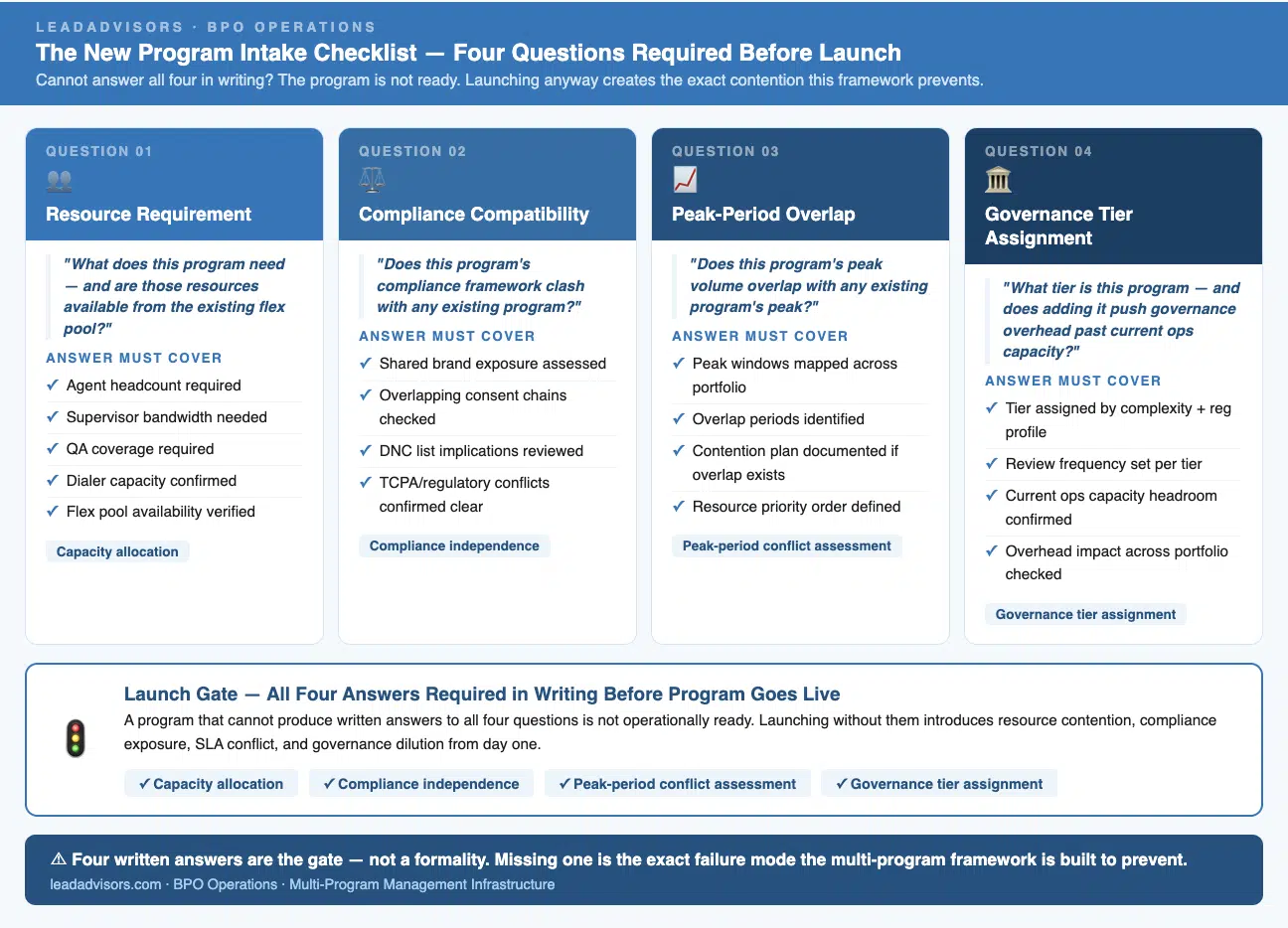
Before a new program launches, four questions get specific written answers:
- Resource requirement. What does this program need: agent headcount, supervisor bandwidth, QA coverage, dialer capacity? Are those resources available from the existing flex pool? Or do they require new headcount?
- Compliance compatibility. Does this program’s compliance framework clash with any existing program? Look at shared brand exposure, overlapping consent chains, and implications for DNC lists.
- Peak-period overlap. Does this program’s peak volume overlap with any existing program’s peak? If so, what is the plan for handling resource contention?
- Governance tier assignment. What is the program’s governance tier? The tier is based on complexity and regulatory profile. Does adding this tier push governance overhead past current ops management capacity?
Cannot answer all four questions before launch? The program is not ready. Launching anyway brings the exact contention and dilution this framework prevents. Four answers are required: capacity allocation, compliance independence, peak-period conflict assessment, and governance tier assignment.
Capacity Trigger for Adding Operations Management Headcount
A portfolio of four to six programs needs one senior operations manager. Two program-level ops coordinators support the senior manager. Beyond six programs, add a second senior ops manager. The constraint is not workload volume. It is cognitive load. Holding escalation-quality judgment across six-plus programs at enterprise cadence wears one manager down. A 2025 large-scale multi-group analysis published through the National Institutes of Health PubMed Central links three factors to operational quality in distributed teams: recognition, fairness, and leadership bandwidth. Cognitive load is a leadership constraint, not a staffing constraint.
The Multi-Program Performance Dashboard
The portfolio dashboard rolls up program-level metrics into a single view. The view surfaces patterns that individual program dashboards miss. Three examples: resource contention signatures, correlated performance drops, and aggregate compliance trends.
Program Status Matrix
A single table shows the current status of every BPO program: Green, Yellow, or Red. Five core metrics are tracked: contact rate, qualification rate, transfer-set rate, show rate, and QA score. One-week trend direction is shown for each. The matrix gives a full portfolio health view in 60 seconds.
Resource Utilization by Program
Agent headcount allocated versus available per program. Supervisor-to-agent ratio per program. QA review coverage rate per program. Three conditions trigger an automatic resource review. A program above its agent ceiling. A program below its supervisor ratio standard. A program with falling QA coverage.
Correlated Variance Alert
A statistical flag fires when two or more programs exhibit correlated changes in a metric. Program A’s contact rate falls while Program B’s rises. That is the classic signature of resource contention. Correlated variance in opposite directions almost always indicates that resource reallocation is underway. The reallocation may be visible to ops leadership, or not. Most competitor operators do not surface this alert. It is the single highest-leverage view on the dashboard.
Aggregate Compliance Posture
Total compliance flags across all programs for the period. Then broken down by flag category and by program. Categories: TCPA disclosure, DNC handling, prohibited language, script deviation. A rising aggregate flag rate points to a systemic compliance issue. This happens even when individual programs remain Green. Individual program QA is missing it. The FTC tracked consumer DNC complaint volume through fiscal year 2025. The volume remained well above the pre-2017 baseline. That is why aggregate compliance posture is monitored continuously, not quarterly.
Summary: What Changes When You Run Multiple Programs
Enterprise BPO management is a portfolio discipline. The single-program model works with one or two programs. It breaks at four. It fails at eight without a redesign.
Five structural shifts define the operating framework:
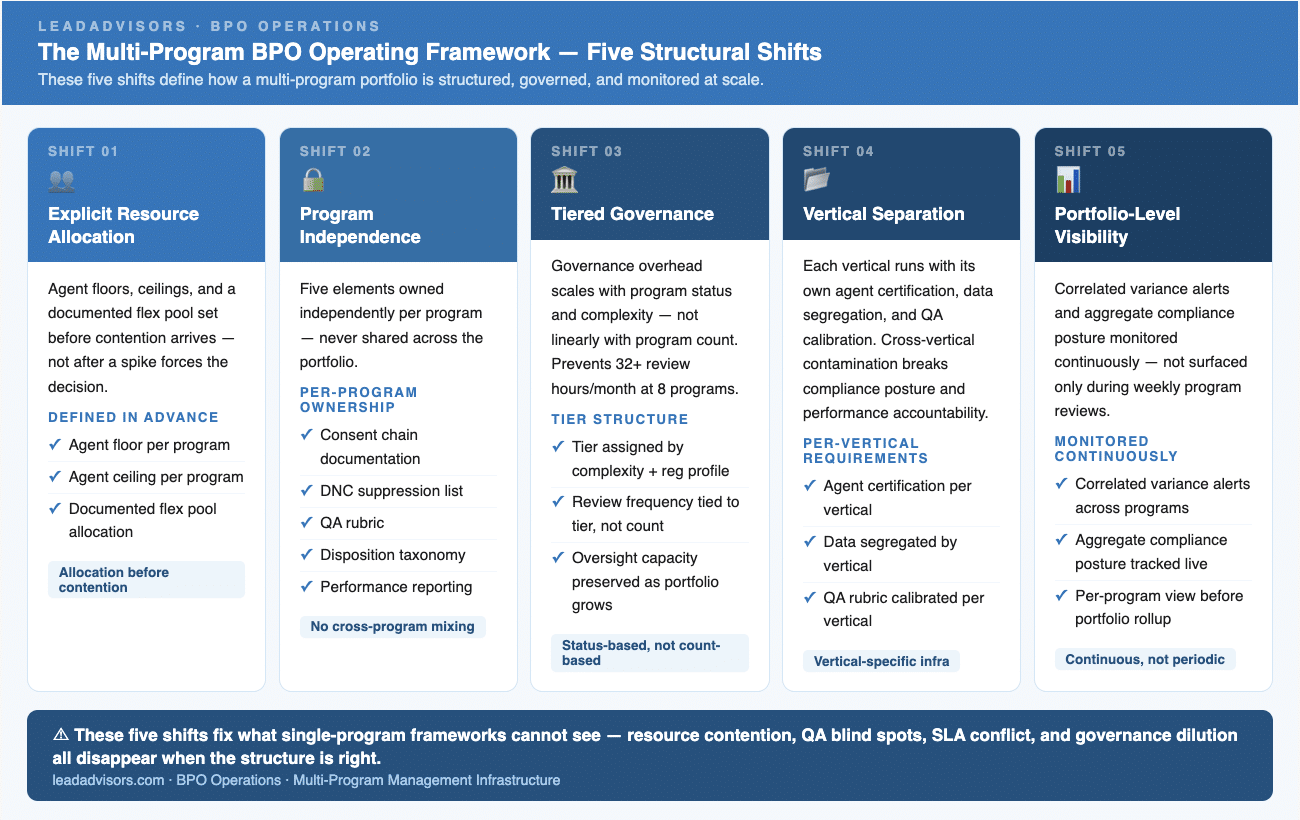
- Explicit resource allocation with agent floors, ceilings, and a documented flex pool.
- Program independence on consent chains, DNC suppression, QA rubrics, disposition taxonomies, and performance reporting.
- Tiered governance that scales overhead with program status, not program count.
- Vertical separation with per-vertical agent certification, data segregation, and QA calibration.
- Portfolio-level visibility with a correlated variance alert and aggregate compliance posture monitored continuously.
The direction ahead is clear. FCC and FTC pressure through 2026 raises the cost of compliance failure. That cost is applied to every BPO program in a portfolio. Talent scarcity raises the cost of fixing contention with headcount alone. Operators who ran four to eight programs built the architecture cleanly early. They built it before they needed it. The ones running single-program governance at a multi-program scale will keep failing. Their program-level dashboards cannot explain the patterns.