The phrase “SEO content writing services” covers products that look alike but cost 100 times as much. A single 1,500-word blog post can be bought for as little as $45 from a marketplace writer. The same post can also be part of a $15,000-per-month managed retainer. Both are called the same thing. Neither buyer is told what is different.
The topic matters in 2026 because search is being reshaped. AI Overviews, generative search, and stricter Google quality signals are the cause. A 2025 study by the Pew Research Center found that AI summaries now appear in about 1 in 5 Google searches. Users who see those summaries click through to source links far less often.
The 2025 AI Index Report from Stanford University’s Institute for Human-Centered AI also showed that AI tool use in business content work rose sharply during 2024 and 2025. The gap between content that ranks and content that is just published has been widened.
This guide has been written for three reasons. It explains what is delivered at each price tier. It shows how SEO content writing services are judged by experienced buyers. It also covers what is being charged across the U.S. market today.


What Are SEO Content Writing Services?
SEO content writing services are services that produce written content for search engines. The work covers blog posts, pillar pages, landing pages, and supporting articles. Each piece is optimized so it can rank on Google and convert the visitors those rankings deliver. A full-service engagement includes seven steps: keyword research, content briefs, original writing, editorial review, on-page optimization, internal linking, and a refresh cycle for published content.
The answer above describes a managed, full-service setup. At the commodity level, work is bought per word, and only the writing is delivered. Keyword research, structure, internal linking, and post-publish work are left to the buyer. At the managed level, most production steps are included. At the operator level, the full content system is owned by the provider.
Why SEO Content Writing Services Matter in 2026
Search traffic is still seen as one of the cheapest sources of new customers in the United States. In 2025, guidance from the U.S. Small Business Administration ranked organic search among the top three marketing channels for small and mid-sized firms. The 2025–2026 BLS Occupational Outlook Handbook for Writers and Authors also reports that demand for writers and authors is projected to stay steady. The median wage for U.S. writers is reported at about $73,000 per year. That figure helps explain why high-quality SEO content writing services cannot be sold at marketplace pricing.
Three shifts have been seen in 2025 and 2026 that make SEO content writing services more important than they were one year ago:
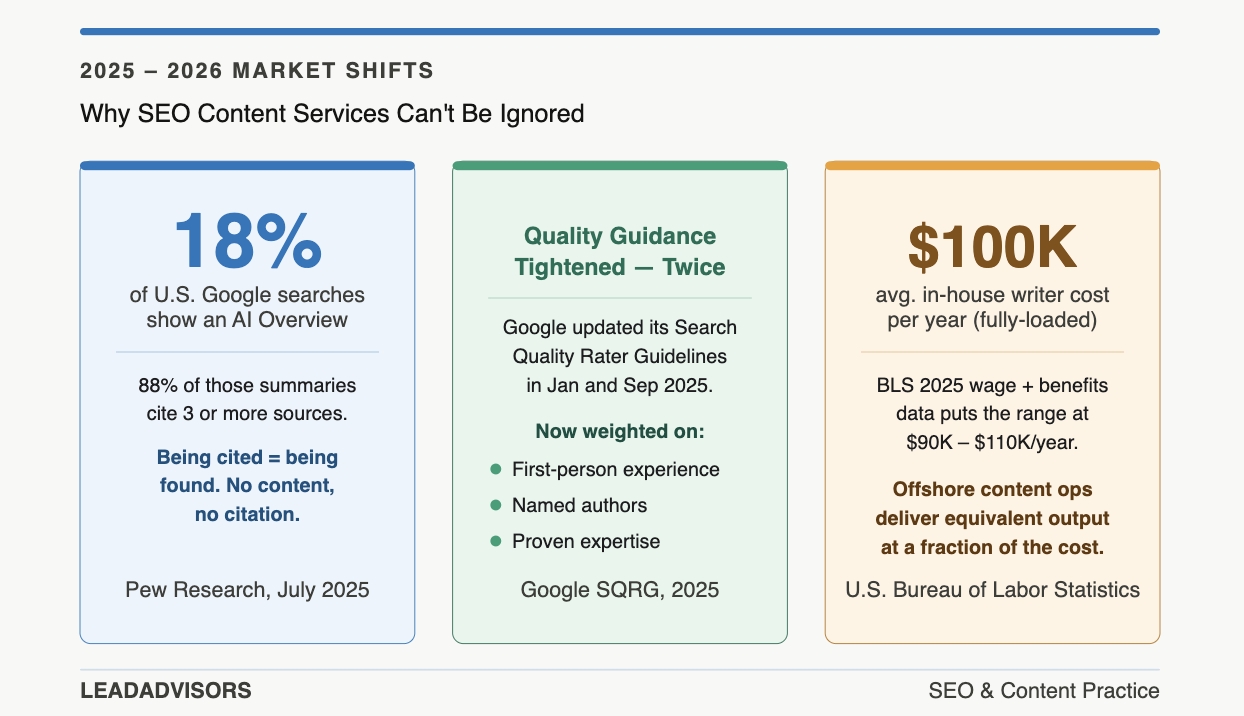
- AI Overviews now appear on a large share of U.S. searches. The same July 2025 Pew Research Center study confirmed that about 18% of all Google searches in March 2025 produced an AI summary. About 88% of those summaries cite three or more sources.
- Google quality guidance has been tightened. The Search Quality Rater Guidelines were updated by Google in January and again in September 2025. They now place more weight on first-person experience, named authors, and proven expertise.
- The cost of in-house production keeps rising. Wage and benefits data from the U.S. Bureau of Labor Statistics (2025) confirm that the full cost of an in-house writer in the U.S. is now $90,000 to $110,000 per year.
What Is Delivered at Each Tier of SEO Content Writing Services
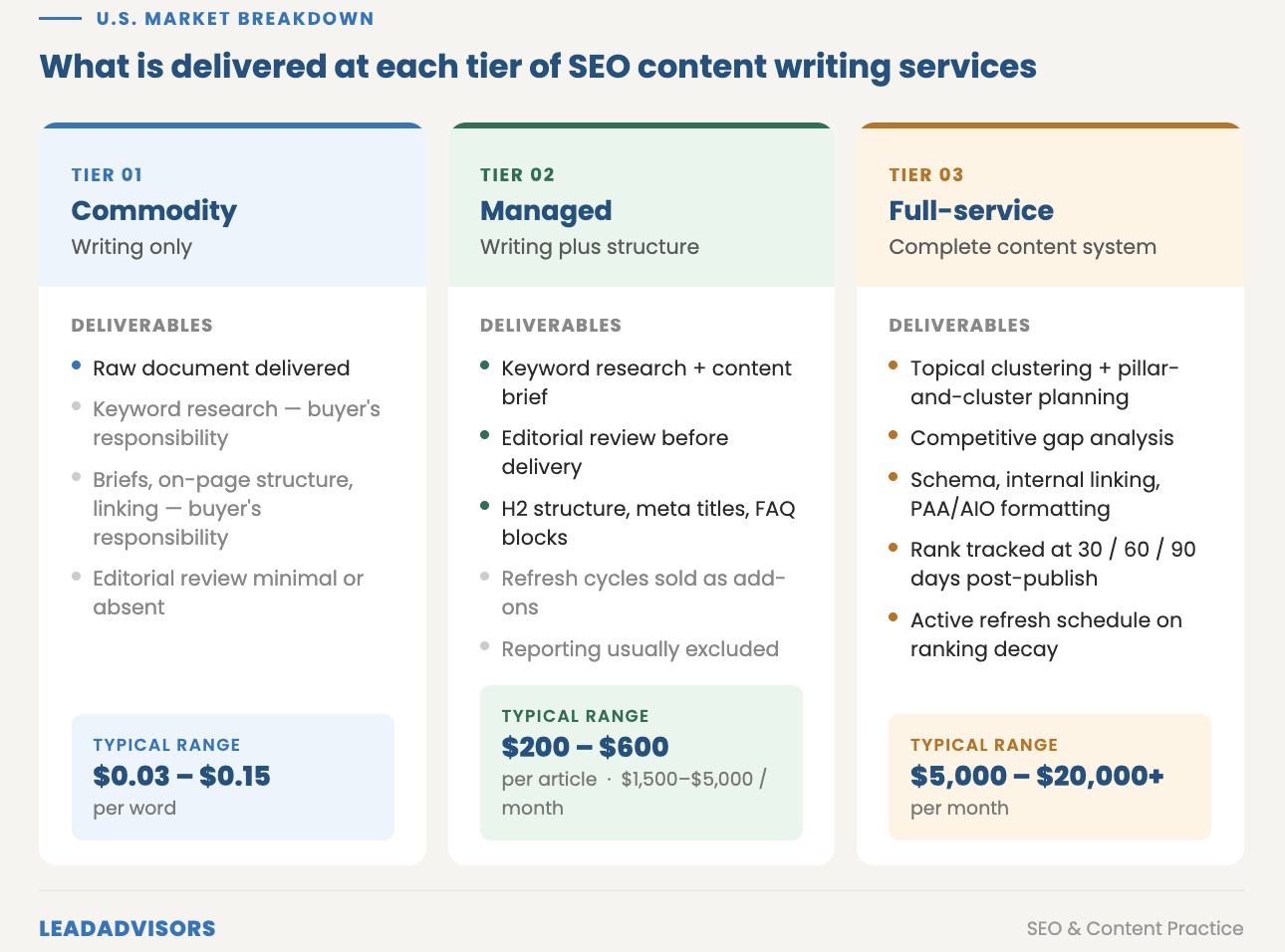
The deliverables of SEO content writing services are grouped into three tiers in the U.S. market. The differences are shown below.
Commodity tier: Writing Only
- A document is delivered.
- Keyword research, briefs, on-page structure, and internal linking are the buyer’s responsibility.
- Editorial review is minimal or absent.
- Typical price range: $0.03–$0.15 per word.
Managed tier: Writing Plus Structure
- The provider produces keyword research and a content brief.
- Editorial review is conducted before delivery.
- Basic on-page elements (H2 structure, meta titles, FAQ blocks) are included.
- Refresh cycles and reporting are usually excluded or sold as add-ons.
- Typical price range: $200–$600 per article or $1,500–$5,000 per month.
Full-service tier: Complete Content System
- Topical clustering, pillar-and-cluster planning, and competitive gap analysis are conducted.
- Schema markup, internal linking, and PAA/AIO formatting are included by default.
- Ranking is tracked at 30, 60, and 90 days after publication.
- A refresh schedule is maintained for content showing ranking decay.
- Typical price range: $5,000–$20,000+ per month.
SEO Content Writing vs SEO Copywriting vs Content Marketing
The three terms are often treated as interchangeable. They are not.
| Term | Primary goal | Typical output | Measured by |
| SEO content writing | Rankings for informational and commercial-investigative queries | Blog posts, guides, pillar pages | Rankings, organic traffic, topical authority |
| SEO copywriting | Conversion of visitors already on the page | Landing pages, service pages, CTAs | Conversion rate, lead volume |
| Content marketing | Brand authority and demand across the funnel | Content strategy, distribution, and editorial | Pipeline influence, share of voice |
A company that buys SEO content writing services when it needs conversion copy will get content that ranks but doesn’t convert. A company that buys the best SEO copywriting services when it needs topical authority will get content that converts a small audience but does not grow it. Most growth programs need both, in this order. Content writing builds the audience. Copywriting converts it.
The Full Scope of a Managed SEO Content Writing Engagement
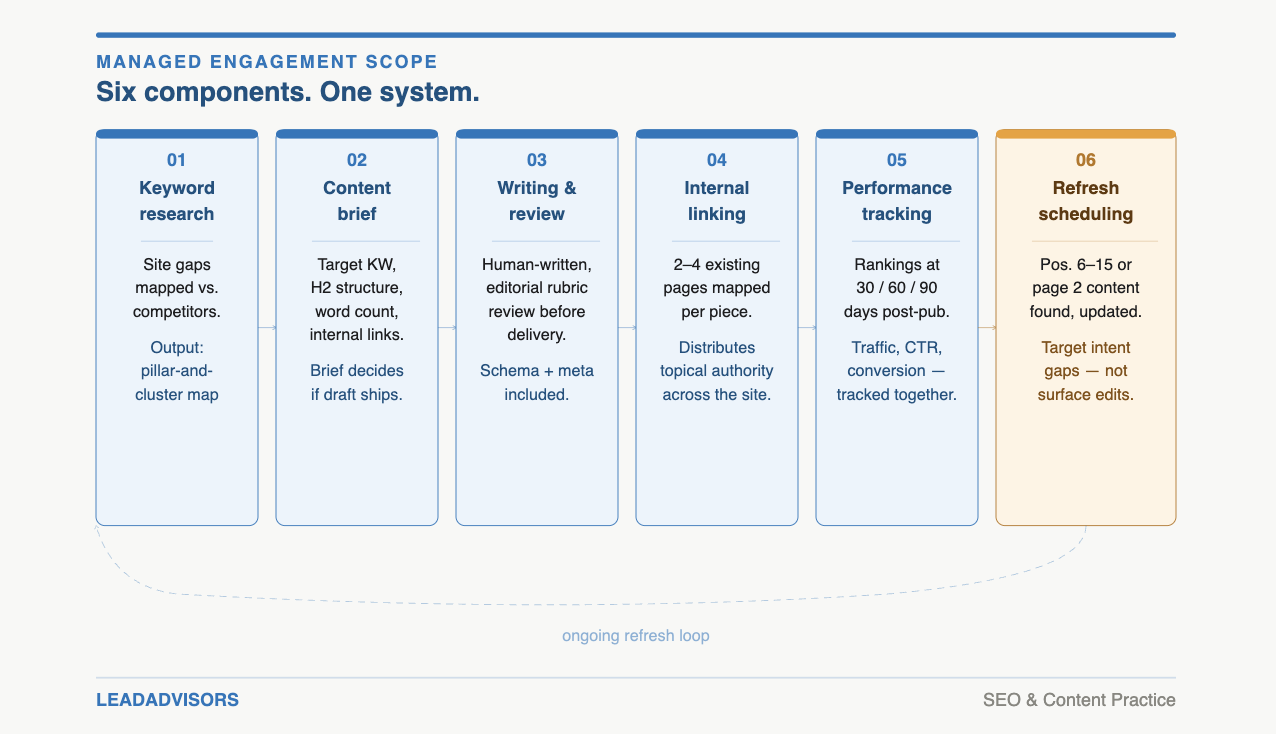
When a managed engagement is signed, six components are typically included.
1. Keyword research and topical clustering
Keyword opportunities are mapped against site gaps and what rivals cover. The output is a ranked list of topics, organized into a pillar-and-cluster architecture. This step enables SEO content writing services for topic clusters. It is the structure that lets each post support a larger pillar page.
2. Content brief production
A writer-ready brief is produced for each piece. The brief lists the target keyword, secondary keywords, H2 structure, internal-link targets, competitive context, and word count. The brief determines whether the first draft can ship or must be rewritten.
3. Original writing and editorial review
Writing is produced by a human writer and then reviewed against an editorial rubric before delivery. Schema markup, meta titles, and meta descriptions are added.
4. Internal linking
Each piece is mapped to two to four existing pages on the site. Internal linking determines how topical authority is distributed across a site’s architecture.
5. Performance tracking
Rankings are checked at 30, 60, and 90 days after publication. Traffic, click-through rate, and conversion contribution are tracked together, not in isolation.
6. Refresh scheduling
Content that has slipped from positions 6–15 down to page two is found and updated. A 2025 study by the Content Marketing Institute found that refreshed content can win back a meaningful share of lost traffic within 60 to 90 days. The update must target intent gaps, not surface edits.
SEO Content Writing Services Pricing in 2026
The pricing gap across SEO content writing services in 2026 is real. It reflects real differences in what is included. The table below has been built from public rate cards and provider pricing pages dated 2025 to 2026.
| Provider | Model | Published rate (2025–2026) |
| Textbroker | Marketplace | From $0.023 per word |
| Verblio | Hybrid | $0.06/word + $49.50/mo platform fee |
| The Urban Writers | Per word | From $0.066 per word |
| Draft.co | Per word | $0.10 per word |
| Compose.ly | Self-service or managed | $85/500w self-service · from $2,500/mo managed |
| ContentWriters | Per piece or retainer | From $99/piece · from $2,500/mo managed |
| Express Writers | Per piece | $50–$1,000 per piece |
| Scripted | Subscription | $349–$1,299 per month |
| Scribly Media | Retainer | From $1,970 per month |
| Brafton | Enterprise retainer | ~$1/word; custom pricing |
| Siege Media | Enterprise retainer | $5,000 minimum project; hourly $100–$149 |
Three variables are credited with most of the gap between a $0.06-per-word marketplace rate and a $10,000-per-month retainer:
- Strategy inclusion. Whether keyword research, topical clustering, and briefs are produced by the provider or by the buyer.
- QA infrastructure. Whether editorial review is conducted before delivery or skipped.
- Post-publish ownership. Whether performance is tracked and refreshes are scheduled, or whether delivery is treated as the end of the engagement.
Affordable SEO content writing services are not always the cheapest. The buyer’s internal time must also be counted. Once keyword research, brief production, editing, and on-page QA are added, a $0.06-per-word post often costs more than a managed $400 piece.
In-House vs Freelancer vs Marketplace vs Agency: The Loaded-Cost View
The wage line is not the full cost. Wage and benefits data from the U.S. Bureau of Labor Statistics in 2025 show that the full cost of an in-house writer in the United States is now $90,000 to $110,000 per year. That figure includes payroll taxes, benefits, software, and management overhead.
The table below is built for a content program that produces eight 1,500-word articles per month. This is a common volume for SEO content writing services for small businesses and mid-market growth programs.
| Model | Hard cost | Hidden cost | Fully-loaded monthly |
| In-house writer ($70K salary) | $5,833/mo base | Payroll tax, benefits, tools, mgmt. Adds 65–80% | $9,600–$10,500/mo |
| Freelance marketplace ($0.08/word) | $960/mo writing | Strategy, briefs, editing, QA. 6–10 hours internal | $1,800–$2,800/mo |
| Per-word service ($0.06–$0.10/word) | $720–$1,200/mo writing | Same ops cost as freelance | $1,600–$2,400/mo |
| Managed content agency ($400/article) | $3,200/mo | Low hidden cost. Brief + QA included | $3,200–$3,800/mo |
| Full-service operator retainer | $6,000–$12,000/mo | All-in: strategy, writing, QA, reporting, refresh | $6,000–$12,000/mo |
For programs that produce eight or more pieces per month, the loaded-cost view almost always favors managed or full-service. In-house or raw marketplace tends to lose on that math.
How an SEO Content Writing Services Company Should Be Evaluated
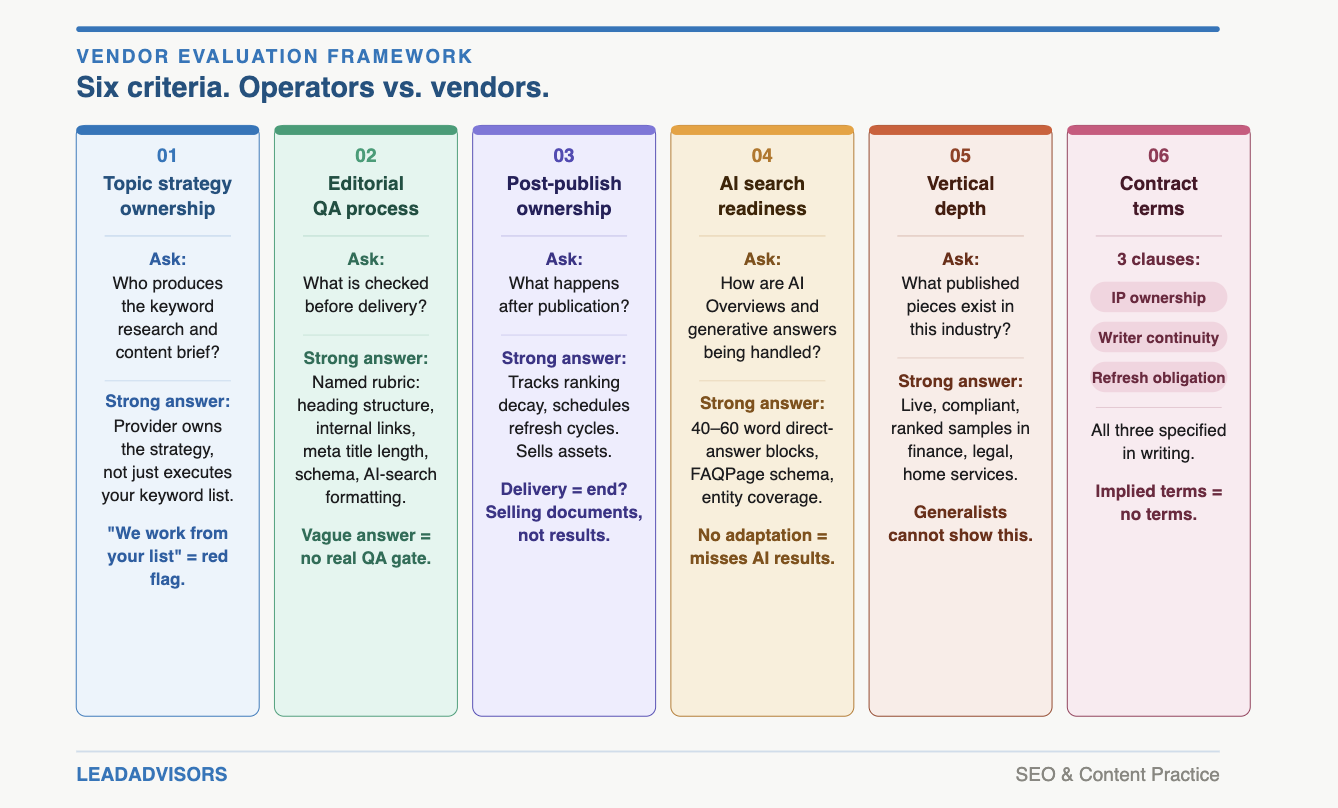
Most “how to choose” sections are written as five generic bullets. The criteria below are drawn from buyer interviews and from the 2025 Google Search Quality Rater Guidelines. These are the questions that set a professional SEO content writing services company apart from a basic writing vendor.
Criterion 1: Topic strategy ownership
It is asked: who produces the keyword research and the content brief? If the answer is “we work from your keyword list,” the provider is a writing service. The best SEO content writing services produce the strategy, not just the copy.
Criterion 2: Editorial QA process
The question is: What is checked before delivery? A specific answer should be expected: heading structure, internal links, meta title length, schema markup, and AI-search formatting.
Criterion 3: Post-publish ownership
The question is: What happens after publication? A provider that considers delivery the end of the engagement is selling documents. A provider that tracks ranking decay and schedules refresh cycles is selling assets.
Criterion 4: AI search readiness (GEO and AEO)
It is asked: how are AI Overviews and generative answers being handled? In 2026, briefs should require direct-answer blocks of 40 to 60 words, FAQPage schema, and entity coverage. A provider that has not adapted to AI search in 2025 and 2026 is making content that ranks in classic results. The same content will fall short in AI-powered results.
Criterion 5: Vertical depth
It is asked: what published pieces can be shown in this industry? SEO content writing services for finance, legal, and home services need to be compliant. Generalist providers do not have it.
Criterion 6: Contract terms
Three clauses are checked: IP ownership (assigned to the client on delivery), writer continuity (the same writers on the account, not rotated through a pool), and refresh obligation (specified, not implied).
SEO Content Writing Services for B2B vs B2C
The differences between B2B and B2C content programs are structural, not cosmetic.
- Buying cycles are longer in B2B. A B2B buyer is in the middle of a two- to six-month evaluation involving multiple stakeholders. More content per cluster is required.
- E-E-A-T is held to a higher standard.** Per the same 2025 Google Search Quality Rater Guidelines, content that affects financial decisions is held to stricter rules. Author credentials and citations are checked more closely.
- Conversions are routed to next steps, not purchases. Demo requests, consultations, and content downloads are the typical B2B conversion events.
- Compliance language is required in regulated verticals. Financial services, legal, and healthcare content must be reviewed for FTC, CFPB, state bar, and HIPAA exposure.
SEO Content Writing Services for Finance Websites, Legal, and Home Services
Three verticals require treatment that generalist content shops are rarely equipped to provide.
Finance websites
Content in the financial services vertical is subject to FTC claims rules, CFPB consumer protection standards, and state-level advertising rules. Outcome promises like “reduce your debt by 50%” must be backed by proof or removed. A compliance review pass should be done before publishing.
Writers without regulated-industry experience often produce content that reads well but creates real legal and regulatory risk. SEO content writing services for finance websites should be judged on two things. Ask for five published pieces in regulated finance categories. Then confirm that the compliance points were handled correctly.
Affiliate editorial reviews and editorial placements in regulated finance outlets also need disclosure language and reviewer credentials. Without those, they cannot be cited as authority signals.
Legal
Legal content is subject to state-bar advertising rules that vary by jurisdiction. Outcome claims are restricted in most states. Disclaimers are typically required. A review by a licensed attorney is often expected before publication. A content provider that does not document state bar rules will produce content that the firm must review again before publishing.
Home services
Home-services content (roofing, HVAC, plumbing, solar, pool) is local, seasonal, and service-page-heavy. The xstrategy is built around local pack rankings, Google Business Profile optimization, and service-area pages. A blog-only strategy for a home-services client misses how home-services buyers actually search.
Red Flags When SEO Content Writing Services Are Being Evaluated
Five red flags have been observed repeatedly during procurement.
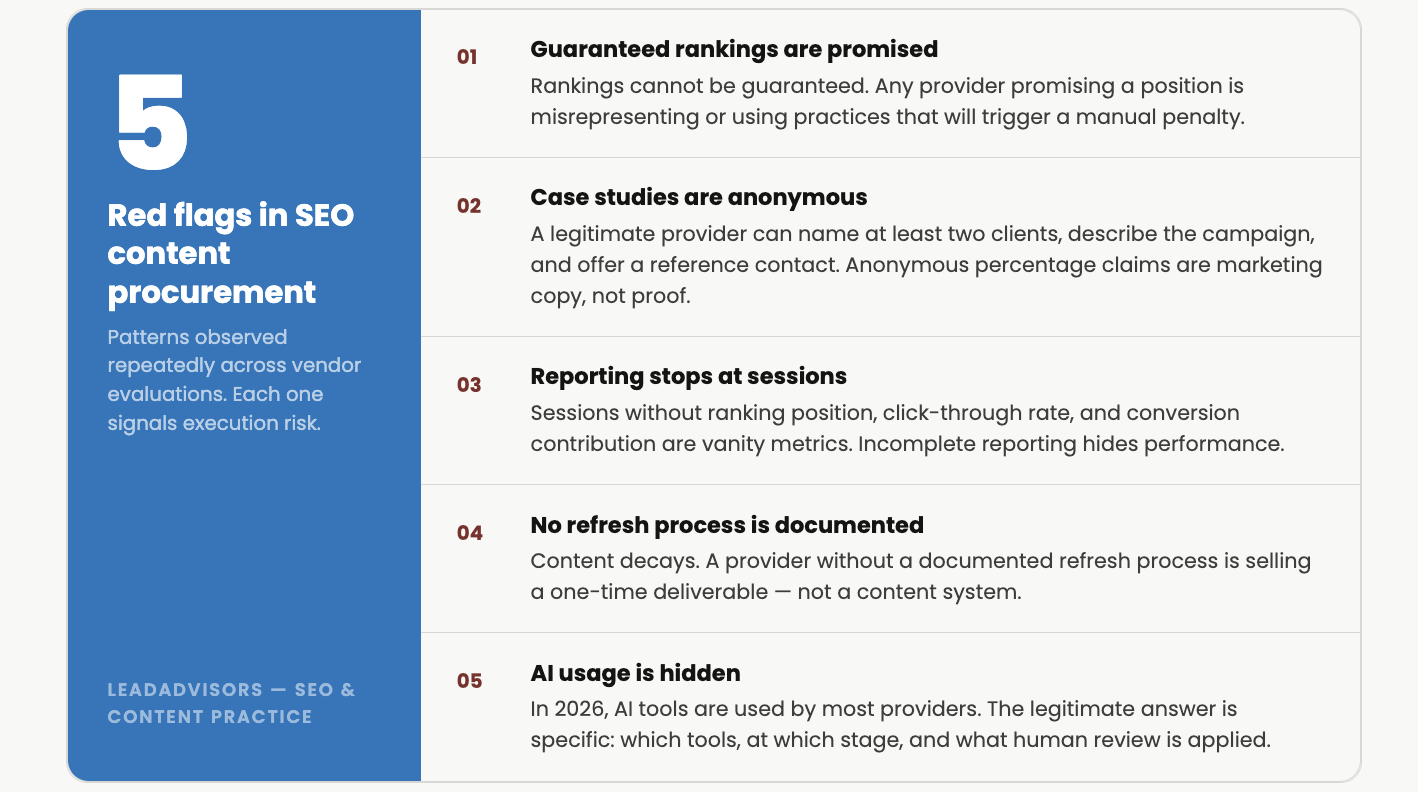
- Guaranteed rankings are promised. Rankings cannot be guaranteed. Any provider that promises a position is either misrepresenting or using practices that will eventually trigger a manual penalty.
- Case studies are anonymous. A legitimate provider can name at least two clients, describe the campaign, and offer a reference contact. Anonymous percentage claims are marketing copy, not proof.
- Reporting stops at sessions. Sessions without ranking position, click-through rate, and conversion contribution are vanity metrics.
- No refresh process is documented. Content decays. A provider without a documented refresh process is selling a one-time deliverable.
- AI usage is hidden. In 2026, most providers will use AI tools at some stage. The legitimate answer is specific: which tools, at which stage, and what human review is applied.