Here’s a scenario that plays out constantly. A business owner gets a referral, the prospect seems genuinely interested, and then — silence. No follow-up. No reply. The deal just stops.
What usually happened was that the prospect Googled the company name, found something they didn’t like, and moved on without saying a word.
According to a 2025 BrightLocal Consumer Review Survey, 98% of consumers read online reviews before choosing a business, and 87% kick off that process with a Google search. That 30-second window after a prospect types your company name is where a lot of deals quietly die.
The tricky part? Most business owners have no idea what that window actually looks like. Their own devices show a version of the results that’s been shaped by months of visiting their own website — Google personalizes everything. They see a clean result. A prospect who has never heard of them sees something completely different.
This audit fixes that. It takes about 30 minutes, covers nine dimensions of online credibility, and produces a scored gap list you can actually act on. Not a vague “we should work on our presence” — a specific list of what’s broken, what’s missing, and what to fix first.


What the Brand Search Audit Measures
When a prospect Googles your company name, they’re not reading. They’re scanning. In under 30 seconds, they’ve already decided whether you look credible or whether they’d rather check out someone else.
The 2025 Edelman Trust Barometer found that B2B buyers go through an average of 12 online touchpoints before ever speaking to a vendor — and seven of those happen before any human conversation. Most of those touchpoints trace back to what they find in a brand search.
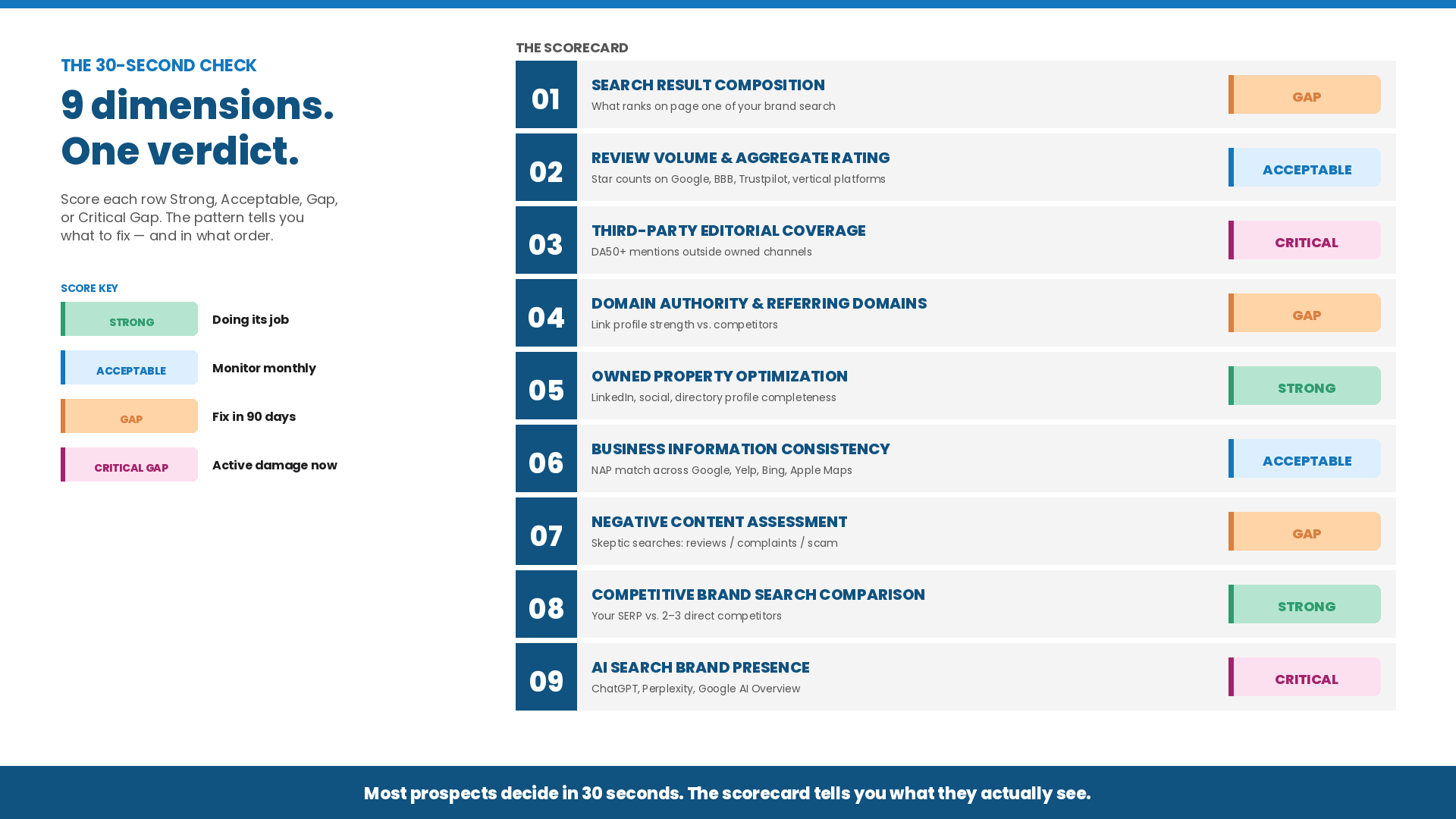
This audit measures the nine signals shaping that impression:
- Search result composition: what actually shows up on page one when someone searches your name, and whether those results build trust or raise questions
- Review volume and aggregate rating: how many reviews you have, what they say, and where they live
- Third-party editorial coverage: whether anyone outside your own company has written about you in a recognized publication
- Domain authority and referring domains: how strong your link profile looks compared to competitors
- Owned property optimization: the state of your digital presence beyond your main website — LinkedIn, social profiles, directories
- Business information consistency: whether your name, address, and phone number match across every place they appear online
- Negative content assessment: whether anything harmful is currently ranking when someone searches your brand
- Competitive brand search comparison: how your results stack up against two or three direct competitors
- AI search brand presence: what ChatGPT, Perplexity, and Google AI Overview say about you when your company name gets searched
You’ll score each dimension as Strong, Acceptable, Gap, or Critical Gap. That nine-row scorecard is the deliverable — it tells you exactly where the problems are and how serious each one is.
Before You Begin: Setting Up the Audit Correctly
The setup matters more than most people expect. Skip it, and you’ll run an audit on a version of Google that’s been tailored specifically for you — not for a stranger who’s never heard of your company.
Here’s the problem: Google tracks your browsing history, your location, and your login data. If you regularly visit your own website, Google knows. It quietly bumps your own pages up in the results. You run the audit, everything looks fine, and you never see what a skeptical prospect actually encounters.
Three things to do before you start:
Step 1: Open an incognito or private browser window.
Chrome Incognito, Firefox Private Window, or Safari Private Browsing all work. This blocks your browsing history and login data from influencing the results.
Step 2: Turn off location services for the browser.
Right-click the browser icon, find location settings, and set it to denied. Location data shifts local results in ways that can hide problems.
Step 3: Sign out of any Google account before you open Incognito.
Even in private mode, a device that’s been logged into a company’s Google account can carry residual signals. Sign out first to be safe.
Once you’ve done all three, what you see is roughly what a first-time prospect would find.
Step 1: The Primary Brand Name Search
Type your exact company name — nothing else. Not your name plus the city. Not your name plus “reviews.” Just the name, the way someone who just got a referral and is checking you out would search for it.
Write down every result on page one:
| Position | Domain | Page Title | Visible Rating | Review Count | Type |
| 1 | [your entry] | [your entry] | [your entry] | [your entry] | [your entry] |
| 2 | [your entry] | [your entry] | [your entry] | [your entry] | [your entry] |
| 3–10 | [your entry] | [your entry] | [your entry] | [your entry] | [your entry] |
Log up to 10 results or stop at the fold. Most brand search decisions get made in the top five — no scrolling involved.
How to read what you’re looking at:
Things that help:
- Your own website in position 1: that’s the baseline, expected
- Editorial coverage from a recognized publication (DA60+): strong signal
- A brand review article on a reputable comparison site: strong signal
- Google Business Profile with 4.5+ stars and 50+ reviews: strong signal
- Industry association or directory listing: moderate help
- LinkedIn company page that looks active and complete: minor positive
Things that don’t move the needle:
- Generic directory listing (Yellow Pages, sparse Yelp page): neutral
- Social media profile that’s half-finished or months stale: neutral to slightly negative
- Press release aggregator: neutral, not what prospects look for
Things that hurt:
- Review platform showing below 4.0 stars or under 20 reviews: moderate problem
- Review platform below 3.0 stars or flagged complaints: serious problem
- Consumer protection site or complaint forum: serious problem
- A competitor comparison page (“Alternatives to [Your Company]”): moderate to serious, depending on what it says
- News coverage with a negative angle: serious problem
- Glassdoor below 3.0 employer rating showing in the top 5: moderate problem
What to record for the scorecard:
Count positives, neutrals, and negatives in your top five positions. You want at least three positives and zero negatives. Write down the actual breakdown.
Step 2: The Skeptic Searches
A cautious buyer doesn’t stop at brand-name searches. They’ve been burned before, or they’re just thorough. Before they pick up the phone, they go looking for problems.
Open three new incognito tabs and run one search in each. Record the first three results per search.
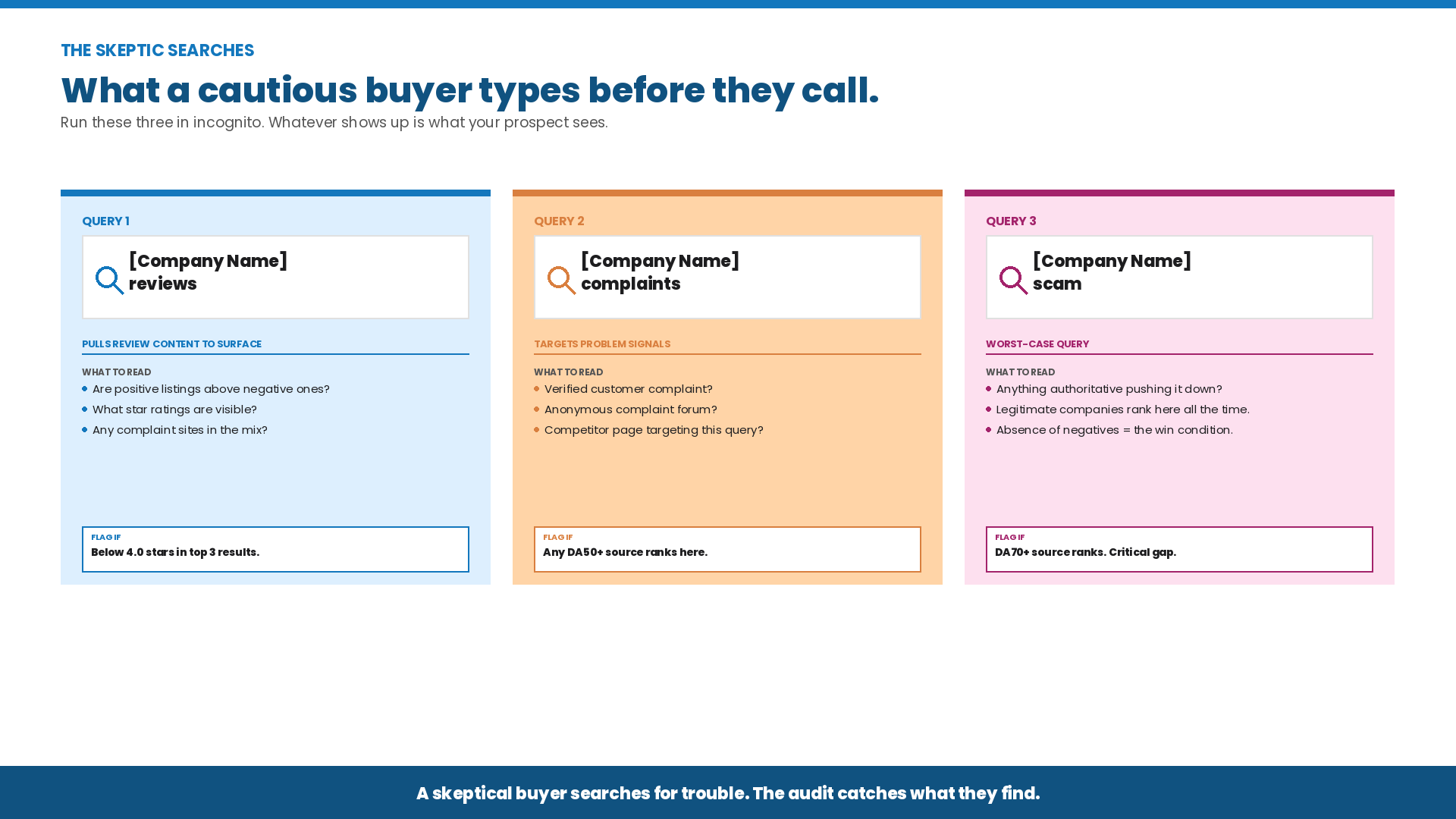
Search 1: [Company Name] reviews
This one surfaces review-focused content. Are positive listings showing up ahead of negative ones? What star ratings are visible? Any complaint sites in the mix?
Search 2: [Company Name] complaints
This is where it gets more pointed. Whatever comes up here, write it down — the source matters. A verified customer complaint is a real signal. An anonymous complaint forum hurts even if the claim is false. A competitor page targeting this query can actually be pushed down with the right displacement content.
Search 3: [Company Name] scam
Some prospects run this one, especially those who’ve had bad experiences elsewhere. Legitimate companies rank for it all the time when there’s nothing authoritative pushing the query down.
How to score the results:
- Nothing shows up for “complaints” or “scam”: strong — no negative signal in these queries
- Low-authority sources only: acceptable — worth setting a monthly alert
- DA50+ sources appearing: gap — a displacement strategy is needed
- DA70+ sources appearing: critical gap — requires immediate attention
Step 3: The Review Platform Assessment
Not all review platforms carry the same weight. Google reviews move differently from BBB ratings, and Trustpilot reads differently from Yelp. This step checks each platform where you have a presence — whether you claimed it or not — and scores what it’s actually communicating.
A 2025 BrightLocal survey found that 79% of consumers trust online reviews as much as personal recommendations. For B2B buyers specifically, the Google star count, BBB rating, and Trustpilot score are among the first things checked after the initial brand-name search.
What to check on each platform:
Google Business Profile:
Search your company on Google Maps and in Google Search with a location term. Is it claimed? Complete? How many reviews, what’s the average, and when did the last one come in? A profile sitting quiet for 14 months or more signals a business that isn’t paying attention.
Trustpilot:
Search your company name directly on Trustpilot.com. Is there a listing? Claimed? What’s the TrustScore and review count? Are there responses to negative reviews? (Unanswered complaints read worse than the complaints themselves.)
BBB:
Search your company name on BBB.org. Is it listed? What’s the rating? Any unresolved complaints? For professional services and financial companies, an F rating with open complaints is one of the most damaging single signals in a brand search.
Your verticals’ platforms:
B2B services should check Clutch and G2. Healthcare should check Healthgrades. Legal should check Avvo. Use whatever platform a prospect in your industry would naturally go to.
Fill in the review platform scorecard:
| Platform | Listed | Claimed | Rating | Review Count | Last Review | Score |
| Google Business | [your entry] | [your entry] | [your entry] | [your entry] | [your entry] | [your entry] |
| Trustpilot | [your entry] | [your entry] | [your entry] | [your entry] | [your entry] | [your entry] |
| BBB | [your entry] | [your entry] | [your entry] | [your entry] | [your entry] | [your entry] |
| [Vertical] | [your entry] | [your entry] | [your entry] | [your entry] | [your entry] | [your entry] |
Step 4: The Editorial Coverage Assessment
This one’s binary in a way the others aren’t. Either a recognized third-party publication has written about your company, or it hasn’t. You can’t fake it or buy it through a press release aggregator. Prospects and Google both know the difference.
Research from the 2025 Moz domain authority analysis found that companies with three or more mentions in DA70+ publications ranked an average of 2.3 positions higher in brand-name searches. In a search where most decisions happen on results one through five, that’s not a rounding error.
Finding editorial mentions:
In incognito, search “[Company Name] featured in, [Company Name] review”, and “[Company Name] [your industry]”. Log every result that isn’t your own website, a review platform, or a directory. Those are your editorial mentions — pieces where a third party chose to cover you.
Evaluating each one:
Use Moz’s Link Explorer or the free Ahrefs toolbar to pull the Domain Authority for each publishing site. Note whether the mention puts you in a positive, neutral, or unfavorable light.
Editorial coverage log:
| Publication | DA | Mention Type | Tone | Visible in Brand Search |
| [your entry] | [your entry] | [your entry] | [your entry] | [your entry] |
Scoring your coverage:
- Zero mentions from DA50+ publications: critical gap — no third-party validation exists
- One or two mentions from DA50+ publications: gap — you have a start, but not enough
- Three or more from DA60+, at least one from DA80+: acceptable
- Five or more from DA70+, at least two from DA80+: strong
Domain Authority and Owned Properties: A Quick Check
Domain Authority reflects how strong your link profile is — how many high-quality external sites point to yours. Google’s E-E-A-T guidelines treat editorial backlinks as markers of authority and trust. A thin link profile pulls down both branded and non-branded search performance.
While you’re at it, audit your owned properties: LinkedIn, social profiles, Google Business Profile, and industry directories. Anything incomplete or dormant sends a quiet negative signal to both algorithms and real people.
Run a quick DA check on yourself and two direct competitors using the free Moz tool or Ahrefs toolbar. The gap between your score and theirs is your starting point for link building.
Step 5: The Business Information Consistency Check
Mismatched business information — a slightly different phone number on Yelp, an old address still live on Apple Maps — seems minor until you understand what it costs you. BrightLocal’s NAP consistency research found that 68% of businesses have at least one major inconsistency across their top five directory listings. Google reads that as reduced confidence in the business, which suppresses your Google Business Profile in local search.
Prospects notice it too. A different phone number or address from what’s on your website triggers a simple, quiet thought: someone isn’t paying attention here.
Run the check:
Search your company name on Google Business Profile, Yelp, Yellow Pages, Bing Places, and Apple Maps. Write down the name, address, and phone number exactly as it appears on each.
| Platform | Name | Address | Phone | Consistent? |
| Google Business | [your entry] | [your entry] | [your entry] | [your entry] |
| Yelp | [your entry] | [your entry] | [your entry] | [your entry] |
| Yellow Pages | [your entry] | [your entry] | [your entry] | [your entry] |
| Bing Places | [your entry] | [your entry] | [your entry] | [your entry] |
| Apple Maps | [your entry] | [your entry] | [your entry] | [your entry] |
Count every mismatch, even small ones — “Suite 200” versus “#200” is still an inconsistency.
How it scores:
- Fully consistent across all five: strong
- One or two minor differences: acceptable
- Three or more inconsistencies, or anything major like an old phone number or wrong address: gap — fix this in week one
Step 6: The Competitive Comparison
Your score only matters in context. Two DA80+ editorial mentions sound decent until you realize every competitor in your market has eight. Zero negative results in a skeptic search looks great until a competitor has five DA90+ editorial features pushing any bad content completely off the page.
Run steps one through five for two or three direct competitors and record the results side by side.
The comparison matrix:
| Dimension | Your Company | Competitor A | Competitor B |
| Positive results in the top 5 | [your entry] | [your entry] | [your entry] |
| Google review count | [your entry] | [your entry] | [your entry] |
| Google’s average rating | [your entry] | [your entry] | [your entry] |
| DA80+ editorial mentions | [your entry] | [your entry] | [your entry] |
| BBB rating | [your entry] | [your entry] | [your entry] |
| NAP consistency | [your entry] | [your entry] | [your entry] |
| Negative results in the top 10 | [your entry] | [your entry] | [your entry] |
This comparison tends to produce one of two findings, and both are useful. Either you’re further ahead than you thought — in which case a lighter maintenance program holds that position — or you’re behind in specific, measurable ways. “We need more editorial coverage” becomes “we need four more DA70+ placements to match what Competitor A has built.” That’s a specific target you can scope and budget.
Step 7: The AI Search Brand Audit
Two years ago, this step didn’t exist. Today it’s non-negotiable. A 2025 Gartner report found that 75% of B2B buyers used at least one AI search tool in their research process, up from 42% the year before. Any brand audit that ends at Google is missing a channel that’s already influencing buyer decisions.
Three Searches to Run
ChatGPT (chat.openai.com):
Type your exact company name. Does ChatGPT say anything about you? What does it describe? Is the information current and accurate? Outdated responses mean the AI is drawing from old sources — fresh, high-authority editorial content is the way to update what it knows.
Run the same search. Perplexity shows its sources right there in the interface. That list tells you which of your editorial mentions are authoritative enough for AI tools to rely on.
Google AI Overview:
Search your company name and key service queries. AI Overview now surfaces above organic results in about 47% of commercial searches (SparkToro, 2025). Do you appear? In what context?
Scoring your AI presence:
- Accurate, positive mentions in both ChatGPT and Perplexity: strong
- Mentioned but with outdated or inaccurate information: gap — new editorial content will update what AI tools pull
- Not mentioned at all: acceptable for now, but this gap compounds year over year
One thing worth knowing: AI tools only surface brands they have credible editorial sources for. No DA70+ coverage means nothing for AI tools to draw from. The AI presence gap and the editorial coverage gap are the same problem.
The Nine-Dimension Scorecard: Pulling It All Together
Once you’ve worked through all seven steps, bring the scores together. This is the part where 30 minutes of audit work becomes an actual document you can act on.
THE BRAND SEARCH AUDIT SCORECARD
Company: [Name] | Audited: [Date] | Auditor: [Name]
| Dimension | Score | Notes |
| 1. Search result composition | Strong / Acceptable / Gap / Critical Gap | |
| 2. Review volume and aggregate rating | Strong / Acceptable / Gap / Critical Gap | |
| 3. Third-party editorial coverage | Strong / Acceptable / Gap / Critical Gap | |
| 4. Domain authority and referring domains | Strong / Acceptable / Gap / Critical Gap | |
| 5. Owned property optimization | Strong / Acceptable / Gap / Critical Gap | |
| 6. Business information consistency | Strong / Acceptable / Gap / Critical Gap | |
| 7. Negative content assessment | Strong / Acceptable / Gap / Critical Gap | |
| 8. Competitive brand search comparison | Strong / Acceptable / Gap / Critical Gap | |
| 9. AI search brand presence | Strong / Acceptable / Gap / Critical Gap |
What the results mean:
If you ended up with zero Critical Gaps and two or fewer Gaps, your brand search result is doing its job. Stay on a regular maintenance rhythm. Nothing urgent.
One or two Critical Gaps with three to five total Gaps is actually the most common outcome for mid-size companies. You’re not in crisis — but you’re probably losing deals you should be winning. Fix the Critical Gaps first, then work down the list by how visible each issue is to a prospect doing a 30-second check.
Three or more Critical Gaps mean the brand search results are actively costing the business money right now. Every prospect who searched your company name and didn’t reach out is a deal that didn’t happen. The audit doesn’t fix that on its own — but it creates the exact roadmap that will.
Turning the Audit Into an Action Plan
The scorecard shows you where the problems are. The action plan answers the question of what to do first and in what order.
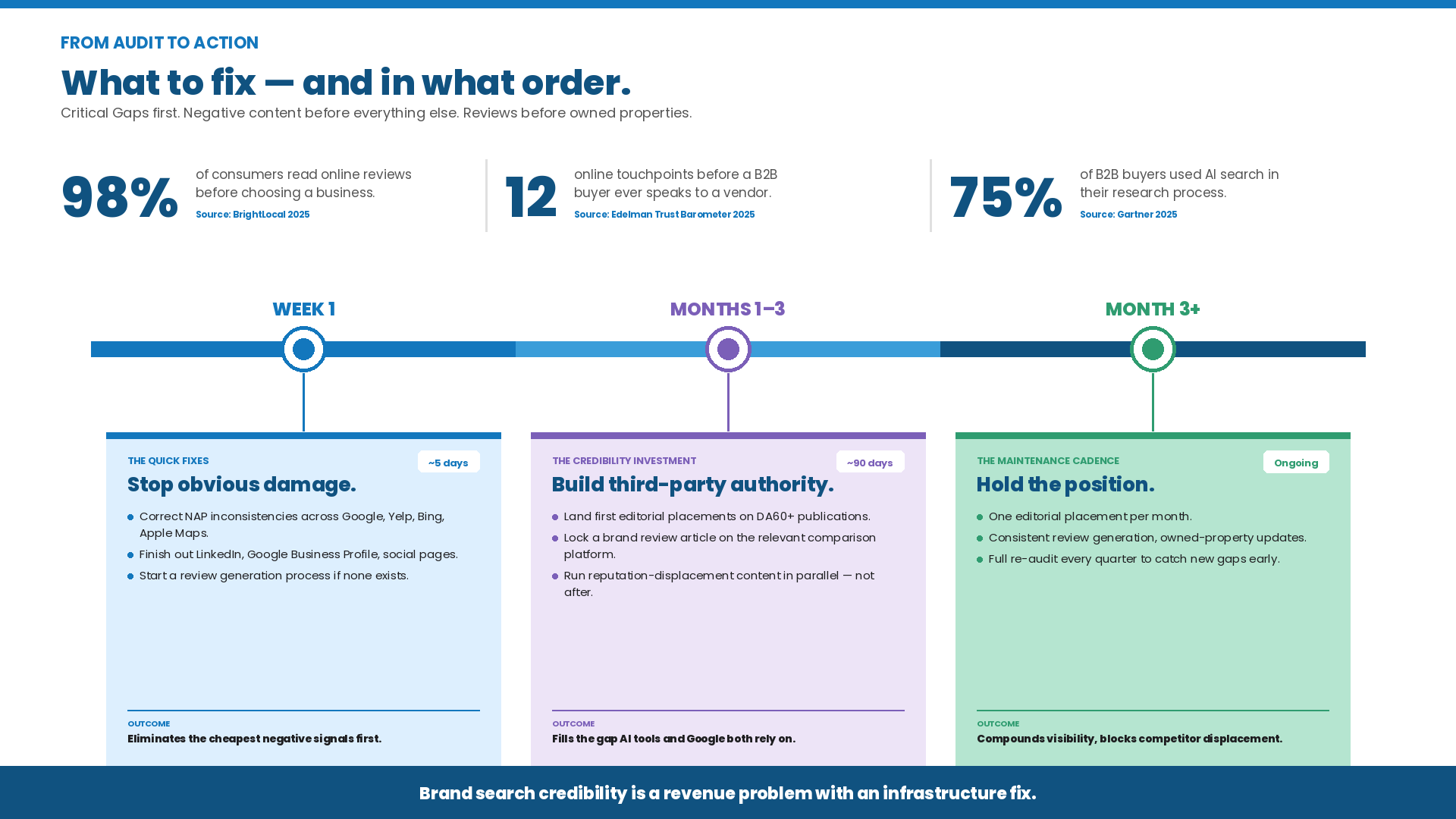
Sequencing matters. Critical Gaps come before ordinary Gaps. Gaps come before anything scoring Acceptable or Strong. Within the Critical Gap bucket, negative content gets tackled first — it’s actively damaging every day it ranks. Within the Gap bucket, reviews and ratings come before owned property optimization, because they’re the signal a prospect is most likely to notice in a quick scan.
Here’s how the build typically breaks out:
Week 1 — the quick fixes. Correct any NAP inconsistencies. Finish out your owned property profiles: LinkedIn description, Google Business Profile, and social pages. Get a review generation process started if there isn’t one already. None of this takes months — and it eliminates the most obvious negative signals fast.
Months 1 to 3 — the real credibility investment. This is where the substantive work happens. Get the first editorial placements live, targeting the highest-visibility coverage gaps. Lock in a brand review article on the most relevant comparison platform. If negative results came up in the skeptic searches, run reputation-displacement content in parallel — not after.
Month 3 onward — the maintenance cadence. One editorial placement a month. Consistent review generation. A full re-audit every quarter to confirm the gaps are closing and catch anything new before it compounds.
This isn’t a content strategy or a branding initiative. It’s an infrastructure fix with a defined sequence and a measurable end state.