More and more clients are asking their marketing agencies for something new. They want their leads worked. That means outbound calls, live transfers, and appointment setting. But most agencies were never built to run a dialing floor.
A 2025 report by the International Association of Outsourcing Professionals (IAOP) found that over 61% of mid-market companies want to use a single partner for both lead generation and lead nurturing. That demand has left a big gap. Many agencies can generate leads. But they cannot work them.
White-label BPO fills that gap. It lets agencies offer outbound calling, live transfers, and appointment setting under their own brand. No floor needs to be built. No agents need to be hired.
This guide explains how the model works, what agencies need to manage, what the markup numbers look like, and what to require of an operator before signing.

What Is White-Label BPO?
White-label BPO is a setup in which a managed BPO operator runs an outbound calling, live transfer, or appointment-setting campaign under the agency’s brand. The end client never knows the operator exists.
The client gets reports with the agency’s logo. They talk to the agency’s team. All their data is delivered in the agency’s format. The operator runs the agents, the dialer, and the quality checks. The client sees the agency.
This is different from the two other setups:
- Staffing setups in which a third party places agents, but the agency manages them. In white-label BPO, the operator manages the agents. The agency does not.
- Referral setups in which the agency sends a client to a BPO vendor and earns a fee. In a referral, the vendor works directly with the client. In white-label BPO, the operator never contacts the client.
A 2026 Everest Group BPO Market Report found that the white-label BPO segment grew by about 28% between 2024 and 2026. Most of that growth came from marketing agencies in financial services, insurance, and home services.
Why the Demand for White-Label BPO Has Grown
The demand did not appear overnight. It built up over several years.
Clients Are Combining Their Vendors
Since 2023, more clients in financial services and other lead-heavy industries have begun reducing the number of vendors they use. They want one partner to handle both lead generation and lead working. They do not want to manage a separate marketing agency and a separate BPO vendor.
A 2025 survey published by Deloitte’s outsourcing practice found that 54% of companies with 50 to 500 employees prefer to get lead generation and lead nurturing services from a single provider. Agencies that only offer lead generation risk losing the full account to a competitor that can do both.
Building a Floor Costs Too Much
When agencies look at building an in-house dialing floor, the costs are usually much higher than expected. They need to pay for recruiting, training, technology, quality control staff, supervisors, and compliance. All of that has to be funded before a single call is made.
Industry benchmarks indicate that a basic in-house dialing operation for a single client costs between $180,000 and $240,000 in the first year. That does not include ongoing costs. For most agencies, that number is too high to justify for one or two clients.
White-label BPO is the practical option. The agency delivers the service. The operator handles the costs and the setup. Both sides share the revenue.
Four Situations Create the Need
Four common situations push agencies toward white-label BPO:
- The “can you work these leads?” question: A client asks the agency to call, qualify, and transfer leads. The agency has no floor to offer.
- The full-stack competitor threat: A rival agency offers lead generation and dialing as a single package. Agencies that only generate leads are at a disadvantage.
- The account growth opportunity: An existing client spends $15,000/month with the agency. White-label BPO can grow that account to $30,000–$40,000/month without finding a new client.
- The new service launch: An agency wants to offer outbound services but cannot spend 12–18 months building the setup from scratch.
How White-Label BPO Works in Practice
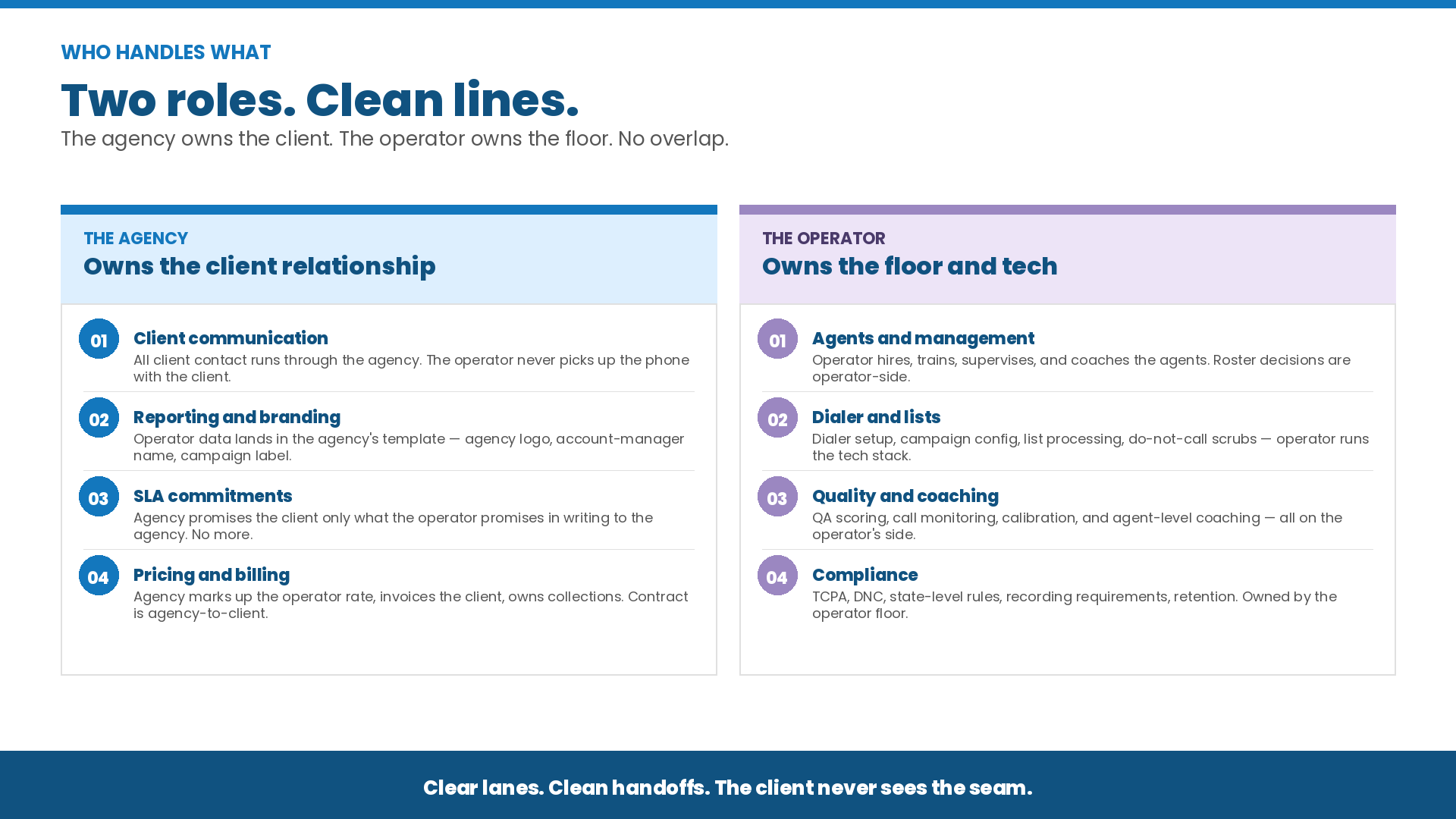
The best way to understand this model is to look at what the agency and the operator handle.
What the Agency Handles
The agency focuses on the client relationship:
- Client communication: All client contact is handled by the agency. The operator does not speak directly to the client.
- Reporting: The operator sends raw performance data. The agency delivers it to the client in a branded format.
- SLA promises: The agency stands behind the service-level targets it commits to the client, even though the operator is doing the actual work.
- Pricing and billing: The agency marks up the operator’s rate and sends invoices to the client. The client’s contract is with the agency.
What the Operator Handles
The operator runs everything the client does not see:
- Hiring, training, and managing agents
- Dialer setup, campaign management, and list processing
- Quality monitoring, scoring, and call coaching
- Compliance (TCPA, DNC, and state-level rules)
- Daily and weekly reports are sent to the agency
The agency runs the client relationship. The operator runs the floor. Neither does the other’s job.
How the Three Parties Work Together
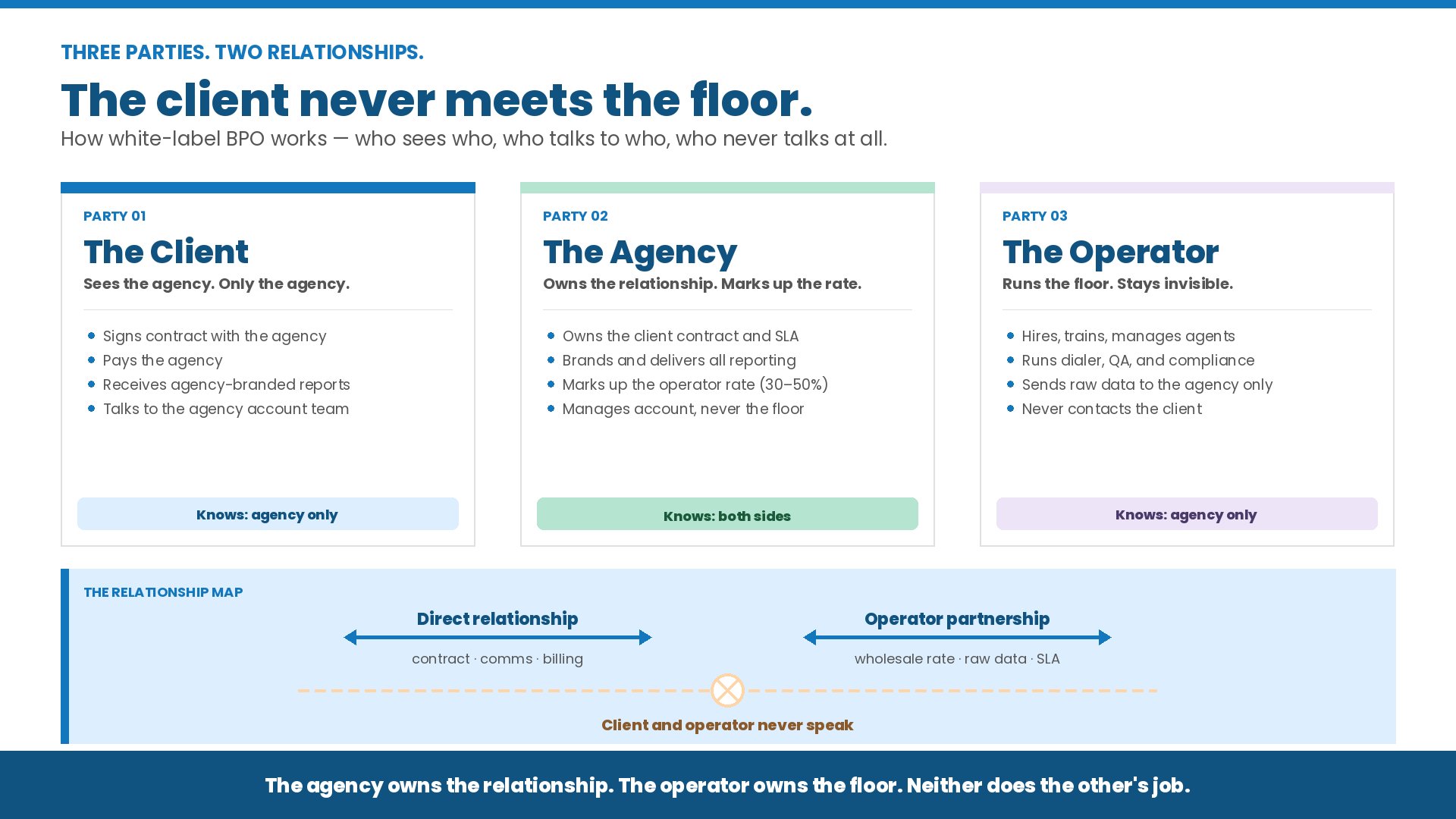
In a white-label setup, there are three parties. Only two of them see each other.
The client only knows the agency. The agency discusses campaign performance and goals with the operator. The operator manages the agents and the tech. The client and the operator never speak.
A 2025 compliance guide from the National Association of Professional Employer Organizations (NAPEO) found that clear three-party structures cut disputes and SLA confusion in managed service setups by about 35%.
The SLA Structure: What Agencies Can Actually Promise
The SLA question is the top reason agencies hold back from offering white-label BPO. If the agency does not control the agents or the dialer, what can it promise to a client?
The answer is simple: the agency promises the same thing the operator promises to the agency. No more, no less.
How the SLA Chain Works
The chain moves in one direction:
- The operator agrees to the performance targets in the agency contract (contact rate, transfer-set rate show rate, and minimum QA score).
- The agency uses those same targets in the client contract.
- The agency cannot promise more than the operator has agreed to deliver.
Before making any promise to a client, the operator’s SLA must be confirmed in writing with specific numbers.
The Risk the Agency Always Carries
Even with a solid SLA chain, one risk stays with the agency: the client relationship.
If the operator does a poor job and the client gets upset, the agency’s name is the one that gets hurt. It does not matter if the operator met their contract terms. The agency’s brand still takes the brunt of the damage. This is why picking the right operator is the most important decision in the whole model.
A 2025 Forrester Research study of B2B reseller models found that 71% of agencies that lost clients in white-label setups blamed poor operator performance. Not the white-label model itself.
The Onboarding Timeline: What “48 Hours” Really Means
Many white-label BPO providers claim they can launch in 48 hours. That claim is only true in one specific situation.
When 48 Hours Works
A new agency client can be onboarded in 48 hours only when the operator already has all of this in place:
- Active agents trained on the same industry and qualification rules
- Dialer set up for the campaign type
- A reporting dashboard template ready for a new client
- Compliance systems already built for the industry
In that case, adding a new client is mostly paperwork. It means signing the contract, setting up reporting, loading the lead list, and doing a short kickoff call. For campaigns the operator already runs, 48–72 hours is realistic.
When It Takes the Full 10 Days
If the campaign is in a new industry, uses custom qualification rules, needs new scripts or agent training, or has special compliance needs, then 10 business days is the honest timeline.
A structured 10-day launch plan with clear daily steps is a stronger signal of reliability than a 48-hour promise that cannot be kept.
The Reporting Layer: How the Agency Brands the Operator’s Data
The reporting layer is where the white-label model becomes real for the client. The operator creates the data. The agency packages and brands it.
What the Operator Sends
The operator delivers raw performance data daily and weekly. The standard metrics are:
- Leads worked rate
- Contact rate
- Qualification rate
- Transfer-set rate
- Show rate
- QA score average
- Trailing cost per acquisition (CPA)
Agent-level data is shared with the agency for internal use. It is usually not sent to the client.
What the Agency Delivers
The agency takes the operator’s data and puts it into its own branded template. The final report carries the agency’s logo, the client’s campaign name, and the account manager’s name. The operator’s name does not appear anywhere in the client’s report.
The Dashboard Access Question
Some agencies give clients direct dashboard access. The operator’s platform is configured to display the agency’s branding. This only works if the operator’s system supports white-label dashboard design. Always confirm this before promising a client direct dashboard access.
The Markup Math: What White-Label BPO Earns for an Agency
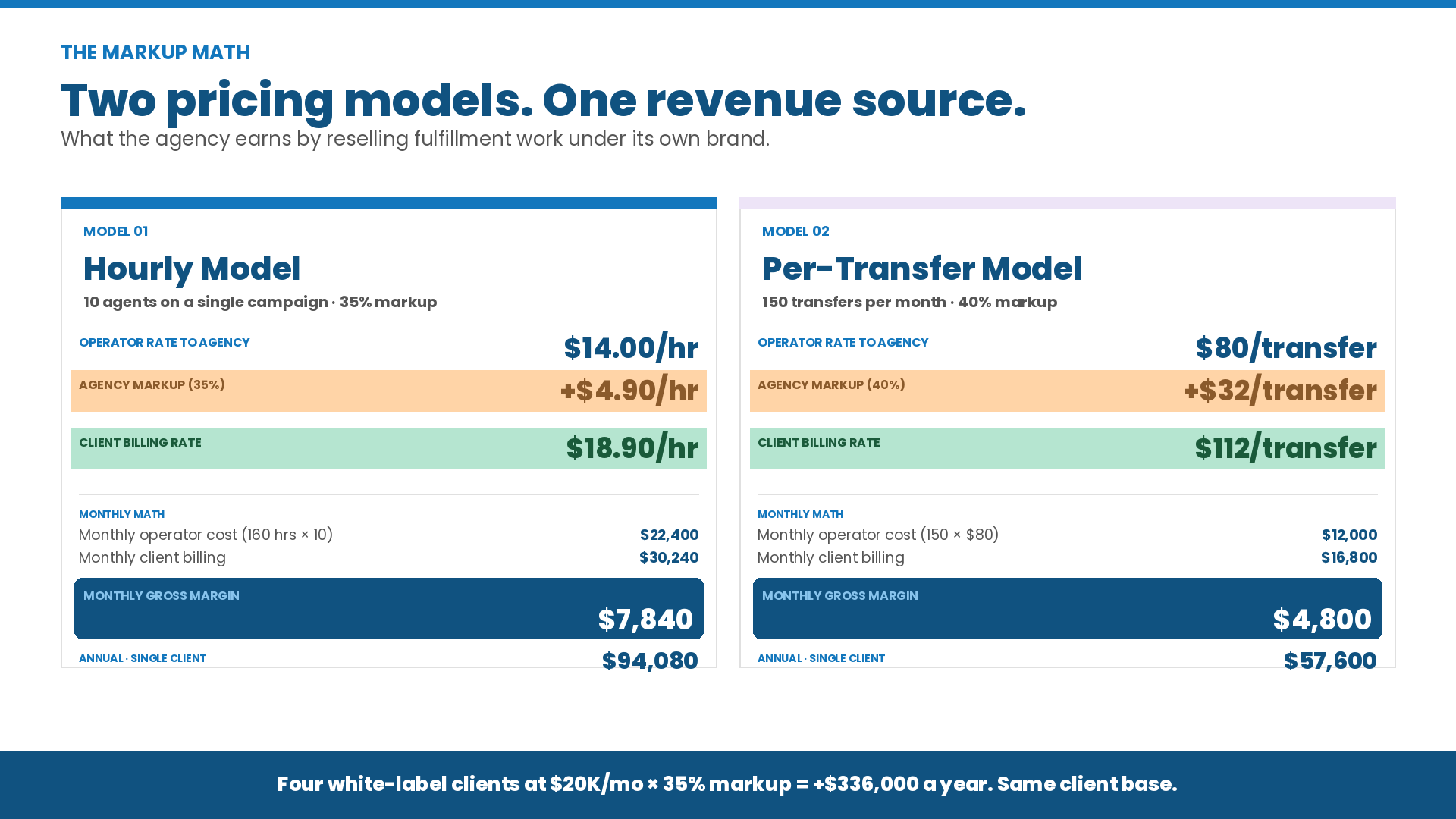
The revenue model depends on the pricing structure the operator uses.
Hourly Model
| Metric | Example |
| Operator rate to the agency | $14/hr per agent |
| Agency markup (35%) | $4.90/hr |
| Client billing rate | $18.90/hr |
| Agents on campaign | 10 |
| Hours per month per agent | 160 |
| Monthly operator cost | $22,400 |
| Monthly client billing | $30,240 |
| Monthly gross margin | $7,840 |
| Annual gross margin (single client) | $94,080 |
Ten agents, one client, 35% markup: $94,000 in annual gross margin from the fulfillment work alone, before any media or content fees.
Per-Transfer Model
| Metric | Example |
| Operator rate to the agency | $80/transfer |
| Agency markup (40%) | $32/transfer |
| Client billing rate | $112/transfer |
| Monthly transfers delivered | 150 |
| Monthly operator cost | $12,000 |
| Monthly client billing | $16,800 |
| Monthly gross margin | $4,800 |
| Annual gross margin (single client) | $57,600 |
The Account Growth Math
An agency with 8 financial services clients, each spending $15,000/month on paid media, generates $1,440,000 in media revenue per year. If four of those clients add white-label BPO at $20,000/month with a 35% markup, the agency adds $336,000 in annual gross margin from the same client base. No new clients needed.
What to Look for in a White-Label BPO Partner
Picking the wrong operator is more costly in a white-label setup than in a normal vendor relationship. The agency’s name is on the line. A bad operator hurts the agency’s brand and client relationships.
Six Things to Confirm Before Signing
- White-label reporting capability
Ask the operator to show a sample report in white-label format. It must have no reference to the operator’s name or brand.
- No direct client contact
Get it in writing. The operator must agree not to contact the agency’s clients without the agency’s permission. A verbal promise is not enough.
- No poaching of agency clients
A white-label operator who goes after the agency’s clients directly is not a partner. They are a competitor. This protection must be in the contract.
- Proof of results in the right industry
Request performance data for the specific industry in which the agency’s clients operate. Overall stats are not enough. Contact and transfer rates vary widely by industry.
- SLA commitments in writing
The operator must agree in writing to the performance targets the agency must meet to deliver to its clients.
- Capacity for multiple agency clients
Confirm the operator can run separate campaigns for different agency clients. Each client’s data must be kept separate. Shared data setups create risk.