
Merchant cash advance live transfers are supposed to solve the problem of wasted floor time, but most don’t. Your closers are expensive. Every call they spend re-qualifying a transfer that should have been screened beforehand is money that does not come back.
The problem is not volume. Most MCA operations have enough leads coming in. The problem is that too many of those calls arrive already broken: wrong deposit range, no decision-maker on the line, a prospect who has already been contacted by three other buyers. The transfer label is technically accurate. The handoff is not.
What follows is how a real MCA live transfer campaign is structured, what gets verified before a call ever reaches your floor, and why the 100% contact rate claim holds when the QA infrastructure behind it is built correctly.

What Separates Real MCA Live Transfers From Bad Ones
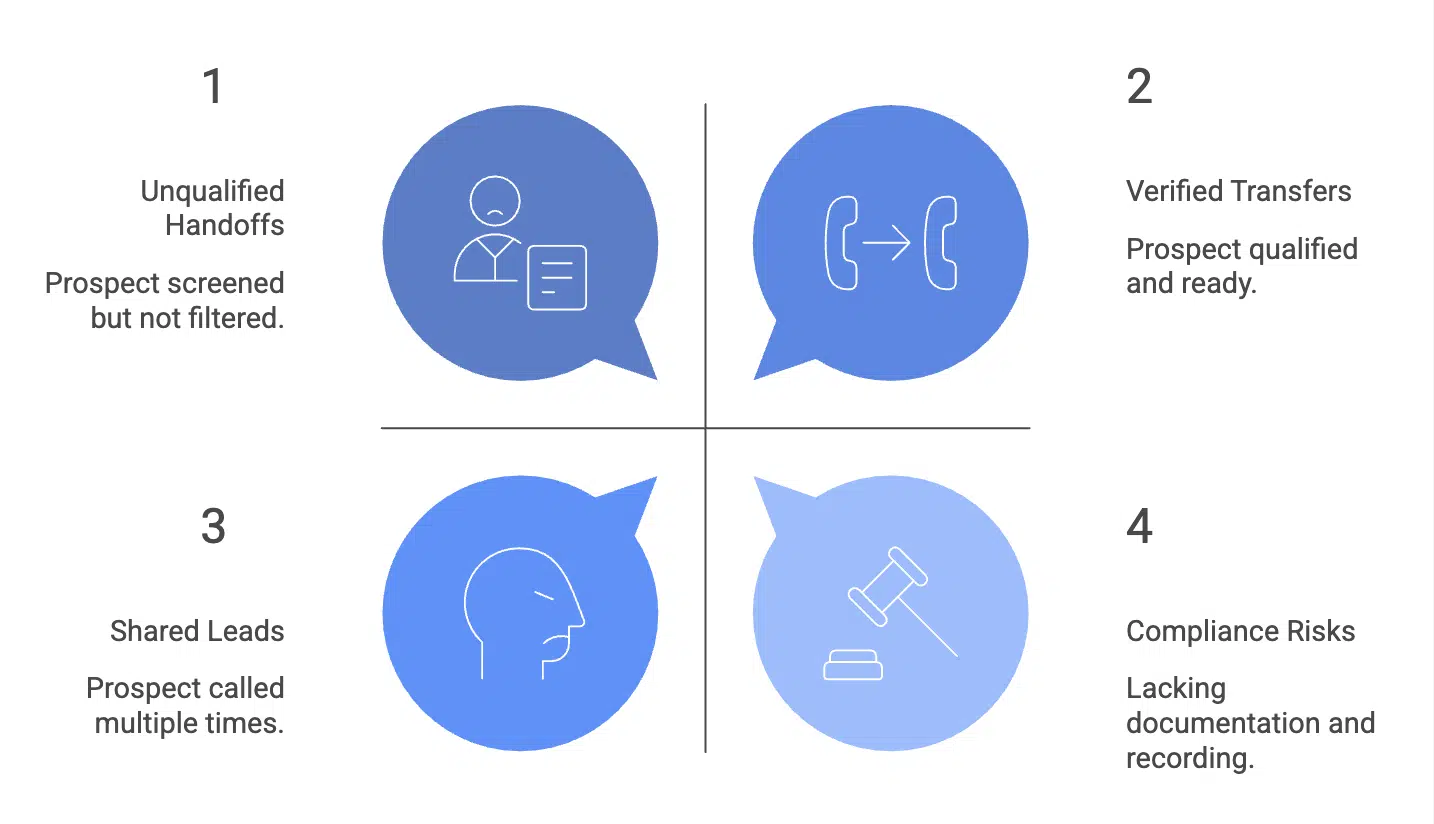
The live transfer label is used so broadly that it has lost meaning. Operators who have purchased live transfer leads from multiple vendors already know the range. At one end, a verified prospect is on the line, qualification is done, and the closer steps into a real conversation. At the other end, a prospect is patched through who does not meet deposit minimums and has already been called by three other buyers.
Both are called live transfers. Only one works like one. The gap between them is where most floors lose floor time, close rate, and closer morale.
The MCA market was valued at approximately $20.67 billion in 2025, according to Precedence Research. It is projected to reach $22.17 billion in 2026. Inside that volume, the operators who win funded deals consistently are the ones whose closers spend their time in real sales conversations, not in re-qualification calls.
Four failure points are seen consistently across the industry. Each one is named below, along with why it costs the buyer.
Unverified Handoffs
Unverified handoffs happen when a prospect is screened against a script but not checked against the client’s actual campaign filters. The transfer goes through anyway. The closer spends the first three minutes doing the qualification work that the transfer agent was supposed to finish before the call was ever passed.
Shared or Recycled Leads
Shared or recycled leads mean the prospect has already been called by multiple buyers before this transfer is attempted. The “live” label is technically correct in the sense that a person is on the line. Operationally, the intent has already been worn down.
Compliance Gaps
Compliance gaps mean no proper consent documentation, no call recording, and no audit trail. According to data reported by The National Law Review in May 2025, 507 TCPA class actions were filed in Q1 2025 alone, which is a 112% increase compared to the same period in 2024. The buyer absorbs that exposure without knowing it until litigation is already in motion.
No Performance Feedback Loop
No performance feedback loop means the vendor ships calls, the campaign runs, and the buyer has no way to see why the close rate is dropping. No weekly comparisons are made. No adjustments happen.
These are not edge cases. They describe how a large portion of the live transfer market operates.
CONNECT WITH QUALIFIED PROSPECTS NOW!
How the LeadAdvisors MCA Live Transfer System Works
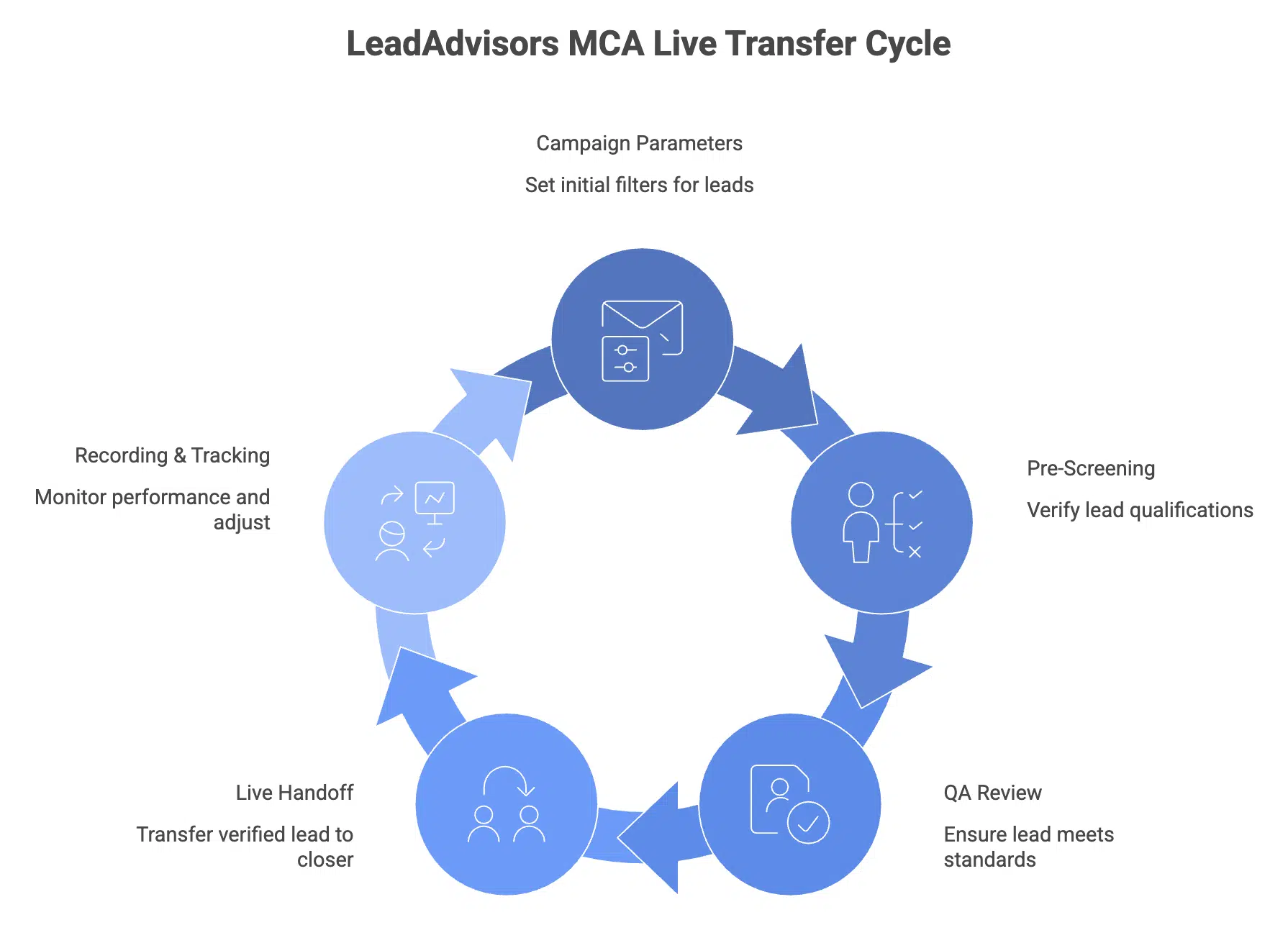
What is described below is the step-by-step process every merchant cash advance live transfer is required to pass through. Each stage is designed to remove a specific failure point. Stages are not skipped.
Stage 1: Campaign Parameters
Every campaign starts with the client’s hard filters. These include minimum monthly deposit, time in business, business owner verification, geographic limits, daily volume cap, and hours of operation. A call that does not meet these filters does not move forward.
Stage 2: Pre-Screening
Transfer agents contact prospects and check every filter before any handoff is tried. The business owner is confirmed on the line. Deposit history and time in business are both verified. If the prospect does not qualify, the call is closed and logged. It is not passed to the floor as a borderline case.
Stage 3: QA Review
Before any merchant cash advance live transfer reaches the floor, the quality assurance team reviews the call. Every lead detail is logged in the buyer’s call tracking portal. The closer does not pick up until QA has confirmed the transfer meets all campaign parameters.
This review layer is where most providers cut costs. Removing it produces call volume. It does not produce qualified handoffs.
Stage 4: Live Handoff
The prospect is verified and on the line at the moment of transfer. The closer does not start the conversation with a screening script. Qualification has already been completed. The conversation opens with intent.
That is what the 100% contact rate claim is built on. The transfer does not happen unless the prospect is live and verified. Contact is confirmed as a condition of handoff, not reviewed after the fact.
Stage 5: Recording, Tracking, and Adjustment
Every call is recorded. The client accesses performance data through the call tracking portal, including lead sheet details logged before the closer picks up. Weekly close rate reviews are run against campaign parameters. If a parameter is producing weak transfers or close rate drops, the campaign is adjusted as part of ongoing management, not at contract renewal.
CONNECT WITH VERIFIED LIVE TRANSFERS
MCA Live Transfer Qualification Parameters: What Gets Verified Before Every Handoff
The word “qualified” is used loosely in the lead industry. What follows is what it means inside a LeadAdvisors live transfer lead qualification campaign. All parameters below are confirmed before a handoff is attempted.
- $10,000 or more in average monthly deposits is required for every MCA live transfer. This figure is confirmed during pre-screening, not self-reported at the time of transfer. Calls that do not clear this threshold are screened out before any handoff is attempted.
- 12 or more months in business, verified. Time in business is confirmed against the stated business history. Businesses that do not clear this threshold are screened out during Stage 2 and never reach the closer.
- Verified business owner on the line at the time of transfer. A proxy or assistant is not a valid handoff. The decision-maker must be confirmed as present before the transfer moves forward. This removes the common problem of reaching someone who cannot authorize a funding discussion.
- Live handoff completed at the point of transfer. If a direct live handoff is not possible after two contact attempts, a confirmed live appointment is set. Both formats are logged and visible in the portal.
- Full business details are logged in the lead sheet before the closer picks up. Business name, owner name, contact info, deposit range, and time in business are all available in the portal before the handoff is completed.
When a call does not meet the criteria, it is not transferred. It is logged, closed, and visible to the client in the portal. The client can see how many calls were screened out and why. That level of visibility is not available from vendors who do not document what fails.
Why MCA Closing Floors Run on Live Transfers: Not Web Leads or Aged Data
The case for live transfers is not a matter of style. It is an operational argument. The math works differently across each lead format, and that difference grows quickly at floor scale.
The Federal Reserve’s Small Business Credit Survey found that speed and ease of access are the top reasons small business owners choose alternative financing. That finding has a direct effect on how leads should be structured. The buyer who reaches a qualified prospect first in a real conversation wins a much larger share of funded deals. This is the core argument for live transfers as the main tool for lead generation on the closing floor.
Web Leads
The prospect filled out a form. By the time a closer calls, intent has cooled. In most MCA web lead programs, the lead has already been sent to two or three other buyers before your closer ever dials. The closer is not opening a conversation. They are entering a line.
Aged Data
Volume is cheap. Contact rate is not. The time a closer spends dialing through aged data to find one qualified prospect is time not spent on funded deals. The cost per funded deal is rarely as low as the cost per lead suggests.
Outbound Cold Calling
Outbound cold calling through outbound prospecting works, but it requires a full infrastructure layer: dialers, scripts, compliance tools, and ongoing QA. Most MCA operations do not want to build and manage that infrastructure in-house.
Live Transfers
The prospect is on the line. Qualification is done. The closer’s first words open a sales conversation, not a screening call. The contact rate is 100% by design because the transfer does not happen unless the prospect is verified and live.
In MCA, the first company to have a real conversation with a qualified prospect wins a large share of the business. Live transfers are the only lead format where that advantage is built into the product itself.
MCA Live Transfer Packages: Volume Tiers, No Contracts
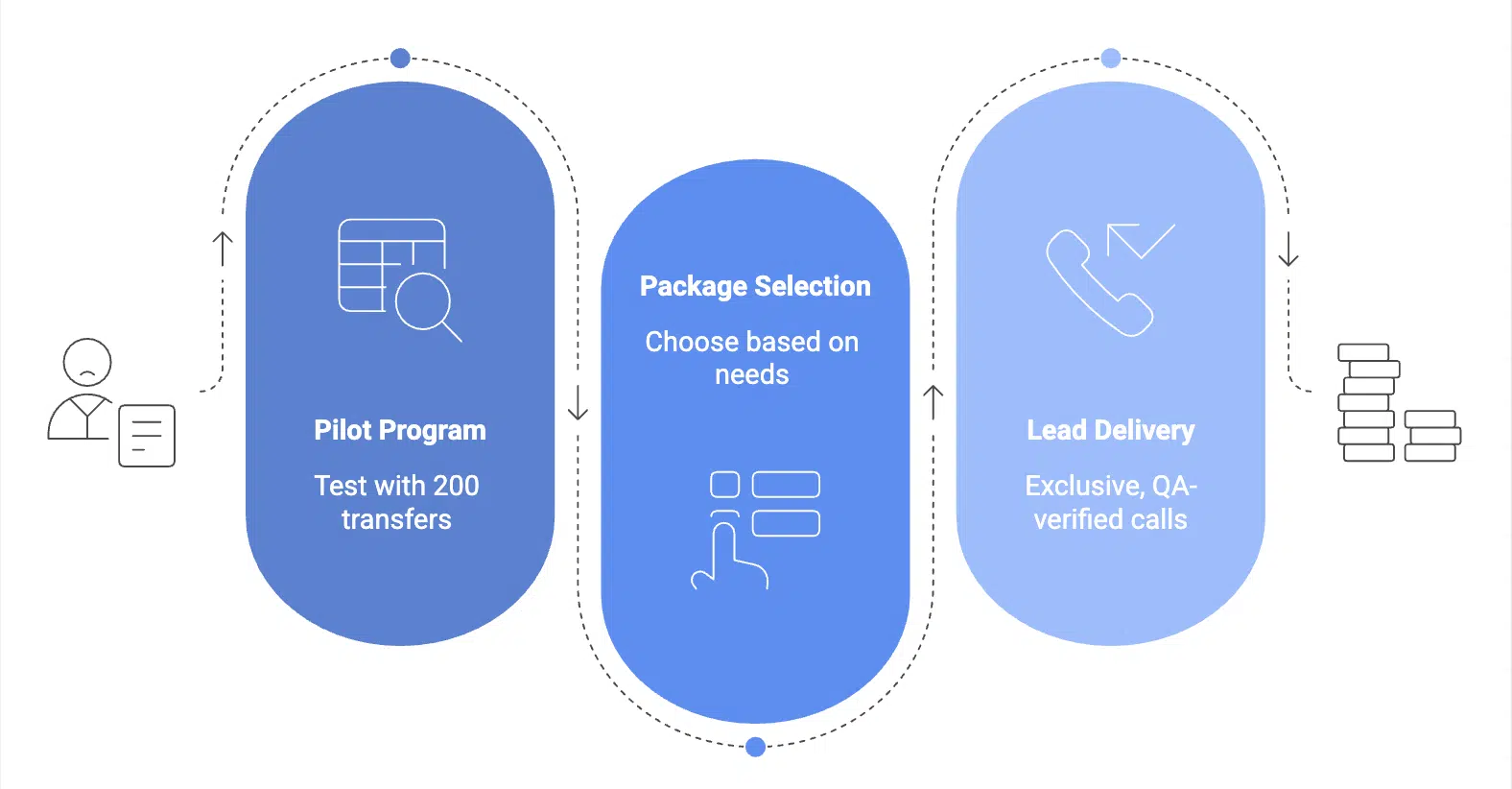
Three packages are available. Each one is built around a different floor size and volume need. No contract is required for any tier. QA-verified, exclusive calls are included across all packages, along with direct lead delivery, full call tracking, and P&L portal access.
Starter Package
- Designed for floors with 3 to 5 active closers, testing a new transfer channel.
- Exclusive, QA-verified calls delivered directly to the closer.
- Call tracking and P&L portal access included.
- No contract. No commitment required.
Growth Package
- Built for established floors with 5 to 15 closers scaling qualified lead volume.
- Higher daily volume caps with weekly performance reviews included.
- Campaign parameter adjustments are managed on an ongoing basis.
- No contract. No commitment required.
Enterprise Package
- For operations with 15 or more closers requiring a consistent high-volume daily feed.
- Dedicated account management and priority QA review.
- Full call recording library and P&L analytics portal access.
- No contract. No commitment required.
For buyers who have been burned by a past vendor, a 200-transfer pilot is available as the entry point. Call quality, transfer consistency, and close rate can all be reviewed against real data before any package decision is made. It is designed to remove risk by replacing guesswork with results.
Who MCA Live Transfer Campaigns Are Built For
This campaign is designed for a specific type of operation. If you match the profile below, the transfer system is built to plug into what you already have. If you do not match it, a different starting point is likely to serve you better.
This Campaign Is the Right Fit If:
- Your closing floor already exists, and the problem is keeping it fed with qualified conversations, not building a sales team from scratch.
- Your operation runs MCA, business loans, or an adjacent financial vertical where deposit verification and decision speed are the core filters.
- There is already a dialer, a closer team of at least three to four people, and some form of CRM or lead tracking in place.
- You have tried at least one other lead source and found the contact rate or qualification quality unacceptable.
This Campaign Is Not the Right Fit If:
- The operation is still being built. If there are fewer than three or four active closers, a managed dialing campaign is the better starting point, not a live transfer package.
- An end-to-end sales infrastructure is what is needed. A live transfer system feeds an existing floor. It does not build one.
The same transfer infrastructure that powers MCA campaigns also covers adjacent verticals. If your operation handles debt settlement, the same system is used for debt live transfer leads.
For tax resolution, the campaign structure applies to tax live transfers. Strong sales pipeline management across multiple verticals can be discussed through the contact options below. The same infrastructure is also used for mortgage live transfers and personal loan verticals.