
Every night, leads go unworked. No one answers calls. Requests sit in a queue for 12 or more hours. No one follows up until morning.
This is a common problem. It stems from a single gap: single-region BPO coverage.
McKinsey & Company found that one-region contact centers miss 30-40% of their leads. This happens when campaigns run across all US time zones. A 2025 Deloitte survey found that 7 in 10 outsourcing firms want longer hours. But fewer than 1 in 3 check.
Multi-region BPO coverage fixes this. It puts agents in several markets. Each market works its own local hours. Together, they cover the full US window, including evenings and weekends.
This guide covers how it works, which markets to use, how to manage teams, and what to ask any vendor.


What Multi-Region BPO Coverage Means
Multi-region BPO coverage involves deploying agents across several markets. Each market works in its own time zone. Together, they cover more hours than one market can.
The idea is simple. Getting it right takes real coordination.
A 2026 IAOP report found a key problem. Fewer than 4 in 10 BPO vendors use real shift handoff systems. Most that claim “global” coverage don’t have them. Without handoffs, “multi-region coverage” is just a sales term.
What multi-region coverage is NOT:
- A vendor with offices in many countries, but all calls are going through one region
- A vendor with one main market and a backup used only when needed
- A vendor that says “global” based on office locations, not actual agents
What multi-region coverage IS:
- Each market covers a set block of the calling window
- Teams pass work to the next shift with a clear briefing
- One report shows results from all markets
- Every market follows the same quality rules
- One person is in charge of results across all markets
Three things that make it real:
- Spread – agents in several markets across different time zones
- Coordination – clear handoffs, shared rules, shared call labels
- Ownership – one person in charge of all markets
No handoff system means separate teams. That is not multi-region coverage.
Why One-Region Operations Leave Gaps
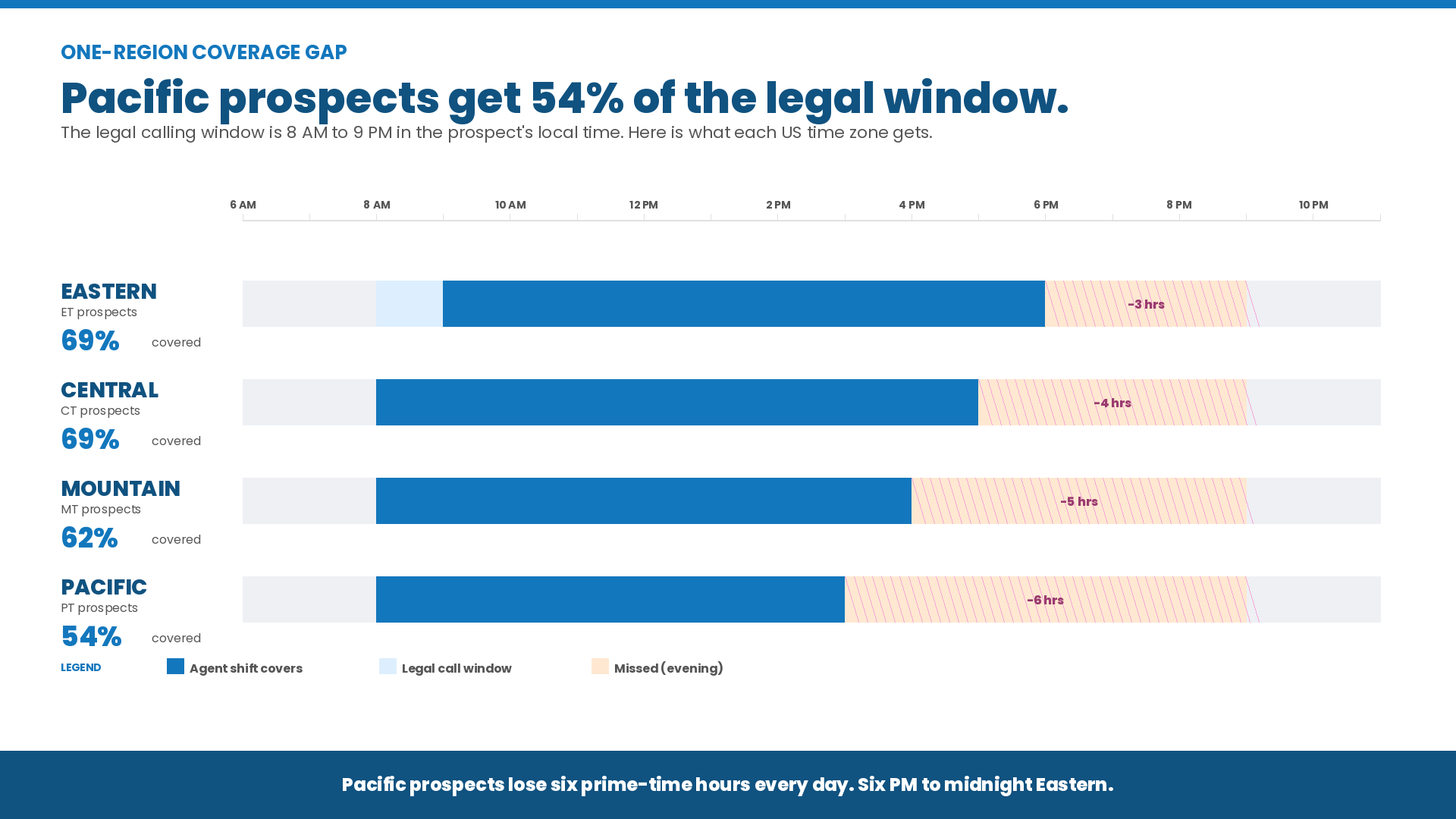
No single region can cover all US time zones. Here is why.
The Time Zone Gap
The US has four time zones. The law is clear. You can only call from 8 am to 9 pm. That window is the prospect’s local time – not your agent’s.
A floor that works 9 am to 6 pm Eastern covers:
- Eastern prospects: 9 am to 6 pm – full 9 hours covered
- Central prospects: 8 am to 5 pm – misses 5 to 9 pm
- Mountain prospects: 7 am to 4 pm – misses 4 to 9 pm
- Pacific prospects: 6 am to 3 pm – misses 3 to 9 pm
For Pacific prospects, 3 to 9 pm is prime time. That’s 6 pm to midnight Eastern. The floor is already closed.
The Evening Lead Gap
People who fill out forms in the evening are ready to act. They’re not at work. They chose to reach out.
Research shows what happens after a lead comes in. After one hour, the chance of reaching them drops by a factor of 10. After five hours, it drops 21 times. (InsideSales.com)
Say a Pacific prospect submits a lead at 7 pm their time. That is 10 pm Eastern. The floor is closed. The lead sits until 9 am. By then, it is 14 hours old.
The Weekend Gap
Ads and mail run on weekends. People respond on Saturday and Sunday. A Monday-to-Friday floor waits until Monday to call them back. Saturday leads to a 2-day wait. Sunday leads wait one.
The Contact Center Association found that this reduces contact rates by 25-35%.
Multi-region coverage solves the first two gaps. Offshore markets that work US weekend hours solve the third.
The Three Offshore Markets That Cover the US Around the Clock
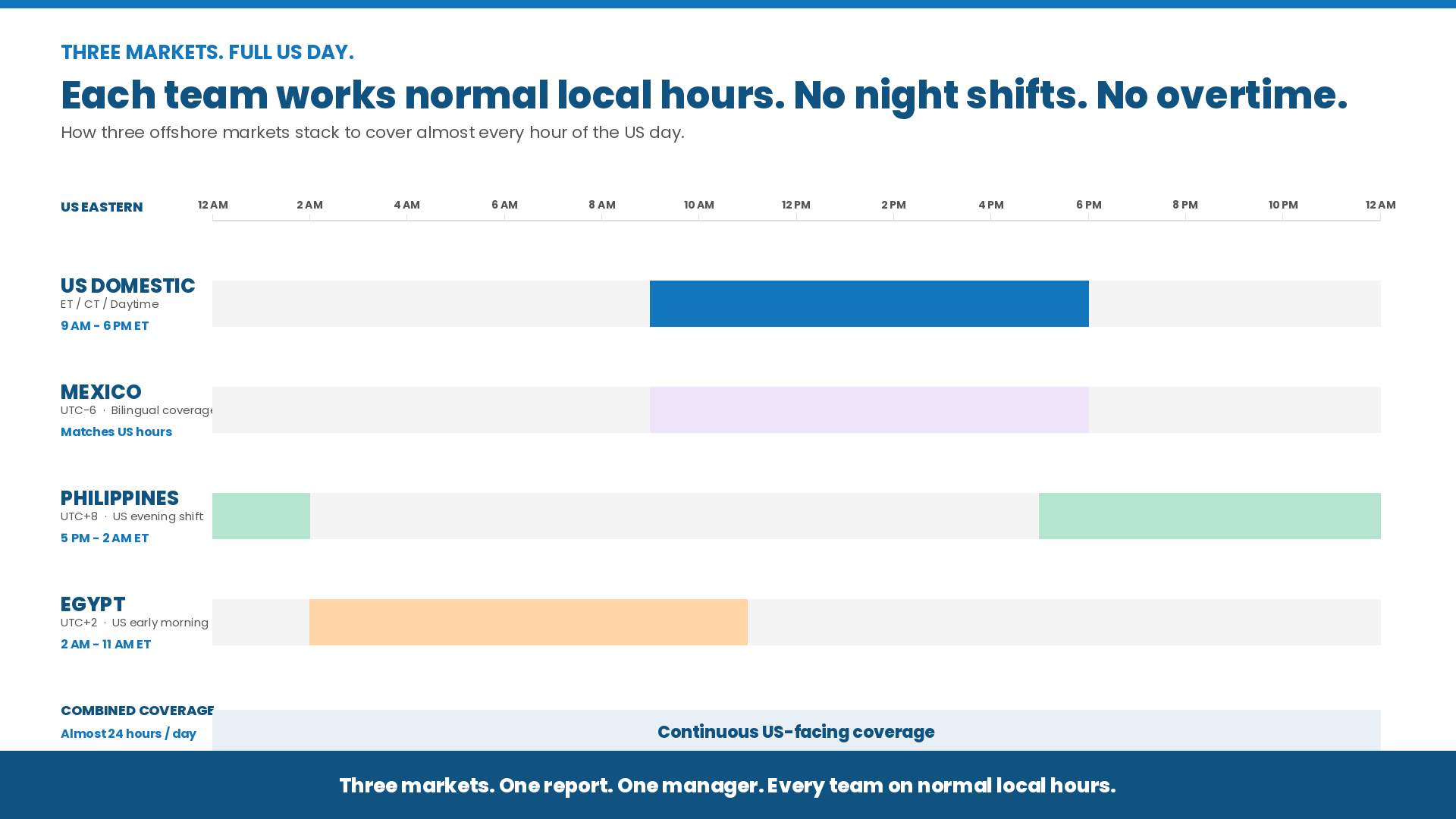
Three offshore markets work well for US-facing BPO. The Philippines, Egypt, and Mexico. Each covers a different part of the US day. Together, they cover almost all US hours with no overtime.
Philippines – UTC+8 (US Evening Hours)
Philippine time is 11 to 13 hours ahead of US Eastern time. A normal Philippine workday runs from 8 am to 5 pm local time. That equals about 5 pm to 2 am Eastern.
This makes the Philippines the best fit for US evenings. A Philippine team, on normal hours, covers the hours US-based teams can’t. No overtime needed.
IBPAP data shows the Philippines had 1.57 million contact center agents in 2025. It is the world’s largest voice BPO market. Strong English skills and a strong cultural fit with the US make it a top choice for offshore staffing. See our offshore staffing guide for cost details.
Best for:
- Evening outbound calls – debt, tax, mortgage, insurance
- After-hours inbound calls and callbacks
- Fast follow-up on overnight Mountain and Pacific leads
Egypt – UTC+2 (US Early Morning Hours)
Egypt is 7 hours ahead of the US Eastern Time Zone. A normal Egyptian workday runs from 9 am to 6 pm local time. That equals about 2 am to 11 am Eastern.
Egypt covers the US early mornings. US floors are just opening then. Overnight leads need fast follow-up. ITIDA data show that Egypt’s BPO sector grew by 18% per year through 2025. US and UK clients drive most of that growth.
Best for:
- Mortgage and rate campaigns where morning is the best time to call
- Tax relief campaigns where people act early in the day
- Working overnight leads before 9 am Eastern
Mexico – UTC-6 (Bilingual Daytime Coverage)
Mexico is 1 hour behind the US Eastern Time Zone. Its work hours match US hours.
Mexico’s strength is bilingual agents. Day-to-day contact with US managers is easy. Mexico’s Secretariat of Economy reports that more than 700,000 BPO agents are employed. Many work on US-Spanish programs in finance, health, and home services.
Best for:
- Spanish-English bilingual outbound calls – debt, insurance, home services
- Programs that need close daily contact with US managers
- US West Coast daytime coverage at a lower cost than US-based agents
How the Three Markets Cover the US Day
| US Eastern Time | Market on Duty | Shift Type |
| 6 am to 9 am | Egypt (morning) / Philippines (overnight overlap) | Normal morning shifts |
| 9 am to 6 pm | US domestic / Mexico (same hours) | Normal business hours |
| 6 pm to 11 pm | Philippines (morning shift) | Normal morning – Philippines |
| 11 pm to 6 am | Philippines (overnight) / Egypt (early morning) | Normal shifts – both markets |
Each market works normal local hours. No night shifts. No overtime.
How Management Works Across Three Markets
Running agents in three countries raises one big question. Who is in charge?
The answer is one campaign manager. This person owns results across all markets. Local managers run their own teams and report to their supervisors.
The Management Layers
Each market has:
- Local manager – runs the team and reports to the campaign manager
- Team leads – each covers about 10 agents
- Campaign manager – the client’s main contact; owns all results
SHRM found that having one manager above local teams results in 28% fewer delays. It also leads to 19% better first-call results compared to teams run by separate vendors.
The Shift Handoff
When one market’s shift ends, the local manager briefs the next market. They share:
- Campaign update: How many contacts were made, transfers done, and any issues
- Callback list: People who asked to be called at a set time
- Open items: Problems or questions that need to carry over
The local manager writes this down each day. It feeds the daily report that the client receives. A 30-60 minute overlap keeps the handoff live.
One Report for All Markets
The client gets one daily report – not three to add up by hand. It shows results for the full campaign and for each market. You can filter by market to find gaps.
A vendor that sends three reports is not running one operation. It’s three deals with a shared logo. For tips on managing teams across markets, see our workforce management guide.
How This Works for Different Campaign Types
Outbound Financial Services – Debt, Tax, Mortgage, Insurance
The big win is evening coverage for outbound financial services – debt, tax, mortgage, and insurance. Most prospects are easiest to reach from 6 to 9 pm local time. Philippine agents on morning shifts cover that window.
Research shows that peak contact rates occur between 4 and 6 pm on weekdays. Those hours match the Philippine morning shift. Covering evenings on your current leads pays off fast. Most clients see results in 30 days – with no new lead spend.
Inbound Support and Callbacks
After-hours inbound support keeps the phone open from 6 pm to 9 am Eastern. Without it, calls after 5 pm go to voicemail. Those calls sit until morning. By then, the lead is 14 hours old. With a Philippine team on duty, someone picks up.
Speed-to-Lead on Overnight Leads
Speed-to-lead matters most for overnight submissions. People in Mountain and Pacific time zones fill out forms in their evenings. That is 10 pm to 7 am Eastern. A Philippine team calls these leads back fast.
LeadSimple and InsideSales.com found a clear fact: calling within 5 minutes makes contact 9 times more likely. Multi-region setups make that speed possible – even for leads that come in at 11 pm Eastern.
Large Multi-Campaign Operations
Large clients can match each campaign to the best market:
- Philippines – evening outbound finance
- Egypt – early morning inbound
- Mexico – bilingual Spanish calls
All three report to a single manager. No juggling vendors.
Legal Rules for Multi-Region Operations
Multi-region BPO brings legal issues that single-region operations do not face. Know these before you start.
TCPA and Time Zone Rules
Our TCPA compliance guide covers the basic rule. You can only call from 8 am to 9 pm in the prospect’s local time. It does not matter where your agent is.
The risk in multi-region work is incorrect dialer settings. The system uses the agent’s time instead of the prospect’s. Calls go out at the wrong hour. They look fine on the agent’s screen – but the prospect gets a call at the wrong time.
The FCC says TCPA fines run from $500 to $1,500 per call. One bad setting can mean big fines fast.
Check these before you launch:
- Does the dialer use the prospect’s area code – not the agent’s?
- Is Hawaii tested on its own? Hawaii does not use daylight saving. It’s the easiest place to catch a time zone error.
- Is time zone checking on the setup list for each new market?
Data Rules for Agents Outside the US
Sending data to offshore agents means it crosses a border. GDPR, CCPA, and GLBA rules all require legal data agreements first.
A 2025 IAPP survey found a gap: 43% of offshore BPO clients had not set these up. That’s a legal risk even if nothing goes wrong.
How to Verify a Vendor’s Multi-Region Coverage
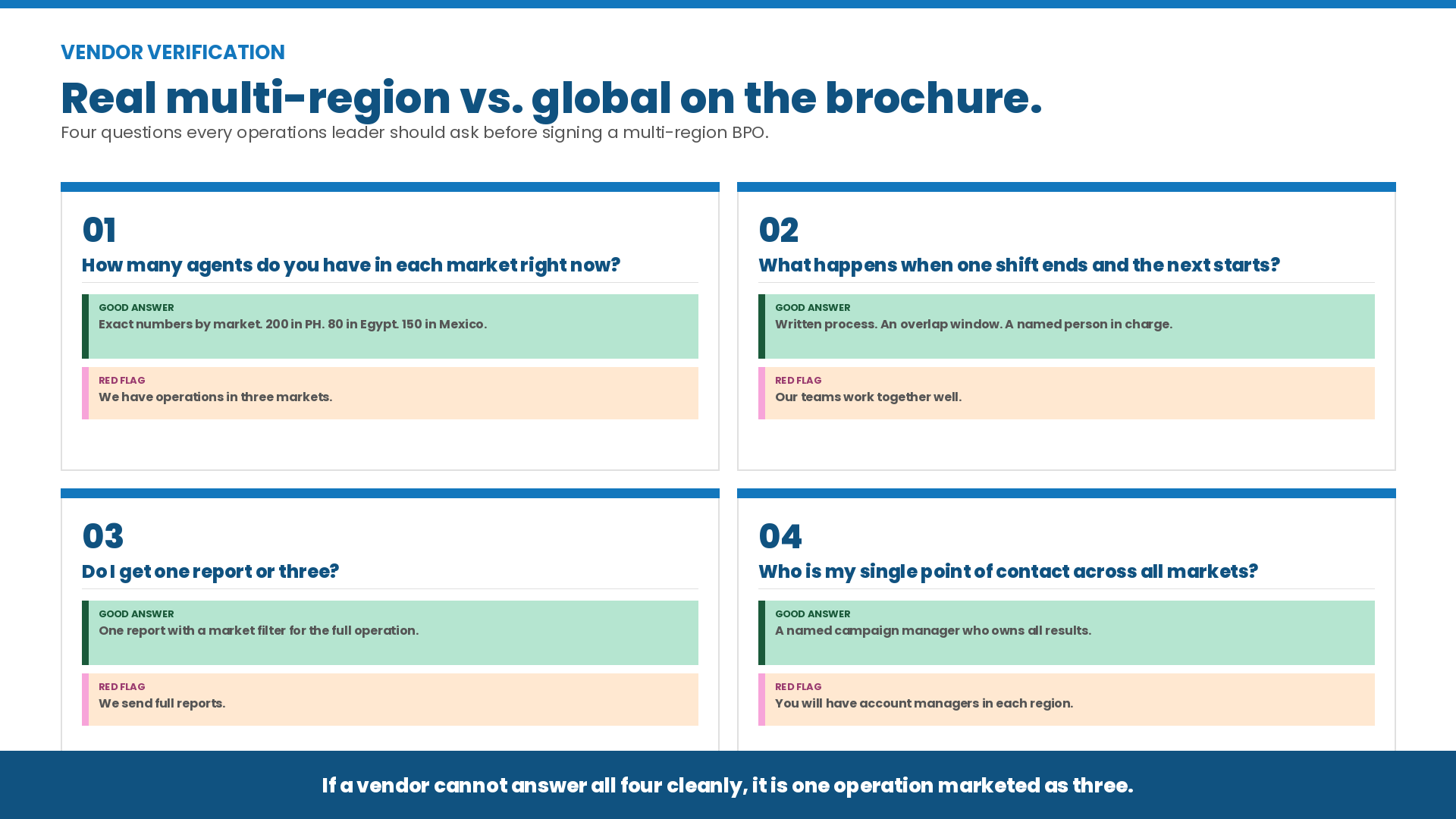
Many vendors claim global or multi-region coverage. Not all of them deliver. Ask these four questions first. Need help picking the right BPO type? See our guide on BPO operators vs. agencies vs. consultants.
Question 1: How many agents do you have in each market right now?
Good answer: Exact numbers by market. “200 in the Philippines. 80 in Egypt. 150 in Mexico.”
Bad answer: “We have operations in three markets.” – with no numbers.
Question 2: What happens when one shift ends and the next starts?
Good answer: A written process. An overlap window. A named person in charge.
Bad answer: “Our teams work together well.”
Question 3: Do I get one report or three?
Good answer: One report with a market filter.
Bad answer: “We send full reports.” – without saying how many.
Question 4: Who is my single point of contact for all markets?
Good answer: A named campaign manager who owns all results.
Bad answer: “You will have account managers in each region.” – three separate deals.
How to Build a Multi-Region Operation Step by Step
Don’t try to launch all markets at once. Start with one. Check results. Then add the next. See our BPO onboarding plan guide for a full 90-day timeline.
Step 1 – Launch the First Market (Days 1 to 30)
Pick the market that covers your most urgent hours. For most US outbound finance work, that is the Philippines or Mexico. Set up your call rules, script, and report format now. Every market you add will use the same setup.
Step 2 – Check Results (Days 30 to 45)
Make sure the first market hits its targets. Don’t add a second one until it does. Adding a new market to a failing first one makes things worse.
Step 3 – Add the Second Market (Days 45 to 60)
Set up the second market with the same rules as the first. Test the handoff between them. Make sure both appear in a single report. Test time zone rules for each market on its own.
Step 4 – Full Operation (Day 60 and Beyond)
All markets run normal shifts. Handoffs happen at every shift change. One daily report covers all markets. The campaign manager owns the full operation. Weekly reviews use the same key metrics across all markets.