
Your business needs someone to manage the CRM. Someone to run outreach calendars, handle inbound leads, and keep the content pipeline moving. That role does not need a $65,000 full-time hire. It needs 25–30 hours per week of skilled, steady work. The right person knows your systems, works your hours, and delivers results rather than punching a clock.
The options sound familiar. A full-time employee you cannot fully use. A freelancer you have to manage alone with no backup. A virtual staffing agency that places someone and vanishes after the invoice clears.
None of those gives you what you need: a dedicated person with a management layer behind them, working inside a clear system, at a price that fits the work.
That is managed virtual staffing. Not a freelancer. Not a temp. Not just a headcount line item. A dedicated team member works inside an operator’s management, QA, and reporting system. A managed BPO structure backs the tasks a growing business needs most.
This guide covers what managed virtual staffing includes. You will learn how it differs from other options, what it costs, and how to pick a provider.


What Virtual Staffing Is and How It Differs From Adjacent Options
Virtual staffing places dedicated remote team members in your business. These people work from offshore or nearshore locations. They handle operations, admin tasks, or sales support. The word “virtual” means the work is done remotely. It does not mean the work is fake. Virtual staff does real work, on real systems, in real time. They do it from a different place.
A 2025 Deloitte report found that 59% of businesses outsource to cut costs. Another 57% do it to focus on core work. These two reasons drive most virtual staffing decisions.
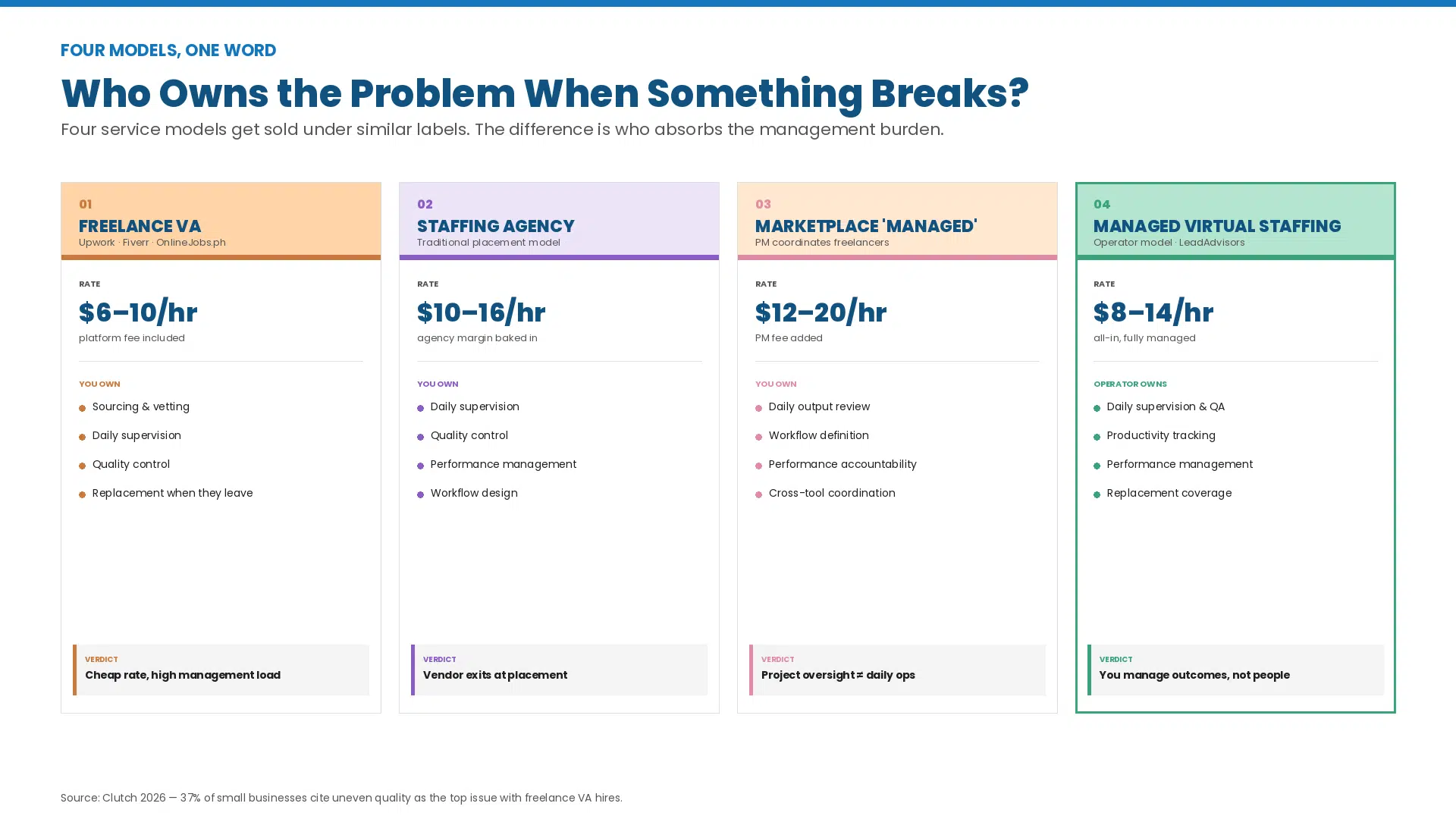
The market is confusing. Four service models use similar words but work in very different ways.
Freelance VA Platforms (Upwork, Fiverr, OnlineJobs.ph)
You find, vet, hire, and manage the worker yourself. No one sits between you and the contractor. You own all the oversight.
- Cost is low
- Management work is high
- Quality varies a lot
A 2026 Clutch survey found that 37% of small businesses that hired freelancers said uneven quality was their top issue. Management burden ranked second.
Staffing Agencies (Traditional Placement Model)
The agency finds and places a candidate. After that, you manage the person yourself. The agency handles payroll but little else. Their job ends at placement. Your management role starts right away.
Freelance Marketplaces With Managed Options
Some platforms add “managed” tiers. A project manager helps coordinate freelancers. But this support covers projects, not daily operations. They check whether a project is finished, not whether daily output is on track.
Managed Virtual Staffing (Operator Model)
The operator recruits, onboards, trains, and manages a dedicated team member. That person works on your tasks under the operator’s watch. The operator tracks performance, quality, and output. You manage outcomes through daily reports. The operator manages the person.
Here is the key difference. With a freelancer or placement model, if the person does poor work, you have a problem to fix. With a managed model, the operator has a problem to fix. They handle it.
That shift in who owns the problem is what sets managed virtual staffing apart. It is the main reason it delivers steadier results than solo VA setups at a similar hourly cost.
What Functions Does Managed Virtual Staffing Cover
Managed virtual staffing is not one job title. It spans many tasks split into four groups by skill level and system access. The ILO’s 2025 report on remote work found that admin and support roles done remotely grew by 34% from 2020 to 2025.
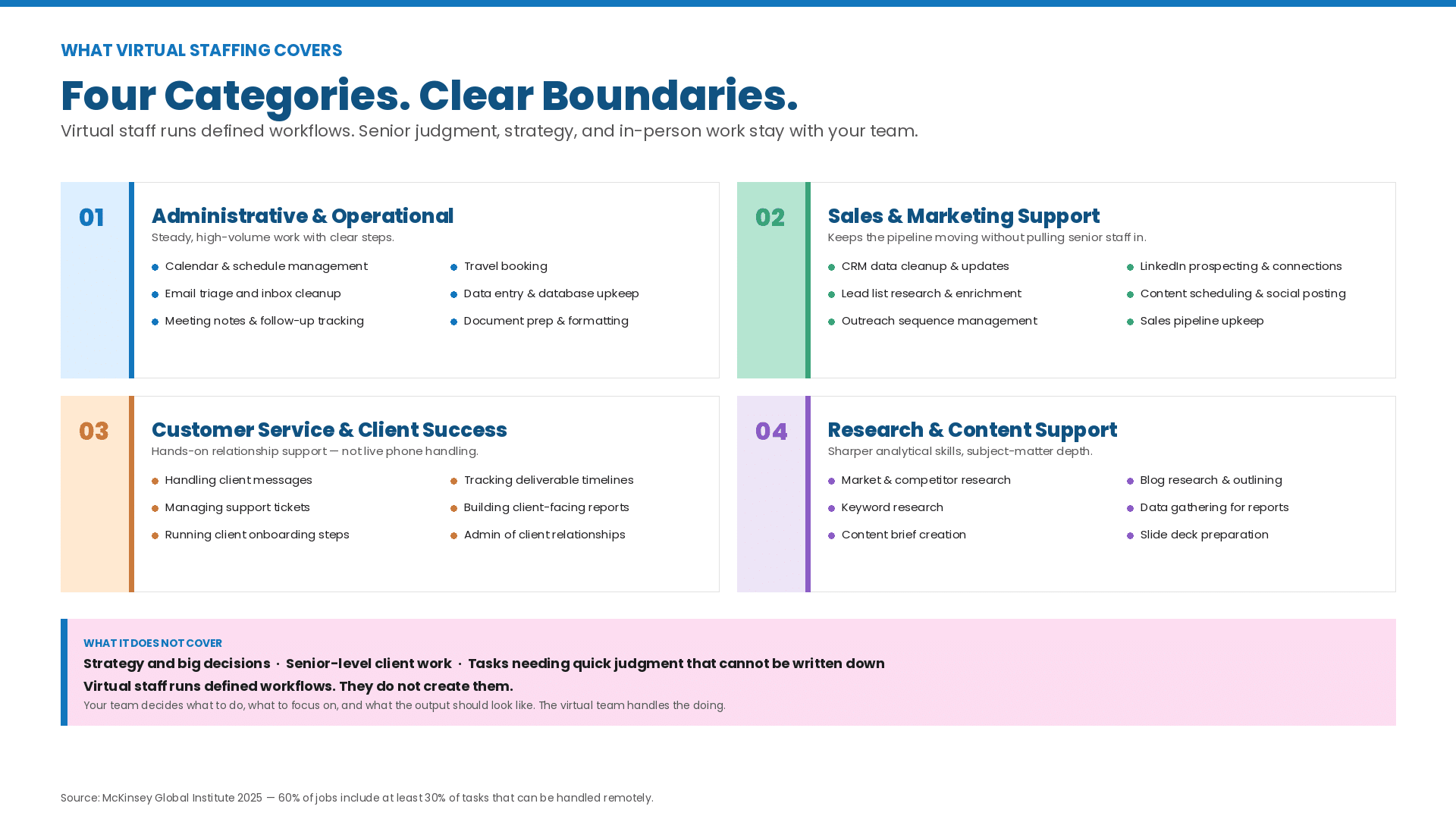
Category 1: Administrative and Operational Support
This is where most businesses start. Tasks include:
- Calendar and schedule management
- Email triage and inbox cleanup
- Meeting notes and follow-up tracking
- Travel booking
- Data entry and database upkeep
- Document prep and formatting
- General admin support for execs or team leads
These tasks take a lot of time but follow clear steps. The work is steady. Quality is easy to define. Output is easy to measure. A 2025 McKinsey Global Institute study found that 60% of all jobs include at least 30% of tasks that can be handled remotely.
Category 2: Sales and Marketing Support
This group handles work that supports sales and marketing without touching strategy or closing deals. Tasks include:
- CRM data cleanup and updates
- Lead list research and enrichment
- Outreach sequence management
- LinkedIn prospecting and connections
- Content scheduling and social media posting
- Email campaign setup
- Report and analytics prep
- Sales pipeline upkeep
Agency operators with 8–12 clients need this the most. It keeps campaigns running without pulling senior staff into the details. Businesses that use dedicated virtual support for CRM management cut data decay by up to 25% compared to teams that handle CRM as a side task.
Category 3: Customer Service and Client Success
This area sits between virtual staffing and inbound support. Tasks include:
- Handling client messages
- Managing support tickets
- Running client onboarding steps
- Tracking deliverable timelines
- Building client-facing reports
- Managing the admin parts of client relationships
This is hands-on relationship support, not live phone call handling.
Category 4: Research and Content Support
This group needs sharper analytical skills. Tasks include:
- Market and competitor research
- Keyword research helps
- Content brief creation
- Blog research and outlining
- Data gathering for reports
Team members in this group often have specific subject matter backgrounds.
What Managed Virtual Staffing Does Not Cover
It does not cover strategy, big decisions, or senior-level client work. It also skips tasks that require quick judgment calls you cannot automate. Virtual staff run defined workflows. They do not create them.
Your team still decides what to do, what to focus on, and what the output should look like. The virtual team handles the doing. This line is what makes virtual staffing valuable. It frees your senior team from tasks they should not spend time on.
The Managed Virtual Staffing Model: What the Operator Provides
A managed setup includes seven parts that freelance or placement deals do not offer. SHRM research shows that the average US cost per hire reached $4,700 in 2025. In a managed deal, the operator absorbs that cost. You do not.
- Recruiting and Vetting
The operator finds and screens candidates for the role. They check English skills, experience, and system knowledge. You approve the final hire. You do not run the search or interviews.
- Structured Onboarding
A set of processes covers system access, workflow documents, communication rules, and role training. This happens before the team member starts live work. You share the workflow knowledge. The operator builds the onboarding plan.
- Daily Supervision
A supervisor or team lead checks output, quality, and communication every day. Not once a week. Not once a month. The supervisor sits between you and the team member. Issues reach you through the supervisor, not directly from the worker.
- Productivity Tracking
Screen monitoring, task logs, and time tracking give you hard proof of daily work. You get reports as part of the standard deal. You do not have to trust that the work was done. You can see it.
- QA on Work Output
The operator sets quality standards for the role. They review output on a regular schedule. If quality drops, the supervisor steps in before it affects you.
- Performance Management
When a team member falls short, the operator starts a structured fix. This includes coaching, extra training, and close monitoring. If results do not improve, the operator replaces the person. You get updates on the process. You do not have to run it.
- Replacement Coverage
When a team member leaves for any reason, the operator starts a replacement right away. Keeping the work going is the operator’s job, not yours.
Virtual Staffing vs Full BPO: Which Model Fits Which Need
Virtual staffing and full BPO are both managed offshore delivery models. But they solve different problems for different buyers.
| Dimension | Virtual Staffing | Full BPO Contact Strategy |
| Primary function | Admin, sales support, research, CS coordination | Outbound dialing, live transfers, and appointment setting |
| Output metric | Task completion, accuracy, productivity rate | Contact rate, transfer rate, and show rate |
| Agent profile | Admin, analytical, and communication skills | Outbound prospecting, qualifying, and objection handling |
| Client interaction | Async, outputs reviewed, not monitored live | Real-time, call outcomes tracked by the minute |
| Minimum viable scale | 1 dedicated virtual team member | 5–7 agents minimum for useful campaign data |
| Entry point | Single dedicated resource | Campaign-based with set volume and cadence |
| Best fit | Growing businesses that need execution help | Sales floors with leads that need to be worked at scale |
For a deeper look at how these models compare, see our breakdown of the BPO operator, agency, and consultant models.
The Buyer Who Needs Virtual Staffing
A founder growing a $3M–$10M business with a sales team but no support layer. Every hour a VP of Sales spends on CRM cleanup or list research is an hour not spent selling. Virtual staffing gives the senior team room to focus on what only they can do.
An agency operator with 8–12 clients. They need help that uses their brand and their systems. They cannot manage freelancers across time zones and platforms.
The Buyer Who Needs Both
A COO running a 50-person service company. They need virtual staffing for back-office work (Categories 1 and 2). They also need a BPO contact strategy for the outbound sales floor. Both run under one operator. One set of reports. One management layer. One point of contact. No need to juggle two vendor deals.
What Managed Virtual Staffing Costs and How to Evaluate the Number
Managed virtual staffing for offshore team members in the Philippines, Egypt, or Mexico runs $8–14/hr, fully managed. That rate covers supervision, tracking, QA, HR, and replacement.
The range depends on:
- Role complexity (admin on the low end, sales or analytical on the high end)
- Seniority needed
- Hours (full-time vs. part-time)
- Location
The Right Comparison Is Not Freelance Rate vs. Managed Rate
A virtual assistant on Upwork at $6/hr looks cheaper than a managed team member at $10/hr. But the math shifts when you add management time.
Managing a freelancer takes work. You monitor output, check quality, cover absences, and coordinate across tools. That eats 3–5 hours of your time per week per VA. At $150/hr, that adds $23–38/hr to the true cost of the freelance deal.
The managed model at $10–14/hr rolls that overhead into the operator fee. Your time goes to reviewing daily reports and guiding the work, and not managing a person.
The Right Comparison Is Also Not Virtual Staff Rate vs. In-House Employee Rate
A US admin or sales support hire at $22–28/hr costs $38–52/hr fully loaded. That includes benefits, payroll taxes, gear, and office costs. SHRM’s 2025 Employee Benefits Survey found that US benefit costs made up 29.4% of total pay.
Against that baseline, managed virtual staffing at $8–14/hr saves $49,920–$89,440 per person each year. These tasks do not require a US-based worker to do well.
How to Identify What Virtual Staffing Functions to Outsource First
Not every task is ready for virtual delivery on day one. Start with a function audit. Look for tasks that pass three tests at once.
Criterion 1: Systematizable
The work follows clear, written steps. You can put it in a standard operating procedure (SOP). Someone trained on that SOP can do it well. If the task needs constant judgment or deep company knowledge that you cannot write down, hold off for now.
A 2025 Harvard Business Review study found that companies with SOPs for routine work saw 33% faster onboarding, remote or in-house.
Criterion 2: High Volume, Low Senior-Time Value
The task takes real time but does not require the person doing it today to have any particular skill. A VP of Sales is entering CRM data. A CEO booking meetings. A senior marketer is pulling lead lists. The output matters. The work is not senior-level.
Criterion 3: Measurable Output
You can judge the work with clear numbers. Emails sent. Records updated. Tasks done. Data entry accuracy. Tasks with subjective quality are harder to QA remotely. They need a longer ramp-up before their output stabilizes.
The Fastest Virtual Staffing Wins
Based on these three tests, these tasks show the fastest ROI on a managed virtual team:
- CRM upkeep and data hygiene
- Lead research and list building
- Outreach sequence management
- Calendar and scheduling
- Report building from existing data
- Content scheduling and social media posting
- Lead nurturing sequence support
Pick one task from this list. Write the SOP. Onboard one team member. Run it for 30 days. Check the output. Then expand.
Evaluating a Managed Virtual Staffing Provider: 6 Questions That Separate Operators From Placement Firms
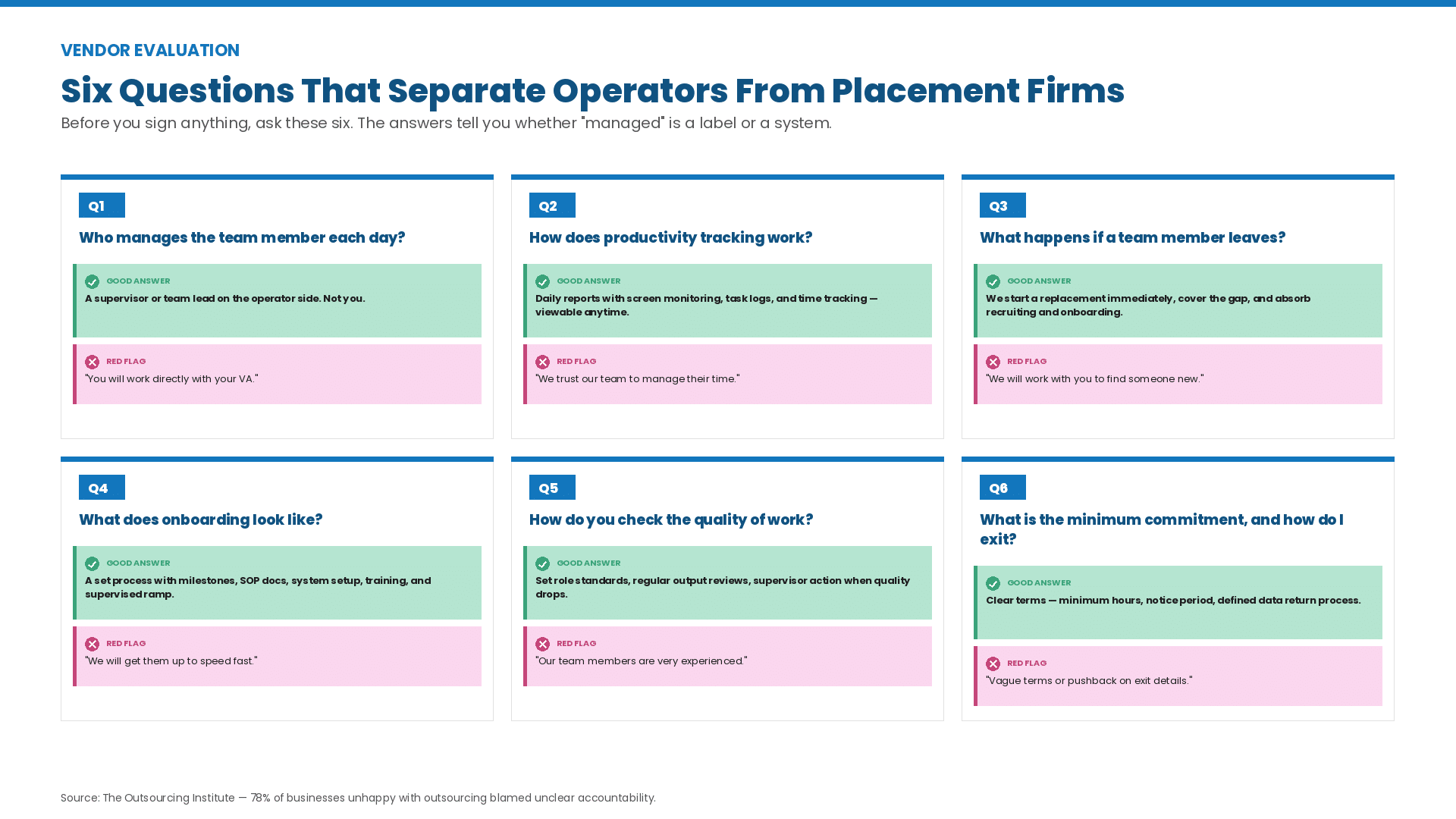
Before you sign with any provider, ask six questions. The answers show if they are a real operator or a staffing firm that uses “managed” as a label.
Question 1: Who manages the team member each day?
Good answer: A supervisor or team lead on the operator’s side. Not you.
Bad answer: “You will work directly with your VA.”
Question 2: How does productivity tracking work?
Good answer: Daily reports with screen monitoring, task logs, and time tracking. You can view them anytime.
Bad answer: “We trust our team to manage their time.”
Question 3: What happens if a team member leaves?
Good answer: The operator starts a replacement right away, covers the gap, and pays for recruiting and onboarding.
Bad answer: “We will work with you to find someone new.”
Question 4: What does onboarding look like?
Good answer: A set process with milestones, SOP docs, system setup, training steps, and a supervised period before full independence.
Bad answer: “We will get them up to speed fast.”
Question 5: How do you check the quality of work?
Good answer: Set standards for the role, regular output reviews, and supervisor action when quality drops.
Bad answer: “Our team members are very experienced.”
Question 6: What is the minimum commitment, and how do I exit?
Good answer: Clear terms with minimum hours, notice periods, and a data return process.
Bad answer: Vague terms or pushback on exit details.
The Outsourcing Institute found that 78% of businesses unhappy with outsourcing blamed unclear accountability. These six questions surface that issue before you sign anything.