
When four vendor dashboards are opened on a Monday morning, something has gone wrong.
- One is for dialing.
- One is for live transfers.
- One is for SMS.
- One is for QA.
That is four tools, four logins, and four reports that do not match.
Technical problems rarely cause outsourcing failures. According to 2026 research from Purdue University, they stem from poorly designed contracts that fail to align the goals of clients and vendors. A study from PMC also found that multi-vendor setups need more control steps. This “raises the risk of project failure.”
This is called vendor stacking. It means running three or more BPO vendors at once. Each one handles one part of the sales floor. No single vendor owns the full result. The global BPO market is now worth about $348 billion (Precedence Research, 2025). It is set to pass $906 billion by 2035 how these setups are built matters more than ever.
This article breaks down the hidden costs of vendor stacking. It shows why no one is held to account in multi-vendor setups. And it makes the case for enterprise BPO programs, in which a single operator runs the entire operation.


What Is Vendor Stacking in BPO?
Vendor stacking occurs when multiple BPO vendors are used within a single sales operation. Each vendor is given one job.
- One does dialing.
- One does transfers.
- One does QA.
- One does SMS.
But no single vendor owns the result.
This setup is rarely planned. It builds up over time as new problems come up:
- Year 1: The in-house dialing team falls short. A dialing vendor is added.
- Year 2: Transfer quality drops. A live transfer vendor is brought in.
- Year 3: A compliance audit finds gaps. A QA tool or consultant is added.
- Year 4: A marketing agency suggests SMS and email drip. A fourth vendor is brought on.
No one sat down and designed a four-vendor system. It was built by accident. And now the client carries all the weight of making it work.
As noted in the 2026 Purdue study, “these failures stem from a fundamental issue: poorly designed contracts that fail to align incentives between clients and contractors.” When many vendors are involved, it leads to blame rather than fixes.
The result is an operation where:
- No vendor can see the full lead journey from first touch to close
- No vendor is held to account for the full sales number
- Every miss is met with a different excuse from each vendor
- The client becomes the de facto operations manager of a floor that was supposed to be outsourced
The Seven Hidden Costs of Running Multiple BPO Vendors
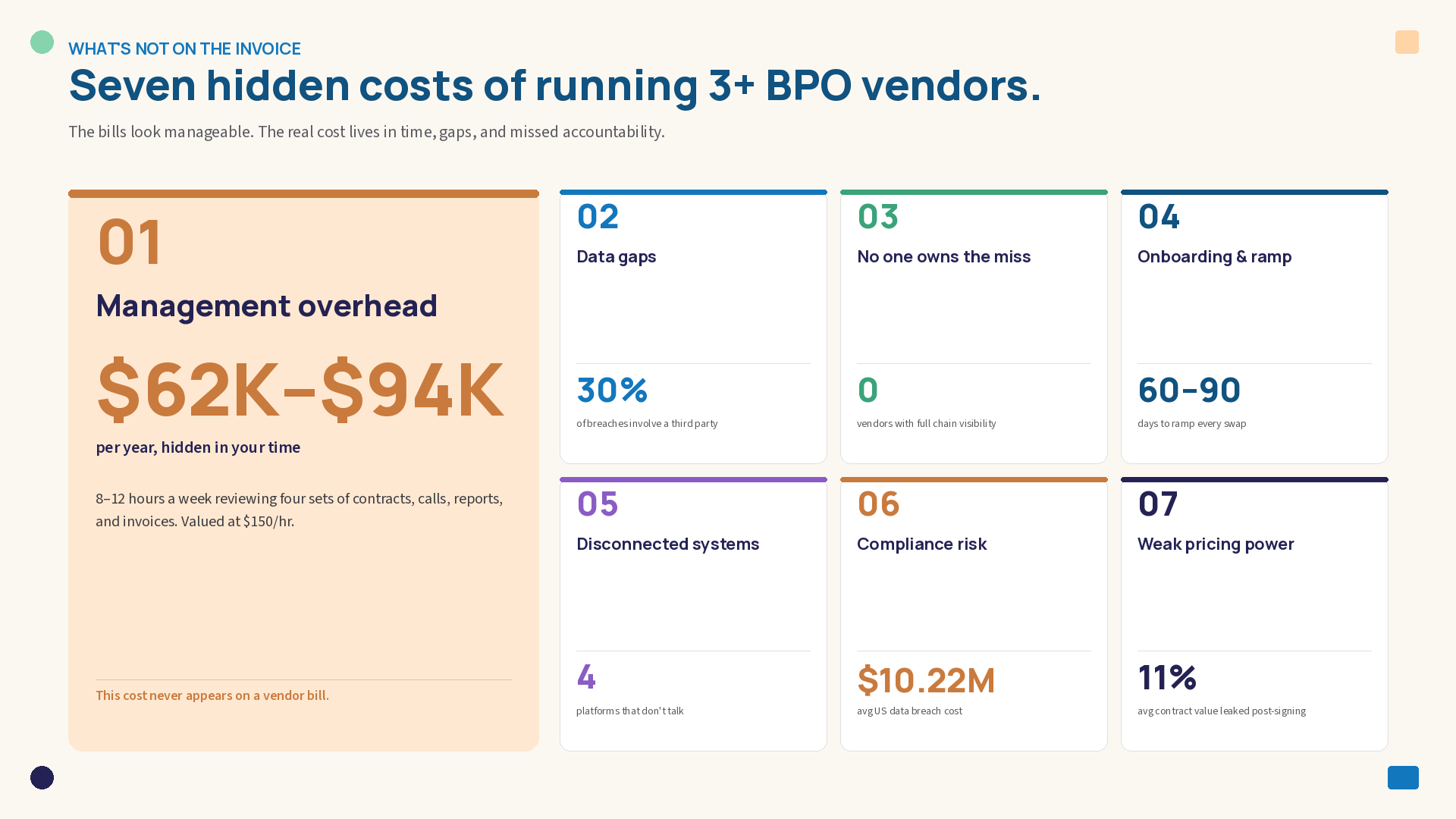
Vendor stacking has costs beyond monthly bills. The hidden costs are often bigger. And they never show up on any invoice.
Hidden Cost 1 – Management Overhead
Each vendor needs time. Contracts must be reviewed. Calls must be scheduled. Reports must be checked. Billing must be matched. According to the World Economic Forum’s 2026 Global Cybersecurity Outlook, organizations often lack direct control over third-party vendor practices. Inheritance risk – the inability to assure the quality of outside services – is the top supply chain risk in 2026.
At 2-3 hours per vendor per week, four vendors take up 8-12 hours. If the floor owner’s time is valued at $150 per hour, that is $62,400 to $93,600 per year. This cost never shows up on a vendor bill.
Hidden Cost 2 – Data Gaps
Each vendor sends reports in a different format. They use different metrics. They report on different days. None of it connects. According to the Identity Theft Resource Center’s 2025 Annual Data Breach Report, about 30% of all breaches now involve a third party. Supply chain attacks doubled between 2021 and 2025. Broken-up vendor setups make these risks harder to track.
The contact rate is seen from one vendor. Transfer rate from another. But the full picture from lead to close cannot be seen in one place. Bad data leads to bad choices.
Hidden Cost 3 – No One Owns the Miss
This is the most harmful hidden cost. When targets are missed, each vendor has a reason. And each reason points to someone else:
- The dialing vendor blames the lead quality
- The transfer vendor blames the closer availability
- The QA vendor blames the scripts
- The SMS vendor blames the timing
As noted in Purdue’s research, misaligned incentives among vendors lead to disputes over who is at fault. No one owns the gap between the goal and the result. So it is fixed by no one.
Hidden Cost 4 – Onboarding and Ramp Costs
Every time a vendor is added or swapped, there is a ramp-up period. Contracts are signed. Systems are set up. Teams are trained. Output drops during this time. If one vendor is replaced each year, this cost adds up fast.
Hidden Cost 5 – Systems That Do Not Connect
Four vendors mean four systems. These systems were not built to work together. CRM data does not flow well between them. Codes from one platform do not match codes in another. SMS data is not fed back into the dialer.
Each gap is a point at which leads are lost. According to the PMC study, managing many vendors “is much harder than managing one.”
Hidden Cost 6 – Compliance Risk
Each vendor handles its own compliance. The dialer follows TCPA rules. The SMS vendor handles consent. The transfer vendor watches its scripts. But none of them can see what the others are doing.
According to the IBM/Ponemon Institute Cost of a Data Breach Report 2025, the global average cost of a data breach is $4.44 million. In the U.S., that figure rises to $10.22 million. The Identity Theft Resource Center found that 30% of all 2025 breaches involved a third party. In a multi-vendor setup, this risk grows. And the client bears the full legal burden, regardless of which vendor caused the issue.
Hidden Cost 7 – Weak Pricing Power
Four small vendor deals carry little weight. A $15,000/month dialer, a $8,000/month transfer vendor, a $4,000/month QA tool, and a $3,000/month SMS vendor are all mid-tier accounts. None of them gets top-level focus.
But a single $30,000/month deal with one operator is a big account. It gets better pricing, faster support, and more senior attention.
Why No One Owns the Number in a Vendor Stack
The core issue with vendor stacking is not about bad vendors. It is about how the work is split up.
Here is how the typical sales chain looks:
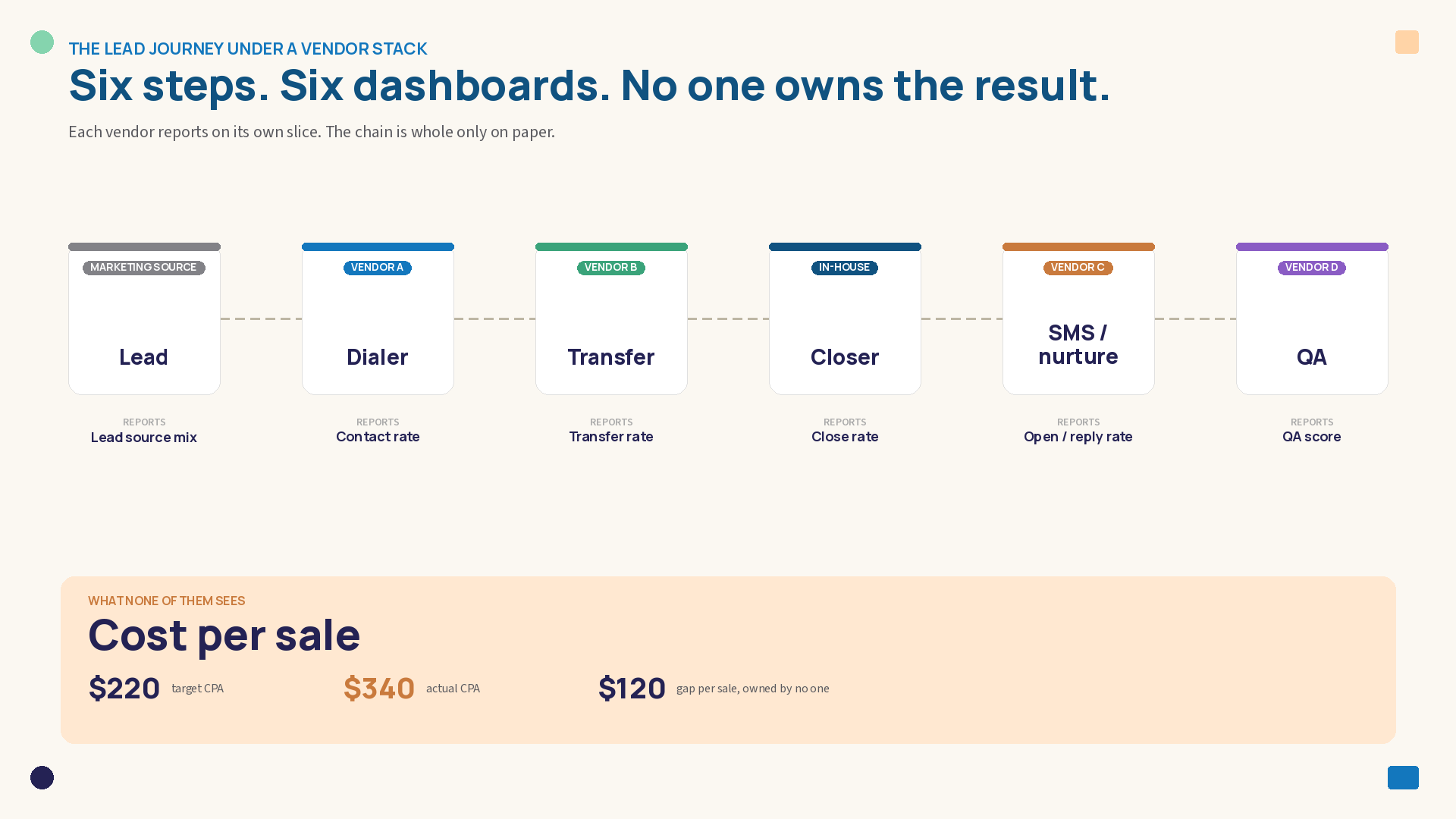
Lead enters → Dialer contacts → Transfer vendor qualifies → Closer receives → CRM logs → SMS re-engages → QA reviews.
A different vendor handles each step. Each one reports on its own piece. The dialer tracks contact rate. The CRM tracks the close rate. The QA vendor provides QA scores. The SMS vendor provides open rates.
But the number that matters most – cost per sale (CPA) – depends on all of these steps combined. No single vendor tracks it. No single vendor owns it.
When the CPA is too high, every vendor can show that their numbers look fine:
- Contact rate: 22% – fine
- Qualification rate: 68% – in range
- QA scores: 91% – solid
- SMS response: 4.2% – normal
Yet CPA lands at $340 when the goal is $220. Where is the leak? No one knows. The client has to pull data from four sources and figure it out on their own.
As noted in 2026 research from Purdue University’s Daniels School of Business, outsourcing projects fail not because of technical challenges but because contracts do not align incentives across parties. The more vendors involved, the harder it is to fix.
With one enterprise operator, this changes. One team. One set of goals. One party owns the number.
What Is Included in an Enterprise BPO Program
An enterprise program is not just a bigger vendor. It is a different model. One operator runs the full stack instead of splitting it across four.
Here is what a solid enterprise program covers:
- Agents: The operator hires, trains, and manages all agents. This includes transfer reps, setters, and re-engagement dialers. The client sets the goals. The operator does the work.
- Dialing and outreach: The operator owns the dialer setup, list logic, call timing, and SMS/email follow-up. No outside vendor is needed.
- Live transfers: Scripts, qualifying rules, routing, and quality checks are all run by the same team. Transfer issues show up in the same reports as dialing data.
- QA and compliance: Call scoring, script checks, and compliance tracking are all done by the operator. Results feed straight back into coaching.
- One dashboard: A single report covers the full chain. Contact rate, transfer rate, show rate, and close rate are all in one view.
- One point of contact: One account manager handles everything. Not four people with four different answers.
According to the U.S. GAO’s 2026 report on federal shared services, even government agencies face adoption challenges when services are split across too many providers. The trend across both public and private sectors is toward fewer, stronger partners – not more scattered ones.
The Direct Comparison – Vendor Stack vs. Enterprise Program
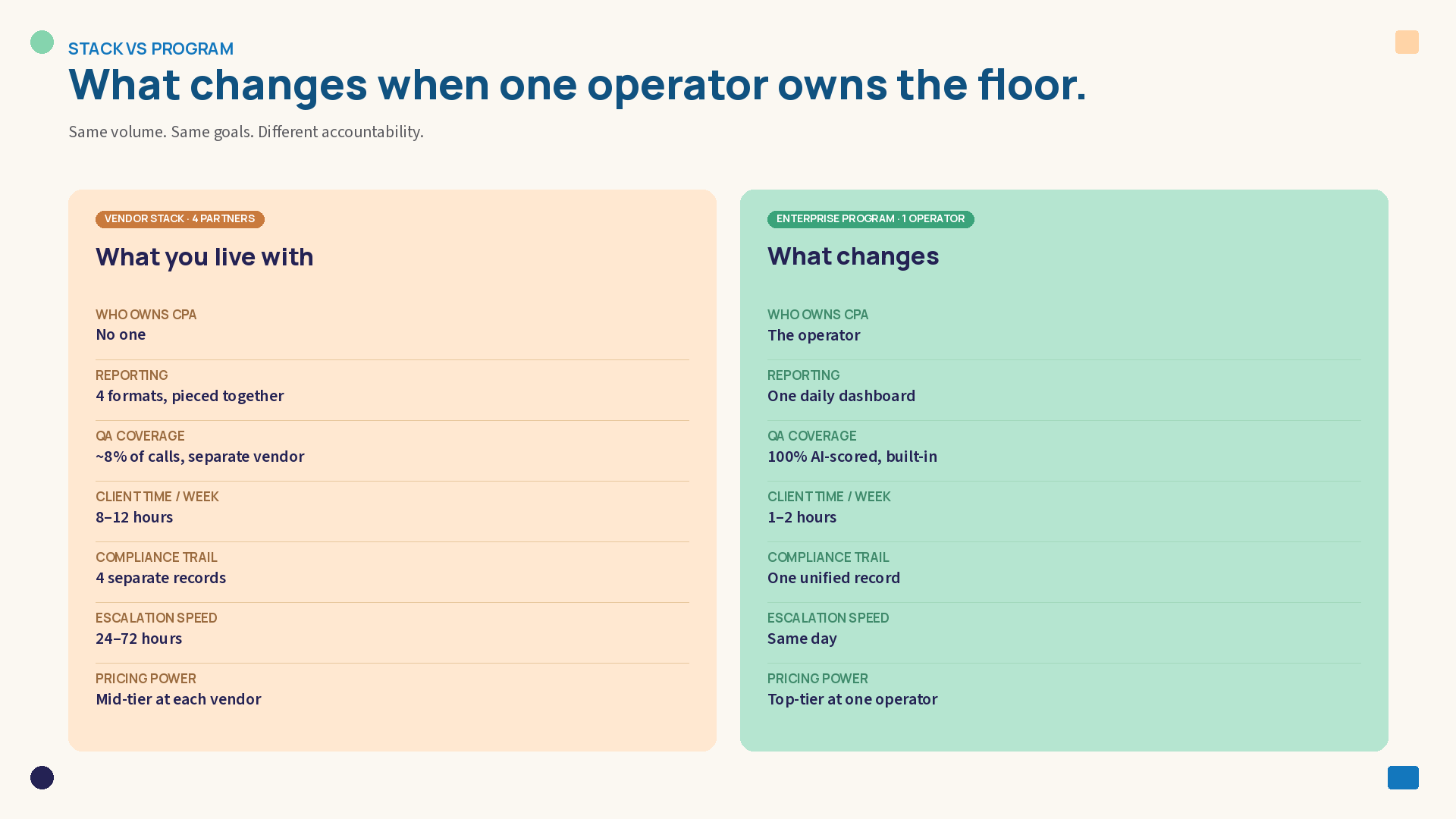
| Area | Vendor Stack (4 vendors) | Enterprise Program (1 operator) |
| Who owns CPA | No one | The operator |
| Reporting | 4 formats, pieced together by hand | One daily dashboard |
| QA coverage | Separate vendor, ~8% of calls | Built-in, 100% AI-scored |
| Client time per week | 8-12 hours | 1-2 hours |
| System integration | Partial, needs manual fixes | All on one platform |
| Compliance trail | 4 separate records | One unified record |
| Escalation speed | 24-72 hours, varies | Same day, one contact |
| Pricing power | Mid-tier at each vendor | Top-tier at one operator |
| Replacing a weak performer | Full vendor swap needed | Agent swap done internally |
| Agent-level visibility | Limited to each vendor’s data | Full access to QA + monitoring |
One note: this only works if the operator is built to deliver it. Not every single-vendor BPO deal runs this way. The right questions should be asked before any switch is made.
How to Move From a Vendor Stack to an Enterprise Program
Most floor owners stay in vendor stacking too long because the switch feels risky. Campaigns are live. Vendors are in place. Starting over sounds scary. That fear makes sense. But the switch can be done safely when it is set up correctly.
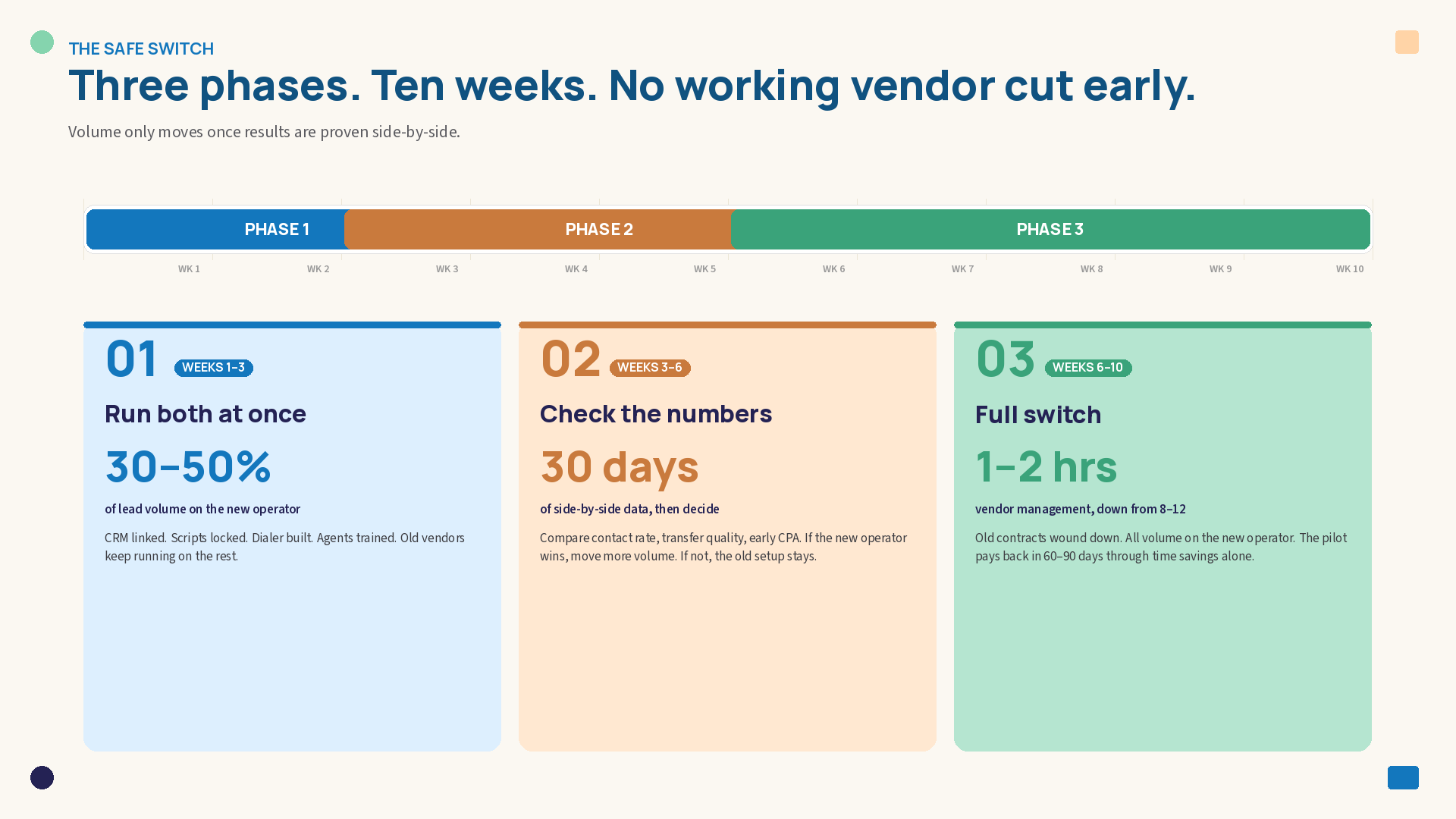
Phase 1 – Run Both at Once (Weeks 1-3)
No vendor is cut right away. The new operator is launched on 30-50% of the lead volume. The current vendors keep running on the rest. Real data is collected without full risk.
In this phase, the CRM is linked. Scripts are locked in. Dialer settings are built. Agents are trained. A good operator can do all of this in 5-7 business days.
Phase 2 – Check the Numbers (Weeks 3-6)
Side-by-side data is now ready. The contact rate, transfer quality, and early CPA for the new operator are compared with those from the old vendor stack.
- If the new operator does better, more volume is moved over.
- If results are close, the savings in time and overhead still make the case.
- If the operator falls short, the old setup stays in place. No harm done.
Most teams have enough data to make a decision within 30 days.
Phase 3 – Full Switch (Weeks 6-10)
Old vendor contracts are wound down. All volume goes to the new operator. Time spent on vendor management drops from 8-12 hours per week to 1-2 hours.
The rule throughout: no working vendor is cut before the new one is proven. The cost of running both for a short time is paid back within 60-90 days through time savings alone.
When Vendor Stacking Is the Right Choice
Vendor stacking is not always wrong. There are times when it makes sense:
- When deep expertise is needed, some fields need very specific skills or tools. If no single operator can match a specialist, keeping that vendor may be the better call.
- When the operation spans many verticals, a company running campaigns in debt, solar, and insurance may not find a single operator who fits all three. A mix of one main operator and niche vendors may work better.
- When the team is small, for floors with fewer than 5-7 agents, the management burden is lighter. The savings from a full switch are smaller. The case for an enterprise program gets stronger as the team grows.
Why a 30-Day Pilot Is the Safest Way to Decide
The switch need not be an all-or-nothing proposition. A short pilot removes the risk. A set number of leads, a set time frame, and clear targets are agreed on up front.
A 30-day pilot usually includes:
- A small team (7 agents is common – enough for real data, small enough to limit risk)
- A set daily lead count is sent to the pilot.
- Clear targets for contact rate, transfer rate, and show rate
- Full access to call recordings, QA scores, and daily reports
- A simple rule: if targets are hit, the full switch moves forward; if not, the client walks away clean
This is not a sales pitch. It is the smart way to make a big choice – with numbers, not guesses.