The September 2025 Core Update, code-named “Perspective,” marked a shift from keyword matching to intent satisfaction. The key changes include the removal of the &num=100 reporting parameter, stricter core web vitals, and the “experience” tiebreaker, where first-hand expertise beats generic AI summaries.
The Google September 2025 core update has definitely shaken things up. In late September, many website owners woke up to a nightmare of crashing impressions and traffic that seemed to be dropping for no reason.
But here is the “insider” secret: not all of those drops were real. Between new AI summaries appearing at the top of the page and a big change in how Google reports its data, the “survival tactics” for search engine optimization have officially changed. If you’re looking at your Google search history and wondering what went wrong, you’re in the right place.

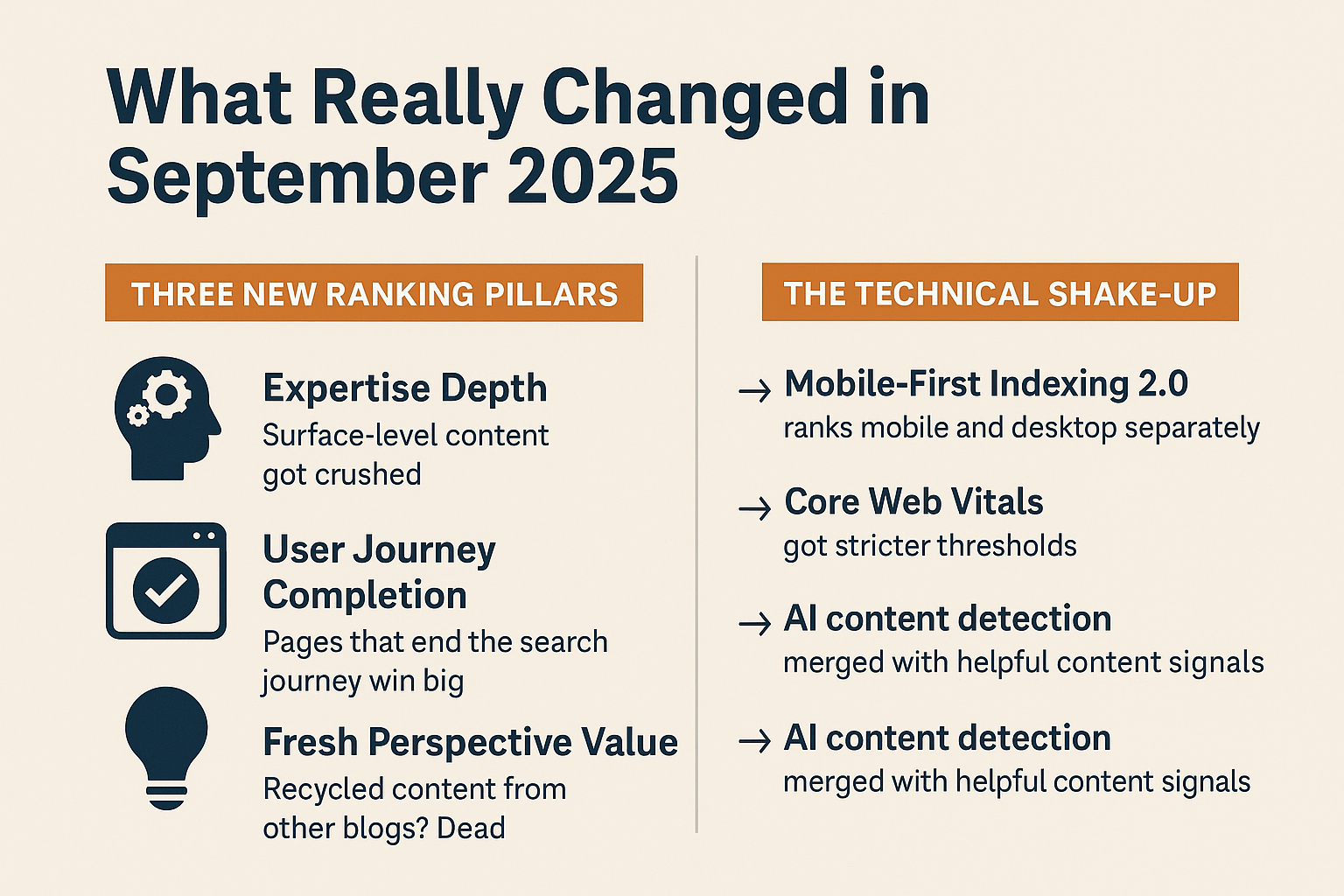
What Really Changed in September 2025
The Google September 2025 core update was more than just a routine update. It was the unveiling of the “Perspective Algorithm.” It was a major change in the way the Google search engine determines the winner.
Here is the way to look at the change: Google used to look for the best “answer.” Now, Google is looking for the best “experience.” Google is no longer just looking to see if your page contains the right Google keywords; Google is looking to see if the human being will be satisfied with what they’ve read on your page.
The Three New Ranking Pillars
Under the hood of the September 2025 Google core algorithm, there are three ranking factors that are the most important:
- Expertise Depth: No longer are surface-level summaries enough. Google is using advanced natural language processing techniques to determine if you’re sharing a genuine understanding or merely “spinning” existing articles.
- User Journey Completion: This is a big change. If a user clicks on your page, then goes back to the SERP and clicks on another result, Google considers your page “incomplete.” Now, you only succeed if you are the last click.
- Fresh Perspective Value: In 2025, being “correct” is no longer enough. Now, in addition to being “correct,” you must also provide value by offering a unique perspective, such as a case study or data.
The Technical Shake-Up
It wasn’t all about the writing, of course. The Google search engine update in September 2025 also had some strong technical elements:
- Mobile-First Indexing 2.0: Google has moved from considering mobile and desktop as similar. The intent of users is different for each. Your page could be ranked #1 on desktop and #10 on mobile if your mobile experience is bad.
- Interaction to Next Paint (INP): This has replaced FID as another key element of Core Web Vitals. This measures how fast your site reacts to all clicks and scrolls, not just the first one.
- Engagement Depth: Google is also looking at “scroll behavior” now. If users are only reading the first 10% of your page and then leaving, it means your content isn’t actually helpful.
Spam Update: Cleaning the House
The Google Core Update September 2025 news today also includes a heavy crackdown on “Black Hat” techniques. The spam part of the algorithm update also focused on the following:
- Site Reputation Abuse: Also known as “Parasite SEO,” where low-quality content is published on high-reputation news sites.
- Thin Affiliate Pages: Review websites that did not test the product before reviewing it.
- Scaled Content Abuse: Large-scale artificial intelligence content farms that produce an abundance of low-quality content.
Pro Tip: Be sure to check your search console for “Manual Actions.” If you were hit by the spam update, you would receive an email notification in your search console. If not, your traffic drop was likely caused by the core algorithm changes.
The Data Anomaly That Fooled Everyone
If your impressions plummet while your average position improves suddenly, you weren’t imagining things. You were just observing the “Alligator Effect” in action.
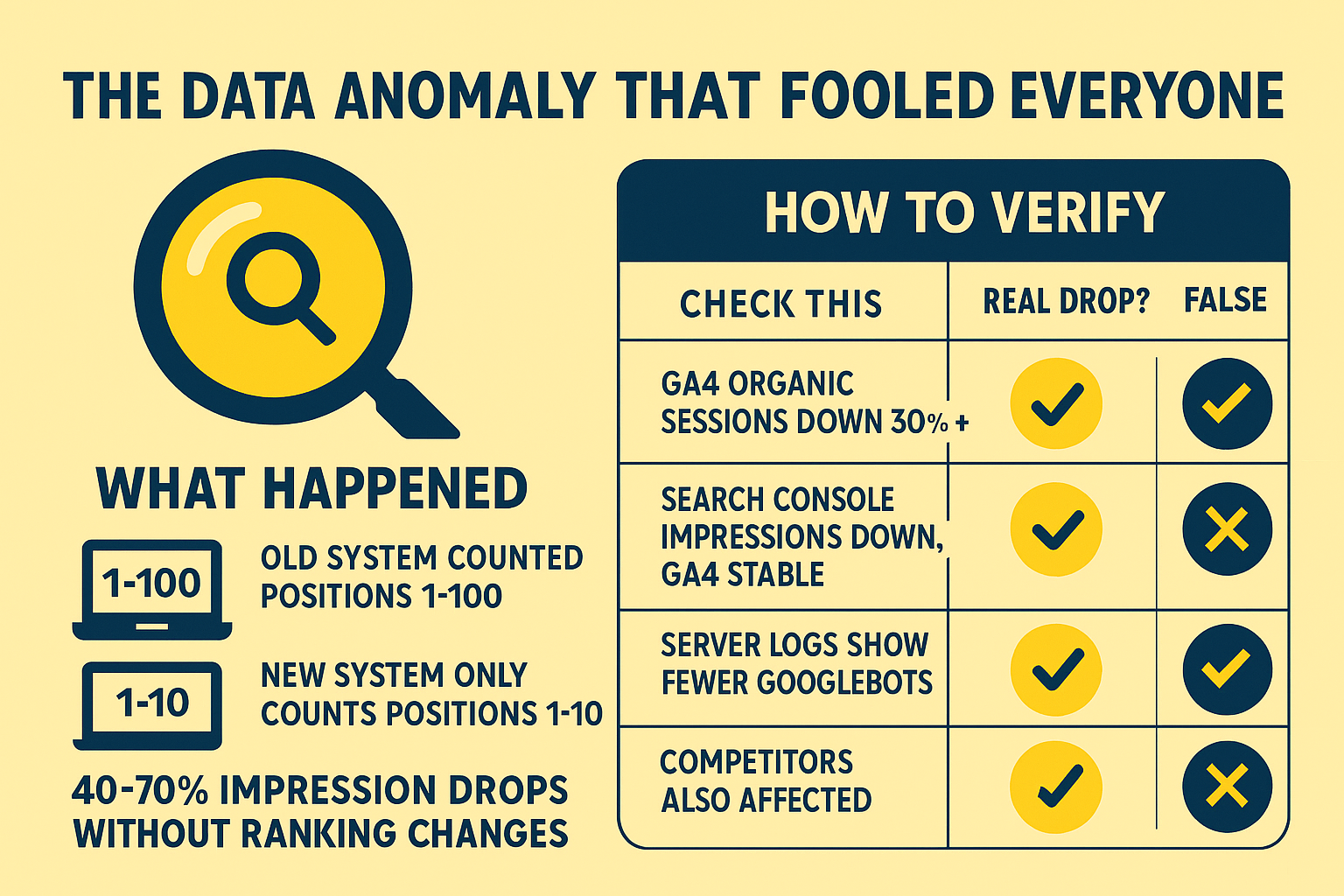
In mid-September 2025, Google secretly removed a technical option called the &num=100 parameter. For a long time, SEO tools and spiders utilized this to load 100 search engine results on one page instead of the standard 10. When these spiders “viewed” those 100 results, Google counted each one as an impression for all sites on that page, even if humans never looked that far.
What Actually Happened?
- The Old Way: Bots processing 100 results at once created an “artificial” set of impressions for sites in positions 11-100.
- The New Way: Google took away the shortcut. Now, an impression only occurs if the result appears on the “current page” (usually the top 10).
- The Result: A massive 40-70% decrease in impressions, and the average position “improves” as the low-ranking, bot-driven data points are deleted from the equation.
How to Verify What’s Real
Don’t let the search console graphs scare you. Use this checklist to see if your Google ranking actually moved or if it’s just a reporting glitch:
Check This Signal | Real Drop? | Reporting Fluke? |
GA4 Organic Sessions are down 30%+ | Yes | No |
Search Console Impressions are down, but GA4 Clicks are stable | No | Yes |
Server Logs show a drop in Googlebot crawl frequency | Yes | No |
Average Position improved while impressions fell | No | Yes |
Pro Tip: As per the latest SEO news reports from the end of 2025, almost 87 percent of the websites experienced this decline artificially. It is always best to cross-check the search console with the actual visitors on your website using GA4 before making any major changes to your content.
The AI Overview Problem: When Impressions Don’t Equal Clicks
The uncomfortable reality is this: Google Search results are no longer just a list of links.
The Google September 2025 core update unleashed a massive proliferation of AI Overviews to the top of Google Search results.
This has created what experts are calling “The Great Decoupling,” where you may see your Google Search results ranked #1, but see no traffic.
What the 2026 Data Shows
Recent studies conducted in early 2026 show us the extent to which the Google search engine has changed:
- The CTR Collapse: Websites in the top 3 spots are experiencing a 58-61% drop in CTR (Click-Through Rate) for those searches in which an AI Overview is present.
- The Zero-Click Surge: Almost 60% of all search results are ending without any website being clicked on. When an AI Overview is present, that rises to an alarming 83%.
- The “Position 1” Trap: Even in the top spot, you’re being pushed down 1,500+ pixels on the page, underneath an AI box that has already answered the user’s question.
Competing for Citations, Not Just Clicks
It’s not just about competing for blue links anymore. It’s about being the source that the AI cites. Digital agencies today compete for “AI Citation Real Estate.”
Example: A healthcare blog ranked #1 for “diabetes symptoms” and used to generate thousands of clicks. Today, Google’s AI shows the list of symptoms right on the SERP, citing the blog at the bottom. The blog still sees thousands of impressions, but clicks have dropped by 42%. The reason? The user didn’t need to click.
How to Win in the “Zero-Click” Era
To thrive in this new world, you must give users a reason to click beyond the basic answer:
- Offer “Decision Content”: While AI is good at facts, it’s terrible at nuance. Offer “Which is better?” comparisons, pricing calculators, or “mistakes to avoid” that an AI summary cannot replace.
- Optimize for the Citation: Sites that are cited in an AI Overview actually see a 35% increase in organic CTR compared to those that were cited but not linked.
Human-Only Value: Offer proprietary data, original images, or video transcripts. Google’s algorithm is 317% more likely to choose pages with text and original media for its AI summaries.
Winners and Losers: What Separated Them
As the dust settled on the Google September 2025 core update, the pattern became quite obvious. It wasn’t about who had the most backlinks; it was about who offered the most “human” experience.
Sites That Thrived Share These DNA Markers
Not only did the successful sites survive, but they also saw a 23% increase in organic traffic as of early 2026. What were the key differences?
Content Characteristics:
- Deep Topical Authority: Instead of publishing random content, successful sites created “content clusters.” They wrote about all possible sub-topics in their niche, demonstrating their authority on the subject.
- The “Experience” Signal: Successful sites used “first-hand experience” as proof. I have seen that adding a sentence such as “I tested this for 3 weeks, and here are the results” can be a significant ranking factor.
- Journey Completion: Successful sites answered the user’s initial query, as well as the next three they were likely to ask. This helped keep visitors on the site and prevent them from returning to the Google search engine.
Technical Excellence (The 2026 Standard):
If your website is “slow” in 2026, that means you’re already losing. To be a winner, your website must achieve the following:
- LCP (Loading Speed): Less than 2.5 seconds. (Pro tip: If it takes 3 seconds, your bounce rate increases by 32%!).
- INP (Interactivity): Less than 200 milliseconds. This is the new FID and measures how fast your website responds when a user actually clicks on something.
- CLS (Visual Stability): 0.1 or lower. No more text jumping around the page while ads are loading!
Trust Signals:
- Verified Expertise: Author bio with a link to actual social profiles or expertise.
- Brand Search: People were searching for your brand on Google, not just general keywords.
Common Loser Patterns
The sites that got hammered, some with declines of 60% or more, were likely:
- “Authority on Autopilot”: These were large sites that were relying on old rankings from 2022 or 2023, and never updated their content. Google finally took away the free ride.
- AI-Spun Content Farms: These were huge sites with 100+ articles per day, all generated with AI, and no human editing. Google’s algorithm is now sophisticated enough to recognize the absence of “Information Gain.”
- Thin Affiliate Reviews: Sites that “pass themselves off as reviewers” of products by simply copying and pasting the Amazon description. Google believes that if you have not touched the product, they don’t want to see you.
- The “Keyword Stuffing” Relic: Who would have thought that some sites were still utilizing techniques that were abandoned in August 2024? Using a keyword 50 times in one article is no longer cool.
The Big Shift: Google is no longer rewarding bloggers based on how frequently they can produce content. Now they want to know how thoroughly you can produce it. One expert-level article is now worth 50 shallow blog posts.
E-E-A-T in 2025: Experience Is the Tiebreaker
If you have been keeping up with the latest in the world of SEO, you are likely familiar with the term E-E-A-T, which stands for Expertise, Experience, Authoritativeness, and Trustworthiness. However, since the September 2025 core update from Google, the tiebreaker is the “E” in E-E-A-T, which stands for Experience.
What the latest quality rater guidelines from Google tell us is huge: Lived experience trumps credentials when the content is great and useful.
What This Looks Like in Practice
Prior to the September 2025 Google core update, a massive medical website with MD authors would almost certainly rank above a small blog. However, the situation has changed as follows:
- Before: A basic article written by a doctor on the subject of “how to run a marathon” ranks at #1.
- After: An in-depth article written by a regular runner, including details of the runner’s training schedule, pictures of the runner’s worn-out shoes, and a list of specific cramps the runner experienced at mile 18, has the potential to rank at #1.
The Google algorithm has now become intelligent enough to understand the runner has “skin in the game,” which is more valuable to the reader than a textbook.
Signals Google Uses to Measure Your “Experience”
How does it know that you really did the work? Well, it looks for these specific markers:
- First-Person Details: Instead of writing “This product is good,” you write “After 3 weeks of using this search console tool at 8:00 AM every day, I noticed a 12% lag in data reporting.”
- Original Media: Uploading original images and videos (not stock images taken last year on the 25th of May) proves that you were really there.
- Verified Author Bylines: You can link your name to your actual LinkedIn profile. Google wants to see human footprints.
- User Validation: Real comments and questions from real users (not bots!) show that your content is starting a conversation.
The YMYL “Must-Haves”
If you’re a Your Money or Your Life website, covering things like health, finance, or legal advice, this is non-negotiable. In the history of updates, this is the strictest Google has ever been. Generic advice is being buried. In order to rank, you need to demonstrate Expertise Depth.
Pro Tip: I audited a financial website, and they lost 30% of traffic after the Google core update in September 2025. Just by adding a ‘Why You Can Trust Us’ box and referencing the author’s 10 years of banking experience, we’re seeing traffic recover after just 7 days.
Technical SEO Survival Checklist
However, before you go through the motions of rewriting each and every sentence, you need to ensure that the “engine” of your website is actually running. The Google September 2025 update was very strict when it came to the technical health of the website. If your website is slow and difficult to use on a mobile device, Google’s algorithm will not even bother looking at your great content.
Foundation First: Quick Wins (Do This Week)
Don’t worry about fancy techniques until these are bulletproof. Most of these you can check yourself in your search console in 10 minutes:
- Verify Indexing: Search site:yoursite.com in Google. If your pages are not showing up, you have a big problem.
- Check for Manual Actions: Check in your Google Search Console under Security & Manual Actions. If you have a red bar, you have been penalized.
- Speed Test: Test your top 10 pages in PageSpeed Insights.
- Audit Robots.txt: Make sure you are not inadvertently telling Google’s spiders to “keep out.”
- Security Check: Make sure you are using HTTPS. Chrome and Google favor HTTPS sites.
High-Impact Fixes (This Month)
If you want to survive the Google Core Update in September 2025, you have to pass the Core Web Vitals test. Here’s your to-do list:
1. Optimization Tips
- Shrink Your Images: Use the WebP format. Large images are the #1 reason sites fail the speed test.
- Fix Layout Shifts (CLS): Does your text jump around because an ad is loading? Google hates this. It should be stable.
- Lazy Loading: Make sure your site loads images only when the visitor scrolls down to them.
2. Mobile-Specific Improvements
Google’s history shows that there’s been a massive shift to mobile. So, your site needs to be “thumb-friendly”:
- Button Size: Ensure that your buttons are at least 48x48px. You don’t want users to have to fight to click on your link.
- Kill Popups: If you have a giant pop-up that takes up the whole screen on mobile, you’ll lose ranking.
- Real Testing: Don’t test your site on a computer. Try it on a real iPhone or Android device.
3. Structured Data (Schema)
Help the Google search engine understand your page by adding “labels” to your code:
- FAQ Schema: Great for “Frequently Asked Questions.”
- HowTo Schema: Great for tutorials or “how-to” guides.
- Article Schema: Great for telling Google who wrote the article and when it was last updated.
Advanced: Semantic Search Optimization
Google is smart now. It doesn’t just read individual words on your page. It reads topics. Instead of writing 10 tiny posts that all sound the same, use a “Topic Cluster” strategy.
The “Coffee” Example: Instead of 10 different articles on “light roast coffee,” “dark roast coffee,” and “French press coffee,” do this:
- Pillar Page: Write a huge “complete guide to coffee brewing.”
- Support Pages: Write 5-8 articles on different coffee-making styles, such as “espresso” or “cold brew.”
Linking: Make sure all your small articles link back to your huge guide. It will help the algorithm realize that you are a real authority on the whole topic.
Adapting to AI Search: The Zero-Click Future
By early 2026, the way we use the Google search engine will have fundamentally changed. It is no longer a “list of links” – it is now an “answer engine.”
Recent data is in, and we can see that 58% of searches on Google are resulting in zero clicks. And for informational searches, that number can jump to a whopping 83% when an “AI Overview” is available. It is no longer a competition for a “rank” – it is a competition to be cited by Google’s AI.
Optimize for AI Citations
Since you can’t stop the AI from doing this, you should ensure it gives you credit. Brands included in the AI Overviews receive a 35% boost in organic CTR compared to brands not included.
How to Get Cited:
- The “Lead with the Answer” Rule: Place your most important information or definition within the first 50-70 words of your section. AI models focus on information that is easily extracted.
- Scannable Structure: Use clear headings and subheadings with H2 and H3 tags. Sections of 70-150 words are the “sweet spot” for AI citations.
- Data-Rich Content: Add original statistics and comparison tables. Pages that contain FAQ blocks receive 11% more citations on average compared to those that don’t.
- Semantic Entities: Use specific brands, tools, and experts. Google’s AI model understands “entities” better than the traditional Google keyword model.
Read More: How to Increase Brand Citations in AI Responses
“Beyond the Answer” Strategy
Why would a user click beyond the answer given by the AI? You need to provide Information Gain, which is beyond the capability of the AI.
- Proprietary Research: The AI cannot conduct a research study and gather data. Your research is your biggest competitive advantage over the AI competitor.
- Case Studies & Stories: The AI cannot provide Experience. Use first-person stories and case histories that prove your Expertise Depth.
- Interactive Tools: The AI cannot be a calculator, a downloadable template, or a checklist.
- Video Integration: Given the history of Google, people love videos, and a 2-minute video from the expert on your page can keep the user engaged long after they have read the answer from the AI.
Diversify Your Traffic Ecosystem
Being 100% dependent on Google search is a 2020 strategy. In 2026, the strategy is “Algorithm Resilience.” If your Google search traffic declines, your business shouldn’t go down with it.
- Email is King: Build a list. It is the only channel that is 100% in your control.
- Community Presence: Google uses a sophisticated AI to determine search results. It heavily cites Reddit, Quora, and YouTube. Participate in these sites to increase your chances of being cited by their AI.
- Brand Search: Focus on PR and social media to increase brand search. “Brand” searches are 99% less likely to be interrupted by a user clicking on an AI Overview.
- Multi-Platform Repurposing: Repurpose your best blog post into a LinkedIn carousel, a TikTok tip, and a newsletter highlight.
The 2026 Metric for Success: Don’t just track clicks. Track “Share of Voice” and how many times your brand is cited by the AI. If a user doesn’t click on your brand today, seeing your brand as the “Source” will help them trust your brand and increase your chances of a sale tomorrow.
Recovery Strategy
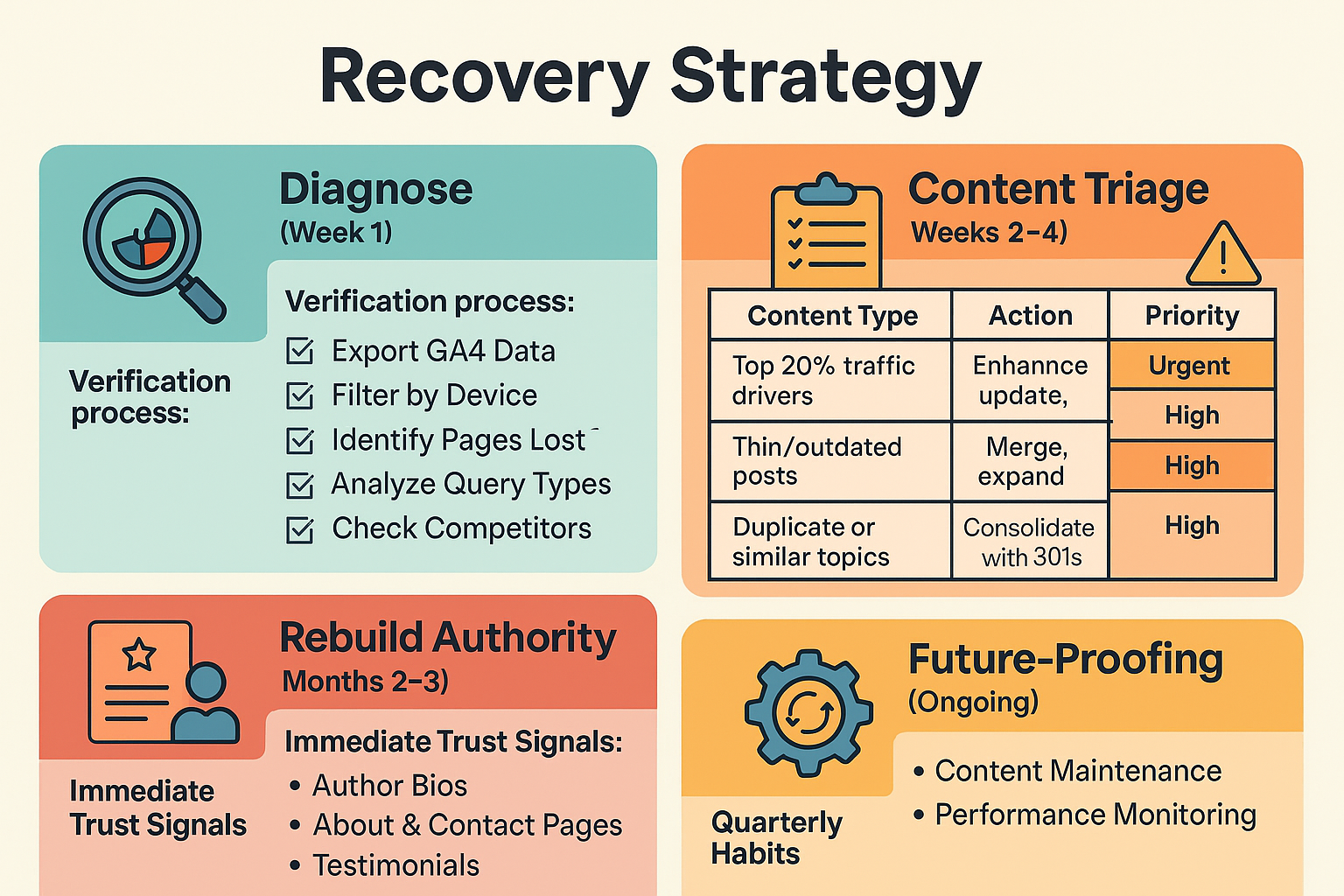
If your visibility took a hit from the Google September 2025 core update, do not simply start clicking buttons. You need a plan. Getting back in 2026 is not about “gaming” the algorithm. It is about proving to Google that you are a living, breathing expert who provides more value than a computer-generated summary.
Phase 1: Diagnose (Week 1)
The first thing to do before changing any words is to determine whether this was a “reporting fluke” or if you really lost some position in the rankings.
- The Verification Process: Open up your GA4 and compare August 1st to 15th with September 15th to 30th, looking specifically for mobile vs. desktop to see if your new mobile indexing score took a hit.
- Identify the “Bleed”: Was it all sites, or was it just a few “money pages”? Did your informational content sites lose positions, while your sales sites remained steady? This is likely a “Helpful Content” issue.
- Check the Bots: Check your server logs to see if the Google search engine bots have stopped crawling your site as frequently. This is a big, bad sign if they have lost all faith in your content!
Phase 2: Content Triage (Weeks 2–4)
Not all content is worth saving. In 2026, “content bloat” is a ranking killer. You have to be ruthless.
Content Type | Action | Priority |
Top 20% Traffic Drivers | Deep dive: Add first-hand data, new photos, and expert quotes. | Urgent |
Thin/AI-Spun Posts | Rewrite completely or delete. Google’s algorithm hates “fluff.” | Urgent |
Duplicate Topics | Merge them! One “mega-guide” beats five tiny posts. | High |
Zero Traffic (12+ Months) | Delete or “Noindex.” Stop wasting Google’s crawl budget. | Medium |
The Refresh Checklist:
- Instead of changing the publication date, add 2026-specific statistics and “I tested this” statements.
- Improve the layout. Use smaller paragraphs and clear headings (H3).
- Add links to other related articles to build a “Topic Cluster.”
Phase 3: Rebuild Authority (Months 2–3)
You need Google to trust you as much as your content. Experience, as the September 2025 Google core update has confirmed, is king. So, you need to prove your work.
- Trust Signals: Update your bio. Make sure you link it to your real LinkedIn profile or your professional portfolio. Add a ‘Fact-Checked By’ line if you are in the YMYL niche.
- Digital PR: Instead of buying links, you need to create one link from your ‘proprietary research’ (like a survey or a study). If you can get a prominent news site to link to your data, then you have achieved more than 1,000 spammy comments.
- Beyond the Blog: Get on a podcast or write a guest post for a prominent industry leader. This generates ‘Brand Search’ volume, which is a massive signal for the Google algorithm update in September 2025.
Phase 4: Future-Proofing (Ongoing)
As you can see, recovery is not a one-time thing; it’s a habit. Here’s what you should make a part of your quarterly routine:
- The 90-Day Audit: Every 3 months, take a look at your top 50 pages. Are the stats still fresh? Are the links still working?
- Core Web Vitals Check: Every week, do a speed test. If you slow down, you’ll fall behind.
- Monitor the SERP: Keep an eye on your competitors. If they start using something new, like video or interactive tables, you should too.
- A/B Testing: Try different headlines or intro texts to see what keeps users on the page longer. Remember, if you keep users on the page, you keep users on the page.
Pro Tip: In the history Google has written so far, the sites that recover fastest are the ones that stop trying to rank for keywords and start trying to solve for humans.
Local SEO in the New Era
The Google September 2025 core update brought a new set of rules for local businesses. Google has brought a new set of signals called “Proximity-Plus.” This means that although proximity to the searcher is important, Google’s algorithm now takes into account the context and the need for the information to determine who will be ranked first.
It’s not just where you are anymore, it’s how you can help and contribute to the community.
Read More: The Master Guide to Local SEO Services in 2026: From Map Pack Dominance to Revenue Growth
What’s Working in 2026: Proximity-Plus Factors
Google is now using your physical location in conjunction with “Real-Time Trust” signals. What this means is a business that is three miles away may rank higher than a competitor that is only one mile away, but is currently closed or has low recent engagement.
- The “Openness” Signal: Google is now extremely strict about your hours of operation. With urgent searches like “emergency plumber” or “food near me,” the Google search engine may now choose not to display businesses that are currently closed, even if they have the best reviews.
- Community Authority: Google is now looking at your “Local Mentions” beyond just your website. Being featured in a local news article or sponsoring a community event is a powerful new signal in the algorithm.
- Behavioral Intent: Google is now measuring how many people click on directions or call your business directly from the search engine results page. The more people are engaging with your listing, the higher you’ll rank as a “local favorite.”
Google Business Profile (GBP) Optimization
Your Google Business Profile is now your “digital storefront.” In 2026, many users will decide to visit you without ever clicking on your website.
- Weekly “Life” Updates: Don’t just set your hours and forget about them. Set a weekly update and include a real photo of your team or new product. Google profiles that are updated weekly receive 26% more views in the Map Pack.
- The 24-Hour Review Rule: Google is now keeping track of how quickly you respond to reviews. Make sure to respond to each and every review, good or bad, within 24 hours to prove you’re an active and trustworthy business.
- Review Keywords: When someone mentions a service like “fast AC repair” in their review, Google uses this as a “justification” to give you more visibility for this exact search term.
Hyperlocal Content Strategy
If you want to succeed in the Google core update 2025 September algorithm update world, you need to go beyond “city-level” SEO.
- Neighborhood Landing Pages: Instead of having one page for “London,” have one for “Soho,” one for “Camden,” and one for “Greenwich.”
- Local FAQs: Add a section of questions and answers to your location-based pages. “Is there parking near the Soho office?” “What bus stops are we close to?”
- Local Event Coverage: A short article about a festival or charity run is good to show Google that you’re a “Geographic Authority.”
Schema Markup for Local Trust
Technical “labels” to help Google’s AI easily locate your business information:
- LocalBusiness Schema: Verify that your NAP (Name, Address, Phone Number) is the same as it appears on your building and across your social media.
- ServiceArea Schema: If you don’t have a storefront and operate in a specific area (like a mobile pet groomer), this tells Google exactly where to display your pin.
- Review Schema: This is how those “gold stars” show up in the search engine results. It can increase your click-through rate by 15%.
Pro Tip: I recommend that you run a “Geo-Grid” scan once per month. This shows you exactly where your ranking stops as you get farther and farther away from your building. It’s the only way to see where you need to build more “Local Authority.”
The Real Question: Is SEO Still Worth It?
Short answer: Absolutely. And in 2026, what we are talking about is no longer “Search Engine Optimization” – we are talking about “Search Experience Optimization.”
The Google September 2025 update was not meant to kill websites. It was meant to kill “lazy” SEO. If you were “lazy” and just followed a formula to trick a computer, I am sure you felt the sting. If, on the other hand, you were building for humans, you are in a better position than ever.
What’s Changing in the New Era?
The “old ways” are no longer relevant. Here is how the world looks after the September 2025 Google core update:
- From Gaming Algorithms → Building Expertise: You cannot “hack” your way to #1 anymore. Google’s AI now looks for “Information Gain”—a new, unique value that has not been said a thousand times before.
- From Traffic Metrics → Brand Recognition: Total clicks are no longer as important as who is clicking. Are they the right customers? Are they searching for your brand name?
- From Keyword Rankings → Topic Authority: Being #1 in the world for a keyword is nice. Being the “go-to” source for an entire subject is how you survive an algorithm change.
- From Backlink Counts → Relationship Quality: One link from a trusted, relevant partner in your industry is now more valuable than 50 random links from a “guest post” farm.
What’s NOT Changing?
Despite all the SEO news today google core update in September 2025, there’s something about the internet that will never change:
- People Still Search: No matter if they type, talk, or use an AI chat, people still want answers.
- Businesses Still Need to Be Found: If you’re not found where your customers look, you don’t exist.
- Quality Content Still Wins: A well-researched, helpful, and easy-to-read article will always have a home in the Google search engine.
- User Experience Matters: If you make it hard for people to use your website, they will leave. Google just got smarter about noticing.
Action Plan: Your Next 30 Days
The initial few weeks following a Google core update in September 2025 are probably the most critical. Instead of making all edits to all pages in a state of panic, follow this roadmap to help determine what a real penalty is and what is just a data anomaly.
Week 1: Assess the Damage
You have to be a detective before you touch your content.
- Verify the “Reporting Artifact”: Did your Google Search Console impressions decline between September 10th and 12th? If yes, and your Google Analytics 4 organic sessions are good, you have been affected by the removal of &num=100. This is a “false alarm.”
- Identify Real Losers: Did your Google Analytics 4 show a 30%+ decline in real visitors? List the specific pages that declined. Were they informational blog posts or your main “money” service pages?
- Check the “Manual Actions” Tab: Did you get hit by Google’s August 2025 spam update, which finished rolling out in late September?
- Competitor Check: Use a SERP rank checker to see if your competitors have also declined. If the whole industry declined, Google might have changed the “intent” of the search entirely.
Week 2: Fix Technical Issues
What is a “slow” website in 2026? It’s an “invisible” website! Use this week to improve your foundations.
- Pass the 200ms INP Test: The new king of interactivity is Interaction to Next Paint (INP). Does your website feel like a “laggy” website when a user clicks a button? Then you’re in trouble!
- Mobile-First 2.0 Audit: Take a look at your top 5 pages on a real phone. Does your website suffer from a “Cumulative Layout Shift” issue? Does the text jump around because of loading ads?
- Schema Upgrade: Add the FAQ schema and the Article schema to your website. This increases your chances of being the “Citation” in an AI Overview!
- Image Compression: Convert your images to the new WebP image format and keep your LCP < 2.5 seconds!
Week 3: Content Triage
Now it’s time to be ruthless with your words.
- Kill the “AI Fluff”: Go through your top 50 pages and, if they sound as though they were written by a robot with no “Experience,” then rewrite or delete them. The new version of Google’s algorithm is highly sensitive to unoriginal content.
- Inject “Perspective”: For your top 20 pages, add a section called “Our Take” or “Real World Example.” This will help you demonstrate “I” and “We” for Expertise Depth.
- Journey Completion: Make sure each page answers the next logical question. For instance, if you write a page about “Coffee Brewing” and do not mention “Best Beans,” then you are leaving the door open for the visitor to go back to the Google search engine.
- Update Stats: Make sure to update any statistics from 2023 or August 2024 with new figures from 2025/2026.
Week 4: Build for Recovery
Real recovery begins when Google recrawls your improved site and recognizes you as a brand, rather than a blog.
- Topic Cluster Strategy: Connect your improved content. Connect your “Deep Dive” content back to your “Pillar Guide.” Show Google you own the entire topic.
- Author Authority: Increase your E-E-A-T. Add more detailed author bios. Connect these to your LinkedIn profile or other authoritative sources. Show Google there’s a real person behind the computer.
- Diversify Your Clicks: Don’t wait around for Google. Create an email newsletter or a YouTube channel. The goal here is to make your business “Algorithm Proof.”
- Digital PR: Reach out to one industry partner. Ask if you can collaborate or get a quote from them. One link from a great source in late 2025 is worth 100 from bad sources earlier.