The operations lead pulled an organic search report across 11 locations and found the same pattern that shows up in most multi-location businesses: a few branches accounted for the majority of leads, while the rest were invisible.
Three locations were generating most of the inbound. The other eight were stuck outside the local pack. The same website template was being used. The same Google Business Profile setup was being used. The same citation approach was being used.
The issue was not “effort.” It was architecture.
In 2025–2026, local search has become more sensitive to accuracy, reputation, and location-level relevance, and consumers have less patience for wrong information. In Rio SEO’s 2025 Local Search Consumer Behavior Study, 53% of consumers said inaccurate listings would drive them away.
This guide breaks down SEO for multiple locations as a system: what must be built per location, what must be centralized, and what failure modes can bring down an entire multi-location program. (If you’re comparing providers, start with local SEO services and our SEO services near me guide.)


Direct Answer (What “SEO for Multiple Locations” Is)
SEO for multiple locations is the process of making each location rank independently in local search by building five coordinated assets per branch: (1) an optimized Google Business Profile, (2) a unique location landing page, (3) a clean citation profile, (4) a location-specific review engine, and (5) local authority signals (links/mentions) tied to that branch.
The 5-Minute Framework (Do This First)
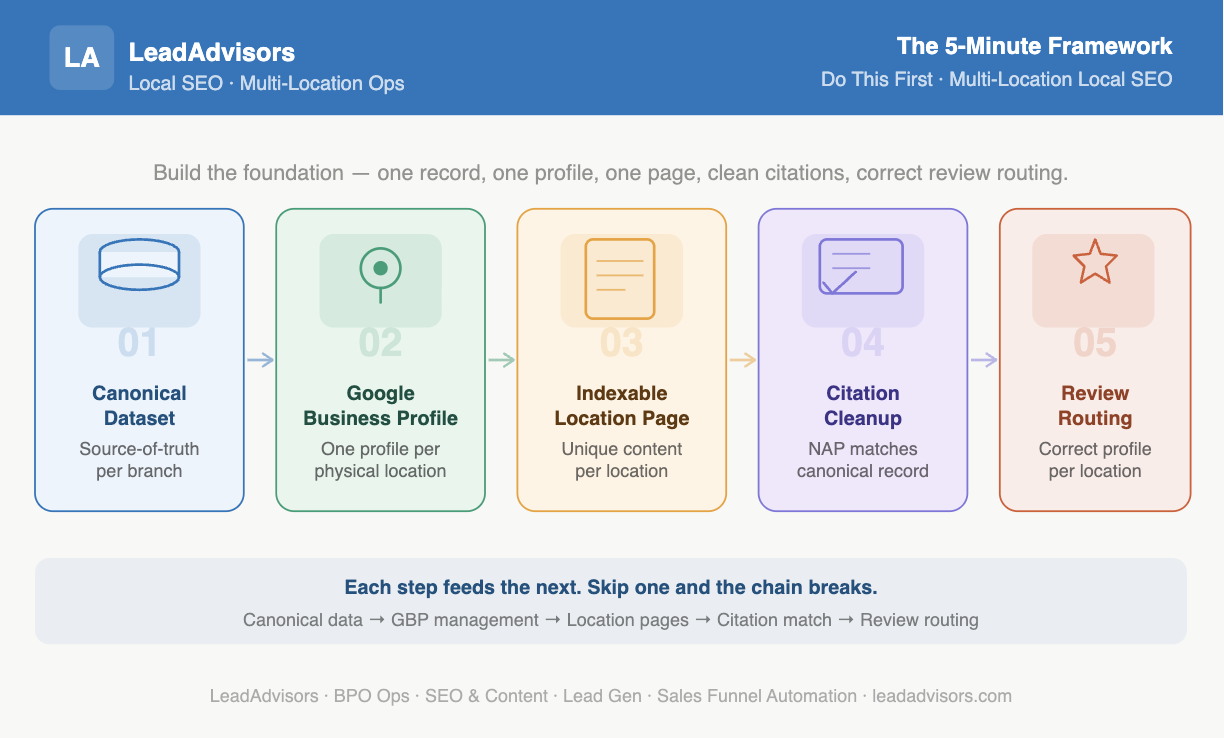
- A canonical location dataset should be created (the “source of truth” record for each branch).
- One Google Business Profile should be managed per physical location.
- One indexable location page should be published per location (with unique content fields).
- Citations should be cleaned per location (address/phone should match the canonical record).
- Review generation should be routed to the correct profile for each location.
Why Multi-Location SEO Is Architecturally Different From Single-Location SEO
Multi-location SEO is not single-location local SEO repeated 10 times. The following structural differences change the rules.
Each Location Competes in a Different Local Pack
Local pack competition is market-specific. A downtown branch can be surrounded by dozens of competitors in close proximity. A suburban branch may face fewer direct competitors but can have a larger service radius.
When a uniform investment is applied across all branches, results will concentrate in the easiest markets. That is why “three locations carry the whole program” is a common outcome.
Location Pages Can Cannibalize Each Other
When similar pages target the same intent with near. identical content, ambiguity is introduced. The algorithm is forced to choose which URL is “the” answer, resulting in weaker visibility across the cluster.
This shows up as:
- One location page ranking for multiple cities
- Multiple location pages swap positions week to week
- The wrong location is showing for “near me” searches in a neighboring market
Reputation and Accuracy Are Evaluated at the Location Level
Consumers do not buy “the brand” in local search. A location is evaluated as a local entity.
If review velocity, review recency, or listing accuracy differs by branch, ranking variance will be created.
BrightLocal’s consumer research shows how much reviews are embedded into the decision path for local purchases.
The Multi-Location SEO Architecture: The Five Required Components
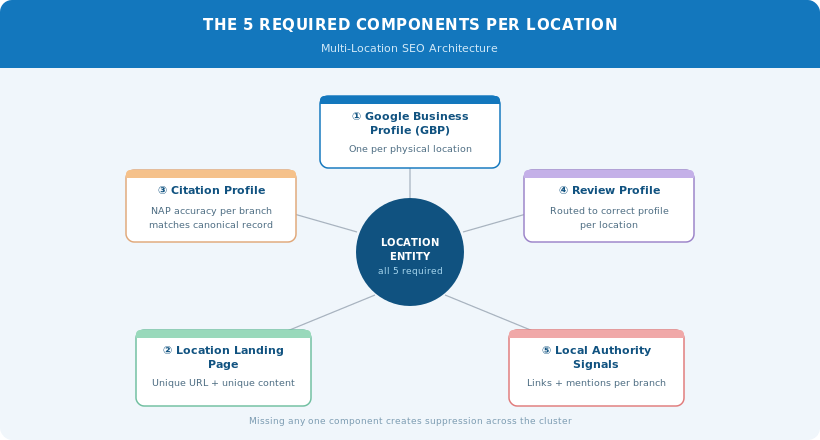
A local SEO strategy for multiple locations works when five components are integrated. If one is missing, suppression tends to occur, and the program becomes uneven.
Component 1: Individual Google Business Profiles (GBP)
One Google Business Profile should be created per physical location. A single profile cannot rank for multiple cities the way a multi-location brand needs.
The following items should be treated as required configuration:
- Primary category (consistent across locations)
- Secondary categories (varied only when services differ by branch)
- Location-specific photos
- Accurate hours (including holiday changes)
- Location-specific service descriptions
Duplicate profiles must be prevented. Google’s duplicate profile guidance states that only one Business Profile should exist per business, and duplicates may not show in Search or Maps.
Component 2: Location-Specific Landing Pages With Unique Content
One indexable, static URL should exist per location. A dropdown-driven “choose your location” page will not function as a location page cluster because separate URLs are not being provided.
The page should include:
- NAP for that location (matching GBP)
- LocalBusiness schema (location-specific)
- Unique location signals (team, service area detail, local proof)
Component 3: Per-Location Citation Profiles
A citation profile is the distributed footprint of NAP across directories and platforms. For multi-location brands, each location’s citations should match that location’s canonical record.
If the wrong address is present for one branch, it can be suppressed while other branches perform normally. That is why citation cleanup must be executed per location, not “sitewide.”
Component 4: Location-Specific Review Profiles
Reviews are both a ranking signal and a conversion signal.
If customers are routed to the wrong profile, the wrong branch accumulates trust while the underperforming branch stays weak.
Component 5: Location-Specific Local Authority (Links/Mentions)
Domain-level authority helps. But it does not substitute for location relevance.
Local authority signals that typically help a branch include:
- chamber of commerce listings
- local sponsorship pages
- local news mentions
- local organization partnerships
Location Page Architecture. How to Build Pages That Don’t Cannibalize Each Other
The goal is simple: each location page should be the best answer for “service + city” queries in its market, without competing with sister pages.
URL Structures That Scale
Two structures tend to work; the correct one depends on the business model.
If services are the primary dimension (service businesses):
- /[city. state]/[service]/
- Example: /dallas. tx/debt. relief/
If locations are the primary dimension (retail/franchise):
- /locations/[city. state]/
- Example: /locations/phoenix. az/
Unique Content Fields (The Anti-Template Rule)
To prevent duplication and cannibalization, a location page template should be built with the required unique fields.
At a minimum, uniqueness should be created through:
- staff or team proof (names, credentials, photos)
- location-specific testimonials (or review excerpts)
- service. area detail (neighborhoods, zip codes, counties)
- location-specific FAQs
A location page cluster should not be published where the only changed field is the city name.
Internal Linking That Supports All Locations
A crawlable hub should be created:
- /locations/ should link to every branch page
- Every branch page should link back to /locations/
Supportive pages (service pages, blogs) should link to the correct location page when the local intent is clear.
What Should Not Be Done
- A single location page with a selector (not indexable per location)
- Parameter URLs (commonly not crawled consistently)
- A “map page” that lists all locations but does not provide unique pages
Google Business Profile Management at Scale. The Multi. Location GBP System
A multi-location GBP system must be run as operations, not as a single one. time setup.
Business Account (Business Group) Structure
A centralized Business Account should be used so ownership and permissions can be controlled, reporting can be pulled by location, and new profiles can be added without credential fragmentation.
Maintenance Cadence (Weekly/Monthly/Quarterly)
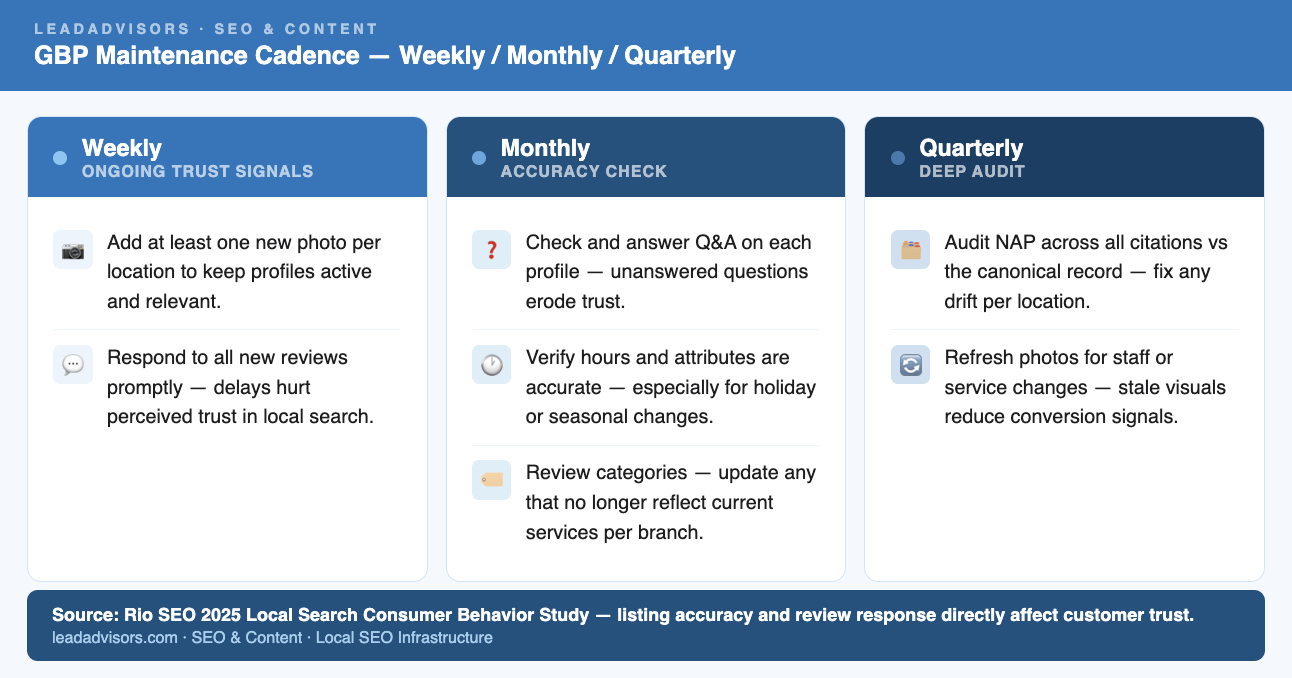
The following cadence is recommended because listing accuracy and review response are part of customer trust behavior in local search (see Rio SEO’s 2025 Local Search Consumer Behavior Study).
Weekly
- One new photo per location (minimum)
- Review responses should be completed promptly
Monthly
- Q&A should be checked and answered
- Attributes/hours should be verified for accuracy
- Categories should be reviewed (especially if services change)
Quarterly
- NAP should be audited across citations vs the canonical record
- Photos should be refreshed for staff/service changes
Duplicate Profile Risk (And How It Shows Up)
Duplicate profiles often get created when a new manager creates a profile instead of requesting access, when an old listing from prior ownership exists, or when a move/rebrand creates a second entity instead of updating the original.
Google’s guidance is explicit that duplicates are against policy and may not show (see Google’s duplicate profile guidance).
Multi-Location Keyword Strategy. Avoiding the Same Keyword on Multiple Pages
The keyword strategy for multiple locations should be designed so that the same intent is not targeted by multiple URLs.
The Geographic Modifier System
A geographic modifier should be assigned as the primary differentiator:
- “debt relief Dallas, TX” vs “debt relief Fort Worth, TX”
- “financial advisor Lincoln Park” vs “financial advisor Wicker Park”
This is how local SEO for multiple locations in one city should be handled: neighborhood/suburb modifiers reduce internal competition.
Service-Area Businesses (SABs)
If a storefront is not present in each city, service-area logic should be handled carefully:
- City pages can still exist to capture demand
- A GBP profile cannot be created for every city unless a staffed location exists
- Coverage should be framed as a service area, not as “multiple offices.”
Scaling Multi. Location SEO as New Locations Open
A scalable system is created when three launch assets are standardized.
1) Location page launch template (with unique fields)
A template should be created that locks URL structure, schema markup, and internal linking patterns, and requires staff proof, service-area proof, local FAQs, and local testimonials/reviews.
2) GBP launch checklist
A checklist should be executed at opening so that a location does not start incomplete.
3) Citation pipeline
A repeatable directory list should be used so citations can be created consistently per launch.
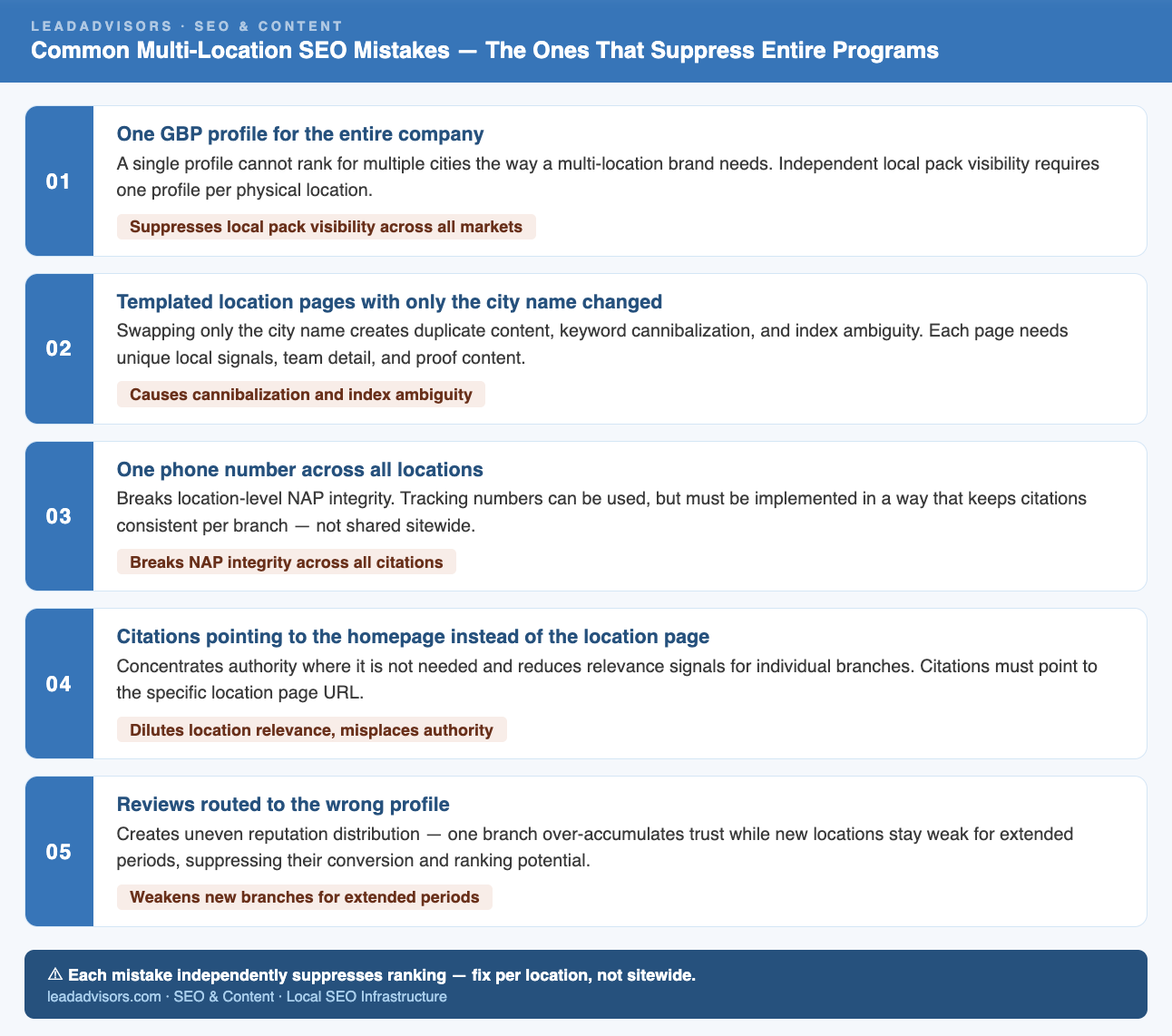
Common Multi. Location SEO Mistakes. The Ones That Suppress Entire Programs
Mistake 1. One GBP profile for the entire company
This prevents independent local pack visibility across markets.
Mistake 2. Templated location pages with only the city name changed
This creates duplication, cannibalization, and index ambiguity.
Mistake 3. One phone number across all locations
This breaks location-level NAP integrity. Tracking numbers can be used, but they must be implemented to keep citations consistent.
Mistake 4. Citations point to the homepage instead of the location page
This reduces location relevance signals and concentrates authority where it is not needed.
Mistake 5. Reviews are routed to the wrong profile
This creates an uneven distribution of reputation and leaves “new locations” weak for extended periods.