Most outbound call floors only check a small part of their calls. According to industry data published by Call Centre Helper in 2026, most contact centers still rely on manual QA teams. That means only 8% to 12% of all calls are reviewed. A supervisor never hears the rest. They are never scored. They are never used for coaching.
That gap is no longer okay. AI-assisted call QA can now review every call a floor makes. It works automatically and takes only minutes. As a result, 100% call coverage is now possible without hiring 20 more QA reviewers.
This matters even more because of what is happening legally. According to a 2025 report published by CompliancePoint, 880 TCPA lawsuits were filed in the first four months of 2025. For a full breakdown of what the law requires and where exposure is created, see TCPA Compliance for High-Volume Outbound. That is a 44% increase from the same period in 2024. A separate analysis cited by the National Law Review found that TCPA class actions jumped 112% year over year in Q1 2025. Nearly 80% of all TCPA cases are now class actions.
Each violation can cost $500 to $1,500. One missed compliance issue can add up fast. AI-assisted call QA is built to catch those issues before they become lawsuits.
This guide explains what AI-assisted call QA is. It covers what manual sampling misses. It also covers what questions to ask any BPO vendor before signing a campaign.


What Is AI-Assisted Call QA?
AI-assisted call QA reviews every call a floor makes. It uses speech-to-text technology, natural language processing (NLP), and automated scoring. Each call gets a quality score, a compliance status, and a performance record. This happens within minutes of the call ending.
According to a 2026 report from Balto, AI QA tools have moved past limited sampling. For a broader look at how QA programs are structured, see Call Center Quality Assurance Best Practices. Manual QA teams can review 60-80 calls per day per person. To cover 1,500 calls per day at 100%, you would need 19-25 full-time QA staff. AI removes that problem.
The AI does not replace human reviewers. It sends work to them. Routine calls are scored on their own. Calls with issues are routed to a human reviewer for a final check.
The Six-Stage AI QA Pipeline
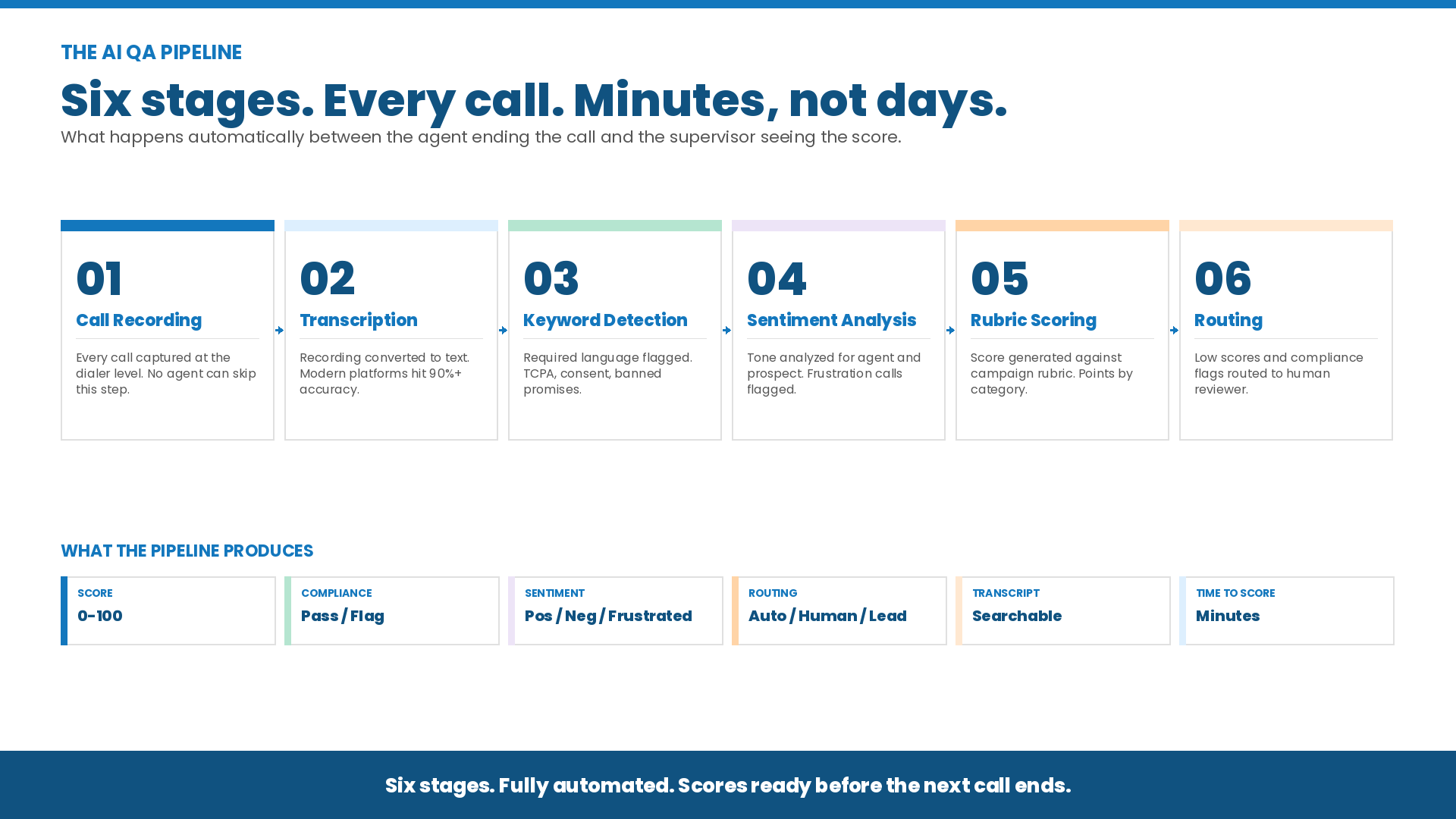
These steps happen automatically after every call:
- Stage 1: Call recording: All calls are recorded at the dialer level. No agent can skip this.
- Stage 2: Automated transcription: The recording is turned into text. Modern platforms hit over 90% accuracy.
- Stage 3: Keyword and phrase detection: The transcript is checked for required language. This includes TCPA disclosures and consent statements. It also checks for banned language like off-script promises.
- Stage 4: Sentiment and conversation analysis. The AI analyzes the tone of both the agent and the prospect. Calls with signs of frustration or breakdown are flagged.
- Stage 5: Rubric scoring: A score is given based on the campaign’s rules. These cover required steps, banned content, communication quality, and process follow-through.
- Stage 6: Human review routing: Calls that score too low or trigger compliance flags go to a human reviewer for coaching notes and score confirmation.
What 8% Sampling Misses, and Why It Cannot Be Fixed
The 8% sampling model is not a quality problem. It is a coverage problem. These are very different things.
Three failure patterns come from sampling-based QA. None of them can be fixed by reviewing the same sample again.
Failure Pattern 1: The Compliant Minority
Some agents learn which calls are being watched. They act compliantly on those calls and differently on the rest. Sampling-based QA cannot catch this. The reviewed calls always look clean.
When AI scores 100% of calls, this stops. Every call is checked. There is no group of unmonitored calls to behave differently in.
Failure Pattern 2: Low-Frequency Systemic Issues
Some compliance problems happen on only 3% to 5% of calls. For example, an agent skips a TCPA disclosure. This shows up once or twice in every 40 calls. At an 8% sampling rate, which covers 40 calls out of 500, the issue may never appear in the sample. But it is still creating legal risk on 15 to 25 calls per week.
According to research published by Clinq in April 2026, AI monitoring at 100% flags these problems the first time they happen. No pattern forms. No violations stack up.
Failure Pattern 3: Performance Drift
Agent performance does not drop all at once. It drifts slowly. An agent who scored 87 in month one and 72 in month three got worse step by step. Each reviewed call looked fine on its own. The trend was only visible across the full set of calls.
100% coverage gives weekly performance data for every agent. It does not rely on monthly averages from a small sample. A downward trend can be caught early and fixed with coaching before it becomes a bigger problem.
The QA Rubric: What Gets Scored and How
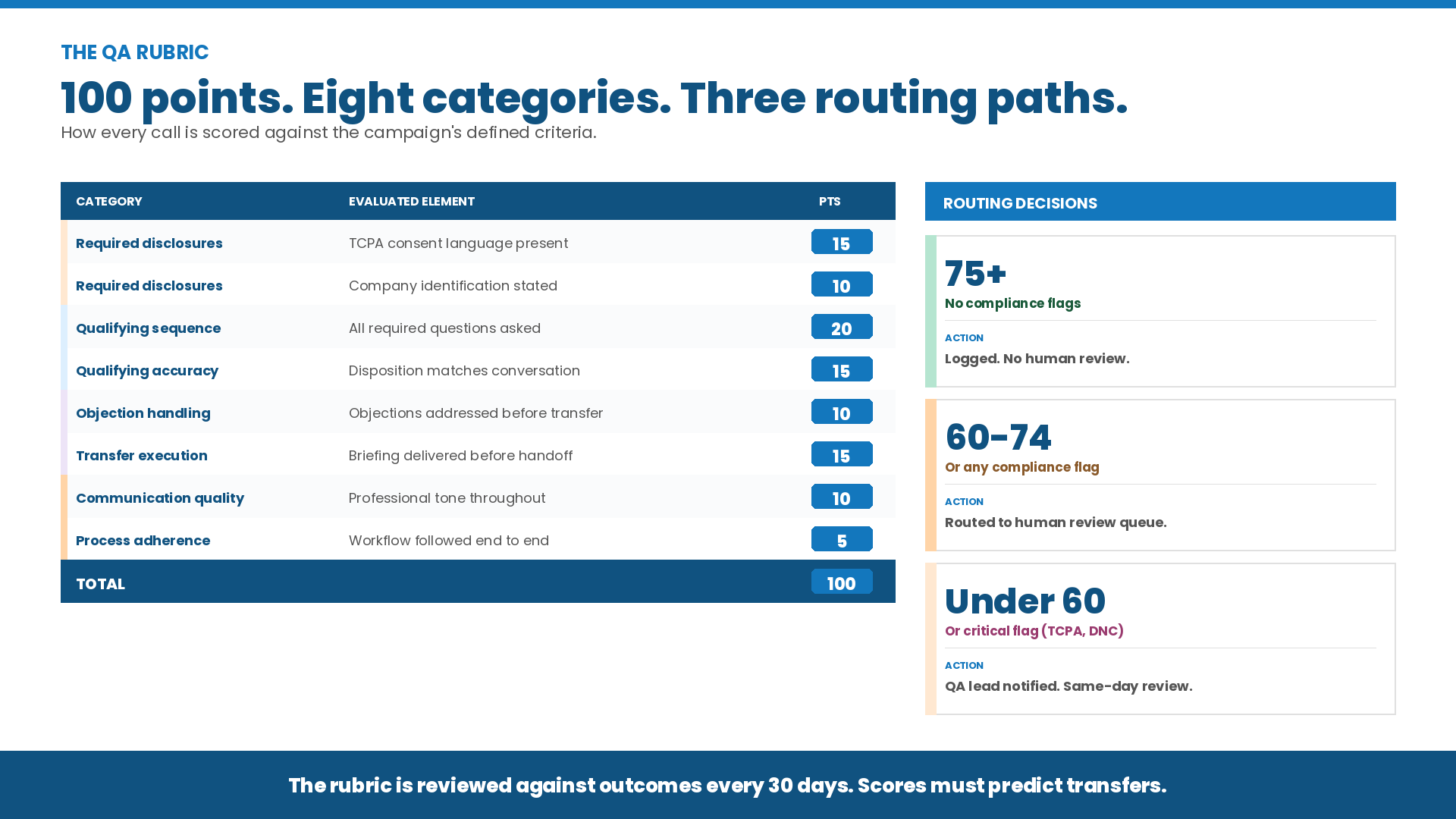
The AI QA rubric is the scoring guide used for every call. It says what is checked, how many points each item is worth, and what score sends a call to a human reviewer. The rubric is built before the AI is set up. It is built for the specific campaign and qualifying criteria.
A standard rubric for an outbound financial services campaign looks like this:
| Category | Evaluated Element | Points |
| Required disclosures | TCPA consent language present | 15 |
| Required disclosures | Company identification stated | 10 |
| Qualifying sequence | All required qualifying questions were asked | 20 |
| Qualifying accuracy | Disposition matches conversation outcome | 15 |
| Objection handling | Objections addressed before transfer or exit | 10 |
| Transfer execution | Transfer briefing delivered before handoff | 15 |
| Communication quality | Professional tone throughout | 10 |
| Process adherence | Call handled within the defined workflow | 5 |
| Total | 100 |
How Routing Decisions Are Made
- 75 and above, no compliance flags: The call is logged. No human review is needed.
- 60 to 74, or any compliance flag: The call goes to the human review queue. The AI score, point deductions, and key transcript parts are included.
- Below 60, or a critical compliance flag (e.g., TCPA language absent, DNC request not acknowledged): The QA team lead is notified right away. Same-day review is required.
Rubric Calibration
The rubric is not set once and left alone. It is checked against real calls at campaign launch. It is updated every 30 days based on the close rate and transfer data. If scores do not match outcomes, the rubric is adjusted.
Five AI QA Patterns Manual Sampling Cannot Catch
These patterns have been found across BPO operations using AI QA on 100% of calls. Each one needs a full dataset to detect. Sampling cannot produce that dataset.
Pattern 1: Systematic Qualification Shortcutting
An agent hits volume goals but skips one qualifying question on every call. The pattern is steady, not random. The 16 calls reviewed by a manual team each month look clean. The AI finds the problem across 200+ calls and flags it as a pattern, not a one-time mistake.
Pattern 2: Compliance Language Variation Across Agents
Three agents use slightly different versions of the TCPA disclosure. One version meets the legal standard. One leaves out a required part. One adds language that makes an unintended promise. All three scored the same in manual sampling because the reviewed calls were not the ones with problems. AI scoring on 100% of calls finds the differences within 48 hours.
Pattern 3: Transfer Quality Correlation With Closer Feedback
The closer team says that one agent’s transfers are not appearing at the expected rate. AI QA of that agent’s full call set shows the agent confirms transfers but does not finish the briefing. Prospects arrive unprepared and drop before the closer can engage. According to performance data published by Convin in 2025, floors using AI QA for 100% call monitoring saw a 21% increase in sales and a 27% boost in customer satisfaction scores. These results appear only when every call is in the dataset.
Pattern 4: DNC Request Handling Inconsistency
An agent says “I’ll remove you” when asked, but does not log the DNC in the CRM. The number is never removed. AI flags every call where “remove me,” “don’t call again,” or “take me off your list” is heard. It then checks if the DNC disposition was applied. The mismatch shows up the first time it happens.
Pattern 5: Show Rate Correlation With Qualifying Language
Calls where the agent confirms the prospect’s interest before the transfer have much higher show rates. This pattern only shows up in a full call dataset. You need 100% coverage to see it clearly.
The Human Review Layer: What AI Cannot Replace
AI-assisted QA is not fully automated. The AI handles coverage, pattern detection, and routing. Humans handle judgment.
In a 100% coverage system, human QA reviewers stop checking routine calls. They focus on the ones the AI has flagged. That work includes:
- Reviewing flagged calls: A human watches every call below the score threshold or with a compliance flag. They confirm or adjust the AI score and write a coaching note.
- Writing targeted coaching: The AI score indicates that points were lost due to incomplete qualifying. For a full framework on how to turn QA data into behavior change, see Call Center Coaching: How to Train and Motivate Agents for Peak Performance. The human reviewer then says, “You confirmed the debt amount but moved to the transfer before asking about bankruptcy status. Get a clear verbal confirmation before transferring.” The AI found the problem. The human explained how to fix it.
- Calibrating the rubric: Every 30 days, QA leads check whether high-scoring calls are producing strong transfers. If not, the rubric is adjusted. The AI scores calls. The human improves the rubric.
According to a 2026 Zendesk analysis, AI quality management works best when automation handles routine reviews, and humans focus on calls that require real judgment. Without humans, the AI only produces data. With humans, it produces improvement.
HeyCX: How the QA Platform Works in a Managed Operation
HeyCX is the AI QA platform used in LeadAdvisors’ managed BPO operations. It handles transcription, scoring, flagging, and review routing for 100% of calls across all active campaigns.
Call recordings are processed as they finish. Scores are ready within minutes. Batching at the end of the day is not used. Supervisors can see flags forming during the calling day, not the next morning.
What Is Produced for the Client
A daily QA summary is sent out. It includes the campaign score average, agent score breakdown, flag count by type, and the flagged calls with reviewer notes. Each metric is shown alongside contact rate, qualification rate, and transfer performance.
What Is Produced for the Supervisor
A live agent view shows each agent’s in-progress and completed calls, and the current session QA score. If an agent starts the day with three low-scoring calls in a row, a supervisor alert fires before the pattern grows.
What Is Produced for Compliance Defense
Every call is saved with its transcript, score, flag status, and disposition. Timestamps are included. If a TCPA complaint is filed, the full record for that call can be pulled up in minutes.
As reported by QevalPro in a 2026 study on AI compliance monitoring, platforms that use AI on 100% of calls reduce compliance risk by up to 90% compared to sampling-based systems.
What to Ask Your BPO Vendor About Their QA Program
QA claims are the most often misrepresented claims in BPO sales. Every vendor says they have a QA program. Very few come close to 100% coverage. These questions help find out what the program actually does.
Question 1: What percentage of calls on my campaign will be reviewed each week?
Right answer: 100% scored by AI, with a set percentage sent to human review based on flags. Wrong answer: “a representative sample” with no specific number.
Question 2: How long after a call finishes before the QA score is ready?
Right answer: Minutes. Scores are generated as calls finish, not overnight. Wrong answer: “Scores are in the weekly report.”
Question 3: Can I see the QA rubric before the campaign starts?
Right answer: Yes. The rubric is shared, reviewed with the client, and approved before the AI is set up. Wrong answer: “We use a proprietary system.”
Question 4: What happens when a call triggers a compliance flag?
Right answer: The QA team lead is told right away. A human reviews it the same day. The client is notified based on the severity of the flag. Wrong answer: “Compliance issues are handled in the weekly QA review.”
Question 5: How is the QA score linked to transfer quality and show rate?
Right answer: The rubric is checked against outcomes every 30 days. Changes are documented. Wrong answer: “We keep improving our methodology.”
The Business Case: What 100% QA Coverage Produces in Financial Terms
There are three clear reasons why 100% QA coverage makes financial sense.
Component 1: Compliance Liability Reduction
One TCPA violation can cost $500 to $1,500 per call. Class-action exposure can push this into the millions. According to a 2025 report published by ActiveProspect, nearly 80% of TCPA cases filed in 2025 are class actions. 507 class actions were filed in Q1 2025 alone. That is a 112% year-over-year increase.
At a 3% problem rate on a floor making 1,500 calls per day, 45 potentially problematic calls are made daily. At $500 each, the daily exposure is $22,500. AI QA at 100% catches these patterns within 48 hours, before the numbers grow.
Component 2: Agent Performance Improvement
When floors move from 8% sampling to 100% AI QA, performance improves. Coaching gets more specific and more timely, based on every call rather than a random slice.
According to performance data published by Convin in 2025, BPO operations using AI-assisted 100% call monitoring reported:
- 21% increase in sales performance
- 27% improvement in customer satisfaction scores
- 60% reduction in agent ramp-up time
- 56-second decrease in average handle time
These results appear only when every call is in the dataset.
Component 3: Disposition Accuracy and Data Quality
Accurate dispositions on 100% of calls mean your CRM data can be trusted. For a complete guide to building a disposition system that supports attribution, compliance, and ops reporting, see Disposition Taxonomy for Outbound. It is reliable for attribution analysis, lead source comparison, and weekly ops reporting. Bad disposition data, built from a floor where 92% of calls are never checked, leads to wrong decisions. The cost shows up in every report and plan made from that bad data.