Inbound call center support involves handling calls, emails, chats, and texts initiated by customers rather than by the company. When this team is staffed and run well, it turns ad clicks, outbound callbacks, referrals, and search traffic into revenue. When it is not, every dollar spent on those channels is wasted.
This function is growing fast. Grand View Research valued the global customer experience BPO market at $112.97 billion in 2025. It is set to reach $296.29 billion by 2033 – a 13.0% CAGR – showing just how much demand there is for managed inbound teams.
A managed inbound operation covers customer service, tech support, order handling, billing, lead qualification, and callback handling. It comes with trained agents, a management layer, QA coverage, and daily reporting.
This guide covers what that operation includes, how it differs from outbound BPO, what metrics to track, and what to look for in a provider. If you are still mapping out the broader outsourcing decision, start with The Ultimate Guide to Business Process Outsourcing.


What Inbound Call Center Support Actually Is
Inbound call center support handles customer or prospect-initiated contacts when they reach out to a company. The inbound team receives and responds. The outbound team calls first and follows up.
This matters because the two functions need very different agents, scripts, routing, and metrics. When they are mixed – for example, when outbound dialers take inbound calls during slow hours – both functions suffer. Research from the Contact Center Association (CCA) showed that blended agent models reduced first-call resolution rates by 18% compared to dedicated inbound teams. A 2025 SQM Group study confirmed that the cross-industry FCR average is just 70%. Rates range from 50% to 90% by vertical. Only 5% of contact centers hit a world-class FCR of 80% or higher.
The five core inbound functions:
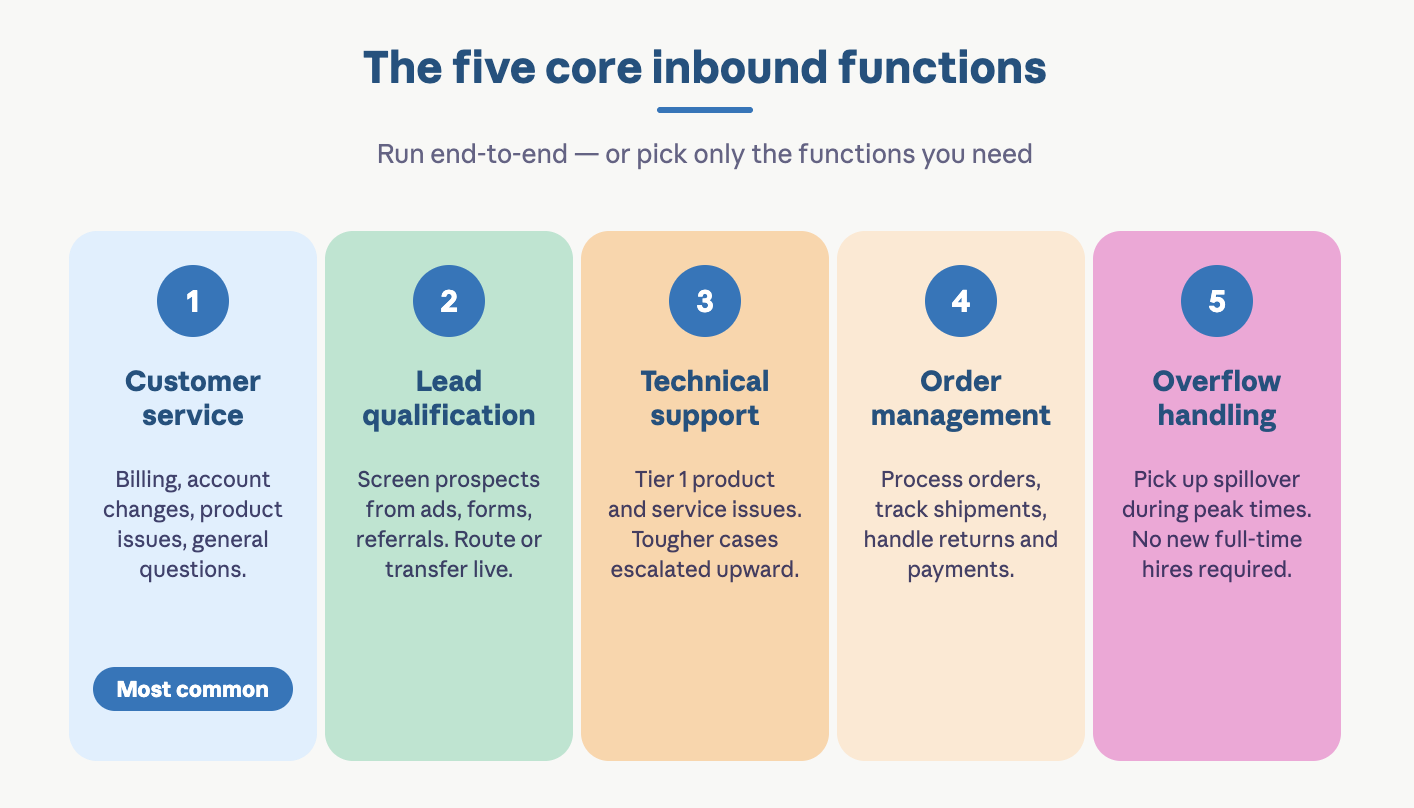
- Customer service: Agents handle questions, complaints, and requests from current customers. This covers billing, account changes, product issues, and general info. It is the most common inbound function.
- Inbound lead qualification: Prospects who call in from ads, form submissions, or referrals are screened and routed to the right sales rep or transferred live to a closer.
- Technical support: Agents handle Tier 1 product or service issues. Problems they cannot fix are sent to the client’s internal tech team.
- Order management: Agents process orders, track shipments, manage returns, and resolve payment issues. This is most common in e-commerce.
- Overflow handling: Calls that exceed in-house capacity during peak times are routed to external providers. The client does not need to hire full-time staff for short-term spikes.
The right managed inbound team handles all of these – or just the ones needed – with agents trained on the client’s product, scripts, and escalation rules.
Inbound vs Outbound BPO – The Operational Differences That Matter
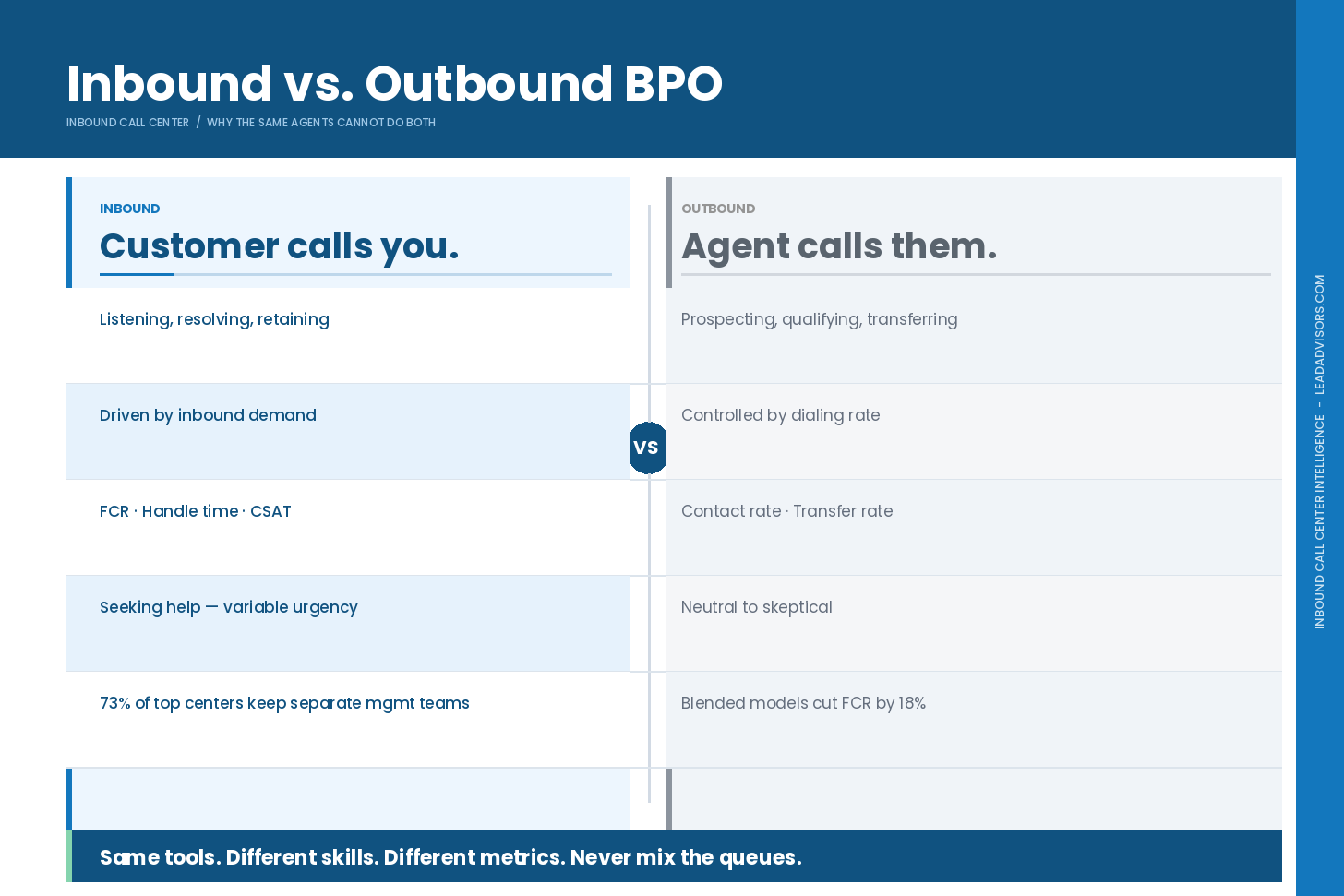
Inbound and outbound BPO share the same tools – phone systems, CRM, QA, and reporting – but they run on very different dynamics. A 2023 Deloitte Digital survey found that 73% of top contact centers keep separate management teams for inbound and outbound.
| Dimension | Outbound BPO | Inbound BPO |
| Who initiates contact | The agent calls the prospect | Prospect calls the company |
| Agent’s primary skill | Prospecting, qualifying, transferring | Listening, resolving, retaining |
| Volume predictability | Controlled by the dialing rate | Driven by inbound demand |
| Script structure | Structured qualification sequence | Decision-free resolution demand |
| Key performance metric | Contact rate, transfer rate | First call resolution, handle time |
| Prospect’s emotional state | Neutral to skeptical | Seeking help, variable urgency |
| Staffing model | Fixed outbound agent teams | Flexible courage aligned to call volume |
| QA focus | Compliance language, qualifying accuracy | Resolution quality, customer satisfaction |
Outbound agents are trained to push calls toward a result – a transfer, a booking, or a qualified lead. They are measured on output: contacts made, leads qualified, and transfers completed.
Inbound agents are trained to receive calls in any state – angry, confused, urgent, or grateful – and guide them to a fix. They are measured on service metrics: first-call resolution, handle time, and customer satisfaction.
Industry research shows that the same agents should not handle both functions. Running an inbound team is a different skill from running an outbound team. A strong outbound operator does not always deliver strong inbound results, and the reverse is just as true.
The Seven Functions a Managed Inbound Operation Covers
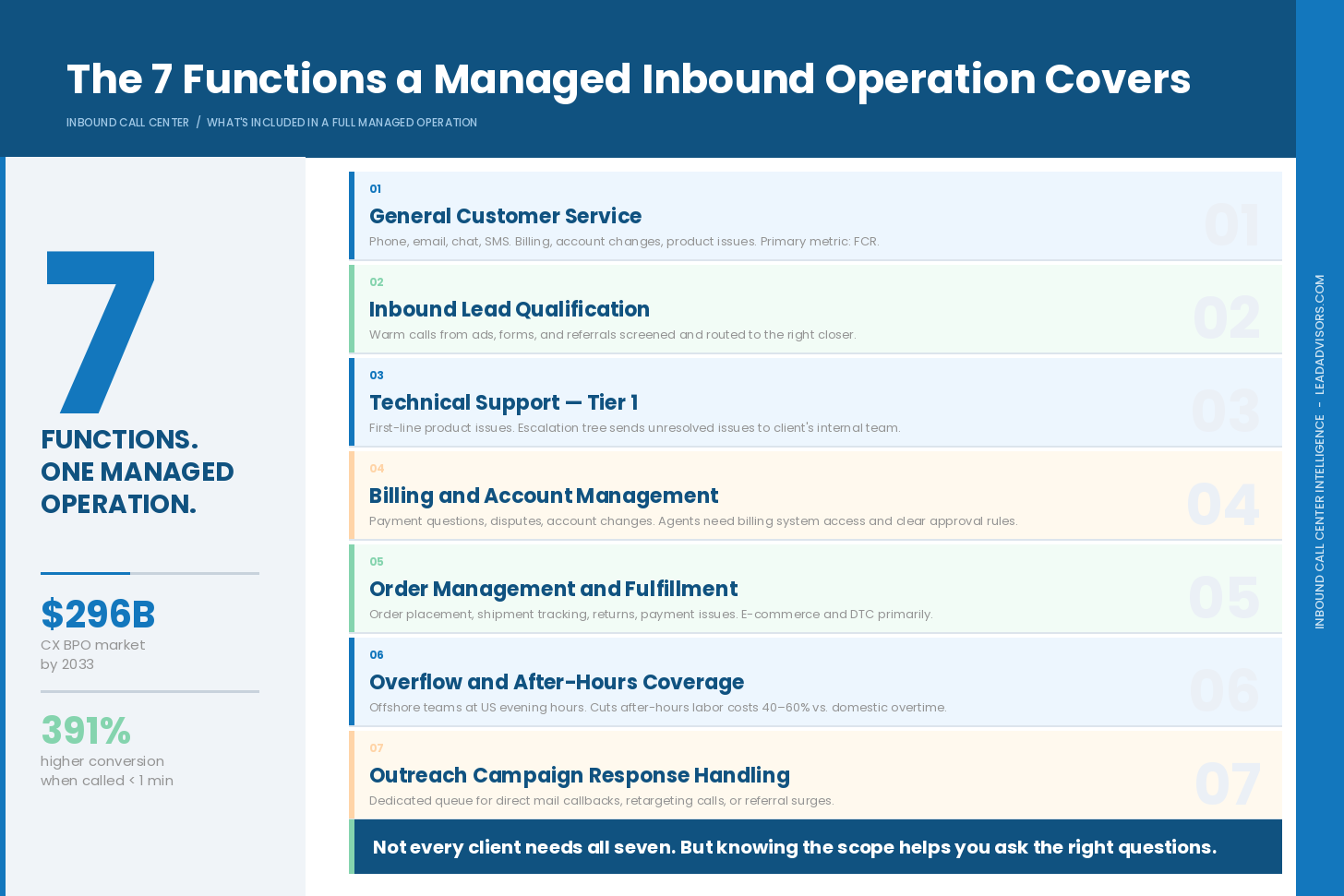
A well-built, managed inbound operation runs on seven key functions. Not every client needs all seven. But knowing the full scope helps you ask the right questions when you evaluate vendors.
Function 1: General Customer Service
Agents handle questions from current customers by phone, email, chat, and SMS. They are trained on the client’s product, account system, and escalation steps. The main metric is first call resolution – the share of calls where the issue is fully fixed without a callback.
Function 2: Inbound Lead Qualification
Warm inbound calls – from ads, form submissions, and referrals – are screened and sent to the right sales rep or transferred live to a closer. A Velocify lead response study found that leads called back within 1 minute convert at a 391% higher rate than those called after 24 hours. This matters most for sales floor owners whose outbound campaigns create callbacks that a general queue mishandles.
Function 3: Technical Support (Tier 1)
Agents handle first-line tech questions – setup, access, and basic fixes. Issues they cannot resolve are escalated to Tier 2 (usually the client’s internal tech team). This function needs deeper product knowledge and a clear escalation decision tree.
Function 4: Billing and Account Management
Agents handle payment questions, account changes, billing disputes, and subscription updates. They need access to the client’s billing system and clear rules on what they can change versus what needs client-side approval.
Function 5: Order Management and Fulfillment Support
For e-commerce and direct-to-consumer clients, agents place orders, track shipments, process returns, and check product stock. They need access to the client’s order system and carrier tracking tools.
Function 6: Overflow and After-Hours Coverage
Calls that exceed in-house capacity are handled on an overflow basis during peak hours or as full after-hours coverage. Offshore teams are a strong fit here – their normal work hours overlap with US evenings. The Site Selection Group’s 2025 BPO Pricing Guide found that offshore after-hours coverage cuts per-contact labor costs by 40-60% compared to domestic overtime.
Function 7: Outreach Campaign Response Handling
A dedicated queue is set up for calls tied to a specific campaign – direct mail callbacks, retargeting calls, or referral surges. This keeps campaign volume from flooding the general support line and hurting service for existing customers.
The Inbound Support Metrics That Matter – And What Benchmarks to Hold a Vendor To
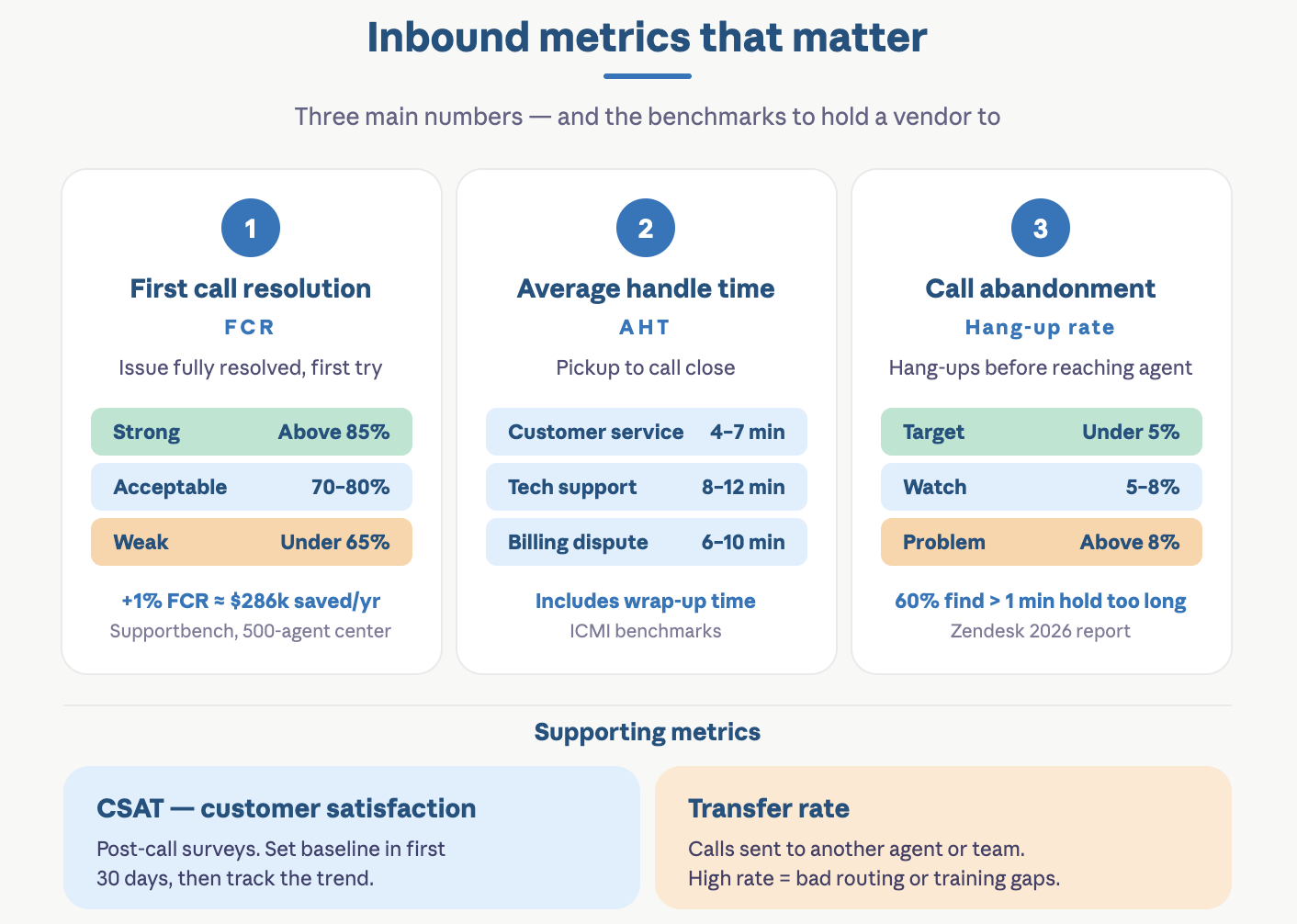
Inbound support uses a different set of metrics than outbound. Three main numbers – first call resolution, average handle time, and call abandonment rate – show whether the team is helping customers or pushing them away.
Metric 1: First Call Resolution (FCR)
FCR is the percentage of calls in which the issue is fully resolved on the first try.
- No callback.
- No escalation.
- No follow-up needed.
The Service Quality Measurement Group (SQM) calls it the most important inbound metric. Their research found that for every 1% increase in FCR, customer satisfaction increases by 1% and costs decrease by 1%. A February 2026 Supportbench analysis showed that a 1% FCR gain can save a 500-agent center up to $286,000 per year. Repeat calls account for 23% of total operating costs. FCR measures the one thing the customer cares about: whether the problem was fixed.
B2B service benchmarks:
- 70-80% FCR is acceptable
- Above 85% is strong
- Below 65% points to weak training, poor tool access, or escalation rules set too low
Metric 2: Average Handle Time (AHT)
AHT is the average length of a call from pickup to close. It includes wrap-up time for logging notes, follow-up tasks, and CRM updates.
AHT benchmarks by call type (ICMI):
- Customer service calls: 4-7 minutes
- Tech support calls: 8-12 minutes
- Billing dispute calls: 6-10 minutes
When AHT runs well above the benchmark, the cause is usually knowledge gaps, a lack of system access, or a decision tree that routes too many calls to agents who cannot resolve them.
Metric 3: Call Abandonment Rate
This is the share of callers who hang up before reaching an agent. It usually happens because hold times are too long.
Benchmarks (ICMI):
- Below 5% is the target for a well-staffed team
- Above 8% signals a staffing or routing problem
A 2026 Zendesk report found that 60% of customers say being on hold for even one minute is too long. This makes the abandonment rate a direct sign of whether the floor has enough agents.
Supporting Metrics
- CSAT (Customer Satisfaction Score): Collected through post-call surveys. Set a baseline in the first 30 days and track the trend over time.
- Transfer rate: The share of calls sent to another agent or team. High transfer rates indicate poor IVR routing or gaps in agent training.
What Should Be in the Contract
Set a minimum FCR, an AHT target range, an abandonment rate cap, and a CSAT floor. Measure them on rolling 30-day windows. Define what happens when a benchmark is missed.
Inbound Support Staffing – How Coverage Models Work
Staffing an inbound team is harder than staffing an outbound team. An outbound floor dials at the rate it picks. An inbound floor takes calls at the rate customers call in. That means agent schedules must closely match demand patterns.
The Three Coverage Models
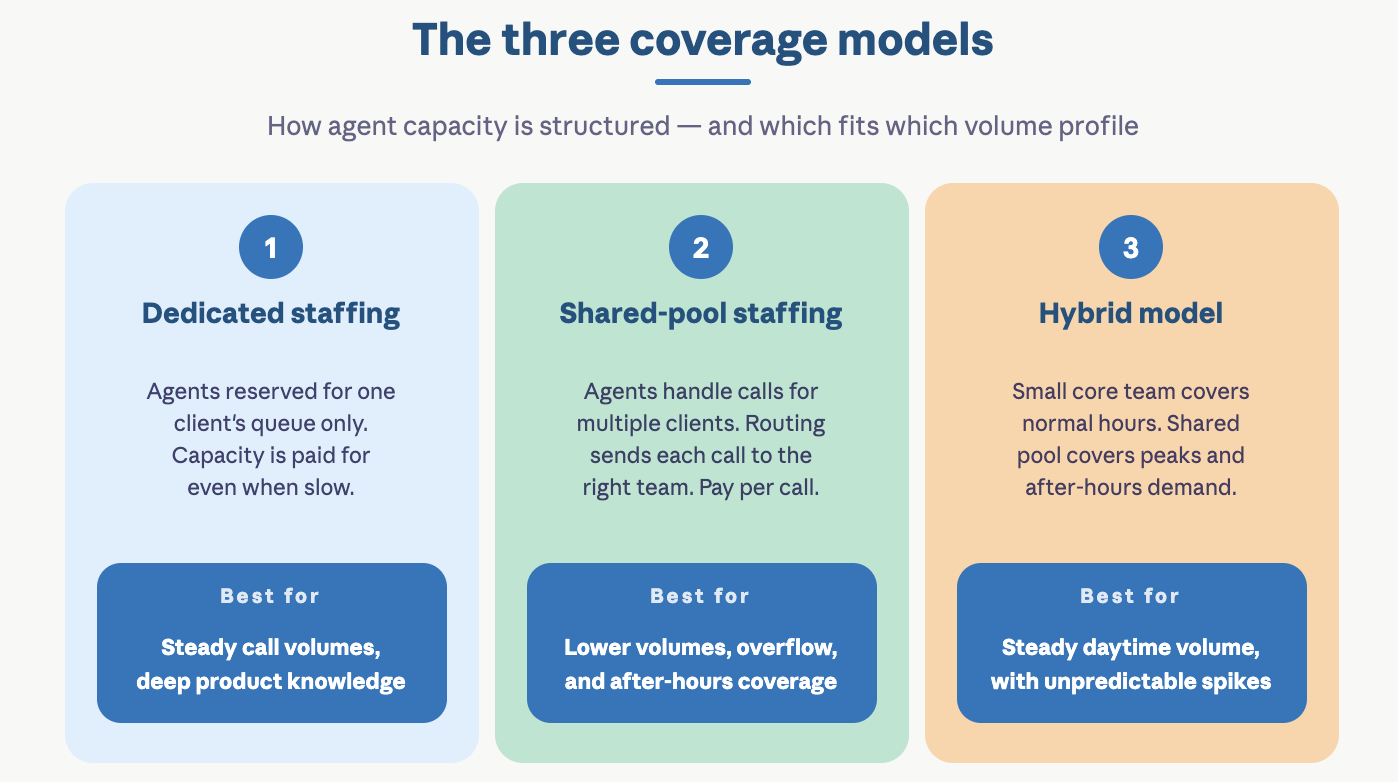
Dedicated staffing: A set number of agents work only on the client’s queue during set hours. The client pays for that capacity even during slow periods.
Best for: Steady call volumes where agents need deep knowledge of the client’s product and customers.
Shared-pool staffing: Agents take calls for multiple clients. Routing sends the right calls to the right agents. The client pays only for the time spent on their calls.
Best for: Lower volumes where dedicated staff costs too much, overflow, and after-hours coverage.
Hybrid model: A small core team handles normal hours. A shared pool covers peak and after-hours demand.
Best for: Steady daytime volume with hard-to-predict spikes.
The Offshore Advantage for Inbound Coverage
After-hours coverage is where offshore staffing saves the most money. The Everest Group’s Pricing Index and 2026 industry data show that managed offshore inbound agents cost $8-14/hr (Philippines), while US agents cost $25-42/hr. That is 40-60% in savings for after-hours shifts. When the offshore team has strong training and QA, the quality gap is small. The cost gap is large.
The Quality Layer – Why QA in Inbound Support Is Different From Outbound
QA for inbound support is scored on different things than outbound QA. The focus is on how well the issue was solved and how the customer felt – not on whether the agent hit the right compliance phrases.
Inbound QA Scorecard
| Category | What Is Evaluated | Weight |
| Issue Identification | Did the agent correctly identify the customer’s issue? | 20 pts |
| Resolution accuracy | Was the resolution correct and complete? | 25 pts |
| Process adherence | Were escalation protocols followed correctly? | 15 pts |
| Communication quality | Was the agent clear, professional, and empathetic? | 20 pts |
| CRM documentation | Was the contact logged accurately and completely? | 10 pts |
| Resolution speed | Was the issue resolved within the AHT benchmark? | 10 pts |
| Total | 100 pts |
Where Inbound QA and Outbound QA Converge
Both need 100% call coverage to spot patterns – not just random samples. AI-powered transcription and scoring now make this possible without hiring a huge QA team. A 2025 McKinsey report found that Gen AI tools helped agents resolve 14% more issues per hour and cut handle time by 9%. 2026 data from Natterbox confirmed that AI QA systems now score 100% of calls as standard, replacing old models that sampled less than 5%.
Where They Diverge
Outbound QA checks compliance language and lead qualifying accuracy. These are pass/fail scores. Inbound QA checks how well the agent solved the problem and how they made the customer feel. These need more human judgment. AI is best used for coverage and pattern detection in inbound QA. Human reviewers still play a bigger role in grading the quality of fixes.
When Inbound Support Is the Right Starting Point for a BPO Relationship
Many teams assume outbound should be the first to evaluate BPO. But for most operations, inbound is more urgent. Starting with inbound gives a faster return and a lower-risk vendor relationship.
Start with inbound when:
- Customer service is the main pain. Response times are slow. Hold times are long. Customers are leaving – and churn is tied to support quality, not product quality. Many of these issues stem from common customer service mistakes in BPO that remain hidden until churn data reveals them. A 2026 Zendesk report found that over 50% of customers will switch to a competitor after just one bad experience.
- Paid ads create calls that no one handles well. Every missed call from a paid campaign is wasted ad spend. Forbes reported that over $75 billion in yearly revenue is lost due to poorly handled inbound calls.
- After-hours coverage is a gap. Callers who reach voicemail after hours rarely call back. Offshore teams at US evening hours pick up this demand at a fraction of the cost. Our guide on Call Center Outsourcing in 2026 covers how to set this up.
- Outbound is about to scale. Build inbound capacity before outbound volume hits. If you wait, callbacks will flood a team that is not ready – and you will not find out until six weeks after launch.
In each case, inbound is not a back-office function. It is the layer that protects revenue, cuts churn, and makes every other sales and marketing dollar work.
How to Evaluate a Managed Inbound Support Vendor
These six questions help you tell a strong vendor from a weak one. For a more comprehensive checklist, see our guide to Choosing the Right BPO Partner.
Question 1: What is your FCR rate in my industry?
Ask for data specific to your vertical. A vendor with high FCR in e-commerce may score lower in B2B financial services. The right answer is specific and backed by data.
Question 2: How do you staff after-hours coverage?
You want a clear answer: which country, what shift hours, and whether after-hours agents are dedicated or shared. A vague “24/7 available” is a red flag.
Question 3: How do you train agents for a new client?
Look for a clear timeline: product training, script practice, system access, a test period, and supervised calls before going live. See our 2026 Call Center Training Guide and Call Center Coaching guides to see what good training looks like. “We get agents up to speed fast” is not a real answer.
Question 4: What does QA coverage look like?
The right answer: AI scores 100% of calls. Humans review flagged ones. Rubrics are checked each week. Scores are tracked per agent. “Supervisors monitor calls” is too vague.
Question 5: How do you handle escalation?
Look for a clear decision tree: what triggers it, who it goes to on the client’s side, and how the handoff works. “We handle it as needed” is not enough.
Question 6: What is in the daily report?
You should get FCR, AHT, abandonment rate, call volume by hour, CSAT scores, and a QA summary every morning. A weekly summary is not enough.