In the past, brand protection was handled quietly by the legal or compliance departments. Right now, it is the first line of defense for revenue, customers, and long-term trust. In 2021, global counterfeit trade was estimated at 467 billion dollars, and it remains a major risk to consumer safety and intellectual property worldwide, according to the OECD–EUIPO report.
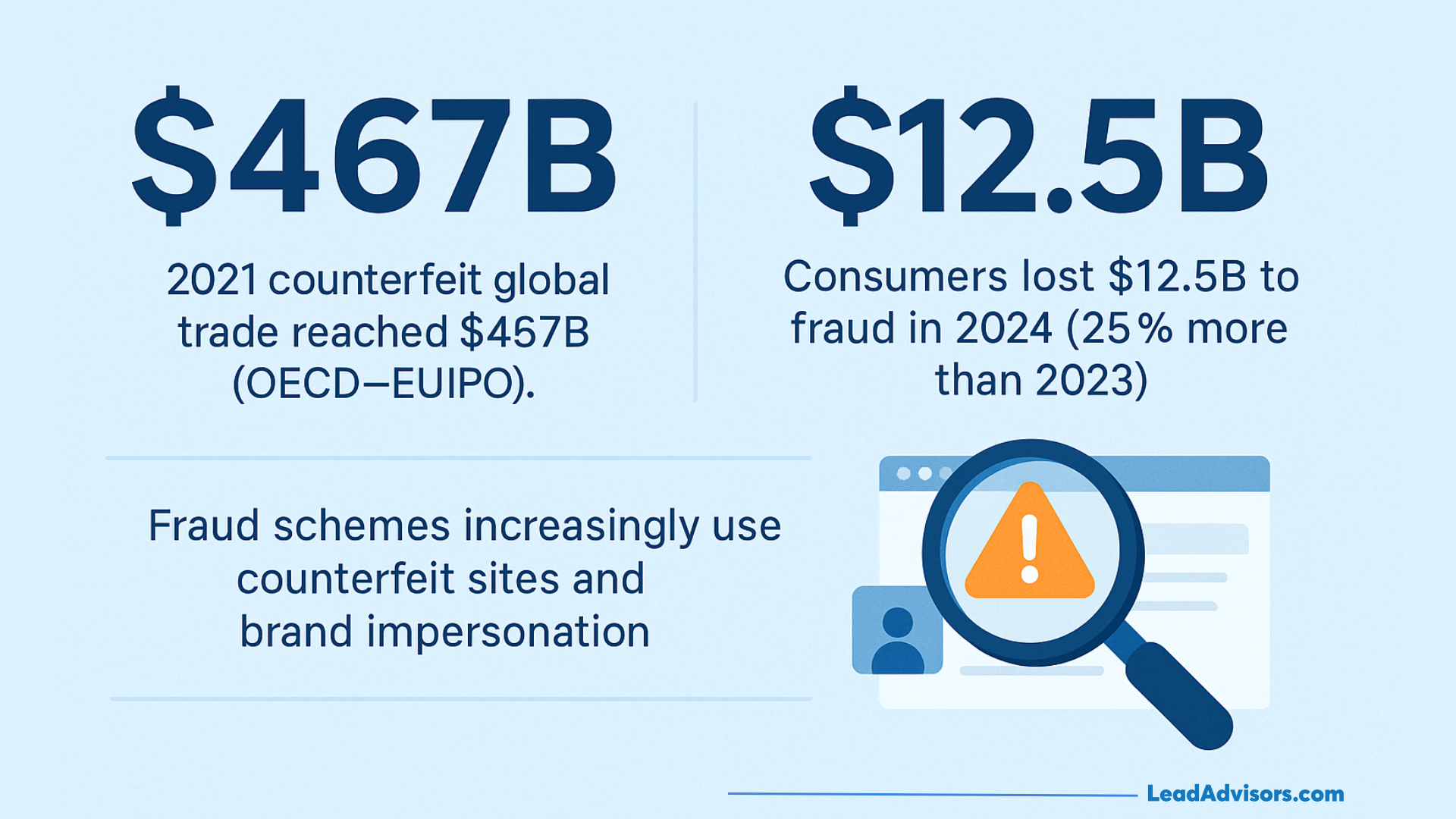
At the same time, the latest information from the U.S. Federal Trade Commission shows that in 2024, consumers lost more than 12.5 billion dollars to fraud, which is 25% more than the year before. Many of these fraudulent schemes involve using popular brands, creating counterfeit websites, and impersonating social media accounts.
This manual strictly adheres to the framework to elucidate the concept of brand safeguarding, the dynamics of digital brand abuse, and effective brand protection strategies that enable intelligent companies to protect their revenue, reputation, and customers.

What Is Brand Protection?
Brand protection is basically a company’s net to catch, stop, and deal with the unfair use of the brand, both in the physical and online worlds. It is the armor that the brand, its intellectual property, and customers can rely on to protect against counterfeit goods, fraudulent domains, and fake account attacks.
Modern definition (across legal, cybersecurity, and anti-counterfeiting domains)
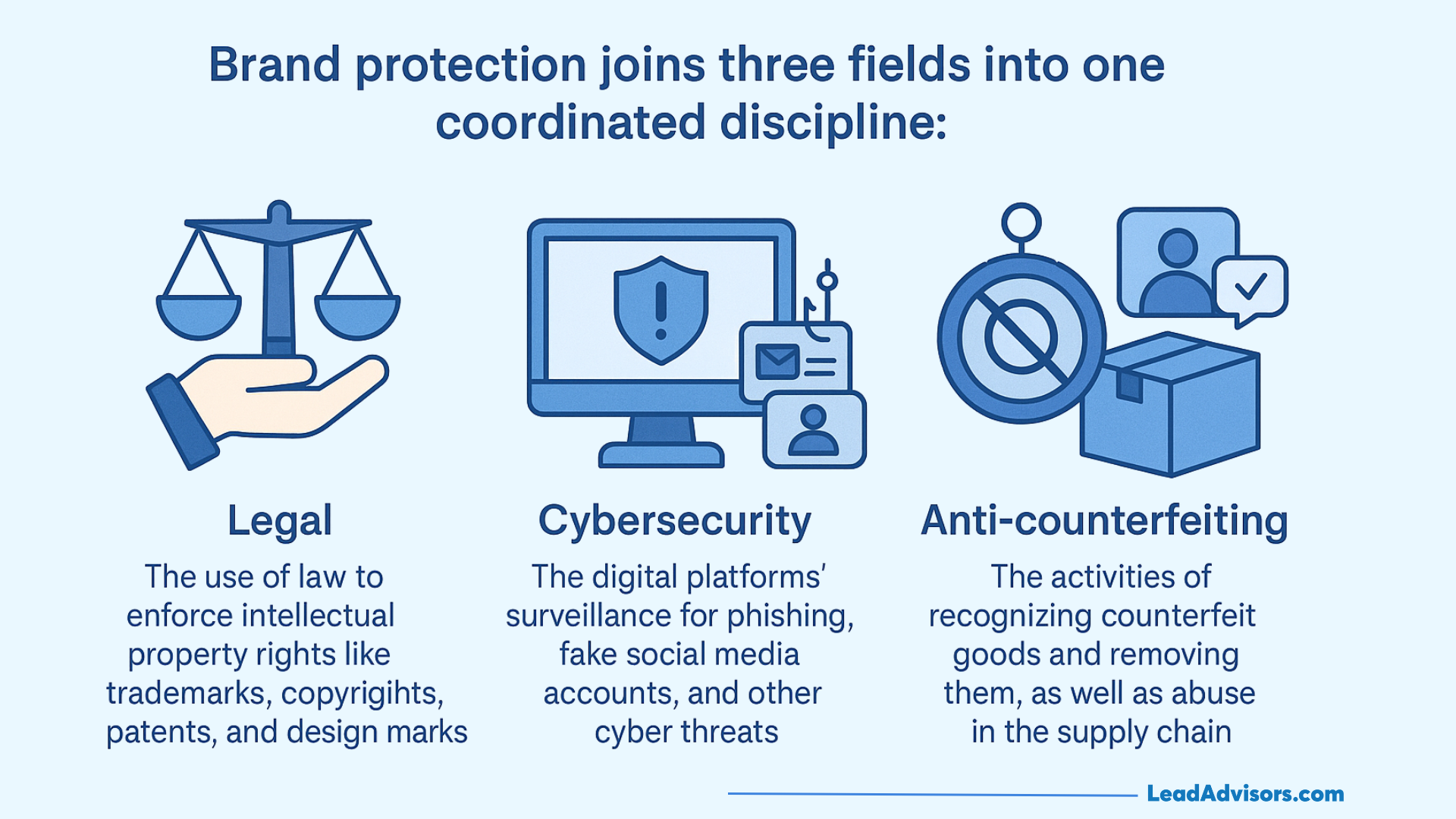
Brand protection joins three fields into one coordinated discipline:
- Legal – The use of law to enforce intellectual property rights like trademarks, copyrights, patents, and design marks.
- Cybersecurity – The digital platforms’ surveillance for phishing, fake social media accounts, and other cyber threats.
- Anti-counterfeiting – The activities of recognizing counterfeit goods and removing them, as well as abuse in the supply chain.
When combined, these tasks are a safeguard for your brand’s identity, revenue, and customer trust.
Protecting intellectual property (trademarks, design marks, copyright, patents)
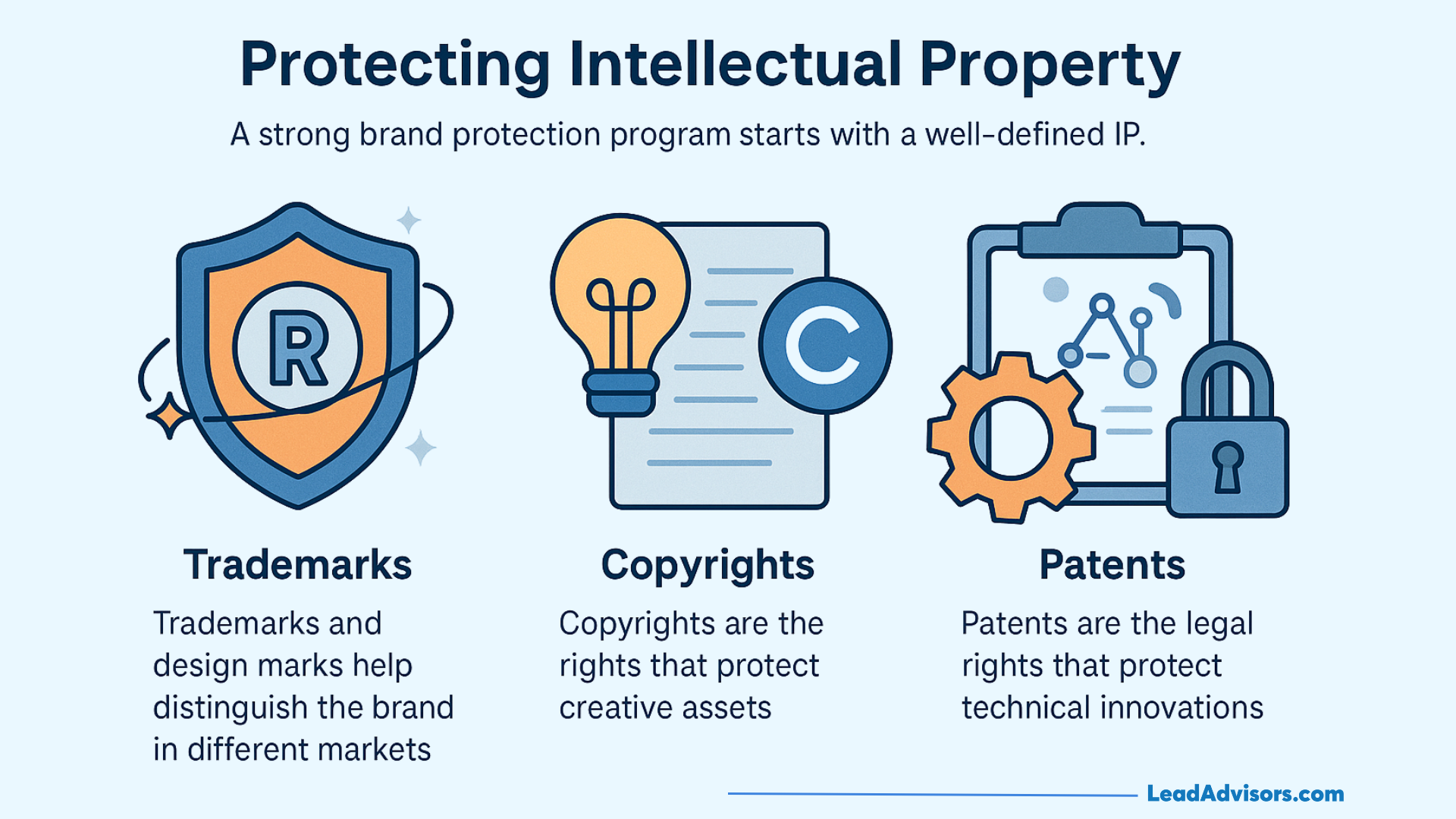
A strong brand protection program starts with a well-defined IP:
- Trademarks and design marks help to distinguish the brand in different markets.
- Copyrights are the rights that protect creative assets.
- Patents are the legal rights that protect technical innovations.
Having clear ownership and trademark registration not only speeds up the exercise of those rights but also makes it more efficient across online marketplaces and regions worldwide.
The evolution from traditional enforcement → to AI-powered, digital-first protection
Conventional brand safeguarding relied on manual searches and letters to the legal department. Now, the misuse of the brand is expanding across various online channels, necessitating tools that incorporate automation, image recognition, and AI-powered threat detection to quickly identify abuse and scale the probe.
Difference between brand protection, online brand protection, and digital risk protection (DRP)
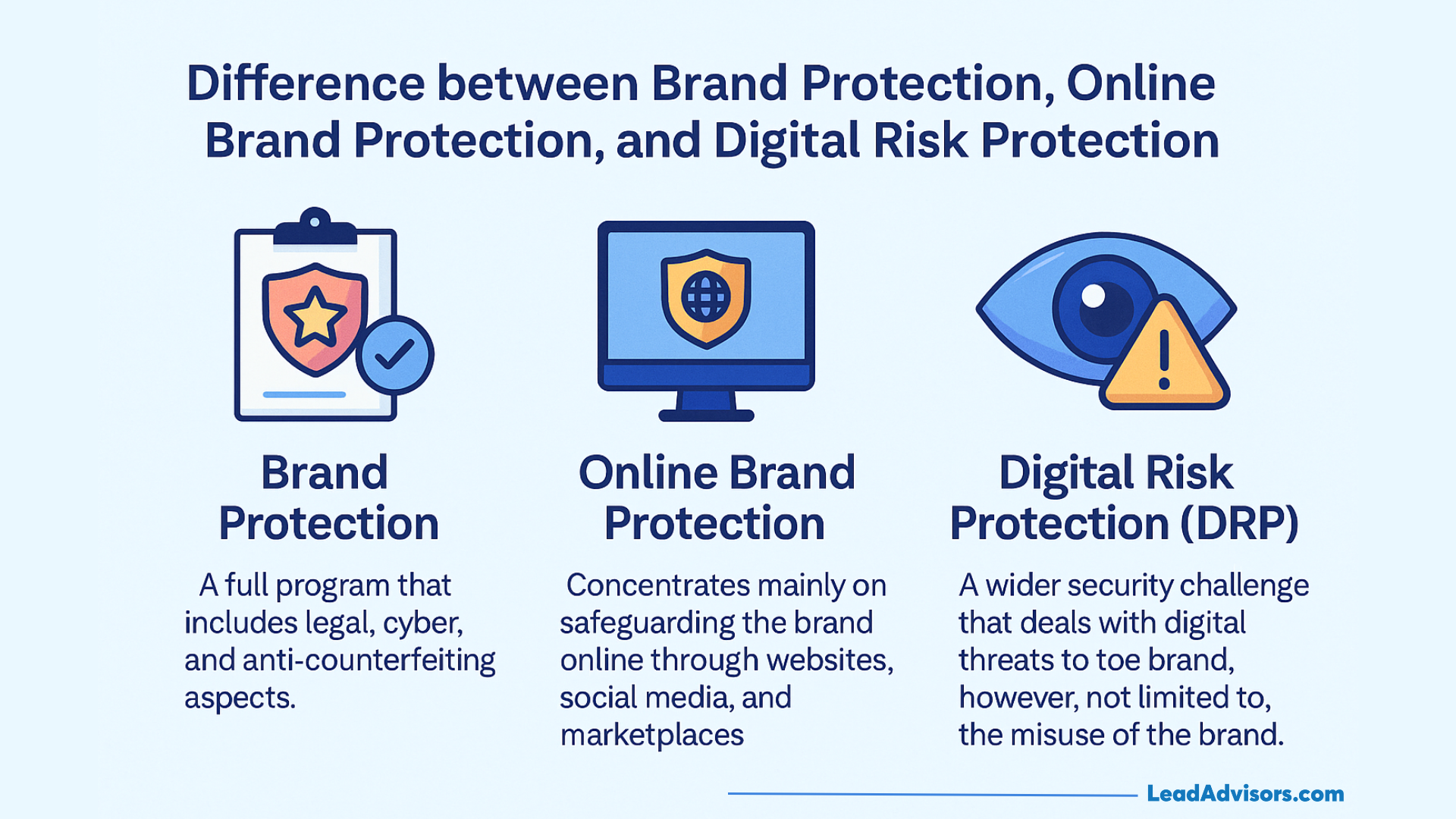
- Brand protection – A full program that includes legal, cyber, and anti-counterfeiting aspects.
- Online brand protection – Concentrates mainly on safeguarding the brand online through websites, social media, and marketplaces.
- Digital risk protection (DRP) – A wider security challenge that deals with digital threats to the brand, however, not limited to, the misuse of the brand.
The majority of companies have now combined these three elements into a comprehensive brand security strategy that enables consistent coordination of actions across teams.
Why is Brand Protection Important
A. Protecting Brand Reputation
A single fake product, fraudulent page, or “support” chatbot can actually reverse the brand building that took you years. The OECD and EUIPO warn that counterfeit and pirated goods “endanger consumer safety and violate intellectual property,” leading to decreased consumer trust in brands.
When customers are disappointed, they usually don’t distinguish the bad guys from the brand they see on the label. They put the blame on the company. The effect is:
- Harsh online reviews and social media storms.
- Critical coverage from journalists and NGOs.
- Reputational damage is occurring slowly, which makes each new release more difficult.
Powerful brand identity protection tactics safeguard your brand’s reputation before it is put to the test in the worst manner.
B. Safeguarding Revenue & Market Share
Brand abuse damages the bottom line not only financially but also in a few other ways:
Direct financial impact
- Lost sales due to counterfeit products that consumers consider to be “close enough”.
- Price erosion caused by gray-market sellers who undercut official pricing without authorization.
- Refunds and additional support work resulting from customer complaints about counterfeit products.
By the same token, the OECD estimates that the share of counterfeit and pirated products in global trade is about 2.5% of the total, corresponding to approximately 464 billion USD annually, based on customs seizure data.
A small portion of the counterfeit trade, for instance, can inflict a considerable amount of damage to a single brand’s revenue and reduce its share of the market in the most important regions.
C. Ensuring Customer Safety
The safety aspect is much more drastic.
OECD-EUIPO studies reveal the presence of counterfeit products posing risks across categories such as medicines, automotive parts, toys, and electronics. Such products lack proper testing and inspection and thus can cause fires, injuries, or improper treatment of a disease.
If people are harmed because of a product with your brand on it, they hardly ever forgive or forget. Your brand security is not only about money; it is about the safety of real people.
D. Preserving Intellectual Property Value
Patents, copyrights, and trademarks are basically capital assets. They are instrumental in licensing, product extensions, and overall deal value when investors or buyers are evaluating a business.
A-CAPP’s publication program is mainly about “evidence-based lessons for preventing and responding to product counterfeiting and brand safeguarding issues.” It emphasizes that one of the main consequences of an unregulated infringement is the discouragement of innovation and the decrease of the company’s value in the long run.
Effective brand protection means that intellectual property (IP) is no longer just a theoretical concept, but a living system that supports real commercial decisions.
E. Meeting Investor & Partner Expectations
Investors, lenders, and industry partners need confirmation that the brand they support is safe:
- Due diligence questions have evolved to include the intellectual property status, brand identity protection services employed, and significant risks.
- Big retailers and platforms might require evidence of IP ownership and experience with takedowns.
The external communication of A-CAPP reveals resources that promote proactive, comprehensive anti-counterfeiting tactics alongside other business functions.
F. Regulatory and Compliance Considerations
Authorities are concerned since the illicit trade of fake goods and fraud has a negative impact on the government’s income through taxes, the health of the public, and the general safety.
According to the OECD–EUIPO report, counterfeit goods have penetrated “almost every facet of daily life” and are, in most cases, linked to the activities of criminal organizations.”
The involvement of your products in investigations might lead to you having to endure:
- Confiscation and holdups at frontiers.
- Additional paperwork and inspections.
- A push to improve your own security measures.
G. Long-term brand equity and competitive advantage
As customers’ perception of the brand worsens due to weak brand protection, these negative experiences become associated with your brand name. When brand security is effective, positive experiences get attached to your brand name:
- Consumers figure out which routes are secure.
- Associates trust you to take care of their customers as well.
- The brand is able to maintain its position as one of the dependable and high-quality ones.
That very brand equity is the main reason a company can charge a reasonable price, expand its operations worldwide, and add new services without having to start from scratch.
Key Components of Brand Protection
A. Intellectual Property Protection (Legal Foundations)
Trademarks: types, distinctiveness, and use
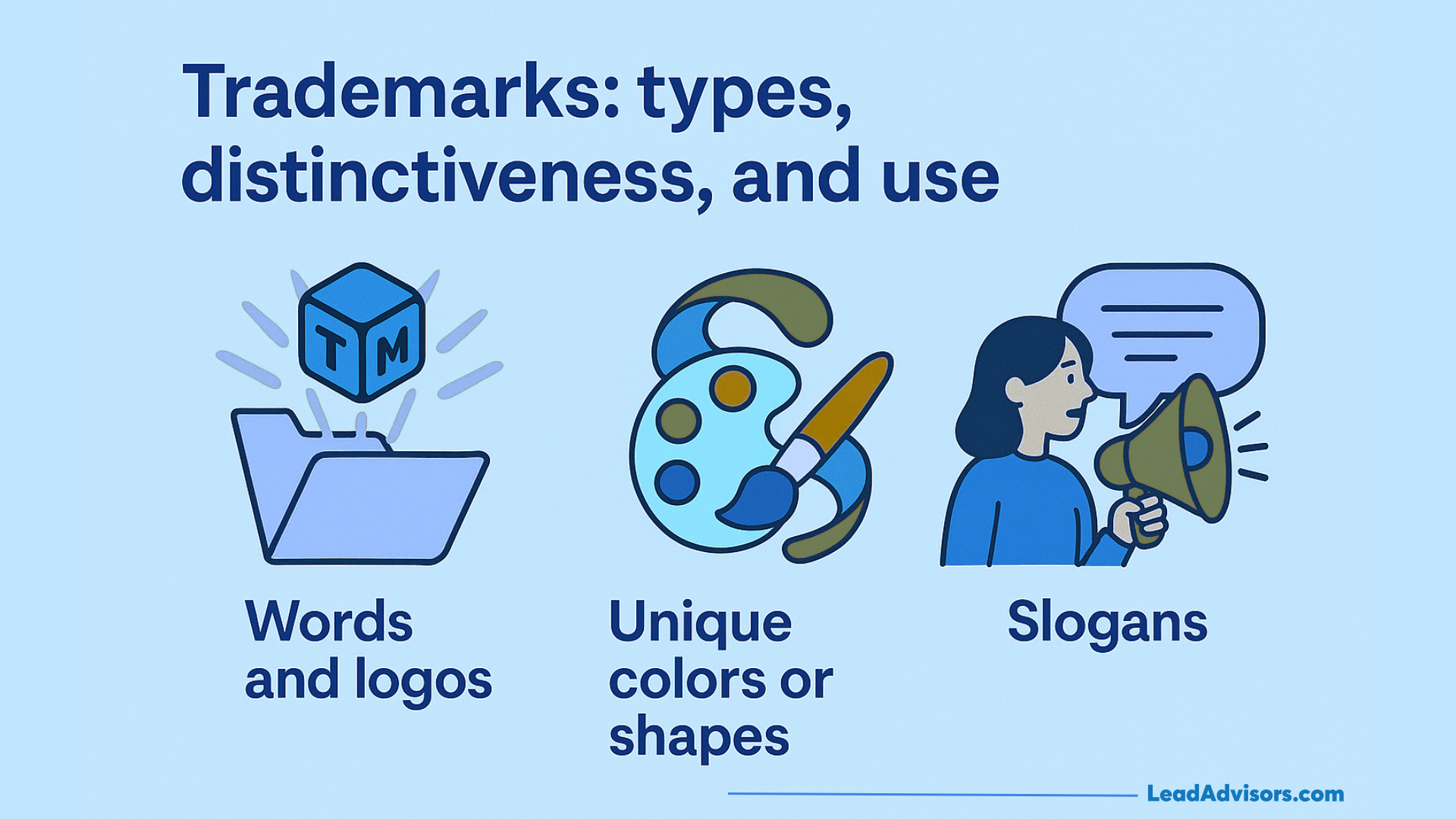
Before you can protect your brand, you have to be clear about what it is that you own:
- Words and logos used on packaging and websites.
- Unique colors or shapes that function as your design marks.
- Slogans that have been employed in campaigns.
Knowing this portfolio thoroughly gives the different departments the chance to identify the places where violations of their intellectual property rights are most likely to occur, as well as the places where the registration of their trademarks is still lacking.
Copyrights, patents, and trade dress
- Copyright is the legal form that protects the creative “surface” of a brand, which may include words, pictures, a video, or even source code.
- Patents are rights that protect the technical features hidden within products or services.
- Trade dress is a legal term referring to the key elements that define the appearance and atmosphere of your products or shops.
These three, along with other intellectual property rights, make up the legal shield that is at the core of your brand protection strategy.
IP as a strategic asset
Rather than dealing with IP as a mere collection of documents, top companies:
- Connect each right to a product, revenue source, or risk.
- Align IP objectives with broader brand-safeguarding measures, such as tracking and removal.
Adopting this way of thinking facilitates securing funds for equipment, staff, and external support.
B. Brand Monitoring
Brand monitoring is very instrumental in brand safeguarding.
- Websites and fake domains that mimic official pages.
- Social media accounts that impersonate the brand or its staff.
- Online marketplaces and resale platforms.
- App stores, forums, and niche digital channels.
The aim is to identify suspicious activity early, like:
- Sudden spikes in low-priced listings in a certain country.
- New accounts using your logo with no clear link to your business.
- Websites are collecting payment data behind a copied checkout design.
C. Enforcement & Remediation
Once a case is verified, the next step is to act.
Common enforcement tools
- Platform abuse reports and DMCA notices.
- Cease-and-desist letters for clear IP infringement.
- Escalation to law enforcement agencies for serious counterfeit and fraud networks.
Automated vs. manual enforcement
- Automated workflows can deal with repeat situations: repeated scam domains, cloned product pages, and patterns that you have seen previously.
- Manual review is absolutely necessary for edge cases, high-value disputes, and situations that may lead to legal actions.
Proper brand protection tools keep evidence and templates so teams can respond quickly and consistently.
D. Global Investigations
If abuse had been just one bad listing, there wouldn’t be any investigations. However, when it is a structured network, investigations are triggered. As a consequence, these might encompass:
- Secret buys and lab tests for fake products.
- Inspection of shipping data and money trails.
- Working with customs, police, and industry partners.
According to the OECD and EUIPO, counterfeit trade often passes through “transit economies” where monitoring is less stringent, making cross-border investigations indispensable.
E. Cross-functional collaboration
Brand protection work has different layers in an organization:
- Legal teams bring in IP and contracts.
- Cybersecurity and DRP teams handle digital risk protection and cyber threats.
- Marketing and communications handle public updates.
- Operations and supply chain teams monitor physical goods.
A-CAPP resources emphasize that well-developed programs bring together research, education, and outreach to facilitate the exchange of lessons between these groups.
Types of Brand Abuse & Common Threats
1. Counterfeiting
Counterfeits are unauthorized reproductions of products bearing your trademarks that are usually of inferior quality or even dangerous. These fakes can be found both in street markets and on online platforms, leading to customer confusion and direct loss of sales.
2. Gray Market / Parallel Imports
Gray market goods are authentic products sold from unapproved sources. This can confuse warranty rules and pricing, which is a subtle but serious form of brand abuse.
3. Cybersquatting & Domain Abuse
The use of domains that resemble or reconstruct the brand name to confuse users or take advantage of their trust is called cybersquatting. These sites may redirect to competitors, have malware that can harm your device, or be fake checkout pages.
4. Social Media Impersonation
Attackers create fake social media accounts using brand logos and names:
- Fake giveaways and promotions.
- False customer support lines.
- Direct messages pushing phishing links.
5. Phishing & Fraud
These are email, SMS, or voice scams that depict the brand to gain the victim’s trust. According to the FTC, data on fraud losses totaling 12.5 billion USD show how common this is, with investment and impostor scams among the most harmful.
6. Rogue Mobile Apps
Apps that appear official but steal user credentials, show malicious ads, or mislead customers are called rogue mobile apps.
7. Spoofed Websites / Fraudulent Online Stores
Sites that mimic the brand’s appearance and either sell counterfeit products or just steal payment information. These sites usually rank in search results for discount-related keywords or appear in paid ads.
8. Digital Piracy (content theft, software piracy)
The unauthorized duplication and distribution of software, templates, reports, or media content made by the brand.
9. Fake Reviews & Negative SEO
Manipulated ratings and spam content that mislead customers or push real pages down in search engines.
10. Malicious Advertising (malvertising)
Ad campaigns that misuse the brand name to attract clicks, then redirect to malware or scams.
11. Stakeholder Impersonation
Criminals pretending to be suppliers, banks, or regulators in order to change payment details, intercept goods, or gain access to internal systems.
12. Supply Chain & Distributor Abuse
The act of mixing counterfeit goods with genuine ones, or selling beyond the agreed territories and channels.
13. Insider-enabled or accidental IP leakage
Staff or partners who inadvertently disclose confidential designs, formulas, or code, or those who intentionally sell them to competitors or criminals.
In all these cases, perpetrators use the brand’s existing reputation to convince victims that their scams are safe.
How Digital Brand Abuse Occurs
A. Across the Customer Journey
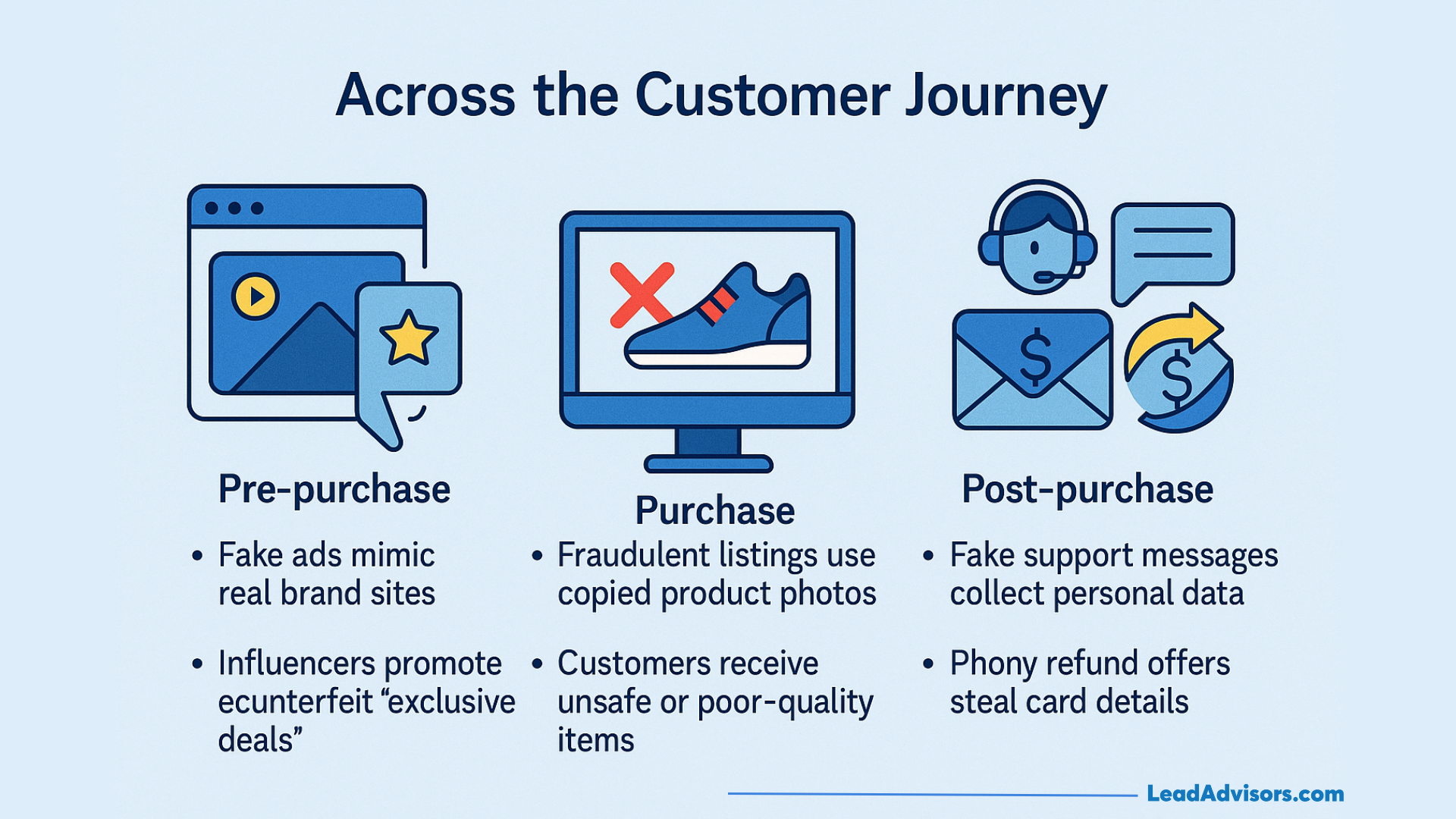
One of the most common ways to detect brand abuse is by analyzing the customer journey, which can reveal it across the pre-purchase, purchase, and post-purchase stages.
Pre-purchase
- Fake ads on social media and search lure potential customers to sites that appear real but are not.
- Influencer posts spread the word about “exclusive deals” that are, in reality, just a trick to get you to buy counterfeit products. Here’s a guide about influencer marketing that you may read.
Purchase
- Fraudulent marketplace listings use copied product photos to make consumers believe that the product is original.
- Customers pay the regular price for the products; however, they receive unsafe or low-quality ones.
Post-purchase
- Fake support emails and chats impersonate the brand and collect more personal data under the guise of assistance. Here’s a guide on how to master email marketing.
- Phony refund offers tempt customers into revealing their card details by posing as legitimate.
The Federal Trade Commission (FTC) data on increasing fraud losses indicate that more people are losing money, while the number of cases remains stable. This, in turn, suggests that scams are becoming more sophisticated.
B. Across Platforms
Digital brand abuse is a chain reaction most of the time and never a one-time event:
- By a fake account on one platform, a scam website is promoted.
- That site collects emails and phone numbers.
- Once they have these details, the attackers send the messages via SMS, messaging apps, or new social media platforms.
Hence, brand protection solutions should be multi-channel to effectively counter digital brand abuse, which spreads across various channels.
C. The rise of scalable, automated cybercrime
Attackers employ kits and automation to duplicate fraudulent activities at a rapid pace:
- Pre-built phishing kits that “re-skin” for various brands.
- Tools that create accounts and posts in bulk.
- AI-driven scripts that change content to go around simple filters.
Such a scale is one reason brand protection is crucial at the top management level of the company. Without automation and data, teams are not able to keep up.
Stages of Counterfeiting Impact (A-CAPP Model)
Michigan State University’s A-CAPP Center most often describes the stages of counterfeit risk for smaller firms.
1. Pre-entry
There are no counterfeit products visible; however, the risk of counterfeit products remains.
Typical signs
- The IP portfolio is incomplete.
- There is little or no digital monitoring.
- Staff do not know how to report suspicious activity.
2. Entry
The very first cases are found: a few fake listings, a few customer complaints, and maybe one unauthorized reseller.
3. Serious
Counterfeit trade has become the most common way of doing business. Customers are starting to ask themselves whether they are buying official products. Distributors become worried and raise their concerns. At this stage, brand protection work requires a budget and a leader to guide the way.
4. Critical
Counterfeit products are infiltrating the core product lines and key regions. Internal teams are spending more time reacting to situations than planning. Business decisions are being made as a result of the crisis, not strategies.
5. Fatal
If the abuse is left without any intervention, it can make a product line or even a whole brand become unviable in some markets. Other competitors will come and fill the trust gap.
Brand owners ought to honestly assess each product or region on this scale and devise their brand protection plans accordingly.
How Brand Protection Works (Step-by-Step)
1. Detection
Detection is the stage where technology is used extensively:
Common detection methods
- Keyword and logo monitoring across the open web. Read our blog about the types of logos to know more.
- Marketplace scans for price outliers and suspicious sellers.
- Social listening for unusual spikes in complaints or scam reports.
Systems aimed at digital brand abuse are usually compatible with the already installed security tools to exchange signals about new domains and fraudulent activity.
2. Validation / Verification
Not all hits correspond to threats. Humans:
- They also confirm if a listing or site is really violating the rules.
- Check resellers to see if they are doing the right business and are not part of the gray market.
- Categorize occurrences by kind and degree.
In this way, time is not wasted on false positives, and the relationships with honest partners remain healthy.
3. Prioritization
Next, teams decide what to work on first according to the risk, for example:
- Possible harm to customers and consumer confidence.
- The risk of loss of revenue and maybe long-term reputation is considered.
- Are there any connections to known high-risk areas or networks?
High-risk situations get fast access to enforcement. The lower-risk cases that might be monitored for patterns or addressed through education can be identified.
4. Enforcement / Takedown
Enforcement, as it were, can take several forms, depending on the situation.
- Firstly, it might be quick removals on the platforms and hosting providers that are concerned.
- Secondly, it could be the enforcement of the contract with the partners.
- Thirdly, in the case of the most serious IP infringements, formal legal action may be initiated.
Teams supported with solid documentation and well-defined procedures are able to handle situations in a fast and uniform manner, even when their workload is heavy.
5. Investigation & Evidence Gathering
For repeated or extensive brand abuses, the probe goes deeper:
- Test purchases verify product quality and source.
- Data analysis links together domains, sellers, and payment accounts.
- Discoveries help support the police and the court.
6. Reporting & Intelligence
Lastly, reporting is a tool that helps to understand the business of the brand:
- Visualizations show the trend in incidents by location, product, and channel.
- Key performance indicators include the time to removal, the number of cases, and the effects on lost sales or complaints.
- Periodic reports enable senior executives to visualize the contribution of brand protection activities to achieving business objectives.
Key Features of Effective Brand Protection Technology
Efficient instruments are not substitutes for human beings; they are facilitators. Some of the common functionalities are:
A. AI-Powered Monitoring
With the help of AI and pattern recognition, the machines can:
- Locate instances of an image or a brand in a large volume of data.
- Detect changes in spelling or design.
- Identify the connection between different cases to point out the location of the bad actors.
B. Global Smart Crawling & Attack Surface Discovery
Systems crawl domains, marketplaces, and forums to find:
- New mentions of the brand in risky contexts.
- Previously unknown sites selling relevant products.
The OECD’s global research has revealed that counterfeit products can travel across several countries and platforms before reaching end users; thus, this broad view is indispensable.
C. Risk-Based Prioritization Algorithms
Algorithms determine scores for situations based on the following:
- Channel (e.g., payment-enabled vs. simple mentions).
- Product type and safety risk.
- Past links to known problem sellers or regions.
D. Automated Alerts
By using pre-built platform integrations, the removal of counterfeit goods, fake domains, and malicious ads can be done quickly, thereby minimizing the time window during which customers are exposed.
E. Fast Takedowns
Since perpetrators are in different time zones, there is a need for continuous coverage. Automated monitoring is always on, even when local teams are taking a break.
F. 24/7 Continuous Monitoring
Case systems keep records of evidence, monitor actions, and indicate results. In the long run, they help to understand which brand image protection strategies and solutions work best.
G. Case Management Systems
Case systems store evidence, track actions, and show outcomes. Over time, they reveal which brand protection solutions and solutions are most effective.
H. Managed Services & Human Expertise
Many organizations pair tools with expert analysts who:
- Understand platform policies and legal requirements.
- Know how to talk with partners and regulators.
- Provide a tailored solution for complex regions and industries.
I. Multichannel Coverage (60+ countries, marketplaces, social, dark web)
Coverage must match where customers (and criminals) are active: marketplaces, social media, app stores, and sometimes dark-web markets.
J. Integration with cybersecurity, SOC, and legal workflows
Integrations allow brand identity protection work to plug into:
- Security operations centers (SOC).
- Legal matter management.
- Customer support systems.
This keeps everyone aligned when serious incidents appear.
Strategies for Building a Strong Brand Protection Program
1. Proactive Monitoring (not reactive)
Don’t wait for customers to report the problem. Enable structured monitoring of the riskiest channels to detect issues early.
2. Secure Trademarks & IP Early
Before major launches, trademarks, designs, and patents should be registered in the key markets. This is a way to keep your options open for the future if you decide to pursue infringement action.
3. Cross-department Alignment
Form a cross-functional team consisting of representatives from legal, security, marketing, and operations departments. Empower them with the responsibility and authority of decision-making regarding brand protection activities.
4. Educate Employees & Partners
Training should:
- Educate employees on brand abuse patterns and help them recognize possible abuse scenarios.
- Inform employees of the correct channels for reporting suspicious listings, emails, or calls.
- Include instructions on both digital and physical security measures.
5. Leverage AI & Automation
Choose a tool with a powerful set of features that allows you to reduce manual monitoring while, at the same time, experts can concentrate on solving complex cases and developing a strategy.
6. Unify Cybersecurity & Brand Protection Functions
Exchange information and work processes so that digital risk protection, cyber defense, and brand safeguarding can draw on the same data source. This is the way that helps to prevent not only scams but also deeper attacks.
7. Involve Your Supply Chain & Distributors
Clearly state requirements in agreements. Verify that partners:
- Follow the instructions on the use of materials and packaging.
- Loyally adhere to the regulated territories.
- Notify the company if you find counterfeit trade.
8. Implement a Global Enforcement Framework
Identify the scripts for low-, medium-, and high-impact cases. This enables teams to respond worldwide in a fair and consistent manner.
9. Monitor Emerging Digital Threat Trends
Be aware of the latest tricks by reading research from the OECD, A-CAPP, and other similar sources. These new tricks can include deepfake videos, new payment methods, or even small platforms.
10. Advocate and participate in industry groups
Being an industry or academic network member provides you with an opportunity to share data, compare solutions, and get insights from those who face similar risks as you do. A-CAPP’s resources and training are good examples of the collective effort in this regard.
Who Needs Brand Protection?
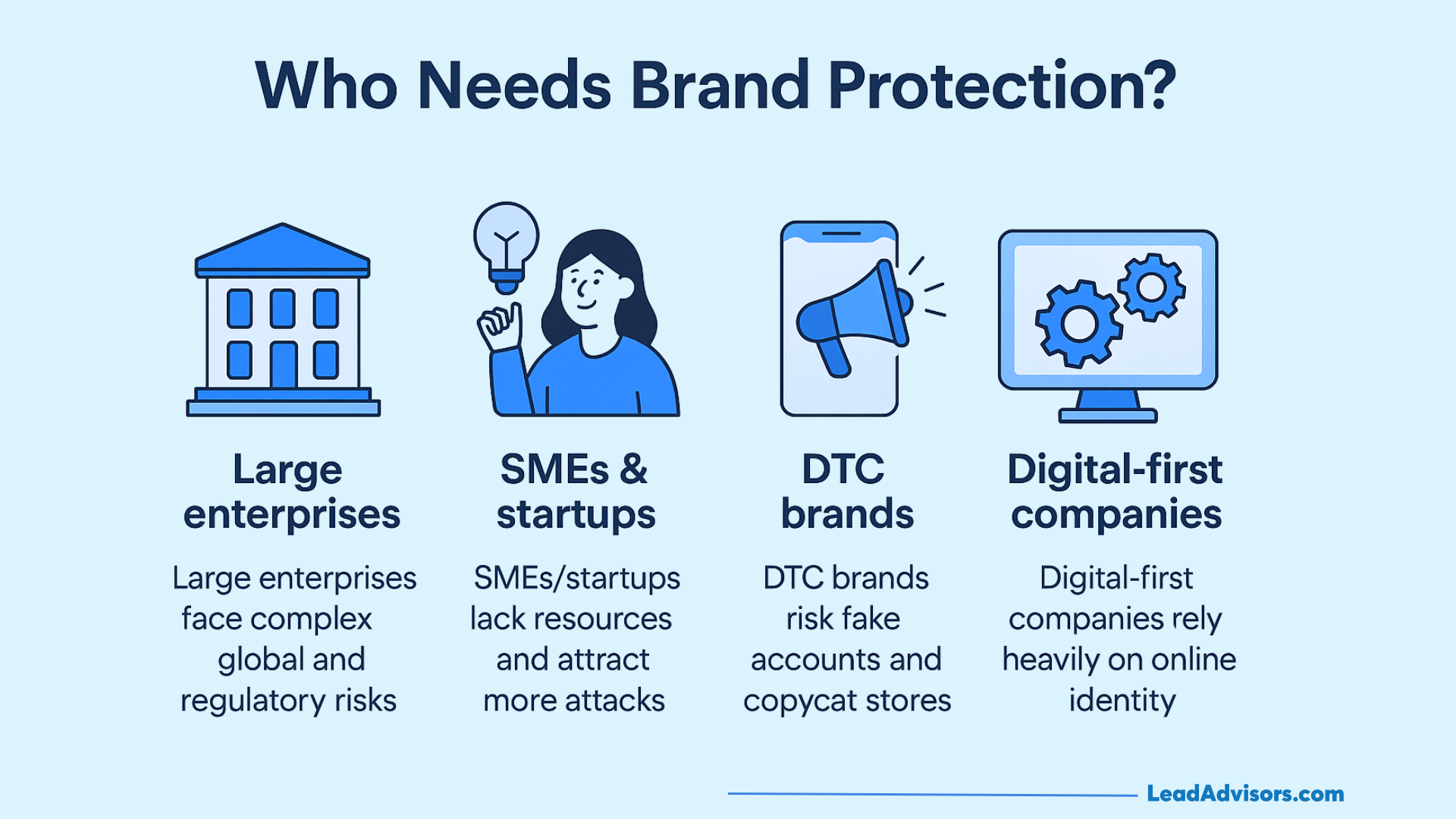
Brand protection is not only for global giants.
- Large enterprises are exposed to complicated worldwide risks, multiple digital channels, and intense regulatory pressure.
- SMEs and startups usually have innovative products but limited internal resources; thus, they become the most attractive targets.
- Direct-to-consumer brands use social media and online marketplaces, where fake social media accounts and copycat stores may appear at any time.
- Digital-first businesses in software, fintech, or gaming are extremely dependent on their digital brand and services.
According to A-CAPP, education and basic planning can do a lot for smaller companies that want to strengthen their defenses but do not have large budgets.
Measuring the ROI of Brand Protection
To maintain backing from the management team, the brand identity protection activities should deliver tangible outcomes.
Revenue and cost metrics
- Revenue impact – quantify the sales that are regained through the removal of counterfeit products or highly risky listings.
- Cost avoidance – keep a record of the prevented legal expenses, crisis works, and refunds.
Risk and trust metrics
- Reduction in fraud reports or scam complaints attributable to the brand.
- Changes in loyalty and satisfaction in the regions where the enforcement has been strengthened.
Operational metrics
- Detection time and removal time by location or method.
- Number of cases handled in each quarter.
- The percentage of incidents uncovered through monitoring versus those reported by outside sources.
These indicators gradually help you adjust brand image protection plans and make more informed decisions about selecting tools and services.
Case Studies
A. Coinbase (Doppel example)
Cryptocurrency exchanges like Binance are employing digital surveillance, as per the reports of brand security companies like BrandBastion and BrandShield. They use this monitoring to identify and remove a large number of fake social media accounts, scam comments, and phishing domains targeting their brand.
The case study illustrates the exchange’s actions in removing hundreds of fraudulent domains and moderating multilingual threats in real time, which led to a 104% increase in the conversion rate and more than a 3,700% increase in the number of scam comments removed. These measures, taken as a result of proactive enforcement, drove away phishers and were instrumental in retaining user trust in a risky crypto environment.
B. Other anonymized examples
A-CAPP publications reveal the stories of companies in consumer goods and electronics that:
- Detailed the geographic location of their IP and primary markets.
- Initiated monitoring on the most important platforms.
- Engaged with customs and local law enforcement in high-risk regions.
Counterfeiting was visibly reduced, and the decrease in customer complaints across the most important channels was the result.
C. Lessons learned
Consistent with the theories of different fields, the leading cases have formed the following successful programs:
- They launch their programs early, even when budgets are limited.
- They integrate technology with local knowledge.
- They regard brand image protection as a continuous process, not a single event.
Choosing a Brand Protection Provider
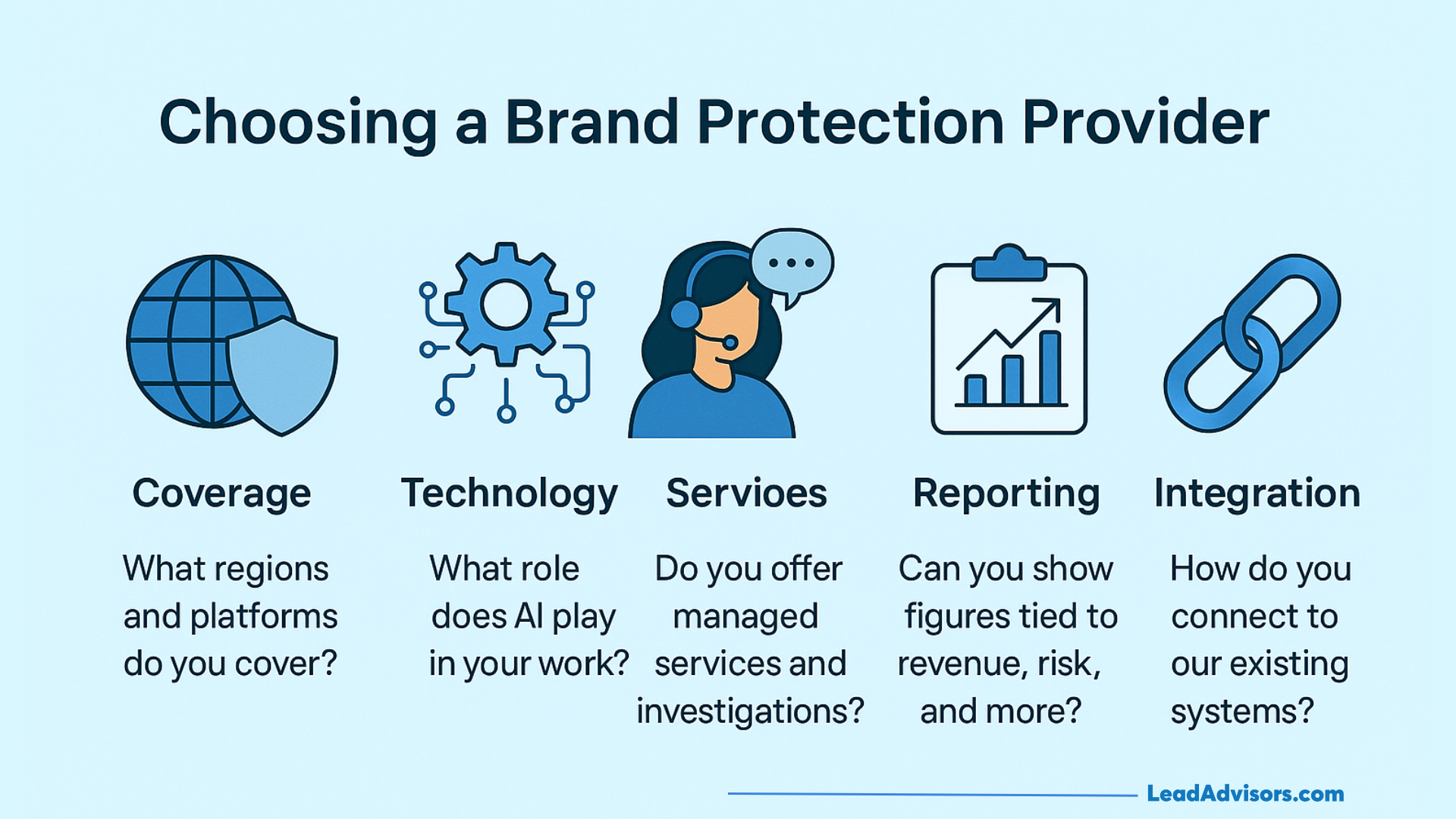
Good questions to ask a company when choosing a brand safeguarding provider include:
- Coverage – What regions, online marketplaces, and social media platforms are included?
- Technology – What role does artificial intelligence play in their work? How do they manage to keep false positives at a minimum?
- Services – Are they providing managed brand protection services and investigations along with software, or only software?
- Reporting – Are they able to demonstrate clear figures linked to revenue, risk, and reputation?
- Integration – What is the connection between your cyber, legal, and customer support systems and their work?
The right partner should work like part of your team internally, not just another vendor externally.