SaaS sales is how you win, grow, and keep customers for cloud software. The rules have shifted since 2022. Buyers now shortlist vendors before sellers know the deal exists. The old math no longer works.
Forrester’s Global Tech Market Forecast, 2025 to 2030, projects global tech spend will hit $5.6 trillion in 2026. That is up 7.8% year over year. Gartner’s February 2026 forecast puts business software spend at $1.44 trillion. The category is growing 15.1%. It ranks second-fastest in IT. The SaaS opportunity has never been larger.
The buyer is also harder to reach. A Gartner survey of 646 B2B buyers in March 2026 found 67% want a rep-free buying path. 45% used AI on a recent purchase. The 6sense 2025 B2B Buyer Experience Report drew on thousands of buyer interviews. It found that buyers fully define their needs 83% of the time before they call sales.
This playbook covers four things. The four SaaS sales motions. The 2026 benchmarks that split efficient growth from cash burn. The outbound model that still produces a pipeline. The build-vs-buy call for sales development. It is written for the operator running the team, not the analyst building the deck.


The Four SaaS Sales Motions: Choose the Right One for Your ACV and Market
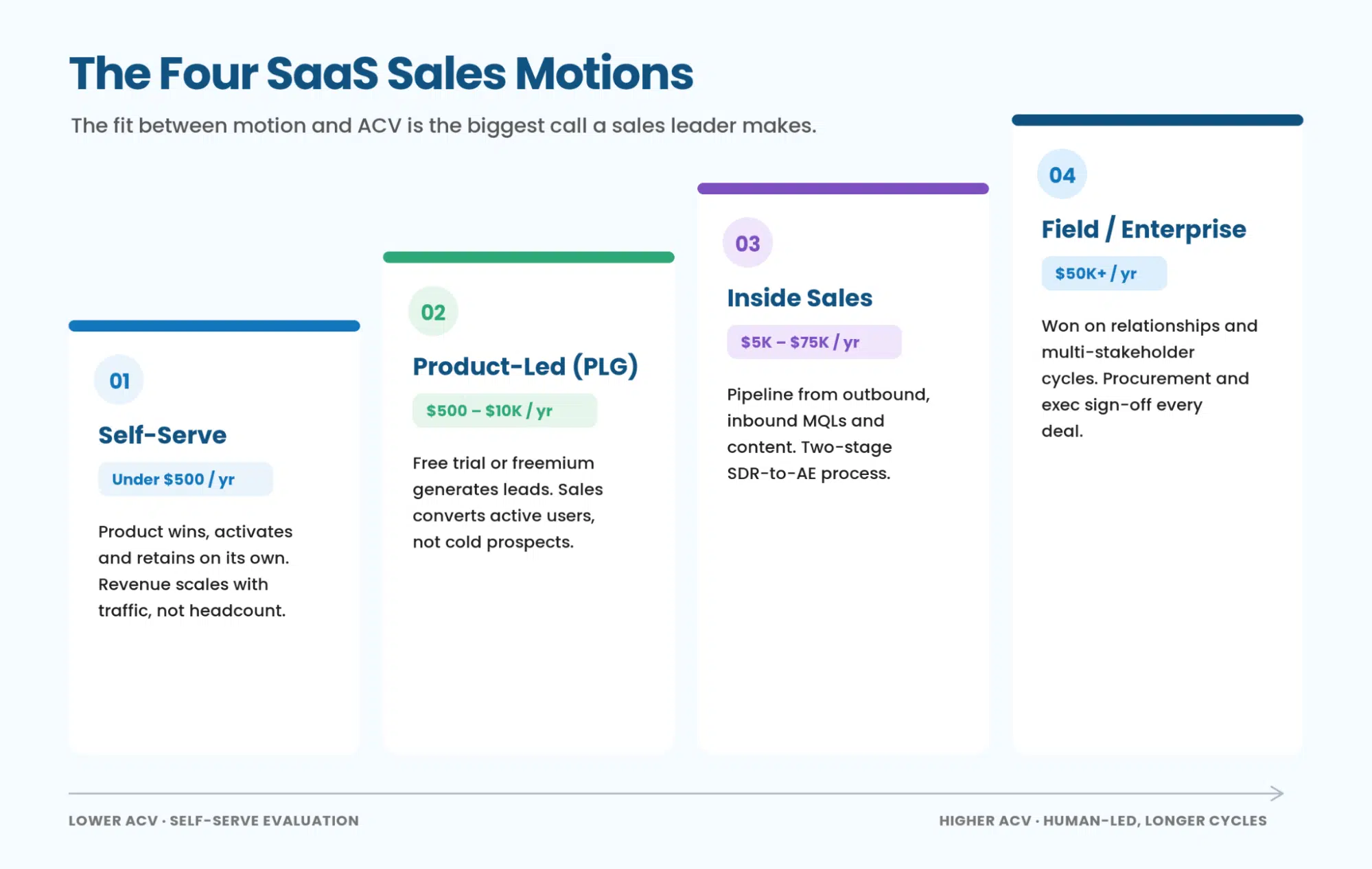
Every B2B SaaS company runs one of four sales motions. Some run two at once. The fit between motion and ACV is the biggest call a sales leader makes. It is also the call most often gotten wrong. The four motions below cover the full ACV range. Self-serve at under $500 sits at one end. Enterprise at $500K+ sits on the other side. Each motion has its own team, tech stack, and CAC ceiling.
Motion 1: Self-Serve
ACV range: under $500 a year. The product wins, activates, and keeps customers on its own. Onboarding is fully automated. Revenue scales with traffic and product conversion rate, not headcount.
This motion works when the product is simple. A buyer can evaluate it during a free trial. No human is needed to explain it. The ACV is also too low to pay for a sales call.
Motion 2: Product-Led Growth (PLG)
ACV range: $500–$10,000 a year. The product generates leads through free trials or freemium use. The sales team then converts active product users, not cold prospects. A 2025 ProductLed study found 58% of B2B SaaS companies now run a PLG motion.
PLG works when three things are true. The product drives organic signups. The free tier gives real value before any sales call. The buyer evaluates through use, not demos.
Motion 3: Inside Sales (SDR-To-Ae)
ACV range: $5,000–$75,000 a year. Pipeline comes from outbound prospecting, inbound MQL routing, and content. This motion fits when the ACV pays for a two-stage sales process. It also fits when the buyer needs a human call before they commit.
Motion 4: Field Sales/Enterprise
ACV range: $50,000+ a year. Deals are won through relationships, multi-stakeholder management, and long evaluation cycles. Procurement is part of every deal. This motion is appropriate when deals require executive sign-off, legal review, and multi-month timelines.
The Motion Selection Mistake Most SAAS Companies Make
Hiring inside sales SDRs for a $3,000 ACV product. The SMB market it serves expects self-serve evaluation.
At $3,000 ACV, the fully loaded CAC ceiling is about $900–$1,200. That ceiling holds a 3x LTV/CAC ratio. A two-SDR team costs $180,000–$220,000 fully loaded. The math rarely closes. The team that misses quota is not underperforming. The motion was wrong for the ACV.
SaaS Sales Methodology: Picking the Framework That Fits the Motion
The motion defines what the team sells. The methodology defines how the team sells. Four frameworks cover most B2B SaaS sales teams in 2026:
- MEDDIC / MEDDPICC: the top framework for enterprise SaaS sales. It forces tight qualification against the economic buyer, decision criteria, paper process, and champion.
- Command of the Message (Force Management): used at $10M–$100M ARR. It ties the sales call to a clear business value framework.
- Challenger Sale: best for complex products. The seller’s job is to reframe the buyer’s view of the problem.
- SPIN Selling: still the core framework for SDR-to-AE motions at SMB and mid-market ACVs.
The best methodology for a team aligns with the ACV, deal complexity, and rep experience. The strongest brand is not always the right one.
SaaS Sales Benchmarks by ARR Stage: What Good Looks Like in 2026
Benchmarks are a reference floor, not a target. The numbers below come from 2025–2026 industry studies. They cover thousands of B2B SaaS companies. They reflect inside sales motions in the SMB-to-mid-market range. The right benchmark for any team depends on ACV, motion, and segment. However, every team should know where its numbers stand relative to the market median before deciding what to fix.
Sales Cycle Length (Optifai 2026, N=939)
- SMB (under $15K ACV): 14–30 days
- Mid-market ($15K–$100K): 30–90 days
- Enterprise ($100K+): 90–180+ days
- Median B2B SaaS cycle: 84 days, up 22% since 2022
The study points to two shifts. Buying committees grew from 5.4 to 6.8 stakeholders. Procurement review also got stricter.
Cycle length is the deal-side benchmark. Pipeline volume per SDR is the team-side benchmark. The gap between the two often explains why pipeline coverage falls short of the target. That can happen even when activity targets are met.
SDR Productivity Benchmarks by Arr Stage
| ARR stage | SDRs typical | SQLs per SDR/month | Pipeline per SDR/month | Qualified meetings/week |
| $0–$1M | 0–1 | 5–10 | $15K–$40K | 3–5 |
| $1M–$5M | 1–3 | 8–15 | $25K–$60K | 4–7 |
| $5M–$15M | 3–8 | 10–20 | $40K–$100K | 5–10 |
| $15M–$50M | 8–20 | 12–25 | $60K–$150K | 6–12 |
SDR output sets the top of the funnel. AE quota and win rate determine what gets through. Model the two ranges together. Take an SDR team producing 200 meetings a month. Feed those into AEs running 15% win rates on $15K ACV. That is a $540K-a-month new ARR engine. The math only holds if the AE quota model can absorb that volume without dropping cycle time.
AE Closing Benchmarks
| ACV range | Win rate on qualified opps | Sales cycle | Quota per AE/year |
| $5K–$15K | 20–30% | 30–60 days | $500K–$900K |
| $15K–$50K | 15–25% | 60–120 days | $800K–$1.5M |
| $50K–$150K | 10–20% | 90–180 days | $1.2M–$2.5M |
| $150K+ | 8–15% | 150–270 days | $2M–$4M+ |
Quota and win rate define the revenue surface. CAC and payback determine whether the revenue covers the cost of producing it. The two metrics that matter most for board reporting in 2026 are below.
CAC and Payback Benchmarks
The Benchmarkit 2025 SaaS Performance Benchmarks Report found the industry-wide median CAC payback has stretched to 18 months. Payback varies sharply by deal size:
- ACV under $5K: median CAC payback 8 months
- ACV $5K–$25K: 12–16 months
- ACV $25K+: 18–24+ months
The Benchmarkit 2026 GTM benchmarks update reported that B2B SaaS CAC has climbed 14%. It now sits at about $2.00 per new ARR dollar. Median growth rates have fallen to 26%. The Bessemer Venture Partners State of AI 2025 report found AI-native SaaS companies run at roughly 25% gross margin. Traditional SaaS sits at 75%+. The gross margin gap is reshaping the LTV side of the ratio for AI-first competitors.
CAC payback measures sales efficiency at the acquisition stage. Net revenue retention measures whether customers remain valuable enough to cover the CAC. In 2026, NRR has become the most-watched durability metric on every SaaS board deck.
Net Revenue Retention: The Durability Signal
The KeyBanc Capital Markets 2026 SaaS Survey reported that top-performing SaaS companies now target an NRR of 110% or higher. The best hit 120%+. Companies in the top NRR quartile grow 2.3x faster than peers stuck at 95–100%. NRR has replaced raw growth rate as the durability metric investors track.
SaaS Sales Team Structure and Roles
The SDR (or BDR) owns pipeline generation. That covers outbound prospecting, inbound MQL qualification, and meeting booking. A 2026 B2B SaaS SDR job description usually includes 80–120 outbound activities per day. The quota is 8–15 qualified meetings per month.
The AE owns the close. That covers discovery, demo, technical validation, proposal, and negotiation. AE quota scales with ACV. It runs from $500K–$900K a year at $5K–$15K ACV. It hits $2M–$4M+ at $150K+ ACV.
The CSM owns the post-sale relationship. That covers onboarding, adoption, renewal, and expansion. The sales-to-customer-success handoff is now a defined operational moment, not a casual one. A documented checklist is standard at any company with $ 5M+ ARR. It covers deal context, configuration, success criteria, executive sponsors, and renewal date.
SaaS Outbound Sales: How to Build the SDR Motion That Actually Works
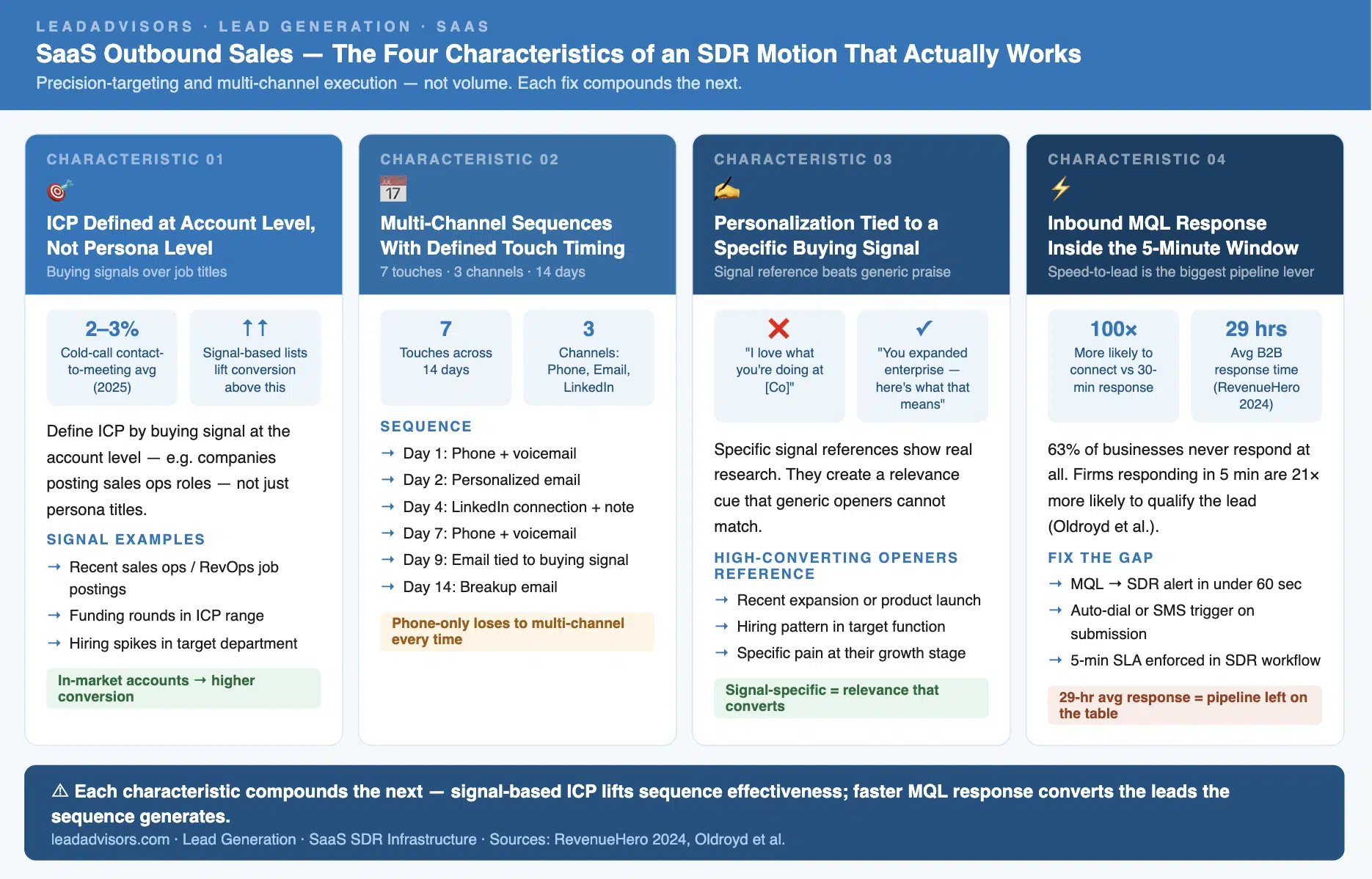
Outbound SaaS sales in 2026 are not a volume game of cold calling. It is a precision-targeting and multi-channel motion. The buyer has already done most of the evaluation before the first sales touch. Four traits separate outbound teams that produce a pipeline from teams that spend the same budget for a fraction of the output. Each fix compounds the next.
Characteristic 1: Icp Is Defined at the Account Level, Not the Persona Level
Most outbound motions define ICP by persona. An example: “VP Sales at a 50–500 employee B2B software company.” High-performing motions define ICP by buying signal at the account level. An example: companies in the ICP range that just posted a sales ops or revenue ops job. Buying signals produce prospect lists with more in-market accounts. That lifts contact-to-meeting conversion well above the 2–3% cold-call industry average reported in 2025 studies.
Characteristic 2: Multi-Channel Sequences With Defined Touch Timing
The pattern proven across 2026 high-performing SMB-to-midmarket SaaS teams:
- Day 1: Phone + voicemail
- Day 2: Personalized email
- Day 4: LinkedIn connection request with note
- Day 7: Phone + voicemail
- Day 9: Follow-up email tied to a specific buying signal
- Day 14: Breakup email
Seven touches across three channels in fourteen days. Phone-only sequences lose to multi-channel sequences in every 2025–2026 outbound benchmark report we reviewed.
Characteristic 3: Personalization Tied to a Specific Buying Signal
“I saw your company recently expanded into the enterprise segment, and we work with several companies at that inflection point who had the same challenge with [specific pain]” converts better than “I love what you are doing at [Company].” Specific signal references show real research. They create a relevance cue that generic praise cannot.
Characteristic 4: Inbound mql Response Inside the 5-Minute Window
The most-cited study in sales response research is The Short Life of Online Sales Leads by Oldroyd, McElheran, and Elkington. It found that firms responding to leads within 5 minutes were 100 times more likely to connect. They were also 21 times more likely to qualify the lead.
The comparison was with firms that waited 30 minutes. A 2024 RevenueHero analysis of 1,000+ companies found that the average B2B response time remains 29 hours. 63% of businesses never respond at all. The biggest pipeline lift available to most SaaS teams is closing the gap between MQL submission and the first sales touch.
SaaS Sales Metrics: The Dashboard Every Sales Leader Needs
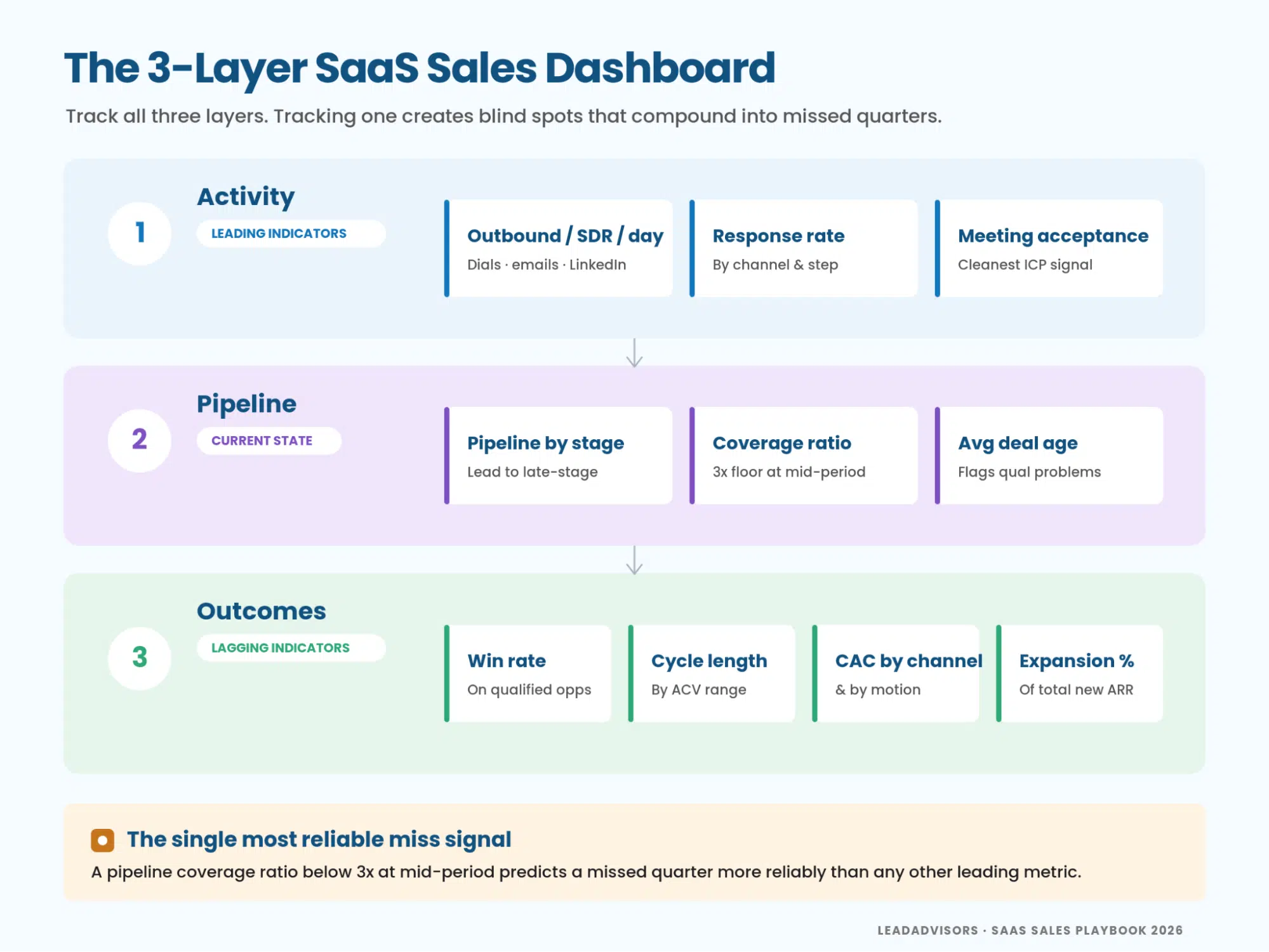
A SaaS sales dashboard tracks three layers. Activity is what the team does. The pipeline is the output of the activity. Outcomes are what the pipeline converts to. Tracking only one layer creates blind spots. Those blind spots compound into missed quarters. The view below shows the structure used by sales teams that forecast within 10% of actual results.
Activity Layer: Leading Indicators
- Outbound activities per SDR per day (dials, emails, LinkedIn touches)
- Response rate by channel and sequence step
- Meeting acceptance rate on first-touch outreach (the cleanest ICP targeting signal)
Pipeline Layer: Current State
- Pipeline by stage: leads, MQLs, SQLs, qualified opportunities, late-stage
- Pipeline coverage ratio (total pipeline ÷ remaining quota). A coverage ratio below 3x at mid-period is the most reliable leading indicator of a missed quarter
- Average deal age by stage (flags qualification problems)
Outcome Layer: Lagging Indicators
- Win rate on qualified opportunities by rep, segment, and lead source.
- Sales cycle length by ACV range
- CAC by channel and by motion
- Expansion revenue as a percentage of total new ARR
The three-layer dashboard above is the baseline. Two additional metrics are the most common blind spots in SaaS sales reporting, and closing those gaps usually produces the biggest near-term lift in forecast accuracy.
The Two Metrics Most SaaS Sales Operations Undertrack
Pipeline-sourced-by-channel. A 2026 Harvard Business Review Analytic Services research report surveyed 522 B2B professionals on GTM execution. The top failure they found was the inability to attribute the pipeline to the source motion. Without channel attribution, budget decisions among outbound, inbound, partner, and product-led channels are made on intuition, not data.
SQL-to-meeting show rate. Meeting acceptance is widely tracked. Meeting show rate is not. A show rate below 65% means qualification standards are too low. Prospects are accepting meetings without real intent. Every no-show is a wasted AE hour. It is also a CAC drag.
PLG vs. Outbound: Running Both Without Cannibalizing Either
Companies with $5M to $20M in ARR often try to run PLG and outbound simultaneously. Product-led acquisition builds a free user base. SDRs go after mid-market and enterprise accounts outbound. The setup works when the two motions own different audiences. It fails when they compete for the same pipeline. The four sub-sections below cover the operating model, the diagnostic, the failure mode, and the expansion play.
The Clean Separation Model
The PLG motion owns self-service signups, free-to-paid conversion in the SMB segment, and product-led expansion in existing accounts. The outbound motion targets mid-market and enterprise accounts that have not started a product trial.
Before designing the split, a sales leader needs to know which motion the company runs today. The signals are visible on the website itself. The check takes under 60 seconds.
How to Tell if a SaaS Company Is Plg or Sales-Led
Three website signals tell you the motion in under a minute. A free trial or freemium signup in the main nav means PLG. A “Request a demo” or “Talk to sales” CTA as the only conversion path indicates a sales-led approach. Open pricing with self-serve checkout confirms PLG. “Contact us for pricing” is confirmed as sales-led. Hybrid companies show both. A free tier sits next to a contact-sales path for the enterprise plan.
Datadog is the textbook hybrid. It is cited across 2026 SaaS industry analyses. The company hit $3.4 billion in revenue in fiscal year 2025. That is up 28% year over year. 603 customers generated $1M+ ARR by Q3 2025 per Datadog’s publicly reported earnings. Developers adopt one monitoring product on a free or low-cost tier. Sales then widens the deal into the full observability platform. The product opens the door. Sales widen it.
The clean split and the diagnostic above are the right setup. The next sub-section is the wrong setup. It is the failure mode that most often breaks the economics.
The Failure Mode
SDRs reaching out to free-trial users via cold outbound sequences. The prospect chose to evaluate without a sales call. The outreach signals the company does not respect that choice. Trial-to-paid rates drop for prospects contacted by an outbound SDR before hitting an activation milestone. They convert at lower rates than prospects who convert solely through the product.
The fix is not to stop outreach to product users. It is to switch motion type once the user hits an activation milestone that signals real intent.
The Expansion Motion
The most efficient sales motion for PLG companies at $5M+ ARR is the expansion motion. Free users who have hit activation milestones with enterprise potential get routed to an inside sales rep. They get an expansion call, not a cold outbound sequence. Expansion calls convert at 30–50%. That is two to three times the rate of outbound new business. The product has already proven value.
When to Outsource SaaS Sales Development: The Build vs. Buy Decision
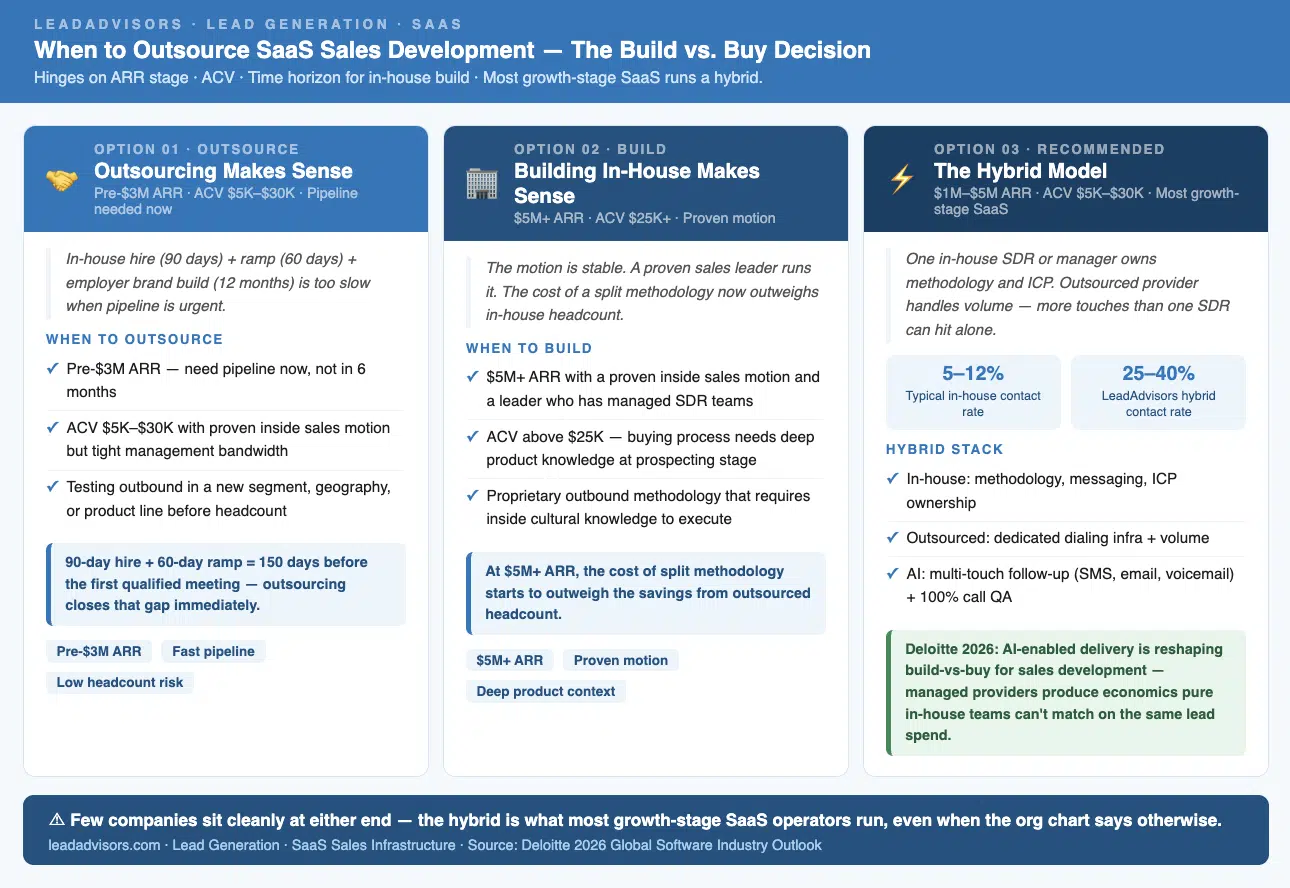
The build-vs-buy call for sales development hinges on three variables. ARR stage. ACV. The time horizon for building in-house. The call is rarely binary in practice. Most growth-stage SaaS companies end up running a hybrid model. The criteria below frame the three options against the company’s current stage.
Outsourcing Makes Sense When:
- The company is pre-$3M ARR and needs a pipeline now. The 90-day hire, 60-day ramp, and 12-month employer brand build are too slow
- The ACV is $5,000–$30,000. The inside sales motion is proven. However, management bandwidth is tight.
- Outbound is being tested in a new segment, geography, or product line before headcount
The criteria flip as the company matures. The motion stabilizes. The cost of the split methodology starts to outweigh the cost of in-house headcount.
Building In-House Makes Sense When:
- The company has an ARR of $5M+. The inside sales motion is proven. A sales leader who has managed SDR teams runs it
- The ACV is above $25,000. The buying process needs deep product knowledge at the prospecting stage
- The sales culture depends on a proprietary outbound methodology. That methodology needs inside knowledge
In practice, few companies sit cleanly at either end of the spectrum. The hybrid model is what most growth-stage SaaS operators run. That holds even when the org chart says “fully in-house” or “fully outsourced”.
The Hybrid Model Most Growth-Stage SAAS Companies Should Run
One in-house SDR or sales development manager owns the methodology, messaging, and ICP. An outsourced managed appointment-setting provider handles outbound volume. They produce more touches than one in-house SDR can hit alone. The in-house resource holds quality and iteration speed. The outsourced capacity supports pipeline volume without growing headcount in step.
LeadAdvisors runs this hybrid model with SaaS clients in the $1M–$5M ARR band and $5,000–$30,000 ACV. Contact rates climb to 5–12%, the range most in-house SaaS SDR teams hit on the same lead set. They reach 25–40%, depending on data quality and segment. The lift comes from dedicated dialing infrastructure, multi-touch AI follow-up (SMS, email, voicemail drop), and AI QA on 100% of calls.
Deloitte’s 2026 Global Software Industry Outlook names AI-enabled delivery as one of five forces reshaping the software industry this year. The same force is reshaping the build-vs-buy call for sales development. Managed providers run AI-augmented dialing and QA layers. They produce pipeline economics that pure in-house SDR teams cannot match on the same lead spend.
SaaS Sales Technology Stack: What Each Stage Requires
The right sales technology stack scales with ARR. Over-investing in tools before the motion is proven creates tool debt. The team gets no performance lift. Under-investing creates manual work. That caps SDR capacity below the pipeline target. The three tiers below match the stack to the stage. The final sub-section covers the one tooling call that beats any single product choice in the stack.
Pre-$1M Arr: Minimum Viable Stack
- CRM: HubSpot free tier or Pipedrive Essentials
- Email sequencing: Apollo, Instantly, or HubSpot Sequences
- LinkedIn: Sales Navigator
- Monthly tool cost: $100–$300
The pre-$1M stack is built for capacity below 200 outbound touches a day. Once the team needs more, the stack tier shifts.
$1M–$5M Arr: Growth Stack
- CRM: HubSpot Professional or Salesforce Essentials
- Sales engagement: Apollo, Outreach, or Salesloft
- Dialer: Aircall, JustCall, or Kixie (or integrated within Apollo)
- Intent data: Bombora or G2 Buyer Intent
- Monthly tool cost: $1,500–$4,000
The growth stack supports a 3–8 SDR team and an AE bench. Full-cycle sequencing and dialing automation do the work. The scale tier adds the layers that become required once forecasting and rep coaching are the constraints on growth.
$5M–$20M Arr: Scale Stack
- CRM: Salesforce Sales Cloud
- Sales engagement: Outreach or Salesloft with full sequence automation
- Dialer: Dedicated parallel dialer (Orum, Nooks, Salesfinity) for SDR teams
- Intent data: Bombora or 6sense account-level intent
- Conversation intelligence: Gong or Chorus
- Revenue operations: Clari or Boostup for pipeline forecasting
- Monthly tool cost: $8,000–$20,000
Tool choice at each tier is the visible call. The invisible call, and the higher-impact one, sits under the whole stack.
The Stack Decision That Matters Most
CRM configuration drives reporting quality. A poorly set up CRM produces pipeline data the team cannot trust. The forecasts are wrong. The setup investment matters more than the choice between Salesforce and HubSpot. A well-set-up HubSpot beats a poorly set-up Salesforce.