
Picture three SEO proposals on your desk. The first agency wants $1,200 a month. The second wants $3,800. The third wants $7,500. All three call their offer a “monthly SEO package.” All three promise better rankings. None of them tells you what the prices actually buy.
The gap is not about quality. It is about scope.
A monthly SEO package is a fixed retainer. The agency sets work each month. The work covers some mix of tech fixes, on-page edits, new content, link building, and reports. In the U.S. in 2026, monthly SEO packages range from about $500 for small local work to $15,000 or more for large programs. Most small firms pay $1,500 to $5,000 a month for real growth-tier work. That number comes from Ahrefs’ 2025 survey of 439 SEOs.
Clear pricing matters more than ever. A 2025 Pew Research Center study found 58% of U.S. adults saw AI summaries in Google search results. Those summaries cut the number of clicks to regular results by about half. Every dollar of a retainer has to work harder now. You cannot afford to guess what you are buying.
This guide breaks down what each price tier delivers. You will learn what gets cut first when budgets shrink. You will see the four items every package must have. You will get the five red flags that should make you walk away. And you will get four questions that match the right tier to your business.

What a Monthly SEO Package Is (And What It Is Not)
A monthly SEO package is a fixed-fee plan. You pay the same amount each month. The agency does a set scope of work. The scope covers tech fixes, content, on-page edits, links, and reports.
Think of it like a magazine subscription. Set price, set cadence, ongoing value.
A monthly SEO package is:
- A written plan tied to a revenue or pipeline goal
- Ongoing tech SEO upkeep
- New content briefed, written, edited, and posted on schedule
- On-page edits to old pages
- Off-page work (digital PR, links, citation cleanup for local SEO)
- A monthly report and a quarterly review
A monthly SEO package is not:
- A one-time site audit
- A flat-rate keyword research file
- Pay-per-lead lead gen
- A Google Ads retainer
- A blog-writing plan with no SEO work attached
Rankings move every week. Your rivals are writing posts, getting links, and fixing tech issues. A one-time project decays the moment your rivals keep working, and you stop. Steady monthly work is what builds gains over time. That is why the retainer model is now the standard for serious SEO.
The Six-Monthly SEO Package Pricing Tiers in 2026
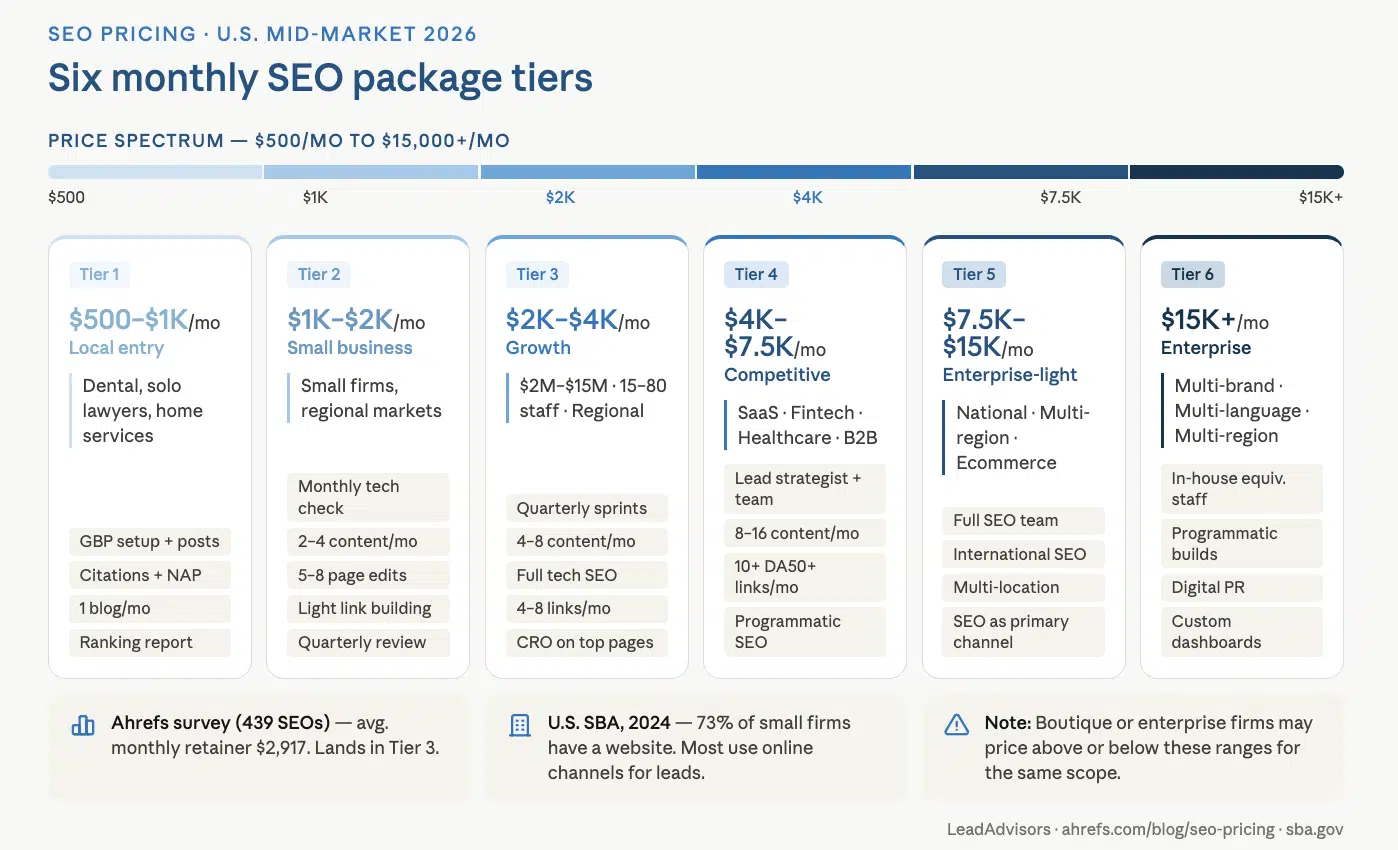
Most U.S. monthly seo packages fit into one of six tiers. The ranges below match mid-market U.S. agencies in 2025 and 2026. Small boutique shops or large enterprise firms may charge more or less for the same scope of work.
Tier 1: $500 to $1,000 per Month (Local Entry Tier)
This is the floor for real work. Clients here are small local service shops. Think dental offices, solo lawyers, home services, and small restaurants.
What is included:
- Google Business Profile setup and posts
- Citations and NAP cleanup
- One blog post a month (often AI-assisted)
- A simple monthly ranking report
What is not included:
- Tech SEO work
- New link building
- Strategy reviews
This is the tier sold as “affordable monthly seo packages” or “cheap monthly seo packages.” It can lift local map-pack rankings in light markets. It will not move the needle in real organic search.
Tier 2: $1,000 to $2,000 per Month (Small Business Tier)
This is the sweet spot for most small business retainers. The U.S. Small Business Administration reports that 73% of small firms now have a website. Most owners use online channels to build their brand and pull in leads. This tier fits small firms in medium-pressure local or regional markets.
What is included:
- A monthly tech check (crawl errors, broken links, Core Web Vitals flags)
- Two to four pieces of content a month
- On-page edits on five to eight existing pages
- Light link building through digital PR or guest posts
- Local SEO upkeep
- A monthly dashboard and a quarterly review
Buyers searching for “monthly seo packages for small business” usually land here.
Tier 3: $2,000 to $4,000 per Month (Growth Tier)
The growth tier is where SEO starts to act like a real revenue channel. Ahrefs’ pricing survey of 439 SEOs found the average monthly retainer was $2,917. That number lands right in this band.
What is included:
- Quarterly strategy sprints
- Four to eight pieces of content a month
- A full technical SEO program (Core Web Vitals, schema, internal links)
- Ongoing link building (four to eight placements a month)
- CRO on your top organic landing pages
- A custom monthly dashboard and bi-weekly check-ins
Most U.S. growth-stage firms work here. Revenue is $2M to $15M. Headcount is 15 to 80. Markets are regional or niche.
Tier 4: $4,000 to $7,500 per Month (Competitive Tier)
This tier fits hard markets like SaaS, fintech, healthcare, and B2B services. Five to seven well-funded rivals make every keyword a fight. So the package size doubles.
What is included:
- A lead strategist plus a content team
- Eight to sixteen pieces of content a month, including pillar pages and original research
- A full tech SEO program with engineering help
- Hard-push link building (10+ placements a month from DA50+ editorial sources)
- Programmatic SEO builds when they fit
- Sales-enablement content alignment
Tier 5: $7,500 to $15,000+ per Month (Enterprise-Light Tier)
Mid-market firms running national or multi-region work. SEO runs as a full team, not a side channel. Multi-location work, international SEO, or large-catalog ecommerce fits here.
Tier 6: $15,000+ per Month (Enterprise Tier)
Multi-brand, multi-language, multi-region work. The price reflects team size and build complexity, not “secret tricks.” You get full in-house equivalent staff, programmatic SEO builds, digital PR, and custom dashboards.
What Gets Cut First When Monthly SEO Budgets Shrink
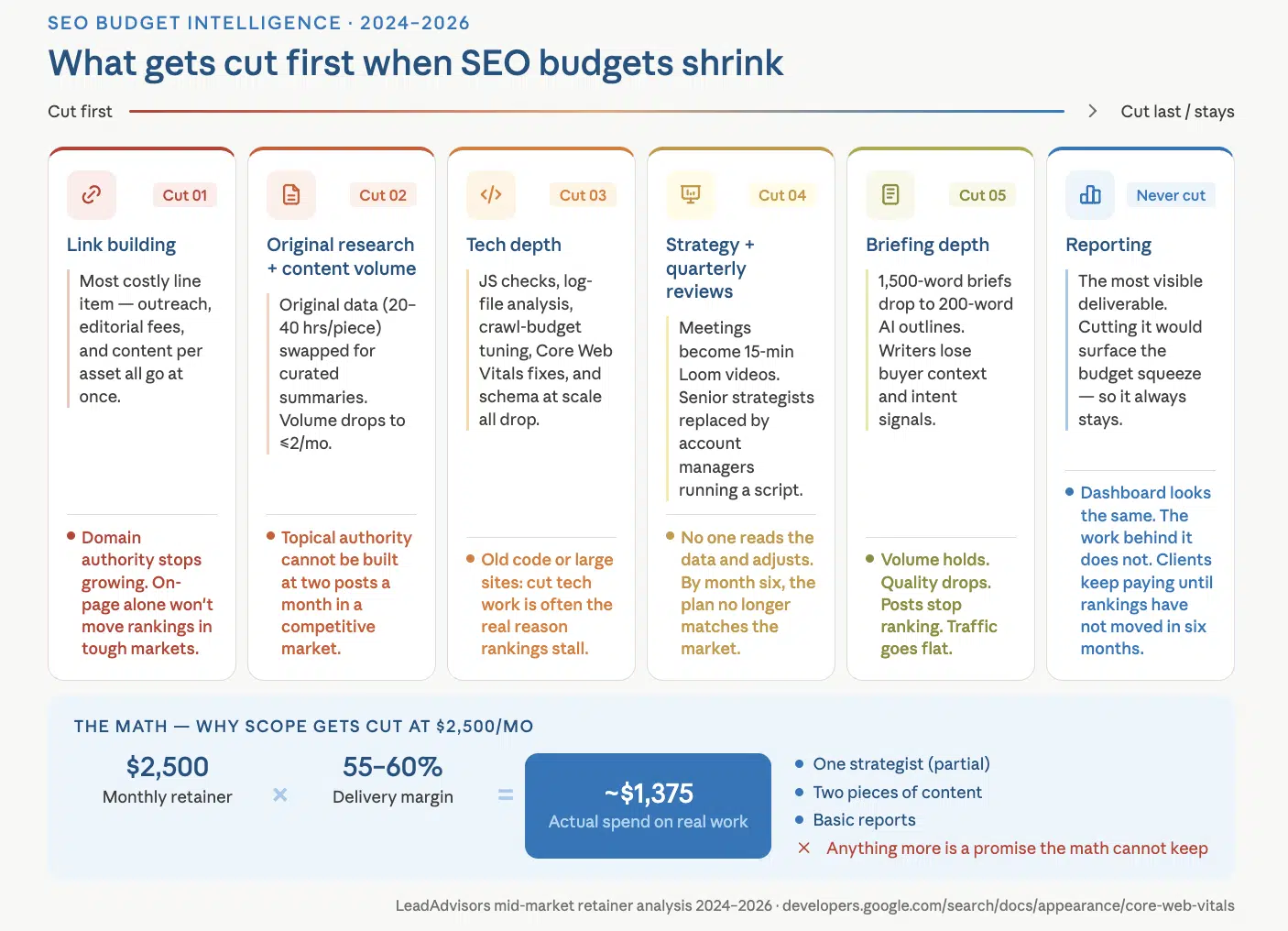
This is the question most blog posts skip. Every monthly seo package has a stack rank. When budgets get tight, the same items get cut first across most agencies. Knowing the order helps you see what you are really paying for.
Here is the cut order we have seen in mid-market retainers from 2024 to 2026.
1. Link Building
Link building is the most costly line item. It takes outreach, relationships, and content for each linked asset, and editorial fees. So when an agency drops a $4,000 plan to $2,000, link building is the first to go. Content and tech work stay longer.
The cost: a package with no link building can still improve on-page content. It cannot lift domain authority. In tough markets where your rivals already have higher authority, on-page work alone will not move you up.
2. Original Research and Content Volume
Original data takes 20 to 40 hours per piece. When margins tighten, original work gets swapped for curated work that just sums up what others said. Below Tier 3, content drops to 2 pieces per month or fewer. Two pieces a month keep a topic fresh. It does not build topical authority in a tough market.
3. Tech Depth
Entry and standard tiers cover basic tech work. That means crawl errors, broken links, and speed flags. They skip the harder stuff: JavaScript checks, log-file checks, crawl-budget tuning for big sites, Core Web Vitals fixes, and schema at scale. For sites with old code or large page counts, the cut tech work is often the real reason rankings stall. Core Web Vitals are a confirmed Google ranking signal per Google Search Central. For the full audit list, see our technical SEO guide.
4. Strategy and Quarterly Reviews
Quarterly strategy meetings are either dropped or reduced to a 15-minute Loom video. Monthly calls turn into email updates. Senior strategists get pulled off the account and replaced with an account manager who runs a script.
The cost: no one is reading the ranking data and adjusting the plan. The retainer keeps running, but the work stops responding to the data. By month six, the plan on paper no longer matches the market.
5. Briefing Depth
Briefs drop from 1,500-word strategy docs to 200-word AI outlines. Writers get less context on the buyer, the intent, and the internal link plan. Editors stop reviewing for topical accuracy and only check grammar.
The cost: content volume holds, but quality drops. The same number of posts go up each month, but they stop ranking. The agency hits its deliverable count, and the client wonders why traffic is flat.
6. Reporting
The monthly report is the most visible deliverable. Cutting it would surface the budget squeeze. So reporting stays, even when the work behind it has been cut everywhere else. In the worst case, the report is the only thing left.
The cost: the dashboard looks the same as it did at $4,000 a month. The work behind it does not. Clients keep paying because the report keeps arriving, until they realize rankings have not moved in six months.
The Math Behind Why Scope Gets Cut
AI tools have reduced routine SEO labor by 20-30%. But strategy and creative work still take real hours. With a $2,500 retainer and a 55%-60% delivery margin, the agency has about $1,375 to spend on real work. Those funds one strategist, two pieces of content, and basic reports. Anything more is a promise the math cannot keep.
A side-by-side: what $2,500 actually buys
| Provider type | What $2,500/month actually delivers |
| Solo freelancer | 25 to 30 focused hours: strong on one or two areas (often content) |
| Boutique agency | 15 to 20 hours of teamwork: better breadth, less depth |
| Mid-size agency | 10 to 12 hours plus tool fees: light-touch support |
| Enterprise agency | An account rep and a PM: very little real execution |
This is what buyers searching for “affordable monthly seo packages with the highest roi” or “best monthly seo packages” are really choosing between.
The Minimum Viable Monthly SEO Package
No matter the tier, four items must appear in every monthly SEO plan. Without them, you are paying for reports, not ranking gains.
- A Clear Keyword Target List With Monthly Tracking
The plan must name the keywords you are chasing. It must track the positions of those keywords each month. An agency that only reports on impressions in Search Console cannot prove its work moves rankings.
- On-Page Work, Not Just Notes
Many low-tier plans provide a list of changes to make to your site. A list is not SEO work. On-page work means the agency makes the title tag, meta, heading, and internal link changes for you. Or they give them to you in a form your dev can paste in.
- Each Month’s Actions Are Written Into the Report
The report must list every action that month. Pages edited, content posted, links earned, tech bugs fixed. Not just the metrics that came out at the end. Inputs are how you hold the agency to its word.
- A Written Scope Doc
A verbal handshake is not a contract. The scope must be on paper. It must list what you get each month, in what amount, and at what standard.
Google’s Helpful Content guidance is clear on this. Content must show experience, expertise, authority, and trust. Trust is the biggest of the four. A package with no fresh content, no tracked tech work, and no real report cannot meet the E-E-A-T bar Google now uses in its core ranking systems.
Anything beyond the four is a bonus. Anything missing from the four will show up as a problem by month four.
Five Red Flags in Monthly SEO Packages
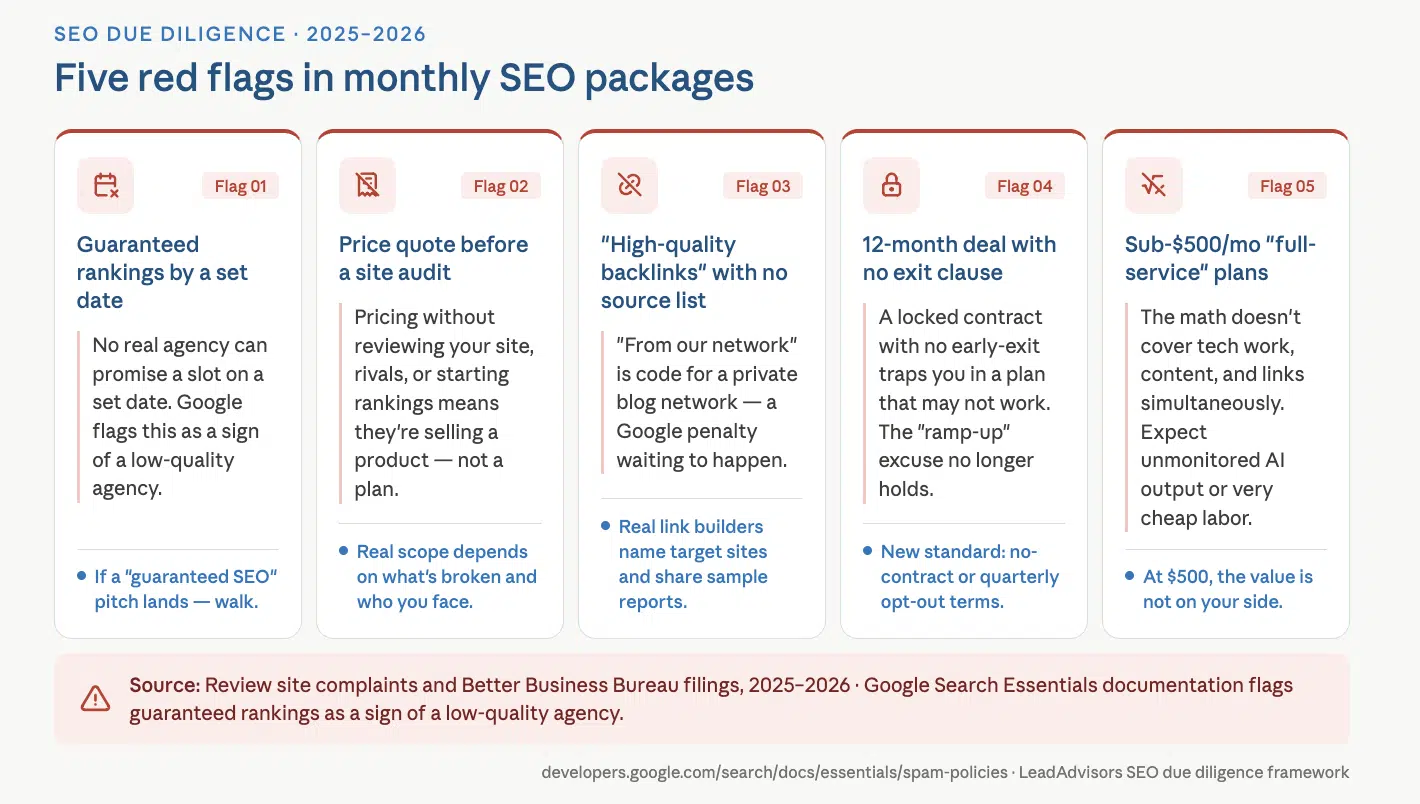
These five red flags appear repeatedly in buyer complaints from 2025 and 2026. You will see them on review sites and Better Business Bureau filings.
- Promised Rankings in a Set Number of Months
Google’s Search Essentials documentation flags promised rankings as a sign of a low-quality agency. No real agency can promise a slot on a set date. If a “guaranteed seo packages” pitch lands on your desk, walk.
- A Price Quote With No Site Audit First
An agency that prices your plan before checking your site is selling a product, not a custom plan. Real agencies look at your site, your rivals, and your starting rankings before they quote. The right scope depends on what is broken and who you face.
- “High-Quality Backlinks” With No Source List
“High-quality backlinks from our network” is code for a private blog network. Private blog networks are a Google penalty waiting to happen. Real link builders name the kinds of sites they target. They can provide you with a sample link report upon request.
- No Exit Clause in a 12-Month Deal
A 12-month contract with no early-exit clause traps you in a plan that may not work. The new standard is no-contract or quarterly opt-out terms. AI tools cut routine labor by 20 to 30%, so the old “we need time to ramp up” excuse no longer holds.
- Sub-$500 a Month “Full-Service” Plans
The math for a $500 plan does not cover tech work, content, and link building simultaneously. The work is either done by very cheap overseas labor or by an AI tool with no oversight. Either way, the value is not on your side.
The Four-Question Framework for Matching the Right Monthly SEO Package
Use these four questions in order. Each one trims the field.
- How tough is the keyword market?
Search your three most important keywords in Google. Count how many of the top ten results come from firms with real SEO content and strong link profiles. Under five strong rivals? Tier 2 or 3 will work. More than five strong rivals? Tier 3 or 4 is the floor.
- How big is the domain authority gap?
Use a free tool to estimate your domain authority. Compare it to the top three sites for your main keyword. If the gap is more than 15 points, link building is not a “maybe.” A plan with no link building cannot close that gap.
- How big is the content gap?
Search your main keyword. Look at the top pages. Count the words. Note the topics they cover and how they link to each other. If your rivals have 3,000-word pillar pages and you have a 500-word service page, content is your priority. Two pieces a month will not close that gap on a real timeline.
- Does the math justify the spend?
A Tier 3 growth plan at $3,000 a month costs $36,000 a year. If SEO is going to bring in 20 leads a month at $2,000 each, with a 15% close rate, that is six new clients a month or $144,000 in monthly revenue. The spend pays for itself. If you can only expect two leads a month, Tier 3 is too much for now.
For ecommerce sites, swap the blog cadence for the product page count and the new SKU rate. For WordPress sites, the plan should include tuning plugins and themes. WordPress Core Web Vitals issues are a common cause of rank drops on the platform.