Outbound does not fail because buyers “stopped responding.” It fails because teams run a 2019 playbook in a 2026 market.
If you lead sales or RevOps, you have seen the mismatch. People say outbound is “over.” However, your pipeline still shows outbound-sourced revenue. In many teams, it also comes with lower CAC than paid channels.
So what changed? The channel stayed. The execution model changed.
In 2019, many teams ran on a single channel. They worked a cold list. They tracked touches.
In 2026, outbound is multi-channel and signal-driven. It runs sequences across phone, email, and LinkedIn. In addition, it uses SMS when opt-in and compliance allow. It also prioritizes accounts with buying signals. Finally, it measures opportunity creation, not raw activity.
Outbound prospecting in 2026 is a system, not an activity. Build the system, and you get predictable opportunities. Track activity, and you get activity.
This guide breaks down:
- The five shifts since 2019 that broke most outbound motions
- The five components of the modern outbound prospecting framework
- A practical sequencing model (including a 9-touch, 12-day cadence)
- Benchmarks that separate working motions from broken ones
- A build vs. outsource decision framework (and when a hybrid model wins)


What Changed in Outbound Prospecting Since 2019, and What It Means for Your Motion
Since 2019, five shifts have broken most outbound motions. Teams that adapt to all five still build a pipeline. Teams that fix only two or three get uneven results.
Shift 1 – Inbox saturation broke the single-channel email
Email did not die. Template email died.
Reply rates fell from the typical 2019 range (5-8 percent) to the low single digits in 2026. A 2026 benchmark report shows many senders sit around 1-3 percent (platform benchmark data).
In addition, inbox volume rose. AI also increased outbound volume. As a result, generic “personalization” lost its edge. Your email now pays an execution tax.
Shift 2 – Phone connect rates compressed structurally
Phone still works. However, raw connect rates are lower.
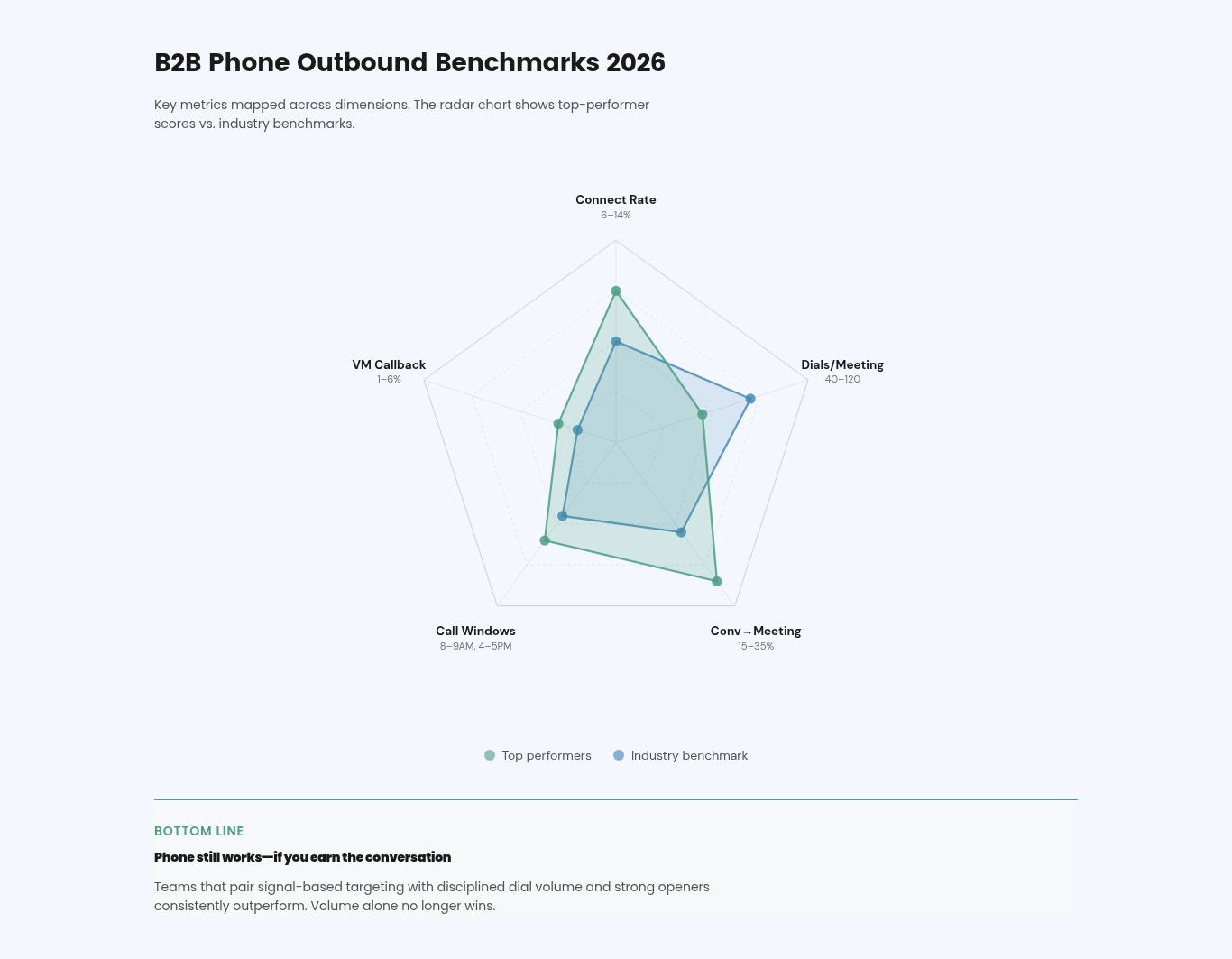
Cold connect rates moved from 12-18 percent in 2019 to roughly 6-10 percent in 2026. For a single large dataset view, see Orum’s State of Cold Calling Report.
Remote work pushed buyers off desk phones. Carriers also filter unknown calls more aggressively. Therefore, persistence matters more than it used to. One call plus one email is not enough.
Shift 3 – Buying signal data became table stakes
In 2019, ICP fit often drove priority. In 2026, an ICP fit is only the entry ticket. After that, signals set the order.
For example, use hiring signals, funding events, tech adoption, and expansion announcements. Those triggers tell you who to contact first.
Without signals, SDRs work a flat list. As a result, effort increases while the pipeline remains flat.
Shift 4 – Multi-channel sequencing became the standard, not an enhancement
Single-channel outbound still works sometimes. However, it caps your reach.
Phone, email, and LinkedIn hit the buyer at different moments. Therefore, sequencing is the unit of execution. A single touch is not.
If you only track “call productivity” or “open rate,” you end up optimizing for fragments. Instead, optimize the full sequence.
Shift 5 – AI tools changed both sides of the equation
Sales teams use AI to scale outreach. Buyers use AI to filter it.
As a result, surface-level personalization now blends in. It does not stand out.
What still breaks through: real signals, accurate research, and direct relevance. In addition, you need a sequence that builds familiarity across channels.
Operators who adjust to all five shifts build a predictable pipeline. Operators who stay in the old model incur high costs.
The Modern Outbound Prospecting Framework – Five Components That Determine Whether the Motion Produces Pipeline
Outbound prospecting in 2026 comprises five components. Each component matters.
Miss one component and the output drops fast. Even if the other four look “fine,” the pipeline will stall.
Component 1 – ICP definition is tight enough to prioritize, broad enough to scale
ICP in 2026 is not a sales kickoff slide. It is a working filter.
It decides which accounts are included on the list. It also decides which ones never get touched.
Tightness depends on your TAM. For example, a B2B SaaS team with 50,000 fits must prioritize with signals and segments. In contrast, a services team with 800 fits must go deeper on research per account.
Therefore, ICP sets the prospecting model. If you get ICP wrong, every other step gets harder.
Component 2 – List building based on buying signals, not just firmographic filters
The 2019 list used firmographics: size, industry, and title.
The 2026 list starts there. However, it adds signals.
Look for hiring, recent funding, tech adoption, and expansion news. Those triggers tell you who is “warm” right now.
As a result, signal-led lists can outperform flat lists by 3 to 5 times, even with the same SDR effort.
Common tools include ZoomInfo, Apollo, Cognism, Clearbit, and signal platforms like Common Room.
Component 3 – Multi-channel sequencing with defined cadence and channel logic
A modern sequence runs 7 to 10 touches in 10 to 14 days.
It blends phone, email, and LinkedIn. In addition, it can use SMS when compliance and opt-in are allowed.
The sequence is the unit of execution. A single touch is just a data point.
Structure matters. For example, early calls often connect better because your name is still fresh. Threaded emails also work better than random “new” emails. LinkedIn adds familiarity without more inbox load. SMS can close the loop fast.
Component 4 – Personalization tied to specific signals, not generic compliments
“I love what you’re doing at [Company]” is not personalization. It is a generic opener.
Modern personalization points to a real trigger. For example: hiring, funding, a new tool, or an expansion announcement.
That kind of opening feels specific. Therefore, it tends to convert better than generic compliments.
Keep the effort level simple:
- Tier 1: Spend 2 minutes of research per prospect.
- High-volume layers: spend 30 seconds.
Most importantly, follow a repeatable research checklist. The structure matters more than raw time.
Component 5 – AI-assisted QA across 100 percent of conversations
Manual QA on 5 to 10 percent of calls gives you a sample. That helps, but it misses patterns.
AI-assisted QA can review 100 percent of conversations. As a result, coaching gets faster and more consistent.
Modern QA should catch:
- missed qualifying questions
- soft commitments not closed
- mishandled objections
- compliance gaps
- broken talk tracks
Then it should produce clear coaching plans per SDR. Base coaching on real trends, not five random calls from last week.
For taxonomy and follow-up rigor, see our disposition taxonomy guide.
Operations missing any one component produce uneven results regardless of effort. Operations running all five produce pipeline that maps to the forecast.
ICP Definition – The Foundation That Determines Whether Prospecting Produces Opportunities
ICP is the most discussed and most under-executed component of B2B outbound. Every company has an ICP slide. Most companies have an ICP that is too broad to filter, too vague to operationalize, or too theoretical to use in list building.
What an executable ICP looks like
An executable ICP is specific enough that two SDRs given the same ICP would build the same prospecting list. If your ICP is “B2B SaaS companies in the US with 50 to 500 employees,” that’s a segment, not an ICP. It returns an unprioritized ocean of accounts.
A workable ICP includes:
- Firmographics: employee band, revenue band, industry classification, geographic region
- Operational signals: tools in their stack (fit), roles they’re hiring (use case + buying power), motions they’re running (go-to-market pattern)
- Trigger signals: funding events, new launches, leadership changes, expansion announcements, compliance/regulatory shifts in their market
- Anti-signals: deal-killers that disqualify the account regardless of base fit (wrong adjacency, known incumbent lock-in, unusable budget profile)
- Tiering model: Tier 1 accounts get deep research and senior SDR time; Tier 2 gets structured sequences with adaptation; Tier 3 is a volume layer gated by signals
A strong ICP does two things at once: it prevents wasted coverage, and it creates predictable volume. Most underperforming programs do neither-they allow list drift until activity targets are met and conversion collapses.
Tiering produces leverage that flat lists don’t
A flat list treats every account the same. Tiered lists allocate effort proportional to expected output.
- Tier 1 (top ~5 percent by fit + signal strength): 20-30 minutes of research per account, custom outreach written for that account, manual sequencing executed by senior SDRs.
- Tier 2 (next ~25 percent): 3-5 minutes of research per account, sequence templates adapted with signal references, standard multi-channel cadence.
- Tier 3 (volume layer): templated sequences with signal-based filtering, AI-assisted drafting, and SDR escalation on responses.
Tiering produces 3 to 4 times the pipeline of flat-list prospecting at the same SDR effort because the highest-output accounts get depth, and the volume layer runs at the right cost.
What kills ICP execution in practice
The most common failure mode is drift. The ICP is written. The list is built. Results come in below expectations. Then the team expands the list to hit activity targets. Six weeks later, the list is four times larger, and conversion is half what it was because half the accounts are off-ICP.
The fix is structural: activity targets should not force ICP expansion. If the original ICP doesn’t produce enough volume, the options are to increase SDR capacity against the same ICP, to deepen buying signals within the ICP, or to document an ICP expansion decision. Silent drift is the most expensive option because it masks the real constraint until quarter performance reveals it.
For a deeper look at how sales development execution ties into pipeline creation and qualification standards, see our guide to sales development services.
Multi-Channel Sequencing – What the Operational Core Looks Like in Execution
A working B2B prospecting sequence in 2026 is structurally different from a 2019 sequence. Cadence, channel mix, and timing changed. The structure below reflects what consistently delivers above-benchmark response rates in outbound B2B SaaS and B2B services.
The 9-touch sequence over 12 days
The goal of the sequence is not to “touch” the buyer. The goal is to create familiarity and relevance across channels, then offer a low-friction next step when the buyer is ready to engage.
Day 1 – Phone touch #1 + voicemail drop
Call quickly after the account enters the active queue. If no answer, leave a ~25-second voicemail referencing the signal that triggered outreach (hiring, funding, expansion, tool adoption).
Day 1 – Personalized email follow-up
Within four hours of the call: 3-4 sentences referencing the voicemail and one relevant data point. No pitch. One specific reason a 15-minute conversation would be useful.
Day 2 – LinkedIn connection request with note
Short note referencing the voicemail/email. Do not repitch. The goal is continuity: “You’ve seen my name before.”
Day 3 – Phone touch #2 + voicemail drop
Call at a different time of day than Day 1. Voicemail references prior touchpoints and adds one new, specific context point.
Day 5 – Email touch #2 (different value angle)
Shift from the trigger angle to the pain/value angle. Reference one outcome common in their segment and offer a relevant insight or resource.
Day 7 – LinkedIn touch
If connected, send a short message. If not connected, use a low-friction touch (comment on a post, follow, or InMail where appropriate). Add one new piece of context.
Day 9 – Phone touch #3 + voicemail drop
Call at a third time of day. Some buyers respond on attempt three who didn’t respond on attempts one and two, especially when voicemails reference each other and show substance and persistence.
Day 11 – SMS touch (where B2B opt-in compliance permits)
Under 15 words. Reference the attempt to connect and offer a binary next step.
Day 12 – Breakup email
Acknowledge you haven’t been able to connect, confirm you’ll close the loop, and offer a clear path to engage if timing changes. Breakups consistently produce high response because they remove pressure and clarify intent.
Cumulative response math
A well-executed 9-touch sequence against a tightly defined ICP list with signal prioritization produces a cumulative meeting acceptance rate of 8 to 15 percent. Single-touch outbound produces 1-3%. The multiplier is the system: list quality, cadence, channel logic, message relevance, and QA feedback loops.
The sequence is the unit of measurement. Optimizing an email subject line while ignoring list quality or qualification criteria is a local improvement that won’t compound in the pipeline.
Phone execution depth note: This article intentionally does not delve deeply into phone-channel operations, compliance, or dialing infrastructure. Those details belong in the companion B2B telemarketing article once it is published.
To improve contact conversion and strengthen follow-up rigor, see our contact rate optimization guide.
Outbound Prospecting Benchmarks – What Good Looks Like in 2026
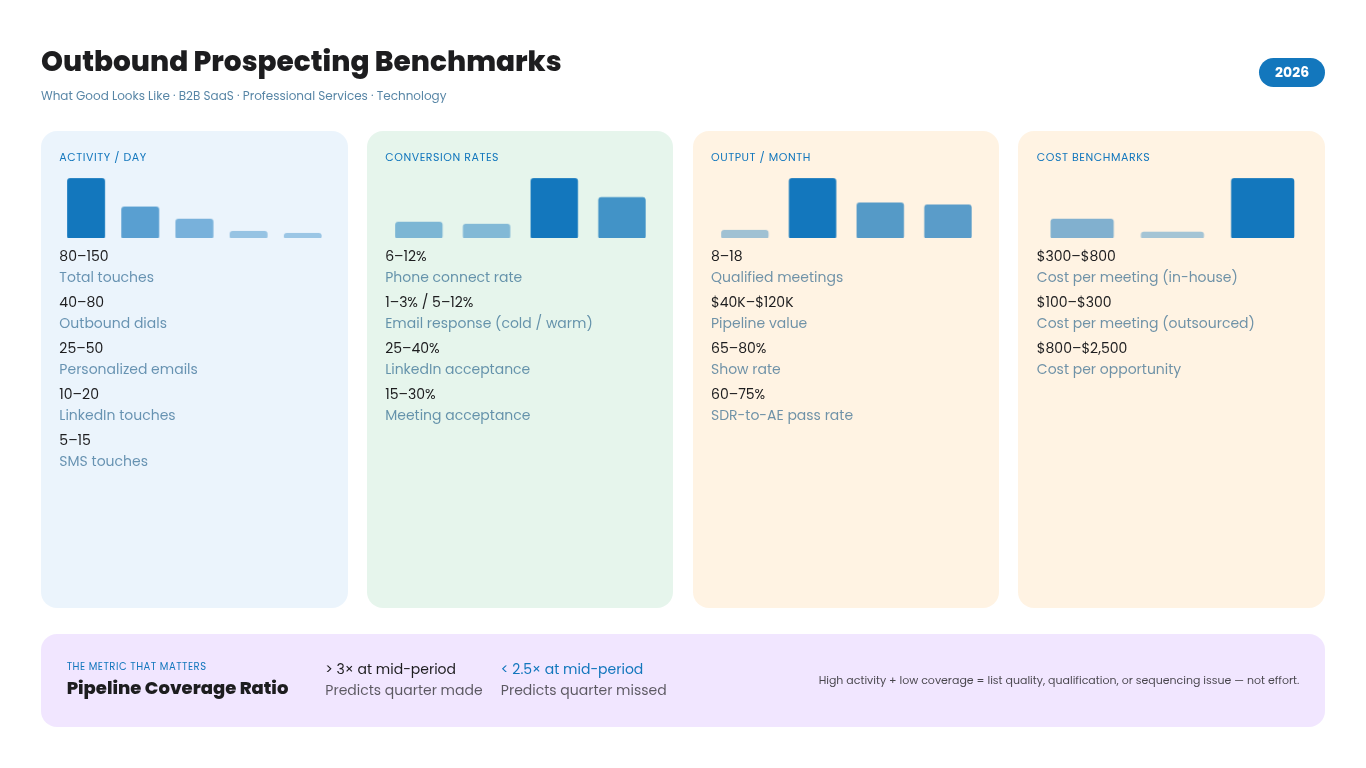
Benchmarks vary by ACV, ICP, and vertical. The ranges below reflect inside sales motions across B2B SaaS, professional services, and B2B technology programs in 2026. Use them to diagnose which component of the system is compressing output.
Activity benchmarks per SDR per day
- Total outbound touches: 80 to 150 across all channels
- Outbound dials: 40 to 80
- Personalized emails: 25 to 50
- LinkedIn touches: 10 to 20
- SMS touches (where compliance permits): 5 to 15
Conversion benchmarks
- Phone connect rate (cold outbound, US-based prospects): 6 to 12 percent
- Email response rate: 1 to 3 percent (cold), 5 to 12 percent (warm ICP lists with strong relevance)
- LinkedIn connection acceptance: 25 to 40 percent
- Meeting acceptance on first qualified conversation: 15 to 30 percent
Output benchmarks
- Qualified meetings per SDR per month: 8 to 18 (depends on ICP complexity and ACV)
- Pipeline value per SDR per month: $40,000 to $120,000 (typical B2B SaaS ACVs; service models vary)
- Show rate on scheduled meetings: 65 to 80 percent (below 65 percent usually indicates qualification drift)
- SDR-to-AE pass rate: 60 to 75 percent should advance to a second conversation
Cost benchmarks
- Fully loaded cost per qualified meeting (in-house): $300 to $800 (at ACVs above $15,000)
- Cost per qualified meeting (outsourced appointment setting): $100 to $300
- Cost per opportunity (meetings that advance): $800 to $2,500
The benchmark that matters most
Pipeline coverage ratio: total active pipeline value divided by remaining quota for the period. For the baseline definition and common 3x-5x framing, see HubSpot – Sales Pipeline Coverage. A ratio above 3x at mid-period predicts a quarter that will be made. A ratio below 2.5x in the mid-period predicts a missed quarter. Coverage ratio is the leading indicator that outbound is producing enough volume before lagging close-rate metrics confirm the gap.
If your activity is high but coverage is low, the issue is rarely “more effort.” It’s usually a list quality, qualification criteria, or sequencing logic.
Common Outbound Prospecting Mistakes
Five mistakes consistently appear across underperforming outbound prospecting motions. None is obvious in isolation. All become visible when pipeline coverage drops below 3x and the team can’t explain why.
Mistake 1 – Activity metrics without quality metrics
Teams measured on dials per day optimize for dials. They produce activity, not a pipeline. Modern outbound measures both activity and quality: meeting acceptance rate, qualification accuracy, conversion to opportunity, and show rate. Quality metrics are the leading indicator of pipeline output. Activity metrics without quality metrics are theater.
Mistake 2 – Generic personalization that signals research was not done
A generic opener (“love what you’re doing”) without a specific reference signals the opposite of personalization. Buyers recognize it immediately. Modern personalization references a signal: hiring, funding, a tool adoption, a launch, or a change in go-to-market motion. It doesn’t need to be long. It needs to be specific and accurate.
Mistake 3 – Single-channel motions in a multi-channel market
Phone-only or email-only motions produce a fraction of coordinated multi-channel outreach. The buyer who ignores email may respond on LinkedIn. The buyer who screens calls may reply after seeing the SDR’s name three times across channels. Multi-channel sequencing increases surface area for recognition and timing.
Mistake 4 – No documented qualification criteria
When qualification criteria aren’t documented at campaign-brief specificity (exact filters, exact signal definitions, exact commitment language), SDRs interpret criteria differently. The result is misqualified meetings, low show rates, and AE rejection. Documented criteria don’t need to be complex. They need to be written, trained, and enforced.
Mistake 5 – Ignoring inbound MQL response time
Inbound MQLs are often the highest-intent prospects in the funnel. When outbound is prioritized and inbound follow-up slips to 24 hours, you give your best conversations to competitors. Responding within 5 minutes can produce 5 to 10 times the meeting conversion rate of a response at 24 hours. If outbound and inbound are separate workflows, you need a unified response-time standard and staffing model. See our speed-to-lead breakdown.
Build In-House vs Outsource the Prospecting Function
The build vs buy decision depends on stage, ACV, and the strategic role of outbound in your go-to-market motion. The framework below produces consistent recommendations across company sizes.
Build in-house when
- ACV is above $25,000, and the sales motion requires product knowledge depth that outsourced teams can’t replicate without heavy training. At this ACV, the per-conversation value justifies the fixed cost of in-house SDRs integrated tightly with AEs.
- You’ve reached ~$10M ARR with a validated outbound motion and an experienced sales development manager. Most teams underestimate management. An SDR team without dedicated coaching and QA underperforms a managed outsourced program at a similar cost.
- Differentiation depends on proprietary methodology (qualification, messaging, positioning) that you need to protect and refine internally.
Outsource when
- You’re pre-$5M ARR, and outbound isn’t validated. A 90-day managed program validates ICP, messaging, and qualification criteria before you commit to a fully loaded annual headcount investment.
- ACV is $5,000 to $25,000, and you need capacity without having to build a full management layer.
- You’re testing a new vertical or geography and need to learn quickly without making permanent hires.
The hybrid model
A common winning structure at $3M-$12M ARR: one in-house sales development manager owns ICP, messaging quality, and coaching; an outsourced appointment setting team executes volume against the validated motion. Strategy and quality remain internal; capacity scales externally.
For a deeper context on build vs. buy, see our lead generation outsourcing guide.
If your outbound strategy depends on outsourced calling capacity tied to qualification standards, review our appointment-setting and outbound calling services.