What is the link between brand reviews and brand awareness? Through social proof, brand reviews are raising brand awareness. This is the first way. The second way is through organic SEO visibility. And the third, by building consumer trust. Quality reviews work as “review signals” that influence Google’s local ranking algorithm and increase click-through rates (CTR) by confirming to customers that a brand is trustworthy at the moment of making a decision, thus helping the customer journey.
Brand reviews will determine the pace of business growth in 2026. But the problem is indeed authenticity; the users are becoming more and more doubtful if a reviewer is a genuine customer or a person with an “axe to grind. ” The whole thing is very risky: a single review can decide your fame and income. Up to 72% of consumers confirmed that positive reviews make them trust a local business more, so a counteractive reputation plan is no longer a marketing option; it is an SEO must.
Nevertheless, how much do reviews influence your earnings? In order to figure it out, we first need to consider the evolution of the modern customer journey.


The Ever-Growing Impact of Reviews on the Customer Journey
Previously, the customer journey was straightforward: a consumer saw an advertisement, went to a store, and bought a product. But nowadays, that journey has changed into an intricate pattern of research and validation. Thanks to social media, customers are going through several touchpoints before they finally choose a brand.
The key touchpoint in this modern loop is definitely the online brand review. In fact, recent statistics indicate that 84% of consumers deem reviews as an important factor in their decision-making. What’s more, 61% of buyers will check out online reviews even if they intend to purchase the product at a physical store.
| Phase | Traditional Journey | Modern Review-Loop Journey |
| Discovery | TV/Print Ads | Search Engines & Social Proof |
| Evaluation | Brand Claims | User-Generated Content (UGC) |
| Trust Factor | Marketing Budget | Peer-to-Peer Authenticity |
| Action | Immediate Purchase | Validation via 3rd-Party Reviews |
This change implies that “Brand Awareness” has evolved from merely being seen to being tested. If during their research phase, potential customers are unable to find credible, positive reviews, they will most probably take their business to a competitor who has a more transparent reputation.
It is no longer a luxury if you actively manage your online presence; rather, it is the basis of the new sale.
How to Leverage Reviews for Brand Recognition
Brand reviews are a multi-dimensional marketing tool. When leveraged correctly, they don’t just build “fame”—they build Brand Equity. Here are eight key reasons to integrate reviews into your growth strategy:
The Psychology of the Sale
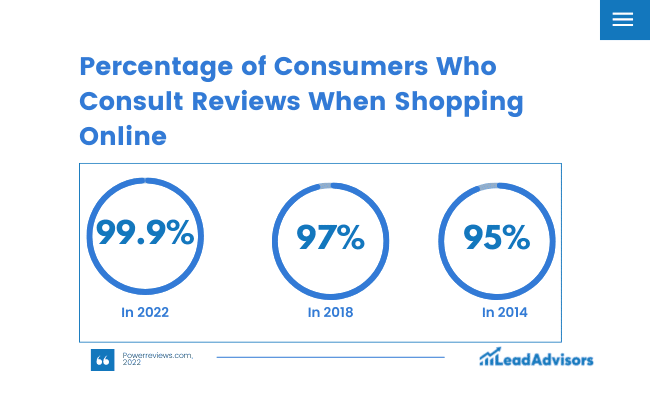
- Digital Word-of-Mouth: The vast majority of consumers (90%) admit that they have been influenced by online reviews when making purchases. Nowadays, a review from a complete stranger has the same influence as a recommendation from a close friend.
- Social Proof in Action: Social proof is a field term describing the phenomenon whereby individuals, to be sure of their safety, subconsciously take the behavior of others as a model. It is the reviews that, to the buyers in the decision stage, function as a “go-ahead” signal in today’s overcrowded marketplace.
- Accelerated Trust and Credibility: When the number of choices is unlimited, reviews can be seen as a clear and honest “window” into the company’s business dealings and, thus, help potential customers determine who is trustworthy even before the initial contact.
- Competitive Differentiation: Properly controlling your reputation is a means of gaining the spotlight. The brand that constantly communicates with its customers through feedback, both the praises and complaints, shows great dedication to customers’ needs, and that is something that “quiet” competitors don’t have.
Business & Operational Growth
- Increased Search Visibility: Well-received reviews help to spread word of mouth naturally and increase the prominence of your business in search results, thus facilitating brand exposure on a larger scale.
- Social Media Integration: Sharing reviews as User-Generated Content (UGC) on social networks is a great way to get trustworthy leads and gain the community’s confidence.
- Internal Morale Boost: Reviews act as a house of mirrors for your team. Identifying employees’ contributions through customer recognition crafts the culture of excellence and high morale.
- Informed Data-Driven Decisions: Customer reviews go beyond marketing to become an “outside, in” audit of your performance. Integrating them with website analytics, they pinpoint the areas where your product or service is lacking the most.
The Ever-Expanding SEO Effect of Local Business Reviews on Building Brand Awareness
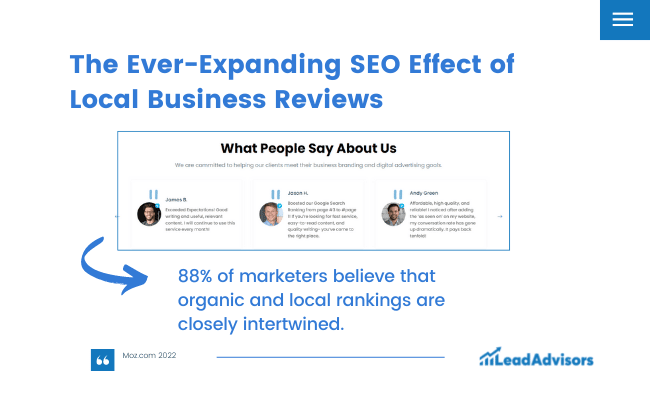
Local business reviews are far more than just “feedback”—they are high-octane fuel for your search engine rankings. According to industry data, review signals account for approximately 9% to 15% of how Google determines local search rankings.
This puts reviews on par with heavy-hitting factors like link signals (11%) and on-page signals (10%). By optimizing your review profile, you aren’t just gaining trust; you are directly manipulating your visibility in the Local Pack.
1. How the Algorithm Reads Your Reputation
Google’s ranking algorithm focuses on three core metrics within your reviews:
- Quantity: A high volume of reviews proves that your business is active and popular.
- Quality: Higher star ratings correlate with higher authority.
- Recency (Review Velocity): Google prioritizes businesses with a steady stream of new reviews. A “stale” profile with no feedback in six months suggests the business may be declining.
2. The CTR (Click-Through Rate) Flywheel
Reviews generate a potent SEO “flywheel”. When your listing shows shiny gold stars (via Review Schema), it basically persuades more people to click on it than a simple text listing. As Google considers CTR as a secondary ranking factor, higher engagement signals to the algorithm that your site is relevant, thus it can raise your ranking even further.
3. Gaining the “Sentiment” Edge Over Competitors
If two businesses are identical in every other SEO metric, Google uses Sentiment Analysis as the tie-breaker. Besides just checking the 5-star rating, the algorithm also looks for “semantic keywords” in the text, like “reliable,” “expert,” and “professional.”
Learn to read these review signals, and you will be able to get ahead of your competitors, making sure that your brand is the only one customers trust and see when they look for your services.
What Information Should the Ideal Review Incorporate?
Brand review is rarely just an opinion. It represents a comprehensive evaluation of a company’s trustworthiness and worth. Product reviews zoom in on only one item, but a Brand Review takes a customer’s entire experience with the business into accountfrom the delivery time to the level of customer service.
In order to harness the full SEO and sales, generating the power of a review, it should be more detailed and comprehensive than just the basic facts. Below is a breakdown of a potent, influential review:
1. Depth and Detail (The 500-Word Benchmark)
When it comes to building authority, length matters. A BrightLocal study revealed that 78% of consumers find longer, detailed reviews more trustworthy. Short, vague praise like “Great service!” offers no SEO value. Aim for at least 500 words to allow for naturally integrated keywords and a comprehensive breakdown of the experience.
2. User-Generated Content (UGC) & Video
Authenticity can be seen visually. Studies show that 67% of buyers are greatly impacted by pictures and videos made by users. By 2026, Google’s “Perspectives” and “Search Generative Experience” (SGE) will give more weight to reviews featuring original media, as they demonstrate genuine experience (the “E” in E-E-A-T).
3. The “Authenticity Sweet Spot”
Every company desires a perfect score, but sometimes a 5.0 rating is actually a red flag. Buyers are smart; they usually consider a perfect profile to be “curated” or fake.
Studies show that a score from 4.2 to 4.7 stars is the main “conversion sweet spot. ” It demonstrates that the brand is of good quality but is also human. A genuine review talking about a small imperfection and the way the brand helped has more value than ten standard 5-star ratings.
4. Semantic Specificity
Great reviews use industry-specific language. For example, a high-quality business review talks about the specific features, how the product can be used, and competitor comparisons. This not only helps Google to understand the brand but also places it correctly within the brand’s topical map, therefore increasing the chances of your website appearing in high-intent search queries.
A Comprehensive Guide to Writing Brand Reviews: In 5 Steps
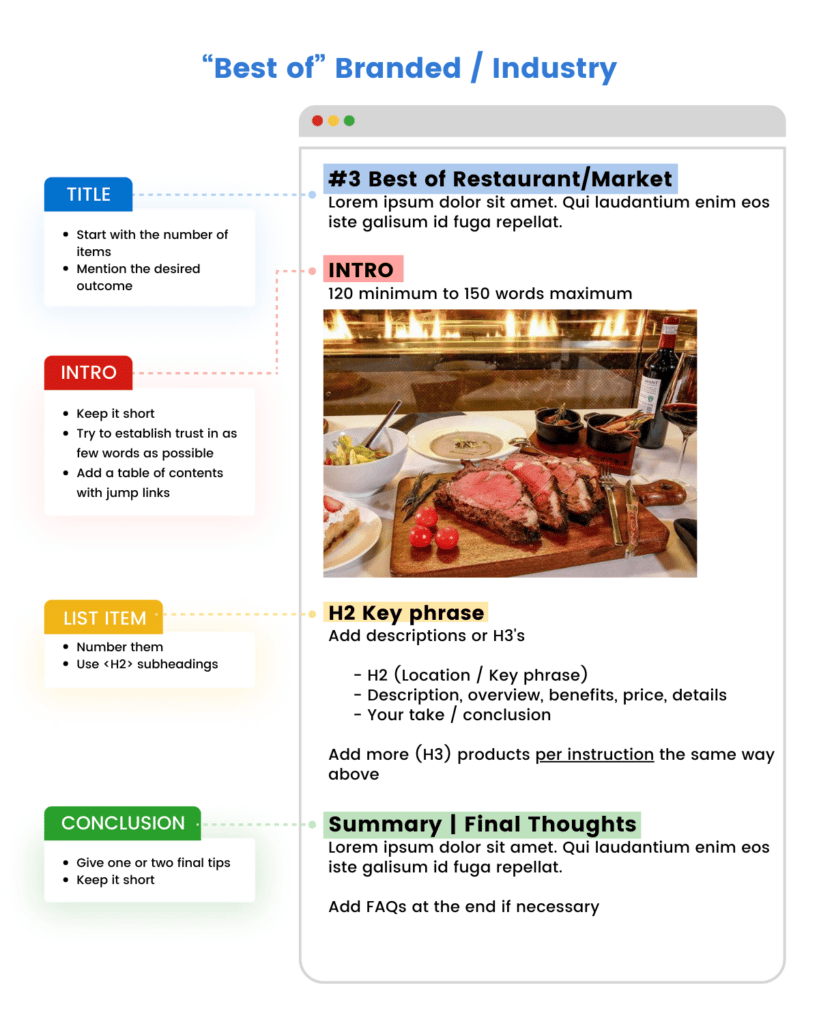
DOWNLOAD OUR FREE TEMPLATE FOR WRITING HIGH-CONVERTING BRAND REVIEWS!
Well-written reviews are more than just feedback; they are assets that provide Information Gain to your audience. Before you write, research the brand thoroughly. Read existing customer complaints and praises to ensure your review covers the “missing gaps” others haven’t mentioned.
Before You Start: The Research Phase
Don’t just skim the product page. Look for real-world usage data and common friction points. The more first-hand knowledge you have, the better you can satisfy Search Intent.
Step 1. Writing the Introduction
Your intro sets the tone. To keep readers engaged, skip the fluff and use the PAS Framework (Problem-Agitation-Solution):
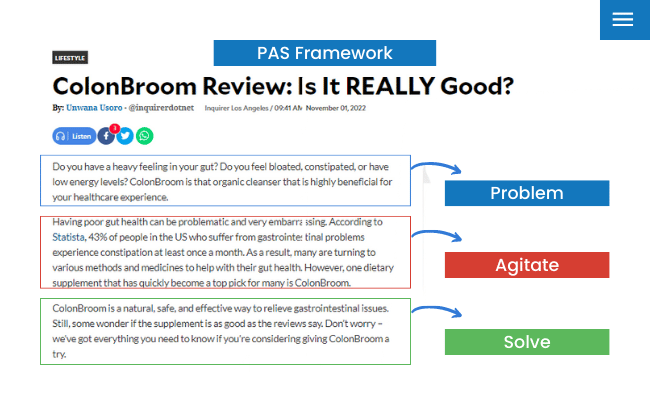
- Identify the Problem: Begin by pinpointing the exact issue your reader is struggling with.
- Agitate the Pain: Help the reader to visualize how their situation will deteriorate if the issue remains unsolved.
- Offer the Solution: Present your brand or product as the solution they are looking for.
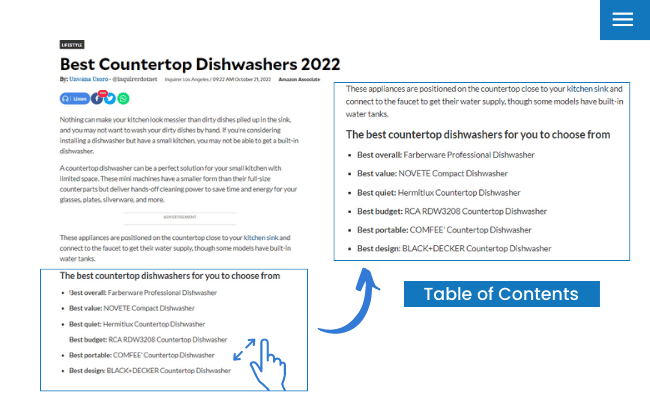
Pro-Tip: Don’t forget to add a table of contents (TOC) to your articles. The reason is that, in 2026, Google is fond of TOC as it generates “jump links” in the search results, thus making your content more user-friendly for skimmers.
STEP 2. Main Headings and Subheadings
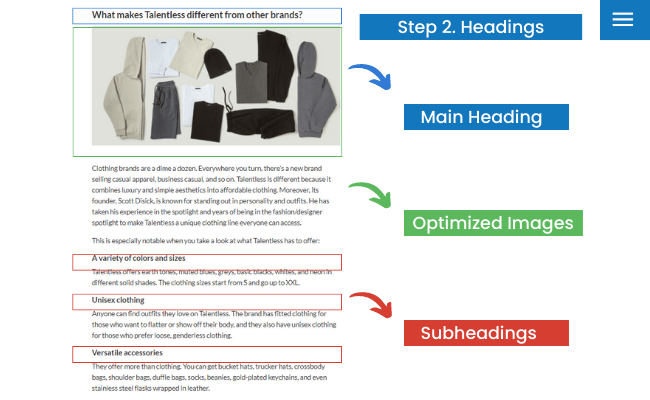
It is a common habit of most readers to scan a text before they read it. Therefore, consider using H2 and H3 headings to divide the text sections.
- Keep Paragraphs Short: a maximum of 2-3 sentences.
- Use Visuals: Use videos, infographics, or UGIs to break up big chunks of text.
Bullet Points: Use these for listing features and technical specifications to make the text easier to read.
STEP 3. Body: Reviews or Findings
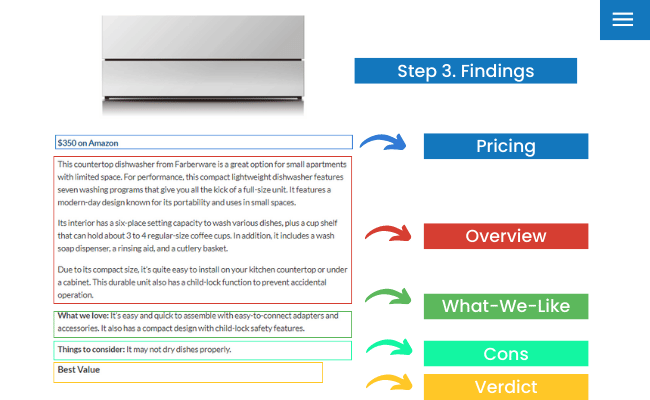
This is basically the meat of your article. To convince your readers that you are an expert, it is necessary to:
- Background & Context: Explain clearly what the product is and who it’s designed for, in simple terms.
- The “Compare & Contrast” Test: Do a side-by-side comparison of this brand with the other two top brands in the market. Which is better in terms of quality, and which one offers better value?
- Evaluating Customer Sentiment: Mention what others are saying. This adds objectivity to your personal findings.
The “What We Like” Section: Highlight 3-5 specific wins based on your first-hand testing.
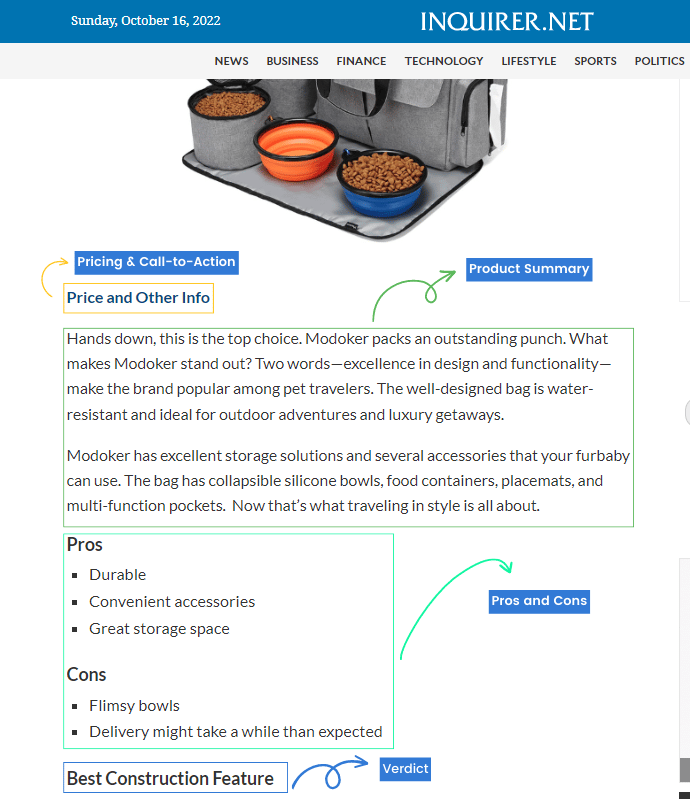
STEP 4. Body: Highlights of the Product.
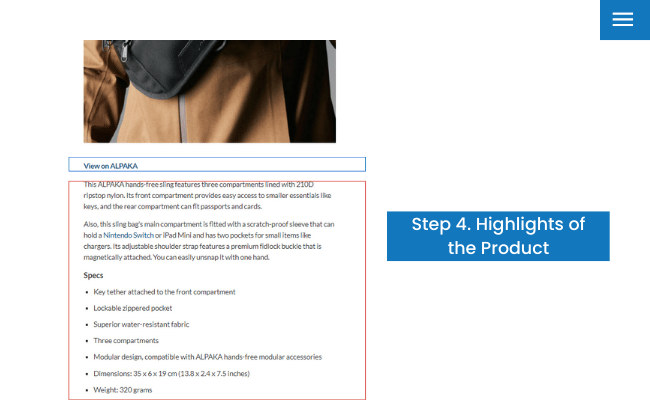
Summarize your review in a visually prominent summary box. It should comprise:
- Quick Summary: The very concise “too long; didn’t read” version.
- Star Rating: Use a scale from 1 to 5 (remember the authenticity rule of 4.7 stars).
- Pros & Cons: A fair listing of the positives and negatives.
- The Verdict: A single, sentence summary of the recommendation (e.g., “Ideal for small agencies with limited budgets.”).
Pricing & CTA: Add a distinct button that will lead the reader to the product page.
STEP 5. The Wrap Up
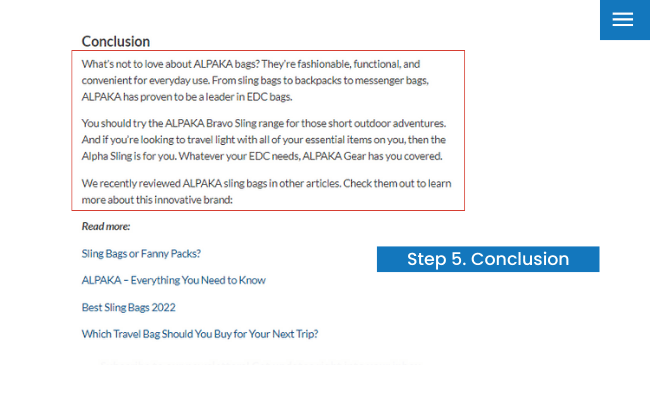
Your conclusion is akin to the “deciding chord” in music. Don’t ramble, just get straight to the point purposefully.
- Restate Key Points: You explain once again why this brand is of such importance.
- Call to Action: There should be no ambiguity in your call for the next step (Download, Buy, or Read More) that you want the reader to take.
- Add 2-4 FAQs: Use “How,” “What,” and “Why” questions to both attract long-tail search traffic and satisfy Answer Engine Optimization.
Bonus Step: Choose the Right Platform
One of the most important considerations when designing your strategy is that it should be aligned with your type of business.
Are you mainly selling to other businesses, or are you selling directly to consumers? It is crucial to get the platform right, such as Google Business Profile or industry-specific aggregators. LeadAdvisors can assist you in quickly scaling your brand reputation by providing you with genuine brand reviews in just three easy steps.
Follow the correct usage of language and spelling. It is almost unnecessary to say this, but when you pen down a review, you should definitely follow grammatical rules correctly and use proper spelling.
Firstly, it works in your favor as it makes your content more readable, and secondly, people view you as a genuine reviewer when you have good language skills. I think we all know who we wouldn’t follow for advice if they couldn’t even spell properly, right?