The digital landscape in 2026 has moved beyond the traditional concept of “search” to a combination of AI-generated solutions and trusted local information. Local small business owners focusing on Search Engine Optimization (SEO) need to look beyond the first page ranking feature; they should aim to be the primary source for “Answer Engines. ” The rise of the new age, Generative Engine Optimization (GEO), mandates a plan that integrates not only tech speed but also genuine human touch.
If you emphasize hyper-local significance and content that is AI-optimized, you will be able to outsmart the big-box retailers. This publication outlines a 30-day plan that is geared towards helping you establish online authority and convert visitors into repeat customers.


TL;DR: The 2026 SEO Essentials
- The Big Shift: SEO (Search) has been replaced with GEO (Generative Engine Optimization). Featuring in AI Overviews is the new success metric, and these overviews are already triggering for 40% of local queries.
- Quality > Quantity: You won’t get far with unedited AI spam; instead, you will be shadow-banned. Google’s 2026 filters mainly E, E, A, T (Experience, Expertise, Authoritativeness, Trustworthiness).
- Technical Baseline: A slow website could cost you up to 53% of your mobile visitors if it takes more than 1.5 seconds to load.
- Local Strategy: No longer is it a case of the closest store winning the customer. Google Business Profile activity and Review Velocity (a steady stream of, frequently, keyword-rich reviews) are the main drivers of the Local Pack.
- Actionable ROI: Simply focusing on traffic is no longer a viable strategy, and conversion tracking (calls and forms) should be your main focus. Closing organic leads in 2026 is still at around 15%, significantly higher than paid ads.
The New Landscape: What is Small Business SEO in 2026?
As a small business owner, you’ve likely noticed that Google search feels different this year. It’s no longer just a list of blue links; it’s a conversational assistant. For your small business, this shift is actually an opportunity to stand out without needing a “Big Box” budget.
The Shift from Search (SEO) to Answer Engine Optimization (GEO)
Traditional search engine optimization is evolving into generative engine optimization (GEO). Instead of just ranking for search queries, we are now optimizing to be the “cited source” in AI summaries.
In early 2026, being mentioned in an AI Overview is the new “Position 1.” Data shows these summaries now appear in 40% of local searches, and being cited can boost your click-through rate by 80%.
Currently, 62% of local searches end without a click because Google provides the answer directly. I recommend using search engine optimization (SEO) tactics like FAQ formatting to ensure your brand is the one providing that answer, building instant trust with potential customers.
Why Organic Traffic Still Rules the Marketing Mix
While AI is gaining ground, organic search is still the mainstay of a good SEO plan. It is the source of the long-term authority that paid ads are not able to imitate.
70% of users still trust organic Google search results more than ads, according to a January 2026 study. Although Google Ads can deliver fast results, organic search ranking is the way that “earned” credibility works, and it is this that turns visitors into loyal customers.
Local SEO is the weapon small businesses can use to beat the big ones by concentrating on “real, world” relevance. By using good-quality pictures and location-specific keywords, you can get more visitors to your site than the national chains. Actually, hyper-local SEO strategy currently generates 2.5 times greater user engagement than large, general, non-targeted campaigns.
SEO vs. Local SEO vs. GEO: A Three-Dimensional Approach
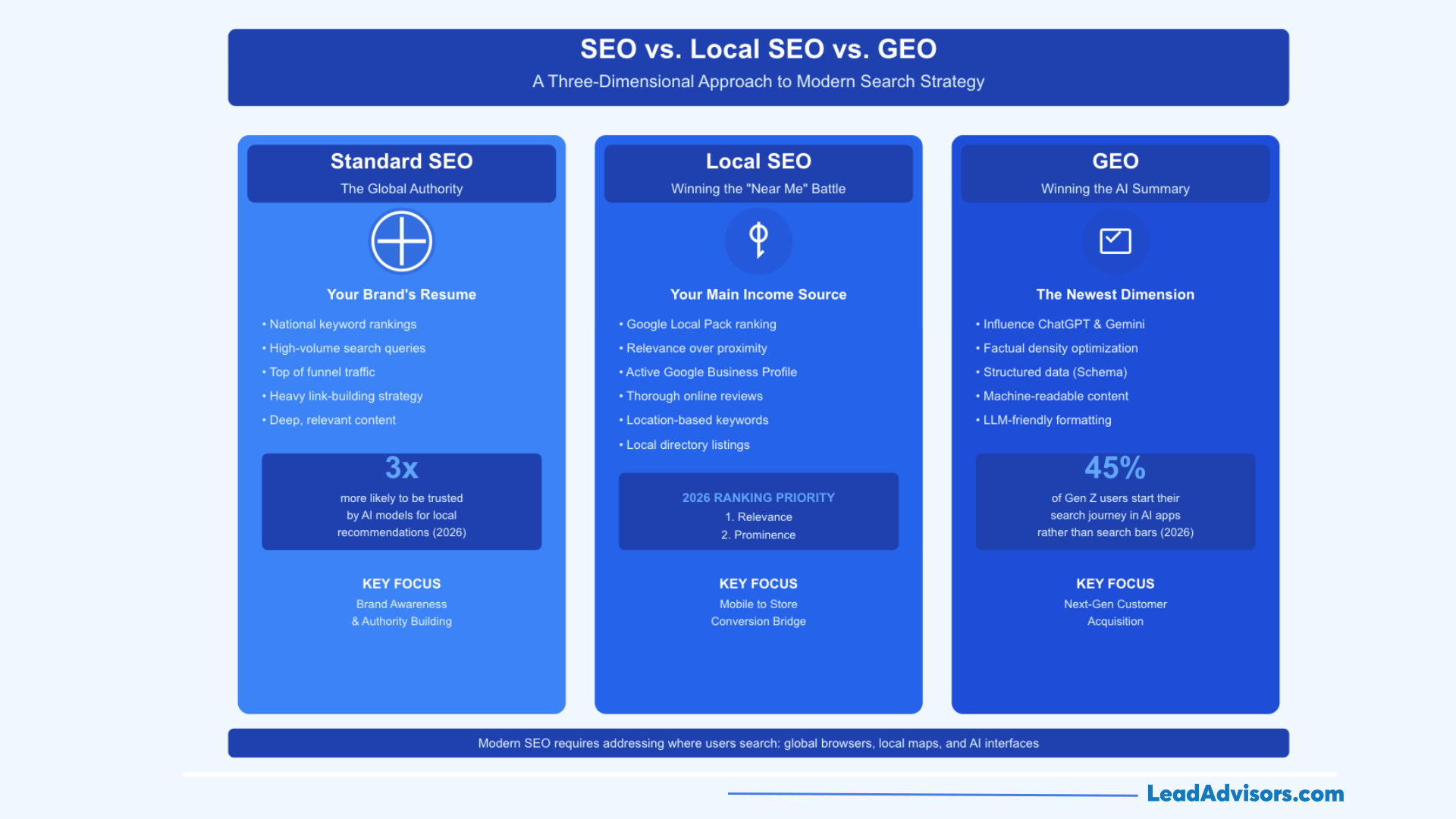
In the past, we just worried about “keywords.” Today, our small business SEO strategy must address where the user is looking—whether that’s a global browser, a local map, or an AI chat interface.
Standard SEO: The Global Authority
Think of standard SEO as your brand’s resume on the world stage. Even for a small business, building broad brand awareness through national informational keywords is vital for establishing SEO success.
We focus on conducting keyword research to find high-volume search queries that relate to your expertise. This builds your “Top of Funnel” web traffic.
Statistics from early 2026 show that businesses with strong national keyword rankings are 3x more likely to be trusted by AI models for local recommendations.
This involves a heavy link-building strategy from other websites and ensuring your web pages have deep, relevant content.
Local SEO: Winning the “Near Me” Battle
If you supply a particular community, local SEO is your main source of income. It is actually about getting into the “Local Pack,” that box of three businesses that you can see on Google Maps.
In 2026, near the place is not the king anymore. Google now puts the first place to “Relevance” and “Prominence. ” You can rank a competitor who is closer lower if your Google Business Profile is more active and your online reviews are more thorough.
In order to win at this, you have to be listed in local directories and use location-based keywords. Local SEO is the bridge that connects someone searching on their mobile to that person actually entering your shop.
GEO: Winning the AI Summary
Generative Engine Optimization (GEO) is the newest dimension. It’s how we influence LLMs (Large Language Models) like ChatGPT and Gemini to name you “the best” in your field.
AI models select “the best” based on factual density and client websites that use structured data. If your small business website clearly defines your services using online tools like Schema, you become “machine-readable.”
Recent 2026 studies show that 42% of Gen Z users now start their search traffic journey inside an AI app rather than a traditional search bar. If you aren’t optimized for GEO, you’re missing nearly half of the next generation of potential customers.
Comparing the Three Dimensions of Success
| Strategy | Primary Goal | Where You Appear | Best For… |
| Standard SEO | Global Authority | Organic Blue Links | Building trust & brand awareness. |
| Local SEO | Regional Dominance | Google Maps / 3-Pack | Driving foot traffic & local calls. |
| GEO | AI Recommendation | AI Overviews / Chatbots | Winning “zero-click” & Gen Z users. |
Understanding the 4 Types of SEO for Small Businesses
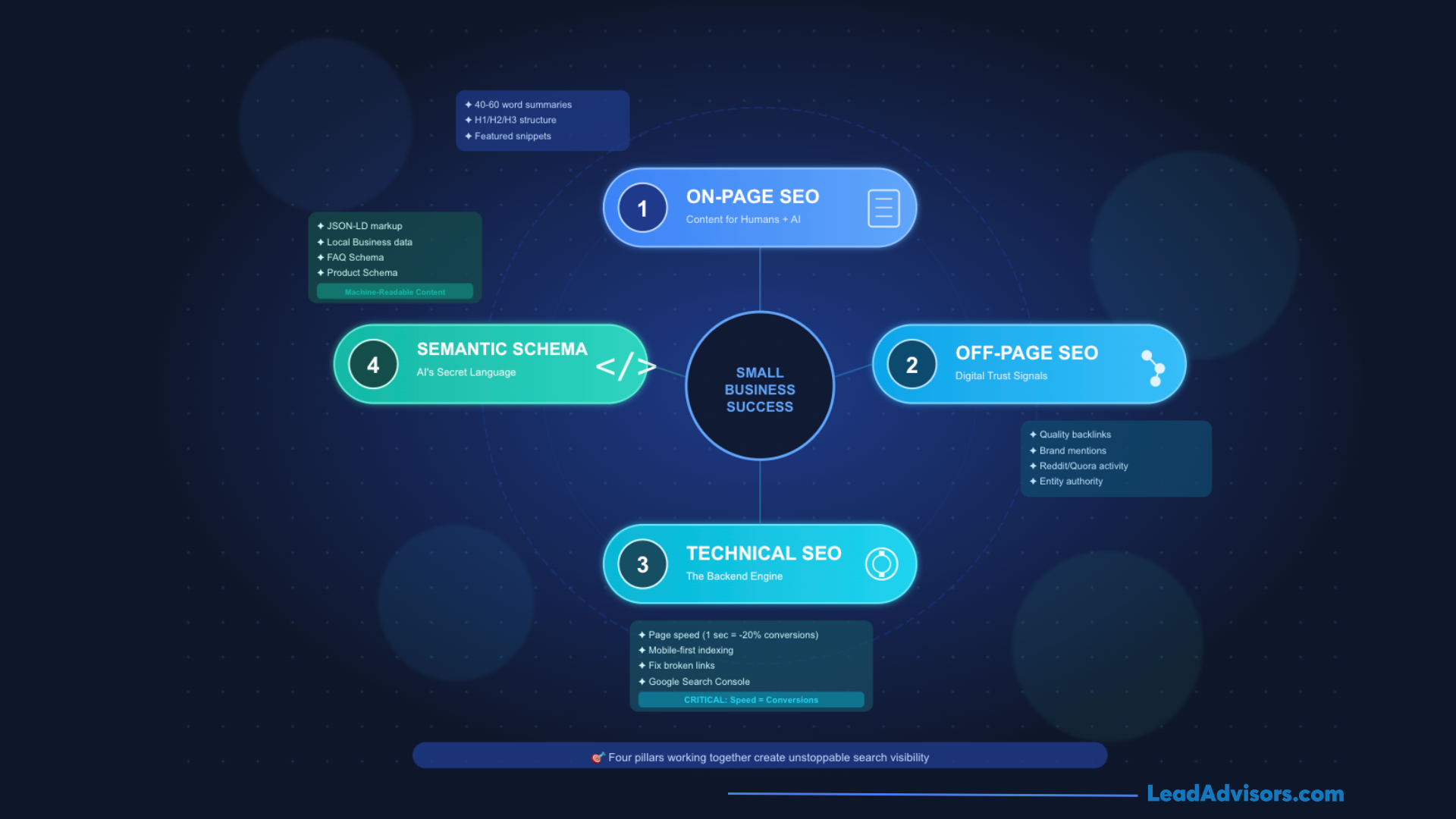
These pillars have changed in the present context. Technical SEO has become more than just catering to bots, and likewise, off-page SEO is more than just link building. Here is a breakdown of how you can leverage these elements to drive more search traffic.
On-Page SEO: Content for Humans and AI
This is the aspect of your small business website that the visitors can actually see. By 2026, on-page SEO will be all about finding the right mix of making your content easily understandable for humans and easily indexable for AI.
Now that Google search favors instant answers, I suggest that you open your web pages with a 40-60-word summary that addresses the main search queries of that page. This way, Google can easily take your text for a featured snippet.
Reserve one H1 tag for your title only and use H2s and H3s to divide your page’s text. The headings should carry relevant keywords. This structure allows search engines to grasp the connections between your concepts.
Instead of merely listing keywords, draft a 155-character “advertisement” that will attract potential customers to click.
Off-Page SEO: The Digital Trust Signal
If On-Page is what you say about yourself, off-page SEO is what the world says about you. In 2026, link building is still a major factor, but “unlinked brand mentions” have become just as powerful.
Google’s AI now tracks how often your business is mentioned in other websites, niche forums, and social media.
Being an active part of the conversation on sites like Reddit or Quora sends a massive trust signal to search engines. When you answer questions in these communities, you aren’t just getting web traffic; you’re building “entity authority.”
Focus on quality over quantity. One link from a local news site or an industry leader is worth more than dozens of links from low-quality other sites.
Technical SEO: The Backend Engine
Technical SEO is like the engine under the hood. Without a functioning engine, the car is not going to move anywhere, even if it has a beautiful paint job.
Data from early 2026 reveals that a 1-second delay in page speed can cause a loss in conversions by 20%. Google demands that your website be extremely fast.
As the majority of buyers use their phones to search, Google mainly considers the mobile version of your site. If your mobile user experience is poor, your search rankings will drop.
Google Search Console is the tool to spot and repair links that are broken links. These “dead ends” annoy users, and your “crawl budget” gets wasted, making it difficult for search engines to locate your relevant pages.
Semantic Schema: The AI’s Secret Language
Without a doubt, Semantic Schema is the most futuristic element of the game plan. It is basically a cover level in code (JSON-LD) that explains to AI what exactly the data is about.
In this way, the AI gets to know literally every element of your NAP (Name, Address, and Phone), thus, spontaneously, Google Maps and local search result domination are achieved.
When you mark up your FAQs, you are essentially guiding Google to showcase those questions right in the search results, thus occupying more “real estate” and decreasing the visibility of the competition.
If you have products to sell, then this is the way you inform search engines about your price, stock level, and customer reviews on the web in real time; thus, your listing becomes far more clickable.
The 4 Pillars: 2026 Implementation Table
| SEO Type | Focus Area | 2026 Key Action | Strategic Value |
| On-Page | Content & Structure | Write 40-60-word “Answer Summaries.” | Wins Featured Snippets & AI Citations. |
| Off-Page | Reputation & Trust | Engage in Reddit/niche forum discussions. | Builds “Entity Authority” and brand trust. |
| Technical | Site Performance | Optimize for sub-1.5s mobile load times. | Reduces bounce rates and improves UX. |
| Semantic | AI Interpretation | Deploy JSON-LD for FAQs and NAP. | Makes your data “machine-readable” for AI. |
The Step-by-Step Small Business Roadmap
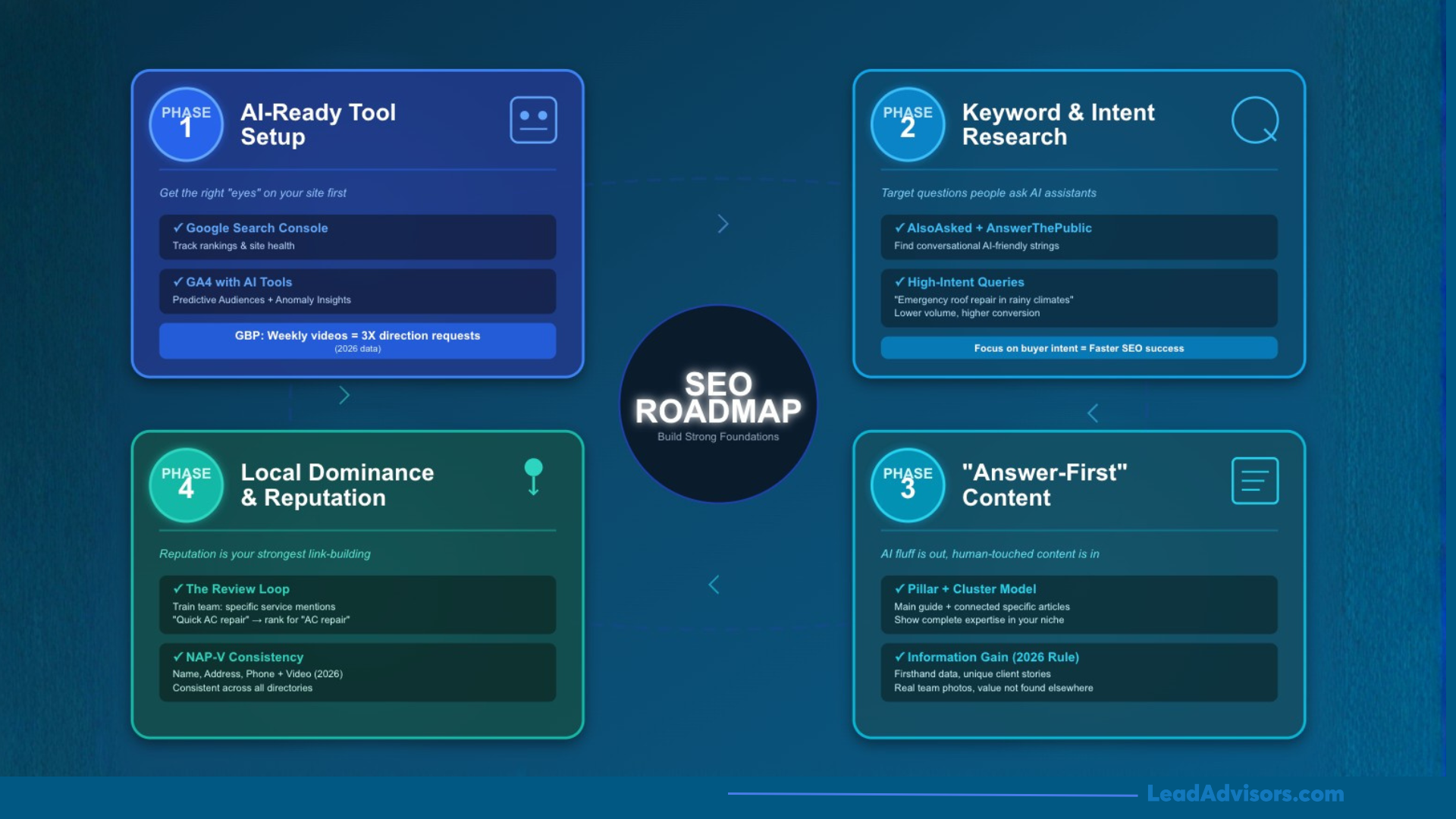
There is no necessity to implement a small business SEO strategy all at once. A phased approach allows you to be sure that your base is strong before you initiate the inflow of traffic to your website.
Phase 1: The AI-Ready Tool Setup
Getting the right “eyes” on your site is a must before you write a word. In 2026, we’re not just tracking clicks, we’re tracking intent.
First, link your website to Google Search Console to track your keyword rankings and site health. Don’t just “count hits” in Google Analytics (GA4). Get “Predictive Audiences” and “Anomaly Insights” ready. These AI-powered tools will notify you of a sudden rise in search queries or a fall in web traffic, thus giving you a chance to respond instantly.
Your Google Business Profile is your physical store on Google Maps. In 2026, the “verification” will be just the beginning. You have to get your primary and secondary categories absolutely right. I suggest uploading high, quality images and short “behind, the, scenes” videos every week. Data from early 2026 indicates that business profiles with video updates get three times as many direction requests as those without.
Phase 2: Modern Keyword & Intent Research
Gone are the days of just “stuffing” the same keyword onto a page. Today, we target the questions people actually ask their AI assistants.
- Use a keyword research tool like AlsoAsked or AnswerThePublic. These help you find the “conversational” strings that AI models use to build summaries. Instead of just targeting “plumber,” you’re looking for “why is my water heater making a knocking sound?”
- Why do phrases like “emergency roof repair in rainy climates” convert better? Because they reflect high-intent search queries. While these have lower search volume, the users searching for them are ready to buy now. Conducting keyword research with a focus on these specific needs is the fastest way to see SEO success.
Phase 3: The “Answer-First” Content Strategy
One thing Google’s “Helpful Content” updates in late 2025 made very clear was that AI-generated fluff is out, and relevant content with a human touch is in.
Rather than churning out random blog posts, construct a “Pillar Page” (e.g., “The Complete Guide to Local Landscaping”) and then connect it to smaller “Cluster” articles (e.g., “Best Plants for Sandy Soil”). This informs the search engines that you’re a complete expert on the whole niche and not just a single keyword.
To really stand out from the ocean of generic content, you have to bring something totally new to the table. That’s the “Information Gain” rule of 2026. Use firsthand data, unique client stories, or real-life photos of your team. Google favours those web pages that offer such value that cannot be easily found on other sites.
Phase 4: Local Dominance and Reputation
Your reputation is your strongest link-building strategy. In 2026, online reviews are the fuel for local search rankings.
- Managing the “Review Loop”: Remember that it’s not just about garnering a “5-star review” from the customers. Your team should be trained in the art of encouraging clients to talk about specific services. Whenever a review mentions, “Quick and affordable AC repair, ” it provides you with an opportunity to rank for “AC repair. ” This results in a naturally occurring “keyword-rich” footprint that local SEO will assist in amplifying.
- NAP-V Consistency: I’m guessing you already know NAP (Name, Address, Phone), but in 2026, we add the “V” for Video. Besides your business information, make sure that your brand’s video style is coherent across local directories, third-party websites, and your social profiles. If you let your information get disorganized, search engines won’t be sure to suggest you to their users.
Roadmap Checklist: Where are you?
- [ ] Tools: GA4 and Search Console connected?
- [ ] GBP: Categories optimized and weekly photos scheduled?
- [ ] Content: First Topic Cluster planned?
- [ ] Reputation: Review request system automated?
How Much Does SEO Cost in 2026? (Pricing Breakdown)
Understanding how much SEO costs for a small business starts with a simple choice: are you paying with your time or your money? In 2026, a “realistic” budget is the only way to ensure SEO success without putting your small business website at risk.
DIY vs. Hiring: The Revenue Matrix
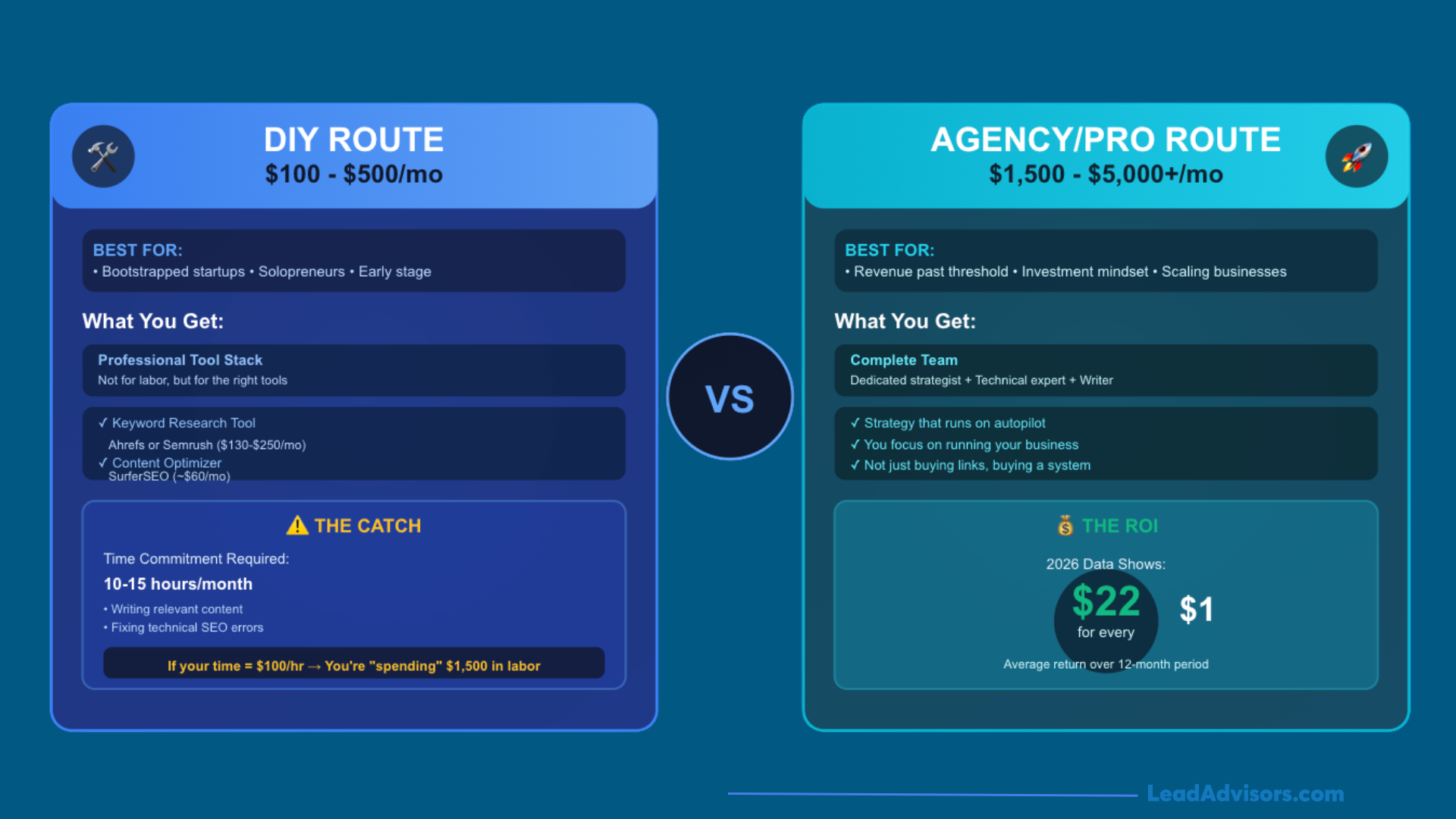
The “Revenue Matrix” helps you decide which path fits your current stage of growth. It’s not just about what you can afford today; it’s about the value of your own time as a business owner.
- The DIY Route ($100 – $500/mo): This is ideal for bootstrapped startups and solopreneurs. Your costs here aren’t for labor, but for a professional online tools stack. You’ll need a keyword research tool like Ahrefs or Semrush ($130–$250/mo) and a content optimizer like SurferSEO ($60/mo).
- The Catch: You must commit at least 10–15 hours a month to SEO tasks like writing relevant content and fixing technical SEO errors. If your time is worth $100/hour, you’re “spending” $1,500 of your own labor.
- The Agency/Pro Route ($1,500 – $5,000+/mo): Once your revenue crosses a certain threshold, hiring SEO services for a small business becomes an investment, not an expense. This budget buys you a dedicated strategist, a technical expert, and a writer.
- The ROI: Data from early 2026 shows that businesses in this tier see an average return of $22 for every $1 spent over a 12-month period. You aren’t just buying links; you’re buying a small business SEO strategy that runs on autopilot while you run your business.
The Affordable SEO Sweet Spot
In 2026, “affordable” doesn’t mean “cheap.” I define the affordable small business SEO sweet spot as the middle ground where you get high-quality, manual work without the enterprise price tag.
Most experienced small business SEO consultants charge between $100 and $150 per hour. For ongoing growth, a monthly retainer of $1,000 to $2,500 is the standard for local SEO services for small businesses. This usually covers your Google Business Profile management, 2–4 high-quality blog posts, and basic link building.
This is the most expensive mistake you can make. If you see an offer for “Full SEO” for $299/month, run. At a $100/hour labor rate, that provider is only spending 3 hours a month on your business.
The Danger: These “churn-and-burn” SEO companies often use automated bots to create duplicate content or spammy links from other sites. By mid-2026, Google’s AI-driven spam filters will be faster than ever at de-indexing sites that use these tactics. You’ll end up paying thousands more later just to have a professional fix the damage.
2026 Pricing Comparison Table
| Tier | Monthly Cost | Best For | Typical Deliverables |
| DIY Tools | $150 – $400 | Solopreneurs | Software access + your own labor |
| Freelancer | $750 – $1,500 | Single-location shops | Local SEO & basic content |
| Small Agency | $2,000 – $4,500 | Growing SMBs | Full strategy, tech fixes, & link building |
| The “Danger Zone” | < $500 | Avoid | Automated spam & high penalty risk |
Measuring Success in the Era of AI
To stay ahead, I recommend shifting your focus from vanity metrics (like total sessions) to key metrics that prove you are solving problems for your potential customers. In early 2026, visibility is about “Answer Share,” not just blue links.
Moving Beyond Rankings
The search engine results page is now a living conversation. In this landscape, a traditional “Rank 1” link might actually be buried under an AI summary, a local map pack, and a “People Also Ask” section.
- Tracking “Share of Voice” in AI Summaries: In 2026, we measure Share of Voice (SOV) by how often your brand is cited in generative answers across Google, ChatGPT, and Perplexity. Tools like LLMrefs or Brand Radar now allow you to track your “Answer Dominance.” If AI is providing the answer to a user’s search queries, you want to be the one it quotes.
- The “Mention” Metric: Even if a user doesn’t click, being cited as an expert by an AI engine builds massive brand equity. I track “unlinked brand mentions” as a core SEO performance signal. If the AI says, “According to the experts at [Your Business]…”, you’ve won the most valuable real estate on the screen.
Conversion Tracking
Traffic is a vanity metric; revenue is a sanity metric. If your web traffic isn’t turning into phone calls or lead forms, your small business SEO strategy needs a pivot.
In Google Analytics (GA4), we’ve moved past simple page views. You should be tracking “Enhanced Measurement” events. For a small business, the most important conversions are phone_call_clicks and form_submissions.
I help my clients set up specific triggers that fire when a user clicks a “Call Now” button on mobile or completes a contact form. By linking your Google Search Console data with GA4, you can see exactly which relevant keywords led to a real human picking up the phone.
A new trend in 2026 is tracking “Assisted Conversions” from AI. We look for spikes in branded searches (people typing your specific business name into the search bar) immediately after you appear in an AI summary. This proves that even “zero-click” searches are driving real-world SEO success.
2026 Success Scorecard
| Old Metric (Ignore) | New Metric (Track) | Why? |
| Keyword Position | AI Citation Rate | Proves you are the “trusted source” for AI. |
| Total Monthly Hits | Engaged Conversion Rate | Focuses on quality leads, not just bots. |
| Backlink Count | Brand Mention Sentiment | Measures how the digital world perceives your authority. |
| Page Views | Phone Calls / Form Fills | Connects digital marketing directly to your bottom line. |
Common SEO Mistakes Small Business Owners Make
Most small business SEO services focus on what you should do, but I think it’s just as important to talk about what you must stop doing. In the era of AI-driven search results, some old habits have become active liabilities.
The Content “Spam” Trap
In early 2026, the biggest temptation is to use AI to mass-produce web pages. It’s fast, it’s cheap, but it’s a recipe for disaster.
Google’s 2026 spam filters are incredibly sophisticated. If your small business website is flooded with generic, low-effort AI text that lacks “Information Gain,” your site may be shadow-banned—meaning your web pages stay indexed, but they are pushed so far down the search engine results that they never see a single visitor.
Use AI for conducting keyword research or drafting outlines, but your final relevant content must include first-hand experience, unique data, or a personal brand voice. SEO success today requires content that only a human could have written.
Neglecting Technical Speed
I still see many client websites that look beautiful but perform like they’re from 2010. In 2026, page speed isn’t just a technical metric; it’s a core part of your small business SEO strategy.
As of January 2026, data shows that 53% of mobile users will abandon a site if it takes longer than 3 seconds to load. If your site is slow, you aren’t just losing organic traffic; you’re literally handing potential customers to your competitors.
Even a 1-second delay can slash your conversion rate by 7%. For a local business, this means fewer phone calls and form submissions.
Regularly check your SEO performance using Google Search Console and PageSpeed Insights. Focus on your “Core Web Vitals”—specifically Largest Contentful Paint (LCP). By compressing high-quality images and cleaning up unnecessary plugins, you can ensure your site is fast enough to keep users engaged and satisfy search engines.
Red Flag Checklist
| The Mistake | The 2026 Consequence | The Quick Fix |
| Pure AI Content | Shadow-banning & zero visibility | Add personal stories and real-world data. |
| Slow Loading Speed | 32% increase in bounce rate | Compress images and use a fast hosting provider. |
| Ignoring Search Intent | High traffic but zero conversions | Map every page to a specific customer problem. |
| NAP-V Inconsistency | Dropping out of the Google Maps pack | Audit your local directories for matching info. |